citizenship by investment vs golden visa
Citizenship by investment vs golden visa: the real difference
A citizenship by investment programme gives you a second passport, usually without needing to live in the country. A golden visa gives you residency first: a permit you hold, renew, and often maintain before any path to a passport. The right choice depends on whether you want a passport now or a place to live and a longer route to one.
The core difference: a passport versus a permit
Citizenship by investment (CBI) and golden visas are often searched together, but they are not the same product. A CBI programme grants nationality and a passport, typically for a government donation or an approved investment, and usually without any requirement to move. A golden visa grants residence: the legal right to live in a country, which you then hold and renew, and which may lead to citizenship only after several years.
In short, CBI is a shortcut to a passport, while a golden visa is a shortcut to residence. Confusing the two is the most common and most expensive mistake in this market, because it changes the cost, the timeline, and what you are actually allowed to do at the end.
Cost: what each route really runs
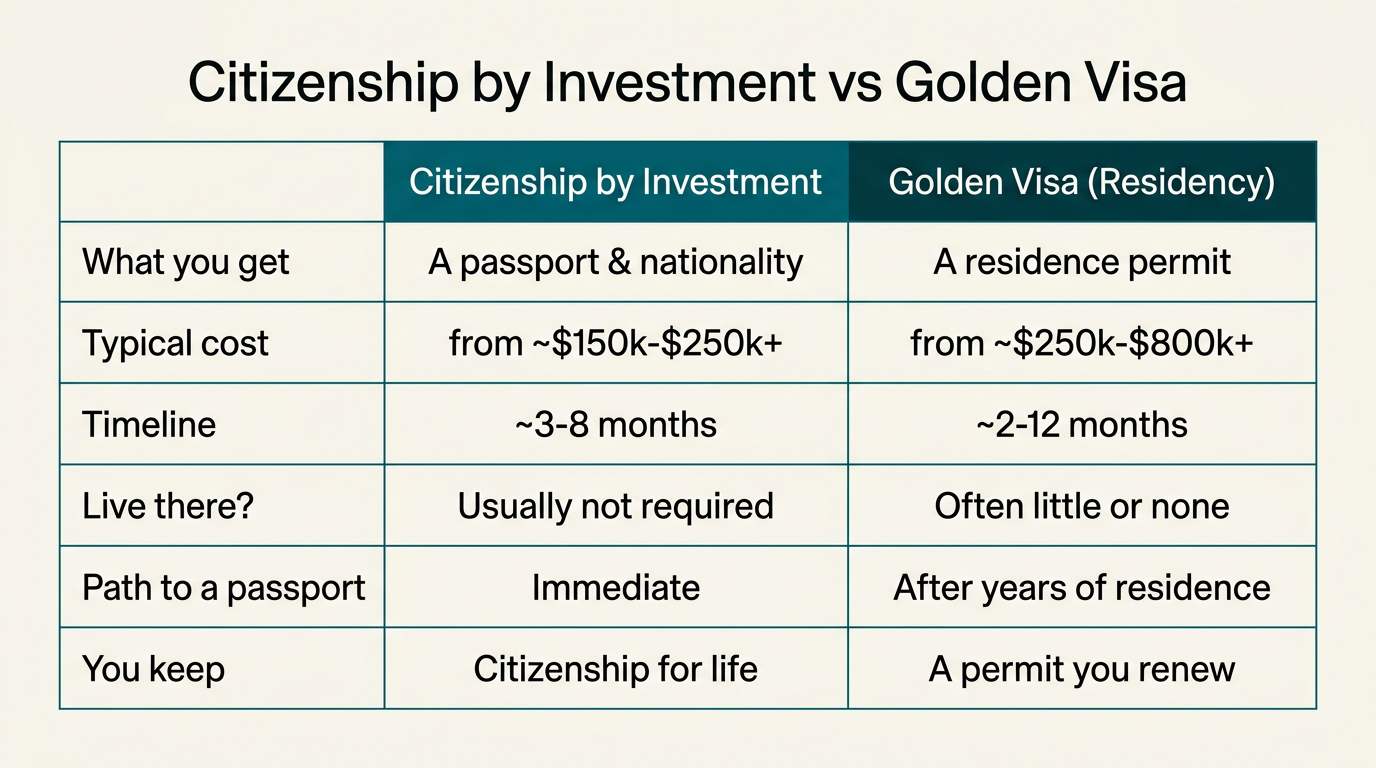
CBI programmes in the Caribbean often start in the region of a low-to-mid six-figure donation for a single applicant, before due diligence, government, and professional fees. Golden visas usually require a larger sum because you are investing rather than donating, and much of it may be recoverable: think property, funds, or a business stake that you still own.
The comparison below is directional, not a quote. Any real number depends on family size, the specific programme, and current official fees, so use planning ranges until a licensed advisor prices your file.
Timeline, residence, and the path to a passport
CBI can be fast because there is no residence period to serve: several Caribbean programmes are marketed in the three-to-eight-month range from a complete file to approval. A golden visa can be issued quickly, but the passport at the end is not: most residence routes require years of holding the permit, and some require you to actually spend time in the country before you can naturalise.
This is why physical-stay rules matter. Many CBI programmes require little or no visit, while golden visa citizenship timelines have been getting longer, not shorter. If your goal is a passport with minimal disruption, CBI is usually the more direct route; if your goal is to live somewhere in Europe with an eventual passport, a golden visa fits better.
Which one fits your goal
Choose CBI if you want travel mobility, a second nationality, or a backup passport quickly, and you do not intend to relocate. Choose a golden visa if you genuinely want to live in or spend time in a specific country and are comfortable with a multi-year path before any citizenship question arises.
A minority of applicants use both: a Caribbean passport for mobility now, and a residency programme for a European base. Whichever you pick, ask any advisor to separate the recoverable investment from the non-recoverable fees, because that single distinction changes the true cost more than the headline number does.
Recent programme changes to factor in (2025 to 2026)
The map has shifted. Spain closed its golden visa in April 2025, and Malta's citizenship-by-direct-investment route ended in 2025 following a Court of Justice of the European Union ruling, though Malta's residence programme remains open. Portugal removed the real estate option from its golden visa and extended the typical naturalisation timeline, pushing demand toward Greece and Italy.
Because rules, thresholds, and official fees in this sector change quickly, treat any figure, timeline, or visa-free claim as provisional and confirm it against the government source before you pay anyone.
Common questions
What is the difference between citizenship by investment and a golden visa?
Citizenship by investment gives you a passport and nationality. A golden visa gives you a residence permit, which you hold and renew, and which may lead to citizenship only after several years of residence.
Which is cheaper, CBI or a golden visa?
Caribbean CBI donations often start lower than golden visa investment thresholds, but a golden visa investment can be partly recoverable because you own the asset. Compare non-recoverable fees separately from recoverable investment.
Does a golden visa give you a passport?
Not immediately. A golden visa is residence. Any passport depends on meeting that country's naturalisation rules, which usually involve years of residence and sometimes physical-stay and language requirements.
Is citizenship by investment faster than a golden visa?
To a passport, usually yes, because there is no residence period. Several Caribbean CBI programmes are marketed in the three-to-eight-month range, while golden visa citizenship can take many years.
Can you hold both a second citizenship and a golden visa?
Some applicants do, using a CBI passport for mobility and a residence programme for a base in another country. Confirm dual citizenship and tax implications with qualified advisors first.
Do these programmes guarantee visa-free travel or tax benefits?
No. Visa-free access and tax treatment can change and depend on other countries' rules and your personal circumstances. Verify current government sources and take independent tax advice before relying on any benefit.
Official sources to verify
- Citizenship by InvestmentGrenada Citizenship by Investment Unit
- ARI - Residency Permit for InvestorsPortuguese Ministry of Foreign Affairs
- Golden VisaHellenic Ministry of Migration and Asylum
- Acquisition of CitizenshipCommunity Malta Agency
- Golden ResidencyFederal Authority for Identity, Citizenship, Customs and Port Security
Compare citizenship by investment advisors
Ask for a line-item quote that separates contribution, due diligence, processing, document, and professional fees.
We may earn a referral fee if you choose an advisor through this site. We still aim to show cost ranges, caveats, and official source links plainly.