e2 visa business plan
E-2 Visa Business Plan: What It Must Actually Prove
The E-2 business plan has one job the regulations actually name: showing the enterprise is not marginal. A marginal enterprise cannot generate more than a minimal living for you and your family, and a new business must show the capacity to clear that within five years of your E-2 status beginning. Everything else in the plan supports two further tests, substantiality and develop-and-direct. Fees and rules below are from USCIS and the State Department and change without notice.
What you need to know
- The plan has one legal target. It exists to answer the marginality test at 8 CFR 214.2(e)(15), not to impress anyone. Everything else is supporting evidence.
- Five years is a regulation, not a convention. A new enterprise must show the capacity to generate more than a minimal living within five years of your E-2 classification beginning.
- There is no minimum investment. Substantiality is a ratio between your capital and what your specific enterprise costs to buy or establish. The cheaper the business, the higher that proportion must be.
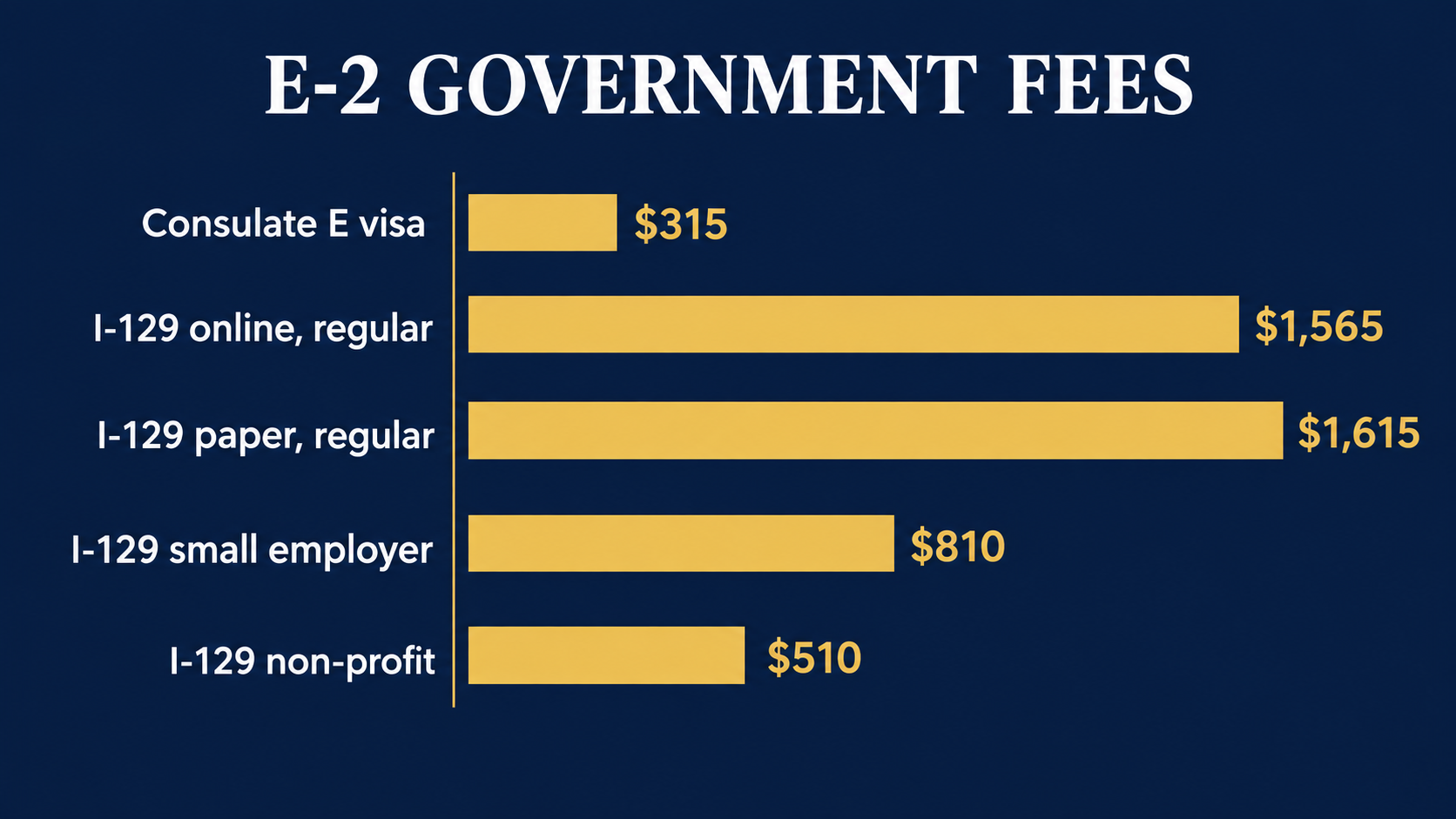
- Official fees are small. A consular application is a 315 dollar visa fee. A change of status inside the US on Form I-129 runs from 810 dollars for a small employer. Professional fees dominate everything else.
- A template cannot answer either test. Structure is inheritable; your ratio and your market are not.
The plan exists to defeat one specific test
Most E-2 business plan guidance describes a document without saying what it is for. The regulations are more specific. Your investment enterprise may not be marginal, and a marginal enterprise is defined as one without the present or future capacity to generate more than enough income to provide a minimal living for you and your family.
The concession follows immediately, and it is the reason every E-2 plan runs to five years. A new enterprise might not be considered marginal even when it currently lacks that earning capacity, provided it has the capacity to reach it within five years from the date your E-2 classification begins. That is the source of the five-year projection, at 8 CFR 214.2(e)(15). It is not a formatting convention.
Read that way, the plan stops being a brochure and becomes an argument with a deadline. Projections that show a comfortable living in year seven do not satisfy the rule. Projections that reach it in year two and then stall invite a different question about whether the business is real.
The three tests your plan has to answer
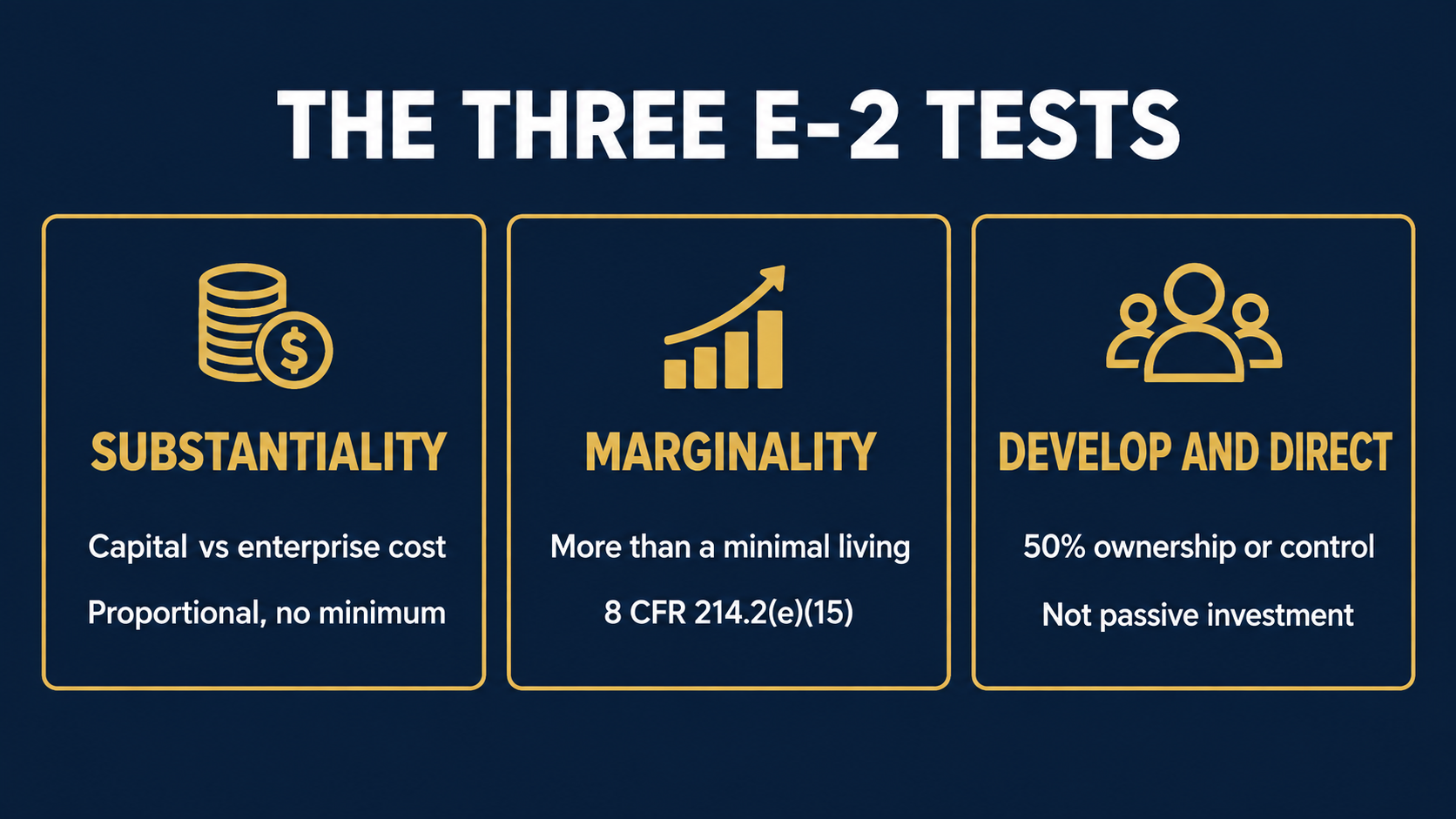
E-2 adjudication is not a single judgement call. It is three separate tests, each with its own source in the regulations, and a plan can pass one while failing another. Laying them out side by side is the fastest way to see which parts of your document are doing real work and which are decoration.
| Test | What it asks | Source | What in the plan answers it |
|---|---|---|---|
| Substantiality | Is the capital substantial relative to what this enterprise costs to buy or establish? | USCIS E-2 guidance | Use-of-funds schedule, enterprise cost build-up, proof the money is irrevocably committed |
| Marginality | Can the business produce more than a minimal living for you and your family? | 8 CFR 214.2(e)(15) | Five-year P&L, hiring schedule, market sizing that supports the revenue line |
| Develop and direct | Do you control the enterprise and are you entering solely to run it? | USCIS E-2 guidance | Org chart, your role and authority, 50 percent ownership or the corporate device that gives control |
The order matters when you are deciding where to spend effort. Substantiality is largely settled by the time you write, because it is a function of money already committed. Marginality is the one the document genuinely wins or loses, because projections are argument rather than fact. Develop-and-direct is cheap to satisfy and expensive to omit, which is why a missing organisational section is such a common own goal.
Substantiality is a ratio, not a number
There is no published minimum E-2 investment, which is why every figure you have seen quoted is somebody's estimate. USCIS describes a substantial amount of capital by three tests: substantial in relation to the total cost of purchasing an established enterprise or establishing a new one, sufficient to show your financial commitment to its successful operation, and of a magnitude supporting the likelihood that you will successfully develop and direct it.
The sentence that follows is the one applicants underestimate: the lower the cost of the enterprise, the higher, proportionately, the investment must be. A 60,000 dollar investment into a business that costs 60,000 dollars to establish is proportionately far stronger than 300,000 dollars into a venture that needs three million. Applicants who fixate on hitting an imagined threshold routinely build the weaker of those two cases. Our separate note on the E-2 visa minimum investment works through why the proportional rule punishes the bigger number.
The capital must also be at risk in the commercial sense, placed with the objective of generating a profit and subject to partial or total loss if the business fails. Funds sitting in a company account waiting for a visa decision are not obviously at risk, which is why irrevocable commitment matters more to the file than the raw balance does.
The plan has to prove something about you, not just the business
The third test is that you are entering solely to develop and direct the enterprise, established by showing at least 50 percent ownership or operational control through a managerial position or other corporate device. A plan that describes an excellent business you happen to have funded does not address this, and passive investment is the classic E-2 refusal.
So the plan needs an organisational section that is specific about your role, your decision-making authority, and who reports to you. Where you hold under half the equity, it needs to name the corporate mechanism that gives you control.
Nationality sits underneath all of it and no plan can repair it. You must be a national of a country with which the United States maintains a qualifying treaty, and where the investor is a company rather than a person, at least 50 percent must be owned by treaty nationals who themselves hold or could qualify for E-2 status. Check your country against the State Department treaty list before commissioning anything, and if it is not there, the Grenada E-2 route is the workaround most applicants end up looking at. The full eligibility picture is on our E-2 visa requirements page.
What goes in an E-2 business plan, section by section
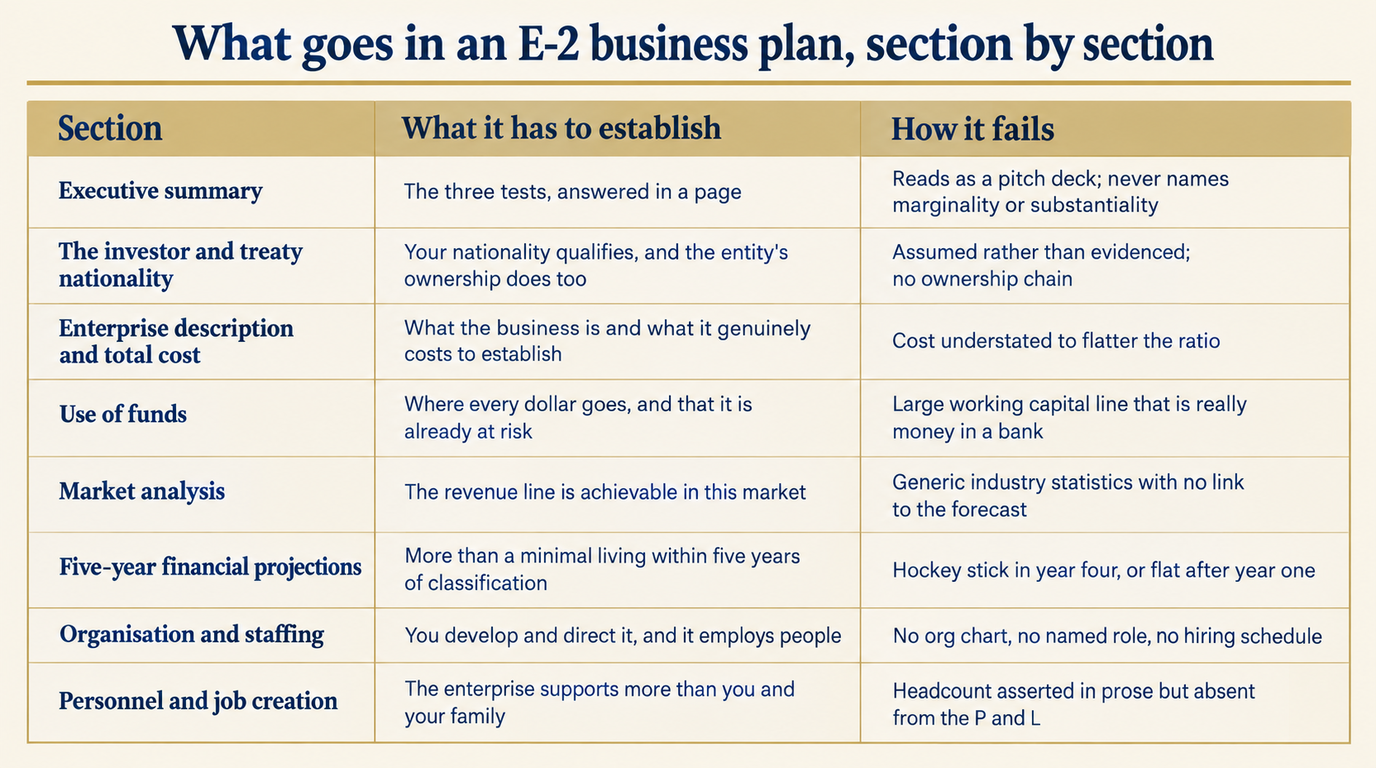
There is no prescribed format, which is precisely why so many plans are long and unpersuasive. What follows is the structure that maps onto the three tests rather than onto a generic startup template, with the failure mode each section is there to prevent.
| Section | What it has to establish | How it fails |
|---|---|---|
| Executive summary | The three tests, answered in a page | Reads as a pitch deck; never names marginality or substantiality |
| The investor and treaty nationality | Your nationality qualifies, and the entity's ownership does too | Assumed rather than evidenced; no ownership chain for corporate investors |
| Enterprise description and total cost | What the business is and what it genuinely costs to establish | Cost understated to flatter the ratio, then contradicted by the use-of-funds |
| Use of funds | Where every dollar of the investment goes, and that it is already at risk | Large "working capital" line that is really money sitting in a bank |
| Market analysis | The revenue line in the projections is achievable in this market | Generic industry statistics with no link to the forecast |
| Five-year financial projections | More than a minimal living within five years of classification | Hockey stick in year four; or profitable year one and flat thereafter |
| Organisation and staffing | You develop and direct it, and it employs people | No org chart, no named role, no hiring schedule |
| Personnel and job creation | The enterprise supports more than you and your family | Headcount asserted in prose but absent from the P&L |
Two practical notes. Job creation is not a numeric E-2 requirement the way it is for EB-5, but a hiring schedule is the most direct evidence against marginality, because payroll in the projections is money the business demonstrably generates beyond your own living. And the use-of-funds schedule should reconcile line by line to the enterprise cost build-up; when those two disagree, an adjudicator has been handed the easiest possible question.
What the process actually costs in official fees
The official fees are modest and public, which makes them a useful sanity check against provider quotes. Applying for the visa at a consulate means the nonimmigrant visa application fee for the E category, currently 315 dollars, raised from 205 dollars in June 2023. It is non-refundable whether the visa is issued or refused.
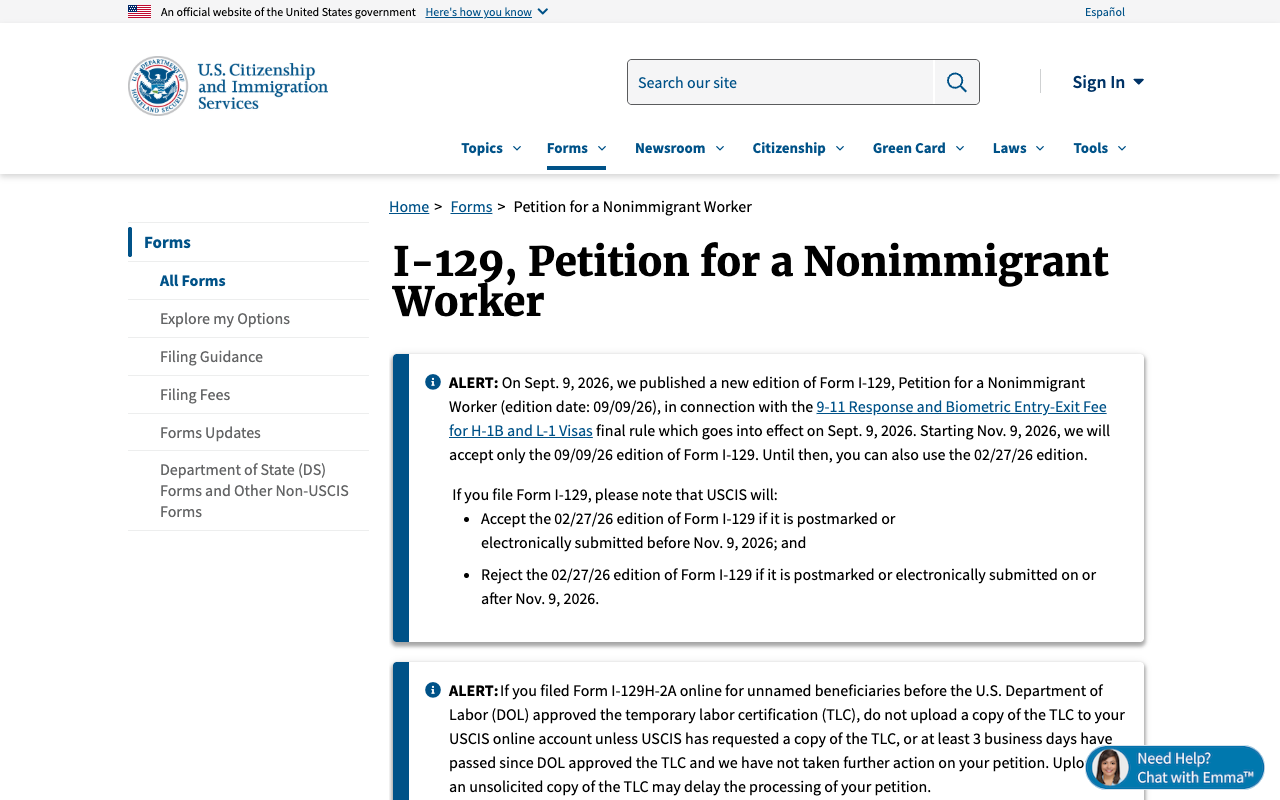
If you are already in the United States in another lawful status, the route is different: Form I-129 to change status, which cannot be filed from outside the country. USCIS lists 1,015 dollars for an E-1, E-2, E-2C or TN petition filed on paper, or 965 dollars online, plus the Asylum Program Fee of 600 dollars for a regular petitioner. A small employer or non-profit pays 510 dollars, with the Asylum Program Fee at 300 dollars for a small employer and nothing for a non-profit.
| Route | Filing fee | Asylum Program Fee | Government total |
|---|---|---|---|
| Consulate abroad, E visa application | 315 | — | 315 |
| I-129 change of status, online, regular petitioner | 965 | 600 | 1,565 |
| I-129 change of status, paper, regular petitioner | 1,015 | 600 | 1,615 |
| I-129 change of status, small employer | 510 | 300 | 810 |
| I-129 change of status, non-profit | 510 | 0 | 510 |
All figures in US dollars, from the USCIS fee schedule and the State Department visa fee table; both change without notice, so check them on the day you file. The realistic USCIS total for a small E-2 company is around 810 dollars, not the five figures some packages imply.
Everything above that is professional cost: immigration counsel, the plan itself, accounting, market research, translations, and the operating capital the plan promises to deploy. Company formation is the one line you can settle early and cheaply, and doing so improves the document, because projections describing an entity that already exists read differently from projections describing one you intend to create after approval.
Firstbase and Doola form the US entity, obtain the EIN, and arrange registered agent and banking from outside the US, so the plan can describe a company that already exists. Doola adds the ongoing bookkeeping and the Form 5472 filing foreign-owned entities owe. Neither is an immigration service, neither affects your treaty eligibility, and forming a company creates no entitlement to a visa.
Consulate or change of status: the plan is the same, the file is not
The two routes ask for the same evidence and package it differently, and the choice changes what your plan has to carry on its own. At a consulate the plan is read alongside a DS-160 and the E-visa supplement, often by an officer who will interview you about it; the document has to survive being questioned out loud. On a Form I-129 change of status the plan is read cold, as paper, by an adjudicator you will never speak to, so anything the document leaves implicit stays implicit.
There is a second, more practical difference. A change of status granted inside the United States gives you E-2 status but not an E-2 visa, so the first time you leave the country you still have to apply at a consulate to get back in. Applicants who take the I-129 route for speed sometimes discover the consular interview was only deferred, not avoided.
Either way the underlying stay is the same. Qualified treaty investors get a maximum initial stay of two years, extensions come in increments of up to two years, and there is no limit on the number of extensions — which is why a plan that only works if year six arrives is answering a question nobody asked.
Why E-2 business plans get refused
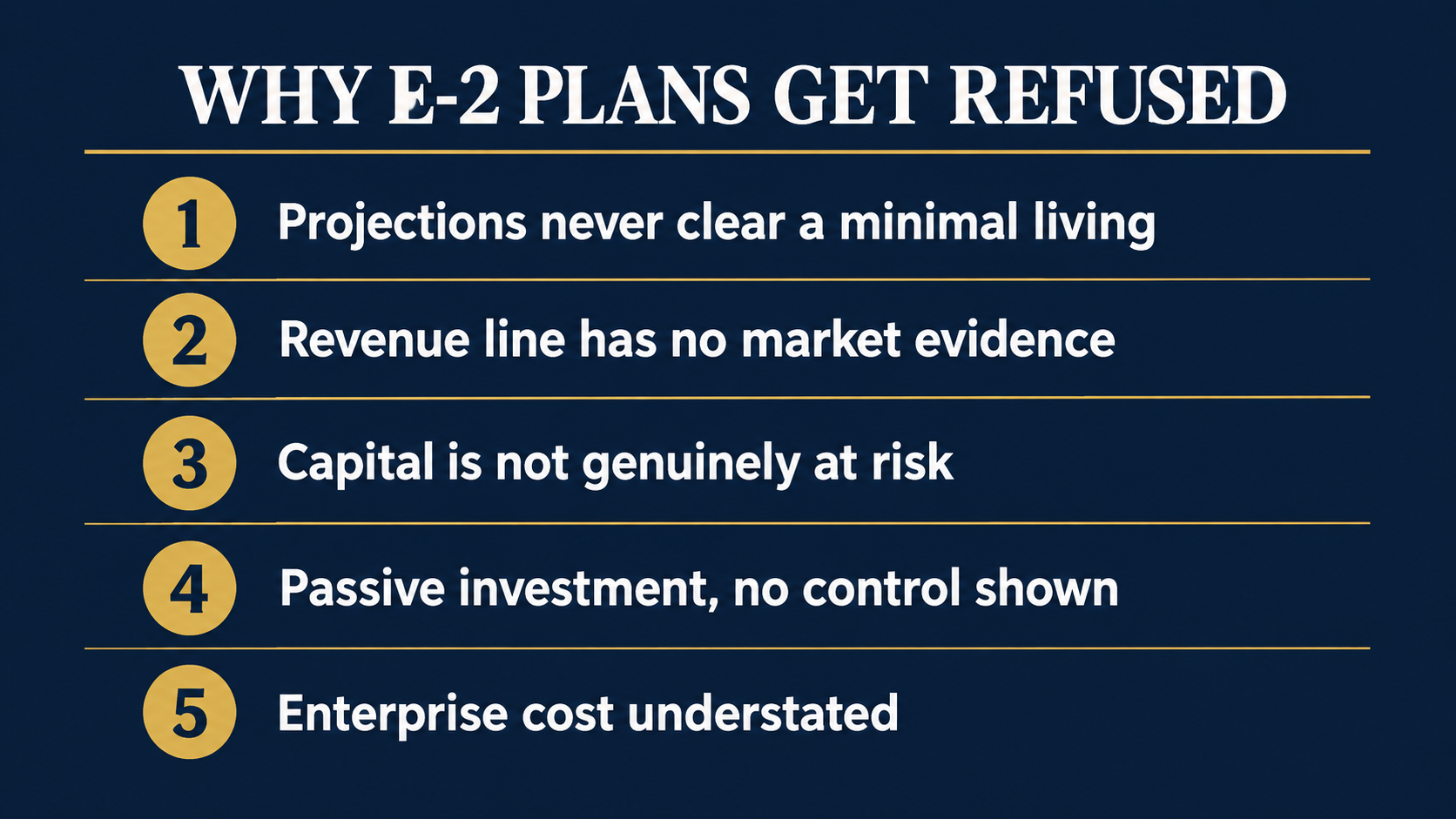
The refusals cluster, and almost all of them trace back to one of the three tests rather than to writing quality. Ranked roughly by how often they appear in the regulation's own language:
- Marginality, on the numbers. The projections never show more than a minimal living for the investor's family, or only show it after year five. This is the plan's own fault and the plan can fix it.
- Marginality, on credibility. The projections do show it, but nothing in the market analysis explains how. A revenue line with no demand evidence underneath reads as an assertion.
- Capital not genuinely at risk. Money is in the company account, uncommitted and recoverable. The regulation asks for capital subject to partial or total loss; a bank balance is not that.
- Passive investment. No organisational section, no named role, no control mechanism where the investor holds under 50 percent. The business may be excellent and still fail this test.
- The enterprise cost is understated. Applicants shrink the cost of establishing the business so the investment looks proportionally larger, then contradict themselves in the use-of-funds. Consistency is worth more here than optimism.
None of these is a formatting problem, which is the useful thing to take from the list. A shorter plan that answers the three tests cleanly beats a ninety-page document that answers none of them.
On templates, samples, and the five-year clock
A large share of the search traffic for this topic is looking for a template, a sample, or an example, so it is worth saying plainly what a template can and cannot do. It can give you a structure, and structure is genuinely useful. It cannot answer the substantiality question, because that answer is a ratio between your investment and your specific enterprise cost, and it cannot answer marginality, because that depends on your market and your numbers.
The published samples circulating online are mostly marketing collateral from plan providers. Reading two or three to learn the shape is sensible. Adapting one and hoping the ratios survive contact with a consular officer is not, and a plan that reads as generic invites exactly the scrutiny you were trying to avoid.
One last piece of context for the projections. E-2 is non-immigrant status throughout: you must maintain an intention to depart when it ends. A plan that reads as a permanent settlement strategy is answering a different question from the one being asked. If permanent residence is the actual goal, the honest comparison is with EB-5, which has a published minimum investment and a green card at the end rather than renewable status.
Common questions
Is a business plan required for the E-2 visa?
The regulations do not list a business plan as a standalone requirement, but in practice you cannot address the marginality test without one. USCIS requires that the enterprise is not marginal, meaning it must have the present or future capacity to generate more than a minimal living for you and your family, and for a new business that capacity must be reachable within five years of your E-2 status beginning. A written plan with projections is how that is evidenced.
How many years should an E-2 business plan project?
Five, and the number comes from the regulation rather than from convention. Under 8 CFR 214.2(e)(15), a new enterprise that currently lacks the capacity to generate more than a minimal living may still avoid being classed as marginal if it has the capacity to reach that point within five years of the date the treaty investor's E-2 classification begins. Projections that only clear the bar later than that do not meet the test.
What should an E-2 business plan include?
At minimum: an executive summary that answers the three tests directly, evidence of treaty nationality for you or the investing entity, a description of the enterprise with its total cost to establish, a use-of-funds schedule showing the capital is already at risk, market analysis that supports the revenue line, five-year financial projections, an organisation chart naming your role and authority, and a hiring schedule. The organisational section is the one most often left out, and it is the only part that addresses the develop-and-direct test.
Does the E-2 visa have a minimum investment amount?
No published minimum exists. USCIS assesses whether the capital is substantial in relation to the total cost of buying or establishing that particular enterprise, sufficient to show your commitment, and large enough to make success likely. The rule that catches people is proportional: the lower the cost of the enterprise, the higher the percentage your investment must represent. Any specific dollar figure you see quoted is an estimate, not a threshold.
How much does an E-2 visa cost in government fees?
Applying at a consulate means the E category nonimmigrant visa application fee of 315 dollars, non-refundable whether you are approved or refused. Changing status from inside the United States on Form I-129 costs 1,015 dollars on paper or 965 dollars online for a regular petitioner, plus a 600 dollar Asylum Program Fee, while a small employer pays 510 dollars plus 300 dollars. Professional fees for counsel and the plan sit on top and usually dominate the total.
How much does an E-2 business plan itself cost?
That is a professional fee rather than a government one, so there is no published figure and quotes vary widely by provider and by how much financial modelling is included. Treat it separately from the official costs above, which are fixed and public. The useful question to ask a provider is not the price but what they do about the two tests a template cannot answer: the ratio between your investment and your enterprise cost, and the market evidence under your revenue line.
Can an E-2 business plan template or sample be used?
A template is useful for structure and useless for substance. The two questions that decide the case are the ratio between your investment and your enterprise's total cost, and whether your projections show more than a minimal living within five years. Neither can be inherited from someone else's document. Most published samples are marketing material from plan providers, so read them for shape and build the numbers yourself or with counsel.
Can a business plan provider promise an E-2 approval?
No, and treat it as a warning sign if one implies otherwise. A plan is evidence supporting three tests: substantiality, non-marginality, and your role in developing and directing the enterprise. Treaty nationality, lawful source of funds, whether capital is genuinely at risk, admissibility, and the judgement of the consular officer or USCIS adjudicator all sit outside the document entirely.
How long does E-2 status last?
Qualified treaty investors and their employees receive a maximum initial stay of two years. Extensions of stay or changes of status may be granted in increments of up to two years each, and there is no limit on how many extensions you may be granted. E-2 remains non-immigrant status throughout, so you must maintain an intention to depart the United States when your status expires or is terminated.
Official sources to verify
- E-2 Treaty InvestorsU.S. Citizenship and Immigration Services
- Treaty Trader and Treaty Investor VisasU.S. Department of State
- Treaty CountriesU.S. Department of State
- Form G-1055, Fee ScheduleU.S. Citizenship and Immigration Services
- Fees for Visa ServicesU.S. Department of State, Bureau of Consular Affairs
Compare E-2 visa support
Ask for a quote that separates immigration counsel, business-plan support, company setup, investment documentation, and filing strategy.
We may earn a referral fee if you choose an advisor through this site. We still aim to show cost ranges, caveats, and official source links plainly.