bahrain golden visa cost
Bahrain Golden Visa Cost 2026: The Fee Is BHD 305
The Bahrain golden visa cost question has two answers and almost every page online gives only one of them. The permit itself costs BHD 305 — a BHD 5 application fee and a BHD 300 issuance fee, about USD 811 at the dinar's peg — which makes it one of the cheapest long-term residence permits any government sells. The qualifying route is the expensive part, and in November 2025 the property threshold fell 35%, from BHD 200,000 to BHD 130,000. We priced both halves from Bahrain's own Golden Residency portal and NPRA's service page, worked out what the cut actually saves, and checked the three claims the advisory pages keep repeating that the official text contradicts.
Key takeaways
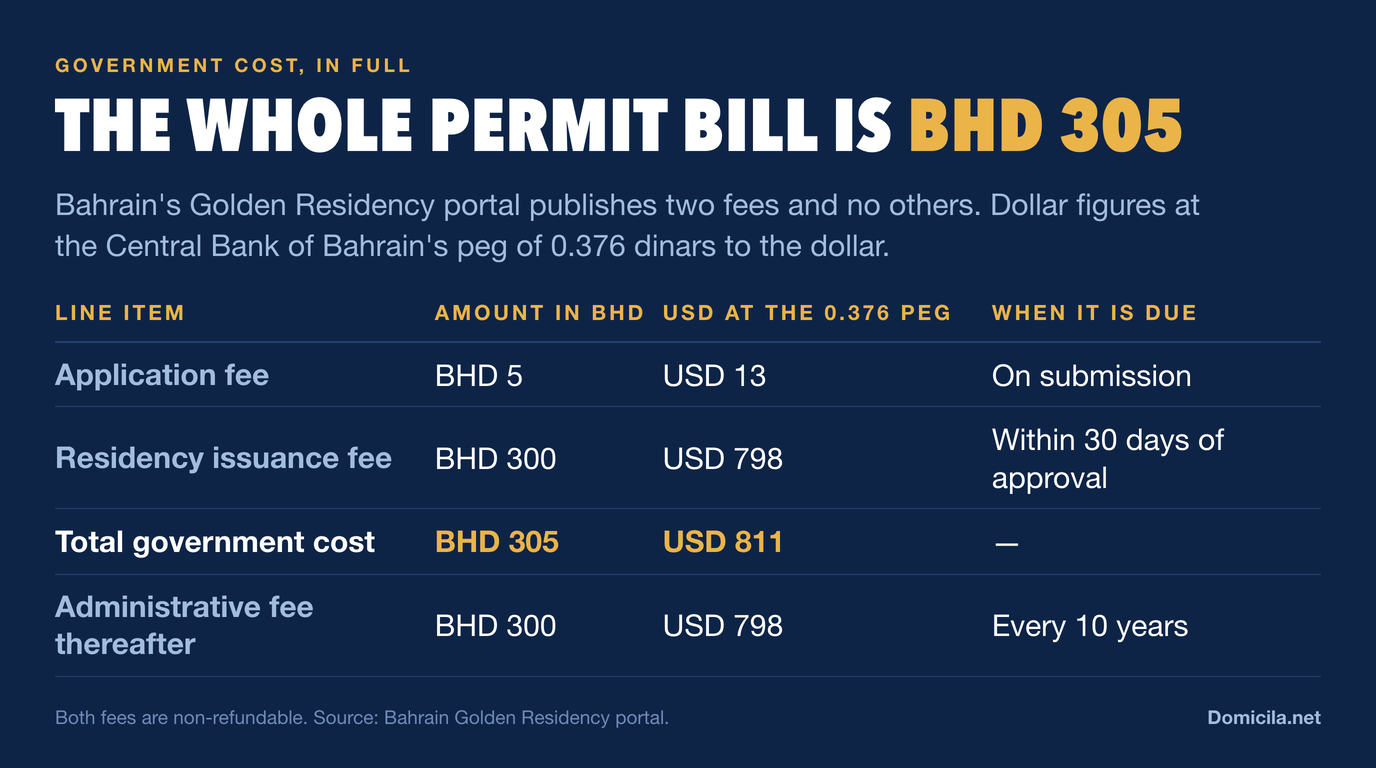
The permit costs BHD 305 and that is the whole government bill. Bahrain's Golden Residency portal states a BHD 5 application fee to submit, equivalent to USD 13, and a BHD 300 issuance fee if you are approved, equivalent to USD 795. At the Central Bank of Bahrain's peg of 0.376 dinars to the dollar that is about USD 811 in total — less than the document-attestation bill on most European golden visas.
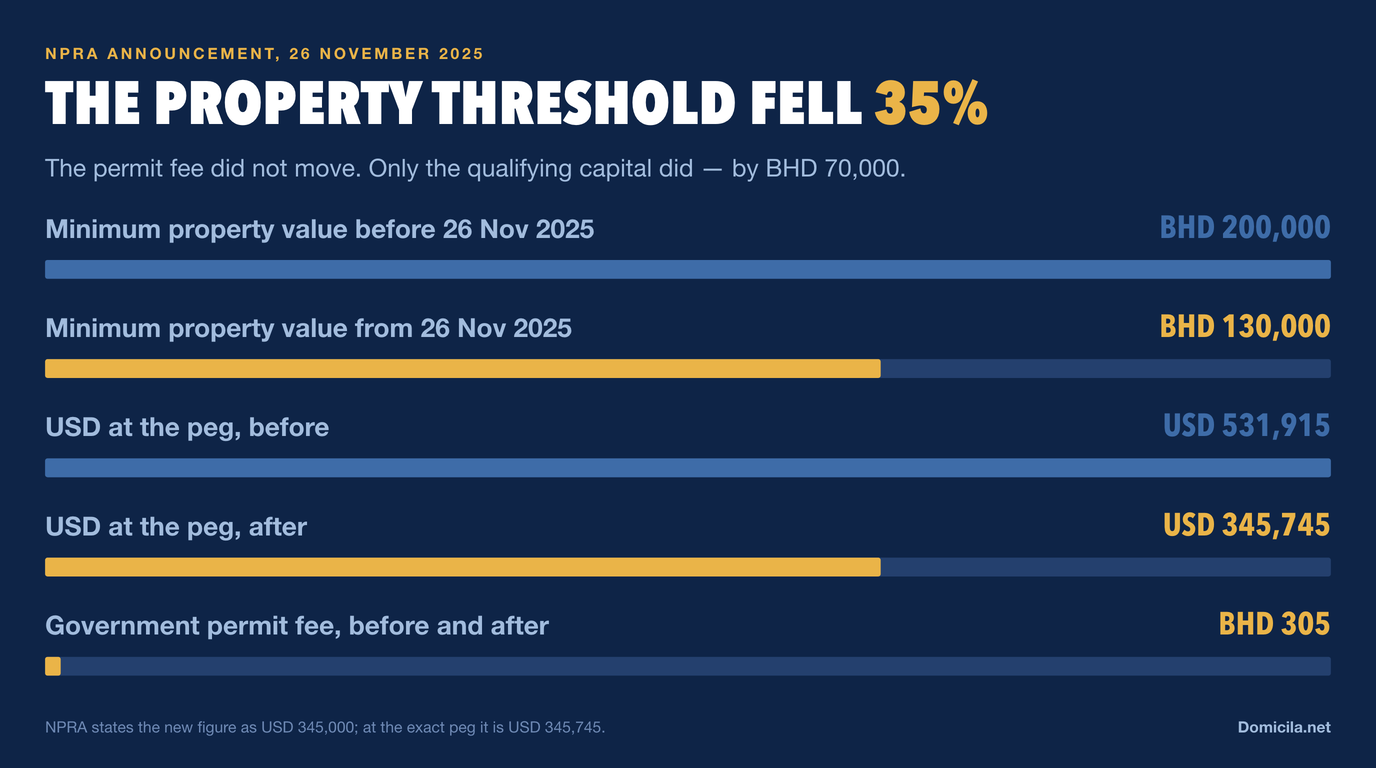
The property threshold fell 35% in November 2025, from BHD 200,000 to BHD 130,000. NPRA's own announcement of 26 November 2025 puts the new figure at USD 345,000; at the exact peg it is USD 345,745. The cut takes BHD 70,000, roughly USD 186,000, off the capital you must commit — and three of the five advisory pages still ranking for this keyword quote the old number.
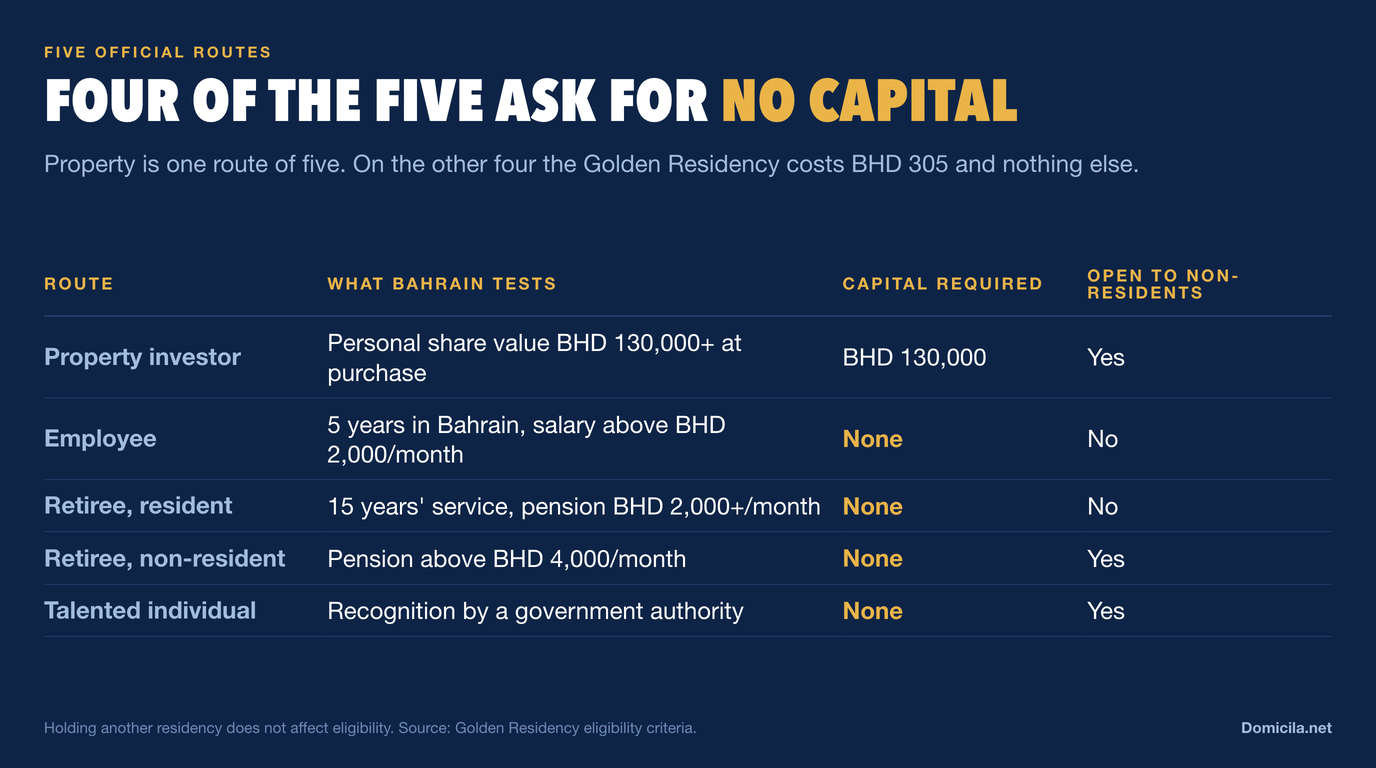
Four of the five qualifying routes ask for no investment at all. A monthly salary above BHD 2,000 with five years worked in Bahrain qualifies. So does a pension above BHD 2,000 after fifteen years' service, or above BHD 4,000 for a retiree who never lived there. For anyone already employed in Bahrain, the Golden Residency costs BHD 305 and nothing else.
"Permanent" and "10-year" are both right, and the fee explains why. NPRA's service page describes the Golden Residency as a permanent residency "subject to a standard administrative fee of BHD 300 every 10 years". The ten years is a billing cycle, not an expiry date — which is a materially different thing to budget for than a permit that lapses.
There is no minimum stay, and there is a 30-day clock that cancels applications. The official FAQ states plainly that no minimum stay in Bahrain is needed to keep the residency valid, contradicting the 90-day figure one large advisory firm publishes. Against that, NPRA gives you 30 days from approval to pay the BHD 300 or the application is cancelled automatically.
On this page
Every figure below is read from the government that charges it: Bahrain's Golden Residency portal for the fees and eligibility tests, NPRA's service page for the permit's legal character and its deadlines, the NPRA press release of 26 November 2025 for the threshold cut, and the Central Bank of Bahrain for the peg used in every dollar conversion. Where a number circulates widely but is not on an official page, the text says so. This site's renderer does not emit heading anchors, so the list below is a map rather than jump links.
- Bahrain golden visa cost in 2026: the fee nobody prices
- The property route after the 35% cut
- The four routes that need no property at all
- Permanent residency or a 10-year visa? The fee settles it
- The 30-day clock, and the other deadlines
- What the Golden Residency is not
- Bahrain against the UAE, Saudi Arabia and Europe
- Related guides on Domicila
Bahrain golden visa cost in 2026: the fee nobody prices
Search the Bahrain golden visa cost and you get the property threshold, over and over, and almost never the price of the permit. That is an odd omission, because the permit is the only line every applicant pays regardless of route — and it is remarkably small.
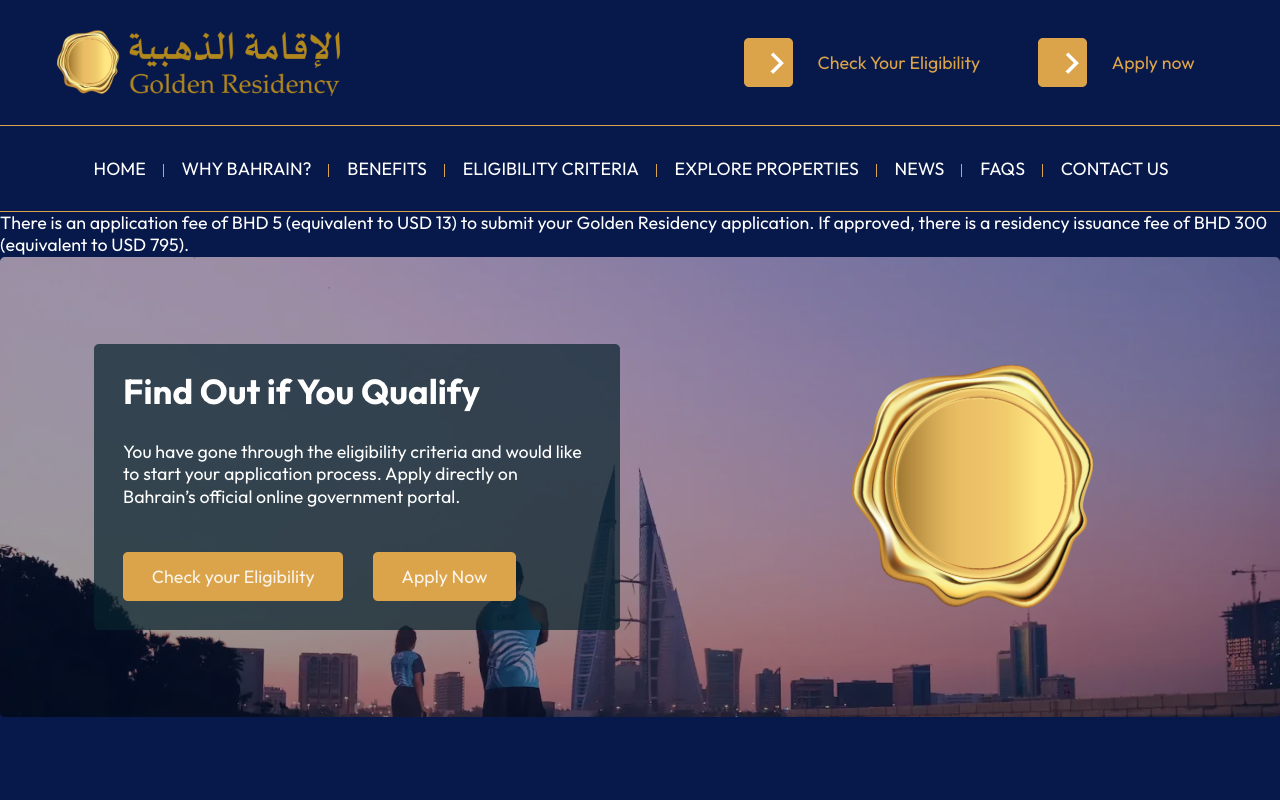
Bahrain's Golden Residency portal gives two numbers. Submitting an application costs BHD 5, which the portal itself converts to USD 13, and it is non-refundable whatever the outcome. If you are approved, issuing the residency costs BHD 300, which the portal converts to USD 795. Nothing else is charged by the government for the permit.
The dollar figures are worth a second look, because the portal's own conversions and the arithmetic disagree slightly. The Central Bank of Bahrain pegs the dinar at 0.376 to the US dollar and has held that rate since 1980, so BHD 300 is USD 797.87 and BHD 5 is USD 13.30. The portal rounds to 795 and 13. The gap is immaterial to a budget but it tells you something useful: these are published figures with published rounding, not an estimate a comparison site built.
| Line item | Amount in BHD | USD at the 0.376 peg | When it is due | Refundable |
|---|---|---|---|---|
| Application fee | BHD 5 | USD 13 | On submission | No |
| Residency issuance fee | BHD 300 | USD 798 | Within 30 days of approval | No |
| Total government cost | BHD 305 | USD 811 | — | — |
| Administrative fee thereafter | BHD 300 | USD 798 | Every 10 years | No |
One caveat on the application fee, because it is the single figure where sources split. Several guides, including one that otherwise prices this programme carefully, publish BHD 4 rather than BHD 5. The official FAQ says BHD 5. A dinar either way changes nothing, but if a page cannot get the cheapest line right it is worth checking its expensive ones too.
The real caution is the opposite error. Commercial pages exist quoting a BHD 1,000 application fee, and others quoting BHD 200 to 500 in vague "processing fees". Neither appears anywhere in Bahrain's published schedule. If a quote you are given exceeds BHD 305 in government charges, the excess is somebody's service fee, and it should be itemised as one.
The property route after the 35% cut
On 26 November 2025, NPRA announced that the minimum real estate investment for the Golden Residency would fall from BHD 200,000 to BHD 130,000. The press release states the new figure as USD 345,000 and quotes Shaikh Hisham bin Abdulrahman Al Khalifa, Undersecretary for NPRA, saying the reduction "reflects Bahrain's commitment to fostering an enabling environment".
The official eligibility page now sets the test as a total personal share value of BHD 130,000 or more at the time of purchase, and is explicit that the threshold can be met across several properties rather than one. Two details in that sentence do real work. Personal share means your share of a jointly owned property counts, not the property's full value. At the time of purchase means the test is applied to what you paid, so a later fall in the market does not retroactively disqualify you.
| Before 26 Nov 2025 | From 26 Nov 2025 | Change | |
|---|---|---|---|
| Minimum property value | BHD 200,000 | BHD 130,000 | −BHD 70,000 |
| USD at the 0.376 peg | USD 531,915 | USD 345,745 | −USD 186,170 |
| As NPRA states it | USD 530,555 | USD 345,000 | −35% |
| Government permit fee | BHD 305 | BHD 305 | Unchanged |
What the announcement did not say is when the change takes effect, and no official page we could reach publishes an effective date. The eligibility portal already shows BHD 130,000, which is the strongest available evidence that it is live. If your purchase is imminent rather than done, confirm the figure with NPRA directly before you commit — a 35% cut is exactly the kind of change that takes months to reach every counter.
Note also what the threshold excludes. BHD 130,000 is the property price, not the cost of acquiring it. Bahrain charges property registration fees through the Survey and Land Registration Bureau, and agents charge commission; neither is published as part of the Golden Residency schedule, and we are not going to invent a percentage for them. Budget for them separately and ask for them in writing, the same way the golden visa cost comparison separates recoverable capital from money that is simply gone.
The four routes that need no property at all
This is where the Bahrain programme diverges from most of the field, and where the headline threshold misleads. Property is one of five routes, and the other four test income or standing rather than capital. For a large share of applicants the real cost of the Golden Residency is BHD 305.
The employee route asks for at least five years worked in Bahrain and an average monthly salary above BHD 2,000, about USD 5,319. The resident retiree route asks for fifteen years of service in Bahrain and a pension averaging BHD 2,000 or more. The non-resident retiree route needs no Bahraini history at all, only a pension above BHD 4,000 a month, about USD 10,638 — the one route open to someone who has never lived there and does not want to buy property. The talent route covers entrepreneurs, highly skilled professionals and people who have made a significant contribution to Bahrain's economy or society, and it publishes no threshold because it runs on recognition rather than a number.
| Route | What Bahrain tests | Capital required | Open to non-residents |
|---|---|---|---|
| Property investor | Personal share value BHD 130,000+ at purchase | BHD 130,000 | Yes |
| Employee | 5 years in Bahrain, salary above BHD 2,000/month | None | No |
| Retiree, resident | 15 years' service, pension BHD 2,000+/month | None | No |
| Retiree, non-resident | Pension above BHD 4,000/month | None | Yes |
| Talented individual | Recognition by a government authority | None | Yes |
The talent route's silence on numbers cuts both ways. There is nothing to budget for, and nothing to plan against: the official page describes the category, not a test you can pre-clear. Treat it as a route to ask about rather than one to rely on, and note that it is also the slowest — ten working days to a decision against five for the other three.
One eligibility point the portal answers directly, and it matters more than it sounds: holding another residency does not affect your eligibility. Bahrain does not ask you to give up a permit elsewhere, which is not true of every programme on the list of golden visa countries still open in 2026.
Permanent residency or a 10-year visa? The fee settles it
Here is the contradiction that runs through nearly every page on this programme. Bahrain's own portal calls the Golden Residency "a permanent residency". Advisory pages overwhelmingly call it a ten-year renewable permit. One guide goes further and states it "does not lead to permanent residency". These cannot all be right, and the reconciliation is sitting in NPRA's fee line.
NPRA's service page describes the Golden Residency as a permanent residency subject to a standard administrative fee of BHD 300 every 10 years. So the status is permanent and the ten years is a billing cycle. That is why both descriptions circulate: everyone is looking at the same decade and disagreeing about what ends at the end of it.
The distinction is not pedantry, it is the difference between two budgets and two risk profiles. A permit that expires must be re-qualified for, which means the salary, pension or property test is re-applied to you a decade older. A permanent status with a recurring administrative fee means you owe BHD 300 and nothing else.
| Claim | Where it comes from | What the official text says |
|---|---|---|
| Permanent residency | Bahrain's Golden Residency portal | "A permanent residency" |
| 10-year renewable permit | Most advisory and law-firm pages | BHD 300 administrative fee every 10 years |
| Does not lead to permanent residency | One visa-guide site | Contradicted by the portal |
| Minimum stay of 90 days a year | One international advisory firm | "No minimum stay requirement" |
The last row is the one worth acting on. The official FAQ states there is no minimum stay requirement in Bahrain to maintain the validity of your Golden Residency. A page telling you to spend 90 days a year in the country is describing an obligation Bahrain does not impose — and for anyone weighing permits on physical-presence terms, that is the whole decision.
Citizenship is the other place to be careful. We found no official statement tying the Golden Residency to naturalisation. Third-party guides cite 25 years of continuous legal residence, or 15 for Arab applicants, under Bahrain's nationality law. That may well be the general rule, but it is not something the Golden Residency pages promise, and nobody should buy this permit as a passport route.
The 30-day clock, and the other deadlines
Bahrain decides fast, which is a genuine advantage, and it then hands you a deadline that is easy to miss precisely because the decision arrived so quickly.
The official FAQ puts processing at five working days for the employee, property owner and retiree categories, and up to ten working days for the talent category. Against the multi-month timelines normal in this market, that is close to instant. Then NPRA's service page adds the sting: payment of the BHD 300 must be made within 30 days of approval or the application is automatically cancelled. Not suspended — cancelled, with the BHD 5 gone and the process to start again.
| Step | Official timing | What happens if you miss it |
|---|---|---|
| Decision, property / employee / retiree | 5 working days | — |
| Decision, talent category | Up to 10 working days | — |
| Pay the BHD 300 issuance fee | Within 30 days of approval | Application cancelled automatically |
| Administrative fee | Every 10 years | Not published |
The practical read: have the BHD 300 liquid before you submit, not after you are approved. On a programme this cheap the money is never the obstacle — but a bank transfer that takes two weeks to clear from the wrong jurisdiction, landing in week five, is.
The documents are the other place applications stall. The portal lists a passport valid for more than six months, six months of bank statements, proof of residence and health insurance. Nothing exotic, but a six-month statement history is something you either have or must wait for, and that wait sits before the five-day decision rather than inside it.
What the Golden Residency is not
One confusion is worth isolating because it has made its way into otherwise careful pages, and it will cost somebody a wasted application.
Bahrain runs a self-sponsorship residence permit that is a separate product from the Golden Residency, with its own thresholds and its own terms. At least one guide ranking for this keyword lists a BHD 100,000 business-investment route and a BHD 50,000 property route as Golden Residency categories. They are not. Bahrain's official eligibility page names five routes and none of them is a BHD 100,000 business investment.
We are deliberately not publishing the self-sponsorship thresholds here. The figures in circulation for it conflict — different sources give different property minimums, different income tests, and disagree over whether a bank deposit is still required — and we could not reach an official NPRA page to settle them. A cost guide that cannot source a number should not print it.
What matters for your budget is the distinction, not the amounts. If an adviser quotes you BHD 50,000 of property for "Bahrain's golden visa", you are being quoted a different permit, with different rights — self-sponsorship does not carry the Golden Residency's work rights — and quite possibly a different processing time. Ask which permit is being applied for, by name, and check it against the five official routes above.
Bahrain against the UAE, Saudi Arabia and Europe
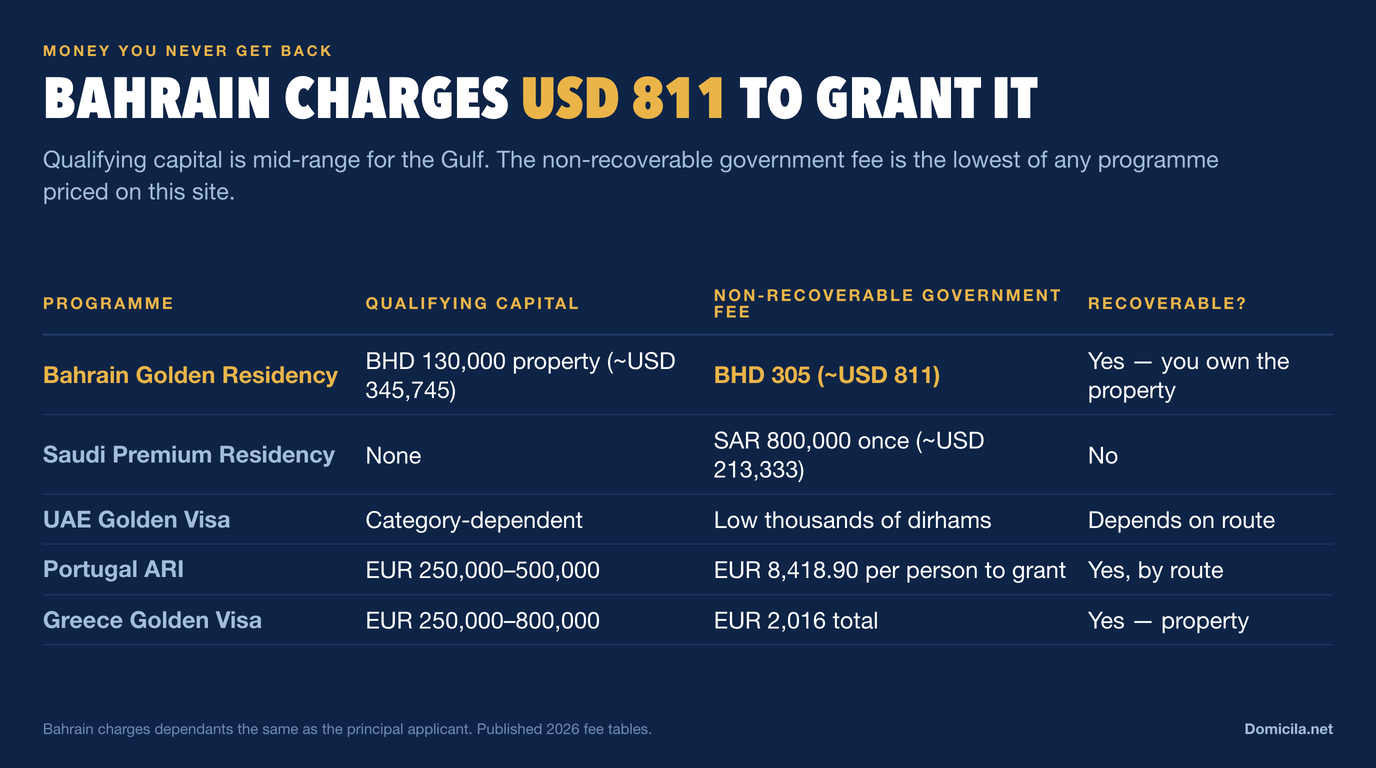
Set against its neighbours, Bahrain's position is unusual: the qualifying capital is mid-range for the Gulf, and the fee is the lowest of any programme we have priced.
Saudi Arabia is the clearest contrast. Its Premium Residency sells an indefinite permit for SAR 800,000 paid once, or SAR 100,000 a year, with no investment and no nomination required — money you never see again. Bahrain's BHD 130,000 buys property you continue to own. On non-recoverable spend the two are not close: the Saudi Arabia golden visa cost is around USD 213,000 of pure fee against Bahrain's USD 811. The UAE golden visa sits between them — no six-figure product fee, but government charges in the thousands rather than the hundreds.
Against Europe the comparison turns on the same axis. Greece charges EUR 2,016 in total government fees and Portugal EUR 8,418.90 to grant a single permit, with every family member paying the principal rate again. Bahrain's BHD 305 is a different order of magnitude, and it is the same for a dependant as for the principal applicant — the portal states the fees are the same for applicants and their dependents.
| Programme | Qualifying capital | Non-recoverable government fee | Recoverable? |
|---|---|---|---|
| Bahrain Golden Residency | BHD 130,000 property (~USD 345,745) | BHD 305 (~USD 811) | Yes — you own the property |
| Saudi Premium Residency | None | SAR 800,000 once (~USD 213,333) | No |
| UAE Golden Visa | Category-dependent | Low thousands of dirhams | Depends on route |
| Portugal ARI | EUR 250,000–500,000 | EUR 8,418.90 per person to grant | Yes, by route |
| Greece Golden Visa | EUR 250,000–800,000 | EUR 2,016 total | Yes — property |
Where Bahrain genuinely wins is the combination this table cannot show: no minimum stay, a five-day decision, no capital requirement on four of five routes, and a permanent status rather than a renewable one. Where it loses is scope — a Bahraini permit is a Bahraini permit, with none of the Schengen mobility that makes the European programmes expensive.
If you are ranking programmes on money you never get back, Bahrain belongs near the top of the cheapest golden visa list and almost nobody puts it there, because the comparisons are built on qualifying capital rather than on fees. Both numbers matter, and they point to different programmes.
Related guides on Domicila
- UAE golden visa cost — the Gulf permit most readers price against this one, category by category.
- Saudi Arabia golden visa cost — the other Gulf flat-fee product, and the opposite trade: a huge fee, no investment.
- Golden visa cost comparison — Portugal, Greece, the UAE and Malta from the published 2026 fee tables.
- Cheapest golden visa — the low end of the market, ranked on money you never get back.
- Golden visa countries — every programme still open in 2026, and what each permit actually leads to.
- Golden visa health insurance requirements — the cover Bahrain and most other programmes ask you to produce with the application.
Common questions
How much does the Bahrain golden visa cost in 2026?
The permit itself costs BHD 305. Bahrain's Golden Residency portal states a non-refundable application fee of BHD 5, equivalent to USD 13, and a residency issuance fee of BHD 300, equivalent to USD 795, payable if the application is approved. That is about USD 811 in total at the Central Bank of Bahrain's peg of 0.376 dinars to the dollar. If you qualify through property rather than salary, pension or talent, you must also commit a minimum of BHD 130,000 to real estate, which is capital you continue to own rather than a fee.
What is the minimum property investment for Bahrain's Golden Residency?
BHD 130,000, roughly USD 345,745 at the dinar's peg. NPRA announced the reduction from BHD 200,000 on 26 November 2025, a cut of about 35%. The official eligibility page expresses the test as a total personal share value of BHD 130,000 or more at the time of purchase, and states that it can be met through one property or several. Because the test applies to your personal share at purchase, a later fall in value does not retroactively disqualify you.
Can you get Bahrain's Golden Residency without buying property?
Yes, on four of the five routes. An employee with at least five years in Bahrain and an average monthly salary above BHD 2,000 qualifies with no investment. A retiree with fifteen years of service in Bahrain and a pension averaging BHD 2,000 or more qualifies, as does a non-resident retiree with a pension above BHD 4,000 a month. The fifth route covers entrepreneurs, highly skilled professionals and people recognised for a significant contribution to Bahrain's economy or society, and publishes no financial threshold.
Is Bahrain's Golden Residency permanent or a 10-year visa?
Both descriptions trace to the same fee line. Bahrain's Golden Residency portal calls it a permanent residency, while NPRA's service page describes it as a permanent residency subject to a standard administrative fee of BHD 300 every 10 years. So the ten-year figure that appears across advisory pages is a billing cycle rather than an expiry date. The practical difference matters: a permanent status with a recurring fee does not require you to satisfy the salary, pension or property test again a decade later.
Is there a minimum stay requirement for Bahrain's Golden Residency?
No. The official FAQ states there is no minimum stay requirement in the Kingdom of Bahrain to maintain the validity of your Golden Residency. At least one large international advisory firm publishes a figure of 90 days per year, which the official text contradicts. If physical-presence obligations are central to your decision, treat the portal's wording as the governing statement and confirm it with NPRA before relying on any third-party summary.
How long does a Bahrain Golden Residency application take?
Five working days for applicants in the employee, property owner and retiree categories, and up to ten working days for the talent category, according to the official FAQ. The deadline that follows is the one to plan for: NPRA's service page states that the BHD 300 issuance fee must be paid within 30 days of approval, or the application is cancelled automatically. Have that money liquid before you submit rather than after approval arrives.
Do family members pay the BHD 300 fee as well?
The official FAQ states that the Golden Residency fees are the same for both applicants and their dependents, and that holders can sponsor dependents including a spouse, parents and children. The natural reading is that each dependent carries the same BHD 5 and BHD 300 charges as the principal applicant, and at least one third-party guide states that each family member requires a separate BHD 300 payment. We could not find official wording that settles it beyond doubt, so confirm the family total with NPRA before budgeting.
Does Bahrain's Golden Residency lead to citizenship?
Nothing on the official Golden Residency pages promises a route to Bahraini nationality. Third-party guides cite 25 years of continuous legal residence under Bahrain's nationality law, or 15 years for Arab applicants, and present the Golden Residency as a way of accumulating that residence. That may describe the general rule, but it is not a commitment the programme makes, and the permit should not be bought as a passport route. If a passport is the actual goal, a residence permit and a citizenship programme are different products.
Official sources to verify
- Golden Residency — Eligibility CriteriaNationality, Passports and Residence Affairs, Kingdom of Bahrain
- What are the applicable fees for applying for the Golden Residency?Nationality, Passports and Residence Affairs, Kingdom of Bahrain
- Golden Residency frequently asked questionsNationality, Passports and Residence Affairs, Kingdom of Bahrain
- Golden Residency for Foreign Residents in Bahrain (Employees/Retirees)Nationality, Passports and Residence Affairs, Ministry of Interior
- Bahrain Lowers Minimum Real Estate Investment for Golden Residency to USD 345,000NPRA press release, 26 November 2025 (AAP Newswire)
- Monetary Policy — the dinar's peg to the US dollarCentral Bank of Bahrain
- Bahrain Slashes Golden Residency Threshold by 35% to US$345,000Investment Migration Insider
Compare golden visa advisors
Ask for a route-specific quote that separates investment amount, government fees, legal work, fund or property costs, and renewal obligations.
We may earn a referral fee if you choose an advisor through this site. We still aim to show cost ranges, caveats, and official source links plainly.