saudi arabia golden visa cost
Saudi Arabia Golden Visa Cost 2026: All 7 Prices
Saudi Arabia does not sell a golden visa. It sells Premium Residency, and since January 2024 it sells seven versions of it: two you can simply buy, at SAR 800,000 once or SAR 100,000 a year, and five tied to a talent, investment or property test that carry a far smaller product fee. We priced all seven from the Premium Residency Center's own published law, the Saudi Press Agency announcement that launched the five new products, and the Ministry of Media's entry for the two older ones — then did the arithmetic nobody publishes: the year at which paying once beats paying annually, and what the work-permit rule introduced in June 2026 adds to every one of them.

Key takeaways
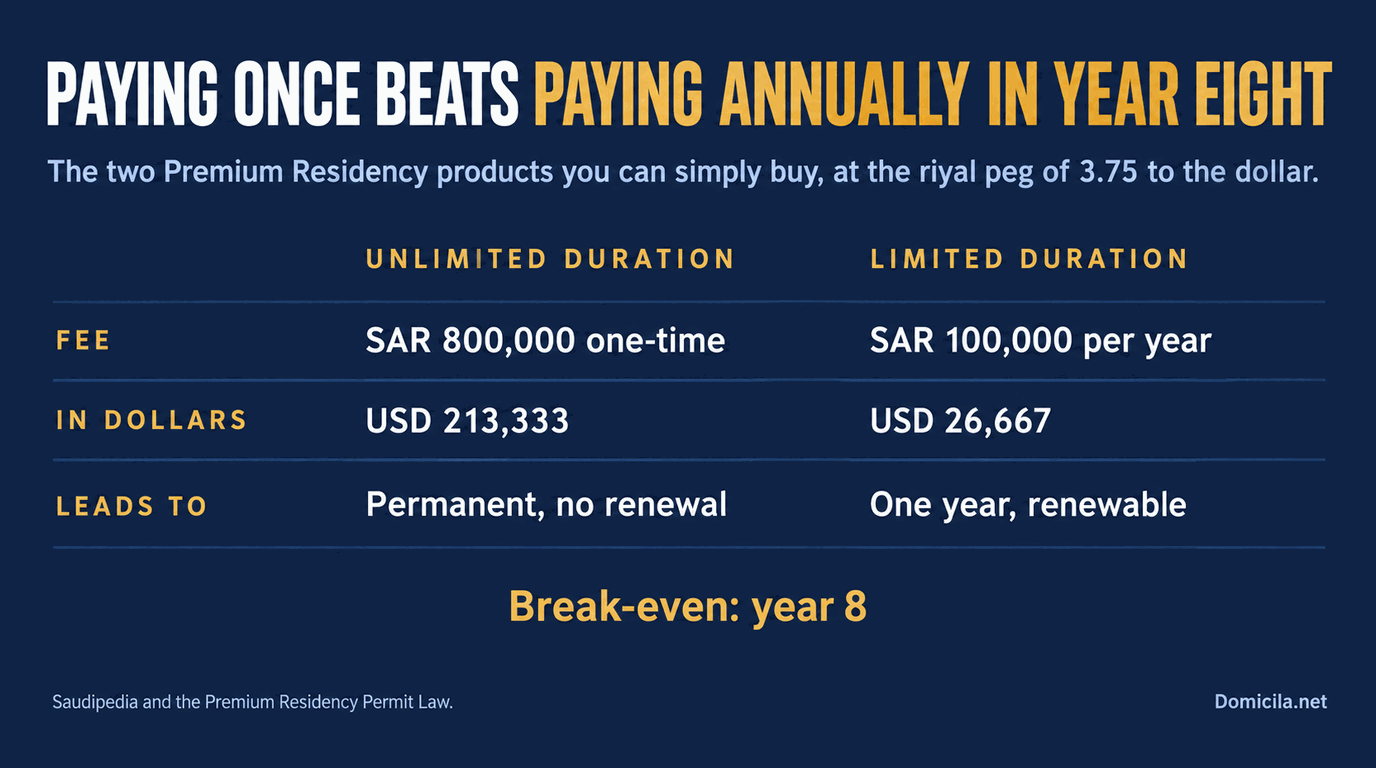
There is no Saudi golden visa. The product is Premium Residency, and the two you can buy outright cost SAR 800,000 once or SAR 100,000 a year. Those are USD 213,333 and USD 26,667 at the riyal's peg of 3.75 to the dollar. The Saudi Ministry of Media's own encyclopedia states both figures.
Paying once beats paying annually in year eight, and not before. SAR 800,000 divided by SAR 100,000 is eight years of fixed-term renewals. Below that the annual product is cheaper; above it the permanent one is, and the gap widens by SAR 100,000 every year you stay.
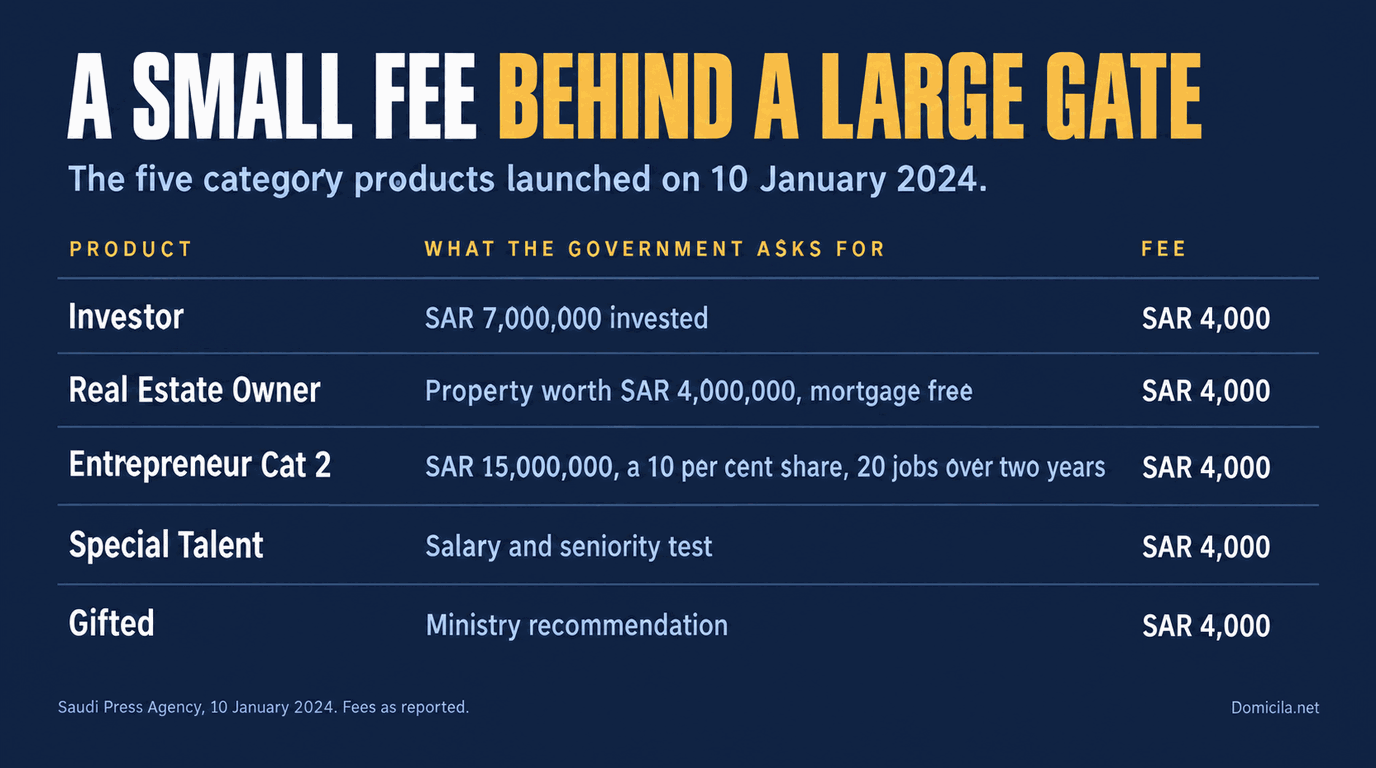
The five category products launched on 10 January 2024 are cheap to file and hard to qualify for. They carry a product fee advisers publish as SAR 4,000, but the gates are SAR 7,000,000 of investment, SAR 4,000,000 of mortgage-free property, or SAR 15,000,000 and twenty jobs. You are not buying a cheaper permit; you are proving you did not need to buy one.
Since June 2026 a Premium Residency holder needs a work permit to work. Deloitte's Middle East tax practice records the change and the SAR 100 Qiwa fee, and states that it ends the prior exemption. Every page still selling the old "work without a permit" benefit is out of date.
The law can cancel the permit you bought, and a fine is enough to trigger it. Article 9 lists conviction of a crime punishable by imprisonment of not less than 60 days or a fine of not less than SAR 100,000 among the grounds, and gives the Board a separate power to terminate where public interest warrants. Nothing in the law provides a refund.
On this page
Every figure below is read from the government that charges it: the Center's own English text of the Premium Residency Permit Law, the Saudi Press Agency for the five new products, Saudipedia for the two headline fees, and the Saudi Central Bank for the dollar peg. Where a number circulates widely but is not on an official page, the text says so. This site's renderer does not emit heading anchors, so the list below is a map rather than jump links.
- Saudi Arabia golden visa cost in 2026: the product is Premium Residency
- The two products you can simply buy
- The five category products: a small fee behind a large gate
- What changed in June 2026: the work-permit exemption is gone
- The costs the fee tables leave out
- What the law promises, and what it does not
- How Saudi compares with the UAE, Thailand and Europe
- Related guides on Domicila
Saudi Arabia golden visa cost in 2026: the product is Premium Residency
The Saudi Arabia golden visa cost question has a clean answer, but only once you drop the words "golden visa", which no Saudi government document uses. The scheme is the Premium Residency permit, created under a Royal Decree of May 2019 and run by a Premium Residency Center reporting to the Council of Economic and Development Affairs.
The structure matters for anyone comparing prices, because it is two-layer and almost every comparison page flattens it. Article 3 of the Law says the permit "shall be of two types" — permanent and fixed-term — and that those types "shall have products, to be proposed by the Board, along with their fees". So there are two types and seven products, and the fee belongs to the product.
Two products predate the rest and carry a published price you can simply pay. The other five were announced on 10 January 2024, when the Chairman of the Center's Board, Dr. Majid bin Abdullah Alkassabi, launched the Special Talent, Gifted, Investor, Entrepreneur and Real Estate Owner products. Here is the whole menu.
| Product | What the government asks for | Fee to the Center | Leads to |
|---|---|---|---|
| Unlimited duration | Nothing beyond the general conditions | SAR 800,000 one-time | Permanent, no renewal |
| Limited duration | Nothing beyond the general conditions | SAR 100,000 per year | One year, renewable |
| Special Talent | Salary and seniority test in executive, healthcare, science or research roles | SAR 4,000 (reported) | 5 years, then permanent after 30 months' residence |
| Gifted | Recommendation from the Ministry of Culture or Ministry of Sports | SAR 4,000 (reported) | 5 years, then permanent with an endorsement |
| Investor | SAR 7,000,000 invested in economic activities | SAR 4,000 (reported) | Permanent directly |
| Entrepreneur (Cat 1) | SAR 400,000 from an accredited investor, 20% of the startup | SAR 4,000 (reported) | 5 years, renewable once |
| Entrepreneur (Cat 2) | SAR 15,000,000, a 10% share, 10 jobs in year 1 and 10+ in year 2 | SAR 4,000 (reported) | Permanent directly |
| Real Estate Owner | Property worth SAR 4,000,000, free of existing and future mortgages | SAR 4,000 (reported) | Tied to continued ownership |
The riyal has been pegged at SAR 3.75 to the US dollar since 1986 — a rate the Saudi Central Bank has held throughout — so these convert cleanly and do not drift the way euro-denominated programmes do. One caveat: the SAR 4,000 product fee is published consistently by law firms and relocation advisers, but we could not confirm it on a page the Center serves to anything but a browser. Treat it as reported, not verified.
The two products you can simply buy
If you meet the general conditions and simply want the permit, there are two prices and the choice between them is pure arithmetic. The Ministry of Media's Saudipedia entry states both: an indefinite-duration permit "after settling a one-time payment of SAR800 thousand", and a one-year renewable permit "after fulfilling the statutory conditions and settling an annual payment of SAR100 thousand".
Eight years is the hinge. Pay annually and you are SAR 100,000 lighter each year with nothing accrued; pay once and you have bought the eighth year and every year after it for nothing. That is a long horizon for a decision most people make on a three-year view — which makes the annual product the right default for anyone whose plans could change, and a slow, expensive mistake for anyone who stays.
| Years held | Fixed-term at SAR 100,000/yr | Permanent at SAR 800,000 | Cheaper option | Difference |
|---|---|---|---|---|
| 1 | SAR 100,000 | SAR 800,000 | Fixed-term | SAR 700,000 |
| 3 | SAR 300,000 | SAR 800,000 | Fixed-term | SAR 500,000 |
| 5 | SAR 500,000 | SAR 800,000 | Fixed-term | SAR 300,000 |
| 8 | SAR 800,000 | SAR 800,000 | Level | — |
| 10 | SAR 1,000,000 | SAR 800,000 | Permanent | SAR 200,000 |
| 15 | SAR 1,500,000 | SAR 800,000 | Permanent | SAR 700,000 |
| 20 | SAR 2,000,000 | SAR 800,000 | Permanent | SAR 1,200,000 |
Two things would move that break-even. One adviser publishes a 2% annual reduction on the fixed-term fee for continuous renewal, which would push the crossover past year eight; we could not verify it officially, so the table assumes a flat SAR 100,000. The other is the time value of the SAR 800,000 paid on day one, which pushes the crossover later still. Neither changes the shape: short stay, pay annually; long stay, pay once.
Note what the permanent product is not. It is a permit of indefinite duration, not a nationality — Article 9 can cancel it, and the Law provides no refund if it is.
The five category products: a small fee behind a large gate
The five products launched in January 2024 are where the headline "Saudi golden visa from SAR 4,000" comes from, and it is true in the same way a cheap lottery ticket is cheap: the fee is small because the qualifying test does the work. Vialto Partners' alert sets out the thresholds.
Investor Residency asks for SAR 7,000,000 invested in economic activities and leads directly to permanent residency. Entrepreneur Residency splits in two: Category 1 wants SAR 400,000 raised from an accredited organisation plus a 20% stake, for a five-year permit renewable once; Category 2 wants SAR 15,000,000, a 10% stake, and ten jobs in the first year and ten more in the second, granting permanent residency directly. Real Estate Owner Residency requires property worth SAR 4,000,000 free of existing and future mortgages — a clause that quietly rules out financing — with validity tied to continued ownership.
The two talent routes trade money for a test of a different kind. Special Talent targets executives and specialists in healthcare, science and research; Gifted targets sport, culture and the arts and needs a recommendation from the Ministry of Culture or Ministry of Sports. Both run five years and convert to permanent only after you have actually lived there: 30 months within five consecutive or non-consecutive years.
| Category route | Qualifying threshold | USD at 3.75 | Initial term | Residence to convert |
|---|---|---|---|---|
| Investor | SAR 7,000,000 invested | ~USD 1,866,667 | Permanent immediately | None stated |
| Entrepreneur Cat 1 | SAR 400,000 raised + 20% stake | ~USD 106,667 | 5 years, renewable once | 30 months in 5 years |
| Entrepreneur Cat 2 | SAR 15,000,000 + 10% stake + 20 jobs | ~USD 4,000,000 | Permanent immediately | None stated |
| Real Estate Owner | SAR 4,000,000 unmortgaged property | ~USD 1,066,667 | Tied to ownership | None stated |
| Special Talent | Salary and seniority test | — | 5 years | 30 months in 5 years |
| Gifted | Ministry recommendation | — | 5 years | 30 months in 5 years + endorsement |
Salary figures circulate for the Special Talent route — commonly SAR 14,000 a month for researchers, SAR 35,000 for healthcare and scientific professionals and SAR 80,000 for senior executives — but they come from advisory summaries, and the launch announcement published no thresholds. If your plan depends on clearing one, get it in writing from the Center.
The practical read: if you qualify for a category product, take it — SAR 4,000 against SAR 800,000 is not a close call. If you do not, the two flat-fee products are the only doors.
What changed in June 2026: the work-permit exemption is gone
This is the one thing that moved in 2026, and the guides still ranking for this keyword have not caught up. Effective June 2026, a Premium Residency holder must obtain a work permit before starting any employment. Deloitte's Middle East practice records the change and is explicit that it "ends the prior exemption, that permitted PR holders to work in KSA without needing a work permit". The permit is obtained through the Qiwa platform at a cost of SAR 100.
SAR 100 is not the point. The point is that "work in the private sector without a separate permit" was a headline benefit used to justify a SAR 800,000 cheque, and it is no longer accurate. Vialto's regulatory update adds that contracts must still be registered through Qiwa and that holders remain subject to General Organization for Social Insurance registration.
| Benefit as marketed before 2026 | Position from June 2026 |
|---|---|
| Work in the private sector with no separate work permit | Work permit required via Qiwa, SAR 100 |
| No employer sponsorship needed | Unchanged — no Saudi sponsor is required for the permit itself |
| Move freely between employers | Unchanged, but each move runs through Qiwa |
| Contract registration | Qiwa registration required; GOSI registration applies |
One open question, and it matters if you already hold the permit: both Deloitte and Vialto note that the position on existing holders and any transitional arrangements has not been clarified. If you bought the unlimited-duration product before June 2026 partly for the work-permit exemption, you have a live question for the Center rather than an answer.
The costs the fee tables leave out
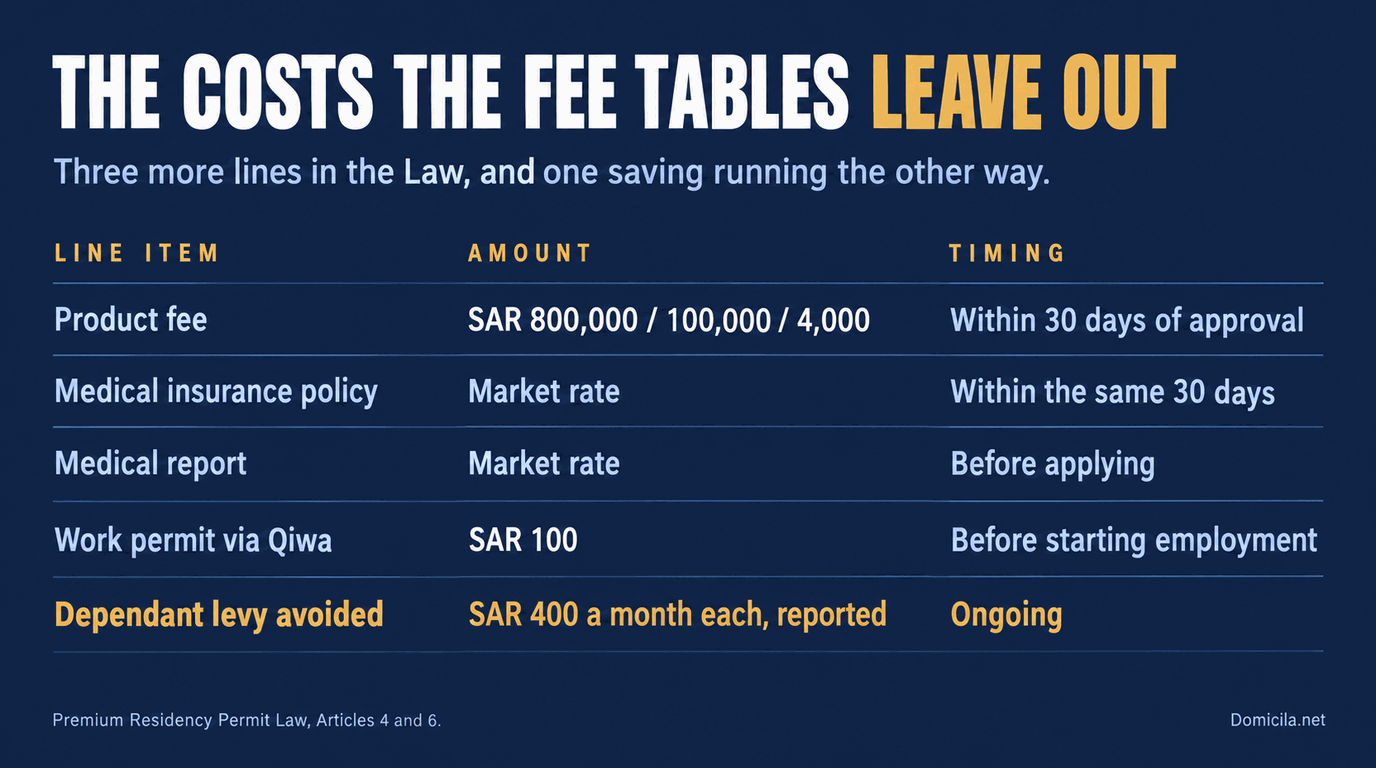
The product fee is the largest line but not the only one, and the Law names two more that no comparison page prices. Article 6 gives you 30 days from notification of approval to pay the fee and produce medical insurance compliant with the Cooperative Health Insurance Law, and says an application is "deemed canceled" if you miss it. Article 4 requires a medical report under six months old, proof of solvency and a clear criminal record.
Running the other way is a saving that may be larger than any of these. The Center's published benefits list includes exemption from the fees imposed on expatriates and their dependants. That levy was introduced by a Council of Ministers decision and phased in from SAR 100 per dependant per month in July 2017 to SAR 400 from July 2020, where commercial trackers still place it in 2026. We could not render an official Saudi page confirming the 2026 rate, so treat SAR 400 as best-reported.
| Line item | Amount | Timing | Note |
|---|---|---|---|
| Product fee | SAR 800,000 / 100,000 / 4,000 | Within 30 days of approval | Article 6; no refund provision in the Law |
| Medical insurance policy | Market rate | Within the same 30 days | Must meet the Cooperative Health Insurance Law |
| Medical report | Market rate | Before applying | Must be under 6 months old (Article 4) |
| Work permit via Qiwa | SAR 100 | Before starting employment | New from June 2026 |
| Dependant levy avoided | SAR 400/month each (reported) | Ongoing | SAR 14,400/yr for three dependants |
That last row is worth modelling. A spouse and two children, if the exemption applies as published, is three dependants at SAR 400 a month: SAR 14,400 a year, or SAR 144,000 over a decade — a meaningful fraction of the SAR 800,000 fee. One caution: Article 2(1)(g), granting the right to work in the private sector, carries the sentence "This privilege shall not prejudice the fees applicable to non-Saudis." The exemption's scope sits in the Implementing Regulations rather than the Law, so confirm it with the Center.
What the law promises, and what it does not
Article 2 is the part worth reading before you pay, because it is the only enforceable statement of what you are buying: residence with your family, visit visas for relatives, the right to recruit domestic workers, exit and re-entry without a visa, use of the lanes reserved for Saudi nationals at entry points, employment in the private sector excluding roles reserved for Saudis, and commercial activity under the Foreign Investment Law.
Property rights come with a geography. The Law permits ownership "in areas other than the cities of Mecca and Medina and border areas", and allows usufruct — a long lease in substance — in Mecca and Medina for not exceeding 99 years. If your plan involves the two holy cities, the answer is a usufruct deed, not a title.
Two silences are louder than the grants. The first: the Law sets out no route to Saudi citizenship. The text published by the Center shows Article 11(2) as "Repealed", and reporting around the 2024 amendments ties that repeal to removing a former bar on premium residents acquiring nationality. Removing a prohibition is not the same as creating a path. Anyone selling this as a passport route is ahead of the text.
The second: cancellation is broad and uncompensated. Article 9 lists conviction of a crime punishable by imprisonment of not less than 60 days or a fine of not less than SAR 100,000, a deportation order, false information, non-compliance, relinquishment, and death or loss of competence — then adds that none of this "shall prejudice the right of the Board to terminate the premium residency permit if public interest so warrants". A SAR 100,000 fine threshold is low against a SAR 800,000 permit, and the Law attaches no refund.
One detail that catches people out: the age requirement is gone. Article 4(1)(b) now reads "Repealed", removing the minimum age of 21 that older guides — including the Ministry of Media's own encyclopedia page — still list. When a government source and a government law disagree, the law is the one that was amended.
How Saudi compares with the UAE, Thailand and Europe
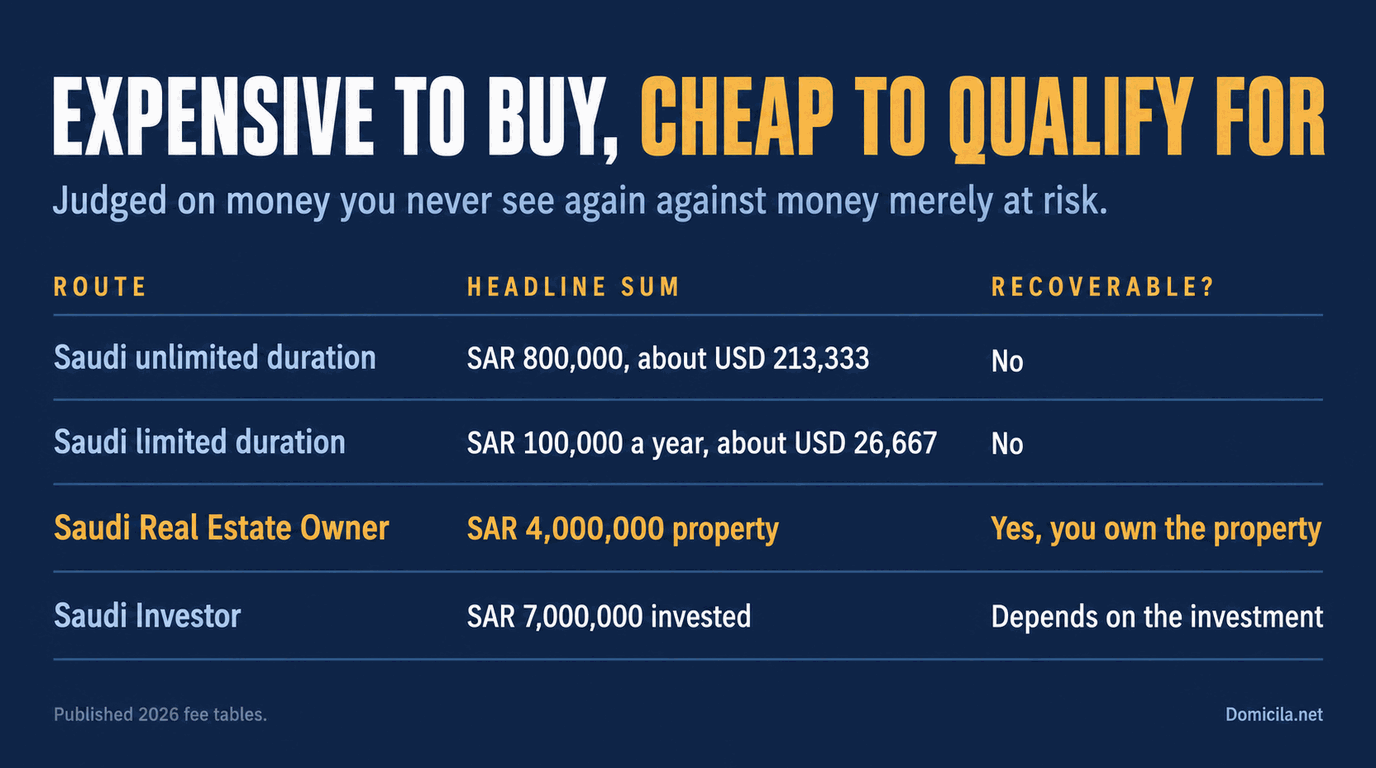
Against its neighbours, Saudi Premium Residency is expensive to buy and cheap to qualify for, which is close to the opposite of how the Gulf usually works. The UAE golden visa has no SAR-800,000-style product fee at all: you clear an investment or talent category and pay government charges measured in thousands, not hundreds of thousands. Saudi Arabia is the only Gulf programme where writing a cheque to the state, with no investment and no nomination, is itself a route.
Against Europe, the comparison flips. Europe's surviving routes mostly ask you to invest a qualifying sum you continue to own — which is why the golden visa cost comparison across Portugal, Greece, the UAE and Malta turns on recoverable versus non-recoverable money. The Saudi SAR 800,000 is wholly non-recoverable: judged on money you never see again, one of the most expensive permits in the world; judged on money at risk, one of the simplest, because there is no asset to value and nothing to sell on exit.
| Route | Headline sum | Recoverable? | What it leads to |
|---|---|---|---|
| Saudi unlimited duration | SAR 800,000 (~USD 213,333) | No | Indefinite permit; no citizenship route in the Law |
| Saudi limited duration | SAR 100,000/yr (~USD 26,667) | No | One year, renewable |
| Saudi Real Estate Owner | SAR 4,000,000 property | Yes — you own the property | Permit tied to continued ownership |
| Saudi Investor | SAR 7,000,000 invested | Depends on the investment | Permanent residency directly |
Where it genuinely competes is on tax and on speed of decision, neither of which this page prices. If that is the real question behind your search, settle where you will be tax resident first and choose the permit second — the list of golden visa countries still open in 2026 is long enough that the permit should follow the plan, not set it.
Related guides on Domicila
- UAE golden visa cost — the Gulf route most readers price against this one, category by category.
- Golden visa cost comparison — Portugal, Greece, the UAE and Malta from the published 2026 fee tables.
- Golden visa countries — every programme still open in 2026, and what each permit actually leads to.
- Cheapest golden visa — the low end of the market, ranked on money you never get back.
- Thailand Elite visa cost — the other major pay-a-fee-for-residence product, and a closer analogue to Saudi Arabia's flat-fee tiers than anything in Europe.
- Citizenship by investment vs golden visa — if the passport, not the permit, is the actual goal.
Common questions
How much does the Saudi Arabia golden visa cost in 2026?
Saudi Arabia does not run a golden visa; it runs Premium Residency. The two products you can buy outright cost SAR 800,000 once for the indefinite-duration permit, or SAR 100,000 per year for the one-year renewable permit — about USD 213,333 and USD 26,667 at the riyal's peg of 3.75. Five further category products, launched in January 2024, carry a much smaller fee that advisers report as SAR 4,000, but each requires an investment, property, salary or ministry-recommendation test.
Is the SAR 800,000 Premium Residency fee refundable?
The Premium Residency Permit Law contains no refund provision. Article 9 sets out the grounds for cancellation, including conviction of a crime punishable by imprisonment of not less than 60 days or a fine of not less than SAR 100,000, a deportation order, false information, and relinquishment. It also preserves the Board's right to terminate where public interest warrants. None attaches a repayment to the fee already paid.
Is it cheaper to pay SAR 800,000 once or SAR 100,000 a year?
On the published fees, eight years of annual renewals equals the one-time payment. Below eight years the fixed-term product is cheaper; beyond eight years the permanent one is, and the gap grows by SAR 100,000 each further year. Two factors push that crossover later: the time value of paying SAR 800,000 on day one rather than spreading it, and an annual fee reduction for continuous renewal that one adviser publishes at 2% per year, which we could not verify on an official page.
Does Saudi Premium Residency lead to citizenship?
The Premium Residency Permit Law does not provide a route to Saudi nationality. The English text published by the Premium Residency Center shows Article 11(2) as repealed, and reporting around the 2024 amendments connects that repeal to the removal of a former bar on premium residents acquiring citizenship. Removing a prohibition is not the same as creating a pathway, and no article of the Law sets out one. Treat any marketing that presents Premium Residency as a passport route as going beyond the published text.
Do Premium Residency holders need a work permit in Saudi Arabia?
Yes, since June 2026. Deloitte's Middle East practice records that holders must secure a work permit through the Qiwa platform before commencing any employment, at a cost of SAR 100, ending the prior exemption. Contracts must still be registered through Qiwa and holders remain subject to General Organization for Social Insurance registration. The position for people who already held the permit before June 2026, and whether transitional arrangements apply, had not been clarified at the time of writing.
Can a Premium Residency holder buy property in Mecca or Medina?
Not as an owner. Article 2 permits ownership of real estate for residential, commercial and industrial purposes in areas other than the cities of Mecca and Medina and border areas. For Mecca and Medina it instead allows usufruct for a period not exceeding 99 years, with the Ministry of Justice and the Ministry of Investment setting the procedure for a usufruct deed from a notary public, transferable under controls set by the Board.
What is the minimum property value for the Real Estate Owner residency?
SAR 4,000,000, roughly USD 1,066,667 at the dollar peg, and the property must be free of existing and future mortgages, which rules out financing. Validity is tied to continued ownership, so selling puts the residency at risk. Buying qualifying property does not grant residency automatically; it is a separate application that must also satisfy the general conditions in Article 4.
How long do you have to pay after approval?
Thirty days. Article 6 of the Law requires the applicant, within 30 days of being notified of the approval decision, to pay the fees approved by the Council of Economic and Development Affairs and to provide a medical insurance policy that complies with the Cooperative Health Insurance Law and its implementing regulations. If either requirement is not met within that period, the application is deemed cancelled, so the funds and the insurance should be arranged before approval arrives rather than after.
Official sources to verify
- Premium Residency Permit Law (English text)Premium Residency Center, Kingdom of Saudi Arabia
- Saudi Premium Residency Center Launches Five New ProductsSaudi Press Agency
- Premium Residency Center portalPremium Residency Center, Kingdom of Saudi Arabia
- Premium Residency VisaSaudipedia, Saudi Ministry of Media
- New Work Permit Requirement for Premium Residency Holders in Saudi ArabiaDeloitte Middle East
- Saudi Arabia: Five new Premium Residency categories announcedVialto Partners
- Saudi Arabia: Regulatory update - premium residency, instant visas and compliance enforcementVialto Partners
Compare golden visa advisors
Ask for a route-specific quote that separates investment amount, government fees, legal work, fund or property costs, and renewal obligations.
We may earn a referral fee if you choose an advisor through this site. We still aim to show cost ranges, caveats, and official source links plainly.