cayman islands residency by investment cost
Cayman Islands Residency Cost 2026: Fees Doubled
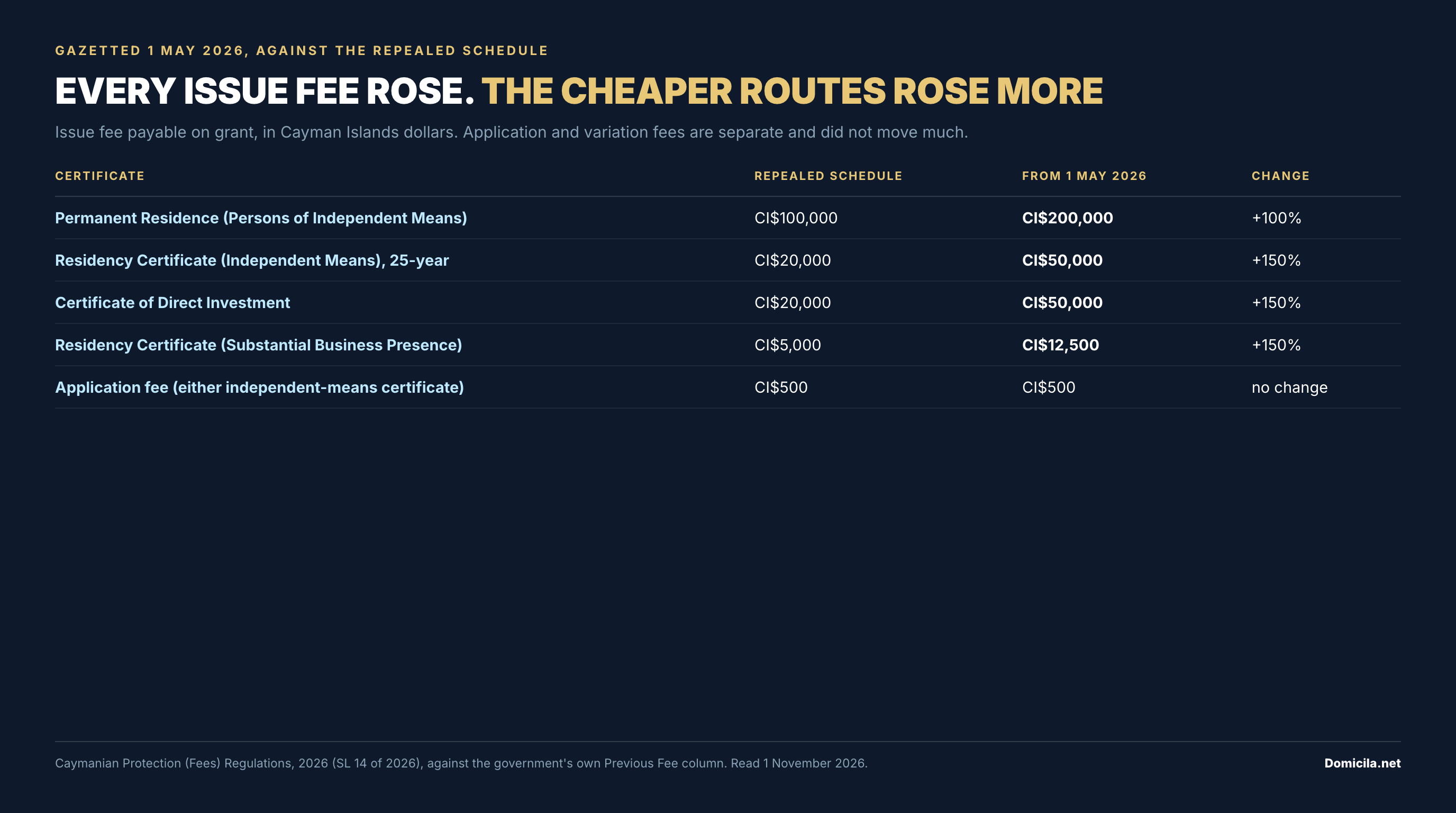
Every guide we could find to the Cayman Islands residency by investment cost still quotes fees that stopped applying on 1 May 2026. The issue fee for a Certificate of Permanent Residence for Persons of Independent Means is CI$200,000, not CI$100,000; the issue fee on the independent-means residency certificate is CI$50,000, not CI$20,000; and the fee for each dependant trebled to CI$3,000 a year. Four months before that, the stamp duty rate on a CI$2,000,000 purchase went from 7.5% to 10% — and CI$2,000,000 of developed real estate is exactly what the permanent residence route makes you buy. We priced every line from the gazetted Caymanian Protection (Fees) Regulations, 2026, the Caymanian Protection (Amendment) Regulations, 2026 and the Stamp Duty (Rates of Duty) (No. 2) Regulations, 2025, read on 1 November 2026, and converted at the Cayman Islands Monetary Authority rate of CI$1.00 to US$1.20.

Key takeaways
The permanent residence issue fee doubled to CI$200,000 on 1 May 2026. Item 8.8 of the Caymanian Protection (Fees) Regulations, 2026 sets it at CI$200,000 against CI$100,000 under the repealed schedule — about US$240,000, payable on grant and on top of the property.
The cheaper route went up by more, proportionally. The independent-means residency certificate went from CI$20,000 to CI$50,000, a 150% rise. The Certificate of Direct Investment made the same move, and the Substantial Business Presence certificate went from CI$5,000 to CI$12,500.
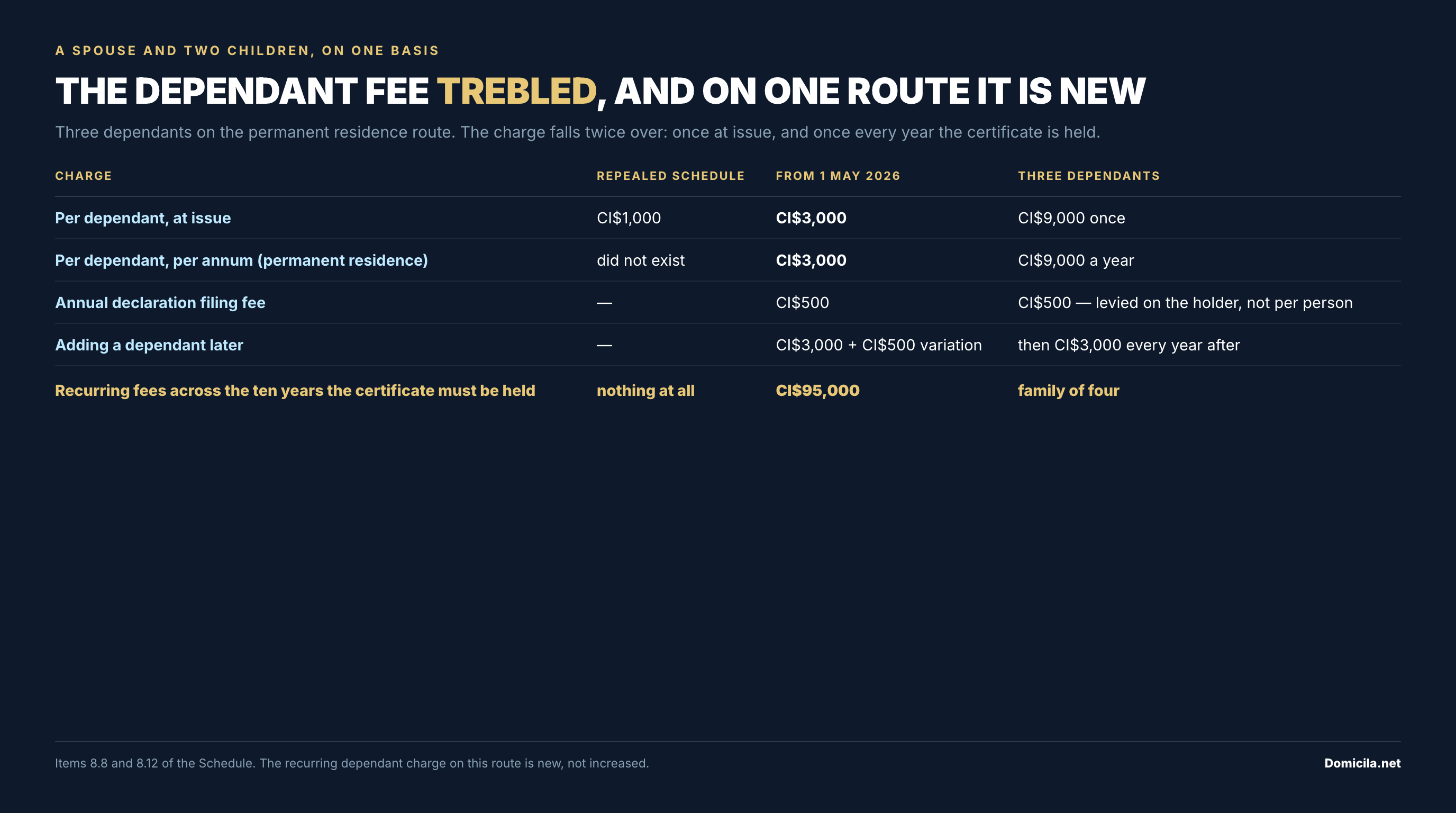
Dependants are the change nobody has published. The fee for each dependant went from CI$1,000 to CI$3,000 per dependant per annum, and on the permanent residence route an annual dependant fee did not exist before at all. A spouse and two children now cost CI$9,000 a year, every year, plus CI$9,000 once at issue.
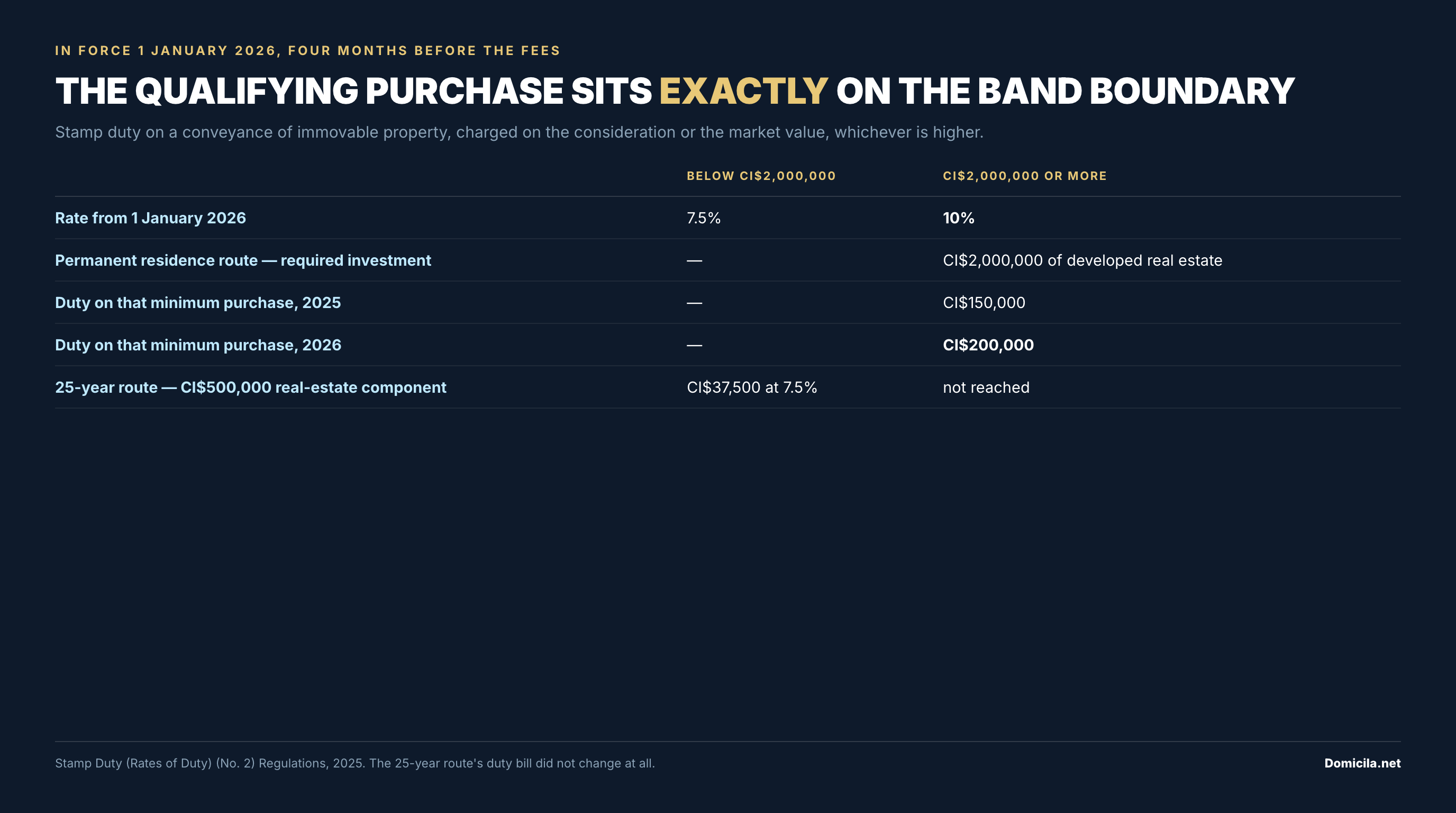
A second 2026 change lands on the same threshold. From 1 January 2026 stamp duty on a conveyance is 10% where the consideration is CI$2,000,000 or more and 7.5% below it. The permanent residence route requires CI$2,000,000 of developed real estate, so its minimum qualifying purchase attracts CI$200,000 of duty where it attracted CI$150,000 in 2025.
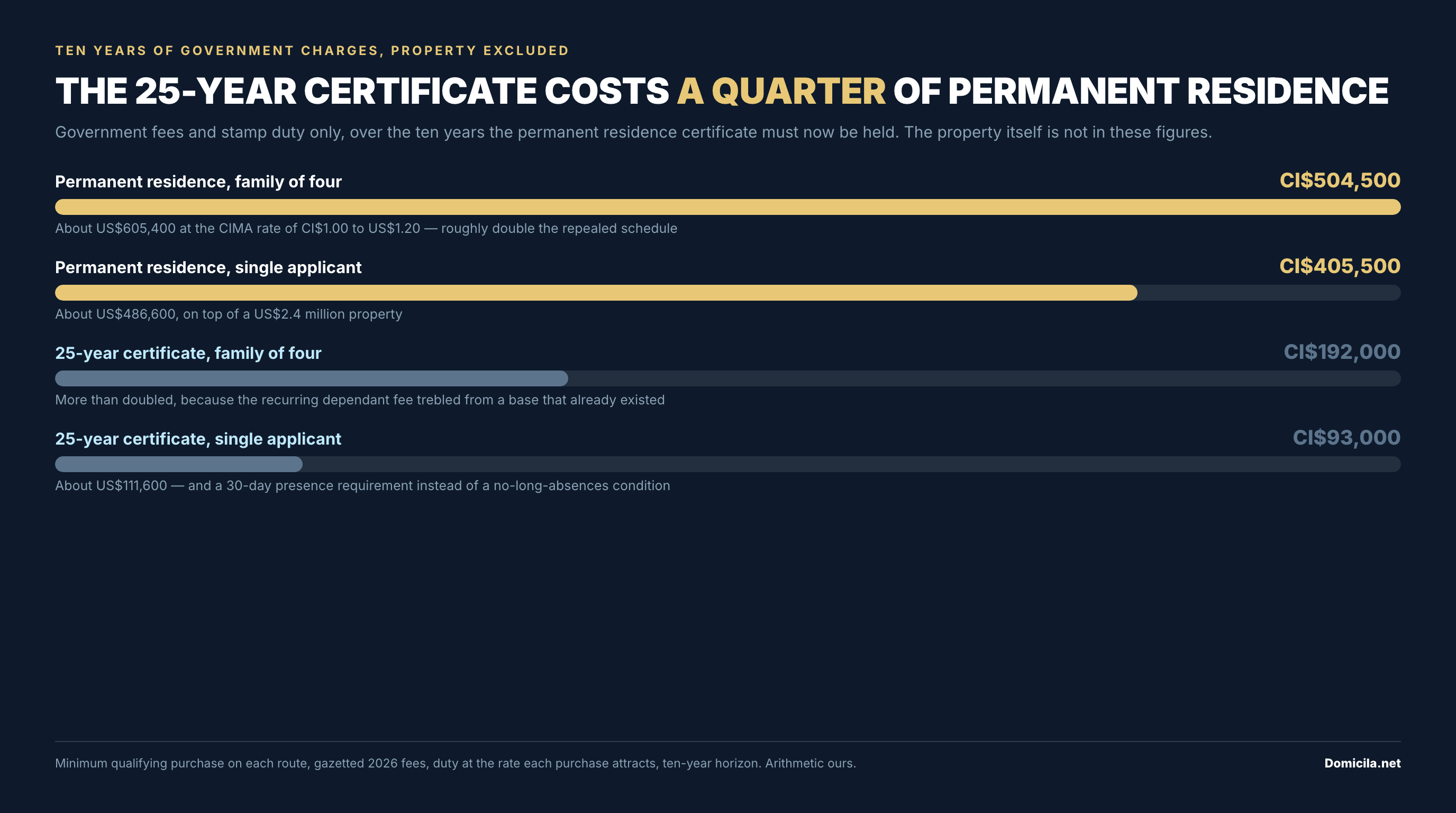
Permanent residence is no longer permanent at the first grant. The 2026 amendments make the holder keep the certificate for 10 years and re-apply in year nine for an indefinite certificate before naturalisation is even available. On the minimum purchase, ten years of that costs a single applicant about CI$405,500 in government fees and duty, and a family of four about CI$504,500 — roughly double the same ten years under the old schedule.
On this page
Every figure below is tied to the gazetted instrument that states it, because the problem here is not that the rules are obscure — they are published in full — but that the pages ranking for this subject all work from a fee schedule that no longer exists. The Caymanian Protection (Fees) Regulations, 2026 (SL 14 of 2026) is the source for every fee. The Caymanian Protection (Amendment) Regulations, 2026 (SL 16 of 2026) is the source for every investment, income, deposit and presence test, because those tests appear verbatim in the annual declarations each holder must now file. The Stamp Duty (Rates of Duty) (No. 2) Regulations, 2025 sets the duty rates, and the government's Immigration Reform Guidebook supplies the before-and-after columns. This site's renderer does not emit heading anchors, so the list below is a map rather than jump links.
- What the Cayman Islands residency by investment cost is after 1 May 2026
- The four routes and what each one makes you prove
- Permanent residence is no longer permanent at the first grant
- The CI$2,000,000 threshold now sits in the 10% stamp duty band
- Dependants are where the 2026 schedule bites
- Ten years of permanent residence, priced line by line
- The 25-year certificate priced the same way
- Two rows in the same schedule that do not agree
- What to confirm before you commit
What the Cayman Islands residency by investment cost is after 1 May 2026
Start with the date, because it is what every other page on this subject is missing. The Caymanian Protection Act (2022 Revision) and its supporting regulations took effect on 1 May 2026, and the fee schedule changed with them. The regulations themselves were gazetted on 16 April 2026 as a supplement to Legislation Gazette No. 23, and the fees instrument commences "immediately after the Immigration (Transition) (Amendment and Validation) Act, 2026 comes into force".
The government published the before-and-after itself, in a reform guidebook with a Previous Fee column beside a New Fee column. These are the rows that matter if you are buying residency:
| Fee (CI$) | Before 1 May 2026 | From 1 May 2026 |
|---|---|---|
| Residency Certificate, Persons of Independent Means — issue | 20,000 | 50,000 |
| Certificate of Permanent Residence, Persons of Independent Means — issue | 100,000 | 200,000 |
| Certificate of Direct Investment — issue | 20,000 | 50,000 |
| Residency Certificate (Substantial Business Presence) — issue | 5,000 | 12,500 |
| Each dependant, at issue, all four routes | 1,000 | 3,000 per dependant |
| Each dependant, recurring, all four routes | 1,000 a year | 3,000 per dependant per year |
| Annual declaration filing fee, all four routes | none | 500 |
| Appeal to the Immigration Appeals Tribunal | 1,000 | 3,000 |
| Re-entry permit or stamp | 20 | 50 |
Application fees did not move much and are the smallest line either way: CI$500 to apply for either independent-means certificate, CI$1,000 for a Certificate of Direct Investment or a Residency Certificate (Substantial Business Presence), and CI$500 to vary any of them.
The scale of this was set out in parliament more than a year ago. The November 2025 statement of new revenue measures put the immigration package at an extra CI$15.4 million in 2026 and CI$17.1 million in 2027, and named the three issue-fee changes above individually. Nothing about it was quiet; it simply has not reached the pages people read. If you want the wider picture of how often published thresholds in this market go stale, our golden visa cost comparison sets every programme's figures beside the date they were read.
The four routes and what each one makes you prove
There are four investment-linked certificates, and the useful thing about the 2026 amendment regulations is that they spell out each one's continuing conditions word for word, because every holder now has to attest to them annually. That turns a marketing claim into a test you can read:
| Route | Minimum investment | Income or deposit test | Days in the Islands |
|---|---|---|---|
| Residency Certificate, Persons of Independent Means — Grand Cayman | CI$1,000,000, of which at least CI$500,000 in developed real estate in Grand Cayman | CI$120,000 a year of continuous income, or at least CI$400,000 held with a locally licensed, CIMA-regulated institution | at least 30 days a year |
| Residency Certificate, Persons of Independent Means — Cayman Brac or Little Cayman | at least CI$500,000, of which at least CI$250,000 in developed real estate there | CI$75,000 a year, or the same CI$400,000 deposit | at least 30 days a year |
| Certificate of Permanent Residence, Persons of Independent Means | CI$2,000,000 in developed real estate, paid up at the time of applying | none stated | no absence of a year or more at a stretch |
| Certificate of Direct Investment | CI$1,000,000 in a licensed employment-generating business | none stated | at least 90 days a year |
| Residency Certificate (Substantial Business Presence) | at least 10% of the shares in an approved category of business, or senior management in one | none stated | at least 90 days a year |
Three details in that table are worth more than the headline sums. The income test on the 25-year route is an either/or, not a both: CI$400,000 sitting with a Class A licensed bank or a securities business satisfies it without any income at all. The Cayman Brac and Little Cayman tier halves every figure, and it is the cheapest formal entry to the islands by a wide margin. And the presence requirement splits the routes neatly — 30 days a year for the independent-means certificate, 90 days for either business route.
The Substantial Business Presence route carries conditions that are not about money at all. The business has to have established a physical presence through the purchase or lease of commercial real estate, and it has to employ at least four full-time employees who are legally and ordinarily resident in the Islands for at least nine months of the preceding calendar year. That is a payroll commitment rather than an investment, and it is why the route's CI$12,500 issue fee is the lowest of the four.
The Certificate of Direct Investment adds a reporting obligation most comparisons omit: audited financial statements on the holder's investments, filed with the Director of WORC at the required intervals. Every route also requires the holder — and on the permanent residence route the spouse and dependent children too — to hold and keep adequate health insurance. Our guide to golden visa health insurance requirements covers what that obligation means in practice across this market.
Permanent residence is no longer permanent at the first grant
This is the single change with the biggest effect on the economics, and we could not find it mentioned on any page competing for this topic. Under the 2026 amendments to section 42, a Certificate of Permanent Residence for Persons of Independent Means has to be held for 10 years, with a re-application in year nine for an indefinite certificate. Only after the indefinite certificate is in hand does naturalisation become an option.
The government's summary of the amendments puts it in one sentence: the Act "has been amended to require persons to hold this facility for 10 years, re-applying at year 9 for an indefinite Certificate." The law-firm briefings still ranking for this topic describe the certificate as having no expiry.
A second change to the same section tightens the money. The applicant must now prove, at the time of the application, that the investment in developed real estate has already been made and that its paid-up value meets the prescribed sum. An agreement to purchase, a deposit, or a mortgage-financed completion scheduled for later does not get an application through the door.
Two things follow for anyone budgeting. There is now a defined ten-year window over which the recurring fees have to be paid before the status becomes indefinite, which is why every table below is priced over ten years. And the route has acquired a continuing residence condition: the annual declaration requires the holder to confirm they have not been ordinarily resident outside the Cayman Islands continuously for a year or more. A certificate you buy and leave alone can lapse on absence, which is not how permanent residence is usually sold.
Existing holders and existing applicants are protected. The Act's transitional rules cover anyone who had already applied for, or already held, a Certificate of Permanent Residence for Persons of Independent Means before 1 May 2026, along with their dependants — the changes simply do not apply to them. If you applied on 30 April 2026 you are on the old terms; if you applied on 2 May you are not.
The CI$2,000,000 threshold now sits in the 10% stamp duty band
Four months before the immigration fees changed, the duty on the purchase did. The Stamp Duty (Rates of Duty) (No. 2) Regulations, 2025 came into force on 1 January 2026 and replaced the flat rate on a conveyance or transfer of immovable property with a two-step scale:
| Consideration for the conveyance | Duty rate | Duty on the minimum qualifying purchase |
|---|---|---|
| Less than CI$2,000,000 | 7.5% | CI$37,500 on the CI$500,000 of developed real estate the 25-year route requires |
| CI$2,000,000 or more | 10% | CI$200,000 on the CI$2,000,000 the permanent residence route requires |
| Same purchases under the 2025 rate | 7.5% throughout | CI$37,500 and CI$150,000 |
The overlap is exact and does not look like a coincidence: the permanent residence route's qualifying investment is CI$2,000,000 of developed real estate, and CI$2,000,000 is precisely where the new 10% band starts. Buy the minimum and you are in the higher band by definition. The November 2025 revenue statement expected the stamp duty measure to raise an extra CI$11.7 million in 2026.
Two mechanics matter when you price it. Duty is charged on the consideration or the market value, whichever is higher, so a purchase documented at CI$1,950,000 against a higher valuation does not reliably stay in the 7.5% band — and would not meet the CI$2,000,000 investment test anyway. And the reduced and nil bands published by the Lands and Survey Department, which run from CI$300,000 to CI$700,000, are written for transfers to Caymanian purchasers; they are not available on these routes.
The 25-year route escapes the higher band, because its real-estate component is CI$500,000 and its total investment is CI$1,000,000. That is the quiet argument in favour of the cheaper certificate in 2026: its duty bill did not change at all, while the permanent residence route's rose by CI$50,000 before a single immigration fee was counted.
Dependants are where the 2026 schedule bites
Every page we checked states the dependant fee as CI$1,000. It is CI$3,000, it is charged twice over — once at issue and once a year — and on the permanent residence route the recurring charge is new rather than increased. Here is the whole dependant picture on one basis, a spouse and two children:
| Dependant charge (CI$) | Before 1 May 2026 | From 1 May 2026 | Spouse + 2 children, 2026 |
|---|---|---|---|
| Issue fee, each dependant added | 1,000 | 3,000 | 9,000 once |
| Recurring fee, each dependant, per year — 25-year route | 1,000 a year | 3,000 a year | 9,000 a year |
| Recurring fee, each dependant, per year — permanent residence | none | 3,000 a year | 9,000 a year |
| Annual declaration filing, holder level, covers dependants | none | 500 a year | 500 a year |
| Ten years of recurring charges | 30,000 (25-year route) / nil (PR) | — | 95,000 |
The arithmetic is worth stating plainly, because a per-dependant-per-year fee compounds in a way an issue fee does not. A family of four on the permanent residence route pays CI$95,000 in recurring government fees across the ten years the certificate must now be held, against nothing at all under the repealed schedule. On the 25-year certificate the same family pays CI$95,000 over ten years where it would have paid CI$30,000.
The filing fee is the one piece of good news in the table: it is levied on the holder, not per person. Item 8.12 charges CI$500 for "the filing of an annual declaration on behalf of the holder and the holder's dependants", so a family of five files once and pays once. Item 8.5 words it the same way for the 25-year certificate.
There is a trap in how dependants get added. The issue fee of CI$3,000 per dependant applies whether the dependant "has been included in the original application for, or has subsequently been added to" the certificate, so adding a child later costs the same CI$3,000 plus a CI$500 variation fee — and then CI$3,000 every year after. A family that grows after the grant is not grandfathered into anything.
Ten years of permanent residence, priced line by line
This is the total nobody publishes. The basis is narrow and stated in full: the minimum qualifying purchase of CI$2,000,000 in developed real estate, the gazetted 2026 fees, duty at the 10% rate the purchase attracts, and the ten-year holding period the amendments now impose, before the year-nine re-application. The property itself is not in the table — only what the government takes.
| Line (CI$) | Single applicant | Family of four |
|---|---|---|
| Application fee | 500 | 500 |
| Issue fee | 200,000 | 200,000 |
| Dependants at issue, 3 × 3,000 | — | 9,000 |
| Stamp duty, 10% of CI$2,000,000 | 200,000 | 200,000 |
| Dependant fees, 10 years | — | 90,000 |
| Annual declaration filing, 10 years | 5,000 | 5,000 |
| Total government cost, 10 years | 405,500 | 504,500 |
| The same lines on the repealed schedule | 250,500 | 253,500 |
| Increase | +155,000 (+62%) | +251,000 (+99%) |
At the CIMA rate of CI$1.00 to US$1.20 those totals are about US$486,600 and US$605,400 — on top of a US$2.4 million property. The family-of-four column has essentially doubled, and almost none of that comes from the headline issue fee: CI$99,000 of the CI$251,000 increase is dependant charges that either trebled or did not exist.
One caveat on the comparison, because the basis is not symmetrical. The repealed column prices the same ten years under the old fees and the old 7.5% duty rate, but the ten-year holding period itself is a 2026 invention — before the amendments there was no term to price. We have held the horizon constant so the fee change is readable; read the right-hand columns as what ten years now costs, not as a rule that existed in 2025.
Compared with the rest of this market the sum is at the top end. Our cheapest golden visa guide ranks residency programmes on money you never get back, and on that measure a CI$200,000 issue fee plus CI$200,000 of duty puts Cayman permanent residence in a different bracket from the deposit-based programmes, where most of the entry sum stays yours. The Caribbean citizenship by investment comparison covers the neighbouring programmes that sell a passport rather than a residence permit, which is a different product at a lower price.
The 25-year certificate priced the same way
The independent-means residency certificate is the route most applicants should be pricing, and in 2026 it is the one that got comparatively cheaper. Same basis: the Grand Cayman minimum of CI$1,000,000 invested with at least CI$500,000 of it in developed real estate, duty at 7.5% on that CI$500,000, gazetted 2026 fees, and a ten-year horizon so the figures sit beside the table above.
| Line (CI$) | Single applicant | Family of four |
|---|---|---|
| Application fee | 500 | 500 |
| Issue fee | 50,000 | 50,000 |
| Dependants at issue, 3 × 3,000 | — | 9,000 |
| Stamp duty, 7.5% of CI$500,000 | 37,500 | 37,500 |
| Cost at grant | 88,000 | 97,000 |
| Recurring, per year | 500 | 9,500 |
| Total over 10 years | 93,000 | 192,000 |
| The same lines on the repealed schedule | 58,000 | 91,000 |
| Increase over 10 years | +35,000 (+60%) | +101,000 (+111%) |
So a single applicant reaches ten years of the 25-year certificate for about CI$93,000, roughly US$111,600, against CI$405,500 on the permanent residence route — a quarter of the cost, for a certificate with a 30-day presence requirement instead of a no-long-absences condition. The gap is the clearest practical finding in this guide.
The family comparison runs the other way and is worth sitting with. On the 25-year route a family of four pays CI$192,000 over ten years against CI$504,500 on the permanent residence route, so the cheaper certificate is still far cheaper — but its ten-year cost more than doubled, because the recurring dependant fee trebled from a base that already existed. The single applicant's rose 60%; the family's rose 111%. Dependants, not the headline fee, are what moved.
We have deliberately not priced the certificate over its full term. Practitioner briefings describe both the independent-means and the business-presence certificates as valid for 25 years and renewable, and that is probably right, but we could not confirm a term in either of the 2026 gazetted instruments or in the government's guidebook, so there is no 25-year column here. On a 25-year horizon the recurring charges would dominate everything else in the table — CI$225,000 of dependant fees alone for a family of four — which is exactly why we are not going to assert a term we cannot cite.
Two rows in the same schedule that do not agree
Three loose ends in the official documents are worth flagging rather than smoothing over, because each one is a question to put to WORC before you budget.
The Certificate of Direct Investment has two different dependant fees. Item 9.4 of the Schedule sets a dependant fee of "3,000 per dependant per annum". Item 9.6, four lines later in the same Part, says the holder "is required to pay an annual fee of $1,000 per dependant and an annual fee equivalent to that payable by a person authorised by a work permit under section 63 in the same occupation". CI$3,000 and CI$1,000 are both stated, both annual, both per dependant. We cannot reconcile them and have used CI$3,000 wherever a figure was needed, because it is the row that matches the other three routes.
Item 9.6 also attaches a work-permit-equivalent annual fee to the Certificate of Direct Investment, as do the notes on the Substantial Business Presence certificate and on a permanent residence certificate varied to allow the right to work. That fee is set by occupation in the Schedule of Annual Work Permit Fees, so it is not a single number and no figure for it appears in our tables. If your route lets you work, it needs an occupation-specific quote.
The November 2025 revenue statement and the gazetted schedule do not match on the filing fees. The statement told parliament that annual declaration filing fees for permanent residency holders would rise "from $100 to $500". In the final schedule the independent-means categories show that fee as newly added at CI$500, the eight-year permanent residence route shows a new CI$250 fee, and CI$100 appears against the right to be Caymanian and the spouse-of-a-Caymanian certificate. A proposal and a gazetted instrument are different documents; where they differ, the instrument is the one that charges you.
One smaller oddity: the Schedule prices a duplicate Residency Certificate for Retirees at CI$100 but contains no Part setting an application or issue fee for that certificate at all.
What to confirm before you commit
Four checks, in the order the money leaves your account. First, the route. The permanent residence certificate costs a single applicant about four times what the 25-year certificate costs over ten years, and buys a stricter absence rule rather than a lighter one. Price both before assuming the expensive one is the better product; the thing it buys that the other does not is a path to an indefinite certificate and then naturalisation.
Second, the duty. Get the rate confirmed against the actual instrument by the Lands and Survey valuation office, not from a rate card. Duty is charged on consideration or market value, whichever is higher, the band boundary is CI$2,000,000, and linked transactions are assessed on the total. A CI$50,000 difference in rate on a minimum purchase is larger than most of the immigration fees.
Third, the dependants. Count them, then multiply by CI$3,000 and by the number of years you intend to hold the certificate, because that product is usually larger than the issue fee and nobody quotes it. Ask WORC in writing which figure applies on a Certificate of Direct Investment, given items 9.4 and 9.6, and whether the work-permit-equivalent annual fee applies to your intended occupation.
Fourth, the timing. If an application was already lodged before 1 May 2026, the transitional rules protect it and the old terms apply once it is granted. If it was not, nothing from the pre-reform schedule is available to you, including the fee figures on the pages currently ranking for this subject.
Every figure here is the gazetted number, read on 1 November 2026 from the instruments linked below; the arithmetic is ours. Thresholds in this sector move without much notice — the three instruments behind this guide took effect within five months of each other — so verify each line against its source and treat the totals as planning arithmetic rather than a quote. None of this is legal, immigration or tax advice, and none of these routes is a citizenship programme: the certificates grant residence, and naturalisation sits at the end of a long process. On that distinction, see citizenship by investment vs golden visa.
Related guides on Domicila
- Cheapest golden visa — this market's low end, ranked on money you never get back rather than on the sum you have to show.
- Golden visa cost comparison — every threshold in the currency it is actually set in, with the date each was read.
- Golden visa countries — which jurisdictions run a residency-by-investment route under any name, and which only appear to.
- Caribbean citizenship by investment comparison — the neighbouring programmes that sell a passport instead of a residence permit.
- Golden visa health insurance requirements — the cover obligation every Cayman certificate holder has to attest to annually.
- Citizenship by investment vs golden visa — why a residence certificate and a passport are priced so differently.
Common questions
How much does Cayman Islands residency by investment cost in 2026?
On the permanent residence route it is a CI$500 application fee, a CI$200,000 issue fee and stamp duty of 10% on the CI$2,000,000 of developed real estate you must already own, so about CI$400,500 in government charges at the grant alone. On the 25-year independent-means certificate it is CI$500, a CI$50,000 issue fee and 7.5% duty on a CI$500,000 unit, about CI$88,000. Both figures exclude the property and both come from the Caymanian Protection (Fees) Regulations, 2026.
What changed on 1 May 2026?
The Caymanian Protection Act (2022 Revision) and its supporting regulations took effect, bringing a new fee schedule. The issue fee for a Certificate of Permanent Residence for Persons of Independent Means went from CI$100,000 to CI$200,000, the independent-means residency certificate and the Certificate of Direct Investment both went from CI$20,000 to CI$50,000, the Substantial Business Presence certificate went from CI$5,000 to CI$12,500, the per-dependant fee trebled to CI$3,000, and a CI$500 annual declaration filing fee was added.
How much do I have to invest for Cayman Islands permanent residence?
CI$2,000,000 in developed real estate in the Cayman Islands, and under the 2026 amendments the paid-up value must already meet that figure at the time you apply. That is about US$2.4 million at the CI$1.00 to US$1.20 rate. The cheaper 25-year certificate requires CI$1,000,000 invested with at least CI$500,000 of it in developed real estate in Grand Cayman, or CI$500,000 with at least CI$250,000 in real estate on Cayman Brac or Little Cayman.
Is Cayman permanent residence still permanent?
Not at the first grant. The 2026 amendments to section 42 require the holder to keep the certificate for 10 years and re-apply in year nine for an indefinite certificate, after which naturalisation becomes an option. The annual declaration also requires the holder to confirm they have not been ordinarily resident outside the Islands continuously for a year or more. Anyone who applied or already held the certificate before 1 May 2026 is covered by the Act's transitional rules.
How many days a year do I have to spend in the Cayman Islands?
It depends on the certificate. The Residency Certificate for Persons of Independent Means requires at least 30 days in aggregate in the preceding calendar year. The Certificate of Direct Investment and the Residency Certificate (Substantial Business Presence) both require at least 90 days. The Certificate of Permanent Residence for Persons of Independent Means states no day count but requires that you have not been ordinarily resident outside the Islands continuously for a year or more.
What do dependants cost on a Cayman residency certificate?
CI$3,000 for each dependant included at issue or added later, and then CI$3,000 per dependant per annum. Both figures were CI$1,000 before 1 May 2026, and on the permanent residence route the recurring annual fee did not exist at all. A spouse and two children therefore cost CI$9,000 once and CI$9,000 a year. The CI$500 annual declaration filing fee is charged at holder level and covers the dependants.
Why did the stamp duty on a Cayman property purchase change?
The Stamp Duty (Rates of Duty) (No. 2) Regulations, 2025 came into force on 1 January 2026 and set duty at 7.5% where the consideration is under CI$2,000,000 and 10% where it is CI$2,000,000 or more. Because the permanent residence route requires CI$2,000,000 of developed real estate, its minimum qualifying purchase sits in the higher band, so duty on it is CI$200,000 rather than the CI$150,000 the old flat rate produced.
Does a Cayman residency certificate lead to a passport?
Only at the end of a long route and not automatically. On the permanent residence route the holder must keep the certificate for 10 years, apply in year nine for an indefinite certificate, and may then apply for naturalisation if eligible. These certificates grant residence, not citizenship, and nothing in the fee schedule or the regulations promises a nationality outcome. Confirm your own position with a qualified Cayman Islands attorney.
Official sources to verify
- Caymanian Protection (Fees) Regulations, 2026 (SL 14 of 2026)Cayman Islands Government
- Caymanian Protection (Amendment) Regulations, 2026 (SL 16 of 2026)Cayman Islands Government
- Immigration ReformCayman Islands Ministry of Commerce and Economic Investment
- Immigration Reform Guidebook, last updated 18 August 2026Cayman Islands Government
- Summary of Amendments: Immigration (Transition) (Amendment and Validation) ActCayman Islands Government
- Statement: Details of New Revenue Measures for 2026 and 2027, 14 November 2025Parliament of the Cayman Islands
- Stamp Duty (Rates of Duty) (No. 2) Regulations, 2025Parliament of the Cayman Islands
- Stamp Duty: Transfer and Sale of LandCayman Islands Lands and Survey Department
- CIMA Fact Sheet (CI$1.00 = US$1.20)Cayman Islands Monetary Authority
Compare golden visa advisors
Ask for a route-specific quote that separates investment amount, government fees, legal work, fund or property costs, and renewal obligations.
We may earn a referral fee if you choose an advisor through this site. We still aim to show cost ranges, caveats, and official source links plainly.