citizenship by investment processing time
Citizenship by Investment Processing Time 2026
Ask five agents how long citizenship by investment takes and you get five numbers, none of them sourced. The gap between the marketing answer and the real one is expensive: an approval that slips from four months to nine is another year in the tax position you were trying to leave, and a second round of police certificates that expire while you wait. This page collects what the units themselves publish about citizenship by investment processing time in 2026 — Grenada says three to four months, St Kitts and Nevis says three to six, and the other three Eastern Caribbean programmes publish nothing at all — then sets those figures against the reforms the OECS Heads of Government announced on 23 September 2025, which added biometric capture, a regional regulator and a US$200,000 floor to every file. We read each unit's own pages rather than an advisory brochure, and we mark clearly which numbers are official and which are planning estimates.

Citizenship by investment processing time in 2026 at a glance
Key takeaways
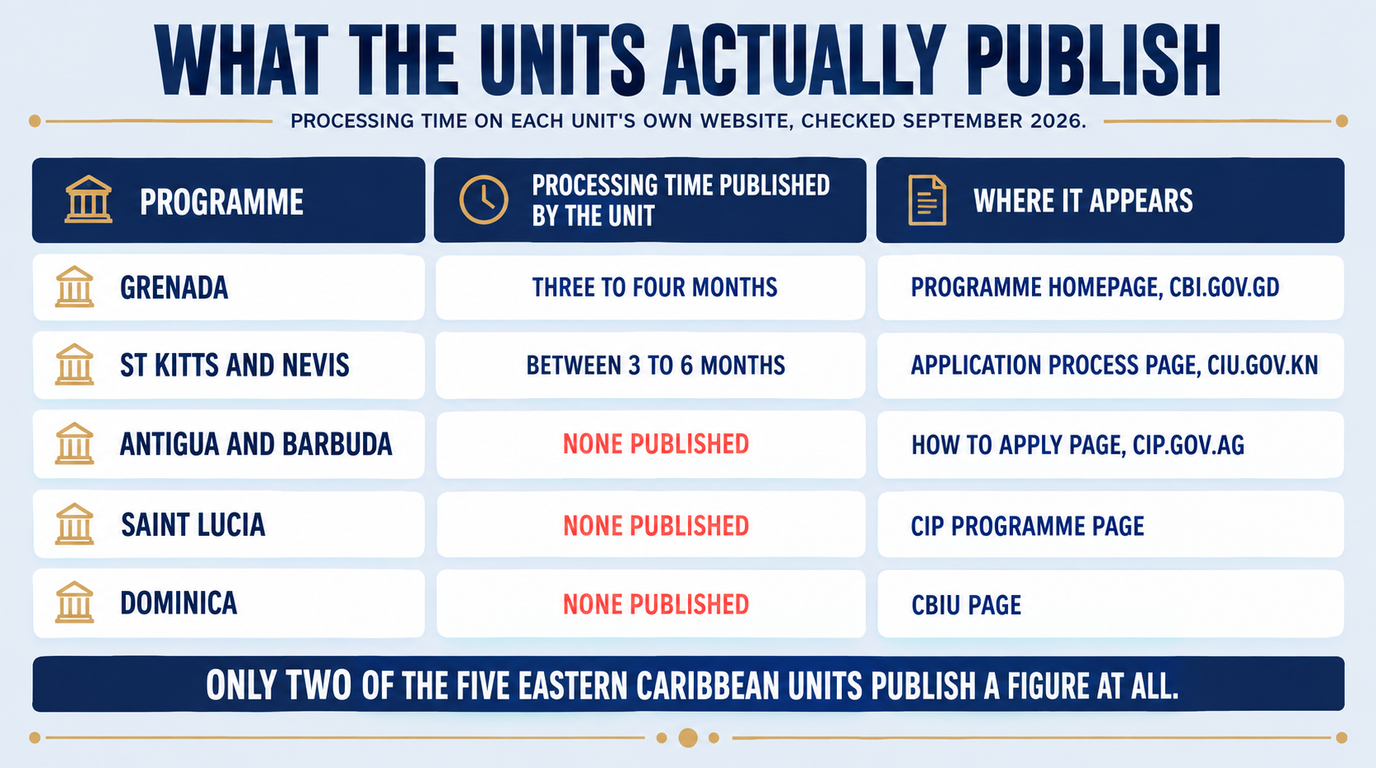
- Only two of the five Eastern Caribbean units publish a processing time at all. Grenada states three to four months on its own programme homepage, and the St Kitts and Nevis unit states three to six months on its application-process page. Antigua and Barbuda, Saint Lucia and Dominica publish no figure we could retrieve.
- Every published figure describes the unit's own review. The clock starts when a licensed agent lodges a complete file, not when you first speak to an advisor, and it stops at approval rather than at a passport in your hand.
- The OECS agreement announced on 23 September 2025 added mandatory biometric collection at the interview, a regional regulator, stronger residency and genuine-link requirements, and a region-wide US$200,000 minimum investment threshold. Each of those is a step, and steps take weeks.
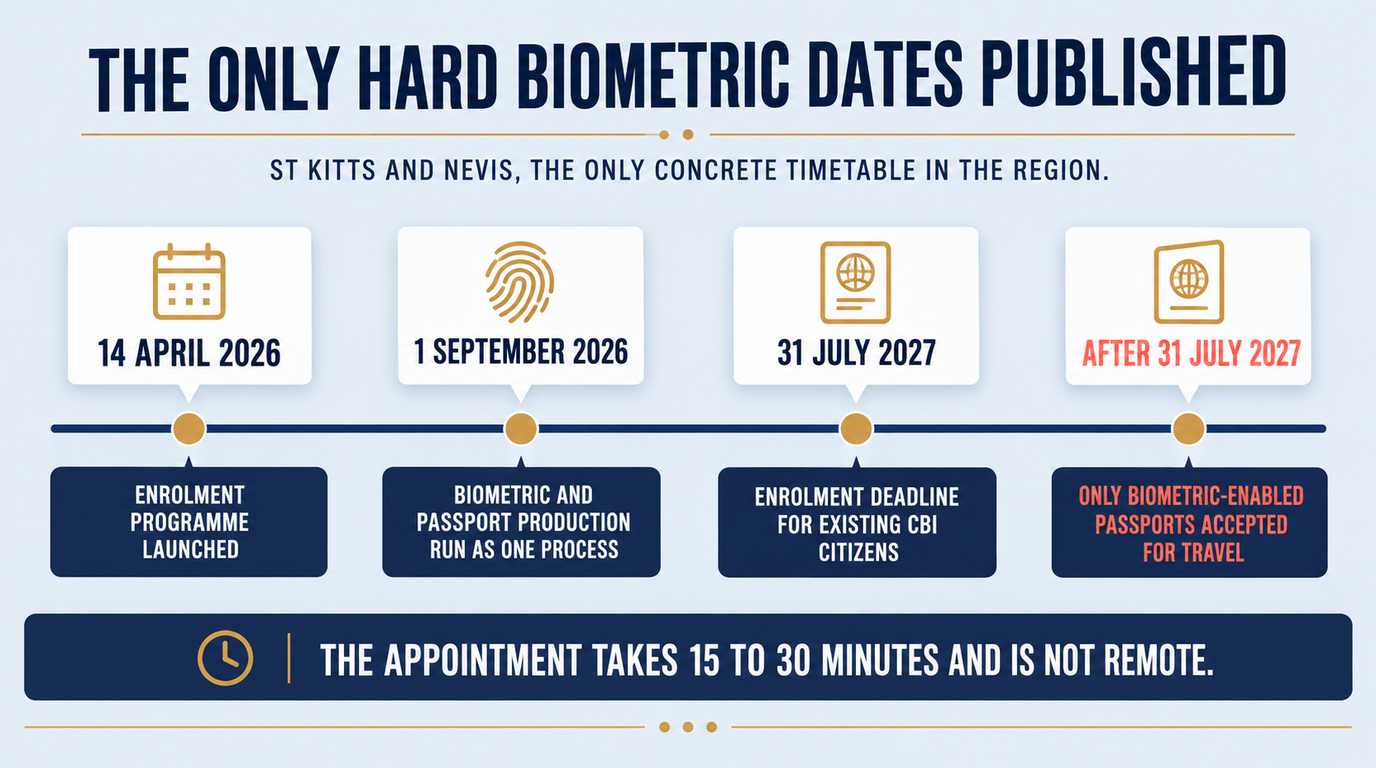
- St Kitts and Nevis is the only programme so far to publish hard biometric dates: enrolment opened 14 April 2026, new applicants enrol once their file reaches Approval in Principle, and from 1 September 2026 biometric capture and passport production run as a single process.
- No published figure is a deadline. It is what a unit aims at for a complete file. Thin source-of-funds evidence is what actually turns four months into nine.
There are two honest ways to answer the question in the title, and the industry almost always gives the wrong one. The wrong answer is a single number lifted from a brochure. The right answer is a range, attached to a named source, with the stages that sit outside it stated separately. This page gives the second kind.
Below is every figure an official unit currently publishes for its own programme, checked against the unit's website in September 2026. Where a cell says none published, that is not an oversight on our part: the unit's public pages describe the steps without committing to a duration.
| Programme | Processing time published by the unit | Where it appears |
|---|---|---|
| Grenada | Three to four months | Programme homepage, cbi.gov.gd |
| St Kitts and Nevis | Between 3 to 6 months | Application Process page, ciu.gov.kn |
| Antigua and Barbuda | None published | How to Apply page, cip.gov.ag |
| Saint Lucia | None published | Citizenship by Investment page, cipsaintlucia.com |
| Dominica | None retrievable | cbiu.gov.dm blocks automated access |
| Vanuatu | None published | Advisory sources report six to eight weeks |
| Turkey | None published | Advisory sources report three to six months |
What this guide covers
- What the units publish, and what they leave blank
- The five stages hiding inside any published figure
- How the September 2025 OECS reforms reset the clock
- Biometrics, and the first hard dates anyone has published
- Interviews: who sits one, and since when
- Turkey and Vanuatu, which run on different clocks entirely
- What actually decides whether your file is fast
- Where to read the cost detail on each programme
What the units publish, and what they leave blank
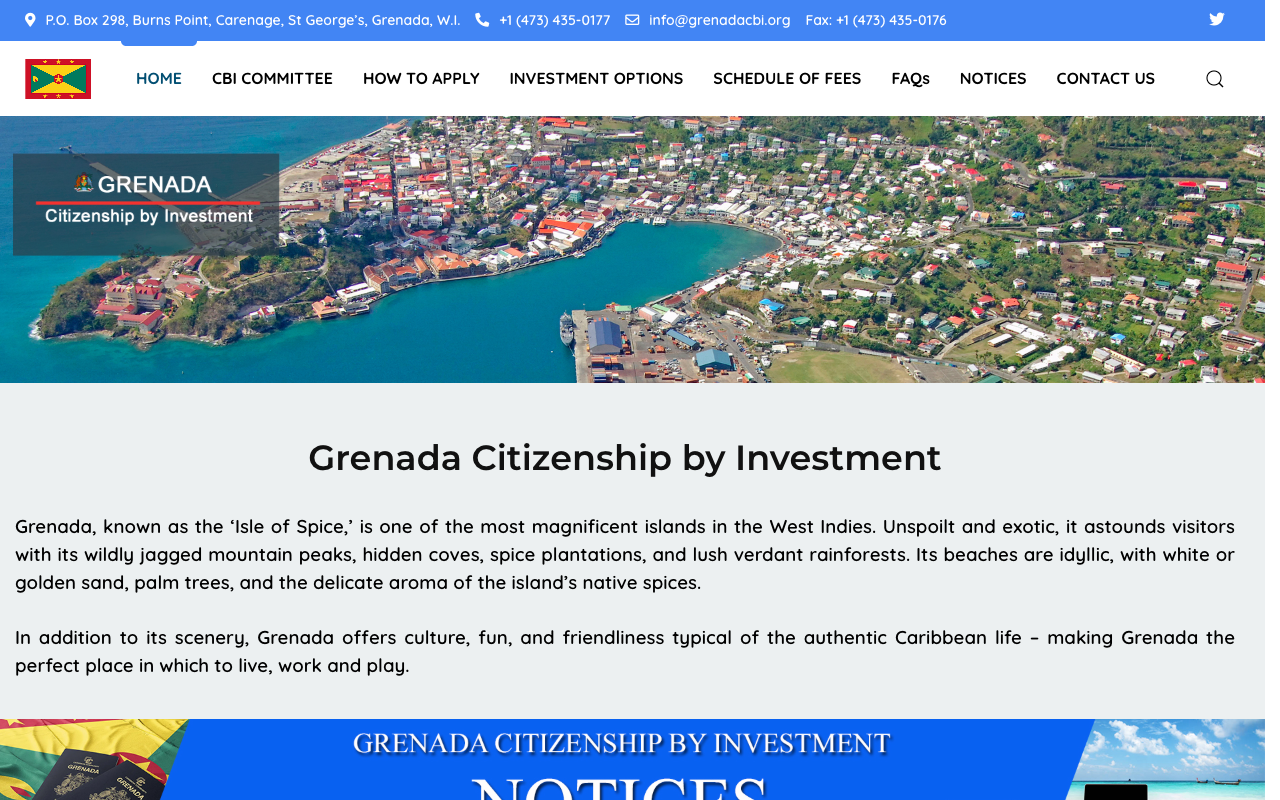
Grenada is the most forthcoming of the five, and it is worth seeing exactly how. Its Citizenship by Investment homepage carries a short summary block with two lines in it: a processing time of three to four months, and a minimum contribution of USD 150,000. The first is useful. The second cannot be current, because the OECS Member States adopted a region-wide minimum investment threshold of US$200,000 in the agreement announced on 23 September 2025, and Grenada's National Transformation Fund minimum has been widely quoted at US$235,000 for a single applicant since the 2024 increase. An official page can be simultaneously authoritative and stale, which is the first reason to date every figure you rely on.
St Kitts and Nevis is the more precise of the two. Its Application Process page sets out five steps — select an authorised agent, submit through that agent, await processing and due diligence to an approval-in-principle letter, make the investment once that letter is issued, then obtain the citizenship certificate — and states the duration as between 3 to 6 months, covering due diligence checks, document verification and approval of the investment. That framing matters more than the number: the investment is made after approval in principle, so the money moves partway through the clock rather than at the start.
The other three are silent by design. Antigua and Barbuda's How to Apply page describes the representative-and-agent chain and the AB1 to AB5 forms, then says only that the agent will be advised of the decision outcome. It adds that there may be occasions when additional information is requested and an interview may be required — conditional wording that predates the regional biometric commitment and sits awkwardly beside it. Saint Lucia's programme pages set out investment amounts in detail and no timeline. Dominica's unit site would not serve to any automated request we made, so we treat it as publishing nothing rather than guessing.
The practical consequence is that three of the five programmes cannot be held to any number, and an agent quoting one for them is quoting themselves. If a timeline appears in a proposal, ask which page of which unit it comes from. If the answer is experience rather than a URL, treat it as a forecast and price the risk of it being wrong.
The five stages hiding inside any published figure
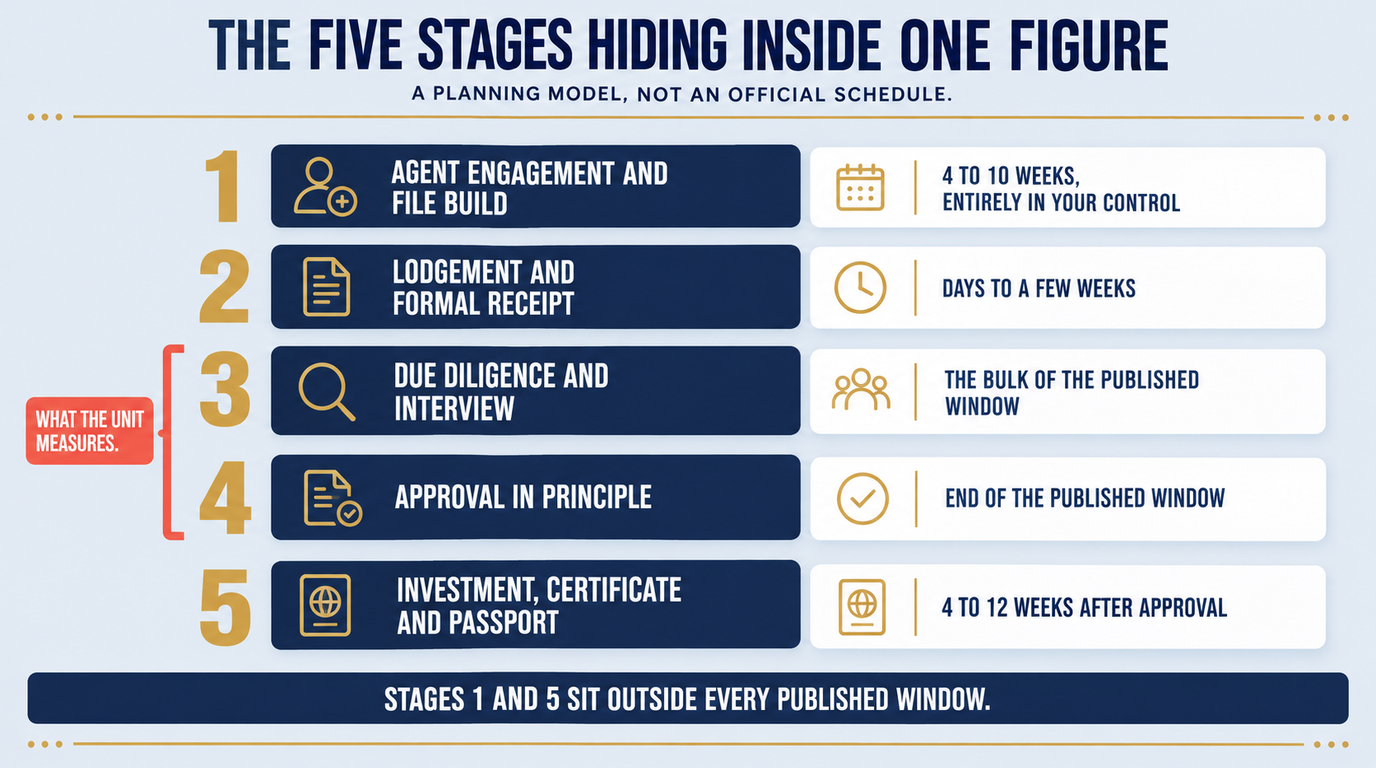
A published processing time covers the middle of the journey, not the whole of it. Reconstructing the stages from the units' own step lists gives a much better planning model than the headline figure, because the two stages that most often blow a schedule sit outside the window the unit is measuring.
The table below is a planning model, not an official schedule. The stage names come from the units' published steps; the durations are conservative allowances we use to sanity-check a proposal, and no unit publishes them.
| Stage | What happens | Planning allowance |
|---|---|---|
| 1. Agent engagement and file build | Licensed agent appointed, forms completed, police certificates, medicals and translations gathered | 4 to 10 weeks, entirely in your control |
| 2. Lodgement and formal receipt | Agent submits to the unit, which acknowledges receipt | Days to a few weeks |
| 3. Due diligence and interview | Third-party vetting, source-of-funds review, interview, biometric capture | The bulk of the published window |
| 4. Approval in principle | Unit issues the approval-in-principle letter | End of the published window |
| 5. Investment, certificate and passport | Funds transferred, citizenship certificate issued, passport produced | 4 to 12 weeks after approval |
Stage one is where most of the lost time actually happens, and it is the stage nobody quotes. Police certificates from several jurisdictions, notarised and translated, are not a two-week job for someone who has lived in four countries, and several of them carry validity periods short enough to expire while the rest of the file is still being assembled. Our guide to what a due diligence file has to contain sets out what the vetting firms are paid to look for.
Stage five is the other one. The published figure at St Kitts and Nevis ends at approval in principle, before the contribution is even paid. Anyone comparing that three-to-six-month number against a Vanuatu passport-in-hand claim is comparing two different measurements, which is how the fastest-programme rankings that circulate online end up meaningless.
How the September 2025 OECS reforms reset the clock
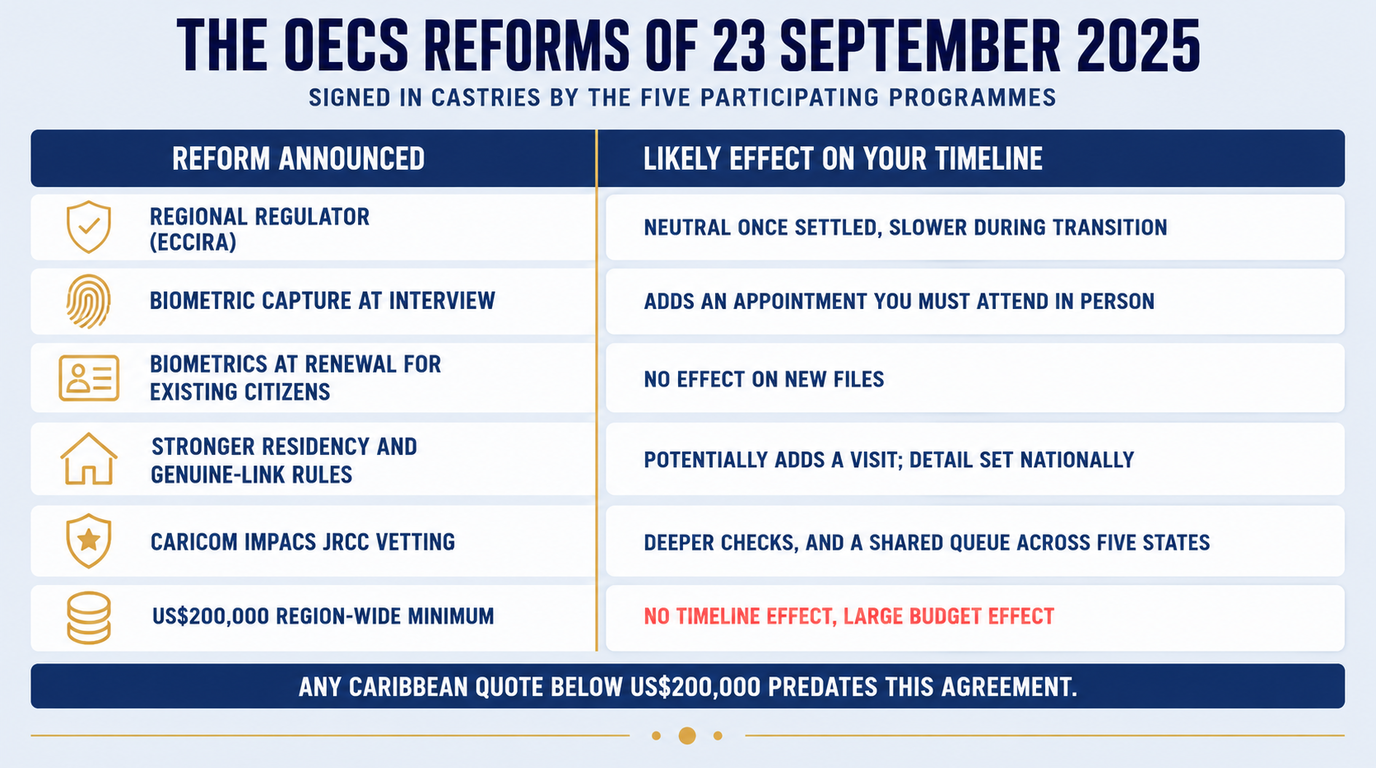
On 23 September 2025 in Castries, the Heads of Government of the five participating Eastern Caribbean programmes announced the signing of an agreement to establish a regional regulator, following two years of consultation with the United States, the United Kingdom and the European Commission. The document is short, public, and the single most important thing published about these programmes in years, because four of its five headings change how long a file takes.
The first is institutional. Member States committed to enact the enabling legislation establishing the Eastern Caribbean Citizenship by Investment Regulatory Authority by October 2025, a body intended to oversee all CBI activity across the five states with uniform standards and compliance powers. A new supervisory layer does not make individual files faster, and during any transition it usually makes them slower.
The second is security. The agreement requires mandatory biometric data collection from all new applicants at the time of interview, biometric collection from previously approved citizens at passport renewal, stronger residency and genuine-link requirements for approved applicants, and comprehensive vetting supported by the CARICOM IMPACS Joint Regional Communications Centre with expanded personnel and technology funded from programme revenues.
| Reform announced 23 September 2025 | Likely effect on your timeline |
|---|---|
| Regional regulator (ECCIRA) | Neutral once settled, slower during transition |
| Biometric capture at interview | Adds an appointment you must attend in person |
| Biometrics at renewal for existing citizens | No effect on new files, real effect on old passports |
| Stronger residency and genuine-link requirements | Potentially adds a visit; detail is set nationally |
| CARICOM IMPACS JRCC vetting | Deeper checks, and a shared queue across five states |
| US$200,000 region-wide minimum | No timeline effect, large budget effect |
Read the genuine-link row carefully before you plan around a no-visit programme. The agreement commits the five states to stronger residency and genuine-link requirements without specifying them, and each state legislates its own. Any advisor telling you today exactly what visit obligation will apply to a file lodged next year is guessing. Our Caribbean programme comparison tracks what each unit has actually enacted.
The US$200,000 floor is the reform with no timeline consequence and the largest budget consequence, and it is the one that dates a proposal instantly. Any quote showing a Caribbean contribution below US$200,000 was written before this agreement, whichever official page it was copied from.
Biometrics: the first hard dates anyone has published
The OECS agreement committed all five states to biometrics without saying when. St Kitts and Nevis has since published a schedule, and it is currently the only concrete implementation timetable in the region, which makes it the best available guide to what the other four will look like.
Enrolment launched on 14 April 2026. New applicants enrol once their application reaches the Approval in Principle stage — so the appointment falls between the published processing window and the passport, in the stage-five gap that no published figure covers. Enrolment happens only at officially designated centres through the government's own platform, with locations including St Kitts, Dubai, Hong Kong, Istanbul, Ottawa, Toronto and London. The appointment itself collects fingerprints, a digital facial image and a digital signature, and takes 15 to 30 minutes.
| St Kitts and Nevis biometric milestone | Date |
|---|---|
| Enrolment programme launched | 14 April 2026 |
| Biometric and passport production run as one process | 1 September 2026 |
| Enrolment deadline for existing CBI citizens | 31 July 2027 |
| Only biometric-enabled passports accepted for travel | After 31 July 2027 |
Two things follow for anyone applying now. The appointment is short but it is not remote, so a file that reaches approval in principle while the applicant is somewhere without a designated centre waits for travel, not for the unit. And the unit is explicit that this is a passport modernisation initiative that does not affect citizenship status — useful reassurance for existing citizens, who nonetheless have a real deadline of 31 July 2027 before their current passports stop being accepted for travel.
If you already hold a St Kitts and Nevis passport obtained through the programme, that renewal obligation is the item to diarise. The cost breakdown for the programme covers the contribution amounts the unit publishes alongside it: US$250,000 for a main applicant or a family of up to four, US$25,000 for each additional dependant under 18 and US$50,000 for each aged 18 or over, with due diligence at US$10,000 for the main applicant and US$7,500 for each dependant aged 16 or over.
Interviews: who sits one, and since when
The interview is the step most likely to be missing from an old timeline, because it did not exist in these programmes until recently and the units introduced it at different moments with different scope.
Saint Lucia was explicit about the start date. Its programme page states that the Applicant Interview and Identity Verification Process commenced on all applications received for processing from 4 September 2023, applying to the principal applicant. Grenada published its own mandatory interview process and fee structure in Circular No. 9 dated 1 September 2023, after Circular No. 8 postponed the original commencement — the sequence is still listed on the unit's homepage. St Kitts and Nevis lists attending an interview as step three of its process, required for main applicants and dependants aged 16 and over. Antigua and Barbuda's published wording remains conditional: an interview may be required.
| Programme | Interview scope as published | Since |
|---|---|---|
| Saint Lucia | Principal applicant, with identity verification | Applications received from 4 September 2023 |
| Grenada | Mandatory process with its own fee structure | Circular No. 9, 1 September 2023 |
| St Kitts and Nevis | Main applicants and dependants aged 16+ | Listed as step 3 of the application process |
| Antigua and Barbuda | An interview may be required | Conditional wording, no start date given |
| All five states | Biometric capture at the time of interview | Committed 23 September 2025 |
The last row is the one that changes the character of the step. An interview that is a video call is a scheduling problem; an interview that also captures fingerprints and a facial image is a travel problem. Antigua's conditional wording and the regional biometric commitment cannot both survive unchanged, so expect the published position there to move.
For a family, the practical question is how many people have to be available. St Kitts and Nevis counts dependants from 16, so a household with two teenagers is coordinating four diaries rather than one, and our family cost breakdown shows how the same threshold ages drive the fee schedule.
Turkey and Vanuatu run on different clocks entirely
Two programmes outside the Eastern Caribbean dominate the fastest-passport conversation, and neither publishes a processing time on its official pages either. What they do publish is the qualifying route, which is what makes their clocks structurally different.
Vanuatu's Development Support Program is consistently reported by advisory firms at six to eight weeks end to end, and that reputation is the programme's entire commercial proposition. It comes with a trade-off no timeline table shows: Vanuatu's visa-free access to the European Union was fully suspended in 2023 and the country was subsequently moved to the visa-required annex of the EU's own regulation, so speed was bought at the cost of the travel benefit most applicants were buying. Our Vanuatu cost page sets out the fee schedule and that history together.
Turkey is slower and structurally different again, because the qualifying act is a property purchase rather than a contribution. Advisory sources report three to six months for a clean real-estate file, but the deal itself, the valuation report and the title process sit in front of that and are entirely deal-dependent. A timeline for Turkey is really a timeline for a property transaction with an immigration process attached.
| Programme | Reported timeline | What the clock is actually measuring |
|---|---|---|
| Vanuatu | Six to eight weeks, advisory-reported | Application to passport, contribution route |
| Turkey | Three to six months, advisory-reported | Post-purchase processing, excludes the deal itself |
| Grenada | Three to four months, unit-published | Unit review of a lodged file |
| St Kitts and Nevis | Three to six months, unit-published | Lodgement to approval and investment |
| Malta | Not applicable | Investor citizenship closed by CJEU ruling, 29 April 2025 |
Malta is in that table deliberately, because it is still the most-searched European citizenship programme and it no longer exists. The Court of Justice of the European Union held on 29 April 2025 in Case C-181/23 that Malta's investor citizenship scheme breached Article 20 TFEU and Article 4(3) TEU. There is no processing time to quote and no reformed successor to wait for, only the residence programme that survived the judgment. If a proposal quotes you a Maltese citizenship timeline in 2026, that is the end of the conversation.
What actually decides whether your file is fast
After the published figures, the variables that move a real file are boringly consistent, and all four are visible before you lodge.
Source of funds is the first and by a distance the largest. Every published window assumes the unit is reviewing evidence, not chasing it, and a file whose funds trace through a company sale, a gift or a property disposal in a jurisdiction the vetting firm cannot reach quickly is a file that sits. The source-of-funds requirements are the single highest-leverage thing to get right before submission.
Document freshness is the second. Police certificates and medicals carry validity periods, and a file that spends ten weeks in stage one can arrive at the unit with a certificate about to expire — which means obtaining it twice, and paying twice. Gather the shortest-lived documents last.
Family composition is the third. Every additional adult dependant is another due diligence subject, another interview diary and, at St Kitts and Nevis, another US$7,500 in due diligence fees from age 16. The fourth is agent quality: only licensed agents can lodge these applications, every unit says so on its own pages, and the difference between a good and a poor one shows up as the number of times the unit comes back for more.
None of this is exotic. It is the same discipline as any regulated filing: complete on the day it is lodged, sourced to documents that will still be valid when they are read, and submitted by someone who has done it before. Programmes do not usually run late. Files do.
Caribbean contributions and due diligence fees are denominated in US dollars, and most applicants do not earn in them. A multi-currency account lets you convert on your own timing rather than at whatever rate applies the week an approval-in-principle letter arrives. It is a banking product, not an immigration service, and it has no bearing on whether any application succeeds.
Where to read the cost detail on each programme
Timelines and money move together on these programmes, and the pages below carry the fee schedules that sit behind each of the clocks discussed here, with the official sources attached.
- Caribbean citizenship by investment comparison — the five Eastern Caribbean programmes side by side
- St Kitts and Nevis citizenship by investment cost — the contribution and due diligence figures the unit publishes
- Grenada citizenship by investment cost — the National Transformation Fund route, and its E-2 relevance
- Citizenship by investment due diligence fees — what the vetting actually costs, per person
- Citizenship by investment family cost — how dependants change both the fee and the diary
- Cheapest citizenship by investment — the same question asked on price rather than speed
- Citizenship by investment vs golden visa — whether you need a passport programme at all
Whichever you shortlist, ask the advisor for a timeline that separates the three parts this page has kept apart: the weeks you control before lodgement, the window the unit publishes, and the stages after approval that no published figure covers. A single number covering all three is not a forecast. It is a sales tool.
Common questions
How long does citizenship by investment take in 2026?
It depends on the programme, and only two Eastern Caribbean units publish a figure. Grenada states three to four months on its programme homepage and St Kitts and Nevis states between 3 to 6 months on its application-process page. Antigua and Barbuda, Saint Lucia and Dominica publish no processing time. Those windows describe the unit's own review of a complete file, so add time before lodgement for document gathering and after approval for the investment, certificate and passport.
Which citizenship by investment programme is fastest?
Vanuatu is consistently reported by advisory firms at six to eight weeks from application to passport, which is faster than anything in the Caribbean. That speed comes with a significant caveat: Vanuatu's visa-free access to the European Union was suspended in 2023 and the country was later moved to the EU's visa-required list, so the travel benefit many applicants were buying is no longer there. Among the Eastern Caribbean programmes, Grenada publishes the shortest window at three to four months.
When does the processing clock actually start?
When a licensed agent lodges a complete application with the unit, not when you first engage an advisor. Every Eastern Caribbean programme requires submission through an authorised or licensed agent and none of them accept applications directly. The weeks spent gathering police certificates, medicals, translations and source-of-funds evidence sit entirely before the published window, and for an applicant who has lived in several countries that stage can easily run longer than the unit's own review.
Is an interview now mandatory for Caribbean citizenship by investment?
For most programmes, yes, though the scope differs. Saint Lucia's applicant interview and identity verification process applies to applications received from 4 September 2023 and covers the principal applicant. Grenada published a mandatory interview process and fee structure in Circular No. 9 dated 1 September 2023. St Kitts and Nevis lists an interview as step three for main applicants and dependants aged 16 and over. Antigua and Barbuda's published wording still says an interview may be required.
What is ECCIRA and does it change how long an application takes?
ECCIRA is the Eastern Caribbean Citizenship by Investment Regulatory Authority, a regional regulator the five participating states agreed to establish in the announcement of 23 September 2025, committing to enact the enabling legislation by October 2025. It is intended to apply uniform standards, oversight and enforcement across all five programmes. A new supervisory layer does not speed up individual files, and transitions of this kind usually slow them, so treat any timeline quoted for a future lodgement date as provisional.
Do I have to attend a biometric appointment in person?
In St Kitts and Nevis, yes. The unit's biometric programme launched on 14 April 2026, new applicants enrol once their application reaches Approval in Principle, and enrolment happens only at officially designated centres including St Kitts, Dubai, Hong Kong, Istanbul, Ottawa, Toronto and London. The appointment takes 15 to 30 minutes and collects fingerprints, a digital facial image and a digital signature. The OECS agreement commits all five states to biometric collection at the time of interview, so expect the other four to follow.
Why do agents quote timelines the units do not publish?
Because they are quoting their own case experience rather than a published standard, which is legitimate as long as it is labelled. The problem is that three of the five Eastern Caribbean units publish nothing, so there is no figure to check a quote against. Ask which page of which unit a timeline comes from. If the answer is experience rather than a URL, treat it as a forecast, and ask what happens to the fee if it is missed.
Can I still get Maltese citizenship by investment, and how long does it take?
No. On 29 April 2025 the Grand Chamber of the Court of Justice of the European Union held in Case C-181/23 that Malta's investor citizenship scheme breached Article 20 TFEU and Article 4(3) TEU, and the route closed. There is no processing time to quote and no announced replacement. What remains is the Malta Permanent Residence Programme, which grants residence rather than nationality. If an advisor quotes a Maltese citizenship timeline in 2026, ask which legal instrument it is issued under and get the answer in writing.
Official sources to verify
- OECS Sets Standards For Citizenship By Investment Programmes (CBI/CIP) to Safeguard Their Integrity and SustainabilityOrganisation of Eastern Caribbean States
- Citizenship by InvestmentGrenada Citizenship by Investment Unit
- Application ProcessSt. Kitts and Nevis Citizenship by Investment Unit
- BiometricsSt. Kitts and Nevis Citizenship by Investment Unit
- Sustainable Island State ContributionSt. Kitts and Nevis Citizenship by Investment Unit
- Citizenship by InvestmentSaint Lucia Citizenship by Investment Programme
- How to ApplyAntigua and Barbuda Citizenship by Investment Unit
- Dominica Citizenship by Investment UnitGovernment of Dominica
- Department of Immigration and Passport ServicesVanuatu Department of Immigration and Passport Services
- Regulation (EU) 2025/11 amending Regulation (EU) 2018/1806 as regards VanuatuEuropean Parliament and Council of the European Union (EUR-Lex)
- Acquiring Property and CitizenshipPresidency of the Republic of Türkiye Investment Office
- Judgment of the Court (Grand Chamber) in Case C-181/23, European Commission v Republic of MaltaCourt of Justice of the European Union (EUR-Lex)
Compare citizenship by investment advisors
Ask for a line-item quote that separates contribution, due diligence, processing, document, and professional fees.
We may earn a referral fee if you choose an advisor through this site. We still aim to show cost ranges, caveats, and official source links plainly.