egypt citizenship by investment cost
Egypt Citizenship by Investment Cost 2026
The Egypt citizenship by investment cost gets quoted four different ways by four different advisers, and the reason is not carelessness. Egypt cut its thresholds by prime ministerial decree in March 2023, and the English-language programme document still published by the government's own investment authority lists the amounts that decree replaced: USD 500,000 for property where the current figure is USD 300,000, and USD 400,000 for a project where it is now USD 350,000 plus a further USD 100,000. We read both schedules side by side, traced every figure to the decree or government report that states it, and worked out what the refundable deposit route actually gives back after the pound's 2024 float. On the cheapest route the state keeps USD 250,000 permanently, and the application fee is USD 10,000 on top.

Key takeaways
The cheapest route is USD 250,000 and you never see it again. A bank transfer from abroad of USD 250,000, credited as direct revenue to Egypt's Public Treasury, is non-refundable in the government's own wording. There is no asset at the end of it and no interest.
The property threshold is USD 300,000, not the USD 500,000 the government still publishes. Prime Ministerial Decree No. 876 of 2023, issued in March 2023, cut it from USD 500,000. The American Chamber of Commerce in Egypt and the Law Library of Congress both record the change, and the US State Department's 2025 investment climate statement repeats the USD 300,000 figure.
GAFI's own English programme sheet is years out of date. The document the General Authority for Investment and Free Zones publishes still lists USD 500,000 for property, USD 400,000 for a project, and deposits of USD 1,000,000 and USD 750,000. Those are the Decree 3099 of 2019 amounts that Decree 876 replaced. This is the single biggest reason no two pages on this topic agree.
Add USD 10,000 for the application, whichever route you take. The Library of Congress recorded the fee when the 2019 bill passed committee: "The fees of the citizenship application will be US$10,000." It is not refundable either.
The USD 500,000 deposit is the worst-value route, not the best. It comes back after three years in Egyptian pounds with no interest, and GAFI's published terms cap the conversion at the rate on the date of deposit. The pound went from EGP 30.9 to the dollar on the morning of 6 March 2024 to roughly EGP 55 in late October 2026. Get the refund formula in writing before you use this route.
On this page
Every figure below is tied to the document that states it and the date that document carries, because on this programme the gap between sources is the story. Decree 876 of 2023 is the current schedule; GAFI's published sheet is the old one. The Law Library of Congress and the American Chamber of Commerce in Egypt are the sources for what the decree changed; the US State Department's 2025 statement is the most recent government-published list of the routes. Where a number circulates widely with no official source behind it, the text says so rather than printing it in a table. This site's renderer does not emit heading anchors, so the list below is a map rather than jump links.
- What Egypt citizenship by investment costs in 2026
- Why the government's own published schedule disagrees
- The USD 10,000 fee, and the costs nobody publishes
- The USD 500,000 deposit is the most expensive route here
- The five-year rule that can cost another USD 250,000
- What the 2023 amendments changed about qualifying property
- Which route actually costs least
What Egypt citizenship by investment costs in 2026
There are four qualifying routes, and the money has to arrive from outside Egypt. The State Department's 2025 investment climate statement describes the asset route as requiring US dollars obtained from abroad, and GAFI's programme sheet specifies a bank transfer from abroad on every option. Egyptian-source funds do not count, which matters if you already live and earn there.
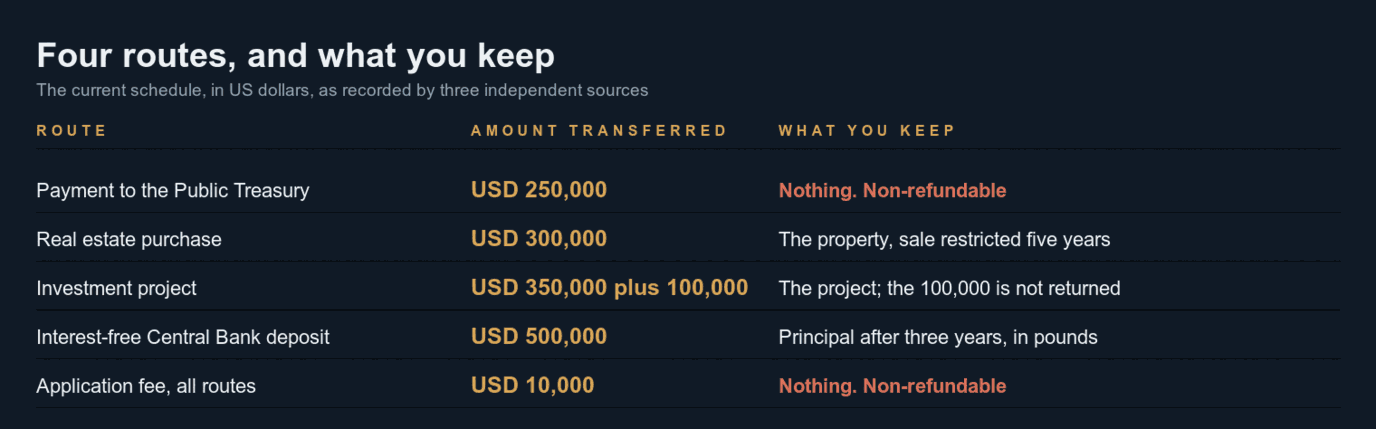
The table below is the current schedule as recorded by the Law Library of Congress, the American Chamber of Commerce in Egypt and the State Department. Every amount is in US dollars because the programme is denominated in dollars, not pounds.
| Route | Amount transferred | What you keep |
|---|---|---|
| Payment to the Public Treasury | USD 250,000 | Nothing — non-refundable |
| Real estate purchase | USD 300,000 | The property, sale restricted five years |
| Investment project | USD 350,000 plus USD 100,000 | The project or your share; the USD 100,000 is not returned |
| Interest-free deposit at the Central Bank | USD 500,000 | Principal after three years, paid in Egyptian pounds |
| Application fee, all routes | USD 10,000 | Nothing — non-refundable |
One wrinkle in the sourcing: the Law Library of Congress and the American Chamber both describe the extra USD 100,000 on the project route as a deposit to the public treasury, while the State Department's 2025 statement calls it a Central Bank deposit. The amount is not in dispute and the payment path runs through the Central Bank either way, but the two descriptions are not identical and no English-language government page we could reach settles it.
There is no language test, no interview and no physical-residence requirement on any of these routes, and Egypt permits dual citizenship. What there is, on every route, is a documented source-of-funds review — the same work every programme now demands, and the part applicants consistently underestimate. Our guide to citizenship by investment source of funds covers what that file has to contain.
Why the government's own published schedule disagrees
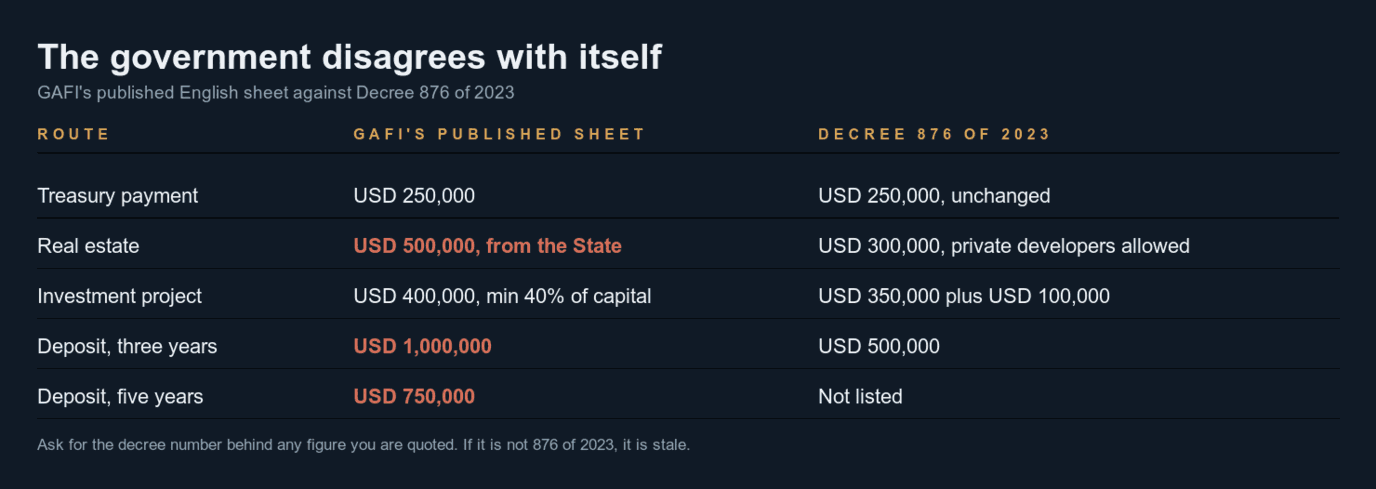
This is the part no competing page explains, and it is the reason their fee tables conflict. Egypt's investment authority publishes an English-language document headed Options of Investment Programs, prepared by GAFI's translation department, describing the naturalisation routes. It is undated, it is still live, and its figures are the ones Decree 876 of 2023 superseded.
| Route | GAFI's published sheet | Decree 876 of 2023 |
|---|---|---|
| Treasury payment | USD 250,000 | USD 250,000 — unchanged |
| Real estate | USD 500,000, bought from the State | USD 300,000, private developers allowed |
| Investment project | USD 400,000, minimum 40% of capital | USD 350,000 plus USD 100,000 |
| Deposit, three years | USD 1,000,000 | USD 500,000 |
| Deposit, five years | USD 750,000 | Not listed |
The American Chamber of Commerce in Egypt states the change plainly: Decree 876 lowered the real estate minimum to USD 300,000 from USD 500,000, and moved the project route to USD 350,000 plus a further USD 100,000 from a previous USD 400,000 with a minimum 40% stake. The State Department's 2024 and 2025 statements both record that Decree 876 amended the earlier Decree No. 3099 of 2019, which is where GAFI's numbers come from.
So a page quoting USD 500,000 for Egyptian property is not inventing it. It is citing the Egyptian government — just not the current version. That cuts both ways for a buyer: the decree is what binds, but the sheet an official might hand you across a desk may still show the old amount, and GAFI's sheet also carries conditions the newer summaries omit entirely, including the five-year clawback covered further down.
The practical instruction is narrow. Ask for the decree number behind any figure you are quoted. If the answer is not 876 of 2023, the figure is either stale or someone's estimate.
The USD 10,000 fee, and the costs nobody publishes
The USD 10,000 application fee has a better source than most figures on this topic. When the Egyptian parliament's committee approved the enabling bill on 10 June 2019, the Law Library of Congress recorded that the fees of the citizenship application would be US$10,000. Advisory pages generally describe it as covering the family rather than each applicant, but we could not confirm that split on any government page, so treat the per-person question as open.
Beyond the threshold and that fee, the real bill has components no Egyptian government page publishes at all. Document work is the predictable one: apostilles, certified Arabic translation, police certificates and medical reports for every adult applicant. These are priced by the provider, not the state, and they scale with family size rather than with the investment.
Professional fees are the larger unknown. No government anywhere publishes what an immigration adviser charges, and on this programme the spread is wide because the approval sits with the Prime Minister's office rather than a published points test. Our guidance is the same as on every programme: insist on a line-item quote that separates the government amount, the state fee, document costs and the adviser's own margin, and compare across at least two firms. A single bundled number is where margin hides.
On the real estate route there is also transfer tax, registration and the usual Egyptian conveyancing cost, none of which counts toward the USD 300,000 threshold. Budget them separately. The threshold is the price of the asset, not the cost of acquiring it.
The USD 500,000 deposit is the most expensive route here
The deposit route reads like the sensible option. You park USD 500,000 at the Central Bank of Egypt, wait three years, and get it back. On the published terms it is the costliest route on the page, and the mechanism is in the fine print rather than the headline.
GAFI's programme sheet sets out the formula for the deposit options it lists: the sum is refunded in Egyptian pounds at the rate the Central Bank announces on the date of refund, not exceeding the exchange rate on the date of deposit, and without interest. The State Department's 2025 statement independently describes the current USD 500,000 deposit as zero-interest and refundable after three years in Egyptian pounds, so the pound-denominated, interest-free character of the route is corroborated. The rate cap appears in GAFI's text, which is also the text carrying the superseded amounts — so it is exactly the clause to get confirmed in writing before committing.
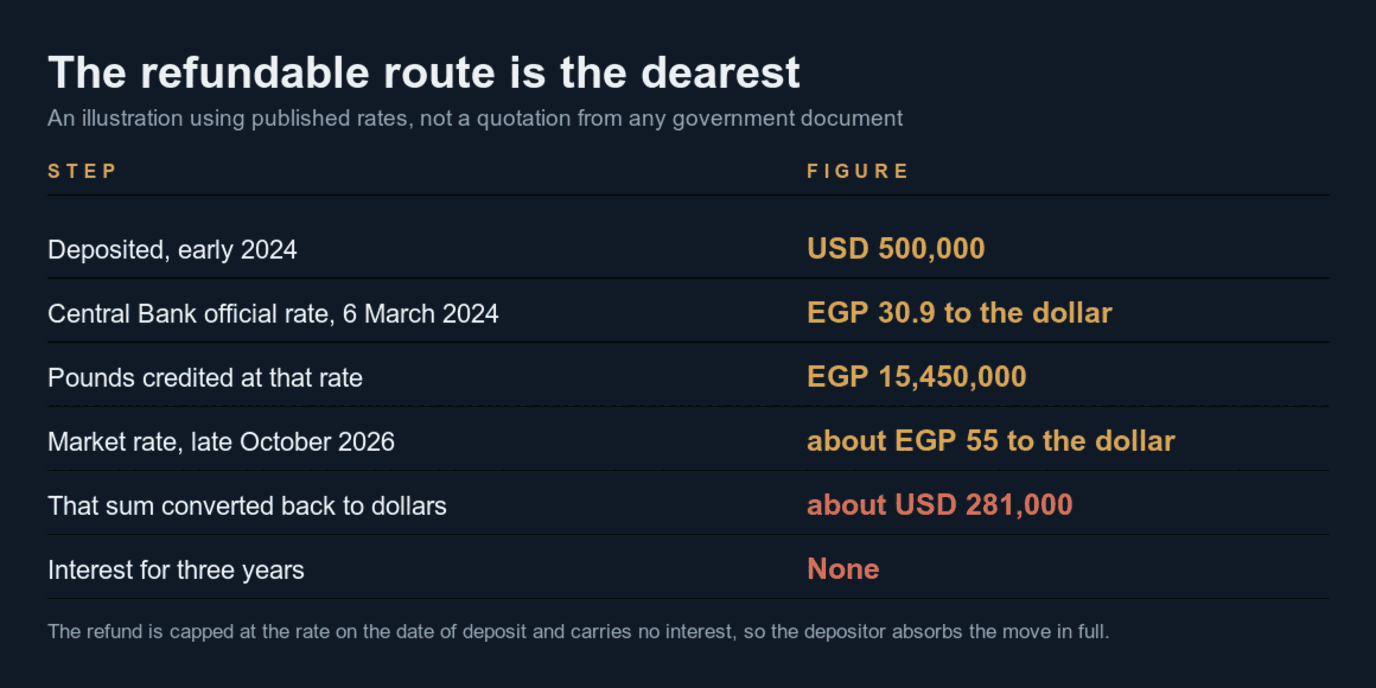
What that cap does is easiest to see with arithmetic. The figures below are an illustration using real published rates, not a quotation from any government document.
| Step | Figure |
|---|---|
| Deposited, early 2024 | USD 500,000 |
| Central Bank official rate, 6 March 2024 | EGP 30.9 to the dollar |
| Pounds credited at that rate | EGP 15,450,000 |
| Market rate, late October 2026 | about EGP 55 to the dollar |
| That sum converted back to dollars | about USD 281,000 |
| Interest for three years | None |
The pound was devalued and allowed to float on 6 March 2024, a condition of Egypt's USD 8 billion IMF programme; the Central Bank's official rate opened that day at EGP 30.9 and the currency traded near EGP 50 within hours. It has weakened further since, to roughly EGP 55 by late October 2026. A depositor who entered before the float and is refunded at the capped rate absorbs that move in full.
None of this makes the route unusable, and the pound may well not repeat a 2024-scale move. It does mean the USD 500,000 deposit should be compared against the USD 250,000 treasury payment on what you expect to recover, not on the sticker price. On the arithmetic above, the "refundable" route costs more than the one that returns nothing.
The five-year rule that can cost another USD 250,000
GAFI's sheet carries a clawback that the shorter summaries drop, and it is worth more than most of the fee detail. Dispose of the qualifying real estate before five years have passed from the date of purchase, and USD 250,000 must be transferred from abroad to the Central Bank as direct revenue to the Public Treasury in order to keep the Egyptian citizenship. That amount is non-refundable.
The same clause applies to the project route, with wider triggers: liquidation, suspension, or disposal of the project or your share in it before five years from the date it starts operating. On the USD 300,000 property route the clawback is most of what you paid for the asset, which makes the five-year hold a real constraint rather than a formality.
Read in sequence, this changes how the routes compare. The property route looks cheapest on recoverable value because you end up owning a USD 300,000 asset, but that asset is illiquid for five years on pain of a USD 250,000 payment, in a market priced in a currency that lost roughly 45% against the dollar over the same kind of window. The treasury payment has no clawback for the simple reason that there is nothing left to claw back.
Whether this clause survives in its published form is one more thing to confirm, since the document stating it also carries the old thresholds. Ask specifically whether the five-year rule and its USD 250,000 figure still stand under Decree 876, and get the answer in writing before you choose between routes on the strength of keeping an asset.
What the 2023 amendments changed about qualifying property
There were two separate changes in 2023 and they are easy to conflate. The decree changed the amounts. A parliamentary amendment changed who you may buy from, and for a property buyer the second one matters more.
Egypt's nationality law is Law No. 26 of 1975, and Law No. 190 of 2019 added the investment route to it. The House of Representatives approved amendments to articles 6 and 11 on 12 April 2023, ratified the following month. Article 11 had covered foreign nationals buying from the government or from state-owned developers; the amendment extended it to foreign nationals who buy real estate from private developers. The American Chamber of Commerce in Egypt and the Law Library of Congress both record that change.
GAFI's published sheet predates it, which is why its property route still reads "buying a real estate from the State". If you are working from that document, the universe of qualifying property it describes is narrower than the law now allows. Independently of the thresholds, this is the clearest evidence that the sheet is not current.
The same 2023 amendment package changed article 6, on an unrelated point: a foreign woman who has acquired Egyptian citizenship may pass it to her minor children where she comes from an Arabic-speaking country or one with a Muslim majority. It has nothing to do with the investment routes, but it turns up in summaries of "the 2023 citizenship changes" and is worth separating out.
Worth noting too that a different statute, Law No. 173 of 2018, offers five-year residency and the opportunity to apply for citizenship against a deposit of EGP 7 million in Egyptian banks — roughly USD 391,000 when it was enacted, and a far smaller dollar sum now. It is a distinct track from the dollar-denominated routes above, and a pound-denominated threshold behaves very differently through a devaluation.
Which route actually costs least
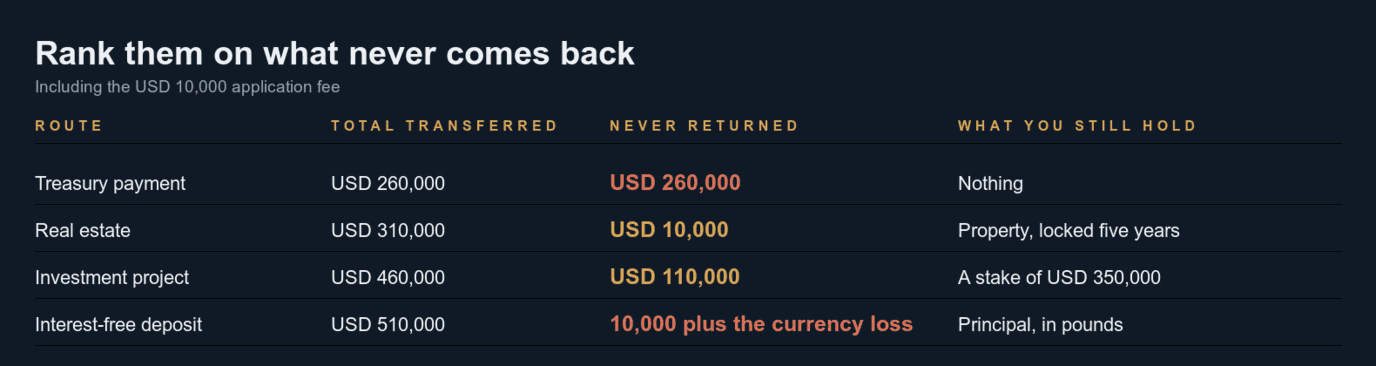
Ranking the routes on what you transfer gets the answer wrong, because two of them hand something back. The useful ranking is on money that does not return. The figures below include the USD 10,000 application fee and come from the current schedule.
| Route | Total transferred | Never returned | What you still hold |
|---|---|---|---|
| Treasury payment | USD 260,000 | USD 260,000 | Nothing |
| Real estate | USD 310,000 | USD 10,000 | Property worth USD 300,000, locked five years |
| Investment project | USD 460,000 | USD 110,000 | A project stake of USD 350,000 |
| Interest-free deposit | USD 510,000 | USD 10,000 plus the currency loss | Principal, in pounds, after three years |
On paper the property route is the cheapest way in: USD 10,000 of genuinely sunk cost against USD 260,000 for the treasury payment. That advantage holds only if you would have wanted Egyptian residential property anyway, can carry it for five years, and accept that its value is set in a currency that has roughly halved against the dollar since early 2024. Read against the USD 250,000 clawback in the section above, the five-year hold is the price of that discount.
The treasury payment is the honest choice for anyone who wants the passport and nothing else. It is the lowest total outlay, it has no clawback, no holding period and no asset to manage or sell, and the cost is known on day one. At USD 260,000 all in it sits above the Caribbean donation routes rather than below them — see our Caribbean citizenship by investment comparison and cheapest citizenship by investment for where that leaves Egypt in the wider market, and citizenship by investment countries for which programmes are still open in 2026.
Whichever route you pick, the one thing to carry into the first conversation with an adviser is the decree number. Every figure on this page is attached to a document above, and that is the standard to hold a quote to.
Related guides on Domicila
- Cheapest citizenship by investment — the low end of the market, ranked on money you never get back.
- Citizenship by investment countries — every programme still open in 2026, and what each one issues.
- Caribbean citizenship by investment comparison — the donation routes Egypt's USD 250,000 sits above.
- Turkey citizenship by investment cost — the other large-market property route, and the closest structural comparison to Egypt's.
- Citizenship by investment source of funds — the documentation review every one of these routes runs.
- Citizenship by investment processing time — how long each programme takes once the money has moved.
Common questions
How much does Egypt citizenship by investment cost in 2026?
The lowest qualifying amount is USD 250,000, paid as a non-refundable transfer from abroad credited as direct revenue to Egypt's Public Treasury, plus a USD 10,000 application fee. The other routes are USD 300,000 for real estate, USD 350,000 for an investment project plus a further USD 100,000 that is not returned, and USD 500,000 as an interest-free deposit at the Central Bank refundable after three years in Egyptian pounds. Document and professional fees are additional and are not published by any government source.
Is the Egyptian property threshold USD 300,000 or USD 500,000?
USD 300,000. Prime Ministerial Decree No. 876 of 2023, issued in March 2023, cut it from USD 500,000, and the American Chamber of Commerce in Egypt, the Law Library of Congress and the US State Department's 2025 investment climate statement all record the lower figure. The USD 500,000 amount is still published in GAFI's own English-language programme document, which has not been updated, so it continues to circulate. Ask for the decree number behind any figure you are quoted.
Why do different websites give different Egypt citizenship costs?
Because Egypt reduced its thresholds in March 2023 and the government's own English-language programme sheet still lists the pre-2023 amounts. That document, published by the General Authority for Investment and Free Zones, shows USD 500,000 for property, USD 400,000 for a project and deposits of USD 1,000,000 and USD 750,000 — the Decree 3099 of 2019 figures that Decree 876 of 2023 replaced. A page citing those amounts is quoting an official Egyptian source, just not the current one.
Do you get the USD 500,000 Central Bank deposit back in full?
Not in dollar terms, on the published mechanism. The deposit is refunded after three years in Egyptian pounds without interest, which the US State Department's 2025 statement confirms, and GAFI's published terms cap the conversion at the exchange rate on the date of deposit. Because the pound moved from EGP 30.9 to the dollar in March 2024 to roughly EGP 55 by late October 2026, a depositor refunded at the capped rate can recover materially less than the amount placed. Ask for the refund formula in writing before using this route.
Is there a USD 10,000 state fee on every route?
Yes, on the record available. The Law Library of Congress reported when the enabling bill passed committee on 10 June 2019 that the citizenship application fee would be USD 10,000, and advisory firms have applied it to every route since. Those firms generally describe it as covering the family rather than each applicant, but we could not confirm that on any Egyptian government page, so treat the per-person question as unresolved and ask for it in writing.
Can you sell the property after getting Egyptian citizenship?
Not within five years without a further payment, on GAFI's published conditions. If the qualifying real estate is disposed of before five years from the date of purchase, USD 250,000 must be transferred from abroad to the Central Bank as direct revenue to the Public Treasury in order to keep the citizenship, and that sum is non-refundable. The same clause applies to the project route on liquidation, suspension or disposal within five years of the project starting to operate.
Does Egypt require you to live there or speak Arabic?
No. None of the investment routes carries a physical-residence requirement, a language test or an interview, and Egypt permits dual citizenship. What every route does require is that the funds be transferred from outside Egypt in US dollars obtained abroad, with a documented source-of-funds file. Approval rests with the Prime Minister's office rather than a published points test, so no adviser can promise an outcome.
Can you buy from any Egyptian developer, or only from the state?
From private developers as well, since 2023. Article 11 of Law No. 26 of 1975 originally covered purchases from the government or state-owned developers; amendments approved by the House of Representatives on 12 April 2023 and ratified the following month extended it to foreign nationals buying from private developers. GAFI's published sheet predates that change and still describes the route as buying real estate from the State, which is one more sign the document is not current.
Official sources to verify
- Options of Investment Programs: Granting Egyptian Nationality to Foreigners through InvestmentGeneral Authority for Investment and Free Zones (GAFI), Translation Department
- Egypt: House of Representatives Approves New Amendments to Citizenship LawLaw Library of Congress, Global Legal Monitor
- Egypt: Parliament Approves Draft Law Allowing Foreign Investors to Acquire Egyptian CitizenshipLaw Library of Congress, Global Legal Monitor
- Real Estate Landscape, Industry InsightAmerican Chamber of Commerce in Egypt
- 2025 Investment Climate Statement: EgyptU.S. Department of State
- Exchange RatesCentral Bank of Egypt
Compare citizenship by investment advisors
Ask for a line-item quote that separates contribution, due diligence, processing, document, and professional fees.
We may earn a referral fee if you choose an advisor through this site. We still aim to show cost ranges, caveats, and official source links plainly.