nauru citizenship by investment cost
Nauru Citizenship by Investment Cost 2026
Nauru's contribution is USD 90,000 for a principal applicant until 31 December 2026, and USD 115,000 once the discount lapses. The fees on top are published line by line: USD 5,000 application, USD 6,000 due diligence, USD 1,200 in bank charges and USD 500 per passport. That puts a single applicant at USD 102,700 and a family of four at USD 115,700 in government charges. All figures come from the Naoero Program Office's own schedule, checked 8 September 2026.

Key takeaways
Nauru's contribution is USD 90,000 for a principal applicant, and it is a discounted figure. The Government of the Republic of Naoero applied a USD 25,000 reduction from 3 February 2026 for applications filed before 31 December 2026, so the standard rate underneath it is USD 115,000.
Adding up the Naoero Program Office's own published line items gives USD 102,700 for a single applicant, USD 110,700 for a couple and USD 115,700 for a family of four with two children under 16. Agent fees sit on top of all three and are not published anywhere.
The filing date matters more than anything else on this page. The same application lodged on 1 January 2027 rather than 31 December 2026 costs USD 25,000 more for an identical product.
The passport does less than the marketing implies. The United Kingdom imposed a visit visa requirement on Nauruan nationals at 15:00 GMT on 9 December 2025 and removed them from the Electronic Travel Authorisation scheme, and the Home Office memorandum names this citizenship programme as the reason.
There was never any Schengen access to lose. Nauru appears in Annex II of Regulation (EU) 2018/1806, but under footnote 3, which makes the exemption conditional on a visa waiver agreement with the European Union that has not entered into force.
What Nauru actually charges, line by line
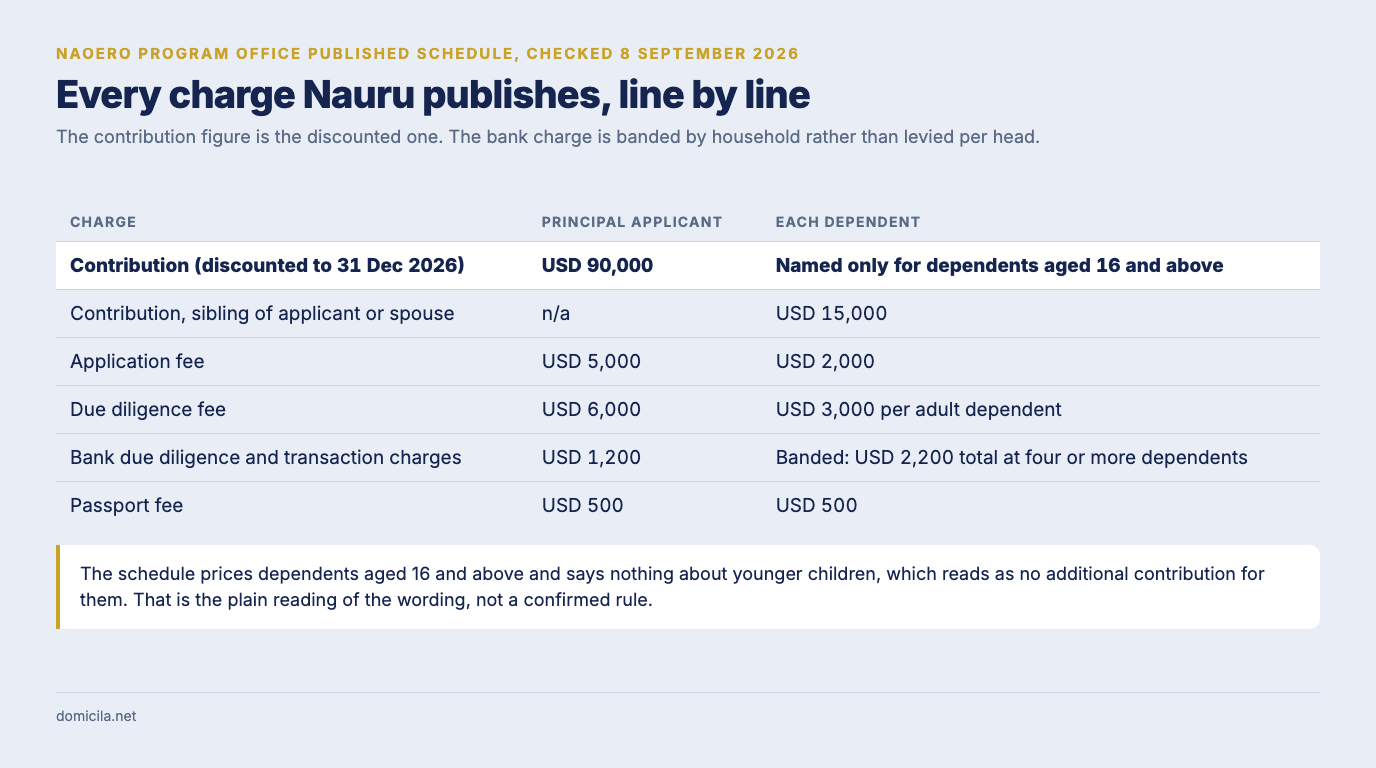
One good thing about this programme is that it publishes its prices. The Naoero Program Office lists every charge on a single page, which is more than several older programmes manage, and it means you can build a total yourself rather than accept an agent's blended figure. Here is that schedule as published, checked on 8 September 2026.
| Charge | Principal applicant | Each additional dependent aged 16+ | Each sibling | Other |
|---|---|---|---|---|
| Contribution | USD 90,000 (limited-time offer to 31 December 2026) | USD 2,000 | USD 15,000 | — |
| Application fee | USD 5,000 | USD 2,000 per eligible dependent | USD 2,000 | — |
| Due diligence fee | USD 6,000 | USD 3,000 | USD 3,000 | USD 3,000 for a benefactor |
| Bank due diligence fee and transaction charge | USD 1,200 alone, USD 1,700 with up to three dependents, USD 2,200 with four or more | included in the principal applicant's tier | included in the tier | USD 1,000 for a benefactor |
| Passport fee | USD 500 | USD 500 | USD 500 | USD 500 per passport |
Two things in that table are worth pausing on. The bank due diligence charge is tiered by household size rather than levied per head, which is unusual and works in a family's favour: four or more dependents cost USD 2,200 in total, not USD 2,200 each. And the contribution line only names dependents aged 16 and above, which reads as though a child under 16 adds nothing to the contribution itself. The published schedule does not spell that out, so treat it as the plain reading of the government's own wording rather than a confirmed rule, and ask your agent to state it in writing.
The due diligence fee is also on the low side for this market. USD 6,000 for a principal applicant and USD 3,000 per adult dependent sits below what the Eastern Caribbean programmes charge, and our guide to due diligence fees across programmes sets out the comparison. A lower background-check budget is not automatically a bargain, and it is one of the reasons the United Kingdom gave for its own decision below.
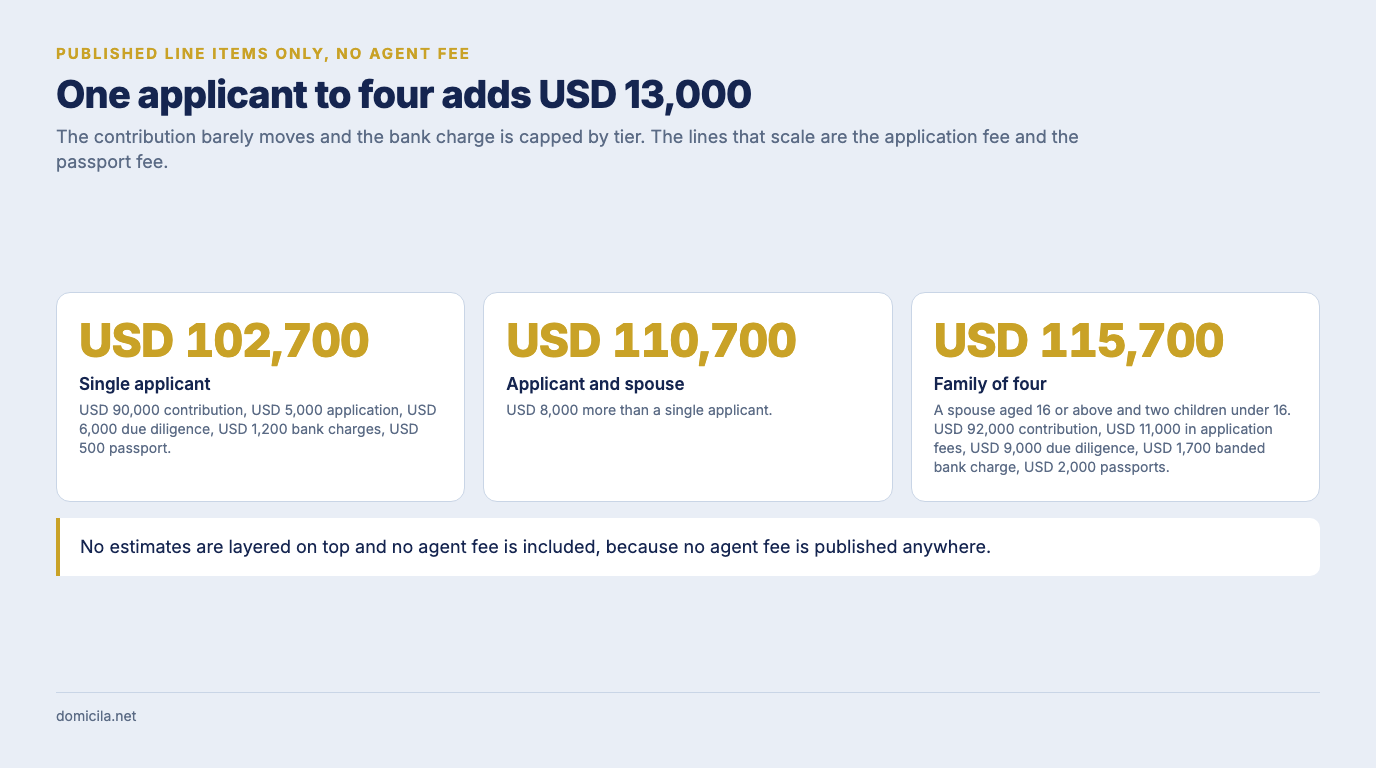
Worked totals: single applicant, couple, family of four
These totals add the published line items and nothing else. No estimates are layered on top, and no agent fee is included, because no agent fee is published. The family of four assumes a principal applicant, a spouse aged 16 or above, and two children under 16.
| Line item | Single applicant | Couple | Family of four (two children under 16) |
|---|---|---|---|
| Contribution | USD 90,000 | USD 92,000 | USD 92,000 |
| Application fee | USD 5,000 | USD 7,000 | USD 11,000 |
| Due diligence fee | USD 6,000 | USD 9,000 | USD 9,000 |
| Bank due diligence and transaction charge | USD 1,200 | USD 1,700 | USD 1,700 |
| Passport fee | USD 500 | USD 1,000 | USD 2,000 |
| Government total | USD 102,700 | USD 110,700 | USD 115,700 |
The shape of that result is what makes Nauru interesting for families. Going from one applicant to four adds USD 13,000, because the contribution barely moves and the bank charge is capped by tier. The lines that scale are the application fee, at USD 2,000 a head, and the passport fee, at USD 500 each. A couple pays USD 8,000 more than a single applicant, and the two children between them add USD 5,000.
Siblings are the exception and they are expensive. A sibling of the principal applicant or their spouse carries a USD 15,000 contribution of their own, on top of the application, due diligence and passport fees, which is more than seven times what a spouse costs. If your file includes a brother or sister, price them separately before you assume the family total.
What is not in the table, and cannot be, is the agent's fee. Applications must be submitted through an approved Agent, and no government schedule anywhere names what that costs. Ask for it as a separate line item, in writing, and ask whether it is charged per application or per person.
The USD 25,000 discount and the 1 January 2027 cliff
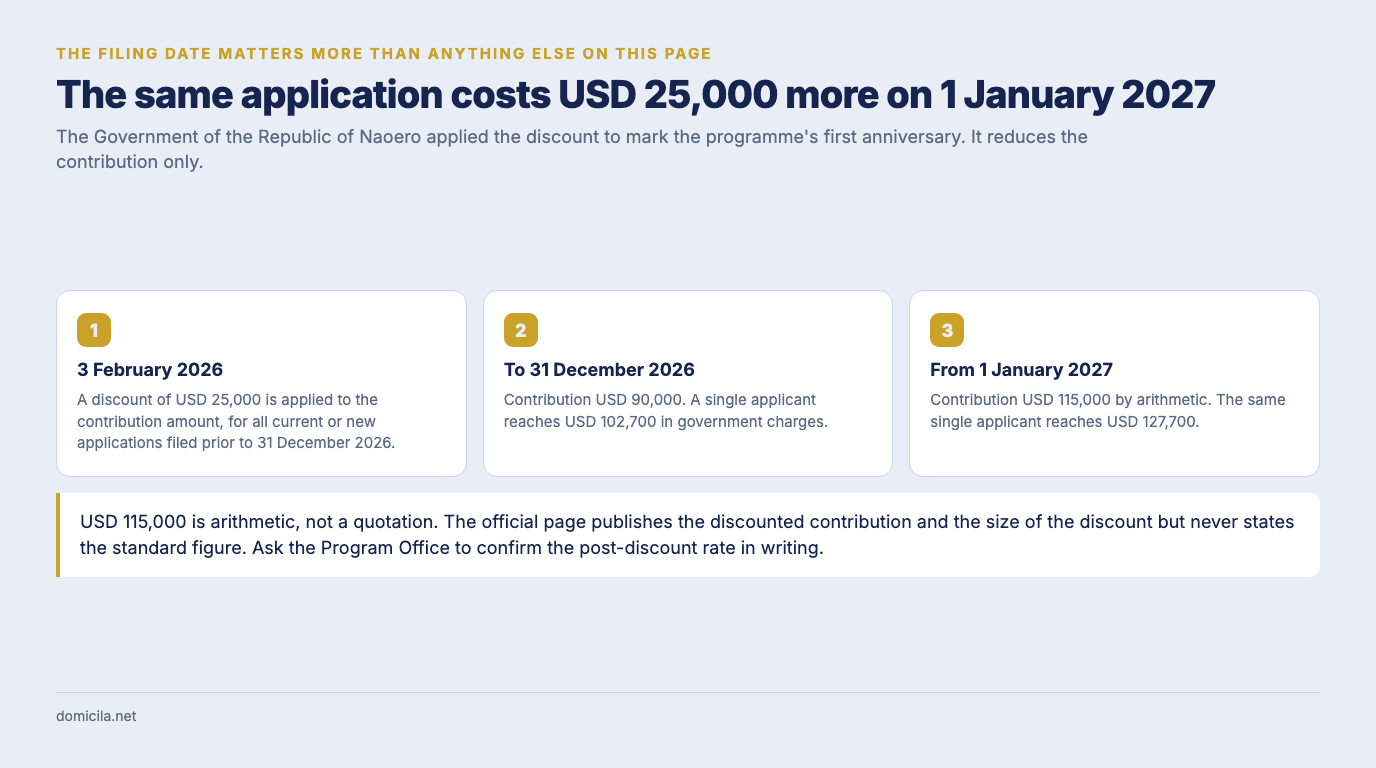
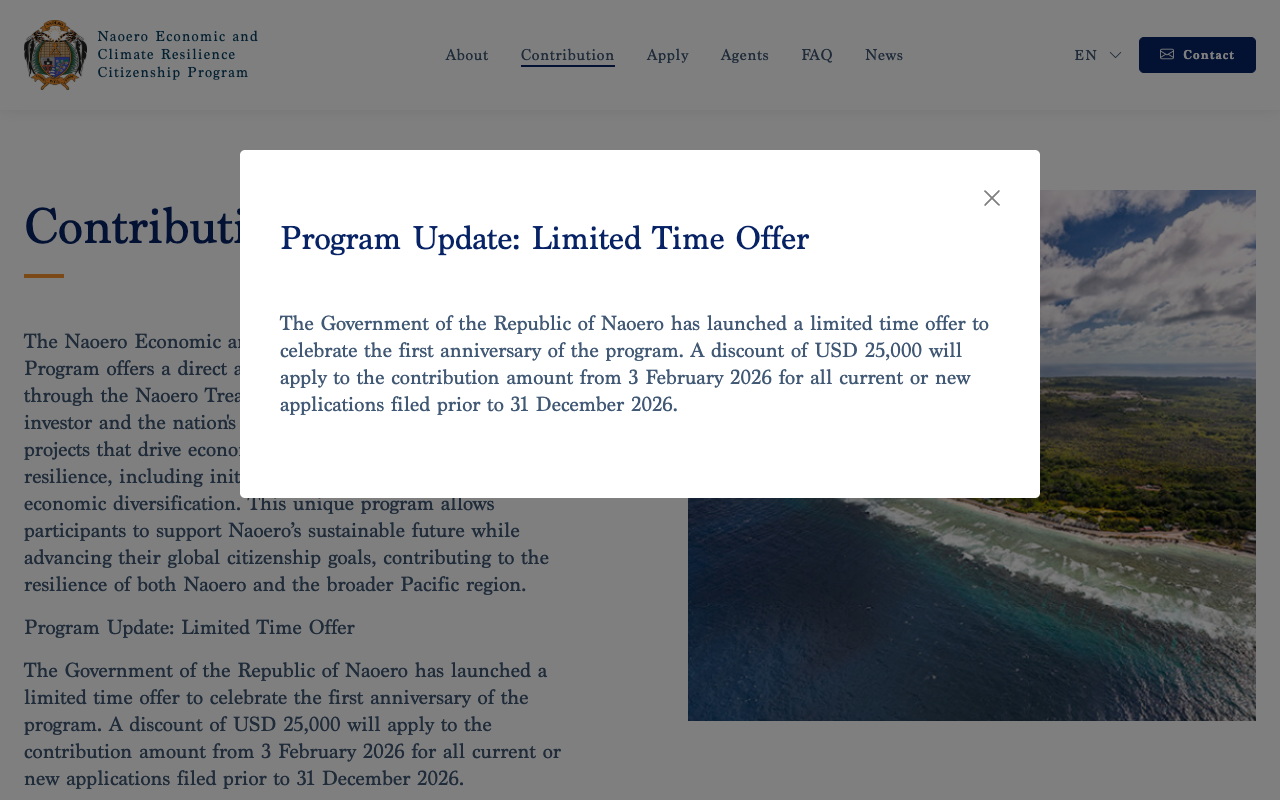
The Government of the Republic of Naoero introduced the discount to mark the programme's first anniversary. The published wording is precise: a discount of USD 25,000 applies to the contribution amount from 3 February 2026, for all current or new applications filed prior to 31 December 2026. It reduces the contribution only, so every other line on the schedule is unaffected.
That makes the filing date the single largest variable on this page, larger than family composition. Here is the same three-household comparison at both rates.
| Household | Filed by 31 December 2026 | Filed from 1 January 2027 | Difference |
|---|---|---|---|
| Single applicant | USD 102,700 | USD 127,700 | USD 25,000 |
| Couple | USD 110,700 | USD 135,700 | USD 25,000 |
| Family of four | USD 115,700 | USD 140,700 | USD 25,000 |
Two cautions about reading that as a deadline to rush toward. The first is that a discount granted by announcement can be extended by announcement, and programmes that discount once often discount again, so treat the cliff as a real risk rather than a certainty. The second is the more serious one: a rushed file is a refused file, and the fees that pay for the background check are consumed whether you are approved or not. The published processing time is three to four months from submission to approval, which our guide to citizenship by investment processing times puts among the fastest quoted anywhere.
Why three sources quote three different prices
Search this programme and you will be given at least three different headline numbers, which is the main reason this page exists. Here is what each source said when we checked on 8 September 2026.
| Source | Standard contribution | Discounted contribution | What it publishes |
|---|---|---|---|
| Naoero Program Office (official) | not stated as a figure | USD 90,000 | The discounted amount plus the USD 25,000 reduction, from which USD 115,000 follows |
| Investment Migration Insider | USD 115,000 | USD 90,000 | Matches the arithmetic of the official page |
| Henley and Partners | USD 120,000 and USD 115,000 on the same page | USD 95,000 and USD 90,000 on the same page | Factsheet box and FAQ say 120,000/95,000; the eligibility text says 115,000/90,000 |
The contradiction inside a single large firm's page is not a scandal, it is what happens when a price changes and one module of a template is updated before another. But it tells you how to handle every number you are quoted for this programme: check it against the government page on the day, not against a summary written at some unstated point in the past.
The official page itself has a gap worth naming. It publishes the discounted contribution and the size of the discount, but never states the standard contribution as a figure. USD 115,000 is arithmetic, not a quotation, and it is what everyone else in the market has arrived at the same way. If you are budgeting for a 2027 filing, ask the Program Office to confirm the post-discount rate in writing rather than relying on the subtraction.
The UK closed its door in December 2025, and said why
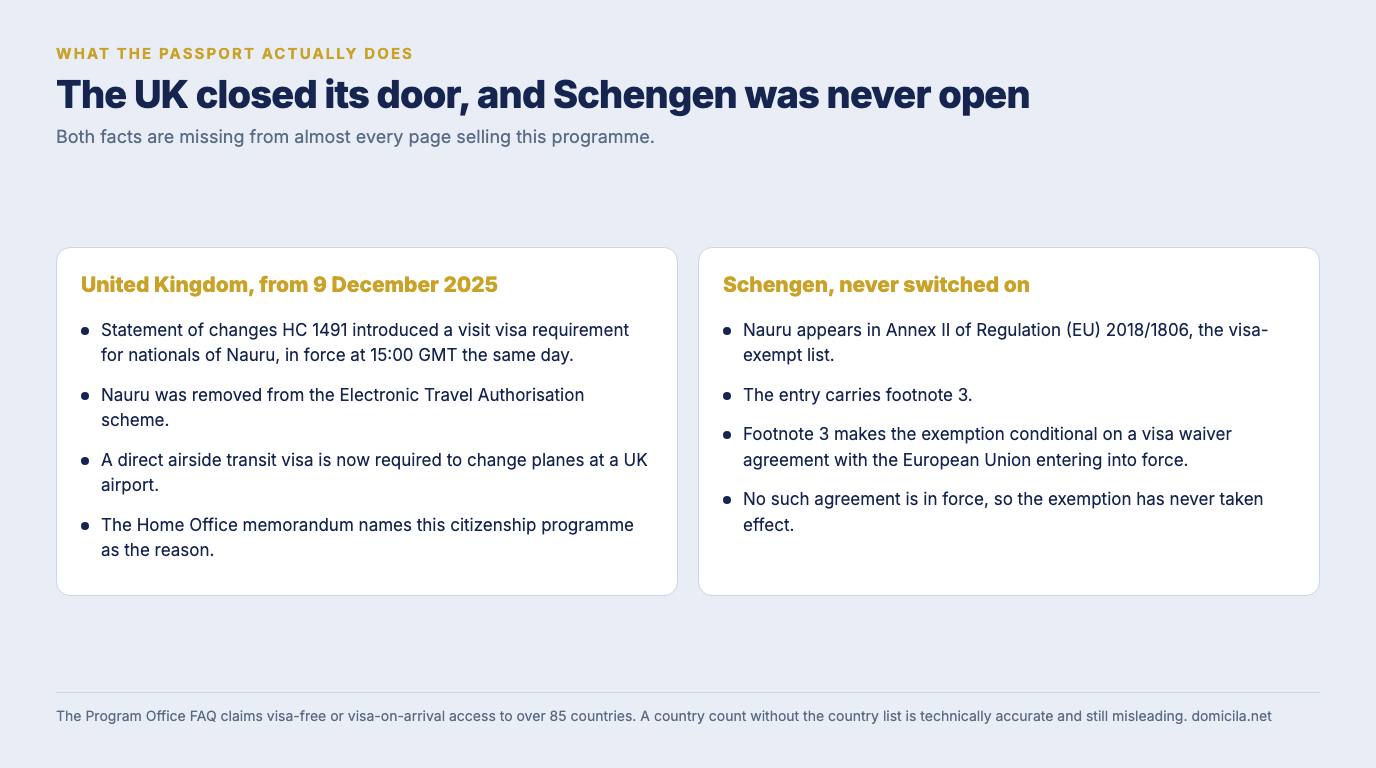
This is the fact that changes the value of the passport, and it is missing from almost every page selling the programme. On 9 December 2025 the UK Home Office laid a statement of changes in the Immigration Rules, HC 1491, introducing a visit visa requirement for nationals of Nauru. It took effect at 15:00 GMT the same day, departing from the usual 21-day notice convention, and Nauru was removed from the list of countries whose nationals can apply for an Electronic Travel Authorisation.
The explanatory memorandum does not leave the reason to inference. It states that the decision was driven by the country's decision to introduce a new Citizenship by Investment programme, describes a scheme that permits persons to acquire citizenship solely for making a one-off payment, and calls the arrangement particularly vulnerable to misuse. It also flags the outsourcing of the programme's administration as creating a clear appearance of a conflict of interest.
The practical consequences are worth stating plainly. A Nauruan passport now requires a visa for a UK visit, and a direct airside transit visa to change planes at a UK airport under the amended Immigration (Passenger Transit Visa) Order 2014. A six-week transition covered people who already held an ETA and a confirmed booking, and it expired at 15:00 GMT on 20 January 2026. There is nothing left of it.
If UK access is part of why you are considering this passport, that is the end of the question, and it is worth knowing before rather than after. It is also a live reminder that visa-free access is granted by other governments and can be withdrawn by them, which is a risk every programme in this market carries and few of them price.
Schengen access was never switched on
The second travel question people ask is about Europe, and here the answer is more subtle than a straight no. Nauru does appear in Annex II of Regulation (EU) 2018/1806, the list of nationalities exempt from the Schengen short-stay visa requirement. But the entry carries footnote 3, and footnote 3 says the exemption applies from the date of entry into force of an agreement on visa exemption to be concluded with the European Union.
No such agreement is in force for Nauru. The exemption is therefore conditional and has never taken effect, which means a Nauruan passport does not currently give visa-free entry to the Schengen area. That is a different situation from Vanuatu, whose access was granted, used, then suspended and finally removed by regulation, and our Vanuatu cost guide sets out how that unwound.
The distinction matters when you read marketing copy. A page that lists a country total without saying which countries are in it can be technically accurate and still leave you with the wrong impression. The Naoero Program Office's own FAQ claims visa-free or visa-on-arrival access to over 85 countries and names Hong Kong SAR, Singapore and the United Arab Emirates as examples. It does not publish the list, and after December 2025 that list no longer includes the United Kingdom.
The honest way to use this passport is as a travel document and a second nationality with no residence obligation, not as a European or British access route. If those two markets are what you are buying, this is not the programme, and no discount changes that.
How USD 102,700 compares with the rest of the market
At the discounted rate Nauru is at or near the bottom of the global price table, which is the reason it gets attention. Here is where it sits against the programmes we track, using government totals for a single applicant where the programme publishes enough detail to build one.
| Programme | Headline contribution, single applicant | Government total, single applicant | Note |
|---|---|---|---|
| Nauru | USD 90,000 to 31 December 2026, USD 115,000 after | USD 102,700 | No UK access since December 2025; no Schengen exemption in force |
| Sao Tome and Principe | USD 90,000 | not published in comparable itemised form | Launched 2025 under Decree-Law 07/2025 |
| Vanuatu | USD 130,000 | — | Schengen access permanently removed by regulation |
| Dominica | USD 200,000 | about USD 210,000 | Fee schedule set in law by S.R.O. 8 of 2024 |
| Grenada | USD 235,000 | about USD 244,000 | The only Caribbean programme with US E-2 treaty access |
Read down that table and the trade-off is obvious. The two cheapest programmes, Nauru and Sao Tome and Principe, are also the two newest and least proven, and both are priced where they are because the market has not yet decided what their passports are worth. The Eastern Caribbean programmes cost two to three times as much and come with decades of operating history, published legislation and, in Grenada's case, a US treaty relationship. Our cheapest citizenship by investment guide works through why the lowest advertised contribution is rarely the lowest real cost.
If you want the middle of that range with a fee schedule written into law rather than posted on a website, Dominica is the comparison to run. Its charges sit in Schedule 1 of a statutory instrument, which is a materially stronger guarantee that the price you were quoted is the price in force.
What to get in writing before you pay anyone
Four things on this page are either unpublished or arithmetic, and each of them is worth resolving in writing before money moves.
The first is the standard contribution. USD 115,000 is derived by subtracting a published discount from a published price, and the government has not stated it as a figure. If your file is likely to be lodged in 2027, ask the Program Office or your Agent to confirm the post-discount amount, and ask what happens to a file that is submitted in December 2026 but not approved until after the deadline.
The second is the treatment of children under 16 in the contribution line. The schedule prices additional dependents aged 16 and above and says nothing about younger children, which reads as no additional contribution for them. That reading is the basis of the USD 115,700 family total above, and it should be confirmed rather than assumed.
The third is the agent's fee, which appears on no government schedule at all. Applications may only be submitted through an approved Agent, so this cost is unavoidable and entirely undisclosed. Ask for it as a separate line, ask whether it is per application or per person, and ask what portion is refundable if the application is refused.
The fourth is refundability. The Naoero Program Office does not publish what happens to the contribution or the fees if an application fails due diligence. In most programmes the check fees are consumed and the contribution is only paid after approval in principle, but Nauru does not say so, and a rule you cannot cite is a rule you cannot rely on. Get the payment sequencing in writing before you transfer anything.
Related guides on Domicila
If you are pricing this programme against the alternatives, these are the comparisons that do the most work:
- Cheapest citizenship by investment — why the lowest contribution is rarely the lowest total
- Sao Tome and Principe citizenship by investment — the other USD 90,000 programme, launched in 2025
- Vanuatu citizenship by investment cost — what happens when visa-free access is withdrawn
- Dominica citizenship by investment cost — a fee schedule written into law
- Grenada citizenship by investment cost — the E-2 treaty programme, and why it costs more
- Citizenship by investment due diligence fees — what background checks cost across every programme
Common questions
How much does Nauru citizenship by investment cost in total?
A single applicant reaches USD 102,700 in government charges: a USD 90,000 contribution, a USD 5,000 application fee, a USD 6,000 due diligence fee, USD 1,200 in bank due diligence and transaction charges, and a USD 500 passport fee. A couple reaches USD 110,700 and a family of four with two children under 16 reaches USD 115,700. Agent fees are additional and are not published by the government. Figures from the Naoero Program Office, checked September 2026.
Is the USD 90,000 price permanent?
No. It is a limited-time offer. The Government of the Republic of Naoero applied a USD 25,000 discount to the contribution from 3 February 2026 for applications filed before 31 December 2026. The standard contribution underneath the discount works out at USD 115,000, which would take a single applicant's government total to USD 127,700. The official page publishes the discounted figure and the size of the discount, but never states the standard rate as a number, so confirm it in writing if you are budgeting for 2027.
How much does Nauru citizenship cost for a family of four?
About USD 115,700 in government charges at the discounted rate, assuming a principal applicant, a spouse aged 16 or above and two children under 16. That is a USD 92,000 contribution, USD 11,000 in application fees at USD 2,000 per dependent, USD 9,000 in due diligence, a USD 1,700 banded bank charge and USD 2,000 in passport fees. Adding three people to a single application costs about USD 13,000 because the contribution barely moves and the bank charge is capped by household tier.
Can a Nauru passport be used to travel to the UK?
Not without a visa. The UK introduced a visit visa requirement for nationals of Nauru at 15:00 GMT on 9 December 2025 through statement of changes HC 1491, and removed Nauru from the Electronic Travel Authorisation scheme. Nauruan nationals also require a direct airside transit visa to change planes at a UK airport. A six-week transition for travellers who already held an ETA and a confirmed booking expired on 20 January 2026.
Why did the UK impose a visa requirement on Nauru?
The Home Office explanatory memorandum accompanying HC 1491 states that the decision was driven by Nauru's decision to introduce a new Citizenship by Investment programme. It describes a scheme allowing citizenship to be acquired solely through a one-off payment, calls it particularly vulnerable to misuse, and identifies the outsourcing of the programme's administration as creating a clear appearance of a conflict of interest.
Does a Nauru passport give visa-free access to the Schengen area?
No. Nauru is listed in Annex II of Regulation (EU) 2018/1806, but its entry carries footnote 3, under which the exemption applies only from the date an agreement on visa exemption with the European Union enters into force. No such agreement is in force for Nauru, so the exemption has never taken effect and a Schengen short-stay visa is required.
How long does the Nauru programme take, and do I have to visit?
The Naoero Program Office publishes a processing time of typically three to four months from submission to citizenship approval. There is no residency requirement and no need to travel to Nauru to apply: the FAQ states the oath can be taken virtually or before a notary public. Passports are issued with ten-year validity and Nauru permits dual citizenship.
Can I apply to the Nauru programme directly?
No. The Naoero Program Office requires applications to be submitted through an approved Agent, who assesses eligibility and files on your behalf. No government schedule publishes what that Agent charges, so ask for the professional fee as a separate written line item, ask whether it is charged per application or per person, and ask what portion is refundable if the application is refused.
Official sources to verify
- Contribution — fees and processing timeNaoero Program Office, Republic of Nauru
- Frequently Asked QuestionsNaoero Program Office, Republic of Nauru
- About the Naoero Economic and Climate Resilience Citizenship ProgramNaoero Program Office, Republic of Nauru
- Explanatory memorandum to the statement of changes in the Immigration Rules: HC 1491, 9 December 2025UK Home Office
- Regulation (EU) 2018/1806 — visa requirement and exemption lists, Annexes I and IIEuropean Commission, Migration and Home Affairs
Compare citizenship by investment advisors
Ask for a line-item quote that separates contribution, due diligence, processing, document, and professional fees.
We may earn a referral fee if you choose an advisor through this site. We still aim to show cost ranges, caveats, and official source links plainly.