thailand elite visa cost
Thailand Elite Visa Cost 2026: All Five Tiers
Most pages quoting a Thailand Elite visa cost are written by agents paid to sell you one, and half of them still list packages the operator discontinued in October 2023. The five current tiers run from THB 650,000 to THB 5,000,000, roughly USD 19,700 to USD 151,540, and the cheapest of them is more than thirty times what the Thai Board of Investment charges for a ten-year visa that does more. We took the prices from Thailand Privilege Card Company Limited's own membership pages on 10 September 2026, worked out what each tier costs per year of validity, and marked every figure the operator does not publish.

Key takeaways
The five current tiers are Bronze at THB 650,000 for five years, Gold at THB 900,000 for five years, Platinum at THB 1,500,000 for ten years, Diamond at THB 2,500,000 for fifteen years and Reserve at THB 5,000,000 for twenty years. Reserve is by invitation only. Every one of those figures comes from the operator's own membership pages, checked on 10 September 2026.
Ranked by cost per year of validity rather than by headline price, the order changes. Bronze is the cheapest at THB 130,000 a year and Platinum is second at THB 150,000, which means Gold at THB 180,000 a year is the worst value of the three cheapest cards and Reserve, at THB 250,000 a year, is the most expensive card the programme sells.
The Thailand Board of Investment charges THB 50,000 for a ten-year Long-Term Resident visa. That is one thirtieth of what Platinum costs for the same ten years, and unlike the membership it can carry a work permit and replaces 90-day reporting with an annual report. It has income and asset tests that the membership does not.
The operator publishes five numbers and nothing else. The THB 50,000 application fee and the companion fees of THB 1,000,000 to THB 2,000,000 that every agent quotes appear nowhere on the official site, and neither do the terms of the THB 750,000 promotion the operator is currently running.
Staying more than 180 days in a calendar year makes you a Thai tax resident, and since January 2024 a resident is taxable on foreign income brought into Thailand at rates rising to 35 per cent. A relaxation was drafted in 2025 and is not law. Several pages selling this visa still describe the pre-2024 position.
On this page
This guide works through the price in the order the decision actually gets made, from the published sticker price to the questions worth asking before money moves. The renderer on this site does not emit heading anchors, so the entries below are a map rather than a set of jump links.
- What the Thailand Elite visa costs in 2026, tier by tier
- The fees the operator does not publish
- Thailand Elite visa cost per year is the only honest comparison
- The LTR visa does the same job for THB 50,000
- What the card does not buy you
- Staying 180 days changes your tax position
- What changed in 2026, and what to get in writing
- Related guides on Domicila
What the Thailand Elite visa costs in 2026, tier by tier
The programme is not called Thailand Elite any more. It was restructured in October 2023 and the operator now trades as Thailand Privilege, which matters when you are reading prices, because the old Elite Easy Access and Elite Ultimate Privilege packages still fill search results and the operator's own site lists them as discontinued. Here are the five packages you can actually buy, exactly as published.
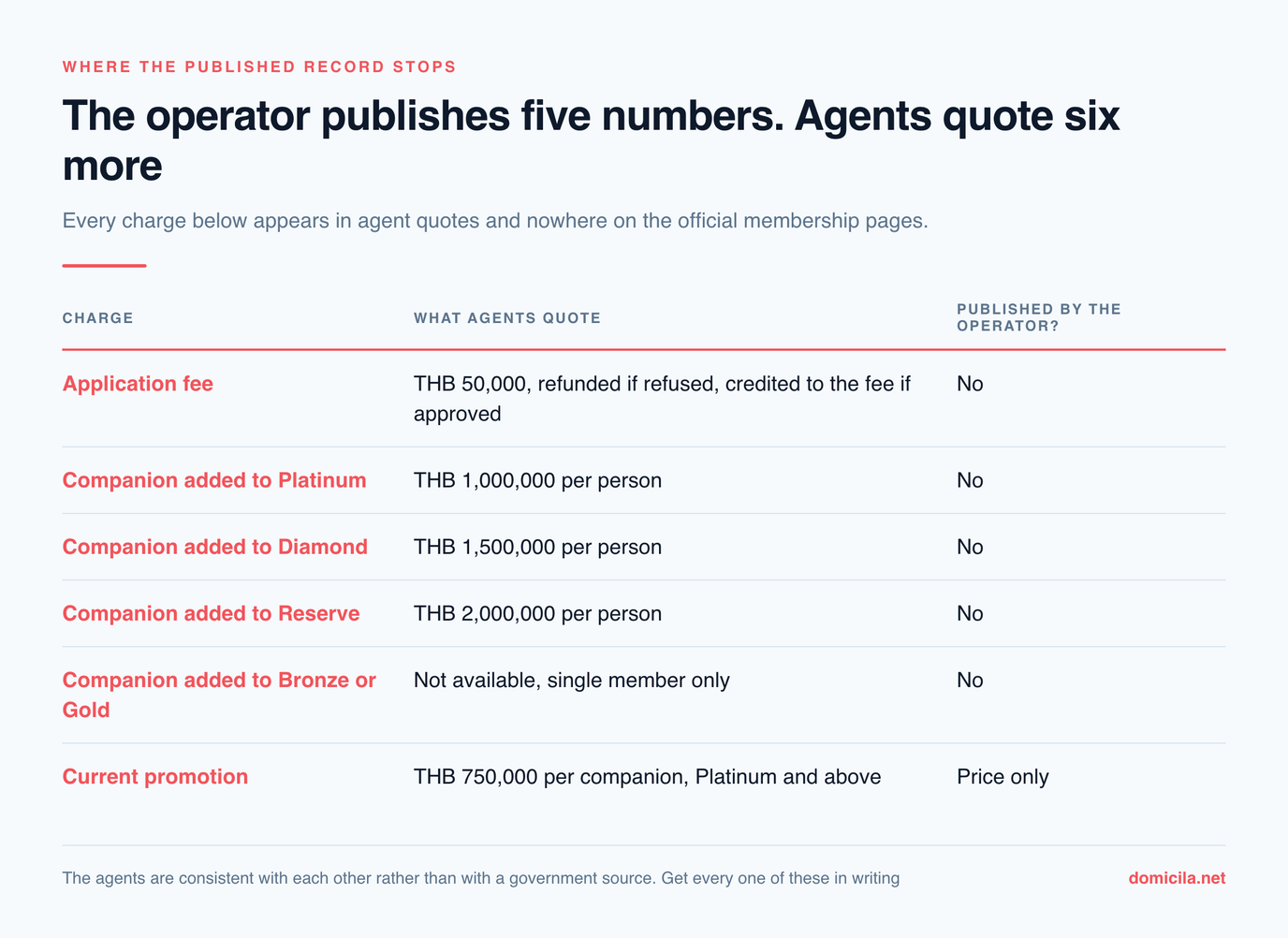
| Tier | Membership fee | Validity | Privilege Points per year | Cost per year |
|---|---|---|---|---|
| Bronze | THB 650,000 | 5 years | 0 | THB 130,000 |
| Gold | THB 900,000 | 5 years | 20 | THB 180,000 |
| Platinum | THB 1,500,000 | 10 years | 35 | THB 150,000 |
| Diamond | THB 2,500,000 | 15 years | 55 | THB 166,667 |
| Reserve (by invitation only) | THB 5,000,000 | 20 years | 120 | THB 250,000 |
In hard currency at the European Central Bank reference rate of 32.995 baht to the dollar on 10 September 2026, that is roughly USD 19,700 for Bronze, USD 27,280 for Gold, USD 45,460 for Platinum, USD 75,770 for Diamond and USD 151,540 for Reserve. Those conversions move with the exchange rate and the operator bills in baht, so treat them as a sense of scale rather than a price.
The fee is charged once, up front, for the whole term. There is no annual renewal charge, no income test and no requirement to buy property, which is the genuine attraction of the programme and the reason it keeps selling against cheaper visas with paperwork attached. What you are buying is a multiple-entry visa with a one-year stay per entry, renewed inside the country for the life of the membership, plus airport fast-track and a concierge that handles 90-day reporting for you.
Privilege Points are the operator's internal currency for those concierge services, redeemable against airport transfers, golf, spa and health checks. Bronze gets none. Gold gets 20 a year for the THB 250,000 it costs above Bronze, which works out at THB 2,500 per point over the five-year term. Whether that is worth anything depends entirely on whether you would otherwise pay for limousine transfers, and most buyers would not.
The fees the operator does not publish
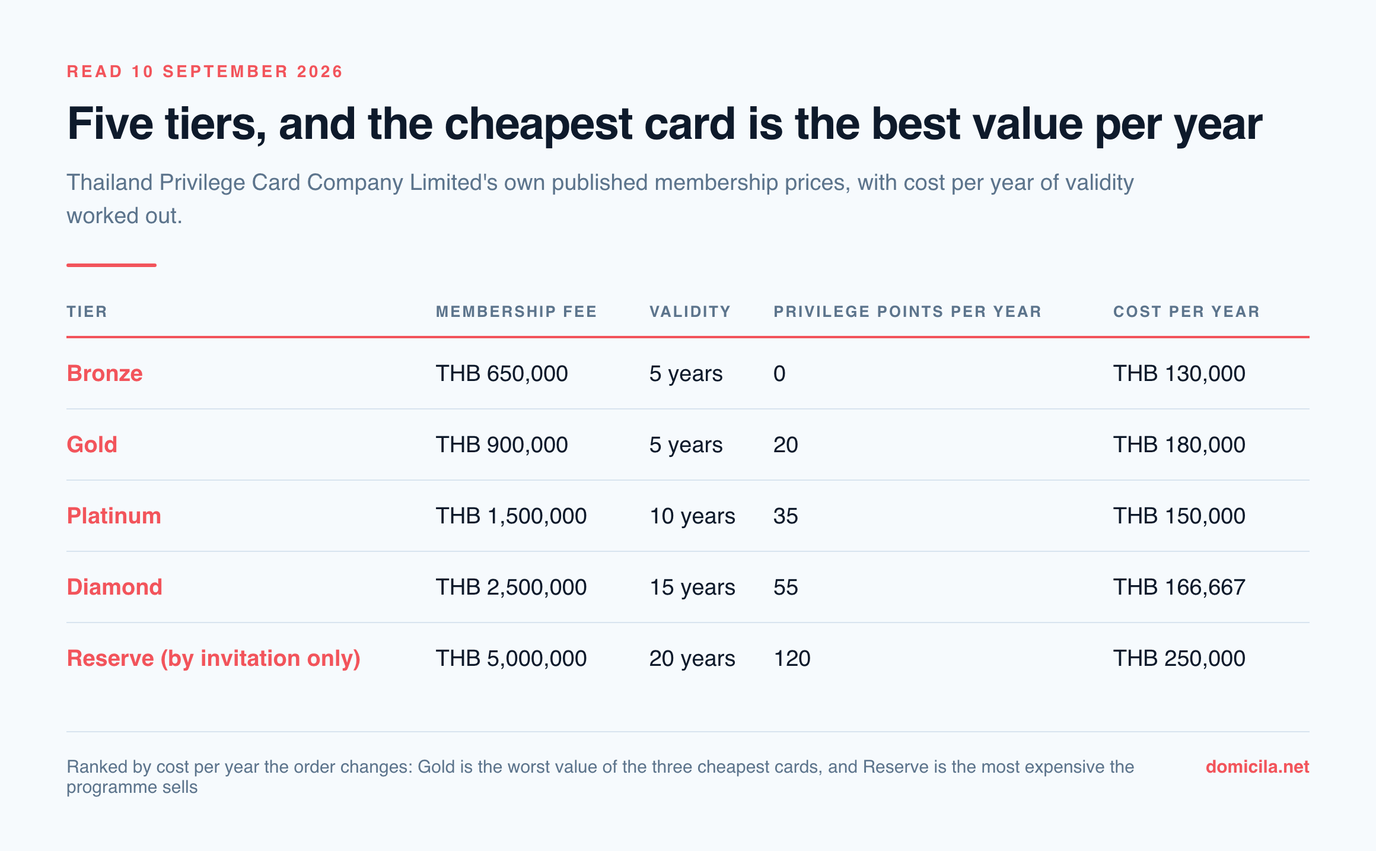
This is where the published record stops and the market takes over. Thailand Privilege Card Company Limited publishes the membership fee, the validity and the points allocation for each tier. It publishes nothing else. Every other number you will be quoted comes from an agent, and the agents are consistent with each other rather than with a government source.
| Charge | What agents quote | Published by the operator? |
|---|---|---|
| Application fee | THB 50,000, refunded if refused, credited to the fee if approved | No |
| Companion added to Platinum | THB 1,000,000 per person | No |
| Companion added to Diamond | THB 1,500,000 per person | No |
| Companion added to Reserve | THB 2,000,000 per person | No |
| Companion added to Bronze or Gold | not available, single member only | No |
| Current promotion | THB 750,000 per companion, Platinum and above | Price only |
| Annual or renewal fee | none | No |
The promotion is the clearest illustration of the problem. The operator's newsroom carries an item headed "Next Member promotion only THB 750,000", so the price is official. The terms are not: the body of that announcement is a picture, with no readable text saying which tiers qualify, how many companions you may add or when the offer closes. Agents fill the gap by saying it runs to the end of September 2026 on Platinum and above, and that may well be right, but it is not something the operator has written down where a buyer can check it.
Take the numbers at face value for a moment and the family arithmetic is stark. A couple on Platinum is THB 2,500,000 at the standard companion rate, or THB 2,250,000 at the promotional rate, against THB 1,500,000 for one person. Adding a spouse costs two thirds of the entire membership. Our guide to what family members add to a citizenship or residency application covers the same pattern in the Caribbean programmes, where the second applicant is usually a fraction of the first.
None of this makes the programme a bad buy. It makes it an unusually opaque one for something operated by a state enterprise, and it means the only price you should treat as fixed is the one on the tier page. Get everything else quoted in writing, on the operator's letterhead rather than an agent's, before you transfer anything.
Membership fees are quoted and collected in Thai baht. Converting at a bank's retail rate rather than the mid-market rate on a seven-figure baht payment is a real cost on top of the fee, so price the transfer before you send it.
Thailand Elite visa cost per year is the only honest comparison
Headline prices are useless for comparing tiers, because each one buys a different number of years. Divide the fee by the term and the ranking rearranges itself in a way the sales material never shows you.
| Rank by value | Tier | Cost per year | Premium over Bronze |
|---|---|---|---|
| 1 | Bronze | THB 130,000 | — |
| 2 | Platinum | THB 150,000 | THB 20,000 a year |
| 3 | Diamond | THB 166,667 | THB 36,667 a year |
| 4 | Gold | THB 180,000 | THB 50,000 a year |
| 5 | Reserve | THB 250,000 | THB 120,000 a year |
Gold is the tier to think hardest about. It costs THB 250,000 more than Bronze and gives you nothing extra except 20 Privilege Points a year for the same five years. Platinum costs THB 600,000 more than Gold and doubles the term, so per year of stay it is cheaper. If you are confident you want a decade in Thailand, the jump from Gold to Platinum is better value than the jump from Bronze to Gold, which is the opposite of how the tiers are usually sold.
Reserve deserves its own note. At THB 250,000 a year it is nearly twice the cost of Bronze per year of validity, and it is the only tier you cannot simply buy: the operator lists it as by invitation only. Twenty years is also a long commitment to a programme whose terms have already been restructured once, in October 2023, with the previous packages withdrawn.
One caveat applies to the whole table. It assumes you use the full term, and a membership is a personal, non-transferable arrangement except through the operator's own transfer process, whose fees the operator adjusted with effect from 15 June 2026. If there is a realistic chance you will leave Thailand after three years, the per-year figure for a fifteen or twenty year card is a fiction and Bronze is the only tier that makes arithmetic sense.
The LTR visa does the same job for THB 50,000
Here is the comparison the agent pages leave out, and it is the single most useful thing on this page. The Thailand Board of Investment runs a Long-Term Resident visa that is valid for ten years, the same as Platinum, and charges THB 50,000 per person for it. That is one thirtieth of the Platinum membership fee.
| Thailand Privilege Platinum | LTR visa | Destination Thailand Visa | |
|---|---|---|---|
| Charged by | Thailand Privilege Card Co., Ltd. | Board of Investment | Ministry of Foreign Affairs |
| Headline cost | THB 1,500,000 | THB 50,000 per person | set by the issuing embassy |
| Term | 10 years | 10 years, issued 5 plus 5 | 5 years, multiple entry |
| Qualifying test | background check only | income, asset or investment thresholds | THB 500,000 bank balance |
| Work permit | not included | available to employed holders | no Thai employment |
| Immigration reporting | every 90 days | annual | every 90 days |
| Tax feature | none | 17 per cent rate for highly-skilled professionals | none |
The catch is qualification. The LTR visa has four categories and each carries a real test: highly-skilled professionals and work-from-Thailand professionals need USD 80,000 of annual income over the past two years, wealthy global citizens need USD 1 million in assets and a USD 500,000 investment in Thailand, and wealthy pensioners need to be over 50 with USD 80,000 of passive income, or USD 40,000 plus a USD 250,000 investment. All four also require health cover of at least USD 50,000 or a USD 100,000 deposit.
So the honest way to frame the choice is this. If you clear an LTR category, the membership is very hard to justify on cost, and the work permit and annual reporting make the LTR better on substance too. If you do not clear one, or you would rather not hand over two years of income documentation and a source-of-funds file, the membership is what you are actually paying for: a long visa with no financial test.
There is a third option below both. The Ministry of Foreign Affairs issues the Destination Thailand Visa, valid five years, multiple entry, on evidence of a THB 500,000 bank balance held over three months and a criminal record certificate. The fee is set by the issuing embassy rather than published centrally. Our digital nomad visa cost comparison sets it against the European equivalents, and it is the route most remote workers should price first.

What the card does not buy you
The word most often misused about this programme is residency. A Thailand Privilege membership is a long-stay visa attached to a paid membership of a state-owned company. It is not permanent residence, it is not a route to permanent residence, and it does not count toward the residence history that a Thai permanent residence or naturalisation application is assessed on.
It carries no right to work. The visa does not include a work permit, and employment in Thailand on it requires a separate permit obtained the normal way through an employer. This is the practical difference from the LTR visa, which is built to carry one, and it is why remote workers whose clients are all outside Thailand tend to end up on the Destination Thailand Visa instead.
It includes no health cover. Nothing in the membership fee pays for insurance, and unlike the LTR visa there is no minimum cover requirement to satisfy, which means the responsibility for arranging it sits entirely with you. Our guide to health insurance requirements on residency programmes sets out what the European schemes demand by comparison, and the contrast is instructive.
It also does not remove immigration obligations. Holders still report their address to immigration every 90 days, though the membership concierge files it on their behalf, and still re-enter and re-stamp on the normal cycle. If you are weighing this against a programme that leads somewhere permanent, our comparison of citizenship by investment against golden visas is the frame to use: this is neither, and pricing it as though it were is the most common mistake buyers make.

Staying 180 days changes your tax position
A long visa is only a good idea if you have priced what it does to your tax position, and this is the part of the decision the sales pages handle worst. The Revenue Department's own rule is unambiguous: a resident is any person residing in Thailand for a period or periods aggregating more than 180 days in a calendar year, and a resident pays tax on Thai income and on foreign income brought into Thailand.
| Taxable income (baht) | Rate |
|---|---|
| 0 to 150,000 | exempt |
| over 150,000 up to 300,000 | 5 per cent |
| over 300,000 up to 500,000 | 10 per cent |
| over 500,000 up to 750,000 | 15 per cent |
| over 750,000 up to 1,000,000 | 20 per cent |
| over 1,000,000 up to 2,000,000 | 25 per cent |
| over 2,000,000 up to 4,000,000 | 30 per cent |
| over 4,000,000 | 35 per cent |
Two things changed recently and both cut against the old received wisdom. Departmental Order Por. 161/2566 took effect on 1 January 2024 and made foreign income taxable in the year it is remitted to Thailand regardless of the year it was earned, which closed the long-standing planning trick of parking income offshore for a calendar year before bringing it in. A relaxation exempting income remitted within two tax years of arising was drafted during 2025 and, at the time of writing, has not been enacted.
The practical consequence for a buyer of this visa is that the membership fee is not the largest number in the decision. Somebody on a USD 150,000 income who moves from a low-tax base and then remits living costs into Thailand while resident can face a Thai liability that dwarfs the difference between Bronze and Diamond. That is a matter for a Thai tax adviser and your own home-country rules, not for a comparison page, but it should be priced before the visa rather than after it.
Worth noting too: the LTR visa's 17 per cent flat rate for highly-skilled professionals is a tax feature the membership simply does not have. If your income is Thai-sourced employment income at a senior level, that gap is likely to be worth more each year than the entire Privilege membership costs once.

What changed in 2026, and what to get in writing
Three things moved this year and all three are worth a question before you sign. The operator adjusted the prevailing rate for membership transfer fees on the older Lifetime, Elite Ultimate Privilege and Elite Family Premium memberships with effect from 15 June 2026, which is a reminder that the terms attached to a twenty-year product are not frozen for twenty years. It also posted a notice about delays in background check processing, so the one to three months agents quote for approval should be treated as an estimate rather than a service level.
The third is the THB 750,000 companion promotion, whose price is official and whose terms are not published in readable form. If you are buying for two people, that difference is THB 250,000 to THB 750,000 depending on the tier, and it is the single largest variable on this page after the tier itself.
So, the questions. Ask the operator to confirm in writing the application fee, whether it is credited against the membership fee on approval and refunded on refusal, and to state the companion fee for your tier and whether the promotional rate applies to your application date. Ask what happens to the fee if the background check fails, and what happens if you surrender or transfer the membership part-way through the term.
Then ask an entirely different question, which is whether you qualify for an LTR visa. If you do, the Board of Investment's THB 50,000 is on the table and the burden shifts to the seller to explain what the remaining THB 1,450,000 buys. If you do not, at least you will have priced the alternative rather than taken an agent's word that none exists. Our golden visa cost comparison applies the same test to the European programmes, where the gap between the advertised investment and the non-recoverable cost is usually the whole story.

Related guides on Domicila
If you are pricing a long stay against the alternatives, these are the comparisons that do the most work:
- Digital nomad visa cost comparison — Thailand's DTV against the European remote-work visas
- Golden visa cost comparison — Portugal, Greece, the UAE and Malta with the full fee tables
- Cheapest golden visa — why the lowest advertised threshold is rarely the lowest real cost
- Golden visa countries — which residency-by-investment programmes are still open
- Citizenship by investment vs golden visa — what a passport buys that a residence permit does not
- Citizenship by investment family cost — what a spouse and children add to a programme's price
Common questions
How much does the Thailand Elite visa cost in 2026?
The five current tiers are Bronze at THB 650,000 for five years, Gold at THB 900,000 for five years, Platinum at THB 1,500,000 for ten years, Diamond at THB 2,500,000 for fifteen years and Reserve at THB 5,000,000 for twenty years. At 32.995 baht to the dollar on 10 September 2026 that is roughly USD 19,700 to USD 151,540. Figures published by Thailand Privilege Card Company Limited, checked 10 September 2026.
Is there an application fee on top of the membership fee?
Agents consistently quote a THB 50,000 application fee, refunded if the application is refused and credited against the membership fee if it is approved. The operator does not publish that figure anywhere on its own site. Ask for it in writing from the operator rather than the agent, together with confirmation of what happens to it if the background check is not passed.
Which tier is the best value?
By cost per year of validity, Bronze at THB 130,000 a year and Platinum at THB 150,000 a year are the two strongest. Gold is THB 180,000 a year and Diamond THB 166,667, so Gold is worse value than the longer Platinum card. Reserve is THB 250,000 a year and is offered by invitation only. These rankings assume you use the full term.
What does it cost to add a spouse?
Agents quote THB 1,000,000 per companion on Platinum, THB 1,500,000 on Diamond and THB 2,000,000 on Reserve, with Bronze and Gold sold to a single member only. The operator is currently advertising a companion price of THB 750,000, but publishes only the headline figure and not the qualifying tiers or the closing date. None of the companion fees appear on the operator's membership pages.
Is there a cheaper long-stay visa for Thailand?
Yes, if you qualify. The Board of Investment's Long-Term Resident visa is valid ten years and costs THB 50,000 per person, which is a thirtieth of the Platinum membership, and it can carry a work permit and replaces 90-day reporting with an annual report. It requires income, asset or investment thresholds that the membership does not, such as USD 80,000 of annual income for skilled professionals.
Does the Thailand Privilege visa give permanent residency or citizenship?
No. It is a long-stay visa attached to a paid membership of a state enterprise. It is not permanent residence, it is not a route to permanent residence, and it does not carry a work permit or health insurance. Employment in Thailand needs a separate work permit obtained through an employer in the normal way.
Will I pay Thai tax if I live in Thailand on this visa?
Possibly. The Revenue Department treats anyone in Thailand for more than 180 days in a calendar year as a tax resident, taxable on Thai-source income and on foreign income brought into Thailand at progressive rates rising to 35 per cent. Departmental Order Por. 161/2566, effective 1 January 2024, made remitted foreign income taxable regardless of the year it was earned. A relaxation drafted in 2025 has not been enacted. Take Thai tax advice before you move.
Why do older pages quote different Thailand Elite packages?
The programme was restructured in October 2023 and now trades as Thailand Privilege. The earlier packages, including Elite Easy Access and Elite Ultimate Privilege, are listed as discontinued on the operator's own site, and existing holders of them are directed to the member contact centre. A page still quoting those names and prices has not been updated since 2023 and should not be used to budget.
Official sources to verify
- Privileges Membership — Bronze, Gold, Platinum, Diamond and Reserve packagesThailand Privilege Card Company Limited
- Who We Are — a state enterprise wholly owned by the Tourism Authority of ThailandThailand Privilege Card Company Limited
- Long-Term Resident (LTR) Visa — qualifications, benefits and government feeThailand Board of Investment
- Destination Thailand Visa (DTV) — entry conditions and required documentsMinistry of Foreign Affairs of the Kingdom of Thailand
- Personal Income Tax — residence rule and progressive ratesThe Revenue Department, Kingdom of Thailand
Compare golden visa advisors
Ask for a route-specific quote that separates investment amount, government fees, legal work, fund or property costs, and renewal obligations.
We may earn a referral fee if you choose an advisor through this site. We still aim to show cost ranges, caveats, and official source links plainly.