andorra golden visa cost
Andorra Golden Visa Cost 2026: Now €1 Million
The Andorra golden visa cost is quoted on page one of Google as €600,000, and on at least one site as a €15,000 deposit. Both numbers are dead. Andorra has never had a programme called a golden visa — what people mean is the residence authorisation without lucrative activity, the investor track of the residence-without-work permit — and Law 2/2026 of 22 January, the second omnibus law, repriced it. The qualifying investment is now **€1,000,000** in Andorran assets, the €47,500 deposit that used to come back when you left has become a **€50,000 payment that does not**, and each dependant costs €12,000 on the same terms. There is a second number nobody computes: the income test is 300% of the Andorran minimum wage, which from 1 July 2026 is €1,568.66 a month, so the real figure is €56,471.76 a year for one person and not the €49,200 or €52,100 the ranking pages print. We priced every line against the Govern d'Andorra's own residence-without-work page, the CASS circular carrying Decree 253/2026, and two Andorran firms' readings of Law 2/2026, all read on 9 November 2026 — and we say plainly which figures the Govern has not yet published.

Key takeaways
- The number is €1,000,000, not €600,000. Law 2/2026 of 22 January 2026, the second omnibus law, raised the qualifying investment for residence without lucrative activity from €600,000 to €1,000,000 in Andorran assets. Andorra's public broadcaster reported the rise as it passed; the pages ranking for this keyword still print the old figure.
- The deposit stopped being a deposit. What was a €47,500 interest-free deposit you got back when the permit ended is now a €50,000 payment that is not returned, plus €12,000 per dependant on the same terms. That is the single most expensive change and the one no competing page mentions.
- If you go in through property, each unit has to clear €800,000. Both Andorran advisers we read put a per-dwelling floor on the real-estate route, so you cannot assemble €1,000,000 out of two modest flats. A €400,000 contribution to the Housing Fund is reported as the alternative route.
- The income test is €56,471.76, and everyone gets it wrong. The requirement is 300% of the annual minimum wage plus 100% per dependant. The minimum wage has been €1,568.66 a month since 1 July 2026, so the main holder must show €56,471.76 a year and each dependant €18,823.92 on top.
- The Govern's own page does not currently list this route at all. On 9 November 2026 the official residence-without-work page sets out three categories — international professionals, science and culture, and private care homes — and not the investor one. Confirm every figure with the Servei d'Immigració before you move money.
On this page
Every figure below is tied to the document that states it, and where two sources disagree we say so rather than pick the prettier number. The difficulty with this subject is not secrecy: the Govern publishes the conditions, the quota rule and the permit ladder, and the CASS publishes the minimum wage the income test runs off. The difficulty is that Law 2/2026 moved the price in February 2026 and almost nothing on page one has been updated since. This site's renderer does not emit heading anchors, so the list below is a map rather than jump links.
- What Andorra actually offers, and why it is not a golden visa
- What the Andorra golden visa cost is after Law 2/2026
- The €50,000 that used to come back
- The income test nobody computes
- The conditions the Govern still publishes
- What the official page does not say right now
- Andorra's tax position, which is the real reason people ask
- What Andorra does not give you
- What to confirm before you commit
- Related guides on Domicila
What Andorra actually offers, and why it is not a golden visa
Andorra has no programme called a golden visa, and anybody selling you one is using a search term rather than a legal instrument. What exists is the autorització de residència sense treball — residence without work — and it comes in several categories, only one of which is bought with capital.
That distinction matters for cost, because the categories are priced completely differently. The investor track, historically numbered D.1.1 and described in the law as residence without lucrative activity, is the one Law 2/2026 repriced to €1,000,000. The other three ask for a fraction of that and are the ones the Govern's page currently sets out:
| Category | What it is for | Deposit the Govern publishes | Permit term |
|---|---|---|---|
| Residence without lucrative activity (investor) | Living in Andorra on your own capital, no local activity | Repriced by Law 2/2026 — see below | 2 years, then 2, then 3, then 10 |
| D.1.2 International professionals | A professional base in Andorra, max one employee, ≥ 85% of services used abroad | €47,500 + €9,500 per dependant | 2 years, then 2, then 3, then 10 |
| D.1.3 Science, culture and sport | Internationally recognised talent, ≥ 85% of services used abroad | €47,500 + €9,500 per dependant | 2 years, then 2, then 3, then 10 |
| D.1.4 Private geriatric or medical care | Residing in a private care or therapeutic centre, no work | Not stated on the page | 1 year, renewable yearly |
Two of those deposits are worth holding on to, because they are the clearest surviving evidence of what the investor deposit used to be. €47,500 for the main holder and €9,500 per dependant is exactly the pair that commercial guides still quote for the investor route, which tells you those guides are describing the pre-2026 regime.
All four categories share a floor that surprises people: you must establish your principal and effective residence in Andorra for at least 90 days per calendar year, and you must take up a place within the quota set by regulation. The quota is the part that cannot be bought. Everything after this section is about the investor track.
What the Andorra golden visa cost is after Law 2/2026
Start by separating two numbers that nearly every page on this subject runs together, because on this route the gap between them is the whole story. The threshold is what you have to put into a qualifying Andorran asset and keep there. The cost is what leaves your account and does not come back.
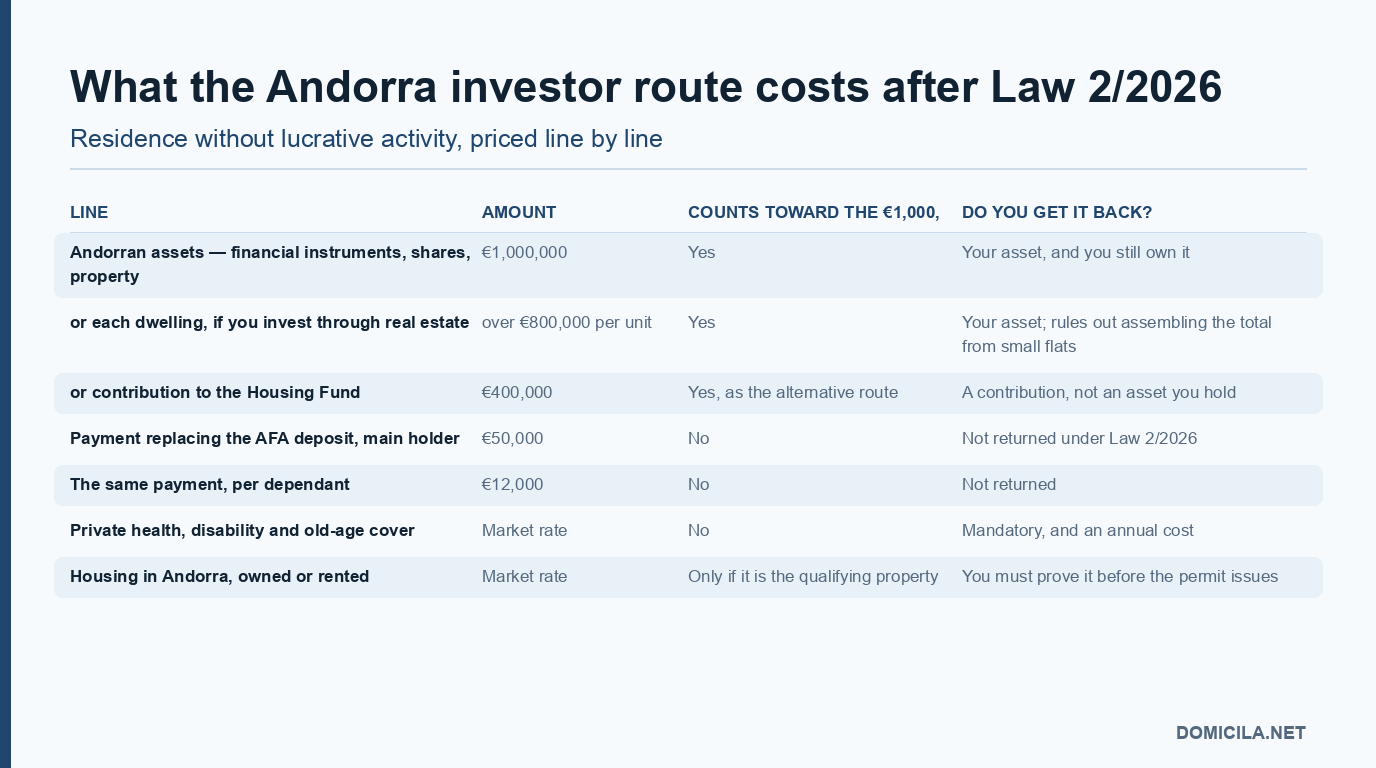
Law 2/2026, of 22 January 2026 — the llei òmnibus 2 — moved both. Andorran advisers reading the law put the qualifying investment at €1,000,000 in Andorran assets, which can include authorised financial instruments and shares in Andorran companies as well as property, with a floor of more than €800,000 on each dwelling acquired if you use the real-estate route, and a €400,000 contribution to the Housing Fund as the alternative. Here is what the million is, and what it is not:
| Component | Amount | Counts toward the threshold | What it is |
|---|---|---|---|
| Andorran assets — financial instruments, shares in Andorran companies, property | €1,000,000 | Yes | Your asset, and you still own it |
| or each dwelling, if you invest through real estate | over €800,000 per unit | Yes | Your asset; rules out assembling the total from small flats |
| or contribution to the Housing Fund | €400,000 | Yes, as the alternative route | A contribution, not an asset you hold |
| Payment replacing the AFA deposit, main holder | €50,000 | No | Not returned under Law 2/2026 |
| The same payment, per dependant | €12,000 | No | Not returned |
| Private health, disability and old-age cover | Market rate | No | Mandatory, and an annual cost |
| Housing in Andorra, owned or rented | Market rate | Only if it is the qualifying property | You must prove it before the permit issues |
So the honest answer to what the Andorra golden visa cost is in 2026 has two halves. You must hold a million euros of Andorran assets, and you must spend €50,000 that you will not see again, plus €12,000 for each person you bring. For a couple with two children that is €86,000 of unrecoverable payments on top of the million, before a single professional fee.
That is a different proposition from Spain's scheme, which closed to new applicants, or from the fund routes our golden visa cost comparison lines up side by side. It is also a reminder that a high threshold and a high cost are not the same thing — the cheapest golden visa on cash actually spent is rarely the one with the smallest headline.
The €50,000 that used to come back
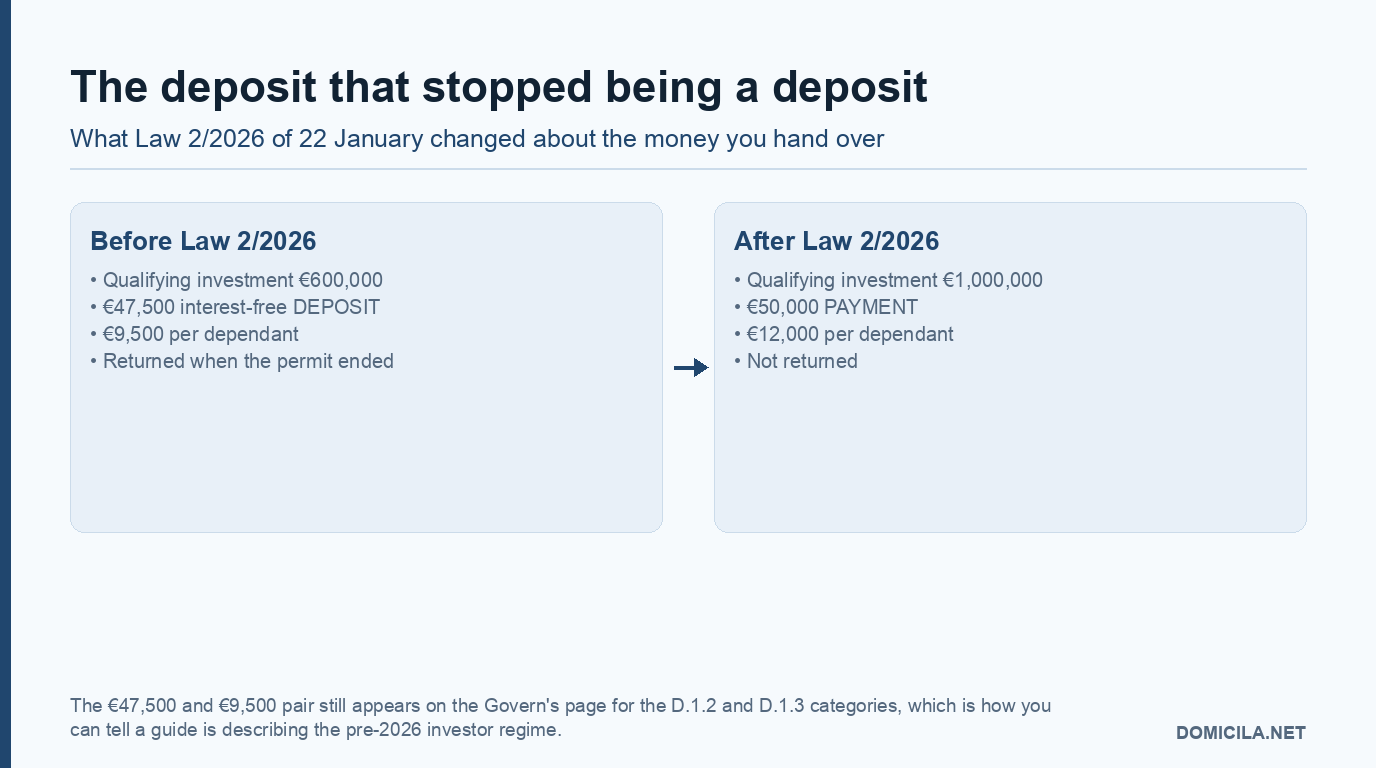
This is the change that costs real money, and it is the one we could not find on any page ranking for the keyword. Under the old regime the main holder deposited €47,500 with the Autoritat Financera Andorrana. It earned no interest, and it was refundable — when the permit ended, the money was yours. Dependants cost €9,500 each on the same refundable basis.
Law 2/2026 keeps the payment and removes the refund. The main holder now pays €50,000 and each dependant €12,000, and those amounts are not returned when you leave. In cash terms the increase is €2,500 on the headline and €50,000 on the economics, because a refundable deposit is a liquidity cost and a non-refundable payment is a purchase.
Our sources diverge on two points of detail, and we would rather flag that than smooth it over. One Andorran firm describes the €50,000 as going to the AFA as before, now simply non-refundable. The text of the bill as it went through the Consell General described an ingrés in favour of Tributs, the tax authority, treated as a tax credit offsettable against future taxes — which would make it something closer to prepaid tax than a fee. A third source says it is returned if the initial application is refused.
Those are three materially different things, and the difference is €50,000 of your money. The bill was amended during passage — the million-euro figure itself arrived as an amendment, which is why the earlier draft text reads differently from the firms' summaries of the final law — so we are not willing to state which version survived without the BOPA text in front of us. Ask the Servei d'Immigració whether the €50,000 is a fee, a deposit or a tax credit, and get the answer in writing. It is the single most valuable question you can ask about this route.
Exceptions are reported for companies set up around a business project validated by a government-recognised body, and for digital economy, innovation and technology activities meeting criteria set by regulation. If your plan involves an operating Andorran company rather than passive capital, that is worth pursuing, because it may take you out of this payment altogether.
The income test nobody computes
Every competitor states the income requirement the same way: 300% of the Andorran minimum wage. Then each of them converts it using a minimum wage that is out of date, and arrives at a different wrong answer — €49,200 on one page, €52,100 on another, from a site that elsewhere puts the minimum wage at €1,371 and €2,100 in two different places.
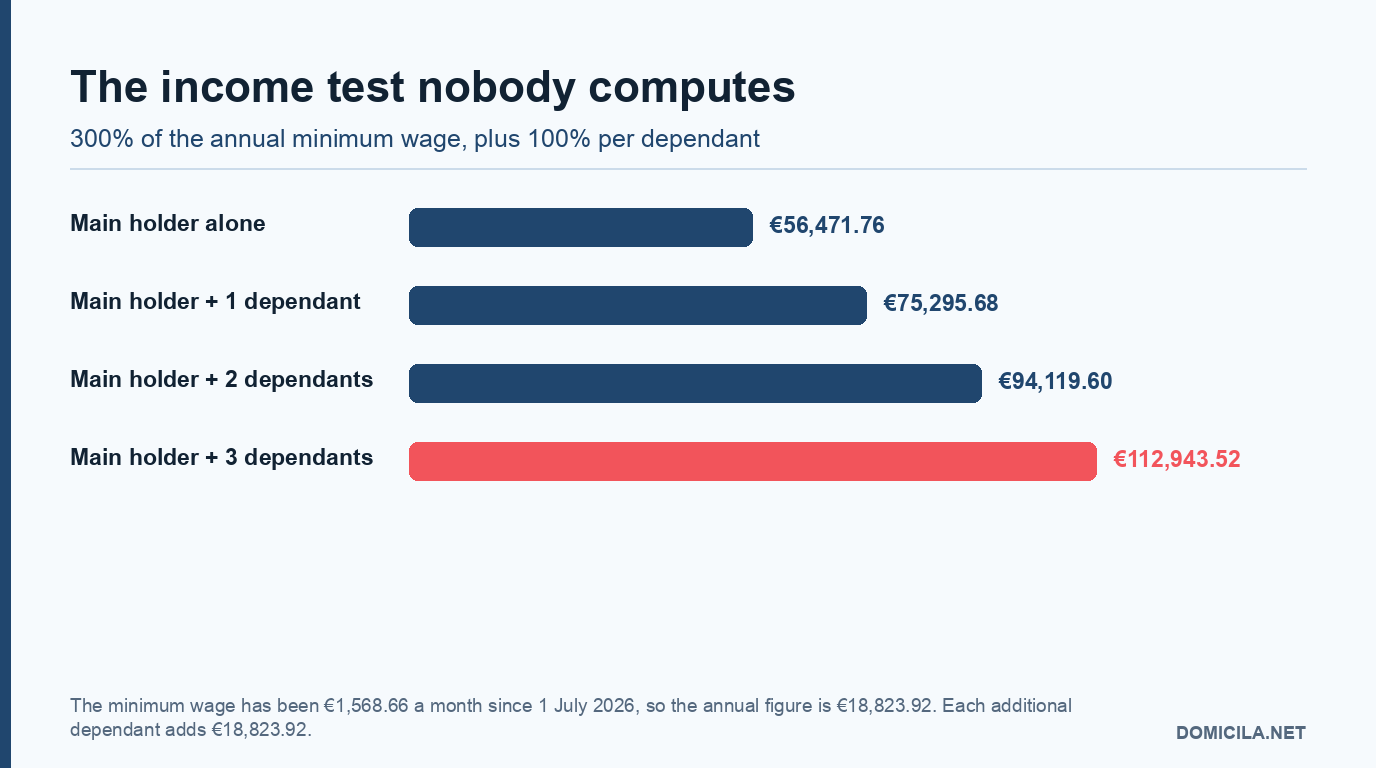
The arithmetic is not hard, and the Govern even shows its working on the page: salari base x 12 mesos x 3. What you need is the current minimum wage, which is published by the CASS. Decree 253/2026 of 1 July 2026, amending Decree 8/2026 of 14 January 2026 and carried in BOPA number 77 of 8 July 2026, set it at €1,568.66 a month — €9.05 an hour, €72.40 a day. That gives:
| Household | Multiplier | Annual income to prove |
|---|---|---|
| Main holder alone | 300% of €18,823.92 | €56,471.76 |
| Main holder + 1 dependant | +100% | €75,295.68 |
| Main holder + 2 dependants | +200% | €94,119.60 |
| Main holder + 3 dependants | +300% | €112,943.52 |
| Each additional dependant | +100% | +€18,823.92 |
The requirement is to demonstrate that income, not to transfer it — the page lists a pension certificate, the previous year's tax return from your last country of residence and bank certifications among the acceptable evidence. One commercial guide tells readers they must move €52,100 into an Andorran bank account. That is a sales process, not the rule.
Note also that this figure moves twice a year in practice. The 2026 minimum wage started at €1,525.33 under Decree 8/2026 and rose 2.8% on 1 July. If you are budgeting a renewal, budget the indexation: the same test applies at every renewal, against whatever the minimum wage is then.
The conditions the Govern still publishes
Whatever happened to the investment figure, the conditions attached to a residence-without-work permit are published, current and identical across the categories. We read them on the Govern's own page on 9 November 2026. They are where applications actually fail, because most of them expire.
| Condition | What is required |
|---|---|
| Physical presence | Principal and effective residence in Andorra at least 90 days per calendar year, as a signed commitment |
| Quota | A place within the quota established by regulation |
| Housing | Proof of ownership or a lease meeting minimum habitability, or proof you have started a purchase to be completed within one year |
| Insurance | Illness, disability and old-age cover valid for Andorra for you and your dependants; minors and over-60s need illness cover only |
| Income | Over 300% of the annual minimum wage, plus 100% per dependant |
| Criminal record | Certificates from your country of origin, your country of nationality and every country of residence, plus a sworn declaration |
| Identity | Valid passport, or national ID card for EU and EEA nationals |
| Photograph | One colour photo, 35 x 45 mm, taken within the previous six months |
| Civil status | Official certificate — single, marriage, separation, divorce, death, or Andorran civil-registry certificate for a stable union |
| Medical | Medical review and consent to medical tests |
| Registration | Register at the Comú of your parish within one month of the permit being granted, with the certificate issued within three months |
Two of these catch people out. The first is that every foreign official document must carry a Hague apostille or be properly legalised, which is a four-to-six week errand in most countries and cannot be started late. The second is the quota: the permit is not available on demand, and no amount of capital creates a place if the regulatory allocation is full.
The permit ladder is generous once you are in. The initial authorisation runs two years, the first renewal two more, the second renewal three, and subsequent renewals ten years at a time — except for nationals of states that have signed and ratified a convention with Andorra, who follow the renewal track instead. Renewal requires you to keep the investment in Andorran assets and to clear the income test again.
What the official page does not say right now
Here is the finding that sent us back to check our work three times. On 9 November 2026, the Govern d'Andorra's page for the initial residence-without-work authorisation sets out category D.1.2 for international professionals, D.1.3 for science, culture and sport, and D.1.4 for private geriatric and medical care. The investor category — residence without lucrative activity, the one this article is about — is not on the page. The phrase activitat lucrativa does not appear on it at all, and neither does any figure of €1,000,000, €600,000 or €400,000.
We are not going to tell you what that means, because we do not know, and the honest options are far apart. It could be a publishing gap, with the page awaiting the regulation that implements Law 2/2026. It could reflect the quota: Andorran press reported in January 2026 that passive residency applications had been paused after the allocation of 600 permits was exhausted, pending the new law. Or the route could be administered without a public trámit page while the regulation is drafted.
What we can say is that the documentation the page does list still includes two items written for the investor: a liquidació del dipòsit de l'AFA form and a compromís d'inversió en actius andorrans — an undertaking to invest in Andorran assets. Those belong to this route and nothing else. The machinery is there; the published description of it is not.
This is the opposite of how the market reads. Every commercial page we checked presents the route as open, priced and available, with a figure that predates February 2026. If you are planning around it, treat the availability question as live and unanswered, and put it to the Servei d'Immigració first — before the lawyers, before the bank, and certainly before an offer on a dwelling over €800,000.
Andorra's tax position, which is the real reason people ask
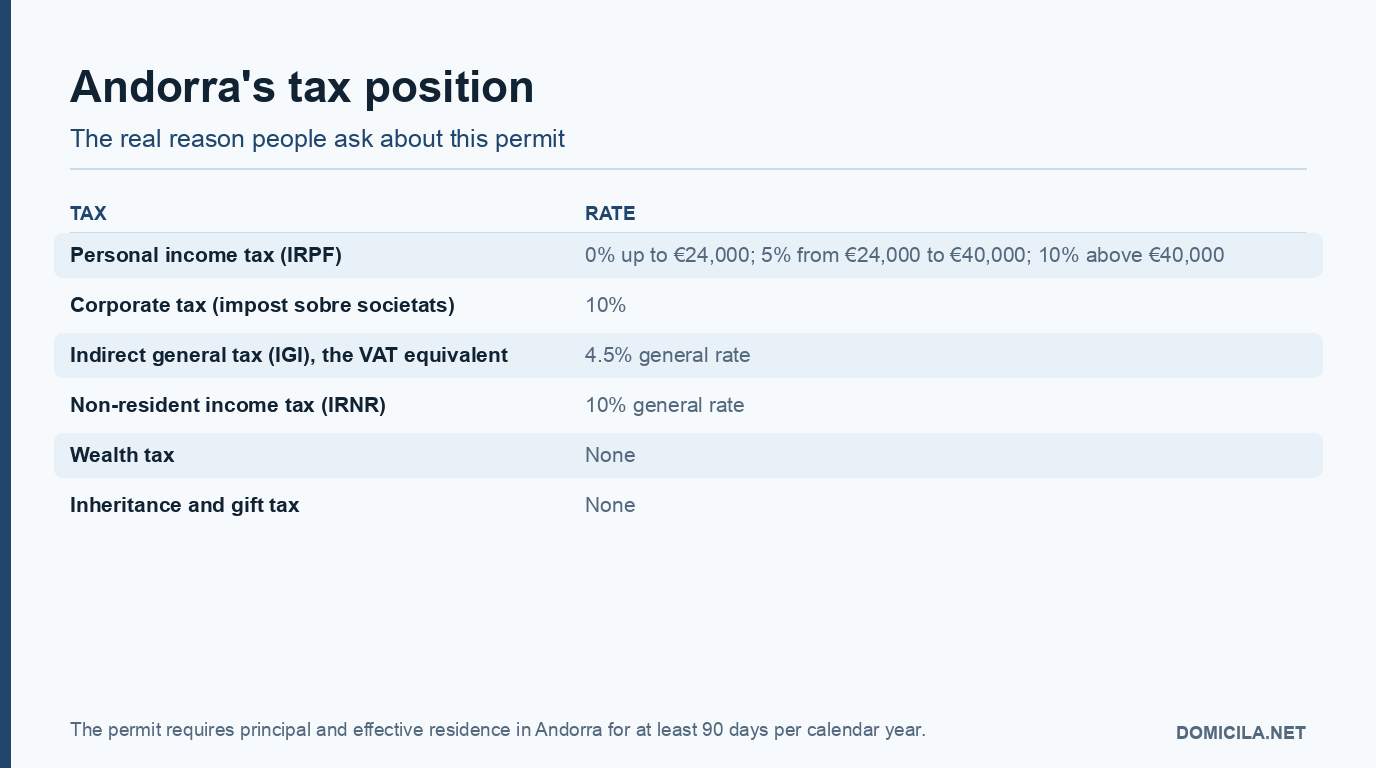
Nobody pays a million euros for the mountains alone. Andorra's draw is a tax system with a 10% ceiling on personal income, and it is worth being precise about it because the 90-day immigration rule and the tax-residence test are different numbers — a confusion that runs through most of the content on this subject.
| Tax | Published rate |
|---|---|
| Personal income tax (IRPF) | 0% up to €24,000; 5% from €24,000 to €40,000; 10% above €40,000 |
| Corporate tax (impost sobre societats) | 10% |
| Indirect general tax (IGI), the VAT equivalent | 4.5% general rate |
| Non-resident income tax (IRNR) | 10% general rate |
| Wealth tax | None |
| Inheritance and gift tax | None |
Those are the rates as published and widely reported; they are not quoted here from a BOPA text, so confirm them with the Departament de Tributs i de Fronteres before you model anything. The structural points are more useful than the percentages anyway.
The first is the gap between 90 and 183. Your immigration obligation is 90 days of effective residence a year. Tax residence in Andorra turns on remaining more than 183 days in the calendar year, per the Govern's own binding consultations. Spend 100 days in Andorra and you have satisfied the permit and have almost certainly not moved your tax residence anywhere — which means your home country's rules still decide where you pay. That is the single most common and most expensive misunderstanding about this route.
The second is that Andorra is a third country for tax treaty purposes with a short treaty network, so relief that EU residents take for granted may not be there. If the plan is to leave a high-tax EU state, the exit rules of the state you are leaving will matter more than Andorra's rates — which is the question our sister site Soveraine exists to answer.
What Andorra does not give you
Three things, and each of them is sold loosely enough that it is worth stating flatly.
It is not EU or Schengen access. Andorra is not a member of the European Union and not part of the Schengen area. In practice you reach it through France or Spain, and an Andorran residence permit is not a Schengen residence permit. The EU and Andorra have been negotiating an association agreement and have concluded an agreement on border management, so the position may change — but it is not a thing you can buy today.
It is not a passport, and the wait is twenty years. Andorran nationality generally requires 20 years of effective and permanent residence, plus examinations in Catalan and in the history and geography of the Principality. The qualified law on nationality was revised in 2026, reportedly to allow non-consecutive residence to count and to raise the marriage route from three years to five. Andorra does not generally permit dual nationality, so naturalisation normally means renouncing what you hold. There is no investment route to an Andorran passport at any price.
It is not a programme with guaranteed terms. The price moved by €400,000 in a single law in February 2026, and the deposit stopped being refundable in the same instrument. A route that has been repriced once can be repriced again, and nothing in the law promises you the terms you entered on at renewal. That is the same lesson as Spain's golden visa, and the reason Norway's non-existent programme is worth reading as a corrective: the brochure and the statute are different documents.
If what you actually want is European residence with a shorter horizon to citizenship, Portugal remains the obvious comparison, and Switzerland is the closer analogue for a lump-sum, low-tax, no-passport proposition.
What to confirm before you commit
Five questions, in this order, and all of them before money moves.
- Is the route open, and what is the quota position? Ask the Servei d'Immigració directly, given that the official page does not currently describe it.
- What is the €50,000, legally? A non-refundable fee, a deposit, or a tax credit against future Andorran tax. Get it in writing, and ask the same about the €12,000 per dependant.
- What exactly qualifies as an Andorran asset, and what is the per-dwelling floor? Confirm whether the real-estate floor is €800,000 per unit, and whether the €400,000 Housing Fund contribution is still an alternative.
- What will the property actually cost in tax? Andorra charges a tax on foreign investment in real estate and the rates were raised in 2026; one Andorran firm puts them at 6% on a first unit and 10% on each additional one. Verify the current rates before you offer.
- What does leaving your current country cost? Exit taxes, deemed disposals and 183-day rules at the other end routinely exceed everything on this page.
And one piece of process advice: get the apostilles moving on day one, because the criminal-record certificates and civil-status documents have shelf-lives and the legalisation queue does not care about your timetable.
Everything in this article is a description of published rules and reported amendments as at 9 November 2026, not advice, and nothing here promises that an application will be accepted. Andorran immigration decisions are discretionary and quota-bound. Take Andorran legal advice before you act.
Related guides on Domicila
If Andorra is on your list, these are the comparisons that answer the question it raises next:
- Golden visa cost comparison — every European route priced side by side, so a million euros has something to sit against.
- The cheapest golden visa — ranked on cash actually spent rather than on the headline threshold.
- Switzerland golden visa cost — the closest analogue: lump sum, low tax, no realistic passport.
- Portugal golden visa cost — the benchmark, and the one with a genuine citizenship horizon.
- Spain golden visa cost — what happens when a programme the market relied on is withdrawn.
- Norway citizenship by investment cost — a programme that does not exist, and how to tell.
- Citizenship by investment vs golden visa — the distinction Andorra makes starkly, since it sells residence and not nationality.
Common questions
Does Andorra have a golden visa?
No. Andorra has no programme of that name. What people mean by the term is the residence authorisation without lucrative activity, the investor track of the residence-without-work permit, which is granted within a quota set by regulation. It confers residence and not nationality, and the Govern administers it through its immigration service rather than as an investment-migration product.
What is the Andorra golden visa cost in 2026?
Law 2/2026 of 22 January 2026 raised the qualifying investment to 1,000,000 euros in Andorran assets. On top of that the main holder pays 50,000 euros that is not returned, plus 12,000 euros for each dependant on the same terms. The million is an asset you continue to own; the 50,000 and the 12,000 are money that leaves. Confirm all three figures with the Servei d'Immigracio, because the Govern's own trámit page did not publish them as at 9 November 2026.
Is the 50,000 euro payment refundable?
Not according to the Andorran advisers who have read Law 2/2026: it replaced a 47,500 euro refundable deposit held at the Autoritat Financera Andorrana and is now a payment that is not returned. The sources conflict on the detail, though. The bill as it passed through the Consell General described it as a payment to the tax authority treated as a credit against future taxes, and one source says it is returned if the initial application is refused. Ask for the answer in writing before paying.
How many days a year must I spend in Andorra?
At least 90 days per calendar year, as a principal and effective residence, and you sign a commitment to that effect as part of the application. Note that this is an immigration condition and not a tax test. Andorran tax residence turns on remaining more than 183 days in the calendar year, so meeting the permit requirement does not by itself move your tax residence to Andorra.
What income do I have to prove?
More than 300% of the annual Andorran minimum wage, plus 100% of that figure for each dependant. The minimum wage has been 1,568.66 euros a month since 1 July 2026 under Decree 253/2026, so the main holder must demonstrate 56,471.76 euros a year and each dependant a further 18,823.92 euros. The requirement is to demonstrate the income with evidence such as a pension certificate, a tax return or bank certifications, not to transfer it to an Andorran account.
Can I buy two apartments to reach the one million euros?
Both Andorran sources we read say no, because the real-estate route carries a floor of more than 800,000 euros on each dwelling acquired. A 400,000 euro contribution to the Housing Fund is reported as an alternative route to qualification. Because the per-unit floor is central to how you structure the investment, verify it against the published regulation before making an offer on any property.
Does Andorran residence lead to an Andorran passport?
Not on any timescale that makes it an investment proposition. Andorran nationality generally requires 20 years of effective and permanent residence together with examinations in Catalan and in Andorran history and geography, and Andorra does not generally permit dual nationality. There is no investment route to Andorran citizenship. Nothing in this route promises nationality, and immigration decisions are discretionary.
Official sources to verify
- D.1. Residència sense treball: autorització inicial (categories, deposits, conditions and permit terms), read 9 November 2026Govern d'Andorra
- D.2. Residència sense treball: autorització de renovacióGovern d'Andorra
- Normativa i legislació d’immigracióGovern d'Andorra, Ministeri de Justícia i Interior
- Circular informativa: salari mínim a partir de l’1 de juliol del 2026 (€1,568.66/month, Decree 253/2026, BOPA no. 77 of 8 July 2026)CASS / Servei d’Inspecció de Treball, Andorra
- La llei òmnibus 2 elevarà fins a 1 milió d’euros l’aportació exigida als residents passiusRTVA (Andorran public broadcaster)
- Butlletí Oficial del Principat d’Andorra (official gazette; Law 2/2026 of 22 January was published in BOPA no. 15 of 12 February 2026)Govern d'Andorra
- Omnibus 2 Law: new requirements for residence in Andorra (reading of Law 2/2026)Advantia, Andorra
- Residència passiva a Andorra: la nova Llei Òmnibus eleva la inversió a 1 milió d’eurosAndorraWay, Andorra
Compare golden visa advisors
Ask for a route-specific quote that separates investment amount, government fees, legal work, fund or property costs, and renewal obligations.
We may earn a referral fee if you choose an advisor through this site. We still aim to show cost ranges, caveats, and official source links plainly.