switzerland golden visa cost
Switzerland Golden Visa Cost 2026: Tax, Not Fee
Every page that quotes a Switzerland golden visa cost is pricing something that does not exist. There is no Swiss residency-by-investment programme, no application fee, and nothing to buy: what the market calls the Swiss golden visa is a residence permit granted at a canton's discretion to someone who agrees in advance to pay that canton a large amount of tax every year. The figure the consultancies circulate — we found CHF 421,700, 429,000, 434,700, 435,000 and 450,000 across the first page of results — is not even a price. It is a minimum taxable base, and the tax on it is a fraction of it. We read the figure out of the federal statute as amended for 2026, pulled the minimum base from eight cantons' own factsheets and the federal tax administration's cantonal sheets, and found the canton whose government published the arithmetic that converts a base into an actual bill.
Key takeaways
There is no Swiss golden visa, and no fee to pay. Switzerland has never legislated a residency-by-investment programme. The route the market sells is a residence permit under Article 30 paragraph 1 letter b of the Foreign Nationals and Integration Act, granted as a derogation from the ordinary admission rules, which the implementing ordinance allows where there are "significant cantonal fiscal interests". You do not buy it. A canton decides it is worth more in tax than it costs in quota.
CHF 435,000 is a taxable base, not a bill — and it is the federal floor only. Article 14 paragraph 3 letter a of the Federal Act on Direct Federal Tax sets the minimum amount on which expenditure-based tax is assessed. The figure rose to CHF 435,000 for 2026 by Article 3 of the Federal Finance Department's ordinance of 10 September 2025 on cold progression (AS 2025 579). The tax you owe is the ordinary tariff applied to that base, which is a fraction of it.
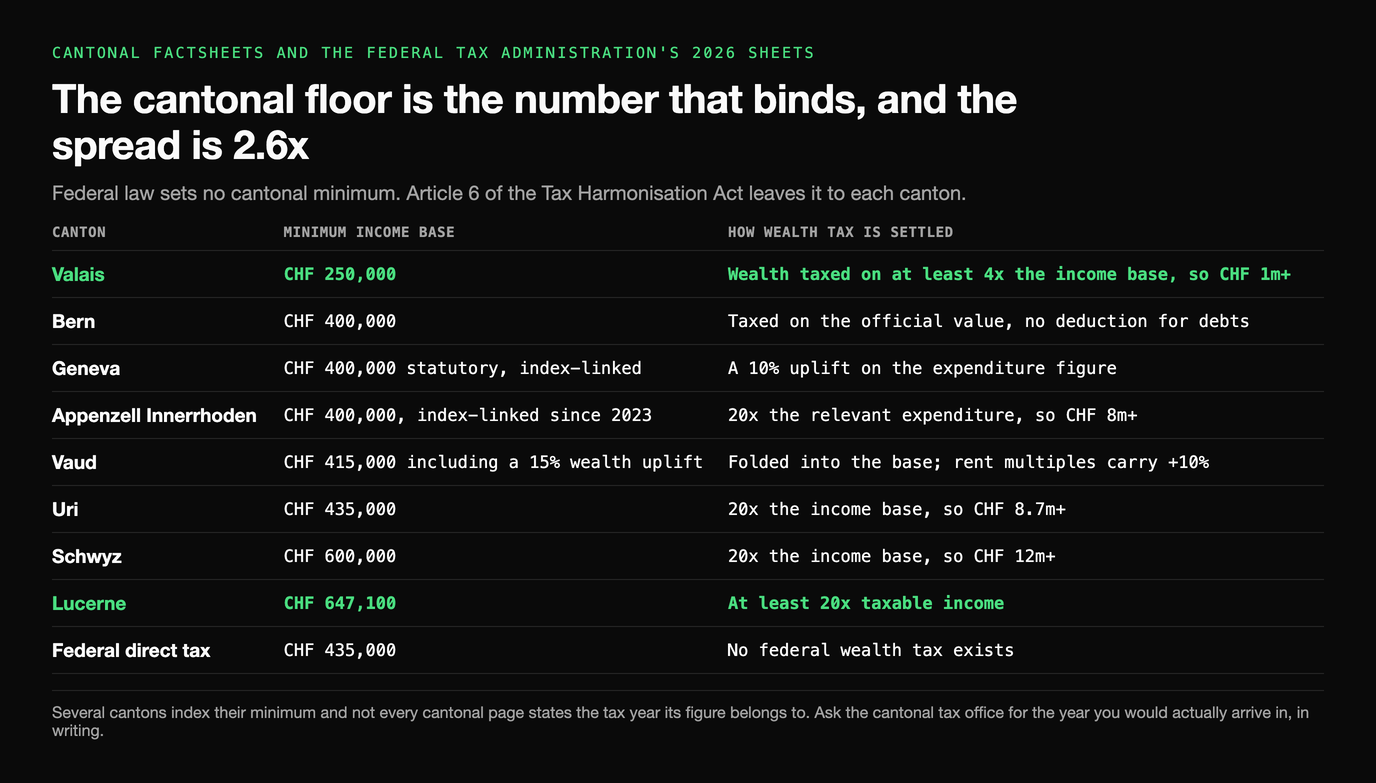
The canton sets its own floor, and the spread is 2.6x. Federal law leaves the cantonal minimum entirely to the canton. Valais sets CHF 250,000, the lowest we found; Lucerne sets CHF 647,100, the highest. Vaud folds a 15% wealth-tax uplift into a CHF 415,000 figure; Geneva adds 10% on top of CHF 400,000; Uri, Schwyz and Appenzell Innerrhoden tax wealth at twenty times the income base.
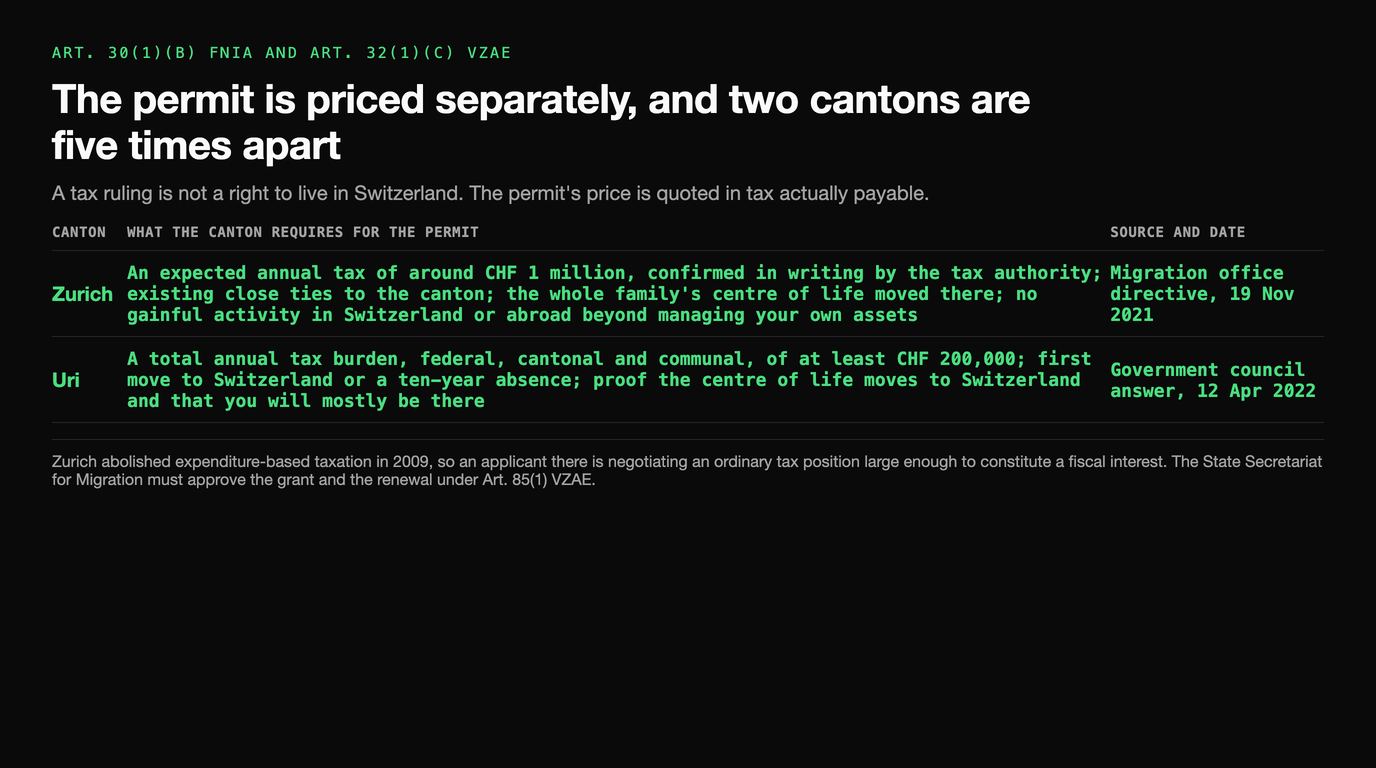
The permit has its own price, and it is quoted in tax actually paid. This is the number nobody publishes. Zurich's migration office requires written confirmation from the tax authority that roughly CHF 1 million a year is expected. Uri requires a total annual burden of at least CHF 200,000. Same federal provision, five times the price.
Five cantons abolished it, and the permit route bans work. Zurich dropped expenditure-based taxation after a 2009 popular vote; Schaffhausen, Appenzell Ausserrhoden, Basel-Landschaft and Basel-Stadt followed. A national initiative to abolish it was rejected on 30 November 2014 with 59.2% voting no. And because the fiscal-interest permit sits in letter c of the ordinance's list, the paragraph that allows employment does not reach it.
On this page
This guide prices the Swiss route from the federal statutes as they read for the 2026 tax year, the Federal Tax Administration's own 2026 cantonal sheets for Vaud, Valais and Geneva, the published factsheets of five more cantonal tax offices, and two official documents — a Zurich migration-office directive and an answer by the Uri government to its parliament — that state what the permit itself requires. This site's renderer does not emit heading anchors, so the list below is a map rather than a set of jump links.
- Switzerland golden visa cost in 2026: there is no visa to buy
- What federal law sets, and the figure the market keeps missing
- The cantonal floor is the number that actually binds
- Base is not bill: a canton's own arithmetic
- The permit is priced separately, and cantons disagree by 5x
- Who actually holds these permits
- Five cantons abolished it, and a referendum kept the rest
- No Swiss passport is for sale, at any price
- Related guides on Domicila
Switzerland golden visa cost in 2026: there is no visa to buy
The honest answer to the Switzerland golden visa cost question is that the thing being priced does not exist, and the prices quoted for it are a category error repeated until it sounded like data. Switzerland runs no residency-by-investment programme. There is no application fee, no contribution, no qualifying fund and no property threshold, because there is no programme to attach them to.
What exists is a discretionary permit and a tax agreement, decided separately by two different authorities. The tax side is expenditure-based taxation — Besteuerung nach dem Aufwand, the forfait fiscal — under which a foreign national who has just moved to Switzerland and does not work there pays tax on a deemed figure instead of on actual worldwide income. The immigration side is a residence permit granted in derogation of the normal rules. Neither is for sale, and the tax one has been in the statute book since long before anyone called it a golden visa.
The confusion is measurable. Here is what the first page of results currently asserts, against what the law says.
| What leading pages quote | What it actually is |
|---|---|
| "CHF 450,000 per year" minimum | Matches no federal or cantonal figure we could find in an official source |
| "CHF 429,000" / "CHF 434,700" / "CHF 421,700" | Superseded federal base figures; the amount is re-indexed annually |
| "CHF 435,000 per year" cost | Correct figure, wrong meaning — it is the taxable base, not the tax |
| "CHF 250,000+ per annum" tax | This is Valais's minimum base, not a tax payable anywhere |
| "Minimum investment CHF 1 million" for the business route | Article 19 of the Act sets no sum at all; the tests are economic interest and viability |
| "Swiss citizenship through investment" | No such route exists; naturalisation needs ten years and a settlement permit |
One of those rows deserves singling out, because it is the error that makes every cost comparison wrong by an order of magnitude: a taxable base is not a payment. If your deemed income is CHF 435,000, you do not hand over CHF 435,000. You hand over the ordinary income tax on CHF 435,000, which depends on which commune you live in. We get to a real number further down, using a figure a cantonal government published itself.
What federal law sets, and the figure the market keeps missing
Expenditure-based taxation is governed federally by Article 14 of the Federal Act on Direct Federal Tax (DBG, SR 642.11). Paragraph 1 sets three conditions, and all three bite: you must not hold Swiss citizenship; you must be becoming liable to unlimited Swiss tax for the first time, or for the first time after an interruption of at least ten years; and you must not carry on gainful employment in Switzerland. Paragraph 2 adds that where spouses live in an undivided marriage, both must satisfy all of it — one working spouse disqualifies the household.
Note what is absent. There is no minimum age in Article 14, despite the "over 55" condition that appears on most commercial pages. That age threshold is real but belongs elsewhere: it governs the separate retiree permit, where the ordinance on admission sets a minimum age of 55 together with a requirement of particular personal ties to Switzerland. Conflating the two produces a rule that exists in neither place.
Paragraph 3 is where the money is, and it is not a single number. The tax is assessed on your annual worldwide living costs — yours and those of the people you support — but at a minimum on the highest of four alternatives.
| Basis under DBG Art. 14(3) | Amount for 2026 |
|---|---|
| (a) The fixed federal floor | CHF 435,000 |
| (b) Taxpayers with their own household | 7x the annual rent or rental value |
| (c) Other taxpayers | 3x the annual board-and-lodging price where they stay |
| (d) Gross Swiss-source income control | The sum of Swiss property, chattel and capital income, Swiss-exploited IP income, Swiss-source pensions, and any income on which you claim treaty relief |
The CHF 435,000 took effect on 1 January 2026 under Article 3 of the Federal Finance Department's ordinance of 10 September 2025 on cold progression (AS 2025 579). The underlying statutory figure was CHF 400,000 when the current version of Article 14 entered into force on 1 January 2016, and paragraph 6 requires the department to adjust it to the consumer price index. That indexation is precisely why half the figures in circulation are stale rather than invented — they were right in an earlier year and were never revisited.
Row (b) is the one that quietly dominates in practice. Seven times the rental value of a lakeside house in a canton where such houses are expensive passes CHF 435,000 without effort, and the base is then set by your address rather than by the floor. Row (d) matters for a different reason: it is a control calculation that prevents the regime from sheltering Swiss-source income, and it is the reason the regime is a poor fit for anyone who intends to hold Swiss assets or claim treaty relief on a large scale.
The cantonal floor is the number that actually binds
Federal tax is the small part of a Swiss tax bill. The cantonal and communal layers are where the weight sits, and Article 6 of the Tax Harmonisation Act (StHG, SR 642.14) hands the key decision to the canton in two words: the canton may grant the right, and the minimum is "an amount set by the canton". There is no federal cantonal floor. That single clause is why a comparison that quotes one number for Switzerland cannot be right.
Article 6 also requires each canton to decide how expenditure-based taxation settles the wealth tax, which federal law does not levy at all. Cantons have answered that question in three incompatible ways, and the answer changes the real cost more than the headline figure does. The table below is built from each canton's own factsheet or from the Federal Tax Administration's 2026 cantonal sheets.
| Canton | Minimum income base | How wealth tax is settled | Source |
|---|---|---|---|
| Valais | CHF 250,000 | Wealth taxed on at least 4x the income base (so CHF 1m+) | Art. 11(3)(a) LF + Art. 1 OID |
| Bern | CHF 400,000 | Taxed on the official value, no deduction for debts | Cantonal tax administration |
| Geneva | CHF 400,000 statutory, index-linked | A 10% uplift on the expenditure figure | Art. 14(3)–(4) LIPP |
| Appenzell Innerrhoden | CHF 400,000, index-linked since 2023 | 20x the relevant expenditure, so CHF 8m+ | Cantonal tax administration |
| Vaud | CHF 415,000 including a 15% wealth uplift | Folded into the base; rent multiples carry +10% | Art. 15(3) LI |
| Uri | CHF 435,000 | 20x the income base, so CHF 8.7m+ | Factsheet valid from 1 Jan 2026 |
| Schwyz | CHF 600,000 | 20x the income base, so CHF 12m+ | Factsheet of 24 Apr 2019, §15a StG |
| Lucerne | CHF 647,100 | At least 20x taxable income | Cantonal tax administration |
| Federal direct tax | CHF 435,000 | No federal wealth tax exists | DBG Art. 14(3)(a) |
Valais at CHF 250,000 against Lucerne at CHF 647,100 is a spread of about 2.6 times on the headline figure alone, and Valais is not an obscure choice — it hosts one of the largest populations of expenditure-taxed residents in the country. The structural lesson is that the cheap cantons are cheap twice over: Valais sets both the lowest income floor and the mildest wealth multiple at four times, where the central Swiss cantons apply twenty.
Two cautions on reading that table. Several cantons index their minimum, and not every cantonal page states the tax year to which its published figure belongs — Appenzell Innerrhoden's own page gives CHF 400,000 while noting the amount has been index-linked since 1 January 2023, so the operative 2026 number will be higher. Geneva publishes an indexation table that was offline for maintenance throughout the period we were checking, so we have given its statutory figure rather than quote an indexed amount we could not verify. Ask the cantonal tax office for the figure for the year you would actually arrive in, in writing, and treat anything else — including this table — as orientation.
Base is not bill: a canton's own arithmetic
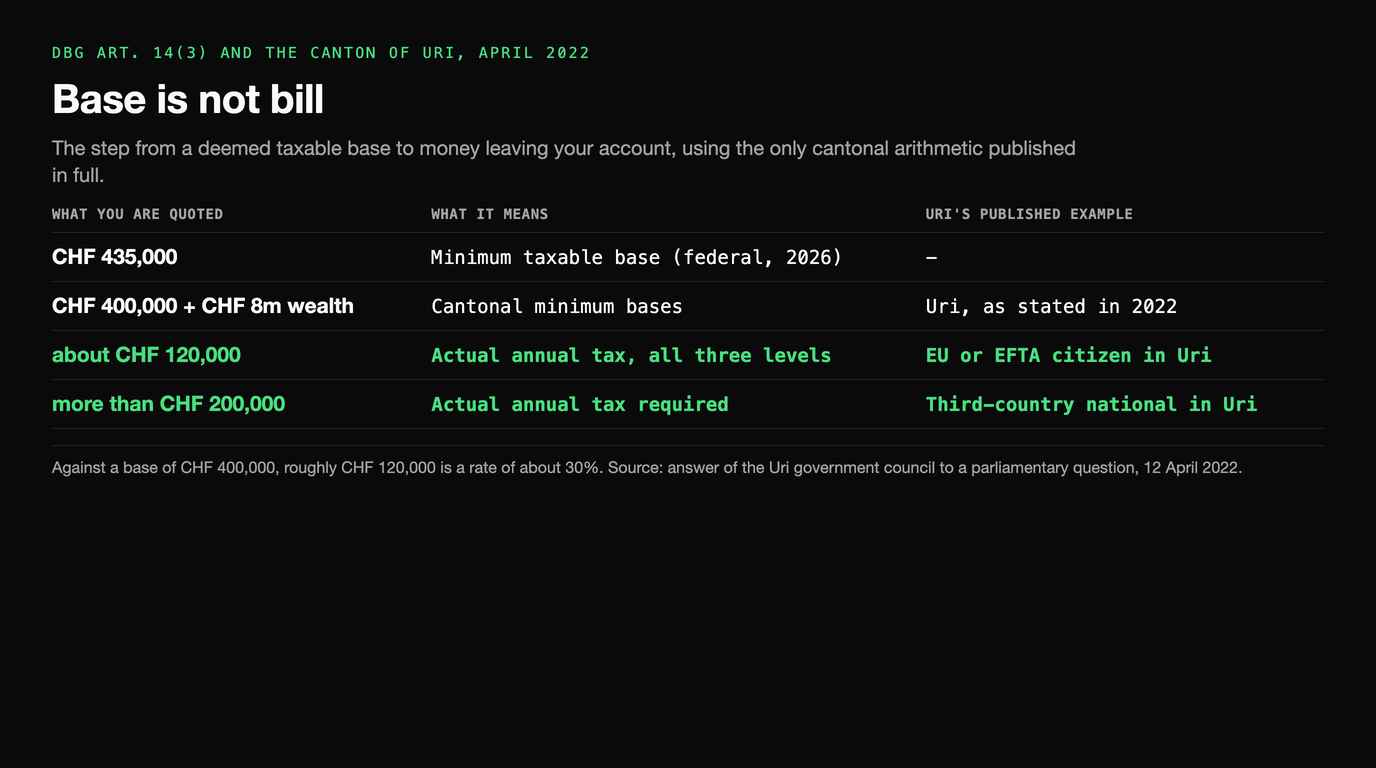
Almost nobody completes the final step from deemed base to money leaving your account, which is strange, because one canton has published the conversion. Answering a parliamentary question in April 2022, the government of Uri set out what its own minimums produce:
On a minimum income of CHF 400,000 and minimum wealth of CHF 8 million — Uri's figures at the time — the resulting minimum annual tax burden is approximately CHF 120,000. That is the all-in figure: federal, cantonal and communal. Against a base of CHF 400,000 it is a rate of roughly 30%, and it is the number a reader actually needs.
The same answer reveals something no commercial page mentions: Uri applies different minimum tax burdens depending on where the applicant is from. Citizens of EU and EFTA states land on the roughly CHF 120,000 just described. Third-country nationals, who need the discretionary permit rather than free movement, must pay more than CHF 200,000 a year. The tax regime is formally nationality-blind — the Uri answer says explicitly that a Russian national is treated the same as anyone else for tax purposes — but the permit requirement layered on top is not.
| What you are quoted | What it means | Uri's published example |
|---|---|---|
| CHF 435,000 | Minimum taxable base (federal, 2026) | — |
| CHF 400,000 + CHF 8m wealth | Cantonal minimum bases | Uri, as stated in 2022 |
| ~CHF 120,000 | Actual annual tax, all three levels | EU/EFTA citizen in Uri |
| >CHF 200,000 | Actual annual tax required | Third-country national in Uri |
Set against that, the numbers these pages usually omit are the ones a reader will meet first. Swiss health insurance is compulsory and bought on the open market per person. Social security contributions are due for non-working residents and are assessed on wealth and pension income. A Swiss tax adviser negotiates and renews the ruling. Housing at a rent whose seven-times multiple does not blow past the floor is itself the largest single commitment. None of those is a government fee, and none of them is published, so we have left them unpriced rather than estimated — the same discipline our golden visa cost comparison applies to agent fees everywhere.
The permit is priced separately, and cantons disagree by 5x
A tax ruling is not a right to live in Switzerland, and this is the half of the subject the market skips. For a citizen of an EU or EFTA state the residence question is largely answered by free movement: a non-working national with sufficient means and health cover has a treaty route that owes nothing to any fiscal deal. For everyone else the permit is discretionary, and it is granted as an exception.
The mechanism is Article 30(1)(b) of the Foreign Nationals and Integration Act, which permits a departure from the ordinary admission conditions of Articles 18 to 29 in order to accommodate serious personal hardship or important public interests. Article 32(1) of the implementing ordinance (VZAE) spells out what counts as such an interest: significant cultural concerns, state-policy reasons, significant cantonal fiscal interests, and the need for someone's presence in criminal proceedings. The third of those is the Swiss golden visa, in the only words the law gives it.
Two consequences follow immediately, and both are routinely got wrong. First, Article 32(2) allows gainful employment to be authorised for the cultural and state-policy categories — letters a and b. It does not extend to letter c. The fiscal-interest permit therefore cannot carry work authorisation, which is consistent with the tax regime it exists to serve. Second, the canton does not have the last word: under Article 85(1) VZAE the State Secretariat for Migration must approve the grant and the renewal. Uri's government describes the sequence plainly — the cantonal migration authority examines the application and submits it to the Secretariat for approval.
The price of the permit is set by the canton, in tax actually payable, and the two cantons that have published their threshold are five times apart.
| Canton | What the canton requires for the permit | Source and date |
|---|---|---|
| Zurich | An expected annual tax of around CHF 1 million, confirmed in writing by the tax authority; existing close ties to the canton; the whole family's centre of life moved there; no gainful activity in Switzerland or abroad beyond managing your own assets | Migration office directive, 19 Nov 2021 |
| Uri | A total annual tax burden (federal, cantonal and communal) of at least CHF 200,000; first move to Switzerland or a ten-year absence; proof the centre of life moves to Switzerland and that you will mostly be there | Government council answer, 12 Apr 2022 |
Zurich's entry is the interesting one, because Zurich abolished expenditure-based taxation in 2009. An applicant there is negotiating an ordinary tax position large enough to constitute a fiscal interest — which is how a canton with no forfait still appears in this conversation, and why "which cantons offer the lump sum" and "which cantons grant fiscal-interest permits" are two different questions with two different answers.
The breadth of that discretion is the real risk in the route, and it is worth stating as plainly as the Uri and Schaffhausen authorities do: "important public interests" is an open-ended legal concept, applied case by case, with a federal approval stage on top. Nothing here is an entitlement, no threshold in the table above is a promise of approval, and the permit that results is a renewable residence permit rather than a settled status.
Who actually holds these permits
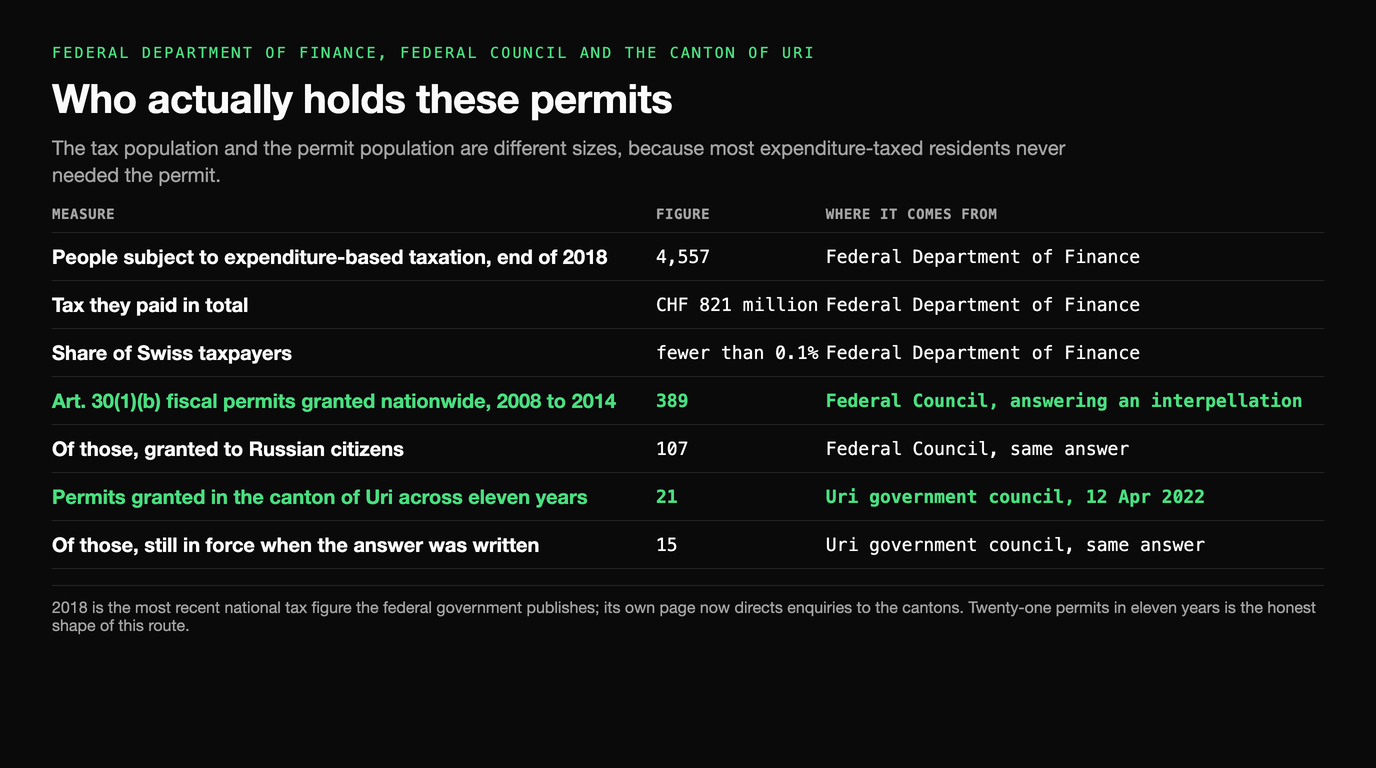
Scale is a useful corrective to the marketing. On the tax side, the Federal Department of Finance reports that 4,557 people were subject to expenditure-based taxation at the end of 2018, paying CHF 821 million in total — fewer than 0.1% of Swiss taxpayers. That is the most recent figure the federal government publishes; its own page now directs enquiries to the cantons for current statistics, which is why any national total quoted for 2024 or 2025 should be treated as an estimate until a canton confirms it.
On the permit side the numbers are far smaller, because most expenditure-taxed residents are EU or EFTA citizens who never needed Article 30(1)(b) at all. Answering a federal interpellation, the Federal Council reported that 389 such permits were granted nationwide for fiscal reasons between 2008 and 2014, of which 107 went to Russian citizens, concentrated in Ticino, Geneva, Zurich, Zug and Vaud.
Uri's answer gives the texture of a single small canton's caseload over eleven years.
| Year | Permits under Art. 30(1)(b) |
|---|---|
| 2007–2010 | 0 |
| 2011 | 3 |
| 2012 | 1 |
| 2013–2014 | 0 |
| 2015 | 1 |
| 2016 | 3 |
| 2017 | 3 |
| 2018 | 5 |
| 2019 | 2 |
| 2020 | 0 |
| 2021 | 3 |
| Total | 21 |
All twenty-one were granted on significant cantonal fiscal interests, eight to Russian and five to Chinese nationals, and fifteen were still in force when the answer was written. Three further residence permits in the canton rested on the retiree provision instead. Twenty-one permits in eleven years, in a canton that publishes a CHF 200,000 threshold, is the honest shape of this route: it is small, slow and individually negotiated, which is the opposite of how it is sold.
Five cantons abolished it, and a referendum kept the rest
Because Article 6 StHG only says a canton may grant expenditure-based taxation, a canton may also stop. Zurich did, after a popular vote in 2009 that took effect in January 2010, and the Federal Department of Finance records that Schaffhausen, Appenzell Ausserrhoden, Basel-Landschaft and Basel-Stadt followed. Any list that shows twenty-one of twenty-six cantons offering the regime is describing that history, and it is worth checking before you choose a canton rather than after.
The regime then survived a national attempt to end it. The popular initiative "Stop tax privileges for millionaires (abolition of lump-sum taxation)" would have required foreign nationals resident in Switzerland and not in employment to be taxed on income and wealth like everyone else. Parliament rejected it first — 135 to 62 in the National Council, 30 to 13 in the Council of States — and voters rejected it on 30 November 2014 by 59.2% to 40.8%, on a turnout of 49.91%.
That vote is the strongest available evidence on the regime's durability, and it cuts both ways. A decade-old national endorsement is real protection, and it is also the kind of protection that a cantonal legislature can withdraw locally without asking anyone outside the canton. Five have. The harmonisation act gives you no federal guarantee that a sixth will not, which is a materially different risk profile from a programme written into statute with a defined term — the distinction our citizenship by investment vs golden visa guide draws for programmes generally.
No Swiss passport is for sale, at any price
Several of the pages competing for this keyword are titled around Swiss citizenship through investment. There is no such route, and the gap between the permit and a passport is wide enough that it should change how the whole proposition is read.
Ordinary naturalisation requires a settlement permit — the C permit — and ten years of residence in Switzerland, of which at least three must fall within the five years before the application. Years spent in Switzerland between the ages of 8 and 18 count double, but at least six actual years are still required. Cantonal law then adds its own residence requirement of two to five years in the canton and the commune, along with proof of a national language and of integration. The State Secretariat for Migration issues the federal naturalisation permit, but communes and cantons run the procedure.
Nothing in the expenditure-based regime shortens any of that, and the regime's own logic points the other way: it is built for someone who does not work in Switzerland and whose economic life stays abroad, which is not the profile that accumulates the integration record a naturalisation file needs. Treat the Swiss route as what it is — a tax residence with a renewable permit attached — and compare it against programmes that do lead to a passport, such as those in our cheapest golden visa analysis, on that basis rather than on the headline figure.
If the attraction is a predictable annual tax rather than a second passport, the comparison that matters is not with the Caribbean but with the other European jurisdictions that price residence through a tax arrangement. New Zealand's four-year transitional exemption is the closest structural cousin outside Europe, and we have priced it alongside the Swiss comparison in our New Zealand golden visa cost guide. The insurance line on every Swiss checklist is the same obligation we unpack in golden visa health insurance requirements.
Related guides on Domicila
If Switzerland is on your shortlist, these are the comparisons that do the most work next:
- Golden visa cost comparison — every open programme priced on its current official fee table
- Cheapest golden visa — where the entry price is genuinely lowest, and what you give up for it
- Golden visa countries — which programmes lead to citizenship and which stop at residence
- Austria citizenship by investment cost — the other Alpine route that is not what it is sold as
- Norway citizenship by investment cost — another country with no programme, and what people are actually searching for
- Germany golden visa cost — residence through a business, priced from the immigration act
- UK golden visa cost — what replaced the closed Tier 1 investor route
- Citizenship by investment vs golden visa — a passport now, or a residence permit first
Common questions
How much does a Switzerland golden visa cost in 2026?
There is no Swiss golden visa and no fee, so the question has no fee-based answer. What you commit to is an annual tax payment. The federal minimum taxable base for expenditure-based taxation is CHF 435,000 for 2026, set by Article 14 paragraph 3 letter a of the Federal Act on Direct Federal Tax as amended by the Federal Finance Department's ordinance of 10 September 2025 on cold progression. That is a base, not a payment: the tax is the ordinary tariff applied to it across federal, cantonal and communal levels. The canton of Uri published the conversion in 2022, stating that minimums of CHF 400,000 of income and CHF 8 million of wealth produce a minimum annual tax burden of roughly CHF 120,000. Separately, the residence permit itself carries a cantonal tax threshold, which Zurich sets at around CHF 1 million a year and Uri at more than CHF 200,000.
Is CHF 435,000 the amount I pay each year?
No, and this is the single most common error in published comparisons. CHF 435,000 is the minimum amount on which your tax is calculated, not the tax. Your actual bill is the ordinary income tax tariff applied to the higher of that floor, seven times your rent or rental value, three times your annual board and lodging, or your gross Swiss-source income. Cantonal and communal tax then sits on a base the canton sets for itself, plus whatever that canton does about wealth tax. Depending on canton and commune, the resulting payment is a minority fraction of the base rather than the base itself.
Which canton has the cheapest lump-sum taxation?
On the published minimum income base, Valais is the lowest we could verify at CHF 250,000, set by Article 1 of its ordinance on expenditure-based taxation under Article 11 of the cantonal tax law. It is also mild on the wealth side, taxing wealth on at least four times the income base where Uri, Schwyz and Appenzell Innerrhoden apply twenty times. Lucerne is the highest at CHF 647,100, with Schwyz at CHF 600,000. Several cantons index their minimum annually and not every cantonal page states which tax year its figure belongs to, so confirm the amount for your arrival year with the cantonal tax office in writing before choosing on price.
Can I work in Switzerland on this permit?
No, on both legs of the route. Expenditure-based taxation is only available to someone who carries on no gainful employment in Switzerland, under Article 14 paragraph 1 letter c of the Federal Act on Direct Federal Tax, and where spouses live in an undivided marriage both must meet that condition. On the immigration side, Article 32 paragraph 2 of the admission ordinance allows employment to be authorised only for the cultural and state-policy categories of important public interest, not for the fiscal-interest category that this permit uses. Managing your own assets is generally accepted; Zurich's directive, for example, requires that no gainful activity be pursued in Switzerland or abroad apart from administering your own wealth.
Do EU citizens need the fiscal-interest permit?
Generally no, and this is why the permit population is so much smaller than the lump-sum population. Citizens of EU and EFTA states have a free-movement route to residence as non-working persons on showing sufficient financial means and health insurance cover, which does not depend on any tax arrangement. The Article 30 paragraph 1 letter b derogation exists for third-country nationals, who have no such right. Uri's government noted that the practical consequence is two different minimum tax burdens in the same canton: roughly CHF 120,000 a year for an EU or EFTA citizen, and more than CHF 200,000 for a third-country national.
Which cantons do not offer lump-sum taxation?
Zurich abolished it following a popular vote in 2009, with effect from January 2010, and the Federal Department of Finance records that Schaffhausen, Appenzell Ausserrhoden, Basel-Landschaft and Basel-Stadt subsequently followed. That is because Article 6 of the Tax Harmonisation Act says a canton may grant the regime rather than must. Note that a canton without the regime can still grant a residence permit on significant cantonal fiscal interests: Zurich's migration office publishes a threshold of around CHF 1 million in expected annual tax, assessed under ordinary taxation.
Can lump-sum taxation be abolished after I move?
It can be changed or withdrawn at cantonal level, and five cantons have done exactly that. A national initiative to abolish the regime across Switzerland was put to voters on 30 November 2014 and rejected by 59.2% to 40.8% on a turnout of 49.91%, after Parliament rejected it 135 to 62 in the National Council and 30 to 13 in the Council of States. That vote is meaningful protection at federal level, but it does not bind a cantonal legislature or a cantonal popular vote. Because the regime is permissive rather than guaranteed, treat the cantonal political position as part of the due diligence rather than as settled.
Does this lead to Swiss citizenship?
Not by itself, and not on any accelerated basis. Ordinary naturalisation requires a settlement permit and ten years of residence in Switzerland, with at least three of those years falling in the five years before the application; years lived in Switzerland between the ages of 8 and 18 count double, subject to a minimum of six actual years. Cantonal law adds a residence requirement of between two and five years in the canton and commune, plus proof of a national language and of integration. The State Secretariat for Migration issues the federal naturalisation permit while cantons and communes run the procedure. Nothing in the expenditure-based tax regime shortens or substitutes for any part of that.
Official sources to verify
- Federal Act on Direct Federal Tax (DBG, SR 642.11), Art. 14 — taxation according to expenditureSwiss Confederation (Fedlex)
- Tax Harmonisation Act (StHG, SR 642.14), Art. 6 — cantonal taxation according to expenditureSwiss Confederation (Fedlex)
- Foreign Nationals and Integration Act (AIG, SR 142.20), Art. 19, 28 and 30Swiss Confederation (Fedlex)
- Ordinance on Admission, Residence and Gainful Employment (VZAE, SR 142.201), Art. 25, 32 and 85Swiss Confederation (Fedlex)
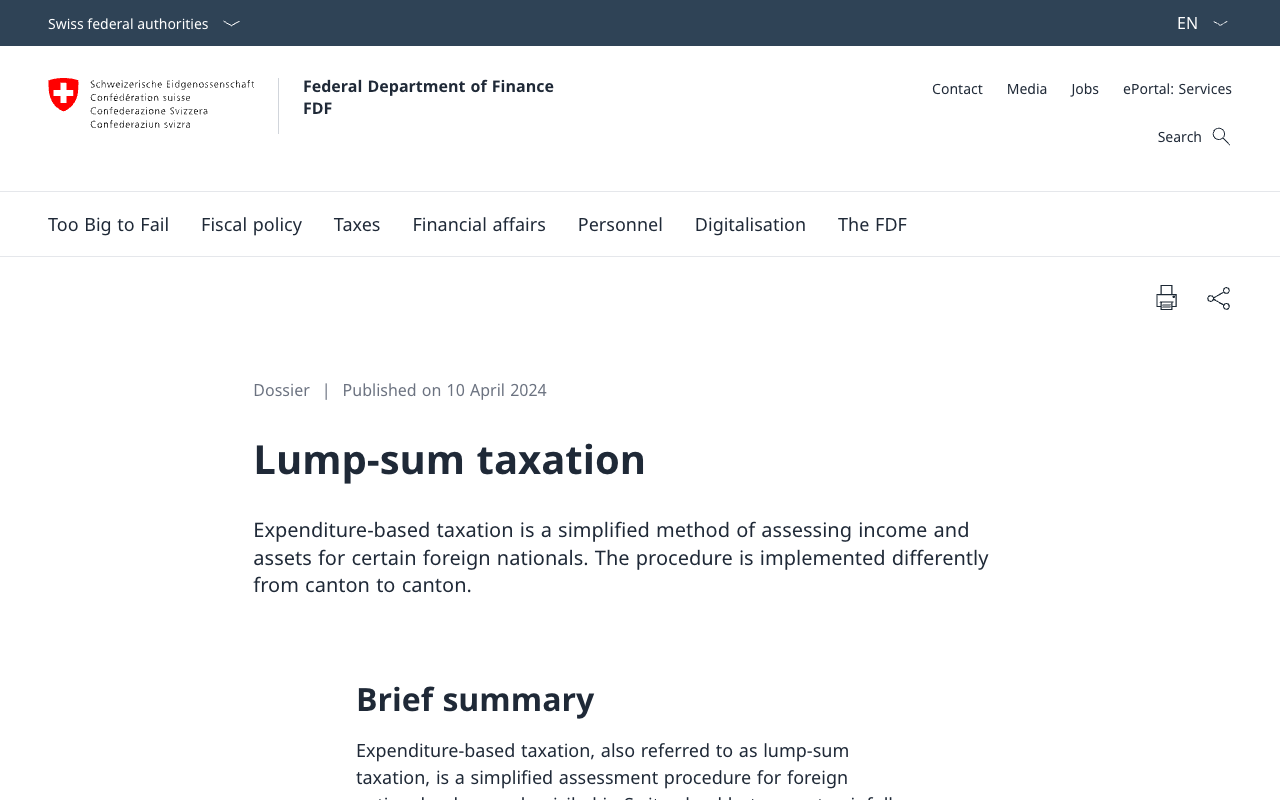
- Lump-sum taxation — numbers of taxpayers, revenue and cantons that abolished itFederal Department of Finance
- Ordinary naturalisation — residence and integration requirementsState Secretariat for Migration
- Weisung Erwerbslose Wohnsitznahme, 19 November 2021 — admission on fiscal interestsCanton of Zurich, Migrationsamt
- Merkblatt uber die Besteuerung nach dem Aufwand, valid from 1 January 2026Canton of Uri, Amt fur Steuern
- Answer of the Government Council to interpellation LA 2022-0218, 12 April 2022Canton of Uri, Regierungsrat
- Merkblatt Besteuerung nach dem Aufwand, 24 April 2019Canton of Schwyz, Steuerverwaltung
- Besteuerung nach dem Aufwand (Pauschalbesteuerung)Canton of Lucerne, Steuerverwaltung
- Besteuerung nach dem AufwandCanton of Appenzell Innerrhoden
- Besteuerung nach dem AufwandCanton of Bern, Steuerverwaltung
- Feuille cantonale Valais 2026 — imposition d'apres la depense (Art. 11 LF; Art. 1 OID)Federal Tax Administration
- Feuille cantonale Vaud 2026 — imposition d'apres la depense (Art. 15 LI)Federal Tax Administration
- Feuille cantonale Geneve 2026 — imposition d'apres la depense (Art. 14 LIPP)Federal Tax Administration
- Popular vote of 30 November 2014 — initiative to abolish lump-sum taxationSwiss Federal Chancellery
Compare golden visa advisors
Ask for a route-specific quote that separates investment amount, government fees, legal work, fund or property costs, and renewal obligations.
We may earn a referral fee if you choose an advisor through this site. We still aim to show cost ranges, caveats, and official source links plainly.