brazil golden visa cost
Brazil Golden Visa Cost 2026: R$1M and 4 Years
Search the Brazil golden visa cost and you will be quoted 194,000 dollars for the property route by almost every page on the first screen. That number is wrong by more than twenty thousand dollars, because it was converted at about 5.15 reais and the Banco Central's PTAX closed at 5.7851 on 17 November 2026. The threshold itself has not moved since 2018 — the currency did. We read the two resolutions that actually create these routes, Resolução Normativa nº 36/2018 and nº 13/2017 in the Ministry of Justice's own PDFs, alongside the Federal Police fee codes, the Migration Law's naturalisation articles and the Banco Central's exchange and inflation series, all on 17 November 2026. What comes out is a cheaper programme than the ranking pages describe, with a shorter route to a passport and one obligation almost all of them get wrong.

Key takeaways
- Brazil has no golden visa. There is no instrument of that name. What exists are two residence authorisations granted by the Ministry of Justice under Resolução Normativa nº 36/2018 for property and nº 13/2017 for a company investment.
- R$1,000,000 in urban property, or R$700,000 in the North and Northeast. At the Banco Central's PTAX selling rate of 5.7851 on 17 November 2026 that is US$172,857 and US$121,000 — not the 194,000 and 136,000 dollars the ranking pages quote from a rate they do not date.
- The company route is cheaper and, since June 2024, open-ended. R$500,000 into a Brazilian company, or R$150,000 for innovation and research ventures meeting one of five published tests. Article 6 § 4 of RN 13/2017, as amended by RN 49/2024, makes that residence indeterminate from the start rather than a fixed term.
- Fourteen days every two years, not thirty. Article 6 of RN 36/2018 sets a minimum of 14 days in Brazil, consecutive or not, in each two-year period, counted from registration with the Federal Police. Miss it and article 6-A lets you reapply for a fresh four-year permit if the investment is intact.
- Four years to naturalisation, not eight. Article 65 of Law 13,445/2017 asks for four years of residence, Portuguese and a clean record — and article 66 cuts it to one year for the parent of a Brazilian child or the spouse of a Brazilian.
On this page
Every figure below is tied to the instrument that states it, and where the ranking pages disagree with the Ministry of Justice we say so rather than split the difference. None of the three largest pages on this keyword cites a single resolution number, a decree or a law, and two of them contradict the statute on how long a passport takes. This site's renderer does not emit heading anchors, so the list below is a map rather than jump links.
- Brazil has no golden visa, and that changes what you are buying
- The property route: R$1,000,000, or R$700,000 in the North and Northeast
- What the thresholds actually cost in dollars today
- The company route: R$500,000, or R$150,000 for innovation
- The fees nobody prints: R$372.90 to the Federal Police, 3% to the city
- Fourteen days every two years, and what happens if you miss them
- Four years to a passport, not eight
- What to confirm before you wire anything
Brazil has no golden visa, and that changes what you are buying
No Brazilian statute, decree or resolution uses the phrase golden visa. The term is a marketing label stretched over two residence authorisations that the Ministry of Justice and Public Security grants under article 35 of the Migration Law and articles 42 and 151 of Decree 9,199/2017. Both are created by resolutions of the National Immigration Council, and both are published in full as PDFs on the ministry's own labour-migration portal, which is where every figure on this page comes from.
The distinction is not pedantry, because it sets what you actually receive. A Caribbean programme takes a contribution and issues a passport. Brazil takes nothing: the money stays yours, in an apartment you own or a company you control, and what the state issues is permission to live there. If you are weighing those two shapes against each other, citizenship by investment versus a golden visa is the comparison to start from, because Brazil sits firmly on the residence side of it and the passport arrives later, on its own conditions.
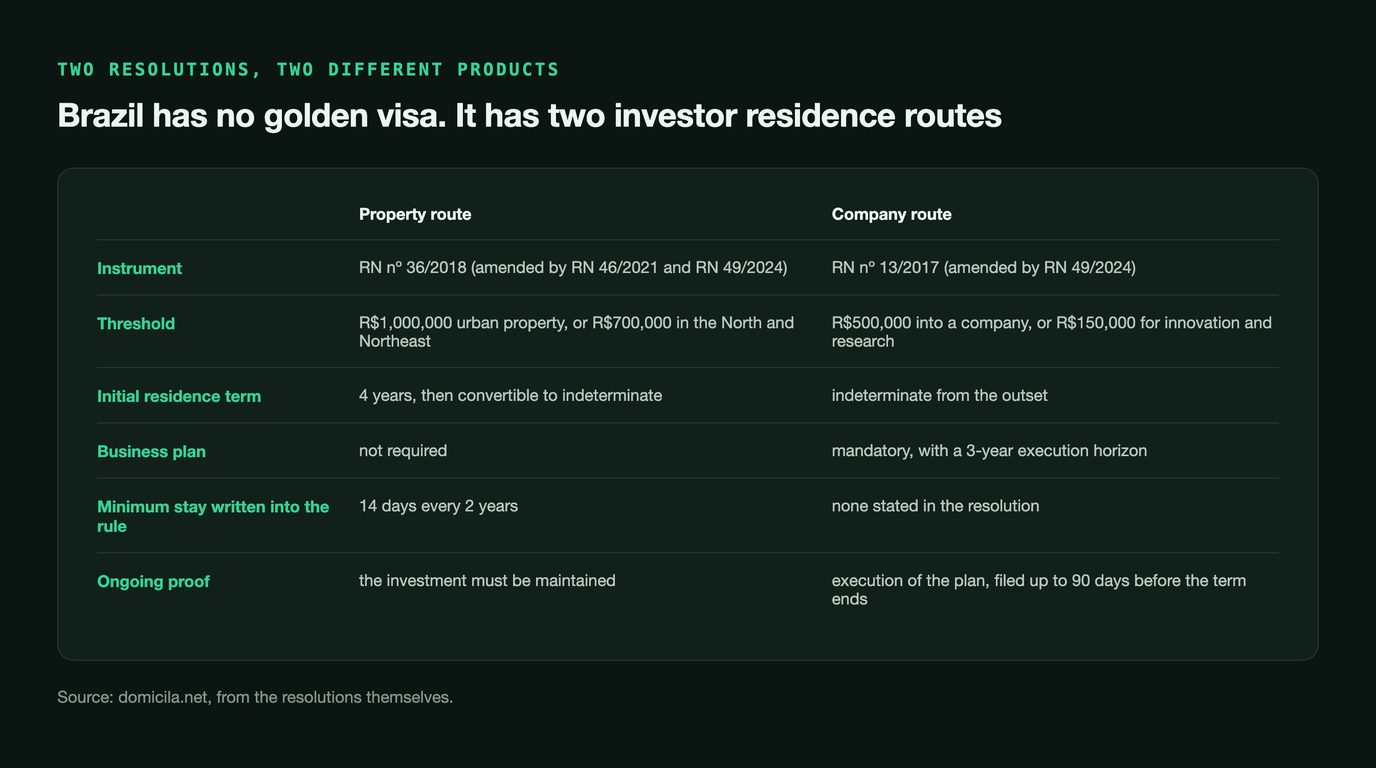
The two routes differ more than the comparison pages suggest, and the gap widened in June 2024 when Resolução CNIg/MJSP nº 49 amended both. Here is what each one is now:
| Property route | Company route | |
|---|---|---|
| Instrument | RN nº 36/2018 (amended by RN 46/2021 and RN 49/2024) | RN nº 13/2017 (amended by RN 49/2024) |
| Threshold | R$1,000,000 urban property, or R$700,000 in the North and Northeast | R$500,000 into a company, or R$150,000 for innovation and research |
| Initial residence term | 4 years, then convertible to indeterminate | indeterminate from the outset |
| Business plan | not required | mandatory, with a 3-year execution horizon |
| Minimum stay written into the rule | 14 days every 2 years | none stated in the resolution |
| Ongoing proof | the investment must be maintained | execution of the plan, filed up to 90 days before the term ends |
Read the bottom-left cell against the bottom-right one and the trade-off is clear. Property buys you an obligation you can discharge in a fortnight every other year; a company buys you open-ended residence in exchange for a plan the ministry will hold you to, including the hiring schedule.
The property route: R$1,000,000, or R$700,000 in the North and Northeast
Article 2 of RN 36/2018 conditions the residence authorisation on acquiring urban real property worth R$1,000,000 or more, either already built or under construction. Paragraph 1 allows the minimum to be up to 30% lower for property in the North and Northeast regions, which is where the R$700,000 figure comes from — it is a ceiling on the discount, not a separate programme. Paragraph 2 lets you reach either figure with more than one property, provided you own them and the total clears the bar.
Three provisions in article 3 do more work than their length suggests, and we have not seen any of them stated on a page selling this route:
| Provision | What it says | Why it matters |
|---|---|---|
| Art. 3 § 1 | Co-ownership is admitted only if each co-owner has invested the full threshold | Two people cannot split one R$1,000,000 flat into two permits |
| Art. 3 § 2 | Financing is allowed only on the portion exceeding R$1,000,000 | The threshold itself has to be paid in, not mortgaged |
| Art. 3 § 3 | The ministry may carry out in-loco checks | The purchase is verifiable on the ground, not just on paper |
| Art. 3 § 4 | The residence term is 4 years | Settles the two-versus-four-year disagreement in the search results |
The money has to arrive from outside. Both limbs of article 3 require a declaration from an institution authorised or registered with the Banco Central attesting to the international transfer of capital for the purchase — wording that RN 49/2024 rewrote to line up with Brazil's foreign-exchange framework. Buying with funds already inside Brazil does not qualify, however good the title is. For property still under construction you file the registered promise of purchase and sale, the construction permit and the registered incorporation memorial, and the transfer declaration may cover a deposit rather than the whole price.
After the four years, article 5 converts the permit to an indeterminate term, on production of evidence that the investment conditions are still met, a copy of your migrant registry card and criminal record certificates from wherever you have lived during the temporary period. If you obtained an initial permit shorter than four years, the sole paragraph of article 5 lets you renew up to the point where conversion becomes available. And article 6-B is the one to keep in view: if the basis for the grant ceases — you sell, and do not replace the investment — that is a ground for declaring the residence lost.
What the thresholds actually cost in dollars today
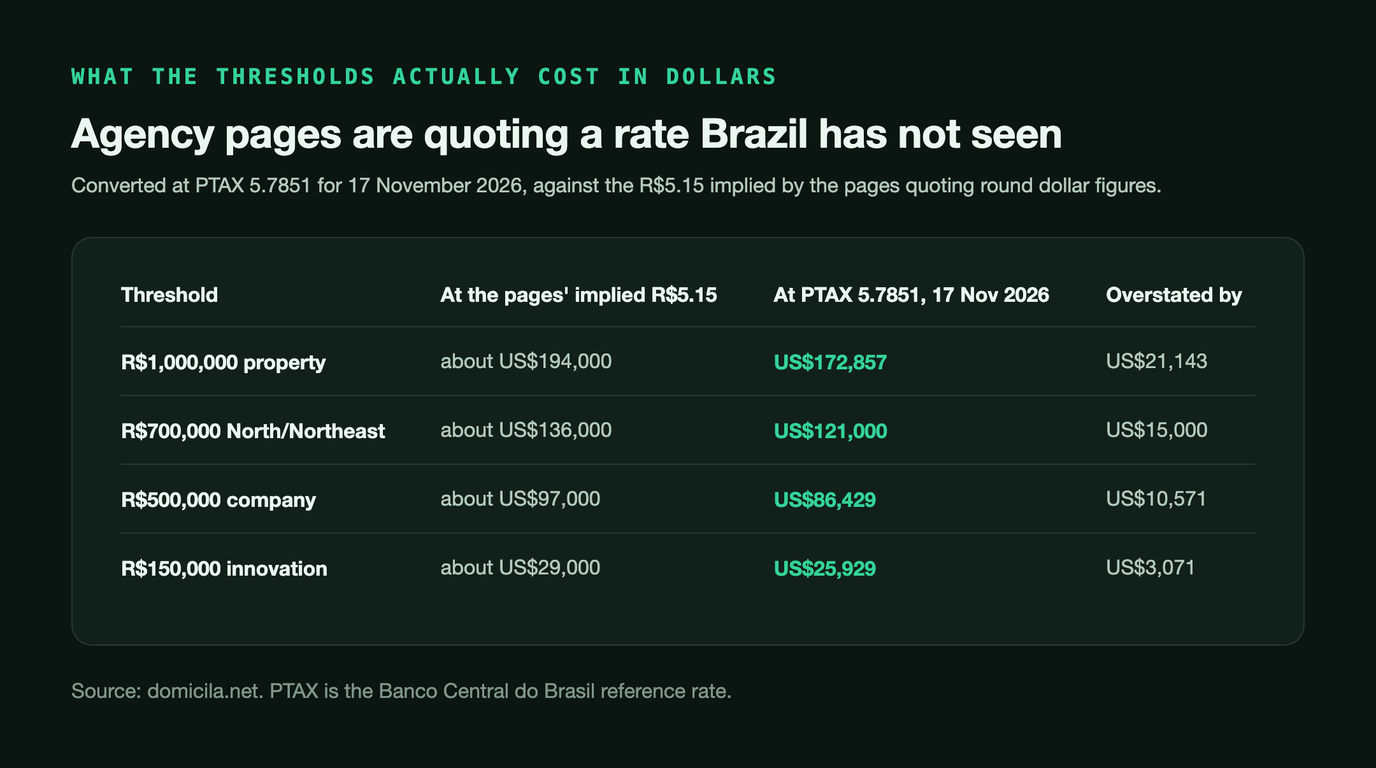
This is where almost every page on this keyword goes wrong, and the error is large enough to change a decision. The thresholds are fixed in reais. The dollar price is therefore whatever the exchange rate says on the day you wire, and the pages ranking for the Brazil golden visa cost quote conversions struck at roughly R$5.15 to the dollar without printing a rate or a date. The Banco Central's PTAX selling rate on 17 November 2026 was 5.7851.
| Threshold | At the pages' implied R$5.15 | At PTAX 5.7851, 17 Nov 2026 | Overstated by |
|---|---|---|---|
| R$1,000,000 property | about US$194,000 | US$172,857 | US$21,143 |
| R$700,000 North/Northeast | about US$136,000 | US$121,000 | US$15,000 |
| R$500,000 company | about US$97,000 | US$86,429 | US$10,571 |
| R$150,000 innovation | about US$29,000 | US$25,929 | US$3,071 |
The drift is not a rounding quibble, it is the direction of travel. R$1,000,000 has been the threshold since RN 36/2018 was published in the Diário Oficial on 21 November 2018, and the PTAX selling rate that day was 3.7872 — so the same rule cost US$264,047 when it was written. Eight years later it costs US$172,857. The programme is 34.5% cheaper in dollars than on the day it was created, and not one word of it has changed.
Inflation has done the same thing from the other side. Brazil's IPCA rose 51.3% between December 2018 and October 2026 on the Banco Central's own series, which means R$1,000,000 today is worth about R$660,861 in the money of the month the rule was signed. The company threshold has aged further still: R$500,000 was set in December 2017, when it converted to US$150,561, and IPCA has risen 56.8% since. In real terms both floors have fallen by roughly a third.
Two practical consequences. First, a quote more than a few weeks old is not a number, it is a guess — the PTAX moved from 5.5606 on 11 November to 5.7851 on 17 November, and that single week took US$6,979 off the dollar price of the property route. Second, this is a currency bet as much as a migration decision, and it runs the opposite way to the euro programmes in our golden visa cost comparison, where the threshold is denominated in the strong currency and a weakening home currency makes it dearer every year.
The company route: R$500,000, or R$150,000 for innovation
Article 2 of RN 13/2017 grants prior residence on proof of investment in foreign currency of R$500,000 or more into a Brazilian legal entity, new or existing, supported by an Investment or Business Plan. Paragraph 2 says the ministry examines the venture's potential to generate jobs or income as a priority — this is a discretionary assessment of a business, not a transfer that clears a threshold.
Article 3 is the provision worth knowing about, because it prices the route at R$150,000 for an entrepreneur investing in innovation, basic or applied research of a scientific or technological character. It is not an open discount. Paragraph 1 requires the receiving venture to meet at least one of five conditions, and paragraph 2 offers an alternative test:
| Route | Threshold | What must be shown |
|---|---|---|
| Standard company investment (art. 2) | R$500,000 | Investment plan; priority given to job and income generation |
| Innovation or research (art. 3 § 1) | R$150,000 | One of: government innovation funding; sited in a technology park; incubated or a graduated venture; finalist in a government startup programme; backed by a Brazilian accelerator |
| Innovation, alternative test (art. 3 § 2) | R$150,000 | Originality, market reach and relevance of the product, process or service that is the company's main activity |
The plan under article 4 is a real document with a three-year execution horizon, and the resolution lists what must be in it: the sector and location, the service, when the investment lands and when trading starts; the importance of the investment to the locality and the sector, the technology involved, any government or local programme support, partnerships, the target market and the development strategy; and a hiring plan for the first three years giving headcount, roles, salaries and spending on training. A one-page summary will not do.
Then the amendment that nobody seems to have noticed. Article 6 § 4, in the wording given by RN 49/2024, says the residence under this resolution is of indeterminate term. The company route no longer hands you a fixed permit to convert later: it is open-ended from the grant. What keeps it is paragraph 2 — proof that the plan is being executed, filed up to 90 days before the end of the period granted — backed by the company's income tax return, three years of RAIS employment filings and the latest severance-fund receipt with the employee list. Paragraph 3 gives the ministry room to weigh the economic context if the plan has slipped.
That is a materially better instrument than the property route for anyone genuinely relocating, and it costs half as much. The cost is that you have to run something. If you want the capital parked rather than deployed, Brazil's property route is the comparator, and against the region it prices close to Panama while asking far less than most of Europe.
The fees nobody prints: R$372.90 to the Federal Police, 3% to the city
The threshold is capital you keep. The money you do not get back is a much smaller number, and it is published — the comparison pages simply quote agency estimates of 50,000 to 100,000 reais instead of the official figures underneath them.
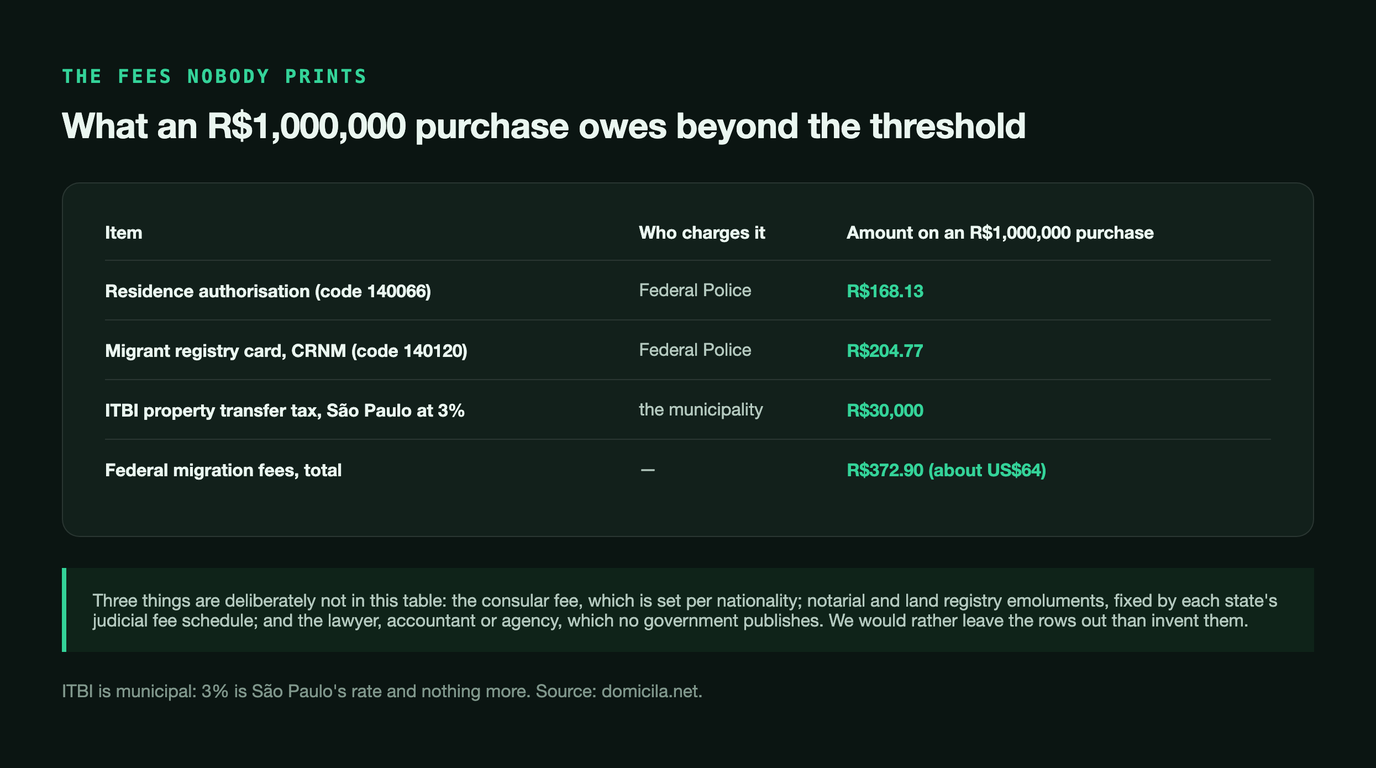
The Federal Police state their own charges by revenue code on the service pages for each residence category: the residence authorisation itself is code 140066, R$168.13, and issuing the migrant registry card is code 140120, R$204.77. Together that is R$372.90, about US$64. Those are the federal migration fees in their entirety.
The real transaction cost is municipal, and it is the property transfer tax. In the city of São Paulo the rate is 3% under article 10, II of Lei 11.154/1991 as amended by Lei 16.098/2014, charged on the greater of the transaction price and the city's reference value. On a purchase at the threshold that is R$30,000, which is eighty times the federal fees:
| Item | Who charges it | Amount on an R$1,000,000 purchase |
|---|---|---|
| Residence authorisation (code 140066) | Federal Police | R$168.13 |
| Migrant registry card, CRNM (code 140120) | Federal Police | R$204.77 |
| ITBI property transfer tax, São Paulo at 3% | the municipality | R$30,000 |
| Federal migration fees, total | — | R$372.90 (about US$64) |
Three things are deliberately not in that table. The consular fee for the temporary visa is set per nationality by Brazil's consular tariff, so there is no single figure to quote. Notarial deed and land registry emoluments are fixed by each state's judicial fee schedule and vary by state and by price band. And the lawyer, accountant or relocation agency is a private price no government publishes — agency pages that fold all three into one range are estimating, and should say so. We would rather leave the rows out than invent them.
One point on the ITBI that catches buyers: it is municipal, so the 3% above is São Paulo's rate and nothing more. Rates and reference valuations are set city by city, and the base is the higher of your price and the city's own figure, which means a bargain purchase does not produce a bargain tax bill.
Fourteen days every two years, and what happens if you miss them
Article 6 of RN 36/2018 is one sentence and it is widely misreported. The property investor must remain in Brazil for at least 14 days, consecutive or non-consecutive, in each two-year period, counted from registration with the Federal Police. The figure of 30 days that circulates on several guides is not in the resolution, and the distinction matters: a fortnight every other year is one of the lightest presence requirements attached to any residence-by-investment route anywhere.
The sole paragraph explains why the number exists at all. Meet it and the ground for losing residence in article 135, III of Decree 9,199/2017 — absence from the country — does not apply to you. The 14 days are not a loyalty test; they are the statutory safe harbour against an absence rule that would otherwise bite.
Miss them and the consequence is far milder than the sales pages imply. Article 6-A, added in 2021, says that where the article 6 requirement is not met, or you let the deadline for converting to indeterminate residence pass, you may apply for a new residence authorisation for a fresh four-year term, provided the investment has been maintained. You restart the clock rather than lose the asset. The thing that genuinely ends the permit is article 6-B: the basis ceasing — selling without replacing the qualifying investment — and article 6-C, which opens a cancellation procedure if relevant information was withheld or a declaration was false.
Note what article 6 is not. It maintains the permit. It does not build the residence that naturalisation requires, and conflating the two is the single most expensive mistake available on this topic.
Four years to a passport, not eight
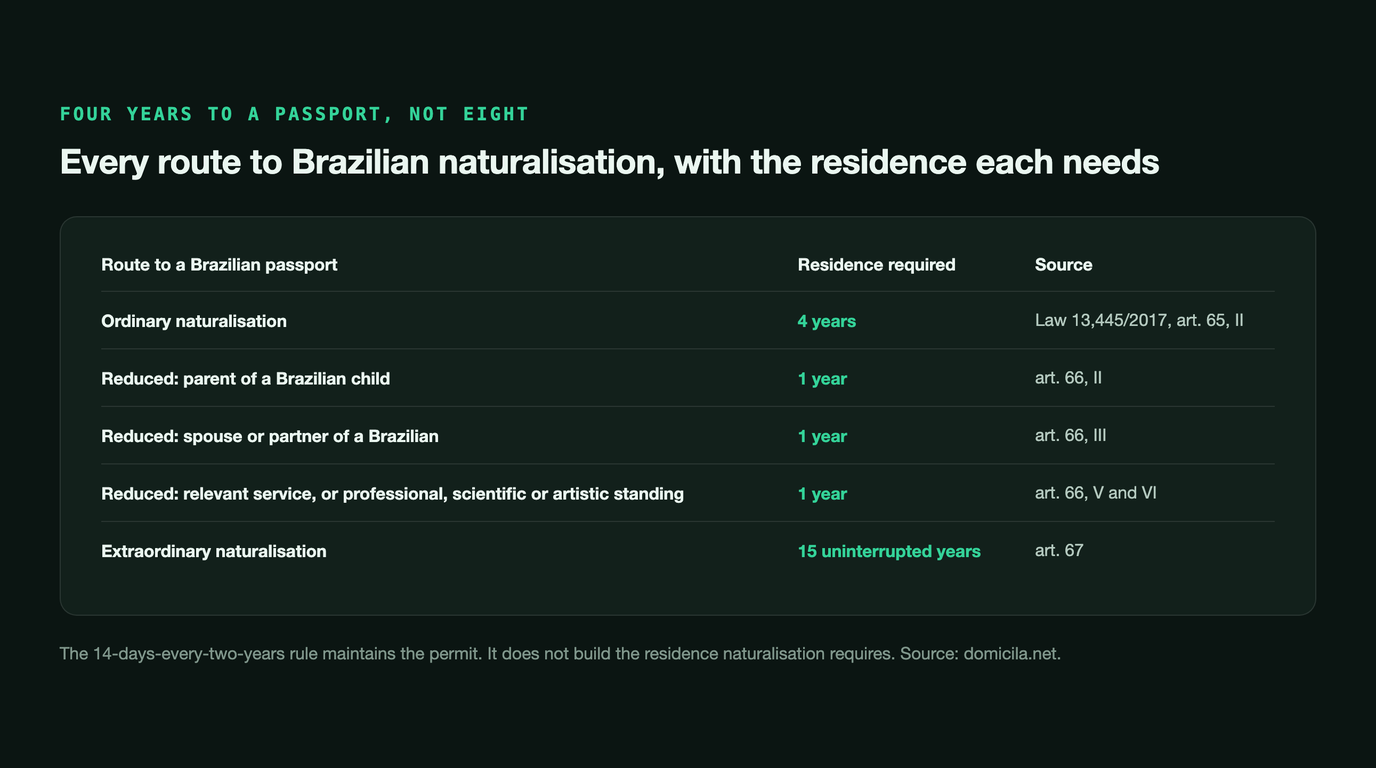
The consensus on the first page of results is that Brazilian citizenship takes about eight years through this route — four years of temporary residence, then four more of permanent residence. That is not what the statute says. Article 65 of Law 13,445 of 24 May 2017 sets four conditions for ordinary naturalisation and the residence one reads: ter residência em território nacional, pelo prazo mínimo de 4 (quatro) anos — residence in the national territory for a minimum of four years. It does not say four years of permanent residence, and it does not stack a second period on top.
| Route to a Brazilian passport | Residence required | Source |
|---|---|---|
| Ordinary naturalisation | 4 years | Law 13,445/2017, art. 65, II |
| Reduced: parent of a Brazilian child | 1 year | art. 66, II |
| Reduced: spouse or partner of a Brazilian | 1 year | art. 66, III |
| Reduced: relevant service, or professional, scientific or artistic standing | 1 year | art. 66, V and VI |
| Extraordinary naturalisation | 15 uninterrupted years | art. 67 |
The other three conditions in article 65 are civil capacity, the ability to communicate in Portuguese — assessed with regard to the applicant's circumstances — and no criminal conviction, or rehabilitation if there is one. Article 66 then cuts the four years to one for anyone with a Brazilian child or a Brazilian spouse or partner not separated at the time of the grant, which is a genuinely short route that no other programme in our comparison of golden visa countries matches.
Now the honest caveat, because it is the other half of the same point. Article 65 asks for residence, not for a permit held at arm's length. An investor who spends 14 days in Brazil every two years satisfies article 6 of RN 36/2018 and will have a hard time arguing they have had four years of residence in the national territory for article 65 — these are two different tests applied by two different authorities, and the ministry assesses the second one on the facts. The correct statement is that the law sets four years, not eight, and that reaching it means actually living in Brazil. Anyone who tells you a fortnight a year compounds into a passport is selling something.
Worth adding: naturalising in Brazil does not require renouncing your existing nationality, and the comparison that matters next is usually tax rather than paperwork. Brazil taxes residents on worldwide income, which is why we treat the move as a tax decision first in our note on Argentina, the other large South American jurisdiction people price against this one.
What to confirm before you wire anything
Six questions, in this order, and all of them before money leaves your account.
- Which resolution am I applying under? Property is RN 36/2018, a company is RN 13/2017, and they have different thresholds, different terms and different ongoing obligations. Any adviser who answers golden visa rather than a number has not told you anything.
- Is my money coming from outside Brazil, through a Banco Central-registered institution? Both routes require the declaration attesting the international transfer. Funds already in the country will not support the application.
- What is today's PTAX? The thresholds are in reais. Price the transfer on the day, from the Banco Central's own quotation, not from a page that converted at some unstated rate last year.
- If I am buying property, am I the sole owner of enough of it? Article 3 § 1 requires each co-owner to meet the full threshold, and article 3 § 2 allows financing only above it.
- If I am investing in a company, who is writing the three-year plan? It has to cover hiring, salaries and training, and article 6 § 2 will be measured against it up to 90 days before each period ends.
- What does leaving my current country cost? Exit charges, deemed disposals and tax-residence tests at the other end routinely dwarf everything on this page and appear in no Brazilian fee schedule.
Everything here describes the published resolutions, the Migration Law and official fee schedules as read on 17 November 2026, converted at the Banco Central's PTAX selling rate of 5.7851 on that date. It is not legal, tax or immigration advice, and nothing here promises that any application will be granted — these are discretionary decisions of the Ministry of Justice and Public Security. Take Brazilian professional advice before you act, and ask any provider offering a Brazil golden visa which resolution number they are filing under.
Related guides on Domicila
If Brazil is on your list, these are the comparisons that answer the question it raises next:
- Golden visa cost comparison — every major route priced side by side, so R$1,000,000 has something to sit against.
- Panama golden visa cost — the closest regional competitor on price, with a very different residence obligation.
- Argentina citizenship by investment cost — the other large South American option, and the usual alternative to this one.
- Cheapest golden visa — where the R$150,000 innovation route sits against the global floor.
- Citizenship by investment vs golden visa — the distinction that decides whether Brazil is even the right shape of programme.
- Golden visa countries — the full list, including the ones whose naturalisation clock is far longer than four years.
Common questions
Does Brazil have a golden visa in 2026?
Not under that name. No Brazilian law, decree or resolution uses the phrase. What exists are two residence authorisations granted by the Ministry of Justice and Public Security: one for real estate investment under Resolução Normativa nº 36/2018, and one for investment in a Brazilian company under Resolução Normativa nº 13/2017.
What is the Brazil golden visa cost in 2026?
The property route requires R$1,000,000 in urban real estate, or up to 30 per cent less, meaning R$700,000, in the North and Northeast regions. At the Banco Central PTAX selling rate of 5.7851 on 17 November 2026 that is about US$172,857 and US$121,000. It is capital you continue to own, not a fee, and the only federal migration fees are R$168.13 for the residence authorisation and R$204.77 for the registry card.
Is the Brazil investor visa cheaper through a company than through property?
Yes. Article 2 of Resolução Normativa nº 13/2017 sets R$500,000 for investment in a Brazilian company, half the property threshold, and article 3 allows R$150,000 for innovation or research ventures that meet one of five published conditions. The trade-off is a mandatory investment or business plan with a three-year execution horizon, including a hiring schedule the ministry will measure you against.
How many days a year do you have to spend in Brazil as an investor?
Article 6 of Resolução Normativa nº 36/2018 requires a minimum of 14 days, consecutive or non-consecutive, in each two-year period, counted from registration with the Federal Police. The 30-day figure that appears on several guides is not in the resolution. Meeting the 14 days protects you from the absence ground for losing residence in article 135, III of Decree 9,199/2017.
How long is the initial Brazilian investor residence permit valid?
Four years for the property route, under article 3, paragraph 4 of Resolução Normativa nº 36/2018, after which it can be converted to an indeterminate term. The company route is different: article 6, paragraph 4 of Resolução Normativa nº 13/2017, as amended by Resolução nº 49 of 25 June 2024, makes that residence indeterminate from the outset.
How long does it take to get Brazilian citizenship through investment?
Article 65 of Law 13,445/2017 requires four years of residence in Brazil, the ability to communicate in Portuguese, civil capacity and no criminal conviction. Article 66 reduces the residence period to one year for the parent of a Brazilian child or the spouse or partner of a Brazilian. The eight-year figure quoted on many pages does not appear in the statute, but the four years must be genuine residence, which a fortnight every two years will not establish.
What happens if an investor misses the 14-day requirement?
Article 6-A of Resolução Normativa nº 36/2018 allows the investor to apply for a new residence authorisation for a further four-year term, provided the investment has been maintained. The same applies if the deadline to convert to indeterminate residence is missed. What genuinely ends the permit is selling the qualifying investment without replacing it, under article 6-B.
Can two people share one property purchase to qualify?
No. Article 3, paragraph 1 of Resolução Normativa nº 36/2018 admits co-ownership only where each co-owner has invested the full threshold amount in their own right. You can, however, combine more than one property you own to reach the figure, under article 2, paragraph 2, and financing is permitted only on the portion of the price above R$1,000,000.
Official sources to verify
- Resolução Normativa nº 36 de 9 de outubro de 2018, as amended by RN 46/2021 and RN 49/2024 — art. 2 R$1,000,000 urban property and the 30% reduction for the North and Northeast, art. 3 § 1 co-ownership, § 2 financing, § 4 four-year term, art. 6 the 14-day rule, art. 6-A reapplication, read 17 November 2026Conselho Nacional de Imigração, Ministério da Justiça e Segurança Pública
- Resolução Normativa nº 13 de 12 de dezembro de 2017, as amended by RN 49/2024 — art. 2 R$500,000 company investment, art. 3 R$150,000 innovation route and its five conditions, art. 4 the three-year investment plan, art. 6 § 4 indeterminate residence term, read 17 November 2026Conselho Nacional de Imigração, Ministério da Justiça e Segurança Pública
- Resoluções Normativas do Conselho Nacional de Imigração — the full index, confirming RN 49 of 25 June 2024 is the most recent resolution amending the investor routes, read 17 November 2026Ministério da Justiça e Segurança Pública
- Federal Police migration fees stated by revenue code — residence authorisation code 140066 at R$168.13 and CRNM issuance code 140120 at R$204.77, read 17 November 2026Polícia Federal
- Lei nº 13.445 de 24 de maio de 2017 (Lei de Migração) — art. 65 ordinary naturalisation after four years of residence, art. 66 reduction to one year, art. 67 extraordinary naturalisation at fifteen yearsCâmara dos Deputados
- PTAX US dollar reference rate — selling rate 5.7851 on 17 November 2026, 5.5606 on 11 November 2026 and 3.7872 on 21 November 2018Banco Central do Brasil
- Time series 433, IPCA monthly variation — cumulative 51.3% from December 2018 to October 2026 and 56.8% from January 2018, retrieved 17 November 2026Banco Central do Brasil, Sistema Gerenciador de Séries Temporais
- ITBI — cálculo do imposto: the 3% rate in the city of São Paulo and the reference-value basis, read 17 November 2026Secretaria Municipal da Fazenda, Prefeitura de São Paulo
- Lei nº 11.154 de 30 de dezembro de 1991, art. 10, II as amended by Lei nº 16.098/2014 — ITBI at 3% on other transfersCatálogo de Legislação Municipal, Prefeitura de São Paulo
Compare golden visa advisors
Ask for a route-specific quote that separates investment amount, government fees, legal work, fund or property costs, and renewal obligations.
We may earn a referral fee if you choose an advisor through this site. We still aim to show cost ranges, caveats, and official source links plainly.