panama golden visa cost
Panama Golden Visa Cost 2026: $300k or $500k?
Almost every page ranking for Panama golden visa cost is counting down to a deadline that no longer governs anything. The claim is that the US$300,000 property threshold expires on 15 October 2026 and jumps to US$500,000 — but the decree that deadline was read out of was repealed on 16 September 2026, when Executive Decree 17 replaced Decree 722 of 2020 outright. What replaced it is not a single number. It is a split: US$300,000 still qualifies on a new, first-sale property bought from the developer, while a resale property now costs US$500,000, and the only live date left in the calendar is 16 March 2027. We pulled Decree 109 from the Ministry of Commerce and Industries' own site to find where the phantom deadline came from, priced every route, itemised the government fees, and totalled the bill for a family of four.
Key takeaways
The Panama golden visa cost is no longer one property number. Since 16 September 2026, Executive Decree 17 of 8 September 2026 asks US$300,000 for a new, first-sale property bought from the developer and US$500,000 for anything already sold, occupied, rented or transferred once. Most pages still quote a flat US$300,000.
The "15 October 2026 deadline" is not in the rules. It appears to be a misreading of the 48-month transitional clock in Decree 109 of 2022, counted from the wrong decree. We read the clause in the ministry's own PDF; the 48 months run from Decree 722 of 15 October 2020, which lands in October 2024, not 2026.
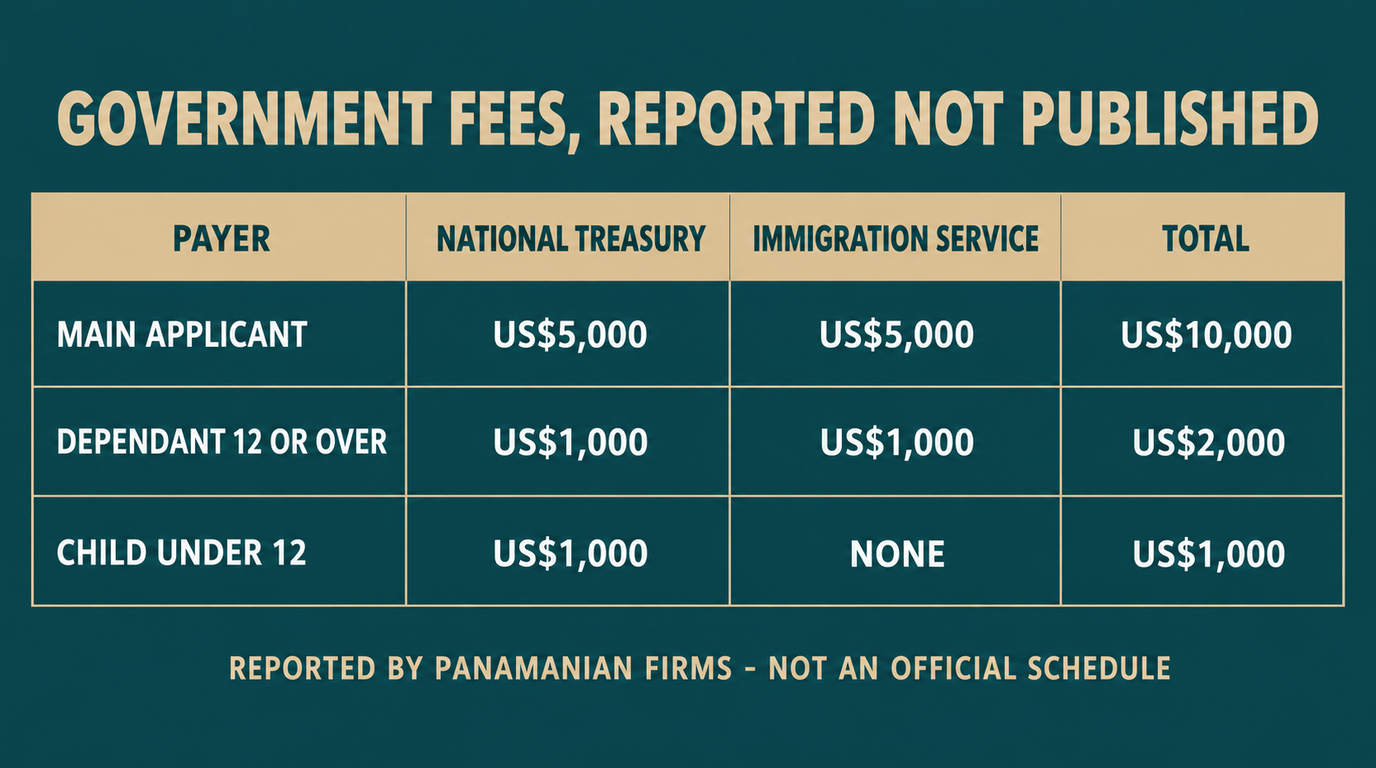
Government fees are US$10,000 for the main applicant — US$5,000 to the National Treasury and US$5,000 to the National Immigration Service — plus roughly US$2,000 per adult dependant. That is on top of the investment and is not published on the ministry's programme page.
There is one real deadline, and it is 16 March 2027. An investment completed before 16 September 2026 can still be filed under the old rules, but only if the application goes in within six months of the decree taking effect.
Permanent residence is granted at approval, with no provisional stage, and the maintenance test is light: hold the investment five years, file documentation with the ministry each year, and visit Panama at least once every two years.
On this page
This guide prices the programme from the Ministry of Commerce and Industries' own material and from the text of the decrees themselves, rather than from adviser marketing. It sets out what each route now costs, traces the phantom deadline back to the clause it was misread from, explains the first-sale versus resale split that replaced it, itemises the government fees nobody publishes, totals a family application, and ends on the residence, tax and citizenship position that several competing pages get wrong. This site's renderer does not emit heading anchors, so the list below is a map rather than a set of jump links.
- Panama golden visa cost in 2026: every route priced
- The 15 October 2026 deadline that isn't, and the one that is
- First sale or resale: the US$200,000 distinction
- Government fees on top of the investment
- Panama golden visa cost for a family of four
- What you have to keep doing for five years
- Residence, tax and the citizenship timeline most pages get wrong
- Related guides on Domicila
Panama golden visa cost in 2026: every route priced
The programme's real name is the Permiso de Residencia Permanente en calidad de Inversionista Calificado — permanent residence as a Qualified Investor. Panama does not call it a golden visa; that is how people search for it. It is administered by the Ministry of Commerce and Industries, which issues the investment certification, and then by the National Immigration Service, which issues the residence.
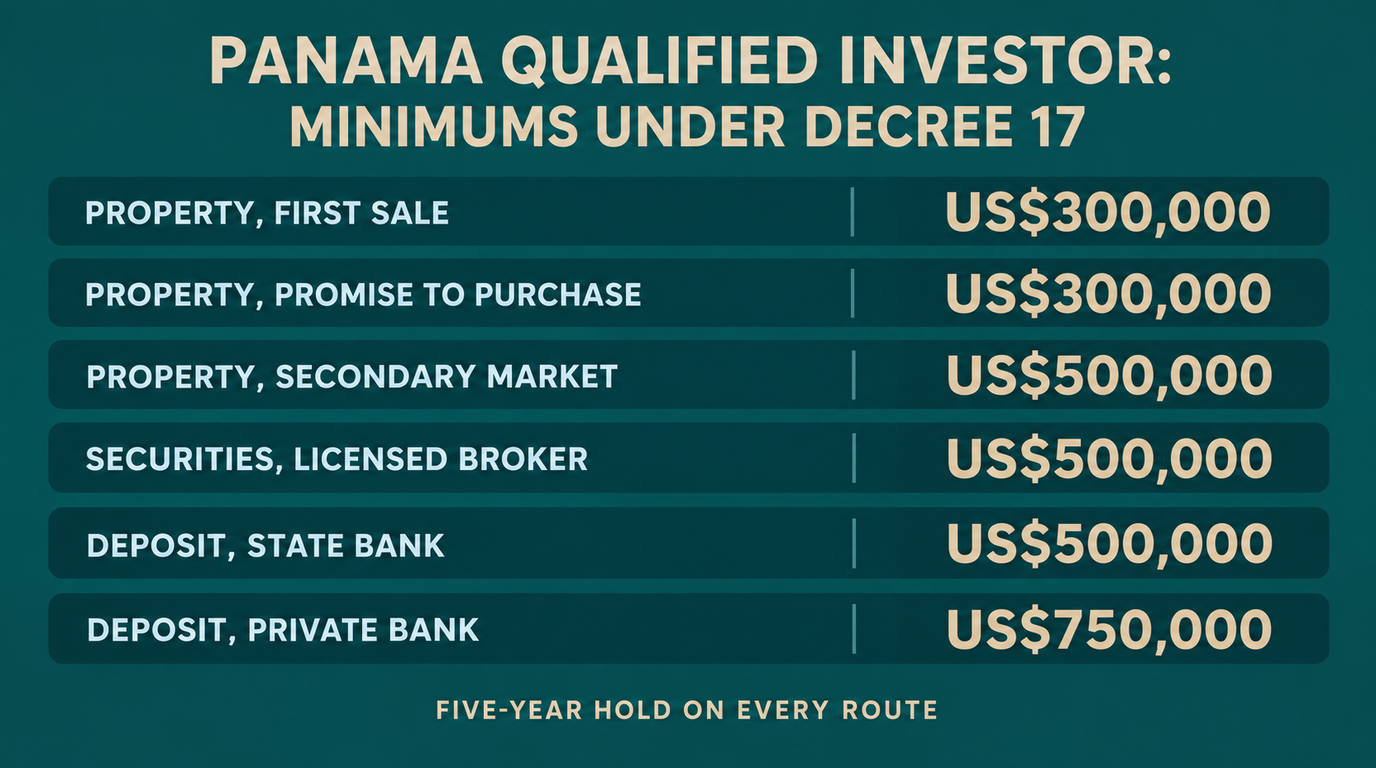
Executive Decree 17 of 8 September 2026 took effect on 16 September 2026 and replaced Decree 722 of 2020 together with its amendments. These are the minimums it set.
| Investment route | Minimum | Hold |
|---|---|---|
| Property, first sale from the developer | US$300,000 | 5 years |
| Property bought through a promise-to-purchase contract | US$300,000 | 5 years |
| Property on the secondary market | US$500,000 | 5 years |
| Securities through a brokerage licensed by Panama's securities regulator | US$500,000 | 5 years |
| Fixed-term deposit at Banco Nacional de Panamá or Caja de Ahorros | US$500,000 | 5 years |
| Fixed-term deposit at a private general-licence bank | US$750,000 | 5 years |
Two of those rows are new. The US$500,000 state-bank deposit did not exist before: the only deposit route used to be US$750,000 at a commercial bank, so the decree has cut the cheapest cash-only route by a third for anyone willing to bank with the state. And the secondary-market property line at US$500,000 is the one that quietly undoes the advertised headline, because the US$300,000 everyone quotes now only reaches new stock.
The money itself has to be foreign in origin and traceable. The decree excludes donations, gifts and other gratuitous transfers from third parties, which rules out the structure where a relative funds the purchase and the applicant simply holds the title. If that is the shape of your file, read our guide to source of funds in investment migration before you commit to a route.
Note that the ministry's own programme page still lists the pre-decree menu — US$300,000 property, US$500,000 securities, US$750,000 deposit — while linking to Decree 17 further down. The page has not caught up with the decree it links to, which is part of why so many guides are wrong.
The 15 October 2026 deadline that isn't, and the one that is
If you have shopped this programme in the last year you have been told that US$300,000 expires on 15 October 2026 and becomes US$500,000. It is on advisory sites, in realtor newsletters and in several of the pages currently ranking for this term. It is wrong twice over, and the second error is the interesting one.
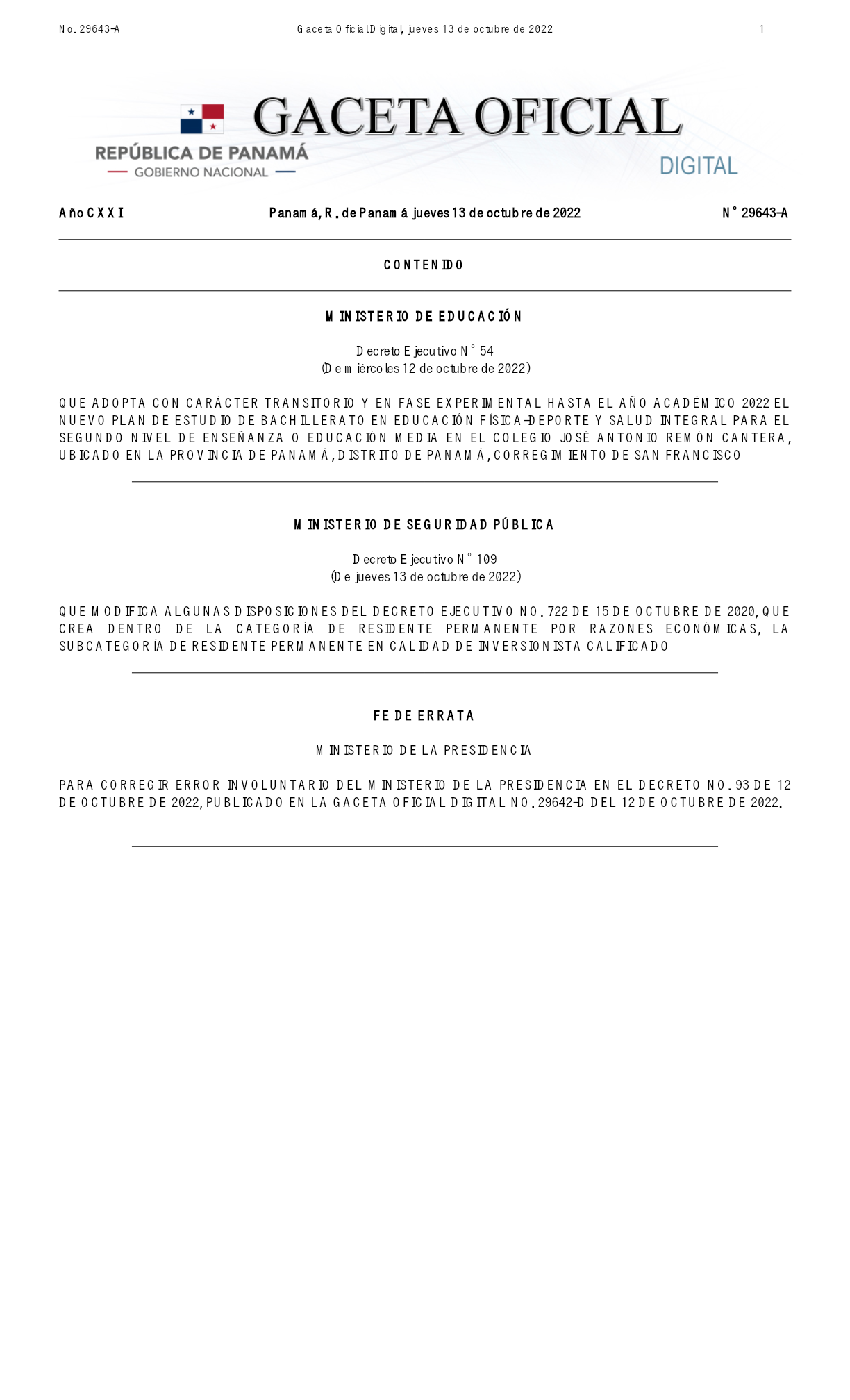
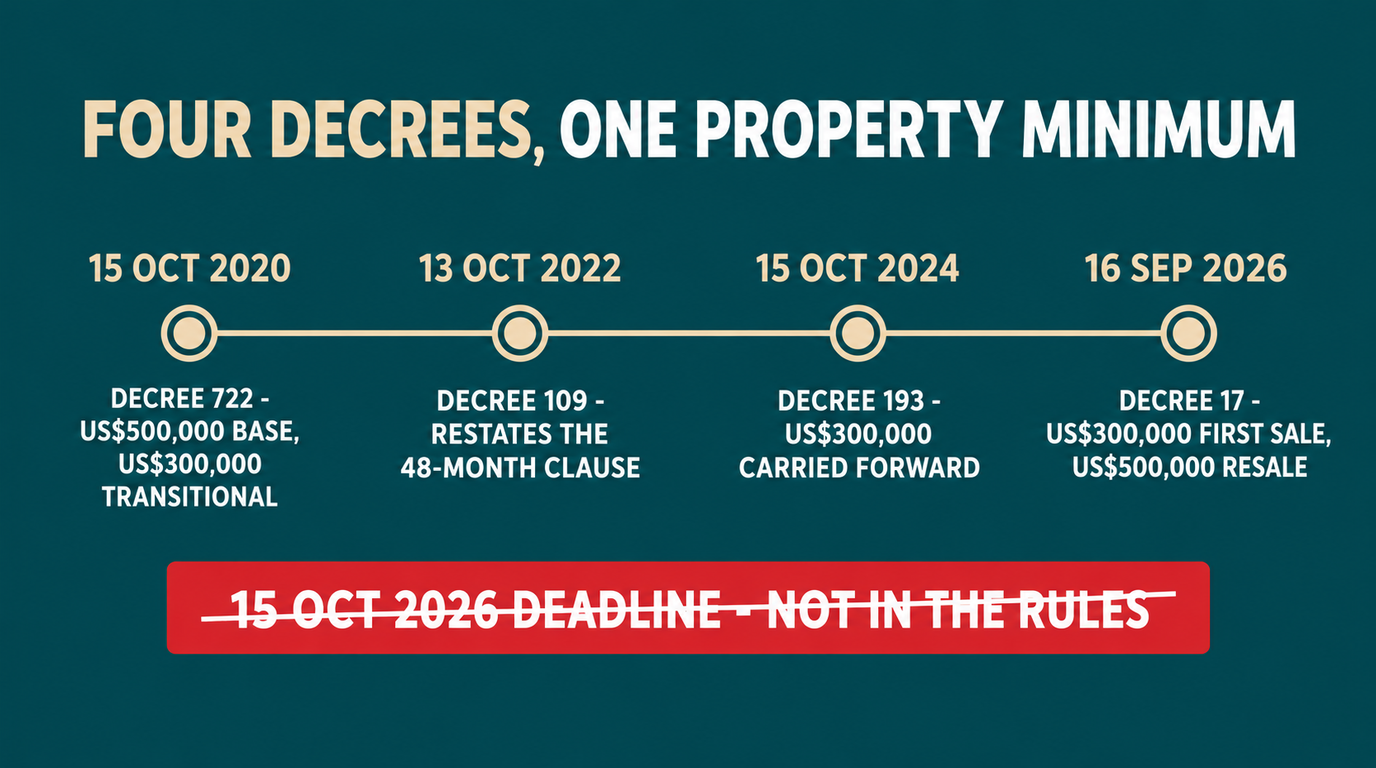
Start with where the date came from. Decree 722 of 15 October 2020 created the programme with a base property minimum of US$500,000 and a transitional discount in its Article 10. Decree 109, published in the Gaceta Oficial of 13 October 2022, restated that transitional article in these words: "Durante los primeros cuarenta y ocho meses posteriores a la entrada en vigencia del presente Decreto Ejecutivo, la inversión mínima en bienes inmuebles ... podrá ser por la suma líquida de trescientos mil balboas (B/.300,000.00)."
Forty-eight months — but from which decree? The clause is Article 10 of Decree 722 being restated, so el presente Decreto Ejecutivo is Decree 722, and 48 months from 15 October 2020 lands in October 2024. Read the pronoun as pointing at Decree 109 instead, promulgated 13 October 2022, and you get October 2026. That is the likeliest origin of the date: the right arithmetic applied to the wrong decree, with the 15 October borrowed from Decree 722's own date.
October 2024 is also exactly when Decree 193 of 15 October 2024 arrived and replaced Article 3 again, carrying the US$300,000 property figure forward as the standing minimum rather than a countdown. Sources disagree on whether Decree 193 set a fresh expiry; the analyses that quote its text say it did not.
And then the argument stopped mattering. Decree 17 repealed Decree 722 and its amendments on 16 September 2026, so the transitional clause everyone was counting down no longer exists to expire.
| Decree | Date | What it did to the property minimum |
|---|---|---|
| 722 | 15 October 2020 | Created the programme: US$500,000 base, US$300,000 transitional for 48 months |
| 109 | Gazetted 13 October 2022 | Restated the 48-month transitional clause and the US$500,000 base |
| 193 | 15 October 2024 | Replaced Article 3, carrying US$300,000 forward as the standing minimum |
| 17 | In force 16 September 2026 | Replaced 722 entirely: US$300,000 first sale, US$500,000 resale |
There is one date that is real. Decree 17 grandfathers investments perfected before it took effect, but only if the application is filed within six months of entry into force — 16 March 2027. Applications already lodged before 16 September 2026 are assessed under the rules as they stood. If you bought a qualifying resale property in August 2026 at US$300,000, that window is the whole of your advantage, and it is a filing deadline rather than a buying one.
First sale or resale: the US$200,000 distinction
This is the change that actually moves money, and it is the one competing pages have mostly not absorbed. The decree does not raise the entry price. It splits it, and which side you land on is worth US$200,000.
| First sale | Secondary market | |
|---|---|---|
| Minimum | US$300,000 | US$500,000 |
| What it means | New, unoccupied, transferred by the developer or promoter | Previously marketed, occupied, rented, or transferred to an unrelated third party |
| Typical stock | Pre-construction and newly completed units | Anything with a prior owner or tenant |
| Promise-to-purchase | Qualifies at US$300,000 on the decree's conditions | Not the relevant route |
The effect is to push the programme toward new development, which is plainly the intent: the ministry has said it wants investment to become projects and jobs rather than changes of title. It also means the cheapest qualifying route now carries construction risk, because pre-construction contracts are where the US$300,000 stock mostly lives.
Be careful with the word new. A unit that has been rented out, or sold once and resold, is secondary market even if nobody has decorated it. A developer's unsold inventory in a finished building is still first sale. If an agent describes a listing as new, the question to ask is who the registered owner is and whether the unit has ever been transferred or let.
If that risk is the part you dislike, the honest comparison is against programmes that still accept straightforward completed property. Our golden visa cost comparison prices those side by side, and cheapest golden visa ranks them on entry price alone.
Government fees on top of the investment
The investment is recoverable. The government fees are not, and they are the line most budgets miss, because the ministry's programme page does not publish them and the decree's fee provisions are not in a format we could verify directly — the gazette carries Decree 17 as a scanned image rather than machine-readable text.
What follows is the schedule reported consistently by Panamanian firms filing these applications. We have labelled it as such rather than presenting it as an official table, and you should ask your own counsel to confirm the figures against the decree before you write a cheque.
| Payer | To the National Treasury | To the National Immigration Service | Total |
|---|---|---|---|
| Main applicant | US$5,000 | US$5,000 | US$10,000 |
| Dependant aged 12 or over | US$1,000 | US$1,000 | US$2,000 |
| Child under 12 | US$1,000 | — | US$1,000 |
The payment to the immigration service is described as a repatriation deposit rather than a fee, which is standard across Panamanian residence categories — the state holds the cost of removing you if it ever has to. The Treasury payment is the application charge.
One caveat worth stating plainly: sources differ on the under-12 line. Several Panamanian firms publish the reduced US$1,000 for children under 12; at least one states that every dependant pays US$2,000 regardless of age. The difference is small against a US$300,000 investment, but if you are filing with young children, get it confirmed rather than budgeted.
Legal fees sit outside all of this and no government publishes a schedule for them. Published quotes from Panamanian counsel for a full qualified-investor file commonly run US$7,000 to US$15,000 — an estimate, not a price. Transfer tax, registration, appraisal and escrow are separate again, and follow the purchase rather than the visa.
Panama golden visa cost for a family of four
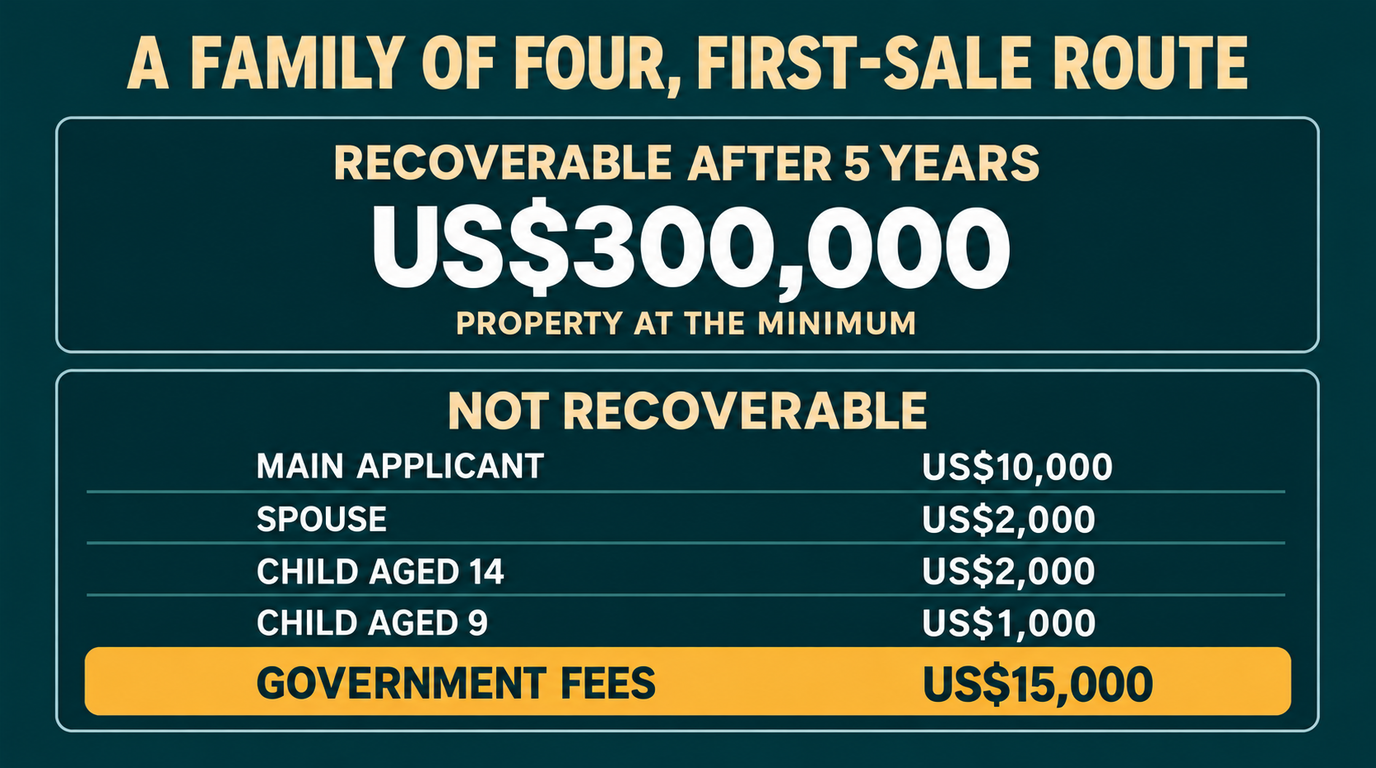
Here is the whole bill for a couple with two children, one aged fourteen and one aged nine, buying a first-sale apartment at the minimum. The investment line is recoverable after five years; everything below it is not.
| Line | Amount | Basis |
|---|---|---|
| Property, first sale, at the minimum | US$300,000 | Official — Decree 17, recoverable after 5 years |
| Government fees, main applicant | US$10,000 | Reported, not published by the ministry |
| Spouse | US$2,000 | Reported |
| Child aged 14 | US$2,000 | Reported |
| Child aged 9 | US$1,000 | Reported, and disputed between sources |
| Immigration counsel | No government schedule | Estimate — published quotes run US$7,000–15,000 |
| Property transfer, registration and appraisal | No government schedule | Estimate — depends on the purchase, not the visa |
| Non-recoverable government fees | US$15,000 |
So the government takes roughly US$15,000 from a family of four, on top of a US$300,000 investment you keep. Add counsel and transaction costs and a realistic non-recoverable figure is somewhere around US$25,000 to US$35,000, almost all of which is the parts no ministry sets a price for.
That compares well on fees. A Caribbean contribution route is non-recoverable in its entirety — the money is a donation, not an asset — which is the structural difference our citizenship by investment vs golden visa guide works through. Against the European programmes the gap is in the asset, not the fee: Panama asks less capital than most and gives residence rather than a route into the Schengen area.
Buy on the secondary market instead and every line above stays the same except the first, which becomes US$500,000. The government fees do not scale with the investment.
What you have to keep doing for five years
Permanent residence is granted on approval — there is no provisional permit to renew first, which is the programme's genuine advantage over most of Europe. But the residence is tied to the investment, and the decree attaches continuing duties that several guides omit entirely.
| Obligation | What it means |
|---|---|
| Hold the investment | Five years minimum, in the form that was certified |
| Annual confirmation | File documentation with the ministry within the 30 calendar days before the anniversary of your immigration resolution |
| Keep the asset unencumbered | The qualifying amount must stay free of liens; only value above it may be mortgaged |
| Visit Panama | At least once every two years to keep the residence alive |
The annual confirmation is the one that catches people. It is not a renewal — the residence is permanent — but an attestation that the investment is still there in its certified form, and the window is narrow: the 30 days before the anniversary of the resolution, not of the purchase. Missing it does not automatically cost you the status, but it puts the file in front of an official who did not need to look at it.
The two-year visit requirement is light by any standard, and lighter than the physical-presence tests attached to most European residence permits. It is not, however, nothing: a permanent resident who stays away longer is exposed to the status lapsing, and there is no published grace mechanism to rely on.
On timing, the ministry gives itself up to 15 business days to issue the investment certification and the immigration service up to 30 business days to decide a complete application. Those are service commitments on a complete file, not a promise about your file — document gathering and apostilles are usually the long pole. Our citizenship by investment processing time guide sets the same kind of published figures against real timelines elsewhere.
Residence, tax and the citizenship timeline most pages get wrong
Three claims circulate about this programme that are worth correcting, because two of them would change a decision.
Panama does not sell citizenship, and the passport is not two years away. Several pages ranking for this term state that the programme offers citizenship in two years, sometimes calling it the fastest in Latin America. The general naturalisation rule is five years of permanent residence, and it is an application assessed on its merits, not an entitlement that matures. Shorter periods exist for nationals of certain Ibero-American countries under reciprocity arrangements and for people married to Panamanians or parenting Panamanian children — which is where the two-year figure appears to have been generalised from. If a passport is the actual objective, a residence programme is the slow road, and our citizenship by investment countries guide covers the routes that are genuinely direct.
Territorial taxation is real but it is not a personal tax exemption. Panama taxes Panamanian-source income and generally leaves foreign-source income outside its net. That is a genuine feature of the system rather than a concession attached to this visa, and it says nothing about what your current country of tax residence will do. Holding a Panamanian residence permit does not by itself end tax residence anywhere else, and the countries most readers are leaving decide that on their own tests. Treat the territorial system as a reason Panama is worth examining, not as a result you have purchased.
Residence is not relocation. The light presence requirement is the thing most people are buying, and it is exactly why the permit does little on its own: appearing once every two years will not shift anyone's centre of vital interests, which is what most tax authorities actually test.
Panama's position is clear enough: a low capital threshold, permanent residence immediately, almost no presence obligation, and a long, discretionary road to a passport. If the immediate permanence is what appeals, golden visa countries shows which programmes still grant it up front and which have moved to renewable temporary permits.
Related guides on Domicila
If Panama is on your shortlist, these are the comparisons that do the most work next:
- Golden visa cost comparison — every open programme priced on its current official fee table
- Cheapest golden visa — where the entry price is lowest, and what you give up for it
- Golden visa countries — which programmes are open, closed or mid-rewrite
- Citizenship by investment vs golden visa — passport now, or residence first
- Citizenship by investment processing time — published timelines against real ones
- US Gold Card cost — the other Americas route, priced per person
- New Zealand golden visa cost — the light-presence comparison at the opposite end of the budget
Common questions
How much does the Panama golden visa cost in 2026?
The investment is US$300,000 for a new, first-sale property bought from the developer, or US$500,000 for a property on the secondary market, under Executive Decree 17 of 8 September 2026. Other routes are US$500,000 in securities through a licensed Panamanian brokerage, US$500,000 in a fixed-term deposit at Banco Nacional de Panamá or Caja de Ahorros, or US$750,000 in a fixed-term deposit at a private bank. Government fees on top are reported at US$5,000 to the National Treasury and US$5,000 to the National Immigration Service for the main applicant, plus about US$2,000 per adult dependant. The investment is recoverable after five years; the fees are not.
Does the US$300,000 threshold really expire on 15 October 2026?
No. That date does not appear in the current rules. It appears to come from reading the 48-month transitional clause in Decree 109 of 2022 as running from Decree 109 itself rather than from Decree 722 of 15 October 2020, which is the decree whose article was being restated. Counted correctly the 48 months ended in October 2024, and Decree 193 of 15 October 2024 carried the US$300,000 figure forward. In any case the question is now moot: Decree 17 repealed Decree 722 and its amendments on 16 September 2026, so the transitional clause no longer exists.
What is the difference between first-sale and resale property?
A first-sale property is new and unoccupied and is transferred by the developer or promoter; it qualifies at US$300,000. A secondary-market property is one that has previously been marketed, occupied, rented or transferred to an unrelated third party, and it requires US$500,000. The distinction is about the unit's history rather than its condition, so a never-lived-in apartment that has already been sold once is secondary market. Unsold developer inventory in a finished building is still first sale.
Is there any deadline that actually matters?
Yes — 16 March 2027. Decree 17 took effect on 16 September 2026, and investments that were perfected before that date can still be assessed under the previous rules provided the application is filed within six months of the decree entering into force. Applications already lodged before 16 September 2026 are assessed under the requirements in place when they were submitted. This is a filing deadline, not a deadline to buy.
Do you have to live in Panama to keep the residence?
No. The maintenance requirement is a visit to Panama at least once every two years, which is among the lightest presence obligations of any residence-by-investment programme. You must also hold the qualifying investment for five years in the form that was certified, keep the qualifying amount free of liens, and file confirming documentation with the Ministry of Commerce and Industries within the 30 calendar days before each anniversary of your immigration resolution.
How long does the application take?
The published service commitments are up to 15 business days for the Ministry of Commerce and Industries to issue the investment certification and up to 30 business days for the National Immigration Service to decide a complete application. Those apply to a complete file, so in practice the timeline is usually set by document gathering, apostilles and the property transaction rather than by the authorities. Permanent residence is granted on approval, with no provisional permit stage to pass through first.
Does the Panama golden visa lead to a passport?
Not quickly, and not automatically. The general rule is that naturalisation can be applied for after five years of permanent residence, and it is a discretionary application assessed on its merits rather than an entitlement. Shorter periods apply to nationals of certain Ibero-American countries under reciprocity arrangements, and to people married to Panamanians or parenting Panamanian children. Claims that this programme delivers citizenship in two years generalise those special cases to everyone.
Official sources to verify
- Programa Inversionista CalificadoMinisterio de Comercio e Industrias de Panamá
- Decreto Ejecutivo No. 109, modificando el Decreto Ejecutivo No. 722 de 2020Ministerio de Comercio e Industrias de Panamá
- Atracción de inversión e impulso al empleo: Panamá amplía el alcance del programa Inversionista CalificadoMinisterio de Comercio e Industrias de Panamá
- Panamá apuesta por más inversión y empleo con nuevo decreto de Inversionista CalificadoMinisterio de Comercio e Industrias de Panamá
- Servicios y trámites de residenciaServicio Nacional de Migración de Panamá
- Gaceta Oficial Digital de la República de PanamáGaceta Oficial de Panamá
Compare golden visa advisors
Ask for a route-specific quote that separates investment amount, government fees, legal work, fund or property costs, and renewal obligations.
We may earn a referral fee if you choose an advisor through this site. We still aim to show cost ranges, caveats, and official source links plainly.