bulgaria golden visa cost
Bulgaria golden visa cost 2026: the full bill
Every page selling this programme quotes the Bulgaria golden visa cost as a round 512,000 euros. The statute does not. On 18 November 2026 parliament adopted the act that writes the thresholds into the Foreigners Act in euro to the cent, and on the same day it added a presence test that can strip permanent residence from a holder who spends under half the year in the country. We read the adopted text in the committee report, priced the permit against the interior ministry's own 2026 tariff and the foreign ministry's consular fees, and set out which investors the new rule exempts and which obligation replaces it.

Key takeaways
- The cheapest permanent-residence route is 511,291.88 euros, and that figure is now statutory rather than approximate. Article 25(1)(6) of the Foreigners Act takes units in a Bulgarian collective investment scheme or an alternative investment fund at that amount, alongside concession rights at the same figure; listed shares or bonds need 1,022,583.76 euros and the capital of an unlisted company 3,067,751.29 euros.
- Property buys residence, not permanent residence. The 306,775 euro real-estate route under article 24(1)(19) gives a renewable long-stay permit, and permanent residence only arrives after five years with the investment maintained, under article 25(1)(17).
- The state's own charges are small and nobody prints them. On the interior ministry's Tariff No 4, in force since 1 January 2026, permanent residence costs 511.29 euros plus a 5.11 euro service fee and 20.45 euros for the residence card, with a 100 euro type D visa before any of it. That is 636.85 euros per person against a six-figure investment.
- A presence test arrived on 18 November 2026, and investors are carved out of it. The adopted text makes a permanent resident lose status after a calendar year with under six months and one day in Bulgaria, but exempts the investment grounds. In exchange those holders get a new rule of their own: twelve consecutive months outside the whole European Union ends the permit.
- It is not a passport programme. Bulgaria repealed investor naturalisation in 2022, so citizenship runs through the ordinary five-year route, with a Bulgarian language test and, for most applicants, release from their existing citizenship.
On this page
This guide follows the money in the order you will spend it: the permanent-residence price list, the cheaper long-stay routes and the wait they carry, the state fees, the presence rules adopted in November 2026, what the money must do once invested, and where the citizenship claim breaks down. The renderer on this site does not emit heading anchors, so the list below is a map rather than a set of jump links.
- What the Bulgaria golden visa costs in 2026, route by route
- The cheaper way in, and the five-year wait it buys
- The Bulgaria golden visa cost nobody itemises: state fees
- The presence test adopted on 18 November 2026
- What the money has to do once it is in
- Why this is not a passport programme
- The costs we will not estimate
- How to check all of this at source
- Related guides on Domicila
What the Bulgaria golden visa costs in 2026, route by route
Bulgaria has no law that uses the phrase golden visa. What it has is article 25(1) of the Foreigners Act in the Republic of Bulgaria, a list of grounds on which permanent residence can be granted outright, several of which are investments. Permanent residence from day one is the thing that makes the programme unusual in the European Union, and it is why the comparison sites quote it at all.
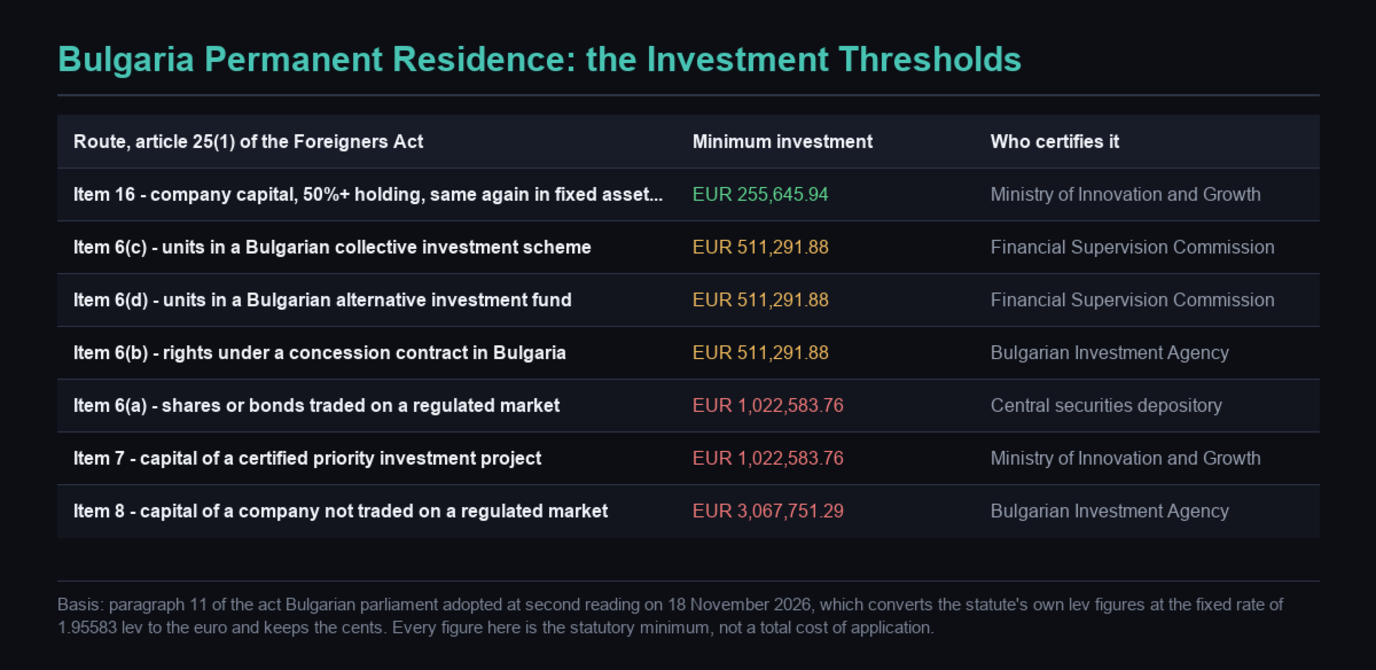
Until this month those thresholds were written in lev. Bulgaria joined the euro area on 1 January 2026 at the fixed rate of 1.95583 lev to the euro, and the act parliament adopted at second reading on 18 November 2026 converts the figures in the statute itself. Paragraph 11 of that act is the whole price list, and it keeps the cents.
| Route (article 25(1) of the Foreigners Act) | Minimum investment | Who certifies it |
|---|---|---|
| Item 6(c) — units in a Bulgarian collective investment scheme, where the scheme's net asset value is at least EUR 2,556,459.41 | EUR 511,291.88 | Financial Supervision Commission licence; central securities depository |
| Item 6(d) — units in a Bulgarian alternative investment fund whose assets are at least EUR 1,533,875.64 | EUR 511,291.88 | Financial Supervision Commission; central securities depository |
| Item 6(b) — rights under a concession contract in Bulgaria | EUR 511,291.88 | Bulgarian Investment Agency |
| Item 6(a) — shares or bonds of Bulgarian companies traded on a regulated market or multilateral trading facility | EUR 1,022,583.76 | Central securities depository |
| Item 7 — capital of a Bulgarian company running a certified priority investment project | EUR 1,022,583.76 | Ministry of Innovation and Growth |
| Item 16 — capital of a Bulgarian company, 50 per cent-plus holding, the same sum again in new fixed assets and 10 jobs for Bulgarian citizens | EUR 255,645.94 | Ministry of Innovation and Growth |
| Item 8 — capital of a Bulgarian company whose shares are not traded on a regulated market | EUR 3,067,751.29 | Bulgarian Investment Agency |
| Item 13 — carrying on an activity certified under the Investment Promotion Act | No figure in the Foreigners Act; set by the certification | Ministry of Innovation and Growth |
Two things in that table are worth pausing on. The 511,291.88 euro figure is a conversion, not a discount: it is one million lev at the fixed rate, so nothing about the programme got cheaper on 1 January. And the 255,645.94 euro line is the lowest number in the statute, but it is not the cheapest route in practice, because it carries ten jobs for Bulgarian citizens that have to be maintained for as long as you hold the permit, plus the same sum again in new tangible and intangible assets. The fund routes ask for money and nothing else.
Property does not appear anywhere in article 25(1). Buying a flat in Sofia or on the coast is a route to a renewable long-stay permit, which is a different instrument and a slower road, and it is the one most of the marketing conflates with this list. That is the next section.
The cheaper way in, and the five-year wait it buys
Article 24(1) of the same act governs continued residence, the renewable permit most foreigners actually hold. Two of its grounds are investments, and the act adopted on 18 November 2026 converts both into euro as well, this time rounded to whole euros after an amendment moved by the chair of the internal security committee.
| Route (article 24(1)) | Minimum investment | What it gives you | Route to permanent residence |
|---|---|---|---|
| Item 19 — ownership of Bulgarian real estate, or 50 per cent-plus of a company that bought property of the same value | EUR 306,775 | Renewable long-stay permit | Article 25(1)(17), after 5 years with the investment maintained |
| Item 20 — capital of a company in an economically disadvantaged region, the same sum again in new fixed assets, and 5 jobs for Bulgarian citizens | EUR 127,823 | Renewable long-stay permit | Article 25(1)(17), after 5 years with the investment maintained |
The property route has a condition the brochures leave out. Article 24(1)(19) requires the sum to be paid in full and received into an account at a licensed Bulgarian credit institution by the date you apply, and where the property was bought with borrowed money the outstanding part of the loan may not exceed 25 per cent. A mortgage-financed purchase at the threshold price does not qualify.
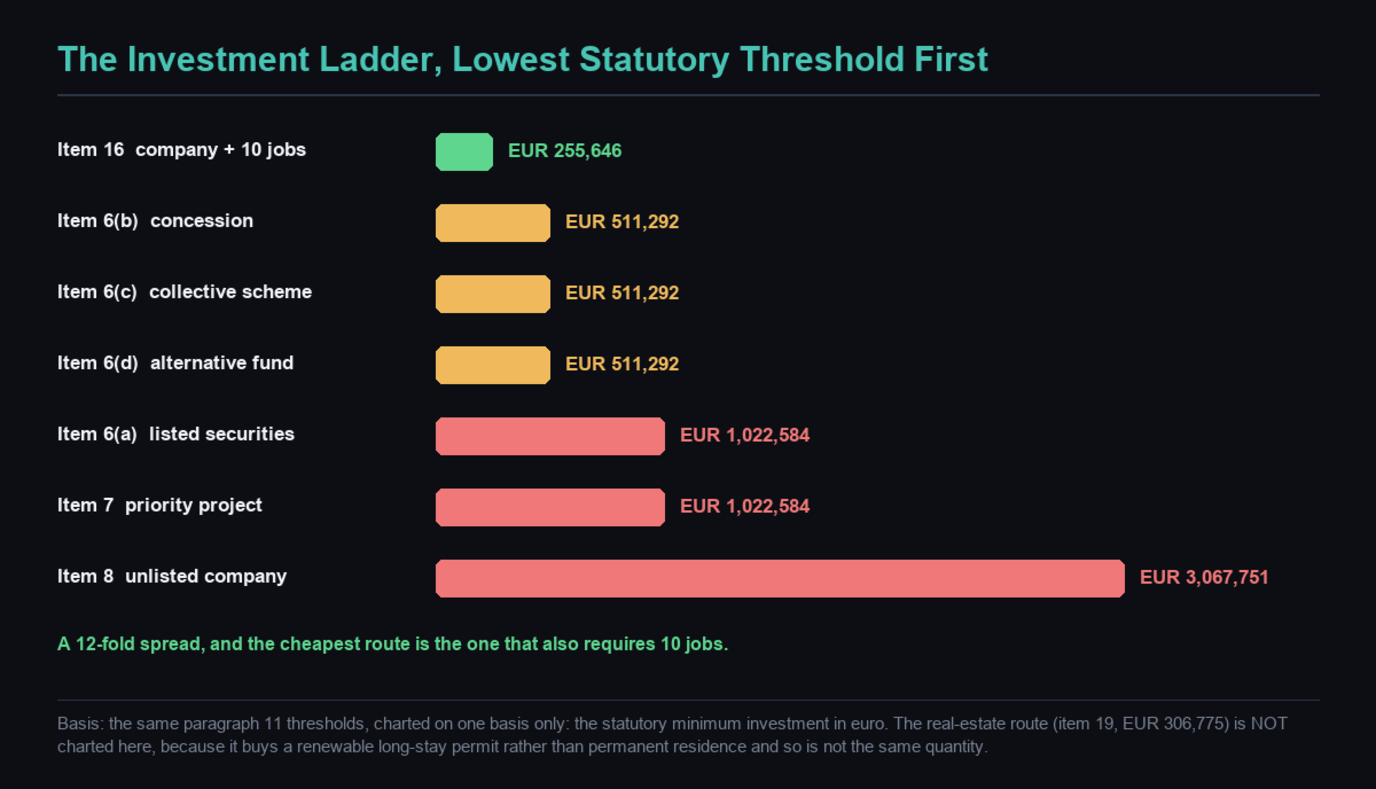
So the real choice is 306,775 euros and a five-year wait against 511,291.88 euros and permanent residence immediately. The gap is about 204,500 euros, and what it buys is the five years. For anyone pricing this against the cheapest golden visa options elsewhere in Europe, that trade is the specifically Bulgarian question, and it is why the fund route dominates the advisory market despite costing two thirds more.
There is also a new catch on the cheaper route, added by the same November act. A continued-residence permit may be refused renewal where the holder has not spent at least half of the previously permitted period in Bulgaria, which for a one-year permit means roughly six months. The exemptions in that provision cover the grounds at items 17 to 21 of article 24(1), which include both investment routes above, so an investor on the property route is outside it. Read it as a rule that has arrived for the category rather than one that currently bites this particular investor.
The Bulgaria golden visa cost nobody itemises: state fees
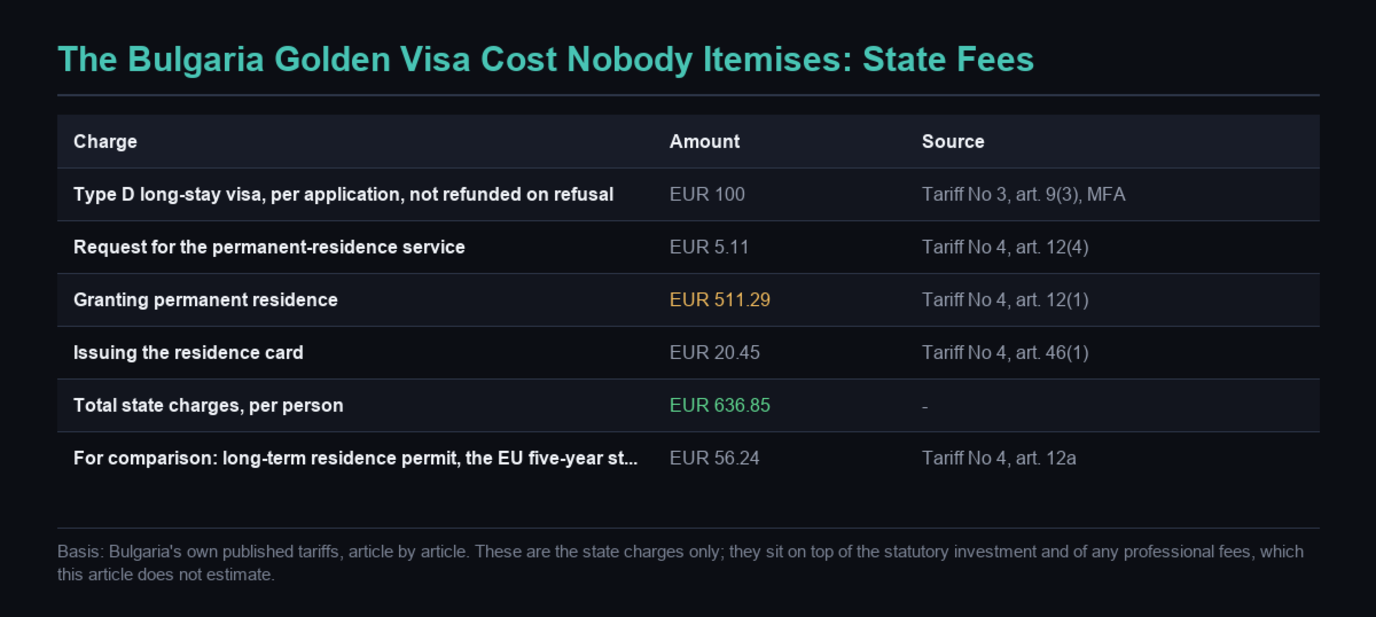
Every guide we read for this page stops at the investment and then writes something like "plus the necessary application fees". The fees are published, they changed on 1 January 2026 when they were restated in euro, and they are small enough to be worth knowing precisely, because an advisor's quote that bundles them is hiding its own margin rather than a government charge.
| Charge | Amount | Legal basis |
|---|---|---|
| Type D long-stay visa, per application, not refunded on refusal | EUR 100 | Tariff No 3, art. 9(3), Ministry of Foreign Affairs |
| Request for the permanent-residence service | EUR 5.11 | Tariff No 4, art. 12(4) |
| Granting permanent residence | EUR 511.29 | Tariff No 4, art. 12(1) |
| Issuing the residence card | EUR 20.45 | Tariff No 4, art. 46(1) |
| Total state charges, per person | EUR 636.85 | — |
| For comparison: long-term residence permit (the EU five-year status, not this route) | EUR 56.24 | Tariff No 4, art. 12a |
Tariff No 4 figures are those in force from 1 January 2026, as amended in State Gazette issue 85 of 2025.
Set against the smallest permanent-residence threshold, 636.85 euros is 0.12 per cent of the money going in. That is cheap by the standards of the programmes we price elsewhere: Portugal's AIMA table, in force since 1 March 2026, charges 8,418.90 euros per person simply to grant the residence permit, sixteen times the 511.29 euros Bulgaria charges for the same act, and it charges family members at the principal rate.
The decision itself is quick on paper. Article 25(3) gives the director of the Migration Directorate two months to decide, extendable by a further two where the case is legally or factually complex or more documents are needed, and the application has to be lodged in person at the directorate or a regional police directorate. Nothing in the tariff charges for a family member of an investor separately from the principal, but each person needs their own card and their own visa, so multiply the 636.85 accordingly.
The presence test adopted on 18 November 2026
This is the part that is new, that the advisory pages have either missed or reported inside out, and that changes the obligations attached to a permit somebody may be buying this week. The bill is reference 52-602-01-29, lodged by the Council of Ministers on 28 July 2026, passed at first reading on 16 September and adopted at second reading on 18 November 2026. Its headline purpose is transposing Directive (EU) 2024/1233 on the single application procedure for a combined residence and work permit. Its effect on investors is in paragraph 17.
That paragraph adds two new grounds for withdrawing a permit to article 40(1), and they work as a pair.
| Who you are | The test you now face | Legal basis |
|---|---|---|
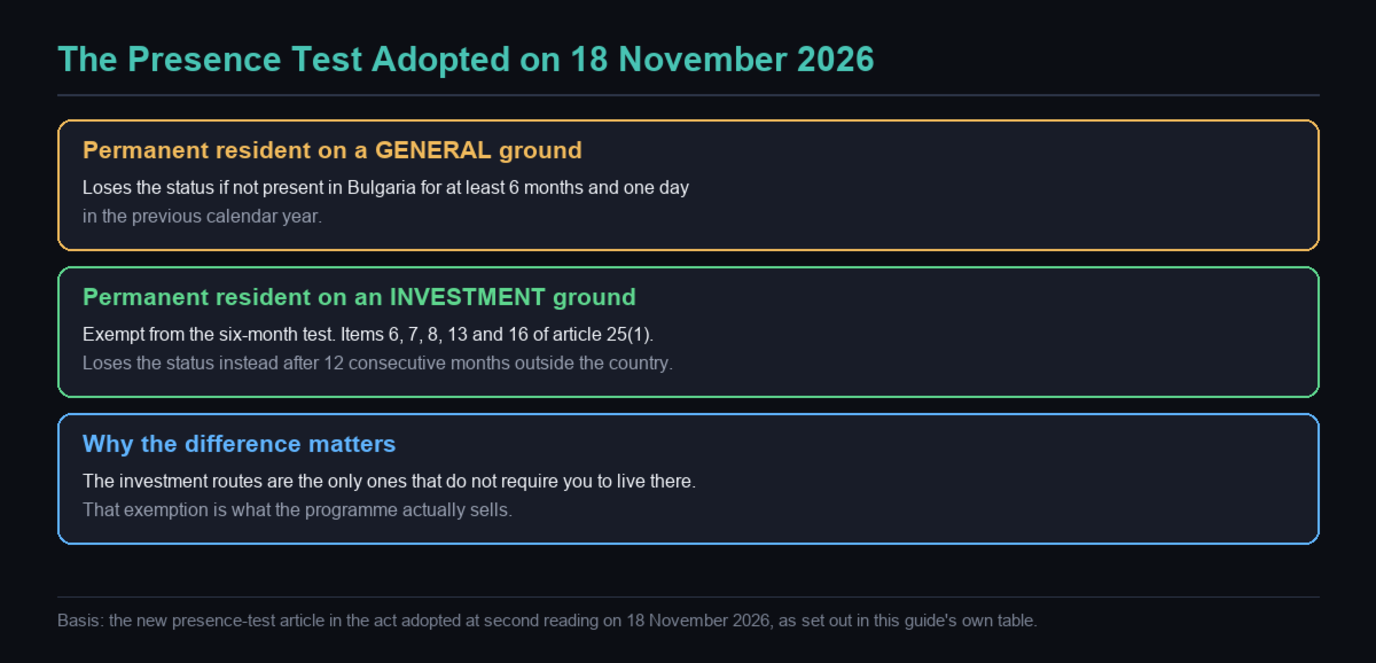
| Permanent resident on a general ground | Lost the status if you did not spend at least 6 months and one day in Bulgaria during the previous calendar year | New art. 40(1)(24) |
| Permanent resident on an investment ground — art. 25(1) items 6, 7, 8, 13 or 16 | Exempt from the six-month test. Instead, lost the status after 12 consecutive months outside the territory of the EU member states, except during a declared state of emergency | New art. 40(1)(25) |
| Permanent resident as family or long-resident (items 2, 3, 4, 11) | Exempt from the six-month test; the 12-month EU-absence rule applies on the same terms | New art. 40(1)(24) and (25) |
| Permanent resident under art. 25g — family of a Bulgarian citizen after 5 years | Exempt from both tests by name | New art. 40(1)(24) and (25) |
| Long-term resident (the EU status) | Absence from EU territory for 12 consecutive months, with the state-of-emergency carve-out | Amended art. 40(1)(6) |
So the reporting that investors are exempt is right, and the reporting that Bulgarian permanent residence is now a six-months-a-year commitment is right too. They are about different people. What an investor acquires is not freedom from presence requirements but a different and much softer one: stay inside the European Union, in any member state, at least once every twelve months. For somebody whose reason for the permit was optionality rather than relocation, that is a materially different product from the one the six-month rule would have produced.
Two further details matter if you are weighing this. The committee rejected an amendment that would have excused documented absences for medical treatment, study, a work posting or the execution of an investment project abroad, and that would have barred the authorities from reading gaps in Entry/Exit System data against an investor who had crossed internal Schengen borders. So there is no statutory list of good reasons, and evidence of presence is the holder's problem. Bulgaria has been inside Schengen for land borders since 1 January 2025, which is precisely why internal crossings leave no stamp.
One timing caveat, stated plainly because it decides when any of this binds you. An adopted act becomes law when the president promulgates it in the State Gazette, and we could not confirm a promulgation as at 23 November 2026: the Gazette's current issue, 106 of 24 November 2026, does not contain the act. So the text is settled and the commencement date is not, and the first calendar year the six-month test could measure is a question for the promulgating issue rather than for us. Check the Gazette for the decree before you plan a year around it.
What the money has to do once it is in
The threshold is the entry price, not the whole obligation, and two provisions decide whether the permit survives.
The investment has to stay above the minimum for five years. Article 25(11) requires investments under items 6, 8 and 16 to be maintained above the statutory minimum for five years from the date permanent residence is granted, and it obliges the holder to declare any change in the circumstances of the investment immediately to the Bulgarian Investment Agency or the Ministry of Innovation and Growth, with evidence. For the fund routes the central securities depository certifies both the investment and its maintenance, and reports to the agency, so compliance is monitored rather than self-reported.
The money is checked before it is invested, not after. Article 25(7) puts the Bulgarian Investment Agency in front of the transaction: it reviews documents identifying the applicant, proof of available funds of at least the threshold already sitting in the applicant's own payment account, evidence of the clear origin of those funds, whether the applicant is a politically exposed person under article 36 of the Measures Against Money Laundering Act, a record of employment, professional and investment activity, and a criminal record certificate from the country of nationality or habitual residence. Our guide to source-of-funds evidence covers what that file looks like in practice.
One trap sits in article 25(10), and it is the kind of thing that costs an applicant a season. The agency's preliminary approval of an investment is not a ground for issuing a type D visa or for granting residence. Approval of the money and permission to live in the country are two separate decisions in that order, and the first does not oblige anybody to make the second.
Why this is not a passport programme
The single most common claim about this programme is that it delivers an EU passport in five years. The route it describes was repealed four years ago.
Articles 12a and 14a of the Bulgarian Citizenship Act, which allowed naturalisation on the strength of an investment and on a shortened timetable, were repealed with effect from State Gazette issue 26 of 2022. The transitional provisions terminated the applications that were still pending, and required anyone already naturalised on those grounds to notify the authority that certified their investment within fourteen days of any change in the facts behind it. There is no investor route to Bulgarian citizenship today.
What remains is ordinary naturalisation under article 12(1), and permanent residence is the clock that starts it. The applicant must be an adult who obtained permanent or long-term residence at least five years before the application, have no conviction for a premeditated offence of a general nature and no pending proceedings for one, have income or an occupation sufficient to support themselves in Bulgaria, command the Bulgarian language as tested under a ministry of education ordinance, and be released from their current citizenship or be released from it on acquisition. Article 12(2) waives that last requirement for citizens of EU and European Economic Area states, Switzerland, and spouses of Bulgarian citizens; most buyers of this programme are in none of those categories.
So the honest framing is the one our citizenship by investment versus golden visa comparison uses: this is residence that counts towards a naturalisation you would then have to qualify for on language and renunciation, not a passport on an instalment plan. Nobody can tell you the outcome of a discretionary naturalisation decision five years from now.
The costs we will not estimate
Three further items sit outside the statutes and tariffs above, and no Bulgarian government source publishes a price for any of them, so we leave them as line items for your own quote rather than inventing a number.
Fund charges. The collective investment scheme and alternative investment fund routes mean buying units in a licensed product, and that product has a management fee and in many cases a performance fee. They are set by the fund, not the state, and they run for the whole five-year holding period, so they are the largest unquantified cost on the cheapest route.
Health insurance and accommodation. The Migration Directorate's own document list for permanent residence requires evidence of secured accommodation and, for several grounds, evidence of stable and sufficient means of support measured against the national minimum wage or minimum pension. Both are bought on the open market. Our note on what residence programmes ask for in cover sets out the pattern across programmes.
The professional layer. Lawyers, translation, notarisation, apostilles and the agency work on the Bulgarian Investment Agency file are unpublished everywhere. Ask for a quote that separates the qualifying investment, the state charges in the table above, fund fees, insurance and professional work into five lines, and refuse a total that merges them.
How to check all of this at source
Every figure on this page comes from a document you can open yourself, which matters in a field where a repealed route survives on advisory sites for years.
The bill, its progress and the vote are on the National Assembly's own page for reference 52-602-01-29, which records the second-reading vote on 18 November 2026. The text that was voted is in the internal security committee's second-reading report of 17 November 2026: paragraph 7 for the article 24 conversions, paragraph 11 for the article 25 price list, and paragraph 17 for the two new withdrawal grounds. The consolidated Foreigners Act, carrying the holding period in article 25(11) and the pre-investment checks in article 25(7), is published as a PDF by the Ministry of Foreign Affairs.
For the money the state takes, Tariff No 4 is published by the Ministry of Interior and the visa fee is on the foreign ministry's consular fees page. The euro conversion rate and the changeover dates are the European Central Bank's, and the Schengen land-border date is Council Decision (EU) 2024/3212.
One practical note from reading them. The National Assembly's site renders its documents in a front-end that search engines index poorly, so a committee report is far easier to find from the bill's own page than from a search, and the bill page is the only place that states plainly whether a text has been voted. The register of promulgated laws, by contrast, carries the State Gazette issue number, which is what tells you a law is actually in force.
Related guides on Domicila
If you are pricing Bulgaria against the alternatives, these are the comparisons that do the most work:
- Golden visa cost comparison — the European programmes side by side with their full fee tables
- Golden visa countries — which residency-by-investment programmes are still open
- Cheapest golden visa — why the lowest advertised threshold is rarely the lowest real cost
- Greece golden visa cost — the other EU route that still takes property
- Portugal golden visa cost — the fund-only regime and the AIMA fee table this page compares against
- Citizenship by investment versus golden visa — what a passport buys that a residence permit does not
Common questions
How much does the Bulgaria golden visa cost in 2026?
The cheapest permanent-residence route is 511,291.88 euros, for units in a Bulgarian collective investment scheme or alternative investment fund under article 25(1)(6) of the Foreigners Act. Listed shares or bonds require 1,022,583.76 euros, the capital of an unlisted company 3,067,751.29 euros, and the job-creating company route 255,645.94 euros plus the same sum in new fixed assets and ten jobs. State charges add 636.85 euros per person, made up of a 100 euro type D visa, a 5.11 euro service fee, 511.29 euros on the grant and 20.45 euros for the card.
Can I buy property to get Bulgarian permanent residence?
Not directly. Property of at least 306,775 euros qualifies for a renewable long-stay permit under article 24(1)(19), and permanent residence follows only after five years with the investment maintained, under article 25(1)(17). The purchase price must be paid in full into an account at a licensed Bulgarian credit institution by the date of application, and if the property was bought with borrowed money the outstanding part of the loan may not exceed 25 per cent.
Do I have to live in Bulgaria to keep the permit?
Investors are exempt from the six-month rule parliament adopted on 18 November 2026. That rule withdraws permanent residence from a holder who spent less than six months and one day in Bulgaria during the previous calendar year, but the adopted text excepts permanent residence granted on the investment grounds in article 25(1), items 6, 7, 8, 13 and 16. Those holders are instead subject to a new provision that ends the permit after twelve consecutive months spent outside the territory of the European Union member states.
Is the new presence rule already law?
It was adopted at second reading on 18 November 2026, which settles its wording, but an adopted act binds nobody until the president promulgates it in the State Gazette. We could not confirm a promulgation as at 23 November 2026, and the Gazette's current issue, 106 of 24 November 2026, does not contain the act. Treat the content as final and the commencement date as open, and check the Gazette for the promulgating decree.
How long must the investment be held?
Article 25(11) of the Foreigners Act requires investments made under items 6, 8 and 16 of article 25(1) to be maintained above the statutory minimum for five years from the date permanent residence is granted. Any change in the circumstances of the investment must be declared immediately to the Bulgarian Investment Agency or the Ministry of Innovation and Growth with supporting evidence, and for the fund routes the central securities depository certifies both the investment and its maintenance.
Does Bulgarian permanent residence lead to an EU passport?
Not through investment. Articles 12a and 14a of the Bulgarian Citizenship Act, which allowed naturalisation on the basis of an investment and on a shortened timetable, were repealed with effect from State Gazette issue 26 of 2022, and pending applications were terminated. What remains is ordinary naturalisation under article 12(1), which requires permanent or long-term residence obtained at least five years earlier, a clean record, sufficient income, command of Bulgarian tested under a ministry ordinance, and release from the applicant's existing citizenship unless they are an EU, EEA or Swiss national or the spouse of a Bulgarian citizen.
How long does the permanent-residence decision take?
Article 25(3) gives the director of the Migration Directorate two months from the date the application is lodged, extendable by a further two months where the case is legally or factually complex or additional documents are required. The application must be lodged in person at the Migration Directorate or at the migration section of a regional directorate of the interior ministry. A separate and earlier step is the Bulgarian Investment Agency's assessment of the investment, and article 25(10) states that its preliminary approval is not itself a ground for issuing a visa or granting residence.
Why did the thresholds change to euro in 2026?
They did not change in value. Bulgaria joined the euro area on 1 January 2026 at the fixed conversion rate of 1.95583 lev to the euro, with one month of dual circulation and the euro as sole legal tender from 1 February 2026. The act adopted on 18 November 2026 rewrites the lev figures in the Foreigners Act as euro at that rate, which is why the permanent-residence thresholds carry cents and why one million lev now reads as 511,291.88 euros.
Official sources to verify
- Законопроект за изменение и допълнение на Закона за чужденците в Република България, сигнатура 52-602-01-29, lodged by the Council of Ministers on 28 July 2026 — the bill page records first reading passed 16 September 2026 and second reading adopted 18 November 2026, read 23 November 2026Народно събрание на Република България (National Assembly of Bulgaria)
- Доклад за второ гласуване на Комисията по вътрешна сигурност и обществен ред, 17 November 2026 — the text as voted: § 7 converting art. 24(1) items 6, 19 and 20 to EUR 51,129, EUR 306,775 and EUR 127,823; § 11 converting art. 25(1) items 6, 7, 8 and 16; § 12 adding art. 26(14); § 17 adding art. 40(1) items 24, 25 and 26 and amending item 6; read 23 November 2026Народно събрание на Република България (National Assembly of Bulgaria)
- Закон за чужденците в Република България, consolidated to State Gazette issue 52 of 2025 — art. 24(1) items 19 and 20 (BGN 600,000 property and BGN 250,000 disadvantaged-region routes), art. 25(1) items 6, 7, 8, 16 and 17, art. 25(2) and (3) (two-month decision), art. 25(7) and (10) (Bulgarian Investment Agency assessment and the effect of preliminary approval), art. 25(11) (five-year maintenance) and art. 25g, read 23 November 2026Ministry of Foreign Affairs of the Republic of Bulgaria
- Тарифа № 4 за таксите, които се събират в системата на Министерството на вътрешните работи по Закона за държавните такси — art. 12(1) EUR 511.29 to grant permanent residence, art. 12(2) EUR 76.69, art. 12(4) EUR 5.11 service fee, art. 12(5) EUR 3.58, art. 12a EUR 56.24 for long-term residence and art. 46(1) EUR 20.45 for the residence card, all in force from 1 January 2026 under State Gazette issue 85 of 2025, read 23 November 2026Ministry of Interior of the Republic of Bulgaria
- Постоянно пребиваване — the Migration Directorate's service sheet for each ground in art. 25(1), listing the required documents, the evidence of secured accommodation and means of support, and the state fees per ground, read 23 November 2026Дирекция „Миграция“, Ministry of Interior of the Republic of Bulgaria
- Такси за консулски услуги — EUR 100 for a long-stay type D visa application under art. 15(1) of the Foreigners Act, EUR 200 under art. 15(2), and EUR 90 for a short-stay visa; fees are not refunded if the visa is refused, read 23 November 2026Ministry of Foreign Affairs of the Republic of Bulgaria
- Закон за българското гражданство, consolidated text — art. 12(1) ordinary naturalisation conditions including five years since a permanent or long-term residence permit and the Bulgarian language requirement, art. 12(2) exemptions from renunciation, and art. 12a and 14a repealed with effect from State Gazette issue 26 of 2022 with pending procedures terminated, read 23 November 2026State Agency for Refugees (saref.government.bg), Republic of Bulgaria
- Bulgaria and the euro — Bulgaria joined the euro area on 1 January 2026 at the fixed conversion rate of BGN 1.95583 to EUR 1, with one month of dual circulation and euro cash as sole legal tender from 1 February 2026, read 23 November 2026European Central Bank
- Council Decision (EU) 2024/3212 of 12 December 2024 setting 1 January 2025 as the date for the lifting of checks on persons at internal land borders with and between Bulgaria and RomaniaCouncil of the European Union (EUR-Lex)
- Tabela de taxas e demais encargos a cobrar pelos procedimentos administrativos (em vigor desde 1 de março de 2026)Agência para a Integração, Migrações e Asilo (AIMA), Portugal
Compare golden visa advisors
Ask for a route-specific quote that separates investment amount, government fees, legal work, fund or property costs, and renewal obligations.
We may earn a referral fee if you choose an advisor through this site. We still aim to show cost ranges, caveats, and official source links plainly.