greece golden visa cost
Greece Golden Visa Cost 2026: The Real All-In Price
The Greece golden visa cost is advertised at EUR 250,000 on far more pages than it is true on, because that number now belongs to two narrow renovation routes rather than to the sea-view apartment in the photograph. Pick the wrong island and the gap between the price you were quoted and the price the law requires is EUR 550,000. We took the thresholds, the fees and the deadlines from the Greek government's own service registry entries, priced the transfer tax, notary and registry work that no brochure adds in, and checked what February's rewrite of the Migration Code actually did to the investor permit.

Key takeaways
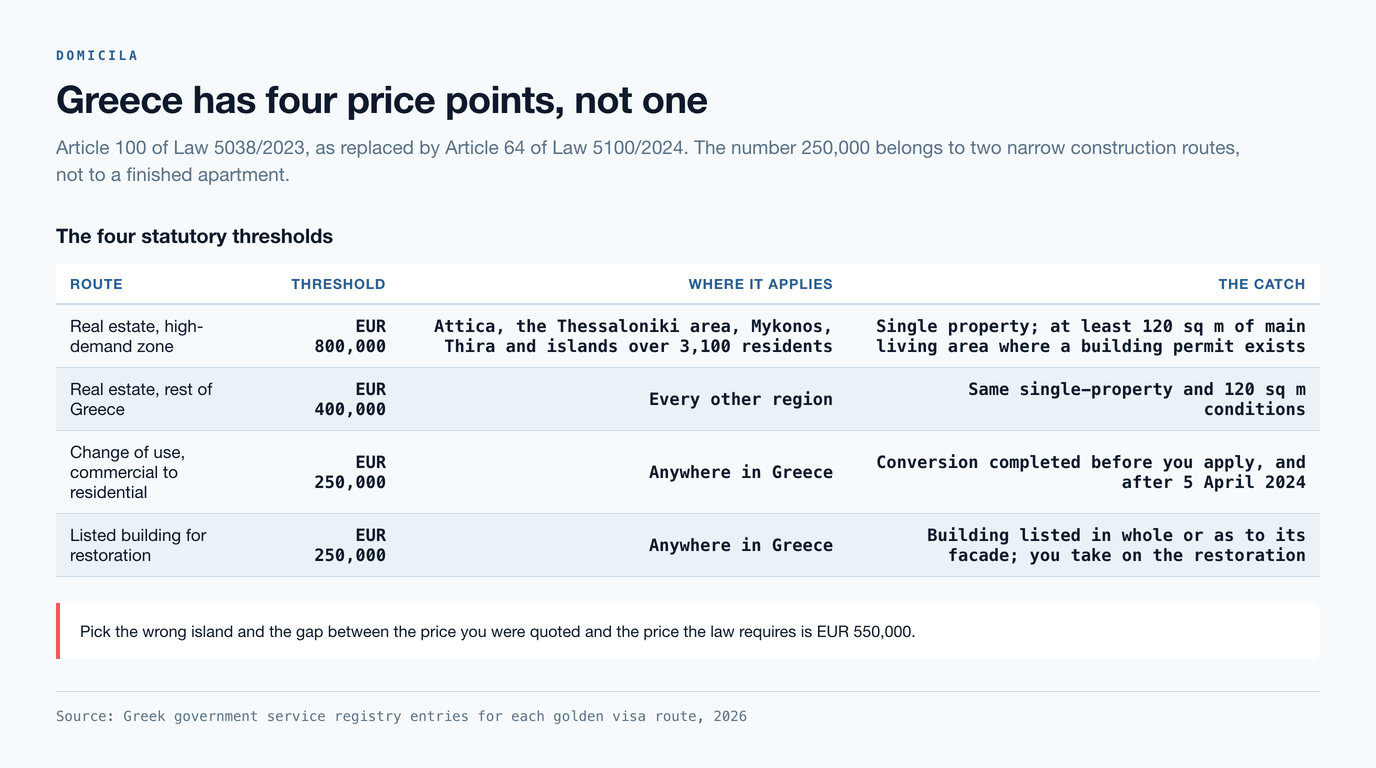
Greece has four real-estate price points, not one. Article 100 of Law 5038/2023, as replaced by Article 64 of Law 5100/2024, sets EUR 800,000 in Attica, the Thessaloniki area, Mykonos, Thira and every island with more than 3,100 residents, EUR 400,000 in the rest of the country, and EUR 250,000 on two narrow routes only: a completed change of use from commercial to residential, or a listed building you take on to restore.
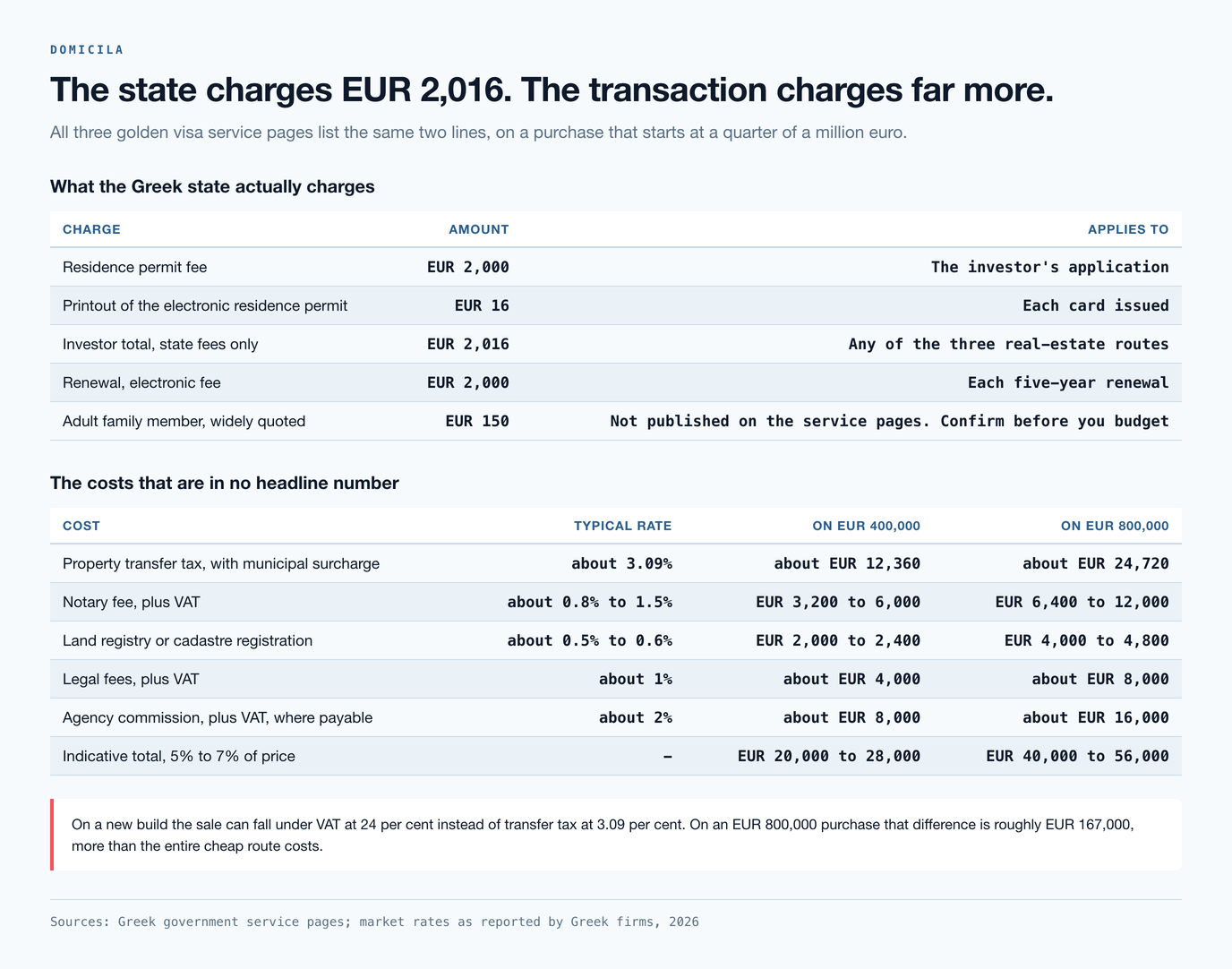
The state's own charge is small, flat and the same on every route. All three golden visa service pages the Greek government publishes list the same two lines: EUR 2,000 for the residence permit and EUR 16 to print the electronic card. That is EUR 2,016 for the investor, on a purchase that starts at a quarter of a million euro.
It has to be one property, and usually a large one. The threshold cannot be assembled from two cheaper flats, and where a building permit exists the main living area must be at least 120 square metres. The cheap routes carry their own trap: on the change-of-use route the conversion must be finished before you apply, not after.
Transaction costs are the missing line. Transfer tax at 3.09 per cent plus notary, land registry and legal work runs to roughly 5 to 7 per cent of the price on ordinary market figures, so an EUR 800,000 purchase carries something like EUR 40,000 to EUR 56,000 that no headline number includes.
Two 2026 developments cut in opposite directions, and only one of them is law. Law 5275/2026 rewrote much of the Migration Code on 6 February 2026 and left the investor thresholds alone. The 15 per cent transfer tax for non-EU buyers that the Prime Minister announced on 6 September 2026 is an announcement, not a statute, and its start date has already moved once.
On this page
This guide runs from the four statutory prices to the fees, then to the costs and the rules that sit outside every quote. The renderer on this site does not emit heading anchors, so the list below is a map rather than a set of jump links.
- Greece golden visa cost in 2026: four price points, not one
- The two EUR 250,000 routes, and the conditions that rule most buyers out
- Government fees: what the Greek state actually charges
- The costs that are not in anyone's headline number
- The 15 per cent transfer tax announced in September 2026
- What Law 5275/2026 changed, and what it did not
- The rules that can cost you the permit after you have it
- Greece against the golden visas still open
- What to get in writing before you transfer
- Related guides on Domicila
Greece golden visa cost in 2026: four price points, not one
The Greece golden visa cost depends on two things before it depends on anything else: where the property is, and what kind of property it is. Article 64 of Law 5100/2024 replaced the single EUR 250,000 threshold that ran from 2013 with a zoned structure, and the government's own service registry now states the split in plain terms on each golden visa service page.
| Route | Threshold | Where it applies | The catch |
|---|---|---|---|
| Real estate, high-demand zone | EUR 800,000 | Attica, the Thessaloniki area, Mykonos, Thira and islands with more than 3,100 residents | Single property; at least 120 sq m of main living area where a building permit exists |
| Real estate, rest of Greece | EUR 400,000 | Every other region | Same single-property and 120 sq m conditions |
| Change of use, commercial to residential | EUR 250,000 | Anywhere in Greece | The conversion must be completed before you apply, and after 5 April 2024 |
| Listed building for restoration | EUR 250,000 | Anywhere in Greece | The building must be listed, in whole or as to its facade, and you take on the restoration |
Read the third and fourth rows as exceptions rather than as options. They are the reason the number EUR 250,000 is still everywhere, and they describe a construction project, not a purchase. If a listing is being marketed to you at EUR 250,000 as a finished apartment in Athens, the arithmetic does not work: Attica is an EUR 800,000 zone unless one of those two routes applies to that specific building.
The zone rule is measured by where the property sits, not by where you live or where the agent is based. The timeshare service page puts the EUR 800,000 zone in the government's own words as Attica, Thessaloniki, Mykonos, Thira and islands with populations above 3,100, which sweeps in most of the Cyclades and the Dodecanese that buyers actually want. Real estate is also not the only door: the capital routes under Article 101, covering share capital, Greek treasury bonds and bank deposits, are summarised by Greek law firms at EUR 500,000 and are outside the three real-estate services the ministry publishes in English, so price them with a Greek lawyer rather than from a comparison table.
The two EUR 250,000 routes, and the conditions that rule most buyers out
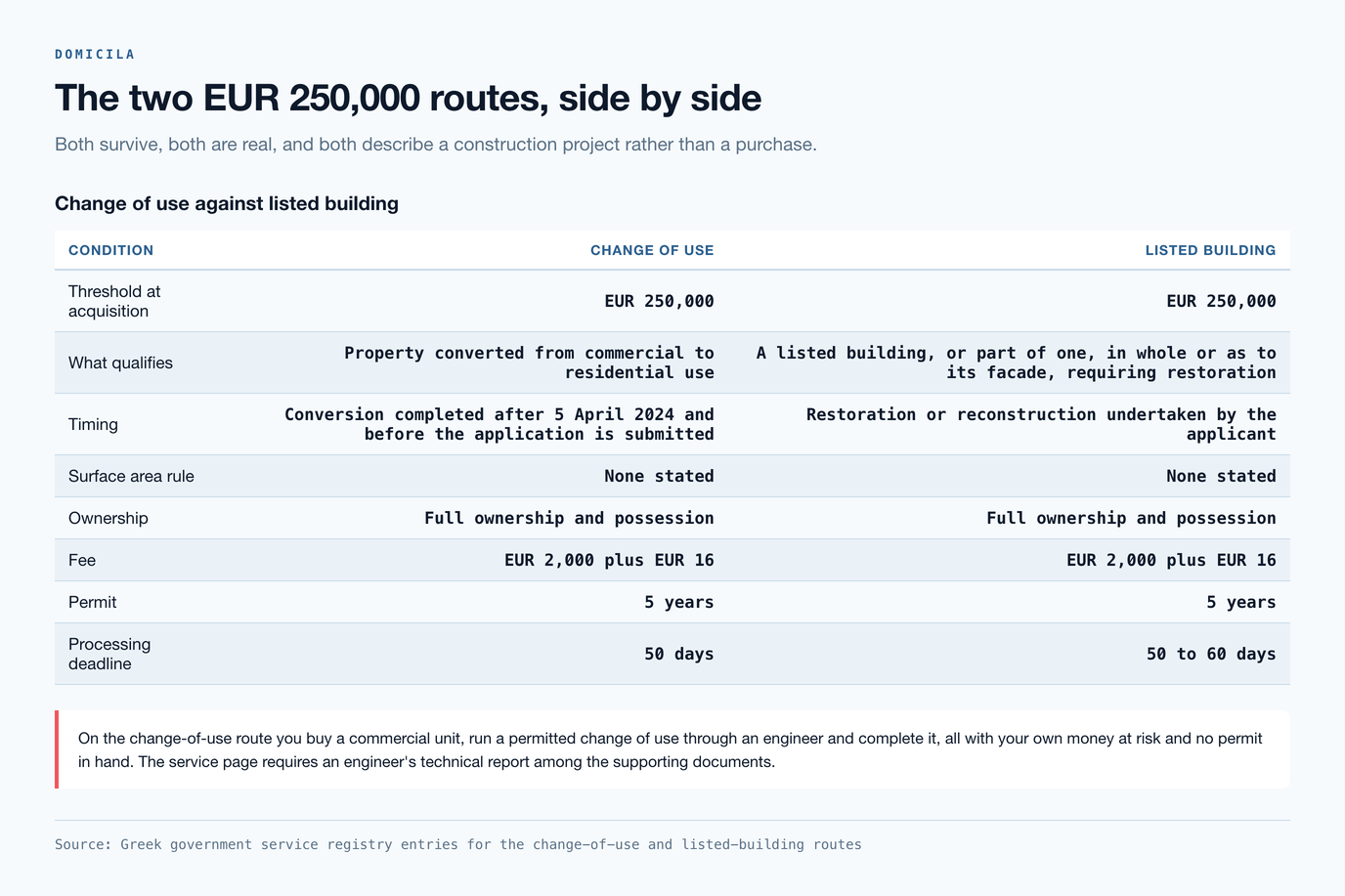
Both cheap routes survive, both are real, and both are narrower than the pages advertising them suggest. The government's service registry entries for each one set out the conditions, the fee and the deadline, and they are worth reading before an agent describes them to you.
| Condition | Change of use | Listed building |
|---|---|---|
| Threshold at acquisition | EUR 250,000 | EUR 250,000 |
| What qualifies | Property converted from commercial use to residential use | A listed building, or part of one, in whole or as to its facade only, requiring restoration or reconstruction |
| Timing | Conversion completed after 5 April 2024 and before the application is submitted | Restoration or reconstruction undertaken by the applicant |
| Surface area rule | None stated | None stated |
| Ownership | Full ownership and possession | Full ownership and possession |
| Fee | EUR 2,000 plus EUR 16 | EUR 2,000 plus EUR 16 |
| Permit | 5 years | 5 years |
| Processing deadline | 50 days | 50 to 60 days |
The change-of-use timing is the condition that catches people. The conversion has to be finished before the application goes in, which means you are buying a commercial unit, running a permitted change of use through an engineer, and completing it, all with your own money at risk and no permit in hand. The service page requires an engineer's technical report on the change of use among the supporting documents, so this is a construction file with an immigration application at the end of it, not the reverse.
The listed-building route asks for something similar in a harder building. You take on a restoration obligation on a protected structure, where the conservation authority rather than the market sets what you may do. Neither route removes the transaction costs below, and both carry the same resale rule: selling the property while the permit is valid revokes the permit of the third-country national who sold it. If the appeal of Greece is that you get to keep the asset, notice that the asset is what is holding the permit up.
Government fees: what the Greek state actually charges
This is the part of the Greece golden visa cost that is genuinely cheap and genuinely published. The National Registry of Administrative Public Services lists the same fee lines on all three golden visa services, in euro, with no variation by route or by threshold.
| Charge | Amount | Applies to |
|---|---|---|
| Residence permit fee | EUR 2,000 | The investor's application |
| Printout of the electronic residence permit | EUR 16 | Each card issued |
| Investor total, state fees only | EUR 2,016 | Any of the three real-estate routes |
| Renewal, electronic fee | EUR 2,000 | Each five-year renewal |
| Adult family member, widely quoted | EUR 150 | Not published on the service pages — confirm before you budget |
The last row needs a caveat the brochures do not give it. The three service pages the Greek government publishes in English list only the EUR 2,000 and the EUR 16, and say nothing at all about spouses, children or parents. The EUR 150 per adult family member, with minors exempt, is quoted consistently by advisers and law firms and is very probably right, but we could not verify it on an official page, so treat it as an adviser figure rather than a government one until your lawyer confirms it in writing.
The family scope itself is one of the widest in Europe: spouse or registered partner, unmarried children under 21 of either spouse, and the parents of both spouses, all on permits running to the same expiry as the investor's. The qualifying investment does not increase with family size, which is the single biggest reason a family of four looks at Greece rather than at programmes charging per applicant.
| State fees only | Single investor | Family of four (two adults, two minors) |
|---|---|---|
| Investor permit fee | EUR 2,000 | EUR 2,000 |
| Adult family member fee, if EUR 150 is correct | — | EUR 150 |
| Minors | — | Exempt from the family fee |
| Card printing at EUR 16 each | EUR 16 | EUR 64 |
| Total | EUR 2,016 | about EUR 2,214 |
Set that against Portugal, which charges its grant fee per person and repeats it at every renewal, and Greece's state charge is close to a rounding error. The money that decides whether this works is in the purchase itself and in the costs around it.
The costs that are not in anyone's headline number
A EUR 400,000 threshold is a threshold, not a budget. Greek property purchases carry transfer tax, notarial fees, land registry or cadastre charges, legal fees and usually an agency commission, and several of those attract VAT on top of themselves. These are market and statutory percentages rather than golden visa fees, so the figures below are planning estimates to be confirmed for your own transaction.
| Cost | Typical rate | On EUR 400,000 | On EUR 800,000 |
|---|---|---|---|
| Property transfer tax, including the municipal surcharge | about 3.09% | about EUR 12,360 | about EUR 24,720 |
| Notary fee, plus VAT on the fee | about 0.8% to 1.5% | EUR 3,200 to EUR 6,000 | EUR 6,400 to EUR 12,000 |
| Land registry or cadastre registration | about 0.5% to 0.6% | EUR 2,000 to EUR 2,400 | EUR 4,000 to EUR 4,800 |
| Legal fees, plus VAT | about 1% | about EUR 4,000 | about EUR 8,000 |
| Agency commission, plus VAT, where payable | about 2% | about EUR 8,000 | about EUR 16,000 |
| Indicative total, 5% to 7% of price | — | EUR 20,000 to EUR 28,000 | EUR 40,000 to EUR 56,000 |
One variable moves more money than all of the others together. New-build sales can fall under VAT at 24 per cent instead of transfer tax at 3.09 per cent, and the suspension that lets developers opt out has been extended repeatedly, most recently to 31 December 2026 by Law 5246/2025. It is the developer's option, not yours, so on any new build the question to ask before you sign is whether the sale is inside the VAT suspension. On an EUR 800,000 purchase the difference between 3.09 per cent and 24 per cent is roughly EUR 167,000, which is more than the entire cheap route costs.
| All-in planning estimate | EUR 400,000 zone | EUR 800,000 zone |
|---|---|---|
| Qualifying investment | EUR 400,000 | EUR 800,000 |
| Transaction costs at 5% to 7% | EUR 20,000 to EUR 28,000 | EUR 40,000 to EUR 56,000 |
| State fees, family of four | about EUR 2,214 | about EUR 2,214 |
| Health insurance, per year, indicative | EUR 300 to EUR 800 per person | EUR 300 to EUR 800 per person |
| Indicative all-in, excluding insurance | EUR 422,000 to EUR 430,000 | EUR 842,000 to EUR 858,000 |
Private health insurance is a documentary requirement rather than a large cost, and the service pages list an insurance contract from a private provider among the supporting documents; our guide to golden visa health insurance requirements covers what the policies actually have to say. The honest summary of the table is that the recoverable part of a Greek golden visa is the property, and the non-recoverable part is roughly a twentieth of it.
The 15 per cent transfer tax announced in September 2026
On 6 September 2026, at the 90th Thessaloniki International Fair, the Prime Minister announced a housing package that included raising the property transfer tax from 3 per cent to 15 per cent for buyers from outside the European Union. Every real-estate golden visa applicant is, by definition, a third-country national, so unless the implementing text carves the programme out, this lands squarely on the route this page is about.
| Element | What was announced | Status as at 16 September 2026 |
|---|---|---|
| Rate | 15% transfer tax for non-EU buyers, up from about 3% | Announced, not legislated |
| Announced | 6 September 2026, 90th Thessaloniki International Fair | Part of a housing affordability package |
| Start date | First reported as 1 January 2027, then reported as 1 July 2027 | Moved once already; no statute yet |
| Scope | Natural persons buying residential property | Companies, commercial property and land reported as outside it |
| Exemptions | Reported for ethnic Greeks and long-term residents | Detail depends on the implementing text |
| Cost on an EUR 800,000 purchase | About EUR 96,000 of additional tax | Only if enacted as announced |
Treat every row of that table as provisional. A measure announced from a podium is not a measure in force: it needs a bill, a vote and publication, and the reported start date has already slipped by six months. Greek national elections fall due in 2027, which is the kind of thing that decides whether announced tax measures survive in the form they were announced in.
What it should change today is your timing question rather than your budget: a reason to ask your lawyer how quickly a file can complete, not a reason to rush a purchase you have not diligenced. It also does not touch the capital routes under Article 101, which matters if the property was only ever the means to the permit.
What Law 5275/2026 changed, and what it did not
Law 5275/2026 was published in Government Gazette A' 17 on 6 February 2026 and is the largest piece of Greek immigration legislation since the Migration Code itself. It transposes Directive (EU) 2024/1233, creates a single residence and work permit procedure, and adds a set of new routes: a tech visa, a talent visa, permits for specialised technical personnel and visiting professors, and a fast track for strategically significant investment projects.
| Law | Date | What it did to the investor permit |
|---|---|---|
| Law 4251/2014 | 2014 | Created the programme at EUR 250,000, flat, nationwide |
| Law 5038/2023 (Migration Code) | 2023 | Re-enacted the investor permit as Article 100 |
| Law 5100/2024, Article 64 | 2024, in force for transactions from 1 September 2024 | Replaced the flat threshold with EUR 800,000 / EUR 400,000 zones, the 120 sq m rule, the single-property rule and the two EUR 250,000 exceptions |
| Law 5275/2026 | Published 6 February 2026, Gazette A' 17 | Rewrote much of the Migration Code. No change to the Article 100 thresholds |
| Announced 15% transfer tax | Announced 6 September 2026 | Not law; would raise the tax on the purchase, not the threshold |
That fourth row is the one to be careful about, because a wave of pages published since February reports that Law 5275/2026 brought in new golden visa thresholds or changed how permit validity is counted for investors. The professional summaries of the law that we checked, from EY's Greek tax alert and from a Greek firm's legal snapshot, both run through the amendments in detail and neither describes any change to the investor thresholds in Article 100.
So the operative rules for a 2026 application are still the ones Article 64 of Law 5100/2024 put in place, and the transitional deadlines for the old EUR 250,000 flat threshold expired long ago. Parts of Law 5275/2026 also depend on implementing ministerial decisions issued through 2026, which is a good reason to have a Greek lawyer confirm the position on the day you file rather than relying on any page, including this one.

The rules that can cost you the permit after you have it
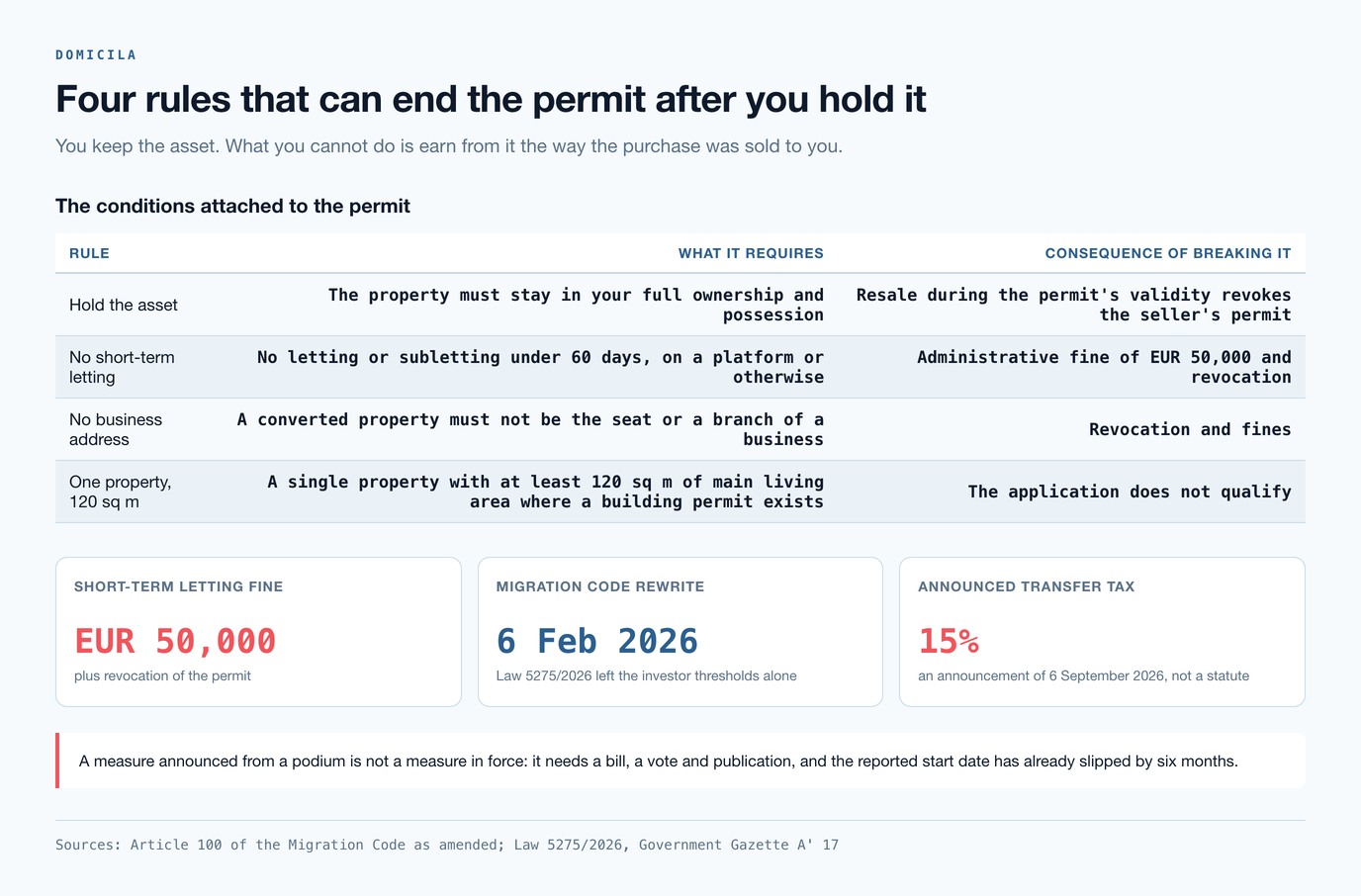
The Greek permit is unusually undemanding about your time and unusually demanding about your property. There is no minimum stay, and the permit renews every five years for as long as you hold the investment, but four rules can end it.
| Rule | What it requires | Consequence of breaking it |
|---|---|---|
| Hold the asset | The property must stay in your full ownership and possession | Resale during the permit's validity revokes the seller's permit |
| No short-term letting | The property cannot be let or sublet short-term, defined as under 60 days, on a platform or otherwise | Administrative fine of EUR 50,000 and revocation |
| No business address | A converted property must not be used as the seat or a branch of a business | Revocation and fines |
| One property, 120 sq m | A single property, with at least 120 sq m of main living area where a building permit exists | The application does not qualify |
The short-term letting ban is the rule most likely to be discovered late, because it removes the yield model that made the purchase look self-funding. Article 100 of the Migration Code as amended prohibits short-term rental of a property used for a golden visa, and the fine attached to it is EUR 50,000 on figures reported consistently by Greek firms. Long lets are the way the asset earns, and they earn considerably less.
None of this makes Greece a bad deal, but it does change what you are buying. A permit with no presence requirement, renewable indefinitely, covering three generations of one family for a single investment, is a genuinely strong product. A property you cannot let on a platform, cannot use as a company address and cannot sell without losing the permit is a constrained asset. Price both halves. If the passport rather than the permit is the goal, citizenship by investment vs golden visa sets out what each route actually delivers.
Greece against the golden visas still open
Greece's pitch is a five-year permit with no presence test, a wide family scope and a low state fee. The comparison that matters is with the other European programmes still selling, on each authority's own published figures.
| Programme | Entry price | State fees | Minimum stay |
|---|---|---|---|
| Greece, investor permit | EUR 800,000, EUR 400,000 or EUR 250,000 by zone and route | EUR 2,000 plus EUR 16 per card | None |
| Hungary, guest investor | EUR 250,000 in fund units held five years | EUR 110 visa plus HUF 26,000 per permit | None |
| Portugal, ARI | EUR 250,000 cultural heritage, or EUR 500,000 fund, company or research routes | EUR 842.80 to lodge and EUR 8,418.90 to grant, each per person | 7 days in year one, 14 days in each later period |
| Spain, investor | Closed since 3 April 2025 | Not applicable | Not applicable |
On the headline threshold Greece is no longer the cheap option it was, and Hungary's guest investor route now undercuts it at EUR 250,000 for a fund subscription with no zone rule at all. What Greece still has is a real asset you choose yourself, in a country you might actually want to be in, with state fees an order of magnitude below Portugal's and a family scope that reaches parents as well as children.
The deciding question is usually what happens at the end rather than what happens at the start. Portugal is the route people take when naturalisation is the point; Greece's investor permit is the route people take when the property and the Schengen access are the point. For the wider field, golden visa countries lists what is still open, golden visa cost comparison sets the published fee tables side by side, and cheapest golden visa explains why the lowest advertised threshold is so rarely the lowest real cost.
What to get in writing before you transfer
Four documents turn a brochure into a file you can defend, and all four should exist before any money moves. Greek purchases are notarial, which makes errors expensive to unwind.
First, a written confirmation from your lawyer of which threshold applies to the specific property: the zone it sits in, whether a building permit exists, and the measured main living area against the 120 square metre rule. A statement that the property is in a EUR 400,000 region is worth having on a letterhead, because the consequence of getting it wrong is a refused application on a completed purchase.
Second, on either EUR 250,000 route, the evidence the service page asks for: the engineer's technical report on the change of use and proof the conversion was completed before submission, or the listing designation and the restoration obligation. Third, on any new build, the developer's written statement of whether the sale is inside the VAT suspension or subject to 24 per cent VAT, because that single answer moves more money than the legal fees on both sides.
Fourth, a schedule of the costs and deadlines in your own case: the fees as amounts rather than percentages, the state fees per family member, the 50-day statutory deadline against the four to nine months applications are reported to take, and who confirms the property is not being let short-term once the permit is granted. Our guide to citizenship by investment processing time explains why statutory and real timelines diverge so widely here.
Related guides on Domicila
- Golden visa cost comparison — Portugal, Greece and the UAE with the full published fee tables
- Golden visa countries — which residency-by-investment programmes are still open
- Cheapest golden visa — why the lowest advertised threshold is rarely the lowest real cost
- Hungary golden visa cost — the EUR 250,000 fund route that now undercuts Greece
- Spain golden visa cost — the European investor route closed by statute in 2025
- Greece digital nomad visa cost — the cheaper Greek route if you are moving rather than investing
Common questions
How much does the Greece golden visa cost in 2026?
The qualifying investment is EUR 800,000 for real estate in Attica, the Thessaloniki area, Mykonos, Thira and islands with more than 3,100 residents, EUR 400,000 elsewhere in Greece, or EUR 250,000 on two narrow routes: a commercial-to-residential conversion completed before the application, or a listed building taken on for restoration. State fees are the same on every route: EUR 2,000 for the residence permit plus EUR 16 to print the card. Transaction costs of roughly 5 to 7 per cent of the purchase price sit on top and are not included in any advertised threshold.
Can you still get a Greek golden visa for EUR 250,000?
Yes, but only on two routes, and neither is an ordinary apartment purchase. The first is a property converted from commercial to residential use, where the conversion must have been completed after 5 April 2024 and before the application is submitted, supported by an engineer's technical report. The second is a listed building, in whole or as to its facade, that you undertake to restore or reconstruct. Both are construction projects with an immigration application at the end, and the flat EUR 250,000 threshold that applied nationwide before September 2024 is gone.
What are the Greek government fees for the golden visa?
The National Registry of Administrative Public Services lists EUR 2,000 for the residence permit and EUR 16 for printing the electronic residence permit card, identically on all three golden visa services it publishes in English. Renewal carries a further EUR 2,000 electronic fee. Advisers consistently quote EUR 150 per adult family member with minors exempt, but that figure does not appear on the official service pages, so confirm it with your lawyer before budgeting.
Is there a minimum stay on the Greek golden visa?
No. The investor residence permit carries no physical presence requirement and is renewable every five years for as long as the qualifying investment is held. That is a rule about the permit, not about tax residence or citizenship: spending enough time in Greece to become tax resident there is a separate question, and Greek naturalisation requires years of genuine residence plus a language examination that the permit does nothing to waive.
Can I rent out a Greek golden visa property on Airbnb?
No. Article 100 of the Migration Code as amended by Law 5100/2024 prohibits short-term rental of a property used to obtain the investor permit, with short-term generally defined as letting or subletting for under 60 days. Greek firms report an administrative fine of EUR 50,000 for breaching it, alongside revocation of the permit. Long-term letting remains permitted, which changes the yield assumptions many buyers start from.
Did Law 5275/2026 change the Greek golden visa thresholds?
Not on the evidence we could find. Law 5275/2026, published in Gazette A' 17 on 6 February 2026, transposes Directive (EU) 2024/1233 and substantially rewrites the Migration Code, adding a single residence and work permit procedure and several new visa categories. Professional summaries of the law, including EY's Greek tax alert and a Greek firm's legal snapshot, describe its amendments in detail without reporting any change to the Article 100 investor thresholds. The operative rules for a 2026 application remain the ones introduced by Article 64 of Law 5100/2024.
Will the announced 15 per cent transfer tax apply to golden visa buyers?
It would if enacted as announced, because every real-estate applicant is a non-EU national by definition, but it is not law yet. The Prime Minister announced the increase from about 3 per cent to 15 per cent for non-EU buyers on 6 September 2026 at the Thessaloniki International Fair, as part of a housing package. It was first reported as taking effect on 1 January 2027 and subsequently as 1 July 2027, it is reported to apply to natural persons buying residential property rather than to companies, and exemptions for ethnic Greeks and long-term residents have been trailed. No implementing statute had been published when this guide was written.
How long does a Greek golden visa application take?
The government service pages give a processing deadline of 50 days for the change-of-use route and 50 to 60 days for the listed-property and timeshare routes, broken into up to 10 days to check the file is complete, up to 40 days to examine it and collect biometrics, and up to 8 days to issue or refuse. Reported real-world timelines have run considerably longer than the statutory deadline, commonly quoted in the four-to-nine-month range, so plan to the practical figure and hold your adviser to the statutory one.
Official sources to verify
- Golden VisaHellenic Ministry of Migration and Asylum
- Permanent golden visa (change of use) — Initial issuanceNational Registry of Administrative Public Services (mitos.gov.gr), Hellenic Republic
- Golden visa programme (investment in a listed real property) — Initial issuanceNational Registry of Administrative Public Services (mitos.gov.gr), Hellenic Republic
- Golden visa (timeshare) — Initial issuanceNational Registry of Administrative Public Services (mitos.gov.gr), Hellenic Republic
- Circular on the permanent investor residence permit (B.5), 24 September 2024Hellenic Ministry of Migration and Asylum
- Legislation — Lawful Migration Service (including Law 5275/2026)Hellenic Republic Ministry of Migration and Asylum
- Greek Ministry of Migration and Asylum — residence permitsHellenic Republic Ministry of Migration and Asylum
Compare golden visa advisors
Ask for a route-specific quote that separates investment amount, government fees, legal work, fund or property costs, and renewal obligations.
We may earn a referral fee if you choose an advisor through this site. We still aim to show cost ranges, caveats, and official source links plainly.