cyprus golden visa cost
Cyprus Golden Visa Cost 2026: The VAT Catch
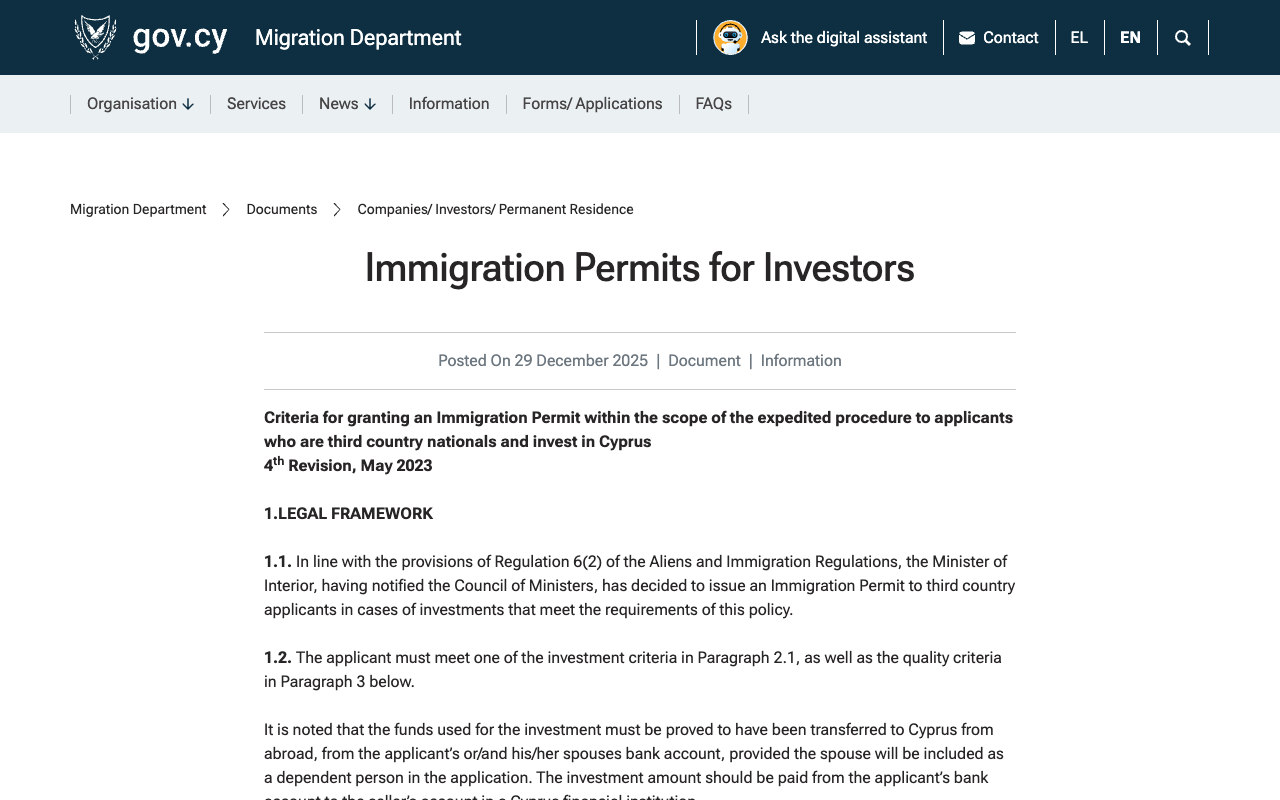
The Cyprus golden visa cost is quoted as EUR 300,000 almost everywhere, and that figure is right as far as it goes: Regulation 6(2) of the Aliens and Immigration Regulations asks for exactly that, excluding VAT. Those two words are doing an enormous amount of work. On the residential route the tax on top is either EUR 15,000 or EUR 57,000, and what decides which is not the property at all but whether you actually move into it. We read the Tax Commissioner's VAT circular, priced all four investment categories against the Migration Department's own criteria, and checked which Cypriot transaction taxes still exist in 2026, because two of the ones competing pages still list were abolished.

Key takeaways
The minimum is EUR 300,000 excluding VAT, and VAT is where the money actually is. Regulation 6(2) sets the same EUR 300,000 floor across all four investment categories. On the Category A residential route, the one most applicants use, VAT is charged on top at either 5 or 19 per cent, which is EUR 15,000 or EUR 57,000 on a EUR 300,000 apartment.
The 5 per cent rate is a fact about the buyer, not about the property. It applies to the first 130 square metres of a primary and permanent residence worth up to EUR 350,000, and it carries a ten-year occupancy condition, a thirty-day notification duty and a proportional clawback if you stop living there. An investor who keeps living abroad pays 19 per cent.
Two Cypriot transaction taxes have disappeared and most comparison pages have not caught up. Law 239(I)/2025 repealed the Stamp Duty Law with effect from 1 January 2026, so a contract executed this year carries none. Transfer fees are nil wherever VAT was charged, and a Category A purchase is always a first sale, so VAT is always charged.
The income test is EUR 50,000 a year, and on the residential route it must originate abroad. Add EUR 15,000 for a spouse and EUR 10,000 per child, so EUR 85,000 for a family of four. Since 2 May 2023 parents and parents-in-law can no longer be included as dependants at all.
The permit does not expire, but it is not citizenship and does not lead there on its own. Naturalisation asks for seven years of legal residence in the preceding ten, plus twelve continuous months and Greek at B1 level, which is physical residence that a holder visiting once every two years never accumulates.
On this page
This guide runs from the four qualifying routes to the VAT question that decides the real price, then through the state fees, the income test, the obligations that survive approval, and three worked totals. The renderer on this site does not emit heading anchors, so the list below is a map rather than a set of jump links.
- Cyprus golden visa cost in 2026: the four routes to EUR 300,000
- The VAT nobody adds: 19 per cent or 5, and what decides it
- State fees, and the two charges that vanished in 2026
- The EUR 50,000 income test, and where the money must come from
- What the permit gives you, and what it costs to keep
- What a Cyprus golden visa really costs: three worked totals
- Related guides on Domicila
Cyprus golden visa cost in 2026: the four routes to EUR 300,000
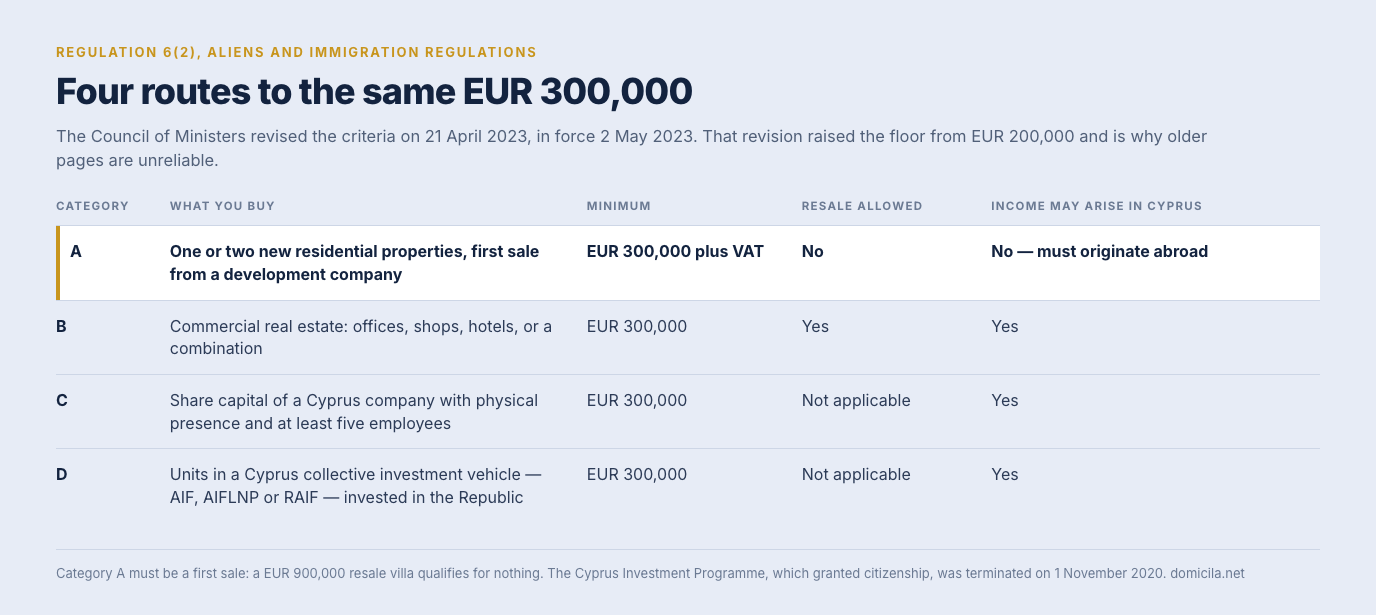
No Cypriot statute uses the phrase golden visa. What exists is an Immigration Permit granted under Regulation 6(2) of the Aliens and Immigration Regulations, a permanent residence permit for third-country nationals that the Migration Department examines on an accelerated basis. It is worth separating from the thing people often mean by a Cyprus investment programme: the Cyprus Investment Programme, which granted actual citizenship, was terminated on 1 November 2020 and has not been replaced. There is no Cypriot citizenship by investment in 2026, only this residence permit.
The Council of Ministers revised the criteria on 21 April 2023 and the new rules took effect on 2 May 2023. That revision is the reason older pages are unreliable: it raised the investment floor from EUR 200,000 to EUR 300,000, raised the income test from EUR 30,000 to EUR 50,000, and removed parents and parents-in-law from the list of people who can be carried on the permit.
| Category | What you buy | Minimum | Resale allowed | Income may arise in Cyprus |
|---|---|---|---|---|
| A | One or two new residential properties, first sale from a development company | EUR 300,000 plus VAT | No | No, it must originate abroad |
| B | Commercial real estate: offices, shops, hotels, or a combination | EUR 300,000 | Yes | Yes |
| C | Share capital of a Cyprus company with physical presence and at least five employees | EUR 300,000 | Not applicable | Yes |
| D | Units in a Cyprus collective investment vehicle, AIF, AIFLNP or RAIF, invested in the Republic | EUR 300,000 | Not applicable | Yes |
Category A carries a restriction that catches people out, and it is absolute rather than a matter of degree: the property must be a first sale from a development company. A resale apartment does not qualify no matter what it costs, so a EUR 900,000 second-hand villa is worth nothing to this application while a EUR 300,000 new-build flat qualifies. The whole EUR 300,000 must also be paid by the time you submit, and the Migration Department requires evidence that the funds were transferred to Cyprus from abroad, from the applicant's or the spouse's own account.
Categories B, C and D relax the resale rule and the income-origin rule, and add one of their own: an applicant investing in something other than a home still needs somewhere to live in Cyprus, owned or rented. Category C is the most demanding in practice, because the five-employee requirement and the physical-presence test turn a residence application into an operating business. If you are comparing programmes rather than committing to this one, our golden visa countries guide lists what is still open in Europe, and cheapest golden visa explains why the lowest advertised threshold is so seldom the lowest real bar.
The VAT nobody adds: 19 per cent or 5, and what decides it
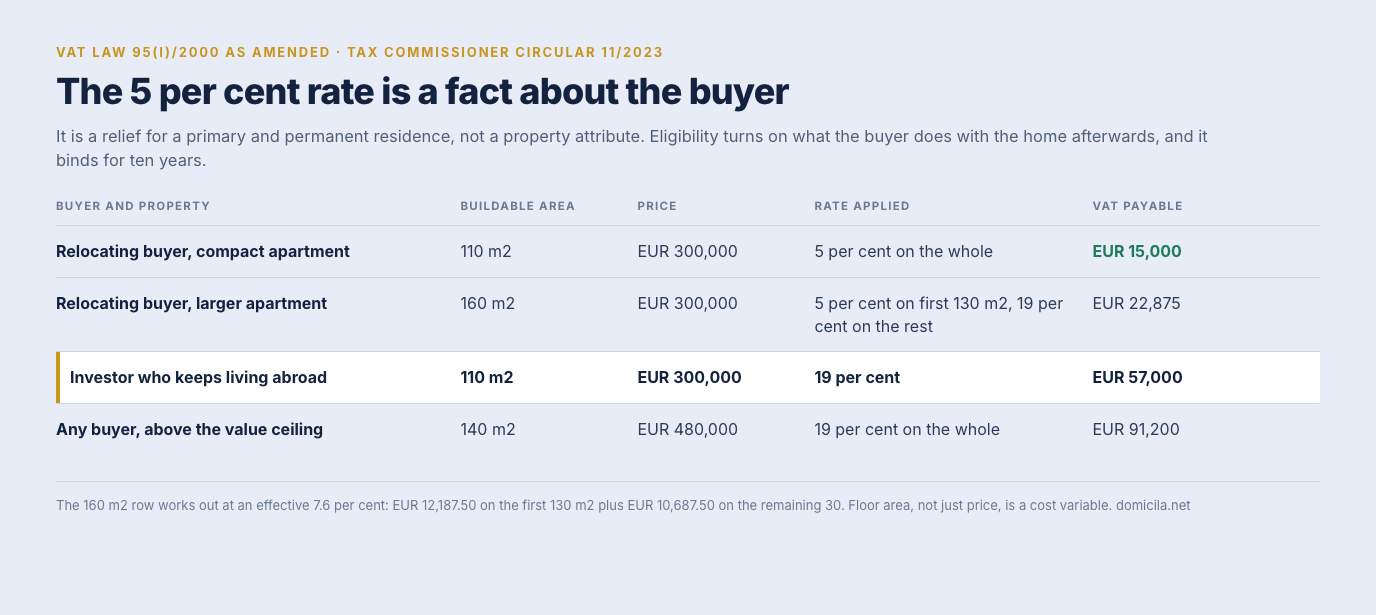
This is the section that changes the arithmetic, and it is the one every page we read while researching this one gets wrong in the same way. The standard Cypriot VAT rate is 19 per cent. A reduced rate of 5 per cent exists for housing. Competing guides present that pair as a property attribute, writing that the 5 per cent rate applies to eligible new residential properties. It does not. It is a relief for a primary and permanent residence, and eligibility turns on what the buyer does with the home afterwards.
The conditions come from the VAT Law 95(I)/2000 as amended with effect from 16 June 2023, and were spelled out by the Tax Commissioner in Circular 11/2023 of 28 November 2023. The reduced rate covers the first 130 square metres of buildable area, up to a value of EUR 350,000, provided the total transaction value does not exceed EUR 475,000 and the total buildable area does not exceed 190 square metres. Above either ceiling the whole purchase reverts to 19 per cent. Between 131 and 190 square metres the rate is applied pro rata by square metre.
The part that matters for an investor is the condition attached. The buyer files a responsible declaration that the property will be their primary and permanent residence, and is bound for ten years. Stop using it as your main home inside that window and you must notify the Commissioner within thirty days and repay the difference between the reduced and the standard rate, in proportion to the years remaining. The exceptions are narrow: death, or transfer to an adult child who qualifies in their own right.
Set that against what a Regulation 6(2) holder typically does. The permit carries no minimum stay, the holder simply has to avoid being absent from Cyprus for two years, and many buyers never relocate at all. Someone in that position cannot honestly file the declaration, so the rate on their purchase is 19 per cent. The gap is not a rounding error.
| Buyer and property | Buildable area | Price | Rate applied | VAT payable |
|---|---|---|---|---|
| Relocating buyer, compact apartment | 110 m2 | EUR 300,000 | 5 per cent on the whole | EUR 15,000 |
| Relocating buyer, larger apartment | 160 m2 | EUR 300,000 | 5 per cent on first 130 m2, 19 per cent on the rest | EUR 22,875 |
| Investor who keeps living abroad | 110 m2 | EUR 300,000 | 19 per cent | EUR 57,000 |
| Any buyer, above the value ceiling | 140 m2 | EUR 480,000 | 19 per cent on the whole | EUR 91,200 |
The second row is worth walking through, because the pro-rata method is never shown anywhere. At EUR 300,000 over 160 square metres the value is EUR 1,875 per square metre. The first 130 square metres, EUR 243,750 of value, are taxed at 5 per cent for EUR 12,187.50. The remaining 30 square metres, EUR 56,250, are taxed at 19 per cent for EUR 10,687.50. The bill is EUR 22,875, an effective rate of 7.6 per cent. Floor area, not just price, is a cost variable.
One transitional rule is still live and has a deadline inside this year. Where a planning permit was issued, or applied for, by 31 October 2023, the older and more generous regime can still apply: 5 per cent on the first 200 square metres with no cap on total area or value. That window was due to close three years after 16 June 2023, and a reform passed on 17 April 2026 and published in the Official Gazette on 24 April 2026 extended it to 31 December 2026. If you are buying a unit in an older development, ask the developer which regime the block sits under before you sign, because the answer stops being available at the end of the year. None of this is advice on your own filing: the declaration is made by you, and a Cyprus VAT adviser should confirm the treatment before you budget from it.
State fees, and the two charges that vanished in 2026
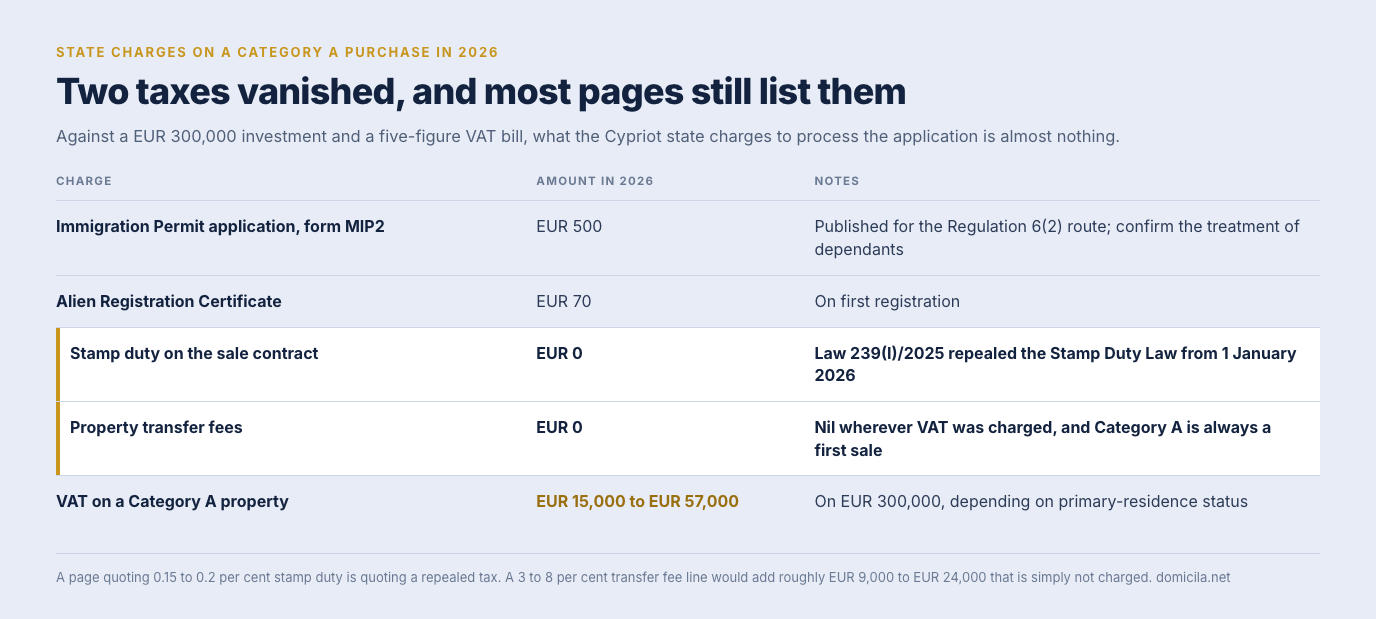
Against a EUR 300,000 investment and a five-figure VAT bill, what the Cypriot state charges to process the application is almost nothing. The published figures are an application fee of EUR 500 for the Immigration Permit, filed on form MIP2, and EUR 70 for the Alien Registration Certificate on first registration. Sources differ on whether the EUR 500 is charged once per application or once per applicant, and we are not going to guess: ask the Migration Department for the per-person breakdown in writing before budgeting for a family.
The more useful finding is subtractive. Two charges that competing cost pages still itemise no longer apply to a purchase made now.
| Charge | Amount in 2026 | Notes |
|---|---|---|
| Immigration Permit application, form MIP2 | EUR 500 | Published for the Regulation 6(2) route; confirm the treatment of dependants |
| Alien Registration Certificate | EUR 70 | On first registration |
| Stamp duty on the sale contract | EUR 0 | Law 239(I)/2025 repealed the Stamp Duty Law from 1 January 2026 |
| Property transfer fees | EUR 0 on a Category A purchase | Nil wherever VAT was charged; reduced by 50 per cent where it was not |
| VAT on a Category A property | EUR 15,000 to EUR 57,000 | On EUR 300,000, depending on primary-residence status |
Stamp duty went first. Law 239(I)/2025 repealed the Stamp Duty Law of 1963 and everything built on it, with effect from 1 January 2026. The test is the execution date of the instrument, not completion or payment, so a contract signed on 31 December 2025 is still chargeable under the old sliding scale of 0.15 per cent between EUR 5,001 and EUR 170,000 and 0.20 per cent above it, capped at EUR 20,000, while one signed in January 2026 carries nothing. A page still quoting 0.15 to 0.2 per cent for a purchase today is quoting a repealed tax.
Transfer fees are the second, and they were never payable here in the first place. Cyprus charges transfer fees at the Department of Lands and Surveys on a sliding scale, but the charge falls away entirely where the transaction was subject to VAT, and is halved where it was not. Because Category A is by definition a first sale from a developer, VAT always applies, so transfer fees always drop to zero. The 3 to 8 per cent transfer fee line that appears on at least one widely-read competitor page would add roughly EUR 9,000 to EUR 24,000 to this purchase and is simply not charged.
What no government publishes, here or anywhere, is the professional layer: immigration counsel, the conveyancing and title work, the anti-money-laundering file on the source of funds, and the developer's own administrative charges. Advisory firms quote broadly, and we would rather leave the number out than invent a range. Ask for a line-item quote, which is the same advice our golden visa cost guide gives for every programme in this category.
The EUR 50,000 income test, and where the money must come from
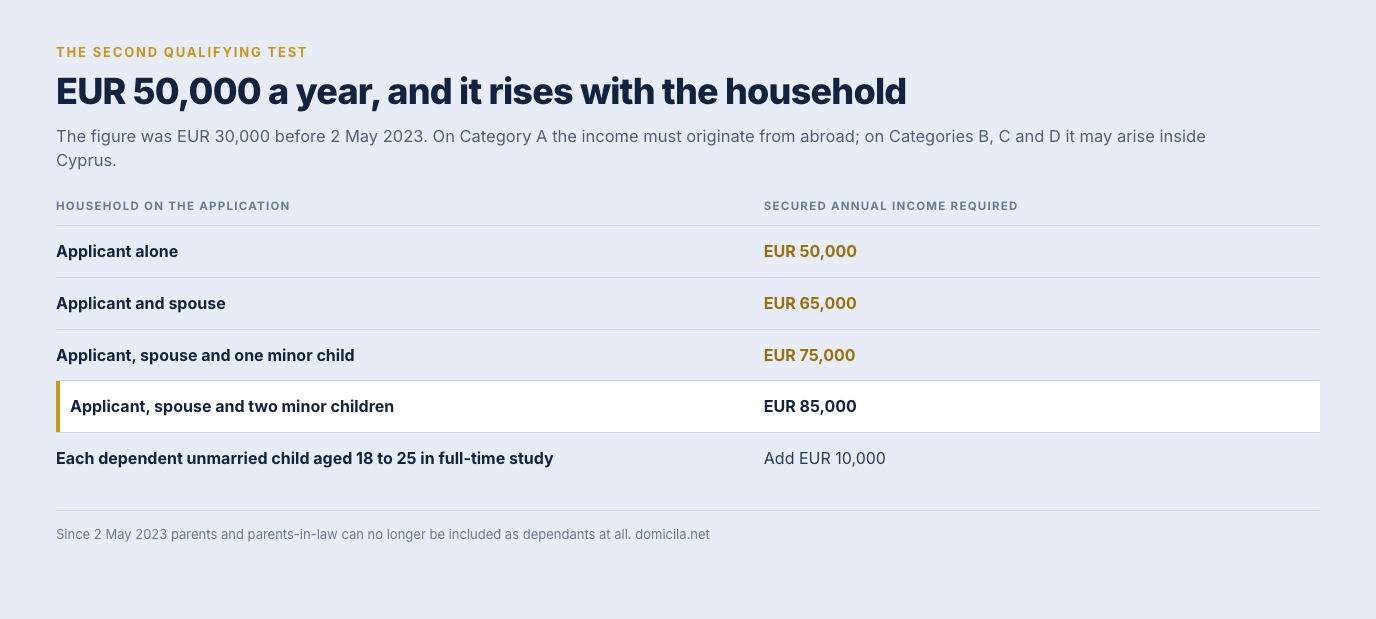
The investment is only half the qualifying test. The applicant must also show a secured and steady annual income of at least EUR 50,000, rising with the size of the household. This figure was EUR 30,000 before 2 May 2023, which is another reason to distrust anything written earlier.
| Household on the application | Secured annual income required |
|---|---|
| Applicant alone | EUR 50,000 |
| Applicant and spouse | EUR 65,000 |
| Applicant, spouse and one minor child | EUR 75,000 |
| Applicant, spouse and two minor children | EUR 85,000 |
| Each dependent unmarried child aged 18 to 25 in full-time study | Add EUR 10,000 |
Where that income may arise depends on which category you chose, and the split is easy to miss. On Category A, the residential route, the income must originate from abroad. On Categories B, C and D it may be derived from activities inside Cyprus. Acceptable sources are the ordinary ones, salaries, pensions, dividends, interest and rents, evidenced through tax filings, but the department assesses the file as a whole rather than against a checklist.
Two further limits on who can be included are worth stating plainly, because they changed in 2023 and cost real applicants real money. Parents and parents-in-law are no longer eligible as dependants on the permit, a route that existed before the revision. Children between 18 and 25 can be included only while they are unmarried, financially dependent and studying, and each one carries its own EUR 10,000 of required income. Our citizenship by investment family cost guide covers how differently programmes treat dependants, because it is routinely the largest single difference between two headline prices that look identical.
What the permit gives you, and what it costs to keep
The Immigration Permit does not expire. This is a genuine advantage over the renewable cards issued by Greece, Portugal and Spain, and it is also the point at which one of the two biggest competitor pages is simply wrong, describing the Cypriot permit as valid for ten years. It is indefinite. What ends it is absence: stay out of Cyprus for two years and it is revoked.
What the permit does not include is the right to work. The holder declares that they will not be employed in Cyprus or draw a salary there, although they may hold shares in and be a director of a Cypriot company. Nor does it give free movement: Cyprus is an EU member state but is not part of the Schengen area, so this is not a permit that lets you move freely across the internal border-free zone. The European Commission adopted a positive assessment of Cyprus's readiness in August 2026 and the file went to the Council in September 2026, where accession needs a unanimous vote of the existing Schengen members. That decision has not been taken, and nobody should price a property on the assumption that it will be.
Keeping the permit is an annual administrative obligation rather than a financial one. Every year the holder files evidence that the investment is still in place, that the required income is still being earned, and that the family still holds health insurance where they are not covered by the national GESY scheme. A clean criminal record certificate from the country of origin and of residence is required every three years. Breach any condition and the permit can be revoked for the holder and the family together.
| What you file | How often | Who it covers |
|---|---|---|
| Evidence that the investment is still held | Annually | The applicant |
| Evidence of the required secured annual income | Annually | The applicant and the household |
| Health insurance certificate, unless covered by GESY | Annually | The applicant and family members |
| Clean criminal record from country of origin and of residence | Every three years | The applicant and adult family members |
| At least one entry into Cyprus | Every two years | Every permit holder |
The question underneath most searches for this programme is whether it leads to a Cypriot passport. On its own, no. Naturalisation by residence requires seven years of legal residence within the preceding ten, including twelve continuous months immediately before applying during which absences must not exceed ninety days in total, plus Greek at B1 level, good character, suitable accommodation and stable resources. A shorter track exists for highly skilled employees, at four years with Greek at A2 or three years with B1. Every one of those routes counts time actually spent in Cyprus, so a permit holder who flies in once every two years accrues nothing toward it. Timelines across this whole category are slippery, which is why we keep a citizenship by investment processing time comparison rather than quoting one number per programme.
On the application itself, be sceptical of any single processing figure. The route is marketed as fast-track, and the two most visible guides currently say two to six months and six to nine months respectively. We are not able to reconcile that from published sources, so treat the range as wide and ask your advisor what they are actually seeing on files submitted this year.
What a Cyprus golden visa really costs: three worked totals
Competitors publish fee tables and stop there, which leaves the reader to add up a number that hinges on a VAT question they have not been told about. Here is the same purchase totalled three ways. Every line is a charge established above, and all three assume the commonest case: a single Category A apartment bought new for EUR 300,000.
| Scenario | Investment | VAT | Transfer fees | Stamp duty | State fees | Total before professional fees |
|---|---|---|---|---|---|---|
| Applicant relocates, 110 m2 | EUR 300,000 | EUR 15,000 | EUR 0 | EUR 0 | EUR 570 | EUR 315,570 |
| Applicant relocates, 160 m2 | EUR 300,000 | EUR 22,875 | EUR 0 | EUR 0 | EUR 570 | EUR 323,445 |
| Applicant keeps living abroad, 110 m2 | EUR 300,000 | EUR 57,000 | EUR 0 | EUR 0 | EUR 570 | EUR 357,570 |
The spread between the top and bottom rows is EUR 42,000 on an identical apartment, and it is decided entirely by whether the buyer moves in. That is the number this guide exists to surface. It also cuts the other way, and pleasantly: the abolition of stamp duty and the transfer-fee exemption together remove between roughly EUR 9,600 and EUR 24,600 of charges that a 2024-vintage cost page would still have you budget for.
None of the three totals includes legal fees, the developer's administrative charges, the source-of-funds file, annual health insurance, or the cost of actually maintaining a household in Cyprus. They are not published by anyone and we will not estimate them. What the table does show is that the honest comparison for Cyprus is not EUR 300,000 against Greece's EUR 250,000 and EUR 400,000 property bands or Portugal's EUR 500,000 fund route, but something between EUR 315,000 and EUR 358,000 depending on a decision most buyers have not realised is a tax decision. Our golden visa cost comparison sets the European programmes against each other on that basis.
Related guides on Domicila
If you are pricing Cyprus against the alternatives, these are the comparisons that do the most work:
- Golden visa cost comparison — Portugal, Greece, UAE and Malta against each other on total cost
- Greece golden visa cost — the closest comparable programme, and its 2024 threshold zones
- Portugal golden visa cost — the fund route, and the government fee nobody multiplies
- Cheapest golden visa — why the lowest advertised threshold is rarely the lowest real bar
- Golden visa countries — every programme still open in 2026
- Golden visa health insurance requirements — the annual cover these permits oblige you to hold
Common questions
How much does the Cyprus golden visa cost in 2026?
The qualifying investment is EUR 300,000 excluding VAT in one of four categories: new residential property, commercial real estate, share capital of a Cyprus company with five employees, or units in a Cyprus collective investment vehicle. State fees are small, at EUR 500 for the Immigration Permit application and EUR 70 for the Alien Registration Certificate. On the residential route VAT is the large variable, adding either EUR 15,000 or EUR 57,000 to a EUR 300,000 apartment, so a realistic all-in total before professional fees runs from about EUR 315,570 to about EUR 357,570.
Is the EUR 300,000 before or after VAT?
Before. Regulation 6(2) sets the qualifying investment at EUR 300,000 excluding VAT, so VAT is charged on top of the amount that qualifies you rather than counting toward it. On a Category A residential purchase that means the cash you need is EUR 315,000 at the reduced rate or EUR 357,000 at the standard rate, not EUR 300,000. Buying a EUR 300,000 property inclusive of VAT would leave the investment itself below the threshold.
Can I pay 5 per cent VAT instead of 19 on a Cyprus golden visa property?
Only if the property genuinely becomes your primary and permanent residence. The reduced rate covers the first 130 square metres up to a value of EUR 350,000, provided the total transaction does not exceed EUR 475,000 and the buildable area does not exceed 190 square metres, and it requires a responsible declaration plus a ten-year occupancy commitment. If you stop using the home as your main residence inside those ten years you must notify the Tax Commissioner within thirty days and repay the difference in proportion to the remaining period. An investor who keeps living abroad pays 19 per cent. Confirm your own position with a Cyprus VAT adviser before budgeting.
Does a resale property qualify for Cyprus permanent residency?
Not on the residential route. Category A requires one or two new residential properties bought as a first sale from a development company, and a resale home does not qualify at any price. Category B, which covers commercial real estate such as offices, shops and hotels, does allow resale purchases at the same EUR 300,000 minimum. An applicant investing under Category B, C or D also has to have somewhere to live in Cyprus, owned or rented.
How much income do I need for Cyprus permanent residency?
A secured and steady annual income of at least EUR 50,000, increased by EUR 15,000 for a spouse and EUR 10,000 for each dependent child, so a family of four needs EUR 85,000. The threshold was EUR 30,000 before the criteria were revised on 2 May 2023. On the Category A residential route the income must originate from abroad; on Categories B, C and D it may be derived from activities inside Cyprus. Salaries, pensions, dividends, interest and rental income are all ordinarily acceptable when evidenced through tax filings.
Does the Cyprus permanent residence permit expire?
No. The Immigration Permit granted under Regulation 6(2) is indefinite and is not a ten-year card, which is a real advantage over the renewable permits issued by Greece, Portugal and Spain. It can still be lost: the permit is revoked if the holder is absent from Cyprus for two years, and it can be revoked for the holder and the whole family if any condition is breached. Holders must file annual evidence that the investment, the income and the health insurance are all still in place, and a clean criminal record certificate every three years.
Does Cyprus permanent residency lead to a Cypriot passport?
Not by itself. Naturalisation by residence requires seven years of legal residence in the preceding ten years, including twelve continuous months immediately before the application during which absences must not exceed ninety days, together with Greek at B1 level, good character, suitable accommodation and stable resources. A shorter track exists for highly skilled employees at four years with Greek at A2 or three years with B1. All of these count time physically spent in Cyprus, so a permit holder who only visits to keep the permit alive accumulates nothing toward citizenship.
Can you still get Cypriot citizenship by investment?
No. The Cyprus Investment Programme, which granted citizenship directly in exchange for investment, was terminated on 1 November 2020 following the controversy over how it had been administered, and it has not been replaced. What remains is the Regulation 6(2) permanent residence permit described in this guide. Any provider still offering Cypriot citizenship by investment in 2026 is describing a programme that no longer exists.
Official sources to verify
- Immigration Permits for InvestorsMigration Department, Republic of Cyprus
- Immigration PermitsMigration Department, Republic of Cyprus
- Permanent Residence in Cyprus: Immigration Permit 6(2)PwC Cyprus
- Guidance on the 5% reduced VAT rate for a primary and permanent residence (Circular 11/2023)PwC Cyprus
- New amendment to the VAT Law on the application of 5% VAT on primary and permanent residencePwC Cyprus
- VAT on first homes: legislative reform and extension of transitional relief to 31 December 2026Michael Kyprianou Law Firm
- Abolition of the Stamp Duty Law as of 01/01/2026The Legal 500
- Calculation of Real Estate Transfer FeesDepartment of Lands and Surveys, Republic of Cyprus
- Acquisition of Cypriot Citizenship by Naturalization (due to years of residence), form M127Ministry of Interior, Republic of Cyprus
Compare golden visa advisors
Ask for a route-specific quote that separates investment amount, government fees, legal work, fund or property costs, and renewal obligations.
We may earn a referral fee if you choose an advisor through this site. We still aim to show cost ranges, caveats, and official source links plainly.