us gold card cost
US Gold Card Cost 2026: $1,015,000 and One Approval
The US Gold Card cost is advertised as $1 million. The real figure for one person is $1,015,000, because a $15,000 processing fee is payable before anyone looks at your file, and neither amount comes back. What it buys is not a new visa. Executive Order 14351 makes the gift evidence of eligibility for EB-1 and EB-2 visas that already existed, already have annual caps and already have a 7 percent per-country limit. In a court filing this year the Department of Homeland Security said Gold Card petitions will not necessarily be adjudicated faster than anybody else's. We priced every line from the order, the Federal Register and the statute.

Key takeaways
The US Gold Card cost for one person is $1,015,000, not $1 million. The Department of Commerce portal takes a $15,000 processing fee with the application and the $1 million gift only after vetting clears. Neither is refundable, and the gift is a gift: it goes into a Treasury fund, not into an investment you own.
A corporate sponsor pays $2 million per employee plus the same $15,000, and the executive order also authorises maintenance and transfer fees that have no published schedule. The $5 million Platinum Card is still advertised as coming soon and is not operational.
Every family member is a full second price. A spouse or unmarried child under 21 needs their own $15,000 fee and their own $1 million gift, so a family of four is $4,060,000 before a single professional bill.
The order creates no new visa category. It directs that the gift be treated as evidence of eligibility under the existing EB-1 extraordinary-ability and EB-2 provisions, which means the existing annual allocations and the 7 percent per-country ceiling still apply. For nationals of heavily oversubscribed countries, the money does not buy a visa number.
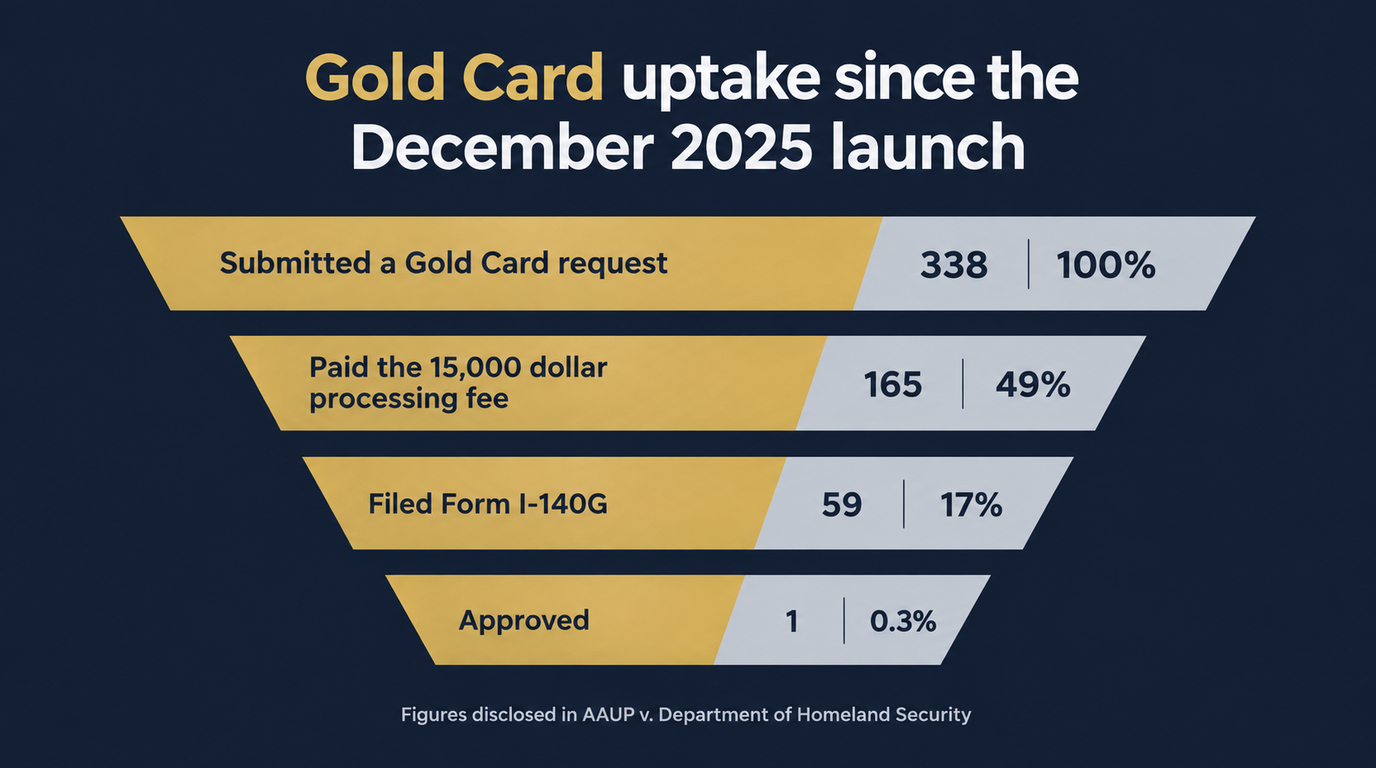
The speed is not guaranteed, and that is the government's own position. DHS told the federal court hearing the challenge to the programme that Gold Card applicants will not necessarily have their petitions adjudicated faster than anyone else. Of 338 requests since the December 2025 launch, 165 had paid the fee, 59 had filed the petition and one had been approved.
On this page
This guide prices the card from the order that created it rather than from the marketing. It separates the fee from the gift, sets out what DHS has said in court about processing speed, totals the cost for a household, explains the visa queue the card actually joins, and compares the whole thing with EB-5 on the fee schedule that takes effect at the end of November 2026. This site's renderer does not emit heading anchors, so the list below is a map rather than a set of jump links.
- US Gold Card cost in 2026: the $1,015,000 line
- What the $15,000 buys, and what the $1 million buys
- The speed you are paying for, and what DHS told a court
- US Gold Card cost for a spouse and children
- The queue behind the card: EB-1, EB-2 and the 7 percent cap
- US Gold Card cost against EB-5, now EB-5 fees have changed
- Related guides on Domicila
US Gold Card cost in 2026: the $1,015,000 line
Almost every page ranking for this term gives the US Gold Card cost as $1 million and stops. That is the gift, and it is the second thing you pay. The official portal is explicit about the order: a $15,000 processing fee goes in with the application, and the $1 million follows only once background checks clear. So the real entry price for a single applicant is $1,015,000.
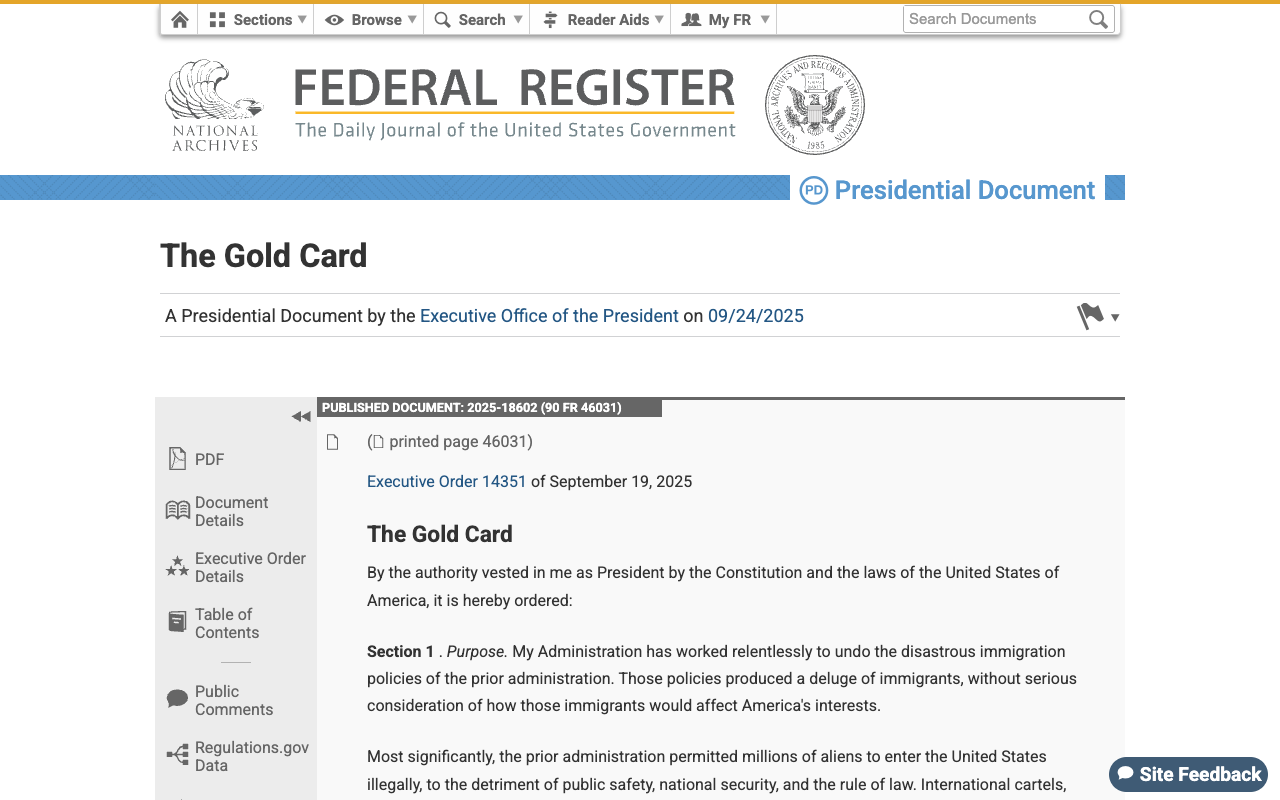
The distinction matters more than it looks, because the two payments carry different risks. The $15,000 is spent whatever happens next. If vetting goes against you, you have bought a refusal. And the million is not an investment with an exit: Executive Order 14351 describes it as an unrestricted gift to the Department of Commerce under 15 U.S.C. 1522, to be deposited in a separate Treasury fund and spent promoting American industry. You are not a creditor, a shareholder or a limited partner. You are a donor.
| What you pay | Individual applicant | Corporate sponsor | Refundable |
|---|---|---|---|
| Processing fee, with the application | $15,000 | $15,000 per employee | No |
| Gift to the Department of Commerce, after vetting | $1,000,000 | $2,000,000 per employee | No |
| Total per person | $1,015,000 | $2,015,000 | No |
| Maintenance and transfer fees for corporate sponsors | Not applicable | Authorised, no published schedule | Not stated |
| Platinum Card, advertised as coming soon | $5,000,000 | Not stated | Not stated |
Two lines in that table are not numbers yet, and both belong to corporate sponsors. The order instructs the agencies to establish maintenance and transfer fees for companies sponsoring individuals, and to build a process for a corporate-sponsored holder to abandon status so the original gift can be re-pointed at a different employee. A transferable immigration benefit is a genuinely new idea in US law, and nobody has published what moving one costs.
If you are weighing this against a programme that sells residence rather than gifting money to a treasury, our golden visa cost comparison prices the European routes on their current published fee tables.
What the $15,000 buys, and what the $1 million buys
The $15,000 buys a place in a queue and an adjudication of Form I-140G, the petition USCIS built for this programme. The form is filed by the individual as a self-petitioner, or by the sponsoring corporation, and it sits inside the ordinary employment-based petition machinery rather than beside it.
USCIS published its own planning assumption for how busy that machinery would be, and it is the most quietly revealing document in the file. The Federal Register notice for the I-140G collection estimates 1,520 self-petitioners and 72 corporate petitioners a year, five hours of work each, 7,960 hours in total, and an annual public cost burden of $819,880. The agency sized the programme for roughly 1,592 petitions a year.
The $1 million buys the evidentiary treatment set out in section 2(b) of the order, and nothing more than that. The Secretary of State and the Secretary of Homeland Security are directed to treat the gift as evidence of eligibility for extraordinary ability under 8 U.S.C. 1153(b)(1)(A), of exceptional business ability and national benefit under 1153(b)(2)(A), and of eligibility for a national-interest waiver under 1153(b)(2)(B).
Read that carefully: evidence, not entitlement. The categories it points at are the two most selective employment-based classifications Congress wrote, normally reserved for people with sustained national or international acclaim. The gift is offered as proof that you belong in them. The portal's own eligibility line concedes the rest of the test is unchanged, requiring that an applicant be eligible for lawful permanent resident status, admissible to the United States, and that a visa be available.
That last clause does most of the work in this article, and we come back to it below.
The speed you are paying for, and what DHS told a court
The product being sold is time. The portal promises US residency in record time, and the order's own section 3 tells the agencies to establish a process for expedited adjudication and to set administrative fees to cover the cost of it. The $15,000 is, on the order's logic, the price of the fast lane.
The programme is being litigated, and the litigation is why we know what the fast lane is actually worth. In AAUP v. Department of Homeland Security, No. 26-cv-00300 in the District of Columbia, filed in February 2026 and amended in May, the plaintiffs argue the programme substitutes wealth for the merit criteria Congress enacted and so exceeds the executive's authority. No injunction has issued and there has been no ruling on the merits; the government has moved to dismiss, largely on standing.
In its filings in that case, DHS said that Gold Card applicants will not necessarily have their petitions adjudicated faster than any non-Gold-Card applicant. We have not found a competing page that mentions this, and it is the single most important sentence written about the programme. The marketing sells speed; the government, under oath in a federal court, declines to promise it.
The uptake figures came out of the same proceedings, and they describe a funnel rather than a rush.
| Stage, since the December 2025 launch | Applicants | Share of the 338 |
|---|---|---|
| Submitted a Gold Card request | 338 | 100% |
| Paid the $15,000 processing fee | 165 | 49% |
| Filed Form I-140G | 59 | 17% |
| Approved | 1 | 0.3% |
Set that against the 1,592 petitions a year USCIS budgeted for and the gap is the story. Half the people who started the process declined to pay $15,000 once they had read the terms. Of those who paid, two thirds stopped before filing the petition. That is not a pricing problem at the margin; it is a verdict on the proposition.
US Gold Card cost for a spouse and children
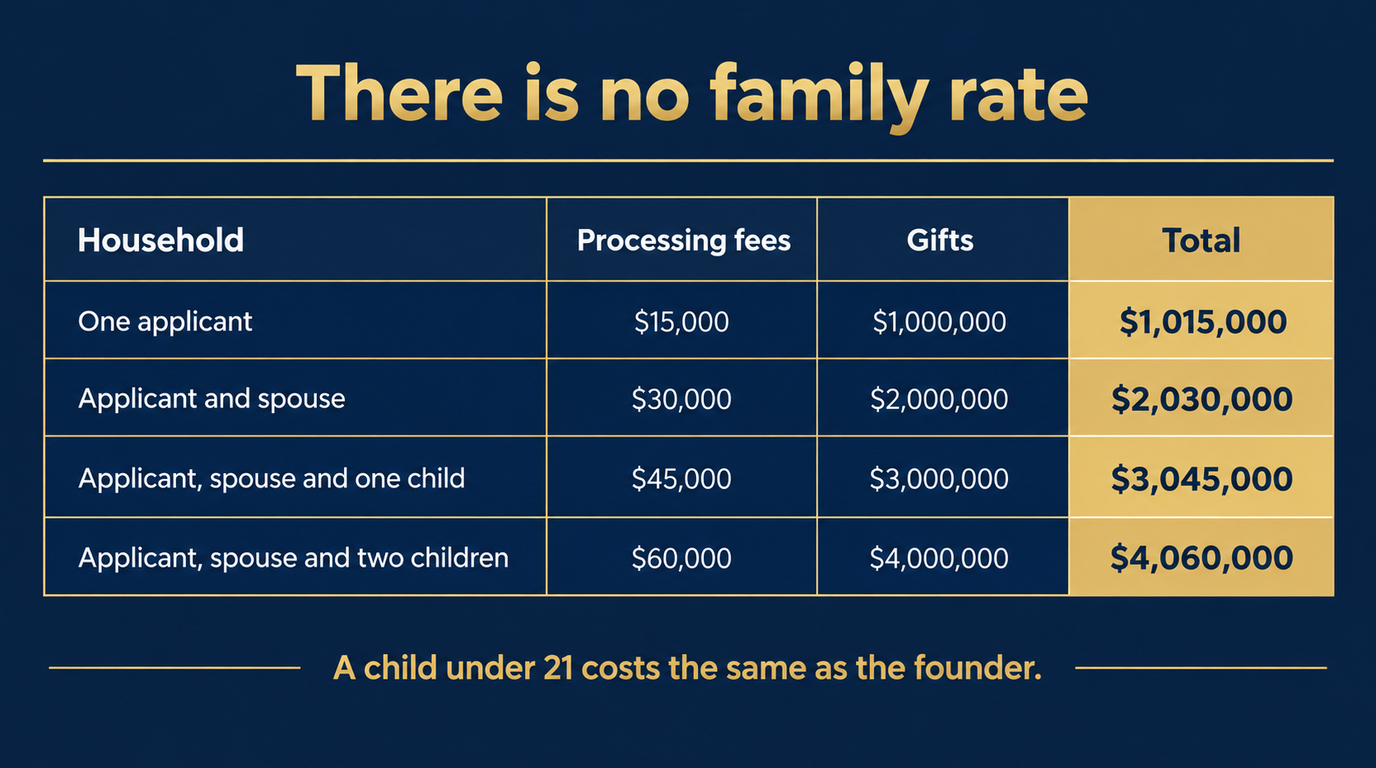
This is where the arithmetic turns, and where the published comparisons are least useful. In most residence-by-investment programmes a family is an increment: a main applicant pays the threshold and dependants are added for a fraction. The Gold Card does not work that way. The official portal states that a spouse or unmarried child under 21 must be included in the initial application, and that each such family member carries their own $15,000 processing fee and their own $1 million gift.
So the household price is linear. There is no family rate, no discount for a second adult and no reduced figure for a minor, which is unusual enough to be worth stating plainly: a child under 21 costs the same as the founder.
| Household | Processing fees | Gifts | Total |
|---|---|---|---|
| One applicant | $15,000 | $1,000,000 | $1,015,000 |
| Applicant and spouse | $30,000 | $2,000,000 | $2,030,000 |
| Applicant, spouse and one child | $45,000 | $3,000,000 | $3,045,000 |
| Applicant, spouse and two children | $60,000 | $4,000,000 | $4,060,000 |
None of those totals include immigration counsel, source-of-funds documentation, the consular or adjustment-of-status stage, or the tax advice that a US permanent resident genuinely needs before the card is issued rather than after. Nor do they include the cost of the thing most comparison pages ignore, which is time: the money is committed while the queue described in the next section is still ahead of you.
For contrast, the cheapest routes to a second passport anywhere sit two orders of magnitude below this. Our guide to the cheapest citizenship by investment programmes prices the Caribbean units on their own published schedules, where a family of four is a six-figure exercise rather than a seven-figure one.
The queue behind the card: EB-1, EB-2 and the 7 percent cap
The order is careful, and the care is easy to miss. Section 3 tells the agencies to implement the programme consistent with applicable law and their statutory authorities, including the limits on the numbers of visas specified in 8 U.S.C. 1151 and following. The Gold Card therefore has no visa numbers of its own. It competes for EB-1 and EB-2 numbers with every other applicant in those categories.
Those allocations are statutory and the percentages are not discretionary. 8 U.S.C. 1153(b) gives the first preference 28.6 percent of the worldwide employment-based level and the second preference another 28.6 percent, with the worldwide level set at 140,000 plus a computed carry-over. On the 140,000 floor that is roughly 40,040 visas each.
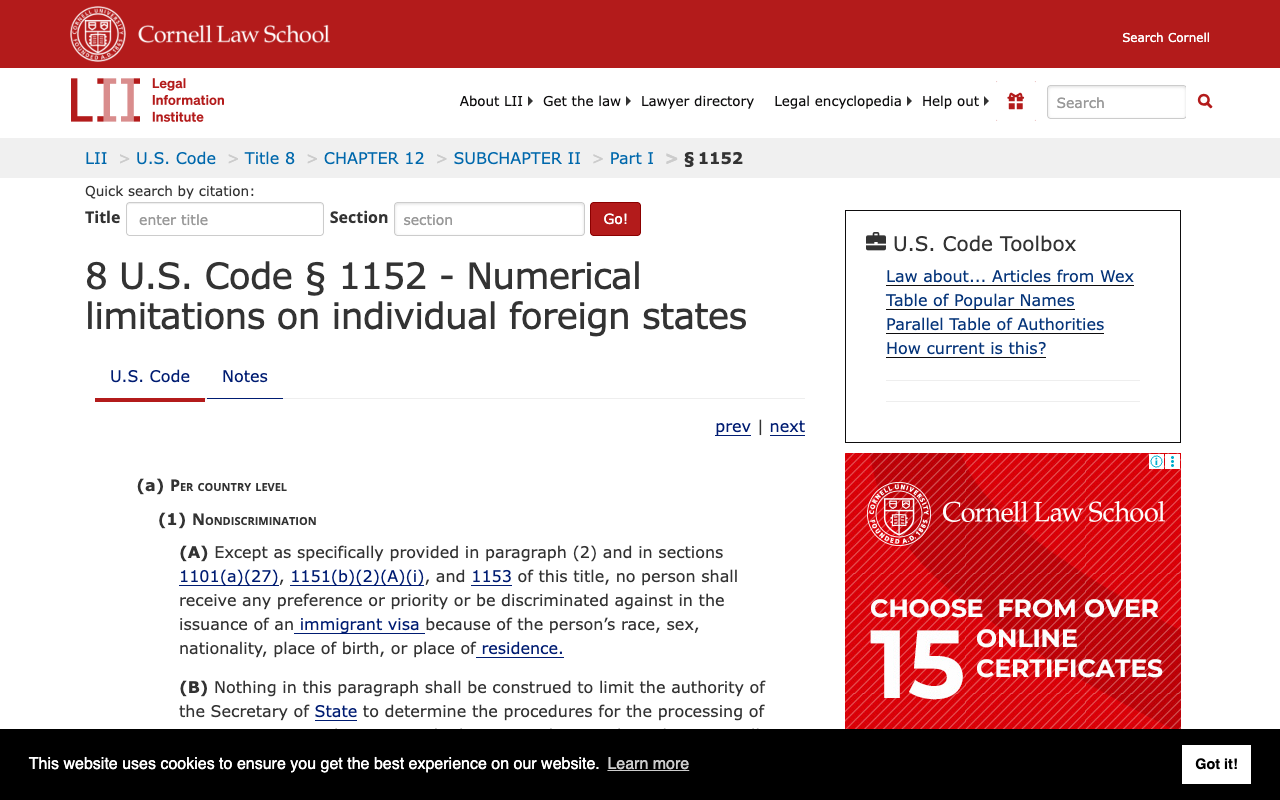
Then comes the constraint that no amount of money moves. 8 U.S.C. 1152(a)(2) caps any single foreign state at 7 percent of the visas available in a fiscal year, and dependent areas at 2 percent. The cap is written against the state, not the applicant, so an Indian or Chinese national buying a Gold Card joins the same oversubscribed per-country line as an Indian or Chinese national with a conventional EB-2 petition.
| Provision the gift points at | Statutory share | Visas a year on the 140,000 floor | Per-country ceiling |
|---|---|---|---|
| EB-1 extraordinary ability, 1153(b)(1)(A) | 28.6% | about 40,040 | 7% |
| EB-2 exceptional ability, 1153(b)(2)(A) | 28.6% | about 40,040 | 7% |
| EB-2 national interest waiver, 1153(b)(2)(B) | Inside the same 28.6% | No separate allocation | 7% |
| EB-5, for comparison, 1153(b)(5) | 7.1% | about 9,940 | 7% |
This is the gap at the centre of the category. A Gold Card cannot create a visa number, cannot lift a per-country ceiling and cannot move an applicant ahead of the queue in a category where their country of chargeability is backlogged. The portal says as much in nine words, requiring that a visa be available, and then the marketing talks about record time. Both things are on the same website.
US Gold Card cost against EB-5, now EB-5 fees have changed
EB-5 is the honest comparison, and the comparison moved two days before this guide was published. On 30 September 2026 USCIS published its final EB-5 fee rule, which takes effect on 30 November 2026 and roughly doubles the investor-facing filing fees. Most published comparisons still quote the amounts reinstated in November 2025.
| EB-5 filing | Fee now, reinstated 13 November 2025 | Fee from 30 November 2026 | Change |
|---|---|---|---|
| I-526, standalone investor | $3,675 | $7,615 | +107% |
| I-526E, regional centre investor, initial | $3,675 | $7,850 | +114% |
| I-829, removal of conditions | $3,750 | $5,000 | +33% |
| I-956, regional centre designation, initial | $17,795 | $44,115 | +148% |
| I-956F, approval of an investment offering | $17,795 | $42,675 | +140% |
| EB-5 Integrity Fund fee, per investor petition | $1,000 | $1,100 | +10% |
Even doubled, those fees are rounding errors against the Gold Card's $15,000, and the structural difference is the one that should decide this. The EB-5 minimum is $800,000 in a targeted employment area or $1,050,000 otherwise, and it is capital you place in a new commercial enterprise that must create ten full-time jobs. It is genuinely at risk and it can be lost. But it is yours, it can be returned, and the statute fixes the amount by filing date, with the first inflation adjustment due for petitions filed on or after 1 January 2027.
The Gold Card million cannot be lost, because it is gone on arrival. For a self-funded applicant comparing like with like, the question is whether a non-refundable $1,015,000 and a queue in a capped category beats an at-risk $800,000 with a defined route out and a statutory framework behind it. Our EB-5 visa cost guide prices the regional-centre route in full, and the lower-cost non-immigrant alternative is set out in our E-2 minimum investment guide, where there is no statutory floor at all.
There is one more line in the order worth knowing if you are an EB-5 investor already. Section 3(f) instructs the agencies to consider expanding the Gold Card to applicants under 1153(b)(5), which is EB-5 itself. Nothing has been published, and the EB-5 statute is an act of Congress that an executive order cannot rewrite, but the intention is on the record.
Related guides on Domicila
If the US is the destination and the Gold Card is not the route, these are the comparisons that do the most work next:
- EB-5 visa cost — the regional-centre and standalone routes priced on the current fee schedule
- E-2 visa minimum investment — the treaty route with no statutory floor, and what substantiality really means
- E-2 visa requirements — who qualifies, and which nationalities cannot
- E-2 visa business plan — the document the whole application turns on
- Grenada E-2 visa — the citizenship route that opens E-2 to Indian and Chinese nationals
- Citizenship by investment vs golden visa — passport now, or residence first
- Golden visa cost — what residence actually costs across the open programmes
Common questions
How much does the US Gold Card cost in 2026?
For a single applicant the US Gold Card cost is $1,015,000: a $15,000 processing fee paid with the application, and a $1 million gift to the Department of Commerce paid after background vetting clears. Neither amount is refundable. A corporate sponsor pays $2 million per employee instead of the $1 million, plus the same $15,000 fee, and the executive order also authorises maintenance and transfer fees for corporate sponsors that have no published schedule yet. The advertised $5 million Platinum Card is not operational.
Is the Gold Card $1 million payment refundable or an investment?
Neither. Executive Order 14351 structures the payment as an unrestricted gift to the Department of Commerce under 15 U.S.C. 1522, to be deposited in a separate fund in the Treasury and used to promote commerce and American industry. You acquire no shares, no debt instrument and no claim on the money. This is the sharpest difference from EB-5, where the investment is capital placed in a commercial enterprise that is at risk but remains the investor's property and can be returned.
How much does a Gold Card cost for a family of four?
$4,060,000 in government charges. The official portal states that a spouse or unmarried child under 21 must be included in the initial application and that each family member requires their own $15,000 processing fee and their own $1 million gift. There is no family rate and no reduction for minors, so two adults and two children are four full prices: $60,000 in fees plus $4 million in gifts, before immigration counsel, source-of-funds work and tax advice.
Does the Gold Card get you a green card faster?
Not necessarily, and that is the government's own position rather than a critic's. In filings in the litigation challenging the programme, the Department of Homeland Security stated that Gold Card applicants will not necessarily have their petitions adjudicated faster than any non-Gold-Card applicant. The executive order does direct the agencies to establish an expedited process and to charge administrative fees to cover it, but the programme creates no visa numbers of its own, so an applicant from a country with a backlogged EB-1 or EB-2 queue still waits for a visa number.
Do per-country limits apply to the Gold Card?
Yes. Because the gift routes applicants into the existing EB-1 and EB-2 preferences, the numerical limits in 8 U.S.C. 1151 and the per-country ceiling in 8 U.S.C. 1152(a)(2) both apply. That ceiling caps any single foreign state at 7 percent of the visas available in a fiscal year, and dependent areas at 2 percent. Nationals of heavily oversubscribed countries therefore gain no queue advantage from the payment, because the cap attaches to the country of chargeability rather than to the individual or the amount paid.
How many people have actually bought a Gold Card?
Very few. Figures disclosed in the litigation show that since the December 2025 launch 338 people had submitted a Gold Card request, 165 had paid the $15,000 processing fee, 59 had filed Form I-140G, and one had been approved as of a hearing in late April 2026. For context, USCIS sized its own paperwork estimate for the programme at 1,520 self-petitioners and 72 corporate petitioners a year. Roughly half of those who started did not pay the fee, and most who paid did not file the petition.
Is the Gold Card programme being challenged in court?
Yes. In AAUP v. Department of Homeland Security, No. 26-cv-00300 in the US District Court for the District of Columbia, filed in February 2026 and amended in May 2026, the plaintiffs argue the programme is an unlawful pay-to-play system that bypasses the merit criteria Congress enacted, lacks congressional authorisation and violates the Administrative Procedure Act. As things stand no injunction has been granted and there has been no ruling on the merits; the government has moved to dismiss, largely on standing. A separate Freedom of Information Act suit seeks records about how the programme was built. The programme is operating, but the outcome is unresolved.
Gold Card or EB-5 in 2026?
They are different instruments. EB-5 requires $800,000 in a targeted employment area or $1,050,000 elsewhere, invested in a new commercial enterprise that must create ten full-time jobs; the capital is at risk but remains yours and can be returned, and the filing fees, though rising sharply on 30 November 2026, are a few thousand dollars. The Gold Card requires a non-refundable $1,015,000 with no asset at the end of it, and offers an expedited process that DHS has declined to guarantee in court. EB-5's amounts are fixed by statute at the filing date, with the first inflation adjustment due for petitions filed on or after 1 January 2027.
Official sources to verify
- Executive Order 14351 of September 19, 2025: The Gold CardFederal Register, 90 FR 46031
- Gold Card: official application portal and fee scheduleU.S. Department of Commerce
- Immigrant Petition for the Gold Card Program, Form I-140G (30-day notice)U.S. Citizenship and Immigration Services, 91 FR 32074
- EB-5 Fee Rule, final rule effective November 30, 2026 (RIN 1615-AC93)U.S. Citizenship and Immigration Services
- About the EB-5 Visa ClassificationU.S. Citizenship and Immigration Services
- Form G-1055, Fee ScheduleU.S. Citizenship and Immigration Services
- 8 U.S.C. 1153: Allocation of immigrant visasLegal Information Institute, Cornell Law School
- 8 U.S.C. 1152: Numerical limitations on individual foreign statesLegal Information Institute, Cornell Law School
- AAUP v. Department of Homeland Security, No. 26-cv-00300 (D.D.C.)American Association of University Professors
Compare EB-5 advisors
Ask for a breakdown of investment amount, regional center costs, legal fees, filing fees, source-of-funds work, and timeline assumptions.
We may earn a referral fee if you choose an advisor through this site. We still aim to show cost ranges, caveats, and official source links plainly.