barbados golden visa cost
Barbados Golden Visa Cost 2026: BDS$5M and No Passport
Search the Barbados golden visa cost and you will be quoted US$150,000, US$300,000, US$2 million, and US$750,000 for a passport — four incompatible numbers, not one of them from a Barbadian government document. Every page carrying them was written before 4 November 2026, when the Senate passed the Immigration Act, 2026 and the Barbados Citizenship Act, 2026, repealing the statute those pages describe and fixing a single investor threshold of $5,000,000 for permanent residence. We read both Acts as passed, Parliament's own record of their passage, the Immigration Department's published fee pages and the Third Schedule points table on 15 November 2026. Barbados has no golden visa and sells no citizenship. What it now has is a residence route whose price is written into law, and whose fees are not yet written at all.

Key takeaways
- Barbados has no golden visa and no citizenship by investment. The minister responsible, Gregory Nicholls, told the House of Assembly on 27 October 2026 that the bill "does not create the sale of citizenship" and "does not sell passports", and told the Senate on 4 November that "Barbados does not grant citizenship by investment."
- The Immigration Act, 2026 prices permanent residence at $5,000,000. Section 10(1) lets a non-citizen be registered as a permanent resident on making a "qualifying investment", which section 10(2) defines as an investment valued at $5 000 000 or more in a ministerially designated "approved national development project".
- Neither Act is in force, and no fee has been set. Both passed Parliament on 4 November 2026 but commence "on a date to be fixed by Proclamation". Every charge in the Immigration Act is a "prescribed fee" — prescribed by regulations that do not yet exist. Nobody can quote you a total today, and anyone who does is inventing it.
- The Third Schedule reaches permanent residence at $3,000,000, not $5,000,000. Points substitute for residence at six months each. An applicant under 50 investing $3m in a designated national project scores 9 points, which with the minimum 180 days on the island covers the five-year residence test outright.
- Citizenship can follow 360 days after permanent residence. Section 3(6) of the Citizenship Act lets non-CARICOM permanent residents register as citizens after an aggregate 360 days of lawful residence as a permanent resident within the preceding 1,460 days. Registration is discretionary, not an entitlement.
On this page
Every figure below is tied to the instrument that states it. Where the pages ranking for this keyword disagree with the Acts as passed, we say so rather than average them — and on this topic they disagree with the law entirely, because all of them were published before it. This site's renderer does not emit heading anchors, so the list below is a map rather than jump links.
- Why the Barbados golden visa has no price
- What the Immigration Act, 2026 actually prices
- The $3 million route hiding in the Third Schedule
- What the government charges today
- The figures the ranking pages quote, and where they come from
- From permanent resident to passport, and what nobody can price yet
Why the Barbados golden visa has no price
Barbados has never operated a citizenship-by-investment programme, and the Acts passed this month do not create one. That makes it the odd one out in its own neighbourhood: the five Caribbean states that do sell passports are all within a short flight, and the contrast is the whole of our Caribbean citizenship by investment comparison. Barbados sells residence, and only since this month has it sold it by statute.
What the advisory market calls the Barbados golden visa is the Special Entry and Residence Permit, a discretionary ministerial permit operated since 2012 under the Immigration Act, Cap. 190. Discretionary is the operative word: the Immigration Department publishes no SERP threshold, no SERP tariff and no SERP category list. Its page headed "Special Entry Permit" is not about the SERP at all — it covers applications to vary a period or condition of stay under section 13(3) of the Act, on Form B, for an application fee of BDS$300.
So the honest answer to the search is that until this month there was no published price, because the permit that everyone prices was never published. If what you actually want is a passport rather than a place to live, the distinction in citizenship by investment versus golden visa is where to begin, and Barbados sits firmly on the residence side of it.
What the Immigration Act, 2026 actually prices
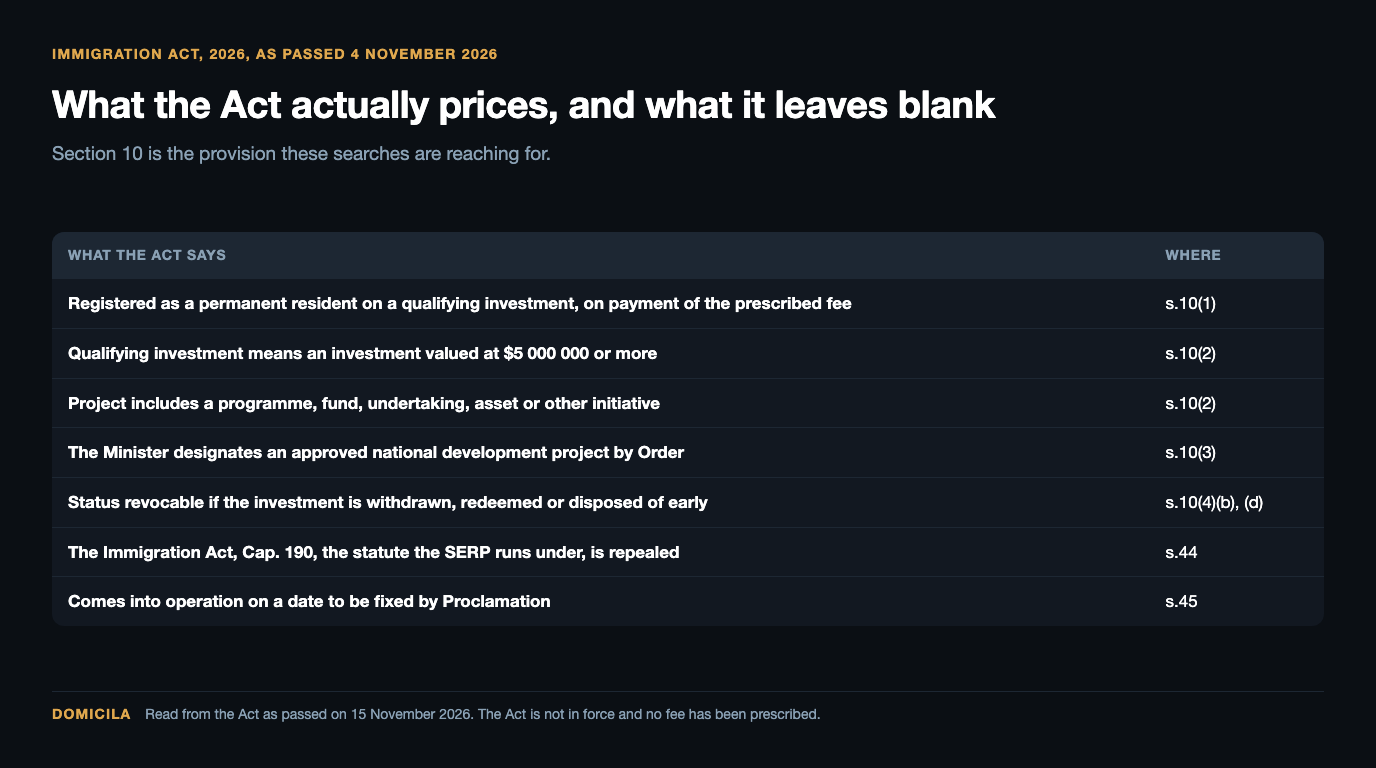
The Immigration Act, 2026 and the Barbados Citizenship Act, 2026 were given a first reading on 29 April 2026, passed the House of Assembly on 27 October 2026, and passed the Senate on 4 November 2026, according to Parliament's own record for each Act. Section 10 is the provision these searches are reaching for, and it is short enough to quote:
| What the Act says | Where |
|---|---|
| A non-citizen "may, upon application to the Minister in the approved form, and on payment of the prescribed fee, be registered as a permanent resident where the person makes a qualifying investment in Barbados" | s.10(1) |
| "qualifying investment" means "an investment valued at $5 000 000 or more" in a project designated under s.10(3) | s.10(2) |
| "project" includes "a programme, fund, undertaking, asset or other initiative" — so a pooled vehicle can qualify | s.10(2) |
| The Minister designates an "approved national development project" by Order, where satisfied it "serves a public purpose" and "contributes significantly" to development | s.10(3) |
| Status is revocable if the investment is "withdrawn, redeemed or disposed of before the approved period", or the project is not completed within it | s.10(4)(b), (d) |
| The Immigration Act, Cap. 190 — the statute the SERP runs under — "is repealed" | s.44 |
| "This Act shall come into operation on a date to be fixed by Proclamation" | s.45 |
Two things in that table deserve more attention than they have had. The first is the currency: the Act says "$5 000 000" and never names a currency. Barbadian statutes are denominated in Barbados dollars, and the Central Bank of Barbados has held the rate at BDS$2.00 to US$1.00 since 1975, so the figure is about US$2.5 million. That dollar conversion is an inference from the peg, not a term of the Act, and every report quoting "US$2.5 million" is making the same inference.
The second is that "approved period" is not defined anywhere in the Act. It carries two of the seven revocation grounds in section 10(4) — your status can be revoked if you dispose of the investment before it, or fail to complete the project within it — and the text never says what it is. That is the single largest unpriced risk in the route, and it will be settled by regulations nobody has seen. Nicholls told the House the designated projects would be things like water reclamation and sewage treatment plants, healthcare, education, housing, renewable energy, infrastructure, technology, agriculture and tourism. No Order designating any project has been made, because the Act is not yet in force.
The $3 million route hiding in the Third Schedule
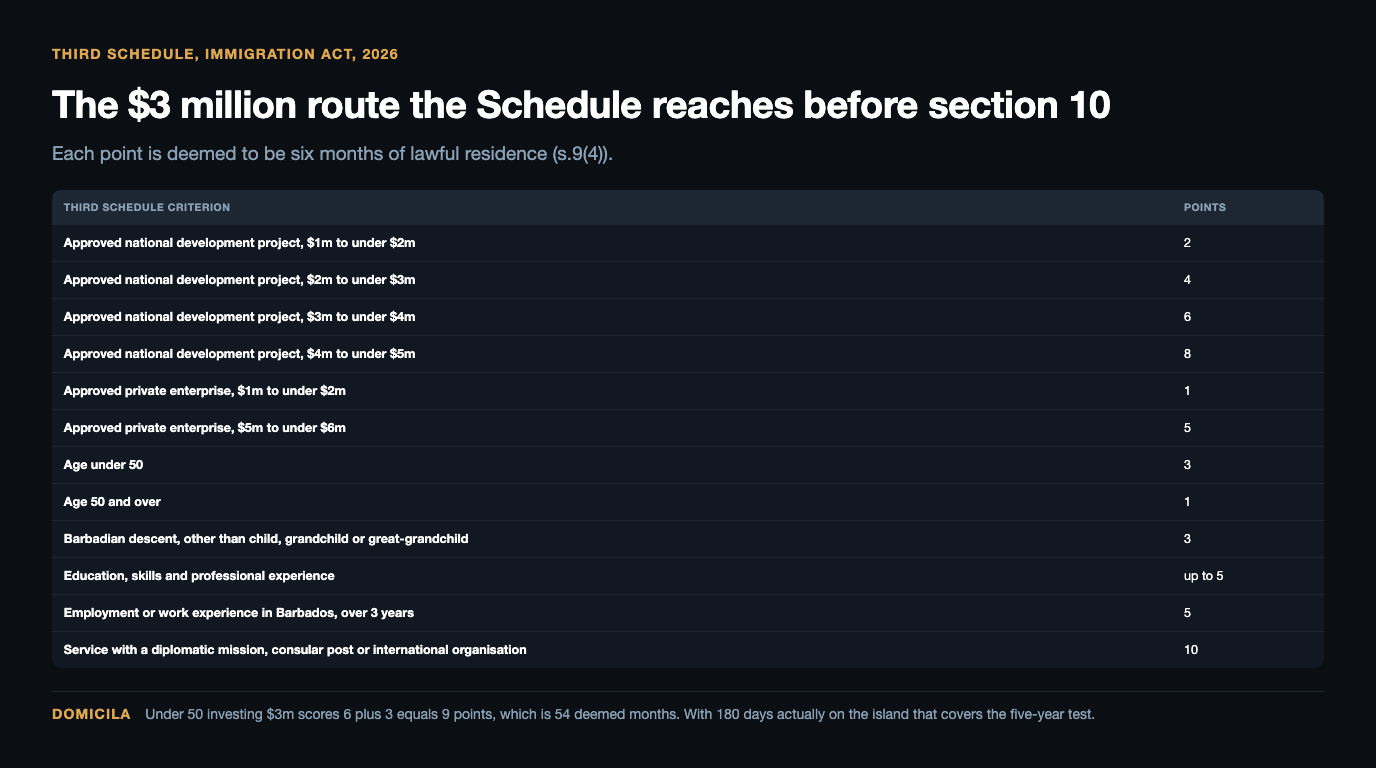
Section 10 is not the cheapest way the Act reaches permanent residence, and as far as we can tell no page covering this topic has noticed. The default test in section 9(1)(c) is five years of continuous lawful residence. Section 9(2) offers an alternative to anyone who cannot meet it: at least 180 days of lawful residence in the preceding three years, plus enough points to make up the shortfall. Section 9(4) sets the exchange rate between the two — each point is deemed to be six months of lawful residence.
Five years is sixty months. Six months of real presence leaves fifty-four to find, which is nine points. Here is what the Third Schedule awards:
| Third Schedule criterion | Points |
|---|---|
| Investment in an approved national development project, $1m to under $2m | 2 |
| Investment in an approved national development project, $2m to under $3m | 4 |
| Investment in an approved national development project, $3m to under $4m | 6 |
| Investment in an approved national development project, $4m to under $5m | 8 |
| Investment in an approved private enterprise, $1m to under $2m | 1 |
| Investment in an approved private enterprise, $5m to under $6m | 5 |
| Age under 50 | 3 |
| Age 50 and over | 1 |
| Barbadian descent, other than a child, grandchild or great-grandchild | 3 |
| Education, skills and professional experience | up to 5 |
| Employment or work experience in Barbados, over 3 years | 5 |
| Service with a diplomatic mission, consular post or international organisation | 10 |
An applicant under 50 who invests $3,000,000 in a designated national development project scores six points for the investment and three for age: nine points, fifty-four deemed months, which with 180 days actually spent on the island satisfies the five-year test. The same investor at $4m scores eleven and has room to spare. In other words the schedule prices permanent residence at $3m through section 9, against $5m through section 10 — and the section 9 route additionally demands you turn up for six months, which section 10 does not.
Treat that as arithmetic on the face of the schedule rather than a promise. Both routes say the Minister "may" register the applicant, both depend on an Order designating the project, and section 12 allows revocation for conduct detrimental to national security or a sentence over five years. There is also a quieter provision worth knowing: section 9(5)(e) counts time held on a Barbados Welcome Stamp as lawful residence, so the remote-work visa is a legitimate way to start the residence clock rather than a dead end.
What the government charges today
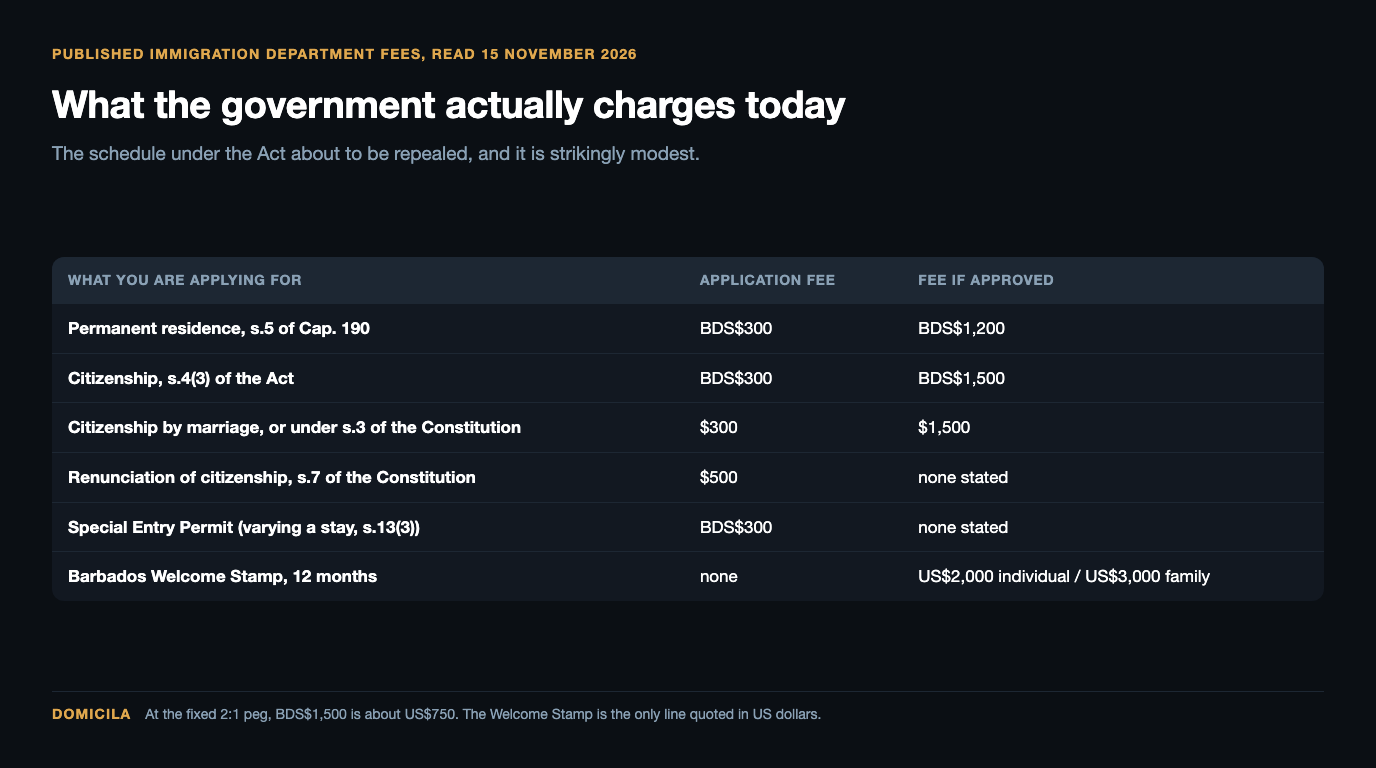
Until the Proclamation comes, the published Barbadian fee schedule is the one under the Act about to be repealed — and it is strikingly modest, which is itself the answer to the cost question. These are the amounts the Immigration Department actually prints:
| What you are applying for | Application fee | Fee if approved |
|---|---|---|
| Permanent residence, s.5 of Cap. 190 | BDS$300 | BDS$1,200 |
| Citizenship, s.4(3) of the Act | BDS$300 | BDS$1,500 |
| Citizenship by marriage, or under s.3 of the Constitution | $300 | $1,500 |
| Renunciation of citizenship, s.7 of the Constitution | $500 | none stated |
| Special Entry Permit (varying a stay, s.13(3)) | BDS$300 | none stated |
| Barbados Welcome Stamp, 12 months | none | US$2,000 individual / US$3,000 family |
At the 2:1 peg, BDS$1,500 is US$750. The entire statutory cost of becoming a permanent resident of Barbados today, government-side, is BDS$1,500 — about US$750 — and citizenship is BDS$1,800, or US$900. That is the real reason the headline investment figure is not a cost in any ordinary sense: the money is capital you still own, and the government's own charge is three figures. The discipline we apply across our golden visa cost comparison applies here too — separate the money you keep from the money you never see again.
Note what the Welcome Stamp row buys. Its own official page sets an income test of US$50,000 a year, approval typically within seven business days, and payment of the non-refundable fee within 28 days of approval. US$2,000 for twelve months of lawful residence that the new Act will count toward permanent residence is the cheapest line in Barbadian immigration, and it is not an investment route at all.
The figures the ranking pages quote, and where they come from
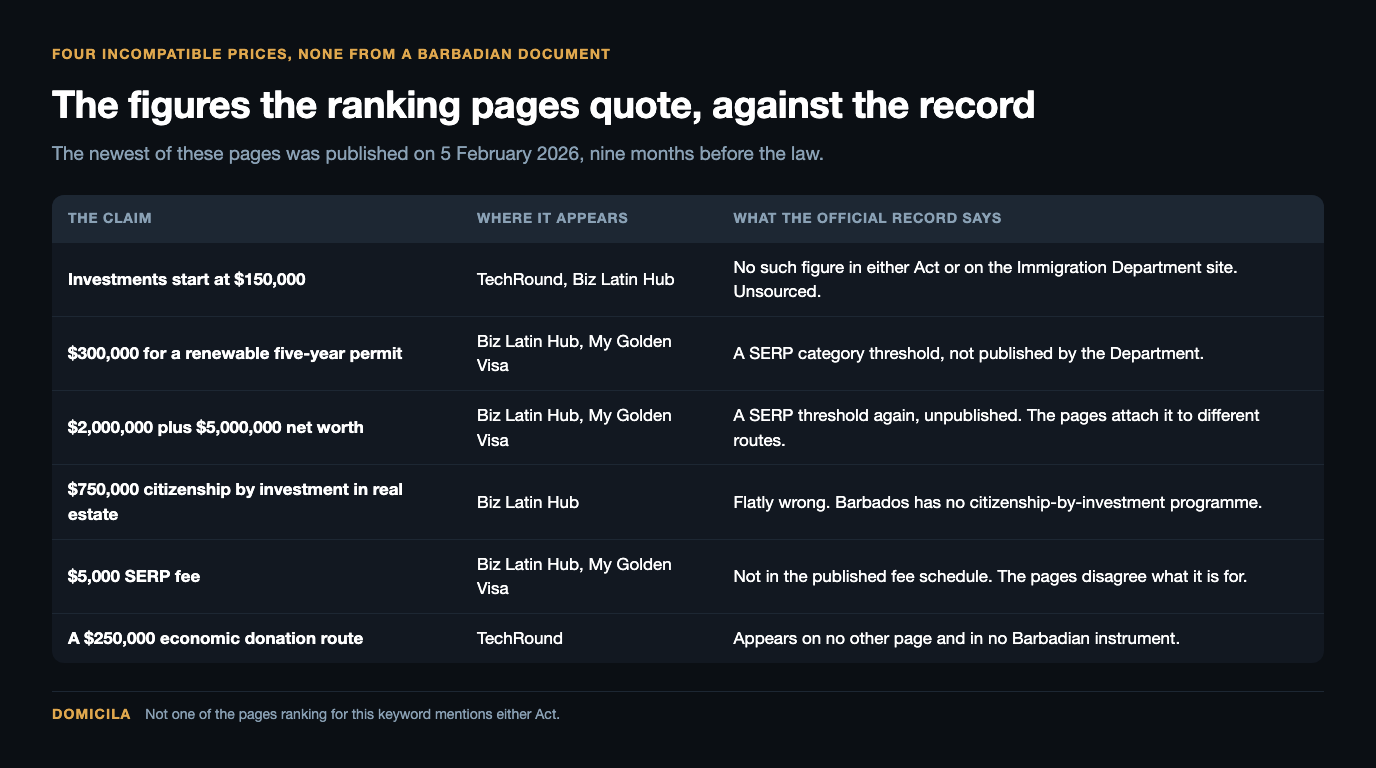
We read the pages currently ranking for this keyword. Between them they state four different prices, and the newest was published on 5 February 2026 — nine months before the law that governs the answer. Not one of them mentions either Act. Here is each claim against the official record:
| The claim | Where it appears | What the official record says |
|---|---|---|
| "Investments start at $150,000" | TechRound, Biz Latin Hub | No such figure in either Act or on the Immigration Department's site. Unsourced. |
| $300,000 for a renewable five-year permit | Biz Latin Hub, My Golden Visa | A SERP category threshold. Not published by the Immigration Department. The two pages disagree on whether it must be real estate. |
| $2,000,000 plus $5,000,000 net worth for permanent residence | Biz Latin Hub, My Golden Visa | A SERP category threshold, again unpublished. The same two pages attach the net-worth test to different routes. |
| "$750,000 Citizenship by Investment (in real estate)" | Biz Latin Hub | Flatly wrong. Barbados has no citizenship-by-investment programme, and the responsible minister said so in both chambers. |
| $5,000 SERP fee | Biz Latin Hub (renewal), My Golden Visa (application) | Not in the published fee schedule. The two pages cannot agree what the fee is for. |
| A "$250,000 economic donation" route | TechRound | Appears on no other page and in no Barbadian instrument. |
This is worth labouring because the pattern is familiar from every programme we track: a figure gets published once, is copied sideways, and acquires authority from repetition rather than from a source. The tell here is the currency. The Acts write amounts as bare dollars in a Barbados-dollar statute; the guides write bare dollars meaning US dollars; and at a 2:1 peg that ambiguity is a factor-of-two error in whichever direction you read it. One of those pages also carries a sentence about obtaining a Bermuda residence permit in its Barbados key-takeaways box, which tells you how the copy was assembled.
If you are pricing the Caribbean on cost rather than on Barbados specifically, our cheapest citizenship by investment comparison is the better starting point, because it deals with programmes that publish tariffs.
From permanent resident to passport, and what nobody can price yet
The companion Barbados Citizenship Act, 2026 is where the investor route gets interesting, and where the minister's denial and the statutory text pull in different directions. Section 3(6) provides that a person who is not a national of a CARICOM Member State, together with a spouse and dependants, may be registered as a citizen on satisfying the Minister that they have lawfully resided in Barbados as permanent residents for an aggregate of at least 360 days during the period of at least 1,460 days immediately preceding the application. For CARICOM nationals, section 3(5) sets the lighter test of 270 days within 1,095.
Read that carefully. 1,460 days is four years, but the residence requirement inside the window is 360 days — roughly a year of physical presence, accumulated as you like across four. Several reports have attributed this test to section 3(5); in the Act as passed, 3(5) is the CARICOM provision and the 360-day test is section 3(6). Either way it is registration at the Minister's discretion, not an entitlement: section 4 permits refusal in the interests of national security and public policy, where the applicant has a sentence of twelve months or more, or where the applicant lacks sufficient means and is likely to become a charge on public funds.
So both things are true. Nicholls is right that the Act confers no citizenship on an investor and promises no passport. And the literal reading is that an investor who becomes a permanent resident under section 10 enters the same 360-day queue as any other permanent resident, with nothing in either Act barring them. Those are not contradictory; they are the difference between selling a passport and selling a place in a line that leads toward one.
What remains genuinely unpriced is most of it. The Act commences by Proclamation and has not been proclaimed. Every fee is a "prescribed fee" awaiting regulations. No project has been designated. "Approved period" is undefined. Until those arrive, the only honest figure for the Barbados golden visa cost is the statutory investment threshold plus a government charge in the hundreds — and a warning that the real bill will be professional fees, due diligence and the capital itself. There is also a transitional provision worth checking if you already have history on the island: section 42 lets anyone who lawfully resided in Barbados for an aggregate 300 days across the seven years before commencement register as a permanent resident, with spouse and dependants, within three years of it.
| Open question | What the Act says | Who settles it |
|---|---|---|
| When can anyone apply? | the Act "shall come into operation on a date to be fixed by Proclamation" (s.45) | Cabinet, by Proclamation |
| What does it cost to file? | every charge in the Act is a "prescribed fee" | regulations, not yet published |
| What is the "approved period"? | used twice in s.10(4) as a revocation trigger, defined nowhere in the text | regulations |
| Which projects qualify? | designated by ministerial Order under s.10(3); none has been made | the Minister |
| How long must the capital stay in? | tied to the undefined "approved period" | regulations |
| What happens to existing SERP holders? | Cap. 190 is repealed by s.44; the Act is silent on their permits | regulations, or a transitional Order |
Everything here describes the Acts as passed by Parliament on 4 November 2026 and the fee pages published by the Immigration Department, all read on 15 November 2026. It is not legal, tax or immigration advice, and nothing here promises any application will be granted — every provision cited turns on the Minister's discretion. Take Barbadian legal advice before you act, and ask any provider offering a "Barbados golden visa" which section they are filing under and what the prescribed fee is. If they can answer the second question today, they are guessing.
Related guides on Domicila
If Barbados is on your list, these are the comparisons that answer the question it raises next:
- Caribbean citizenship by investment comparison — the five neighbours that do sell passports, priced side by side.
- Bahamas residency by investment cost — the nearest residence-only route, and the closest structural comparison to Barbados.
- Cayman Islands residency by investment cost — the other British-system jurisdiction pricing residence rather than citizenship.
- Antigua citizenship by investment cost — the cheapest Caribbean passport, for contrast with Barbados's refusal to sell one.
- St Kitts and Nevis citizenship by investment cost — the oldest programme in the region and the benchmark for due diligence.
- Golden visa cost comparison — every major route priced together, so $5,000,000 has something to sit against.
Common questions
Does Barbados have a golden visa in 2026?
Not under that name. Barbados has never operated a citizenship-by-investment programme, and what the advisory market calls the Barbados golden visa is the Special Entry and Residence Permit, a discretionary ministerial permit. The Immigration Act, 2026, passed by Parliament on 4 November 2026, replaces it with a statutory permanent residence route for investors, but that Act is not yet in force.
What is the Barbados golden visa cost?
There is no published price for a golden visa because there is no golden visa. Under the Immigration Act, 2026 the investor threshold for permanent residence is an investment valued at 5,000,000 dollars or more in an approved national development project. The Act does not state a currency; in a Barbados-dollar statute that is about US$2.5 million at the 2:1 peg, and it is capital you continue to own rather than a fee.
How much does permanent residence in Barbados cost in government fees?
The Immigration Department currently publishes an application fee of BDS$300 and a final fee of BDS$1,200 if approved, for permanent residence under section 5 of the Immigration Act, Cap. 190. That is about US$750 in total at the fixed 2:1 exchange rate. Fees under the new Act are described only as a prescribed fee, and the regulations prescribing them have not been published.
Can you buy Barbados citizenship or a Barbados passport?
No. The minister responsible, Gregory Nicholls, told the House of Assembly on 27 October 2026 that the bill does not create the sale of citizenship and does not sell passports, and told the Senate on 4 November that Barbados does not grant citizenship by investment. Any page offering Barbadian citizenship by investment for a figure such as 750,000 dollars is describing something that does not exist.
Is the Barbados Immigration Act 2026 in force yet?
No. Both the Immigration Act, 2026 and the Barbados Citizenship Act, 2026 completed their passage through Parliament on 4 November 2026, but each provides that it comes into operation on a date to be fixed by Proclamation. No Proclamation has been made, no regulations prescribing fees have been published, and no national development project has been designated, so applications cannot yet be filed.
Can you get Barbados permanent residence for less than 5 million dollars?
On the face of the Act, yes. Section 9(2) allows an applicant with at least 180 days of lawful residence in the preceding three years to make up the five-year residence requirement with points, and section 9(4) deems each point to be six months of residence. The Third Schedule awards six points for an investment of 3,000,000 to under 4,000,000 dollars in a designated national project and three points for being under 50, which together cover the shortfall.
How long until an investor can apply for Barbadian citizenship?
Section 3(6) of the Barbados Citizenship Act, 2026 allows a non-CARICOM permanent resident, with spouse and dependants, to apply to be registered as a citizen after an aggregate of at least 360 days of lawful residence as a permanent resident within the 1,460 days before the application. Registration is at the Minister's discretion and can be refused on national security, public policy, criminal record or insufficient means grounds.
Does the Barbados Welcome Stamp count toward permanent residence?
Under the new Act it does. Section 9(5)(e) includes time held on a Barbados Welcome Stamp, within the meaning of the Remote Employment Act, 2020, in the definition of lawful residence for permanent residence purposes. The Welcome Stamp itself costs US$2,000 for an individual or US$3,000 for a family bundle and requires annual income of at least US$50,000.
Official sources to verify
- Immigration Act, 2026 — Parliament's record of passage: House of Assembly 27 October 2026, Senate 4 November 2026, read 15 November 2026Parliament of Barbados
- Immigration Act, 2026, full text as passed — s.9 points route, s.10 qualifying investment of $5,000,000, s.42 transitional, s.44 repeal of Cap. 190, s.45 commencement by Proclamation, Third Schedule pointsParliament of Barbados
- Barbados Citizenship Act, 2026 — Parliament's record of passage: House of Assembly 27 October 2026, Senate 4 November 2026, read 15 November 2026Parliament of Barbados
- Barbados Citizenship Act, 2026, full text as passed — s.3(5) CARICOM 270 days in 1,095, s.3(6) non-CARICOM 360 days in 1,460, s.4 grounds of refusalParliament of Barbados
- Permanent Resident Status under s.5 of the Immigration Act, Cap. 190 — application fee BDS$300 and final fee BDS$1,200 if approved, read 15 November 2026Barbados Immigration Department
- Barbadian Citizenship — published fees by route, including s.4(3) application BDS$300 and final BDS$1,500, read 15 November 2026Barbados Immigration Department
- Requirements for Special Entry Permit — application under s.13(3) to vary a period or condition of stay, Form B, application fee BDS$300, read 15 November 2026Barbados Immigration Department
- Barbados Welcome Stamp — official fees US$2,000 individual and US$3,000 family bundle, income test US$50,000, read 15 November 2026Government of Barbados
- CBB 101: the exchange rate peg — BDS$2.00 to US$1.00, fixed since 1975, read 15 November 2026Central Bank of Barbados
Compare golden visa advisors
Ask for a route-specific quote that separates investment amount, government fees, legal work, fund or property costs, and renewal obligations.
We may earn a referral fee if you choose an advisor through this site. We still aim to show cost ranges, caveats, and official source links plainly.