bahamas residency by investment cost
Bahamas Residency by Investment Cost 2026
The Bahamas residency by investment cost is quoted almost everywhere as $1 million, and that figure describes the threshold rather than the money you spend. Section 17A of the Immigration Act asks for an investment of one million dollars held for a minimum of ten years, in Bahamian real estate or in Zero Coupon Bonds issued by the Central Bank — an asset you still own. What leaves your account is separate and larger than most pages admit: an economic permanent residence certificate costs $25,000 with the right to work in your own business or $20,000 without, the processing fee is $200, and if you buy property the Act itself requires you to file evidence that VAT was paid on the conveyance, which on a $1 million purchase is charged at 10%. The two routes therefore price very differently, and nobody ranking for this term says so. We priced every line from the Immigration Act amendment as tabled by the Attorney-General's ministry, the Department of Immigration's own fee scale and permanent residence page, and Deloitte's Bahamas Highlights for 2026, all read on 7 November 2026.

Key takeaways
The $1 million is a holding requirement, not a payment. Section 17A(1)(a) of the Immigration Act, as substituted by the Immigration (Amendment) Act 2024 and in operation since 1 January 2025, requires an investment of one million dollars for a minimum period of ten years, either in real estate in The Bahamas or in Zero Coupon Bonds issued by the Central Bank of The Bahamas. You still own the asset at the end.
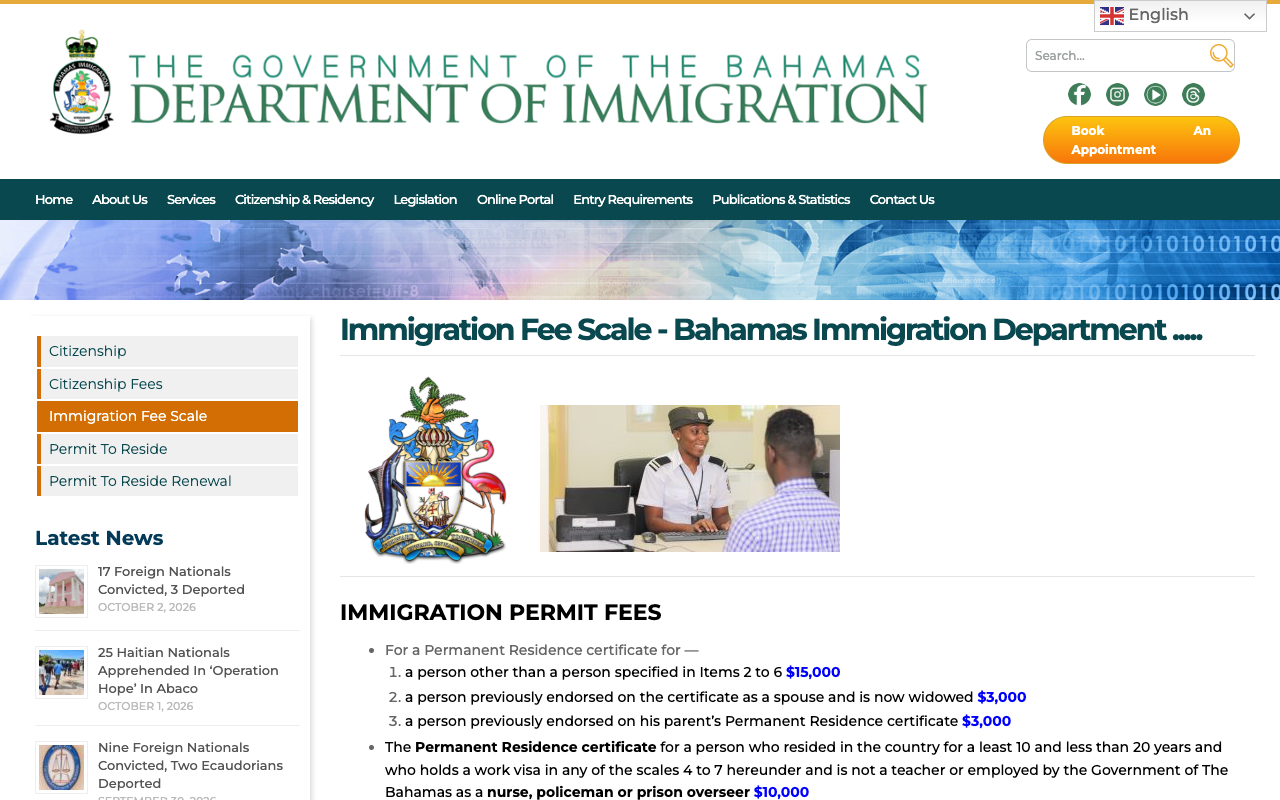
The certificate fee is the real price, and it has two tiers nobody publishes. The Department of Immigration's fee scale sets the economic permanent residence certificate under section 17A at $25,000 with the right to engage in a gainful occupation in your own business and $20,000 without it, plus a $200 processing fee. Every competing page we checked for this keyword gave the threshold and no fee at all.
Buying property triggers a tax the statute makes you prove you paid. Section 17A(1C)(a)(ii) requires an applicant investing in real property to submit evidence that VAT was paid on the conveyance. The supply of real property is charged at 10% above BSD 100,000, so a $1 million purchase carries roughly $100,000 of conveyance VAT — four times the certificate fee, and it is not recoverable.
The bond route sidesteps that entirely. A Central Bank Zero Coupon Bond purchase needs only a receipt for one million dollars, with no conveyance, no appraisal and no real property tax assessment number. On cash actually spent, bonds cost about $20,200 to $25,200 against roughly $120,200 to $125,200 for the property route.
A deed of gift does not count, and the fee has a ninety-day fuse. Section 17A(1B) excludes a Deed of Gift as a qualifying investment, and section 17A(1A) deems an application lapsed if the prescribed fee is unpaid within ninety days of submission, reinstatable only on a further fee.
On this page
Every figure below is tied to the instrument that states it, because the difficulty with this subject is not secrecy — the Department of Immigration publishes a full fee scale and the amending Bill is a public document — but that the pages ranking for this term stop at the $1 million headline. The amending Act is the source for the threshold, the holding period and the documents; the Department's fee scale for every amount you pay the government; and Deloitte's Bahamas Highlights 2026 for the tax treatment. This site's renderer does not emit heading anchors, so the list below is a map rather than jump links.
- What Bahamas residency by investment costs in 2026
- The fees the government actually charges
- The 10% conveyance VAT the Act makes you prove
- The bond route, and what it avoids
- What you pay every year you hold it
- The 1 July 2026 change aimed at foreign owners
- The ninety-day rule that lapses your application
- What to confirm before you commit
- Related guides on Domicila
What Bahamas residency by investment costs in 2026
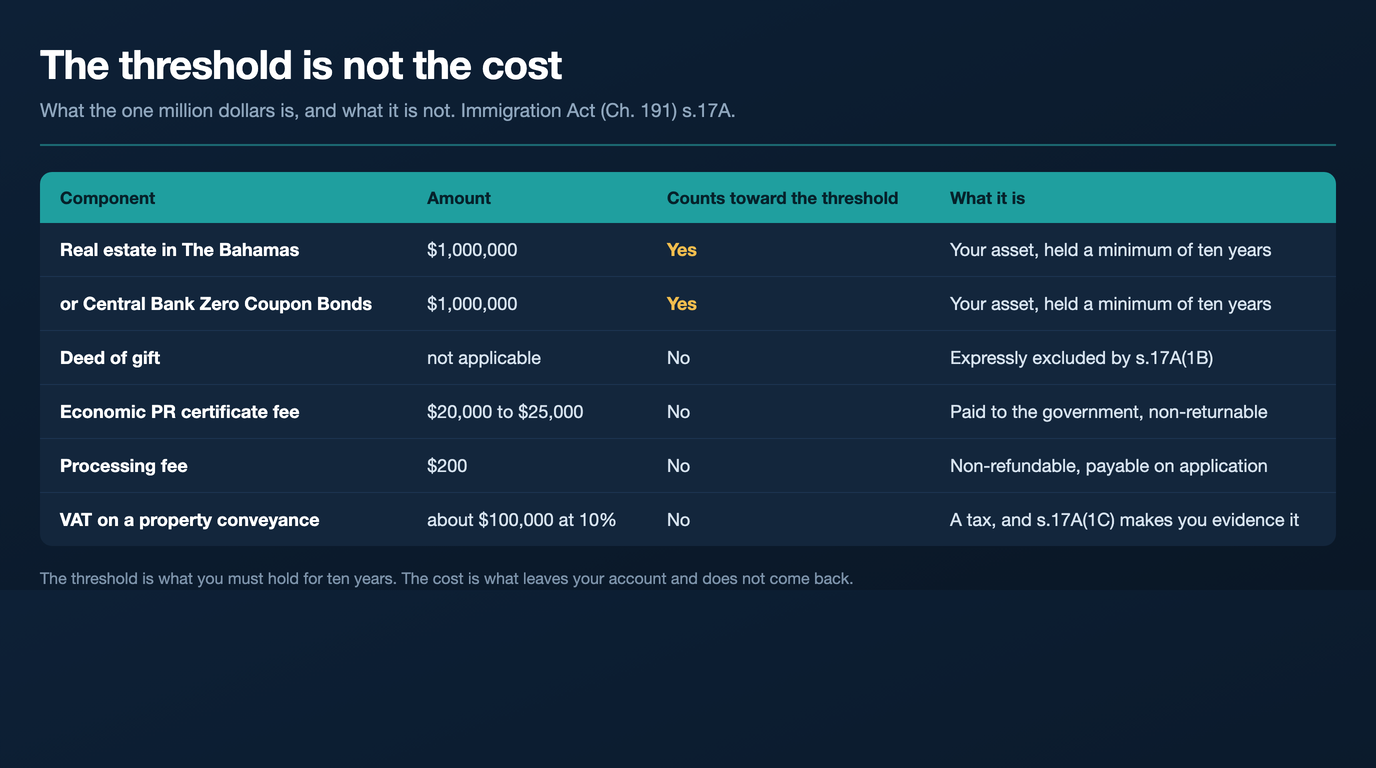
Start by separating two numbers that nearly every page on this subject runs together. The threshold is what you must put into a qualifying asset and keep there for ten years. The cost is what leaves your account and does not come back. The Bahamas has a high threshold and — on one of its two routes — a genuinely low cost, and that gap is the whole story.
The status is an economic permanent residence certificate under section 17A of the Immigration Act (Ch. 191). It is residence, not citizenship, and it is granted at the discretion of the Board. The qualifying investment was narrowed and raised by the Immigration (Amendment) Act 2024, which came into operation on 1 January 2025: before that the route turned on purchasing a residence or making investments of a kind prescribed by ministerial order, and the threshold stood at $750,000. The increase to $1 million was announced in the 2024-2025 Budget.
Here is what the one million dollars is, and what it is not:
| Component | Amount | Counts toward the threshold | What it is |
|---|---|---|---|
| Real estate in The Bahamas | $1,000,000 | Yes | Your asset, held a minimum of ten years |
| or Central Bank Zero Coupon Bonds | $1,000,000 | Yes | Your asset, held a minimum of ten years |
| Deed of gift | — | No | Expressly excluded by s.17A(1B) |
| Economic PR certificate fee | $20,000-$25,000 | No | Paid to the government, non-returnable |
| Processing fee | $200 | No | Non-refundable, payable on application |
| VAT on a property conveyance | ~$100,000 at 10% | No | A tax, and s.17A(1C) makes you evidence it |
The Bahamian dollar is pegged at par with the US dollar by the Central Bank of The Bahamas, so the Act's "one million dollars" and a US$1 million figure are the same money. That is worth stating because it is the one place this programme is simpler than its Caribbean neighbours, where thresholds are set in US dollars and paid in them. Our Caribbean citizenship by investment comparison sets out how differently those programmes price the same ambition.
The distinction between threshold and cost is the point: on the bond route you can satisfy a one-million-dollar requirement while spending about twenty thousand.
The fees the government actually charges
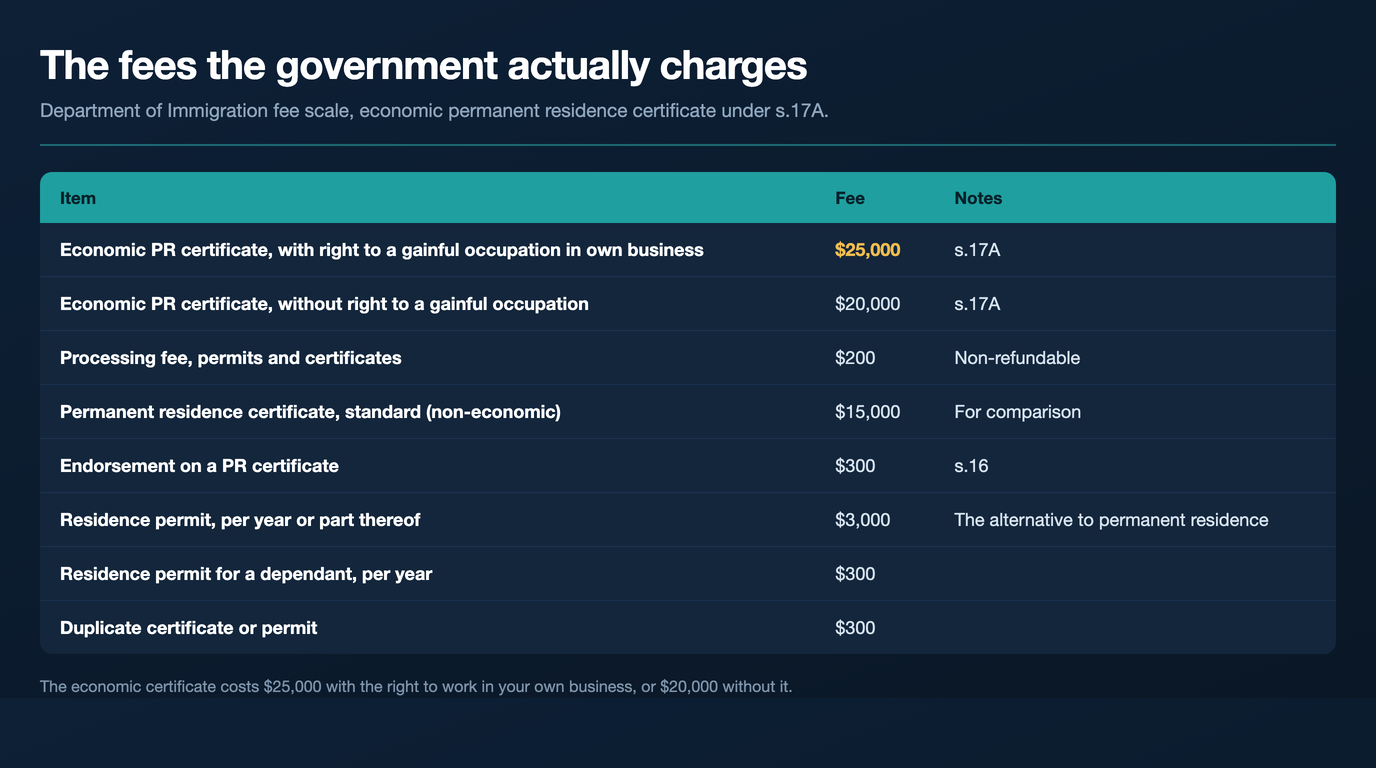
This is the part the market does not publish. The Department of Immigration maintains a public fee scale, and it prices the section 17A certificate in two tiers according to whether you want the right to work for yourself.
| Item | Fee | Notes |
|---|---|---|
| Economic PR certificate, with right to a gainful occupation in own business | $25,000 | s.17A |
| Economic PR certificate, without right to a gainful occupation | $20,000 | s.17A |
| Processing fee, permits and certificates | $200 | Non-refundable |
| Permanent residence certificate, standard (non-economic) | $15,000 | For comparison |
| Endorsement on a PR certificate | $300 | s.16 |
| Residence permit, per year or part thereof | $3,000 | The alternative to permanent residence |
| Residence permit for a dependant, per year | $300 | |
| Duplicate certificate or permit | $300 |
Two things stand out. The first is that $5,000 buys the right to run your own business, which is a remarkably cheap option on a $20,000 base and is never mentioned in the comparison pages. If there is any prospect of you working for yourself in The Bahamas, the higher tier is the one to take at the outset rather than seeking an endorsement later.
The second is that the annual residence permit at $3,000 a year is a real alternative, not a lesser version of the same thing. Seven years of it costs about what one certificate costs, with no million-dollar asset locked up for a decade. If the objective is to spend part of the year in The Bahamas rather than to hold permanent status, the permit is the cheaper instrument and the Act does not ask you to invest anything to get one.
The Department's permanent residence page also sets short shelf-lives on the supporting documents: a medical certificate no older than thirty days, a police certificate no older than six months covering five years of residence, and photographs taken within six months. None of it is expensive and all of it expires, which is how applications slip.
The 10% conveyance VAT the Act makes you prove
Here is the figure that changes the answer, and the one the ranking pages omit. If you qualify through real estate, section 17A(1C)(a) sets out six documents you must file with the Board, and the second of them is evidence that VAT was paid on the conveyance. The tax is not an incidental closing cost you might negotiate around; filing proof of it is a statutory condition of the application.
Deloitte's Bahamas Highlights 2026, updated January 2026, states the rates plainly: the standard rate of VAT is 10%, and the supply of real property is subject to VAT at 2.5% on transactions not exceeding BSD 100,000 and 10% on transactions over BSD 100,000. A qualifying purchase is a million dollars by definition, so it falls in the 10% band.
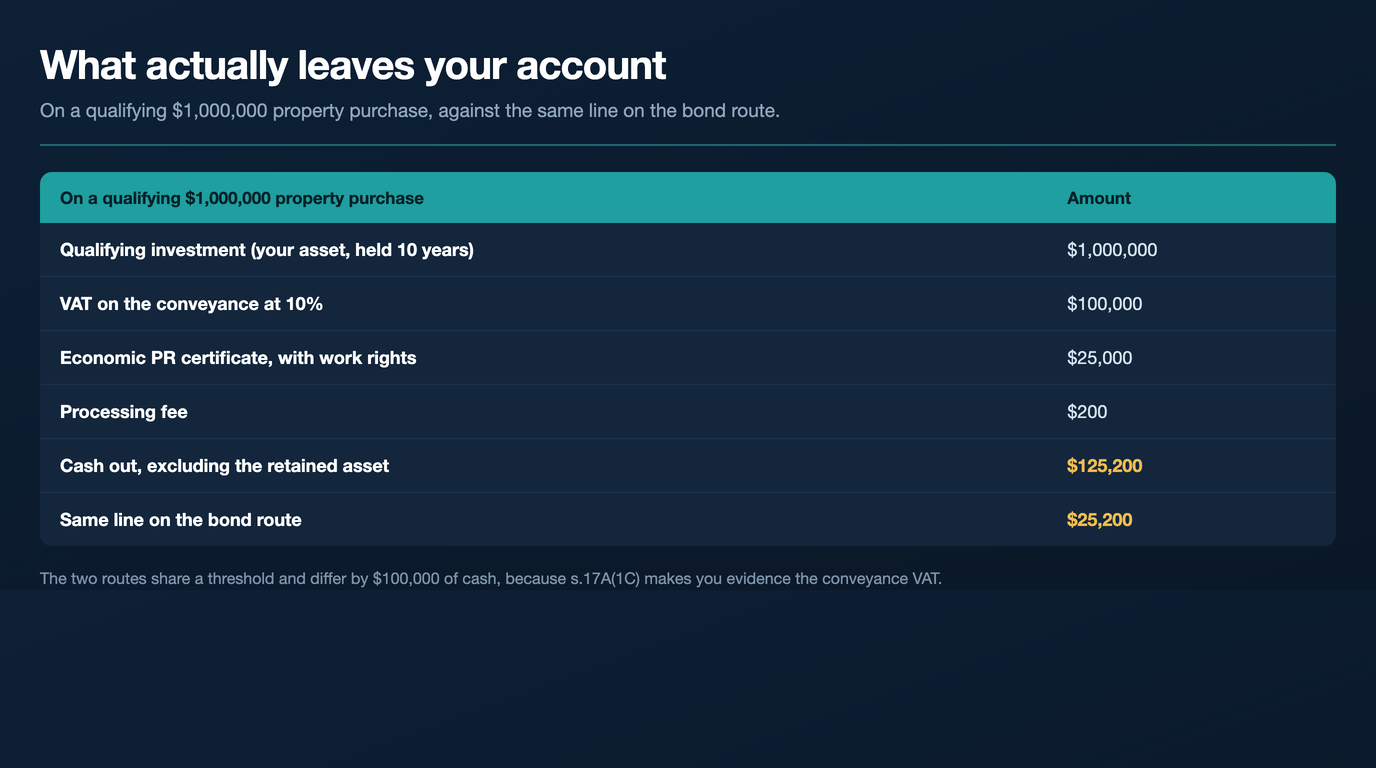
| On a qualifying $1,000,000 property purchase | Amount |
|---|---|
| Qualifying investment (your asset, held 10 years) | $1,000,000 |
| VAT on the conveyance at 10% | $100,000 |
| Economic PR certificate, with work rights | $25,000 |
| Processing fee | $200 |
| Cash out, excluding the retained asset | $125,200 |
| Same line on the bond route | $25,200 |
How that $100,000 is split between buyer and seller is a matter for the sales agreement rather than the Act, so treat the full amount as the transaction's exposure and negotiate from there. What you cannot do is avoid it and still file a complete application, because the evidence of payment is on the list.
The other five documents in section 17A(1C)(a) are the conveyance itself, the sales agreement, the real property tax assessment number, evidence that real property tax has been paid, and an appraisal by a licensed appraiser confirming the value of the property. That last one matters: the threshold is tested against a professional valuation, not against what you agreed to pay, so a purchase at exactly $1,000,000 leaves no margin if the appraiser comes in lower. Section 17A(1D) then prints the property's tax assessment number on the certificate itself, which ties your residence status to that specific property in a way the bond route does not.
The bond route, and what it avoids
The 2024 amendment added Zero Coupon Bonds issued by the Central Bank of The Bahamas as a qualifying investment, and on cost it is the clearly cheaper of the two routes. The documentary requirement is a single item: section 17A(1C)(b) asks for a receipt from the Central Bank of The Bahamas confirming purchase of Zero Coupon Bonds to the value of one million dollars.
Compare that with the property route's six documents and the difference is not just paperwork. No conveyance means no conveyance VAT — roughly $100,000 saved. No property means no real property tax assessment number, no annual property tax bill, no licensed appraisal and no exposure to a valuation coming in under the threshold. Nothing in the fee scale charges extra for the bond route.
Section 17A(9) states what the money is for: the proceeds are to be used for education, health, family island infrastructure, or youth and sports. So be clear-eyed about the instrument. A zero coupon bond pays no interest and returns its face value at maturity, and its discount, maturity and terms are set by the Central Bank rather than the Immigration Act, which promises no yield. Price those terms against what Bahamian property might do over the same decade before treating the $100,000 saving as free money.
Capital movements of this kind sit under exchange control. Deloitte notes that transactions subject to the foreign exchange rules must be approved by the Central Bank, other than specific capped amounts that authorised banks may handle, so confirm the mechanics of a non-resident bond purchase with the Central Bank before committing funds.
What you pay every year you hold it
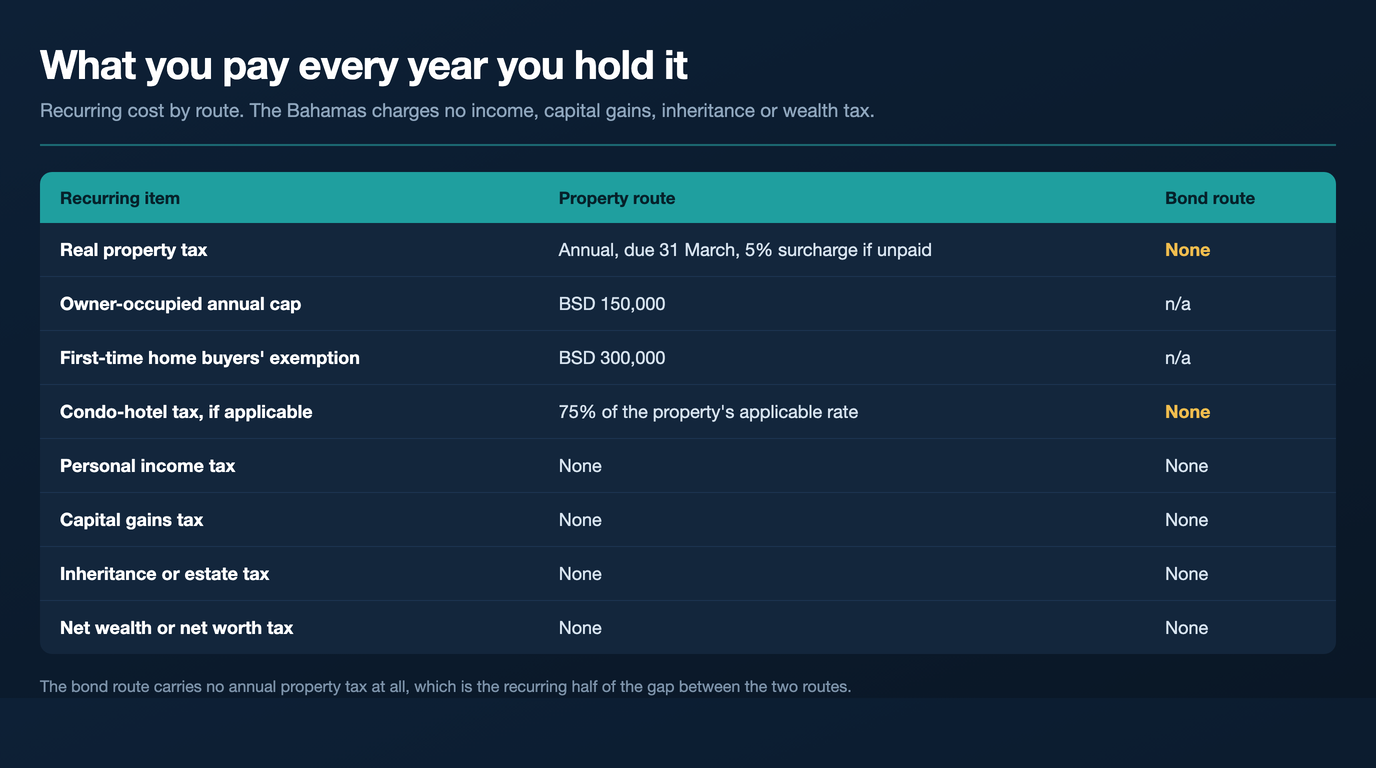
A ten-year holding requirement means the annual carrying cost matters as much as the entry cost, and this is where the property route keeps charging. Real property tax is annual, is payable by 31 March, and attracts a 5% surcharge if unpaid — and since section 17A(1C) requires evidence that real property tax has been paid, arrears are not merely a tax problem but an immigration one.
| Recurring item | Property route | Bond route |
|---|---|---|
| Real property tax | Annual, due 31 March, 5% surcharge if unpaid | None |
| Owner-occupied annual cap | BSD 150,000 | n/a |
| First-time home buyers' exemption | BSD 300,000 | n/a |
| Condo-hotel tax, if applicable | 75% of the property's applicable rate | None |
| Personal income tax | None | None |
| Capital gains tax | None | None |
| Inheritance or estate tax | None | None |
| Net wealth or net worth tax | None | None |
The exemptions and the cap come from Deloitte's 2026 highlights. We have deliberately not published a band-by-band rate schedule: the Department of Inland Revenue's real property tax pages confirm payment is required by law but do not publish the bands, and the secondary guides that do disagree with each other on both the bands and the ceiling. Rather than present one set as official, assume real property tax is a live annual cost on the property route and get the current assessment from the Department.
The zero-tax lines are the genuine draw and they are worth stating precisely. The Bahamas has no personal income tax, no capital gains tax, no inheritance or estate tax and no net wealth tax, and it has concluded no tax treaties — though tax information exchange agreements are in effect with more than thirty jurisdictions. None of that changes what your home country taxes you on, which is the question that actually decides whether this is worth doing.
The 1 July 2026 change aimed at foreign owners
The 2026-2027 Budget, delivered on 27 May 2026, created a separate real property tax class for foreign owner-occupied property, and it takes effect from 1 July 2026 under a Real Property Tax (Amendment) Bill tabled with the budget. The reported rate is 0.625% with an annual cap of $200,000, and the government forecast $24 million of revenue from the new class in the budget year.
Two features of it matter to anyone holding Bahamian property for a residence certificate. The first is that qualification moves away from a day-count: the test becomes whether the property is used as a residence rather than whether the owner spends a set number of days in the country. The second is that it is a distinct class for foreign owners, which is precisely the position an economic permanent residence holder is in.
We are flagging rather than pricing this one, because the sources conflict on the base: some reporting applies the 0.625% to value up to US$1 million, other reporting to full assessed value. On a million-dollar property the gap is small, but it is the difference between a known number and a guess. Treat $6,250 a year as the order of magnitude and get the assessment in writing.
This is also a reminder that the carrying cost of this route is subject to change across a ten-year hold in a way the certificate fee is not. If you want a programme whose annual obligations are fixed at the outset, the Cayman Islands residency by investment cost page covers the nearest alternative that works that way.
The ninety-day rule that lapses your application
One provision in the 2024 amendment deserves its own section because it converts an administrative slip into a repeat payment. Section 17A(1A) provides that where an applicant fails to pay the prescribed fee within ninety days from the submission of the application, the application shall be deemed to have lapsed, and may be reinstated only on payment of a reinstatement fee.
Read that against the sequence. You submit, the Board considers, and the certificate fee — $20,000 or $25,000 — becomes payable. Ninety days is not long for a decision to work its way through a board, a bank transfer to clear across exchange control, and an applicant who may not be in the country. The amount at risk is a reinstatement fee the published scale does not quantify, which is itself a reason to ask what it is before you file rather than after the clock has run.
The practical answer is to have the certificate fee liquid and locally payable before submitting, not to arrange it once approval arrives. Our guide to citizenship by investment processing time makes the same point about programmes where the government's clock and the applicant's clock run independently.
What to confirm before you commit
It is worth being explicit about which figures here are settled and which are not. The threshold, the ten-year hold, the two qualifying assets, the exclusion of a deed of gift, the ninety-day fee rule and the six documents are all in the amending instrument; the certificate and processing fees are on the Department's published scale; the VAT bands and the absent taxes are in Deloitte's 2026 highlights.
What is not settled: the real property tax rate bands, the base of the new foreign owner-occupied class, the amount of the reinstatement fee, and the terms of the Central Bank's zero coupon bonds. Put those four in writing before money moves — to the Department of Inland Revenue, the Department of Immigration and the Central Bank respectively.
A last point on what this status is. An economic permanent residence certificate grants residence. It is not citizenship, nothing in the fee scale or the amending Act promises a passport, and the Board's decision is discretionary. Naturalisation in The Bahamas is a separate statutory process with its own residence requirements, and anyone whose actual objective is a second passport should compare the cost of this route against programmes designed to deliver one — our cheapest citizenship by investment page prices that market directly. Confirm your own position with a qualified Bahamian attorney before relying on any figure here.
Related guides on Domicila
- Cayman Islands residency by investment cost — the nearest Caribbean comparison, and the one whose annual obligations are fixed rather than assessed.
- Caribbean citizenship by investment comparison — what the neighbouring programmes charge to deliver a passport instead of a permit.
- Cheapest citizenship by investment — the low end of the passport market, ranked on money you never get back.
- Hong Kong investment visa cost — the other major route where the headline figure is a holding requirement, not a payment.
- Golden visa cost comparison — every residence threshold in the currency it is actually set in, with the date each was read.
- Citizenship by investment vs golden visa — why a residence certificate and a passport are priced so differently.
Common questions
How much does Bahamas residency by investment cost in 2026?
The qualifying investment is one million dollars held for at least ten years, in Bahamian real estate or in Central Bank Zero Coupon Bonds, and you keep that asset. The money you actually spend is the economic permanent residence certificate fee of $25,000 with the right to work in your own business or $20,000 without, plus a $200 processing fee. On the property route you should also budget roughly $100,000 of VAT on the conveyance, because the supply of real property is taxed at 10% above BSD 100,000.
Is the $1 million a payment or an investment you keep?
It is an investment you keep. Section 17A(1)(a) of the Immigration Act requires an investment of one million dollars for a minimum period of ten years in real estate in The Bahamas or in Zero Coupon Bonds issued by the Central Bank. Unlike a Caribbean citizenship contribution, it is not a donation to the government, though the ten-year hold means the capital is committed.
Which is cheaper, the property route or the Central Bank bonds?
The bonds, by roughly $100,000. A property purchase at the threshold attracts VAT on the conveyance at 10%, and section 17A(1C) requires you to file evidence that the VAT was paid, so it cannot be avoided. The bond route needs only a Central Bank receipt for one million dollars, with no conveyance, no appraisal and no annual real property tax. Weigh that saving against the bonds' actual terms, which the Central Bank sets.
When did the Bahamas threshold rise from $750,000 to $1 million?
The increase was announced in the 2024-2025 Budget and took legal effect with the Immigration (Amendment) Act 2024, which came into operation on 1 January 2025. The same amendment narrowed the qualifying investments to Bahamian real estate or Central Bank Zero Coupon Bonds and excluded a deed of gift. Guides still quoting $750,000 are describing the pre-2025 regime.
Does Bahamas permanent residence let me work?
Only if you pay for that tier. The Department of Immigration's fee scale prices an economic permanent residence certificate at $25,000 with the right to engage in a gainful occupation in your own business and $20,000 without it. If self-employment in The Bahamas is a realistic prospect, the $5,000 difference is cheap at the outset compared with seeking an endorsement later.
Does the Bahamas tax my income or capital gains?
The Bahamas has no personal income tax, no capital gains tax, no inheritance or estate tax and no net wealth tax, and it has concluded no tax treaties, though tax information exchange agreements are in effect with more than thirty jurisdictions. None of that affects what your country of citizenship or tax residence taxes you on, which is a separate question to take to your own adviser.
What happens if I miss the ninety-day fee deadline?
Your application lapses. Section 17A(1A) of the Immigration Act provides that where the prescribed fee is not paid within ninety days from the submission of the application, the application is deemed to have lapsed and may be reinstated on payment of a reinstatement fee. The published fee scale does not state that reinstatement amount, so ask the Department what it is before filing and have the certificate fee liquid in advance.
Does a Bahamas residence certificate lead to a passport?
Not automatically and not as part of this route. An economic permanent residence certificate grants residence, the Board's decision is discretionary, and nothing in the amending Act or the fee scale promises a nationality outcome. Naturalisation is a separate statutory process with its own residence requirements. Confirm your own position with a qualified Bahamian attorney.
Official sources to verify
- Permanent Residence, including the economic (investment) categoryDepartment of Immigration, The Bahamas
- Immigration fee scale (economic permanent residence certificate, s.17A)Department of Immigration, The Bahamas
- Immigration (Amendment) Bill, 2024 — amendment of section 17A, in operation 1 January 2025Office of the Attorney-General and Ministry of Legal Affairs, The Bahamas
- Home Owner Resident PermitDepartment of Immigration, The Bahamas
- Real Property TaxDepartment of Inland Revenue, The Bahamas
- Bahamas Highlights 2026 (VAT on real property, real property tax, absent taxes), updated January 2026Deloitte
- Central Bank of The Bahamas (Zero Coupon Bonds issuer and exchange control authority)Central Bank of The Bahamas
- 2026-2027 Budget: new foreign owner-occupied real property tax class from 1 July 2026The Tribune (Nassau)
- Investment of $1m needed for economic permanent residenceThe Tribune (Nassau)
Compare golden visa advisors
Ask for a route-specific quote that separates investment amount, government fees, legal work, fund or property costs, and renewal obligations.
We may earn a referral fee if you choose an advisor through this site. We still aim to show cost ranges, caveats, and official source links plainly.