colombia golden visa cost
Colombia Golden Visa Cost 2026: $184k or $342k
Almost every page ranking for the Colombia golden visa cost quotes US$140,000 for the property route and US$40,000 for the company one. Both are last year's numbers. Colombia does not write its investment thresholds in dollars or even in pesos — it writes them in multiples of the monthly minimum wage, and that wage rose 23 per cent on 1 January 2026 while the peso strengthened by eleven per cent. The same unchanged rule now costs 38 per cent more in dollars than it did twelve months ago. We read article 79 of Resolución 5477 de 2022 in the Foreign Ministry's own normogram, the 2026 fee schedule in Resolución 3969 de 2026, the minimum-wage decrees, the Migración Colombia tariff resolution and the nationality act that replaced the one most of these pages still cite, and priced all of it at the Banco de la República's official rate for 19 November 2026.

Key takeaways
- Colombia has no golden visa. What exists is the Visa M Inversionista under article 79 of Resolución 5477 de 2022, granted for up to three years to a foreigner holding registered foreign direct investment or property in their own name.
- The thresholds are 650 and 350 minimum wages, not dollar amounts. At the 2026 monthly minimum wage of COP 1,750,905 that is COP 1,138,088,250 for the investment route and COP 612,816,750 for property — US$342,081 and US$184,197 at the Banco de la República rate of 3,326.96 on 19 November 2026.
- That is 38 per cent more in dollars than a year ago, and the rule never changed. The minimum wage rose 23 per cent on 1 January 2026 and the peso gained about eleven per cent against the dollar over the same period.
- The cheap route is article 75, not article 79. A Visa M Socio o Propietario needs 100 minimum wages — COP 175,090,500, about US$52,628 — in a Colombian company, and it accumulates toward permanent residence on exactly the same five-year clock.
- Government fees are trivial and the passport is far off. A Visa M costs US$260 in two stages plus COP 294,000 for the foreigner ID card. But article 9 of Ley 2332 de 2023 counts the five years to naturalisation from the day the resident visa is issued, so the realistic clock is ten years, not five.
On this page
Every figure below is tied to the instrument that states it and priced on one named day at one named rate, because that is the whole difficulty with this programme: the rule is stable and the price is not. Where the ranking pages disagree with the Foreign Ministry we say so rather than split the difference. This site's renderer does not emit heading anchors, so the list below is a map rather than jump links.
- Colombia has no golden visa, and the label hides which article you are using
- The two thresholds, priced at today's official rate
- Why the dollar price rose 38 per cent in twelve months
- The cheaper route almost nobody prices: 100 minimum wages
- The fees are US$260, and some nationalities pay less than that
- The 180-day rule is not a stay requirement
- Five years to residence, ten to a passport
- The threshold is before the courts, and that is a real risk
- What to confirm before you wire anything
Colombia has no golden visa, and the label hides which article you are using
No Colombian statute or resolution uses the phrase golden visa. The instrument is the Migrant (M) visa, and the Foreign Ministry's Resolución 5477 de 2022 creates several categories of it that an investor might qualify for. Two matter here, and they sit sixty pages and roughly US$290,000 apart.
This is not pedantry, because the categories carry different thresholds, different evidence and different names on the sticker. Pages that advertise an "M-10" or "M-6" visa are using labels that appear nowhere in the resolution; the official names are Visa M Inversionista and Visa M Socio o Propietario. If an adviser cannot tell you the article number they are filing under, they have not told you the price.
| Visa M Inversionista (art. 79) | Visa M Socio o Propietario (art. 75) | |
|---|---|---|
| Qualifying act | Registered foreign direct investment, or property held solely in your own name | Incorporating a Colombian company, or buying into the paid-in capital of a working one |
| Threshold | 650 minimum wages (FDI) or 350 (property) | 100 minimum wages |
| Validity | Up to 3 years | Up to 3 years |
| Work permit | Not an open permit | Limited to the company you own a stake in |
| Counts toward residence | Yes — 5 years (art. 90) | Yes — 5 years (art. 90) |
| Evidence | Banco de la República investment registration; for property, a Certificado de Tradición y Libertad | Paid-in capital certificate signed by a public accountant |
Both categories accumulate time toward the Resident (R) visa under article 90, which was rewritten by Resolución 10434 de 2023 and now lists five years against each of them. That equivalence is the single most useful fact on this page, and we come back to it below, because it means the expensive route buys no speed at all. If you are still deciding whether a residence permit is even the right shape of thing to buy, citizenship by investment versus a golden visa is the comparison to start from.
The two thresholds, priced at today's official rate
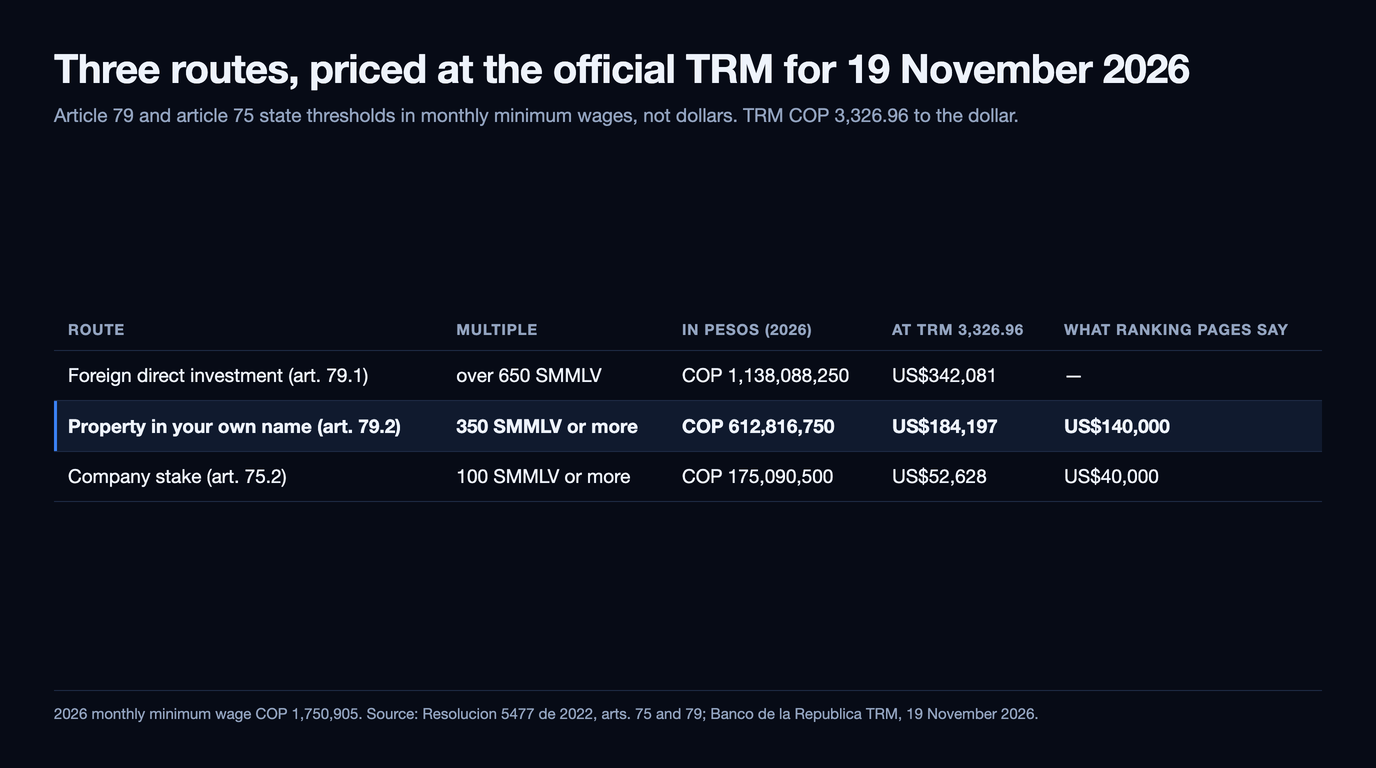
Article 79 states the Colombia golden visa cost in multiples of the salario mínimo mensual legal vigente, the monthly minimum wage. For foreign direct investment the registered amount must be more than 650 of them; for property the title must show a value of at least 350. The 2026 wage is COP 1,750,905, fixed by Decreto 1469 de 2025 of 29 December 2025.
Converting those needs a rate and a date, and Colombia publishes an official one: the Tasa de Cambio Representativa del Mercado, which for 19 November 2026 is COP 3,326.96 to the dollar. Everything below is that single rate, applied on that single day.
| Route | Multiple | In pesos (2026) | At TRM 3,326.96 | What the ranking pages say |
|---|---|---|---|---|
| Foreign direct investment (art. 79.1) | > 650 SMMLV | COP 1,138,088,250 | US$342,081 | — |
| Property in your own name (art. 79.2) | >= 350 SMMLV | COP 612,816,750 | US$184,197 | US$140,000 |
| Company stake (art. 75.2) | >= 100 SMMLV | COP 175,090,500 | US$52,628 | US$40,000 |
The property gap is the one that will cost somebody a trip. A reader who budgets the widely published US$140,000, flies to Medellín and signs on an apartment at that price has bought a flat and not a visa: they are US$44,197 short of the title value article 79 requires, and the Certificado de Tradición y Libertad they file will say so.
Two conditions on the property route are worth stating because they are routinely dropped. The title must be exclusively in the applicant's name, so a couple cannot pool one purchase to clear 350 wages between them, and the Banco de la República registration of the inbound funds has to exist as well as the deed. Capital you already hold inside Colombia does not support the application.
Why the dollar price rose 38 per cent in twelve months
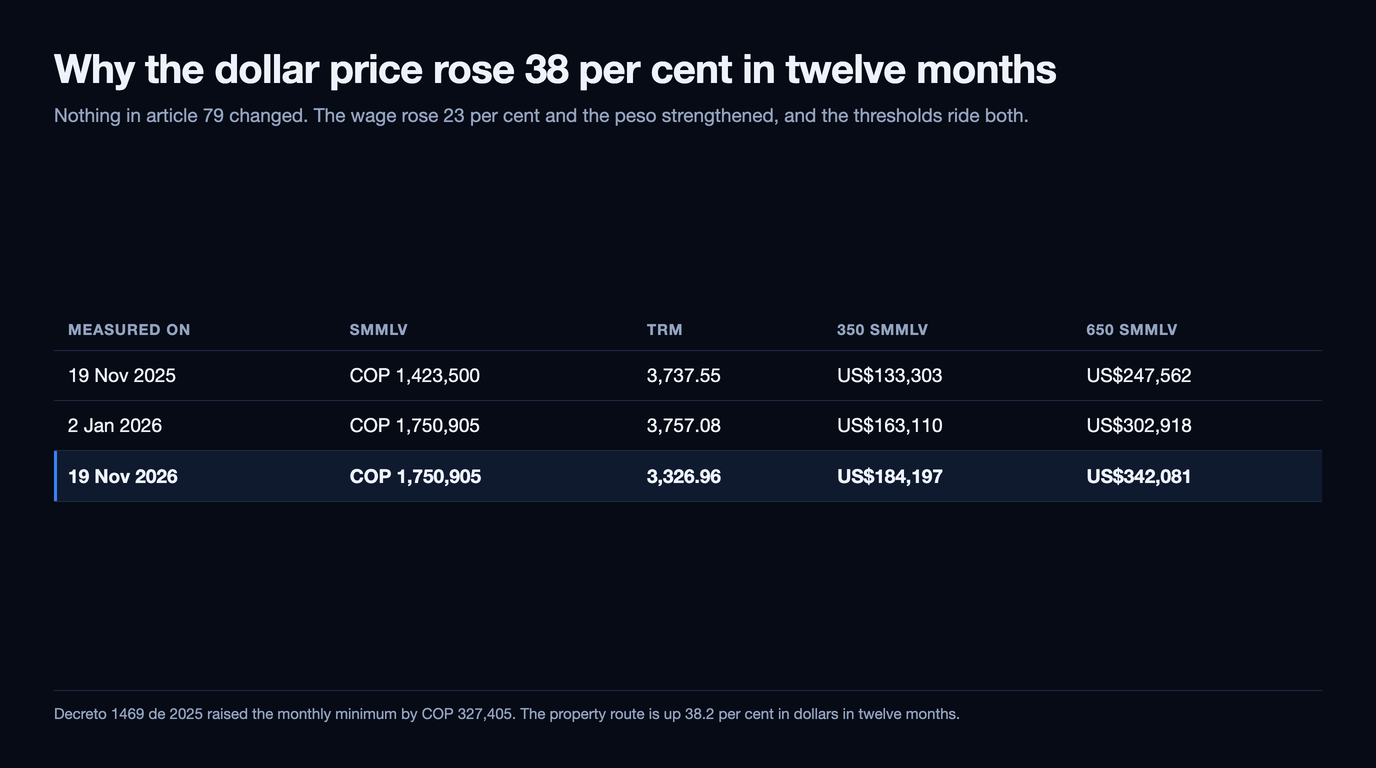
Nothing in article 79 changed during 2026. The dollar figure moved anyway, and it moved a long way, because two things happened at once.
The first is the wage. Decreto 1469 de 2025 raised the monthly minimum from COP 1,423,500 to COP 1,750,905 — an increase of 23 per cent, or COP 327,405, which the decree's own recitals describe as a measure to close a material-sufficiency gap. Every threshold in the visa resolution is a multiple of that number, so every threshold rose 23 per cent on 1 January 2026 without anyone amending a visa rule.
The second is the peso. The TRM was COP 3,737.55 on 19 November 2025 and COP 3,757.08 on 2 January 2026; it is COP 3,326.96 today. A stronger peso makes a peso-denominated threshold more expensive in dollars, and the two effects compound.
| Measured on | SMMLV | TRM | 350 SMMLV | 650 SMMLV |
|---|---|---|---|---|
| 19 Nov 2025 | COP 1,423,500 | 3,737.55 | US$133,303 | US$247,562 |
| 2 Jan 2026 | COP 1,750,905 | 3,757.08 | US$163,110 | US$302,918 |
| 19 Nov 2026 | COP 1,750,905 | 3,326.96 | US$184,197 | US$342,081 |
So the property route is up 38.2 per cent in dollars in twelve months, and so is every other multiple, because they all ride the same two numbers. The practical lesson is narrow and important: a dollar price for a Colombian visa is only true on the day it was calculated, and a page that gives you one without naming a wage, a rate and a date is not giving you a price at all. It is the same trap we flagged on Brazil, where the threshold is in reais and the published dollar figures were converted at a rate nobody dated.
The cheaper route almost nobody prices: 100 minimum wages
Article 75 is the most under-covered thing in Colombian investment migration. A Visa M Socio o Propietario goes to a foreigner who has incorporated a Colombian company or bought into the paid-in capital of a working one, and the threshold is 100 minimum wages — COP 175,090,500, about US$52,628. That is a sixth of the foreign-direct-investment route and under a third of the property one.
What makes it interesting is article 90. Both categories are listed there at five years toward the Resident visa, so the expensive route buys no speed. On the published rules, US$52,628 into a company and US$342,081 of registered FDI reach permanent residence on the same day.
| Art. 75 company route | Art. 79 property route | Art. 79 FDI route | |
|---|---|---|---|
| Cost today | US$52,628 | US$184,197 | US$342,081 |
| Years to the R visa | 5 | 5 | 5 |
| Asset you end up holding | Equity in a Colombian company you run | A Colombian apartment | Whatever the registered investment is |
| Ongoing proof | Trading activity and solvency, from the second visa on | The investment maintained through each visa term | The investment maintained through each visa term |
| Work rights | Only in your own company | Not an open permit | Not an open permit |
The trade-offs are real and they are operational rather than financial. From the second visa onward article 75 asks you to show the company is actually trading — bank statements, a tax return, social-security contributions, a lease, industry-and-commerce tax receipts — so this is a route for someone running a business, not parking money. And its work permit is confined to that company. Against the global floor, both figures still look modest; see the cheapest golden visa routes for where US$52,628 actually sits.
The fees are US$260, and some nationalities pay less than that
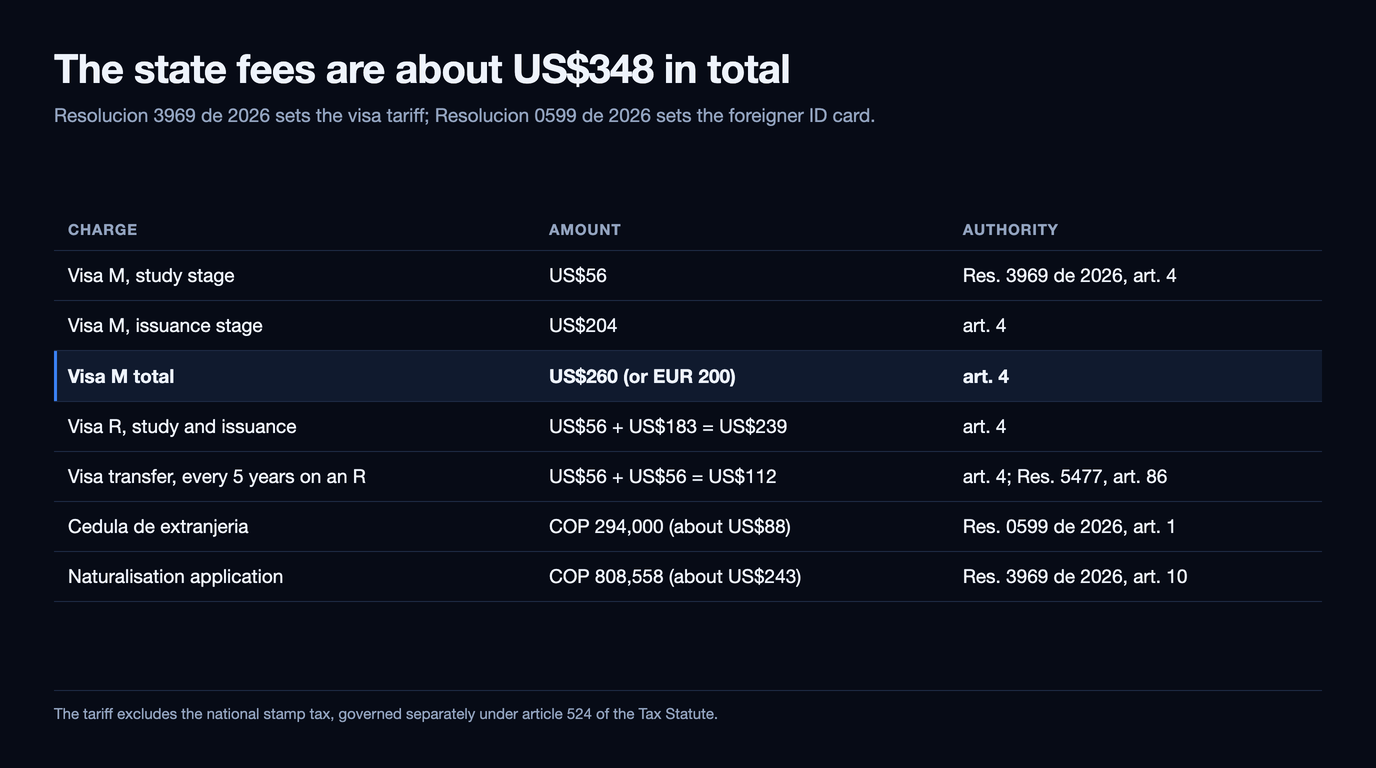
The visa fee schedule is Resolución 3969 de 2026, published on 31 March 2026, and it replaced the 2023 schedule most comparison pages are still quoting. Every Colombian visa is paid in two stages: a study fee when you file, which is non-refundable and does not commit the ministry to anything, and an issuance fee only if the visa is granted.
| Charge | Amount | Authority |
|---|---|---|
| Visa M — study stage | US$56 | Res. 3969 de 2026, art. 4 |
| Visa M — issuance stage | US$204 | art. 4 |
| Visa M total | US$260 (or EUR 200) | art. 4 |
| Visa R — study + issuance | US$56 + US$183 = US$239 | art. 4 |
| Visa transfer, every 5 years on an R | US$56 + US$56 = US$112 | art. 4; Res. 5477, art. 86 |
| Cédula de extranjería | COP 294,000 (~US$88) | Res. 0599 de 2026, art. 1 |
| Naturalisation application | COP 808,558 (~US$243) | Res. 3969 de 2026, art. 10 |
So the whole state cost of getting onto this programme is about US$348 — US$260 for the visa and COP 294,000 for the foreigner ID card that Migración Colombia issues once you hold a visa. Against a US$184,197 property threshold that is noise, which is exactly why it is worth saying out loud: on this programme, unlike the Caribbean ones in our golden visa cost comparison, essentially none of your money goes to the government and all of it stays in an asset you own.
Two things the fee table does not include. Article 4's closing paragraph says the tariff excludes the national stamp tax, which is governed separately under article 524 of the Tax Statute and is not published in this resolution — so a quote slightly above US$260 is not necessarily wrong. And the exemptions in article 4.1 are unusually generous: Spanish nationals pay nothing at either stage, and nationals of Japan and South Korea pay the study stage only, which makes a Colombian investor visa free of government fees for a Spaniard and US$56 for a Japanese or Korean applicant.
The 180-day rule is not a stay requirement
This is the most commonly inverted fact on the topic, and the inversion costs people months. Several ranking pages say an investor must spend six months a year in Colombia to keep the visa. The rule says close to the opposite.
Article 65 of Resolución 5477 de 2022 provides that Migrant (M) visas whose holders are absent from the country for more than 180 continuous calendar days, within each 365 days counted from the issue of the visa, lose their validity automatically. Note each of those words. The period is continuous, so twenty separate trips totalling eight months abroad do not trigger it. The loss is automatic, so no official decides it and no notice arrives. And it is framed as a ceiling on absence, not a floor on presence: there is no minimum number of days you must spend in Colombia to hold a Visa M Inversionista.
The practical effect is that the obligation is light but unforgiving. Someone who treats the visa as a document and goes home for seven straight months has no visa at the end of it, whatever the investment is doing, and the resolution adds that the absence is counted from the departure stamp or Migración Colombia's own movement records. The Resident visa is looser again — article 88 ends an R visa only after two consecutive years outside Colombia.
There is a separate 183-day test that has nothing to do with immigration and catches people anyway: Colombian tax residence. Immigration and tax are different authorities applying different counters, and the one that costs money is usually the second. That is the question we would take to Soveraine before the visa question, not after it.
Five years to residence, ten to a passport
Here is where the published guidance is weakest, because the law changed and most pages did not. Ley 43 de 1993, cited for the citizenship timeline on page after page, was repealed by article 54 of Ley 2332 de 2023. Applications paid up to 24 September 2023 still run under the old act; everything since is governed by the new one.
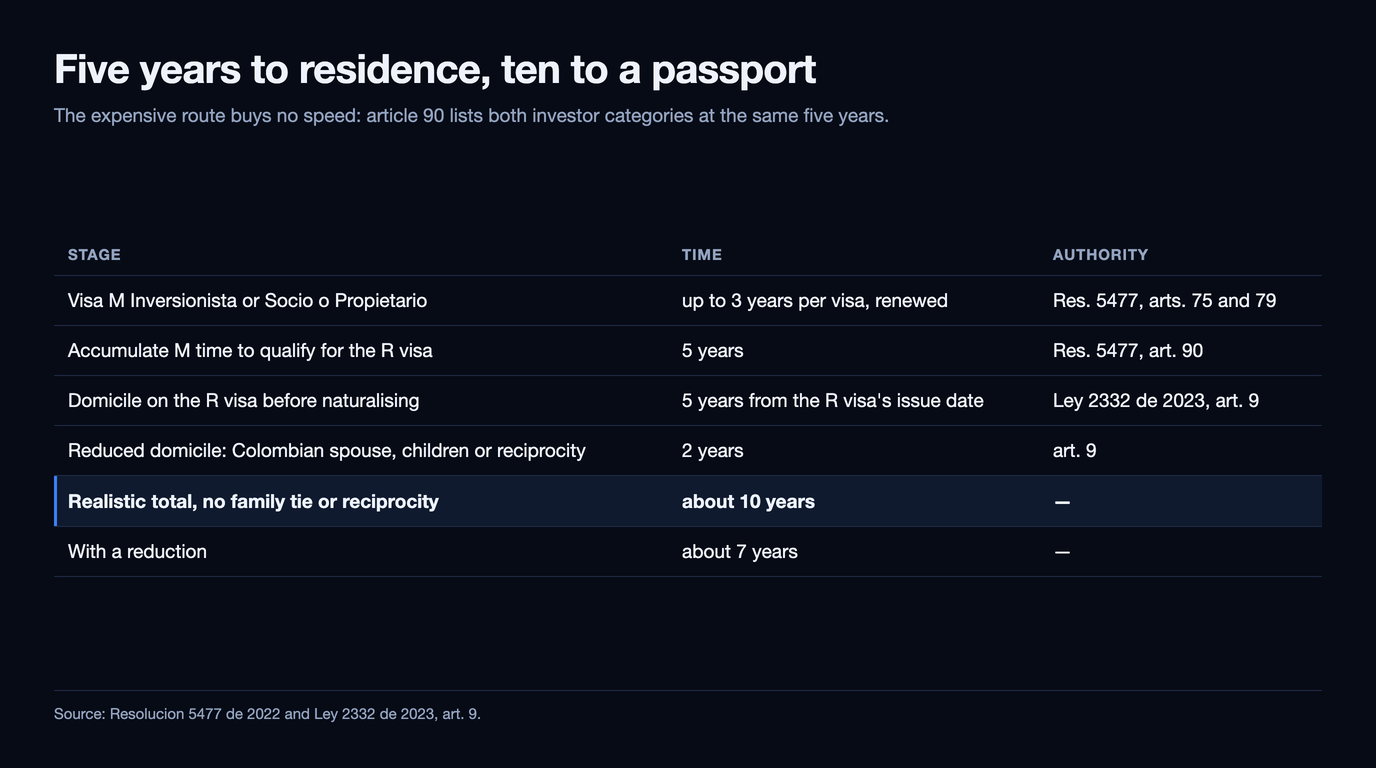
Article 9 of Ley 2332 de 2023 sets two requirements that interact badly with an investor's assumptions. The applicant must hold a Resident (R) visa when applying and throughout, and must show five continuous years of domicile immediately before applying — and the article states that this period is counted from the date the resident visa was issued. Time spent on the Migrant visa does not count toward it.
| Stage | Time | Authority |
|---|---|---|
| Visa M Inversionista or Socio o Propietario | up to 3 years per visa, renewed | Res. 5477, arts. 75 and 79 |
| Accumulate M time to qualify for the R visa | 5 years | Res. 5477, art. 90 |
| Domicile on the R visa before naturalising | 5 years from the R visa's issue date | Ley 2332 de 2023, art. 9 |
| Reduced domicile: Colombian spouse or partner, Colombian children, or verified reciprocity | 2 years | art. 9 |
| Realistic total, no family tie or reciprocity | ~10 years | — |
| With a reduction | ~7 years | — |
So a claim that this route reaches a Colombian passport in five years is reading article 90 and stopping. Five years is the wait for permanent residence; the naturalisation clock starts there. The reduction to two years is genuinely valuable and worth checking early, because "verified reciprocal treatment by the state of origin" is a bilateral question that depends on your own nationality, not on anything you do in Colombia.
Two more conditions in article 9 catch investors. Leaving Colombia for a year or more in the period before applying interrupts the domicile count outright. And unless you completed secondary or university study in Colombia, you sit knowledge examinations administered through the governor's office of your domicile. Naturalisation also remains a discretionary act, so meeting every requirement is not the same as being granted.
The threshold is before the courts, and that is a real risk
One thing no page on this topic mentions, and it belongs in a cost guide: the number every Colombian visa threshold is built from is currently the subject of litigation.
Decreto 1469 de 2025 set the 2026 minimum wage at COP 1,750,905 on 29 December 2025. The Consejo de Estado then ordered its provisional suspension, and the government issued Decreto 0159 de 2026 on 19 February 2026, published in Diario Oficial 53.403, which fixes the 2026 minimum wage transitorily at the same COP 1,750,905. Its article 2 states that it stays in force until judgment is given in nullity proceedings 11001-03-25-000-2026-00004-00, and the compiled text carries a note recording that the decree served its purpose once the suspension of Decreto 1469 was lifted.
The reassuring half: the amount is identical under both decrees, so nothing on this page changes depending on which one you read it against, and the thresholds above are correct today either way.
The honest half: a 23 per cent increase is being tested in court, and the visa thresholds are a multiple of whatever survives. We are not going to predict a Consejo de Estado ruling, and nobody selling you a Colombian visa should either. What follows from it is procedural and worth acting on — article 79 fixes the threshold at the date the application is presented, so what matters to you is the wage in force on your filing date, not today's. If you are filing near a January, the wage changes on the first of the month and your threshold changes with it.
What to confirm before you wire anything
Seven questions, in this order, and all of them before money leaves your account.
- Which article am I filing under? Article 79 for investment or property, article 75 for a company stake. They differ by roughly US$290,000 and by what you have to prove every three years.
- What is the minimum wage on my filing date, and what is the TRM that day? Both thresholds are a multiple of the first, and your dollar budget depends on the second. Price it on the day from the Banco de la República's published rate.
- Is the title exclusively in my name? Article 79.2 requires sole ownership of property worth at least 350 wages. Two people cannot combine one purchase to clear it.
- Is my money arriving from abroad and registered with the Banco de la República? The registration certificate from the Departamento de Cambios Internacionales is a document the application asks for, not a formality you arrange later.
- Can I avoid leaving Colombia for 180 straight days? That, and not a residence quota, is what ends a Visa M under article 65 — automatically, with no notice.
- Does my nationality get a fee exemption or a shorter naturalisation clock? Spain, Japan and South Korea have fee treatment under article 4.1, and the two-year domicile reduction in article 9 of Ley 2332 de 2023 turns on reciprocity.
- What does leaving my current country cost? Exit charges, deemed disposals and tax-residence tests at the other end routinely dwarf everything on this page and appear in no Colombian fee schedule.
Everything here describes Resolución 5477 de 2022 as compiled in the Foreign Ministry's normogram, Resolución 3969 de 2026, Resolución 0599 de 2026 of Migración Colombia, Decretos 1469 de 2025 and 0159 de 2026 and Ley 2332 de 2023, all read on 19 November 2026, with pesos converted at the official TRM of 3,326.96 for that date. It is not legal, tax or immigration advice, and nothing here promises that any application will be granted — visas and naturalisation are both discretionary decisions of the Colombian state. Take Colombian professional advice before you act.
Related guides on Domicila
If Colombia is on your list, these are the comparisons that answer the question it raises next:
- Golden visa cost comparison — every major route priced side by side, so US$184,197 has something to sit against.
- Brazil golden visa cost — the closest regional comparison, and the other programme whose threshold is in local currency.
- Argentina citizenship by investment cost — the third large South American option, with a far shorter naturalisation clock.
- Panama golden visa cost — the usual alternative for anyone who wanted Colombia for the time zone rather than the country.
- Cheapest golden visa — where the 100-minimum-wage company route sits against the global floor.
- Golden visa countries — the full list, including the routes that reach a passport in far less than ten years.
Common questions
Does Colombia have a golden visa in 2026?
Not under that name. No Colombian statute or resolution uses the phrase. What exists is the Migrant (M) visa, and the two categories an investor normally uses are the Visa M Inversionista under article 79 of Resolución 5477 de 2022 and the Visa M Socio o Propietario under article 75. Both are granted for up to three years at a time.
What is the Colombia golden visa cost in 2026?
Article 79 requires registered foreign direct investment of more than 650 monthly minimum wages, or property held in your own name worth at least 350. With the 2026 minimum wage at COP 1,750,905 that is COP 1,138,088,250 and COP 612,816,750, which at the official rate of 3,326.96 on 19 November 2026 is about US$342,081 and US$184,197. It is capital you continue to own, not a fee.
Why do other sites say the Colombian property route costs US$140,000?
Because they converted 350 minimum wages using the 2025 wage of COP 1,423,500 and an undated exchange rate. The wage rose 23 per cent on 1 January 2026 under Decreto 1469 de 2025 and the peso has strengthened since, so the same unchanged rule now costs about US$184,197. The threshold in pesos is what the resolution states; the dollar figure is only true on the day it was calculated.
What is the cheapest investor visa for Colombia?
The Visa M Socio o Propietario under article 75 of Resolución 5477 de 2022, which requires 100 minimum wages in a Colombian company — COP 175,090,500, about US$52,628 in November 2026. Article 90 lists it at five years toward the Resident visa, the same as the investor categories, so it is not a slower route. From the second visa onward you must show the company is genuinely trading.
How many days a year do you have to spend in Colombia on an investor visa?
There is no minimum. Article 65 of Resolución 5477 de 2022 works the other way: a Migrant visa loses its validity automatically if the holder is absent for more than 180 continuous calendar days within each 365 days from the visa's issue. Separate trips do not aggregate. Pages stating that six months a year in Colombia is required have inverted the rule.
What are the government fees for a Colombian investor visa?
Under article 4 of Resolución 3969 de 2026 a Visa M costs US$56 for the study stage and US$204 on issuance, US$260 in total, or EUR 200. The cédula de extranjería from Migración Colombia is COP 294,000 under Resolución 0599 de 2026. The schedule expressly excludes the national stamp tax. Spanish nationals are exempt from both visa stages and Japanese and South Korean nationals pay the study stage only.
How long does it take to get Colombian citizenship through investment?
Longer than most pages say. Article 90 of Resolución 5477 de 2022 requires five years as an investor-category Migrant visa holder before you can apply for the Resident visa, and article 9 of Ley 2332 de 2023 then requires five continuous years of domicile counted from the date the resident visa was issued. That is about ten years in total, reduced to about seven where the applicant has a Colombian spouse or partner, Colombian children, or verified reciprocity with their state of origin.
Can two people combine one property purchase to qualify?
No. Article 79.2 of Resolución 5477 de 2022 requires the Certificado de Tradición y Libertad to show title held exclusively in the name of the foreigner applying, for a value of at least 350 minimum wages. A spouse would need to qualify as a beneficiary of the principal holder's visa rather than as a co-owner, or meet the threshold separately in their own name.
Official sources to verify
- Resolución 5477 de 2022, as compiled with its amendments — art. 65 (absence), art. 75 (Socio o Propietario), art. 79 (Inversionista), art. 86-88 and art. 90 (Resident visa), read 19 November 2026Ministerio de Relaciones Exteriores de Colombia
- Resolución 3969 de 26 March 2026 — art. 4 visa tariffs and art. 4.1 exemptions, art. 10 naturalisation fee; Diario Oficial 53.445, read 19 November 2026Ministerio de Relaciones Exteriores de Colombia
- Decreto 1469 de 29 December 2025, fixing the 2026 monthly minimum wage at COP 1,750,905, a 23 per cent increase over the COP 1,423,500 set for 2025, read 19 November 2026Gobierno de Colombia
- Decreto 0159 de 19 February 2026, transitorily fixing the same 2026 minimum wage pending nullity proceedings 11001-03-25-000-2026-00004-00; Diario Oficial 53.403, read 19 November 2026Gobierno de Colombia
- Ley 2332 de 2023 — art. 9 naturalisation requirements and domicile periods, art. 54 repealing Ley 43 de 1993, read 19 November 2026Congreso de la República de Colombia
- Resolución 0599 de 2026 — art. 1 tariff schedule setting the cédula de extranjería at COP 294,000 for 2026, read 19 November 2026Unidad Administrativa Especial Migración Colombia
- Tasa de Cambio Representativa del Mercado (TRM) historical series — COP 3,326.96 per USD for 19 November 2026, COP 3,737.55 for 19 November 2025 and COP 3,757.08 for 2 January 2026Datos Abiertos Colombia / Superintendencia Financiera
Compare golden visa advisors
Ask for a route-specific quote that separates investment amount, government fees, legal work, fund or property costs, and renewal obligations.
We may earn a referral fee if you choose an advisor through this site. We still aim to show cost ranges, caveats, and official source links plainly.