germany golden visa cost
Germany Golden Visa Cost 2026: There Isn't One
Every page ranking for the Germany golden visa cost tells you to budget somewhere between EUR 360,000 and EUR 512,000. Not one of them cites a German source for that number, because there is no German source: Germany has never had a golden visa, and the residence permit people mean when they search for one has had no minimum investment since 2012. What Germany does have is a published price list, and it is startling. The entire state bill for a founder, a partner and one child over three years comes to roughly EUR 763. We took the fee regulation, the Residence Act, the company law, the commercial register fee schedule and Berlin's own fee sheet, and costed every line a real applicant pays.
Key takeaways
Germany has no golden visa, so there is no price for one. The permit every comparison page is describing is the residence permit for self-employment under section 21 of the Residence Act, and its text sets no monetary threshold at all. The EUR 250,000 minimum that used to exist was removed in 2012, and nothing replaced it.
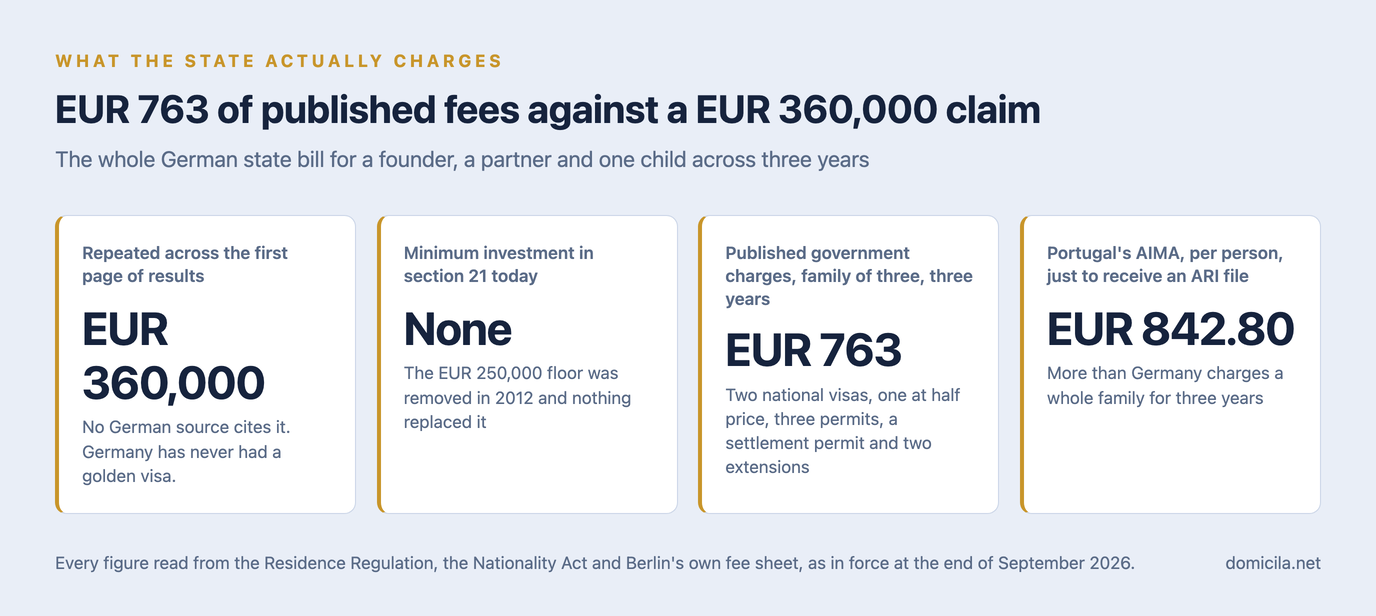
The EUR 360,000 figure repeated across the first page of results has no German source. What section 21 asks is whether the business shows an economic interest, expects positive economic effects and has its financing secured by equity or a loan commitment, judged partly on how much capital you are putting in, but against no stated floor.
The published government charges total about EUR 763 for a family of three across three years. That is two national visas at EUR 75 and one at half price, three residence permits, the founder's settlement permit at EUR 124 with its EUR 62 processing fee, and two extensions. For comparison, Portugal's AIMA charges EUR 842.80 per person simply to receive an ARI file.
The only hard threshold in the whole route is company law, not immigration law. A GmbH needs EUR 25,000 of share capital, of which EUR 12,500 must be paid in before the company can be registered, and the commercial register charges a flat EUR 225 to register it. A rejected registration costs 170 per cent of that fee.
If you are over 45 the real bar is a pension. Berlin's immigration office requires applicants past their 45th birthday to show that at 67 they will have either EUR 1,612.53 a month for at least 12 years or EUR 232,204 in assets. That is the closest thing Germany has to an investment threshold, and it is a retirement fund rather than a business.
On this page
This guide reads what section 21 actually requires, traces where the EUR 360,000 claim came from, prices every published charge from the visa counter to the naturalisation certificate, sets out the EUR 25,000 of company capital that is the route's only hard number, deals with the pension test that catches applicants over 45, maps the three-year and five-year clocks, and ends with the costed total. This site's renderer does not emit heading anchors, so the list below is a map rather than a set of jump links.
- Germany golden visa cost in 2026: the product does not exist
- What section 21 asks for, and where EUR 360,000 came from
- Every published government fee, from the visa to the passport
- The only hard threshold: EUR 25,000 of company capital
- Over 45? Then the threshold is a pension, not a business
- Three years to permanent residence, five to a passport
- Germany golden visa cost, added up, and what you can buy instead
- Related guides on Domicila
Germany golden visa cost in 2026: the product does not exist
If you are pricing a Germany golden visa cost in 2026, the useful answer is that there is nothing to price. Germany has never operated a residence-by-investment programme: no contribution, no qualifying property, no fund subscription, no schedule of government charges attached to a capital sum. Every page selling you a German golden visa is describing an ordinary residence permit for running a business, and charging you to explain it.
That permit is the residence permit for self-employment under section 21 of the Residence Act: a normal immigration route with a normal fee, assessed on whether your business is any good. A golden visa is a transaction and section 21 is a judgement, because your file goes out to the chamber of commerce for the locality where you intend to trade.
We checked what the first page of results for this query actually says. Three pages quote a range of EUR 360,000 to EUR 512,000, one of them acknowledging in the same paragraph that Germany abolished its minimum in 2012. None of the three cites a German statute, regulation, ministry or authority for any figure. One tells you the visa costs EUR 75 and then tells you to budget EUR 10,000 to EUR 30,000 for the help of the firm publishing the page.
| What "Germany golden visa" usually means | Status in September 2026 | What a new applicant pays |
|---|---|---|
| A residence-by-investment programme with a price | Has never existed in German law | Not applicable |
| The old EUR 250,000 self-employment minimum | Removed in 2012, no replacement threshold | Not applicable |
| Self-employment permit, section 21 Residence Act | Open | EUR 75 visa, EUR 100 permit |
| Freelance permit, section 21(5) | Open | EUR 75 visa, EUR 100 permit |
| EU Blue Card, section 18g | Open, salary-based | EUR 75 visa, EUR 100 card |
| Citizenship after three years | Repealed by the Bundestag in October 2025 | Not available |
Read that table as the whole answer to the search term, then read the rest of this guide as the price list nobody publishes. If you want the version of this comparison that covers countries which do sell residence, our golden visa cost comparison prices the programmes that are actually open.
What section 21 asks for, and where EUR 360,000 came from
Section 21(1) of the Residence Act sets three conditions and not one of them is a number. There must be an economic interest or a regional need; the activity must be expected to have positive effects on the economy; and the financing of its implementation must be secured through equity or a loan commitment. That is the entire test.
The second sentence is where the money enters, and it is worth quoting carefully, because this is the sentence that gets turned into a threshold. The assessment is directed in particular at the viability of the underlying business idea, the applicant's entrepreneurial experience, the amount of capital invested, the effects on the employment and training situation, and the contribution to innovation and research. Capital is one of five factors, with no floor attached to it, and the authority must consult the competent chambers, the trade authorities and the professional bodies for the place where you intend to operate.
| Section 21(1) requires | What it is not | How it is judged |
|---|---|---|
| An economic interest or a regional need | Not a payment | The chamber of commerce for your intended location is consulted |
| Positive effects on the economy expected | Not a job-creation quota in the statute | Effects on the employment and training situation are one factor |
| Financing secured by equity or a loan commitment | Not a minimum capital sum | Amount of capital invested is one of five listed factors |
| Nothing else | No property, fund or donation option exists | Viability of the idea and your entrepreneurial track record |
Two softer routes sit inside the same section and the comparison pages miss both. Under section 21(2a), someone who has completed a degree at a German university, or who holds a research permit or an EU Blue Card, should be granted a self-employment permit with no economic-interest test at all, provided the business relates to what they studied or researched. Under section 21(2b) a skilled worker on a start-up scholarship from a German business organisation or public body gets a permit for the length of the scholarship, up to 18 months.
Section 21(5) covers the freelance route, for the liberal professions: writers, engineers, doctors, architects, tax advisers and the rest. It also sets no threshold, but it drops the three-year settlement shortcut that section 21(4) gives the self-employed, which is the one respect in which freelancing is slower than founding.
Our read is that the EUR 360,000 claim began as a half-memory of the pre-2012 rule and acquired false precision through repetition. If an advisor quotes you a German investment threshold, ask which provision it appears in.
Every published government fee, from the visa to the passport
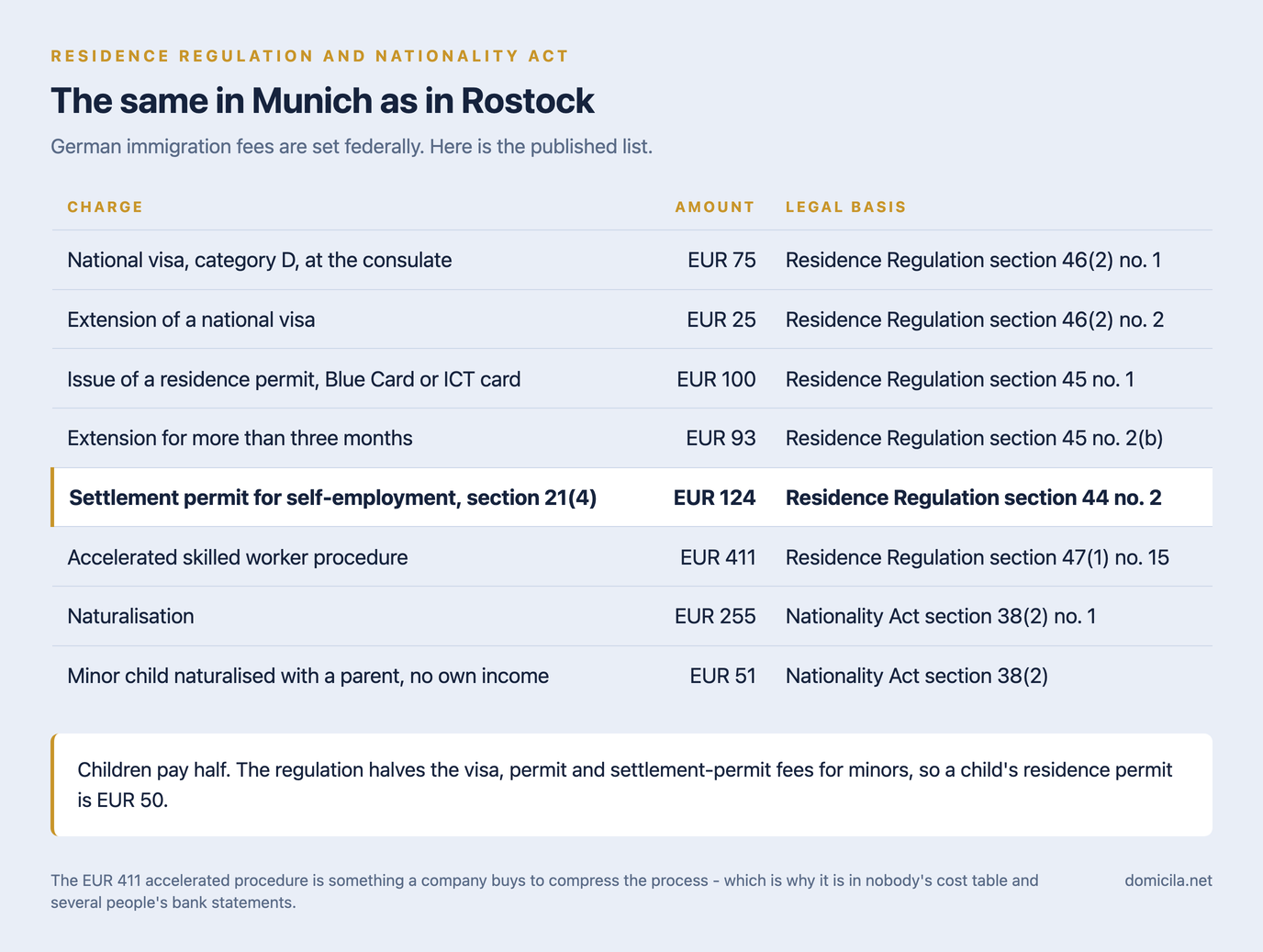
Here is the part no page ranking for this term publishes. German immigration fees are set in a federal regulation, the Residence Regulation, and they are the same in Munich as in Rostock. Every figure below is an item in that regulation or in the Nationality Act, read as in force at the end of September 2026.
| Charge | Amount | Legal basis |
|---|---|---|
| National visa, category D, at the consulate | EUR 75 | Residence Regulation section 46(2) no. 1 |
| Extension of a national visa | EUR 25 | Residence Regulation section 46(2) no. 2 |
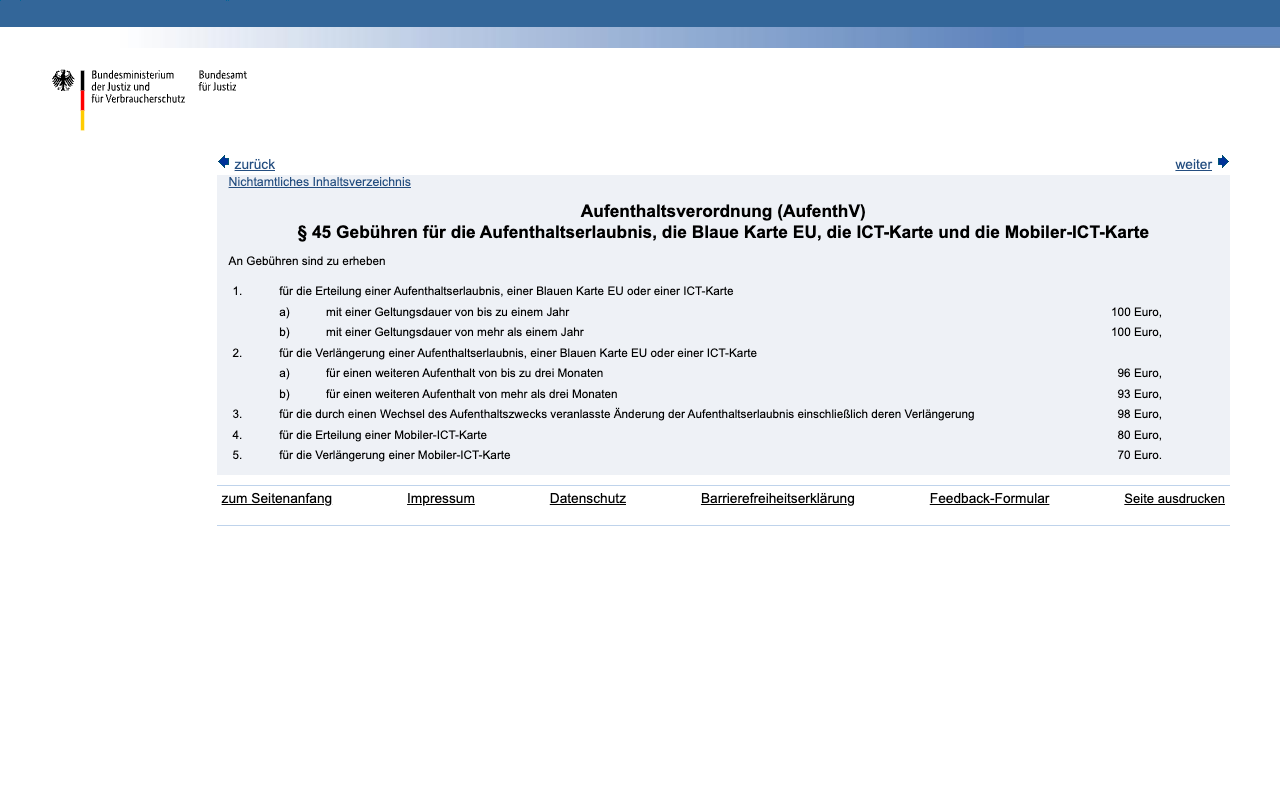
| Issue of a residence permit, Blue Card or ICT card | EUR 100 | Residence Regulation section 45 no. 1 |
| Extension for more than three months | EUR 93 | Residence Regulation section 45 no. 2(b) |
| Change of the purpose of stay | EUR 98 | Residence Regulation section 45 no. 3 |
| Settlement permit for self-employment, section 21(4) | EUR 124 | Residence Regulation section 44 no. 2 |
| Settlement permit, all other cases | EUR 113 | Residence Regulation section 44 no. 3 |
| Settlement permit for the highly qualified, section 18c(3) | EUR 147 | Residence Regulation section 44 no. 1 |
| Accelerated skilled worker procedure | EUR 411 | Residence Regulation section 47(1) no. 15 |
| Naturalisation | EUR 255 | Nationality Act section 38(2) no. 1 |
| Minor child naturalised with a parent, no own income | EUR 51 | Nationality Act section 38(2) |
Two lines deserve more attention than they get. Children pay half, because the regulation halves the visa, permit and settlement permit fees for minors, so a child's residence permit is EUR 50. And the accelerated skilled worker procedure at EUR 411 is something a company buys to compress the process, which is why it appears in nobody's cost table and in several people's bank statements.
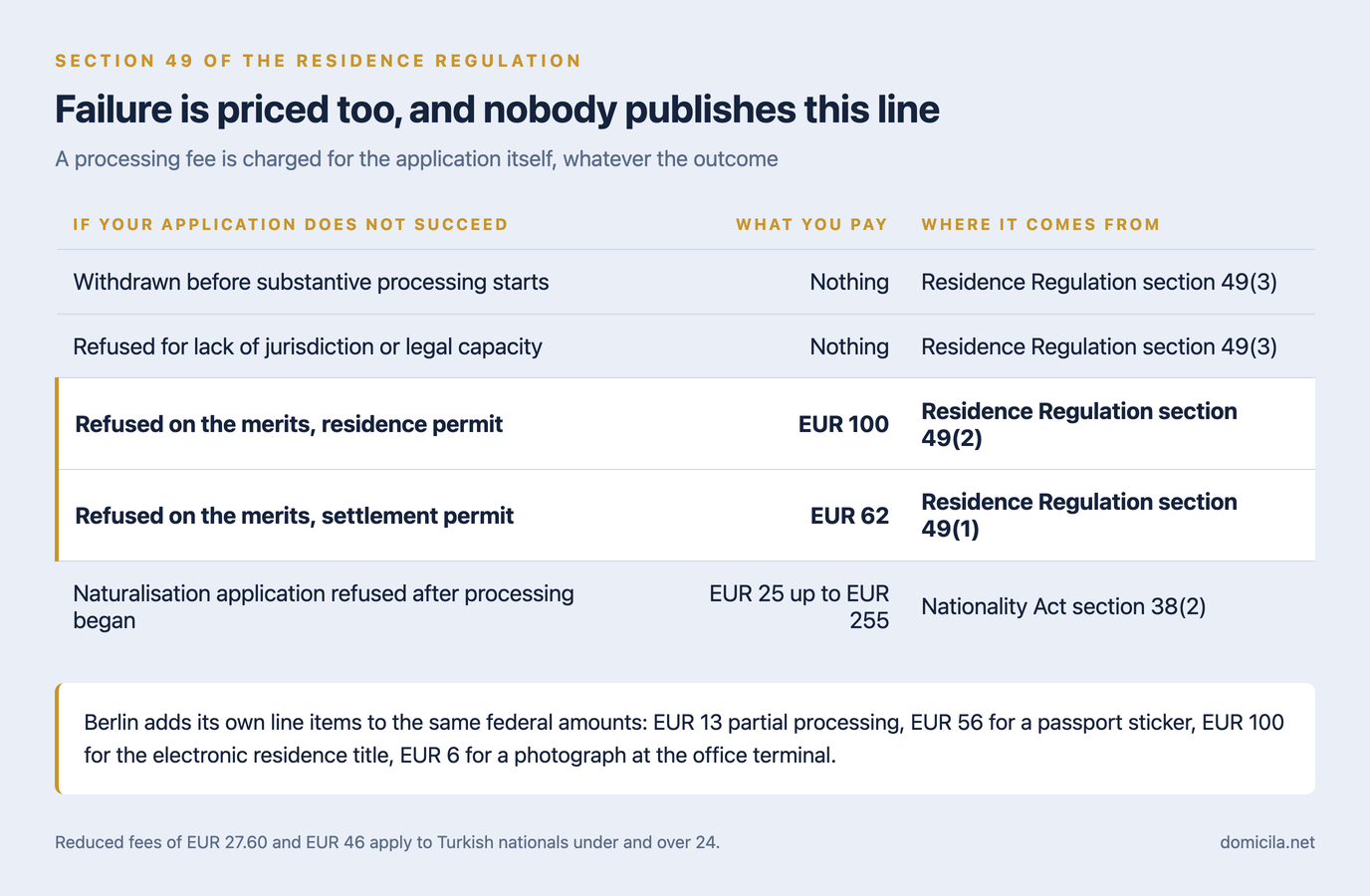
Failure is priced too, and this is the line we have not seen anywhere else. Section 49 of the regulation charges a processing fee for the application itself: half the settlement-permit fee for a settlement application, and the full amount again for every other title. No fee is due if the application is withdrawn before substantive processing begins, or refused only because the authority lacked jurisdiction. In plain terms, a refused section 21 application still costs EUR 100, and a refused settlement application costs EUR 62.
| If your application does not succeed | What you pay | Where it comes from |
|---|---|---|
| Withdrawn before substantive processing starts | Nothing | Residence Regulation section 49(3) |
| Refused for lack of jurisdiction or legal capacity | Nothing | Residence Regulation section 49(3) |
| Refused on the merits, residence permit | EUR 100 | Residence Regulation section 49(2) |
| Refused on the merits, settlement permit | EUR 62 | Residence Regulation section 49(1) |
| Naturalisation application refused after processing began | EUR 25 up to EUR 255 | Nationality Act section 38(2) |
Local offices publish their own breakdown of the same federal amounts, which is where the odd extra euro shows up. Berlin's immigration authority lists EUR 13 as a partial processing fee, EUR 56 if the permit is issued as a passport sticker, EUR 100 for the electronic residence title, EUR 6 for a photograph taken at the office terminal, and reduced fees of EUR 27.60 and EUR 46 for Turkish nationals under and over 24.
The only hard threshold: EUR 25,000 of company capital
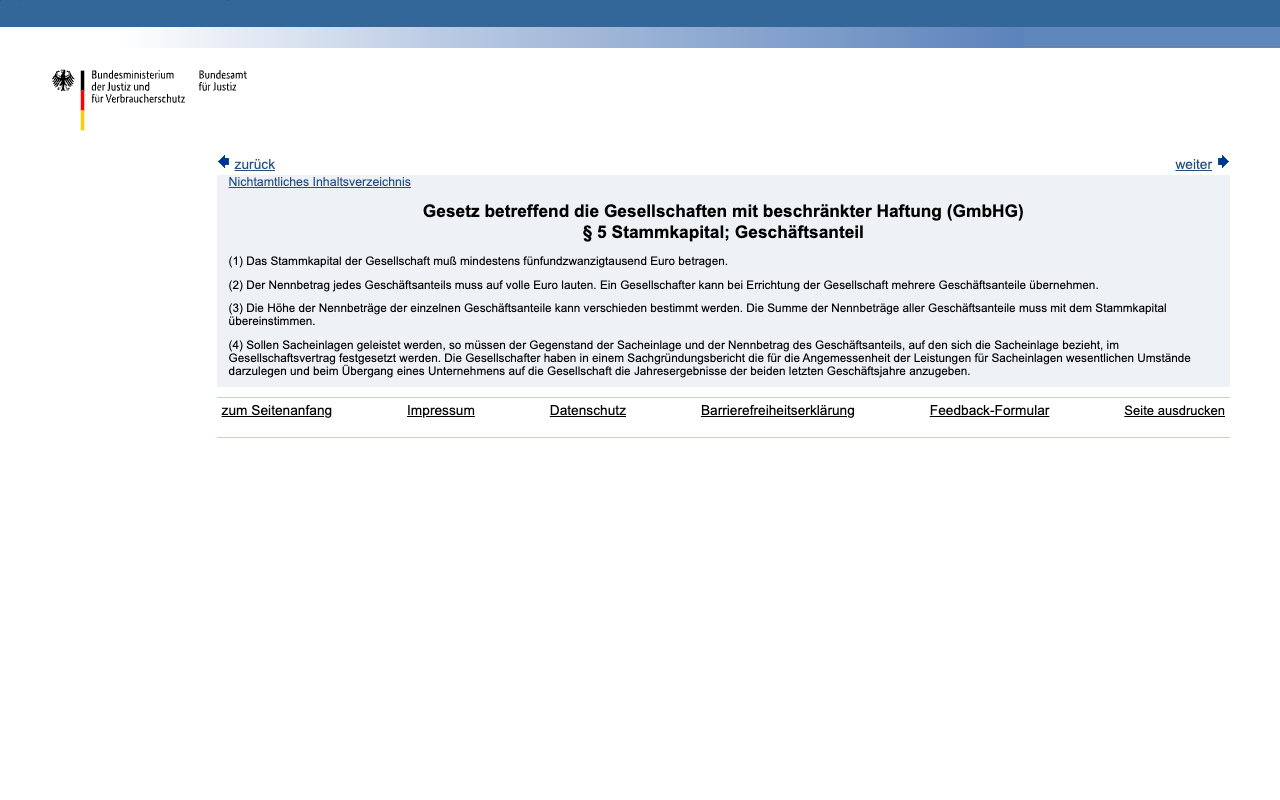
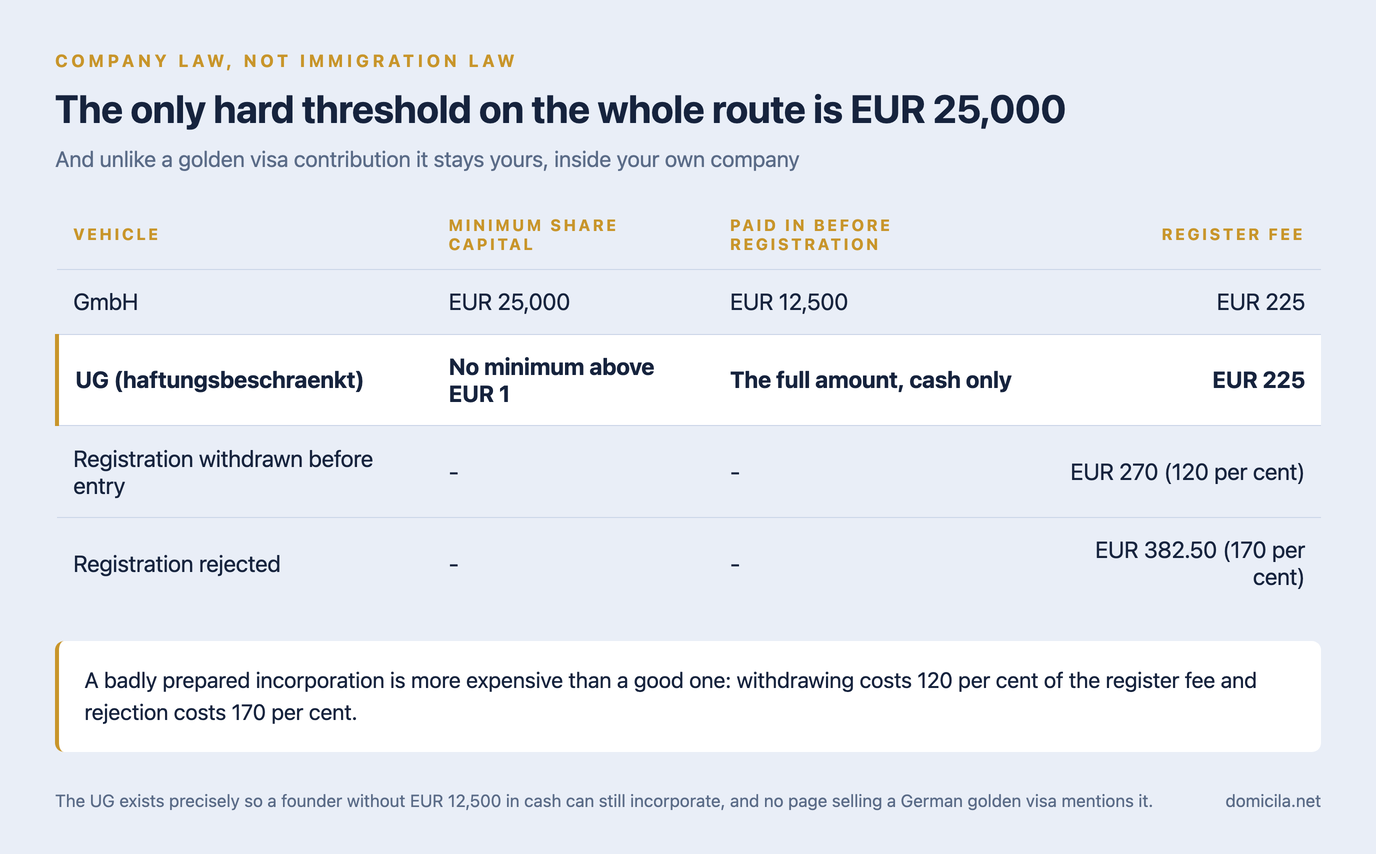
Germany does have a number, and it sits in company law rather than immigration law. A GmbH, the limited company most founders use, must have share capital of at least EUR 25,000. It cannot be registered until a quarter of each share is paid up and the total paid in reaches at least half the minimum capital, which is EUR 12,500. That is the real money you need at the start, and unlike a golden visa contribution it stays yours, inside your own company.
The cheaper vehicle is the UG, formally the Unternehmergesellschaft (haftungsbeschränkt), which can be formed with less than EUR 25,000 but must have its capital paid in full, cannot use contributions in kind, and must retain a quarter of its annual profit as a statutory reserve until it reaches the full EUR 25,000. It exists precisely so that a founder without EUR 12,500 in cash can still incorporate, and no page selling a German golden visa mentions it.
| Vehicle | Minimum share capital | Paid in before registration | Register fee |
|---|---|---|---|
| GmbH | EUR 25,000 | EUR 12,500 | EUR 225 |
| UG (haftungsbeschränkt) | No minimum above EUR 1 | The full amount, cash only | EUR 225 |
| Registration withdrawn before entry | — | — | EUR 270 (120 per cent) |
| Registration rejected | — | — | EUR 382.50 (170 per cent) |
The commercial register fee is a flat EUR 225 for the first registration of a GmbH or a UG, set in the register fee schedule. Note the two rows below it: withdrawing an application costs 120 per cent of the fee and having it rejected costs 170 per cent, so a badly prepared incorporation is more expensive than a good one, which is not how anybody assumes court fees work.
The notary is the remaining state-set cost and it is smaller than founders expect. Notarial fees are fixed by statute against the transaction value, and the table gives a base value of EUR 115 at a share capital of EUR 25,000, from which the deed of formation and the certified register application are charged as multiples: hundreds of euros, not thousands. Lawyers, tax advisers and the business plan are priced by the market, no German authority publishes those figures, and we will not invent a range for them.
One real cost stays unpublished: health insurance. Berlin requires cover in the statutory system or comparable private cover, and for a self-employed founder in the voluntary statutory scheme that is a contribution assessed on income rather than a price. Our guide to golden visa health insurance requirements covers how the same demand is worded across Europe.
Over 45? Then the threshold is a pension, not a business
Section 21(3) is one sentence long and it is the most expensive sentence in this guide. Applicants who are older than 45 should be granted the permit only if they have adequate old-age provision. The statute stops there, leaving the amount to the authority deciding your file, which means the figure you must meet is published locally rather than federally.
Berlin's immigration office publishes it, and the numbers are specific. Since 1 July 2025, an applicant who has completed their 45th year must be able to show that on reaching 67 they will have either a monthly pension of EUR 1,612.53 for at least 12 years, or assets of EUR 232,204. Read that against the EUR 360,000 business investment the comparison pages quote: for the over-45 applicant, the genuine capital test in this route is a retirement provision of nearly a quarter of a million euros, and it buys no shares in anything.
| Section 21(3) test, as published by Berlin | Figure | Notes |
|---|---|---|
| Monthly pension from age 67 | EUR 1,612.53 | Must be payable for at least 12 years |
| Or assets available at 67 | EUR 232,204 | Business assets and foreign pension rights can count |
| In force since | 1 July 2025 | Adjusted periodically, so confirm before you file |
| Applies from | Completion of the 45th year | Not from 46, and not from the date of the decision |
| Nationalities exempt from the proof | Dominican Republic, Indonesia, Japan, Philippines, Sri Lanka | Treaty-based, per Berlin's published list |
The exemption list is not an oversight and it is not a loophole: those five nationalities benefit from older bilateral arrangements, and Berlin states plainly that the old-age provision proof is waived for them. If you hold one of those passports and are over 45, you have just saved the largest sum in this article, and no aggregator page will tell you so.
What can satisfy the test is broader than a German pension: own assets in any form, pension rights built up at home or abroad, and the capital in the business itself can all be weighed, because the authority is making a forecast rather than checking a balance. That is genuinely good news for a founder whose wealth is in a company, and it is the one place in this route where we would spend money on advice, because the forecast is argued rather than proved.
Three years to permanent residence, five to a passport
Germany's timetable is the real product here, and it is better than its reputation. Section 21(4) caps the self-employment permit at three years, and then allows a settlement permit — permanent residence — after those three years if you have been self-employed throughout, the business looks likely to keep developing, and your household income covers your family. That provision explicitly departs from the general rule in section 9(2), which needs five years of permits and 60 months of pension contributions.
So the self-employed route reaches permanent residence in three years without the 60-month contribution record that an employee needs. We have not seen that stated on a single page competing for this term, and it is worth more than any fee in this guide.
| Route | Time to permanent residence | Contribution record required | German required |
|---|---|---|---|
| Self-employment, section 21(4) | 3 years | None stated in the provision | Not stated in the provision |
| General rule, section 9(2) | 5 years | 60 months | Sufficient knowledge |
| Skilled worker, section 18c(1) | 3 years, or 2 with a German qualification | 36 months, or 24 | Sufficient knowledge |
| EU Blue Card, section 18c(2) | 21 months with sufficient German, otherwise 27 | For that period | Basic, or sufficient for 21 months |
| Freelance, section 21(5) | Section 21(4) does not apply, so the general rule | 60 months | Sufficient knowledge |
Citizenship is where 2026 differs sharply from what most pages still say. The Nationality Act requires five years of lawful habitual residence, together with an unlimited right of residence or a Blue Card, subsistence without social assistance, no relevant convictions, German at B1 level and a naturalisation test. The fee is EUR 255 for an adult and EUR 51 for a minor child naturalised alongside a parent.
The three-year route is gone. The 2024 reform had allowed naturalisation after three years for special integration achievements; the Bundestag repealed it on 8 October 2025 by 450 votes to 134 with 2 abstentions, in the Sixth Act amending the Nationality Act, and the consolidated statute now shows that subsection as lapsed. Anyone quoting a three-year German passport in 2026 is quoting a rule that was in force for about sixteen months.
One detail in the same provision is quietly useful: a Blue Card holder can naturalise without ever obtaining a settlement permit, because the Blue Card is listed alongside an unlimited residence right. Holders of the Chancenkarte, the year-long job-search permit that allows 20 hours of work a week and two-week trial jobs, are excluded from that list, so a job-search year does not count toward the qualifying titles.
Germany golden visa cost, added up, and what you can buy instead
Putting the published charges together for the case most readers are in — a founder, a partner and one child under 18, arriving from outside the EU, with the founder taking permanent residence at year three — produces a total that is hard to believe next to the numbers in this market. Every line is a federal fee item. None of it is advice, insurance, translation, or the company's own capital.
| Line item | Rate | Count | Total |
|---|---|---|---|
| National visa, adults | EUR 75 | 2 | EUR 150 |
| National visa, child under 18 | EUR 37.50 | 1 | EUR 37.50 |
| Residence permits on arrival, adults | EUR 100 | 2 | EUR 200 |
| Residence permit, child | EUR 50 | 1 | EUR 50 |
| Settlement permit at year three, founder | EUR 124 | 1 | EUR 124 |
| Processing fee on that application | EUR 62 | 1 | EUR 62 |
| Permit extensions at year three, partner | EUR 93 | 1 | EUR 93 |
| Permit extension, child | EUR 46.50 | 1 | EUR 46.50 |
| Three-year published state total | EUR 763 | ||
| Naturalisation at year five, adults | EUR 255 | 2 | EUR 510 |
| Naturalisation, child with a parent | EUR 51 | 1 | EUR 51 |
| Running total to two passports | EUR 1,324 |
Separately, and not part of that total: EUR 12,500 paid into your own GmbH before registration, EUR 225 to the commercial register, a notary's fee calculated from a EUR 115 table value, health cover, and whatever the business itself costs. For an applicant over 45, add the pension provision above, which is a holding of assets rather than a payment.
Set that against the programmes this site prices. Portugal's immigration agency charges EUR 842.80 per person to receive and analyse a golden visa application and EUR 8,418.90 per person to grant it, on the fee table in force since 1 March 2026, before the EUR 500,000 fund subscription; our Portugal golden visa cost guide has the full table. Germany's entire published three-year bill for a family of three is less than one Portuguese reception fee for one adult.
| Country | Cheapest route open to a new applicant | Entry threshold | Published state fees |
|---|---|---|---|
| Germany | Self-employment, section 21, business you run | No published minimum | EUR 763 for a family of three over 3 years |
| United Kingdom | Innovator Founder, endorsed business | No published minimum | GBP 1,357 per person plus endorsement |
| Ireland | Start-up Entrepreneur Programme | EUR 50,000 | EUR 350 |
| Latvia | Share capital of a small company | EUR 50,000 | EUR 10,000 |
| Greece | Property in the lowest-threshold zones | EUR 250,000 | EUR 2,000 electronic fee |
| Portugal | Qualifying funds | EUR 500,000 | EUR 842.80 to receive, EUR 8,418.90 to grant, per person |
| Spain | Closed to new applicants since April 2025 | Not available | Not available |
The honest comparison is not about money. Germany is cheap and hard to satisfy: a chamber of commerce judges a business you have to actually run, and nothing buys past that judgement. Ireland and the United Kingdom are closest in shape, both having closed investor routes and kept entrepreneur ones. Austria is the country people confuse this with, and its route is a discretionary grant of citizenship, not a visa.
Our view: Germany belongs on the shortlist of anyone who genuinely wants to build a company in Europe's largest economy, and nowhere near the shortlist of anyone who wants residence as a purchase. If you want the second thing, the distinction is the whole subject of our guide to citizenship by investment versus a golden visa, and the money is better spent on a programme that admits it is selling something.
Related guides on Domicila
If Germany has ruled itself in or out, these are the comparisons that do the most work next:
- Golden visa cost comparison — Europe's surviving programmes on published 2026 fee tables
- Golden visa countries — what is open, what closed, and when
- Cheapest golden visa — why the lowest advertised threshold is rarely the lowest real bar
- UK golden visa cost — the other big economy with no investor route and low fees
- Ireland golden visa cost — a closed investor route with an entrepreneur programme behind it
- Austria citizenship by investment cost — the German-speaking route people confuse with this one
- Golden visa health insurance requirements — the cover European programmes demand, priced
Common questions
How much does a Germany golden visa cost in 2026?
There is no German golden visa, so there is no price for one. The permit people mean is the residence permit for self-employment under section 21 of the Residence Act, and the published charges for it are a EUR 75 national visa at the consulate and EUR 100 for the residence permit itself, with children paying half. Across three years, a founder, a partner and one child pay roughly EUR 763 in federal fees, including the founder's EUR 124 settlement permit and its EUR 62 processing fee. Separately, a GmbH needs EUR 12,500 paid into its own share capital before it can be registered.
Does Germany have a golden visa programme?
No. Germany has never operated a residence-by-investment programme, and no provision of the Residence Act sells residence against a contribution, a property purchase or a fund subscription. What exists is a set of ordinary permits: self-employment under section 21, the freelance variant under section 21(5), the EU Blue Card under section 18g for salaried work, and the Chancenkarte for job-seeking. Pages advertising a German golden visa are describing one of those permits.
What is the minimum investment for a German self-employment visa?
There is none. The EUR 250,000 minimum was removed in 2012 and nothing replaced it. Section 21(1) requires an economic interest or regional need, an expectation of positive economic effects, and financing secured by equity or a loan commitment, and it lists the amount of capital invested as one of five assessment factors alongside the viability of the business idea, your entrepreneurial experience, the effect on employment and training, and the contribution to innovation and research. The EUR 360,000 figure circulating online has no German source.
What are German residence permit fees in 2026?
They are set federally in the Residence Regulation and are the same in every city. A national category D visa is EUR 75, issuing a residence permit or an EU Blue Card is EUR 100, extending one for more than three months is EUR 93, and changing the purpose of your stay is EUR 98. A settlement permit for the self-employed under section 21(4) is EUR 124, and EUR 113 in most other cases. Minors pay half of these amounts. The accelerated skilled worker procedure, which an employer buys to speed up a file, is EUR 411.
Do you need EUR 25,000 to start a company in Germany?
For a GmbH, yes as share capital, but only EUR 12,500 has to be paid in before the company can be registered, and a quarter of each individual share must be paid up. The alternative is the UG (haftungsbeschränkt), which can be formed with any amount above EUR 1 but must have that capital paid in full, cannot accept contributions in kind, and must retain a quarter of each year's profit as a reserve until it reaches EUR 25,000. The commercial register charges a flat EUR 225 to register either one.
What happens if you are over 45 and apply for a German self-employment permit?
Section 21(3) says the permit should only be granted to applicants older than 45 if they have adequate old-age provision, and the amount is set locally. Berlin's immigration office publishes it: since 1 July 2025, an applicant who has completed their 45th year must be able to show that at 67 they will have either a monthly pension of EUR 1,612.53 for at least 12 years, or assets of EUR 232,204. Business assets and pension rights earned abroad can be counted, and Berlin waives the proof for nationals of the Dominican Republic, Indonesia, Japan, the Philippines and Sri Lanka.
How long does it take to get permanent residence in Germany through self-employment?
Three years. Section 21(4) caps the self-employment permit at three years and then allows a settlement permit after that period if you have been self-employed throughout, the business looks likely to keep developing, and your household income covers your family. That provision departs from the general rule in section 9(2), which requires five years of residence permits and 60 months of pension contributions, so the self-employed route is both faster and free of the contribution record. The freelance route under section 21(5) does not get this shortcut.
Can you still become a German citizen after three years?
No. The three-year route for special integration achievements, introduced by the 2024 reform, was repealed by the Bundestag on 8 October 2025 in the Sixth Act amending the Nationality Act, by 450 votes to 134 with 2 abstentions, and the consolidated statute now shows that subsection as lapsed. Naturalisation requires five years of lawful habitual residence, an unlimited residence right or an EU Blue Card, subsistence without social assistance, German at B1 level and a naturalisation test. The fee is EUR 255 for an adult and EUR 51 for a minor child naturalised with a parent.
Official sources to verify
- Section 21 Residence Act: self-employment (Selbständige Tätigkeit)Bundesministerium der Justiz, gesetze-im-internet.de
- Section 45 Residence Regulation: fees for the residence permit, EU Blue Card and ICT cardBundesministerium der Justiz, gesetze-im-internet.de
- Section 44 Residence Regulation: fees for the settlement permitBundesministerium der Justiz, gesetze-im-internet.de
- Section 9 Residence Act: settlement permit (five years, 60 months of contributions)Bundesministerium der Justiz, gesetze-im-internet.de
- Section 18c Residence Act: settlement permit for skilled workers and Blue Card holdersBundesministerium der Justiz, gesetze-im-internet.de
- Section 18g Residence Act: EU Blue Card salary thresholdsBundesministerium der Justiz, gesetze-im-internet.de
- Section 10 Nationality Act: naturalisation requirementsBundesministerium der Justiz, gesetze-im-internet.de
- Section 38 Nationality Act: naturalisation feesBundesministerium der Justiz, gesetze-im-internet.de
- Sozialversicherungsrechengrößen 2026 (contribution ceiling EUR 101,400 a year)Bundesministerium für Arbeit und Soziales
- Commercial register fee schedule, item 2100: first registration of a GmbH or UGBundesministerium der Justiz, gesetze-im-internet.de
- Section 5 GmbH Act: minimum share capital of EUR 25,000Bundesministerium der Justiz, gesetze-im-internet.de
- Residence permit for the purpose of self-employment: requirements and feesLandesamt für Einwanderung Berlin, Service Berlin
- Bundestag vote of 8 October 2025 on the Sixth Act amending the Nationality ActDeutscher Bundestag
Compare golden visa advisors
Ask for a route-specific quote that separates investment amount, government fees, legal work, fund or property costs, and renewal obligations.
We may earn a referral fee if you choose an advisor through this site. We still aim to show cost ranges, caveats, and official source links plainly.