uk golden visa cost
UK Golden Visa Cost 2026: The Route Closed in 2022
Search the UK golden visa cost and you get quoted GBP 2 million, because that is what the Tier 1 (Investor) visa asked for. Nobody has been able to buy it since 4pm on 17 February 2022, and on 17 February 2026 the extension window shut on the people who already held one. What is left is a set of ordinary work routes carrying ordinary Home Office fees, and almost no page ranking for this query prices them. We took the Home Office's own fee table of 8 April 2026, the Tier 1 (Investor) caseworker guidance at version 20.0 and the current Immigration Rules, and costed every route a new applicant can actually file today.
Key takeaways
There is no UK golden visa to buy in 2026, so there is no price. The Tier 1 (Investor) route closed to all new initial applications from 4:00pm on 17 February 2022. The caseworker guidance is blunt about what happens if you try anyway: any initial application made after that moment must be recorded as void and the fee refunded.
The second deadline has now passed too, and most pages have not caught up. Existing Tier 1 (Investor) holders had to file any extension before 17 February 2026. That date is behind us. The route is now a settlement-only scheme for people already inside it, and paragraph 245EF of the Immigration Rules gives them until 17 February 2028 to apply for indefinite leave to remain.
The cheapest route with an investment flavour costs GBP 1,357, not GBP 2 million. An Innovator Founder application from outside the UK is GBP 1,357 per person on the Home Office fee table in force from 8 April 2026, plus GBP 1,000 to the endorsing body. There is no published minimum investment on that route at all; the endorsing body decides whether your funding is enough.
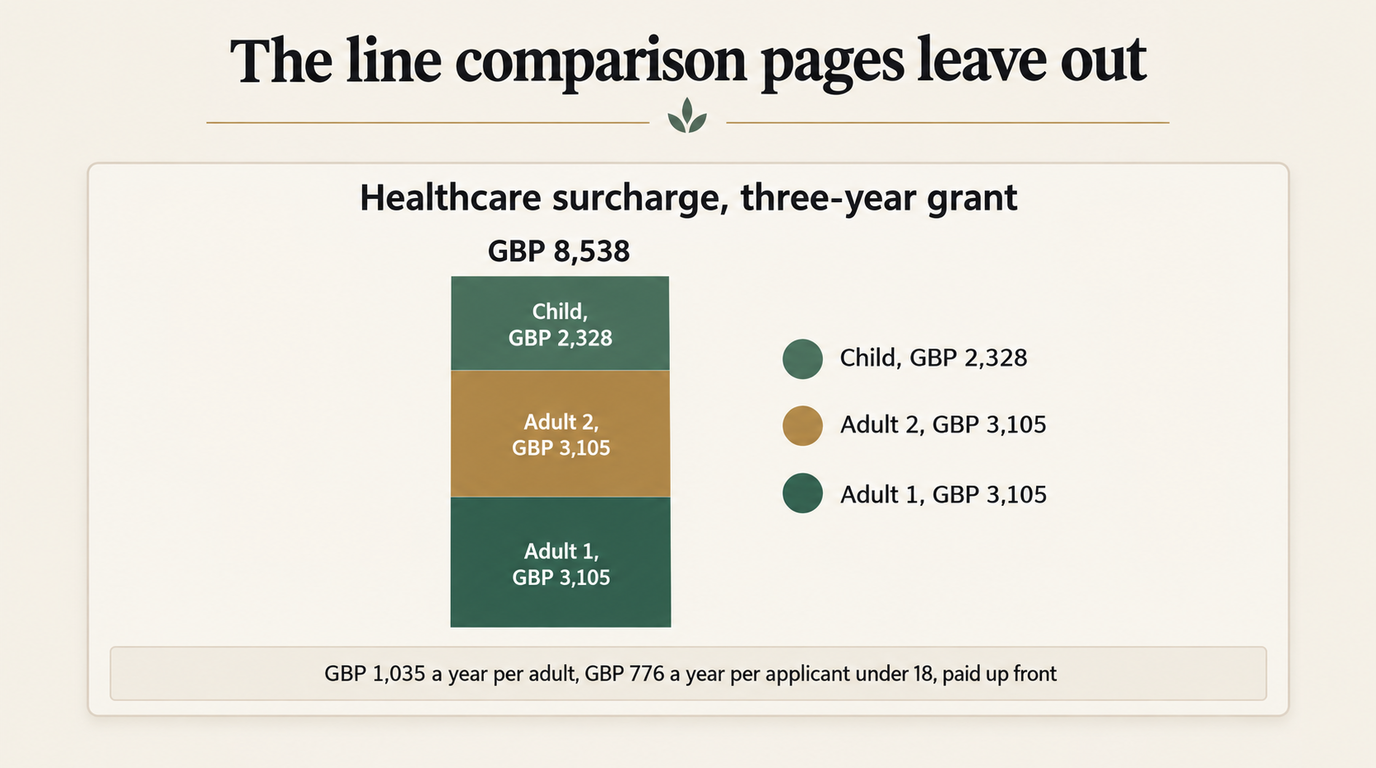
The healthcare surcharge is the line that moves the total, and comparison pages leave it out. It is GBP 1,035 a year for each adult and GBP 776 a year for each applicant under 18, paid up front for the whole grant. On a three-year Innovator Founder visa for two adults and a child, that alone is GBP 8,538 before a single application fee.
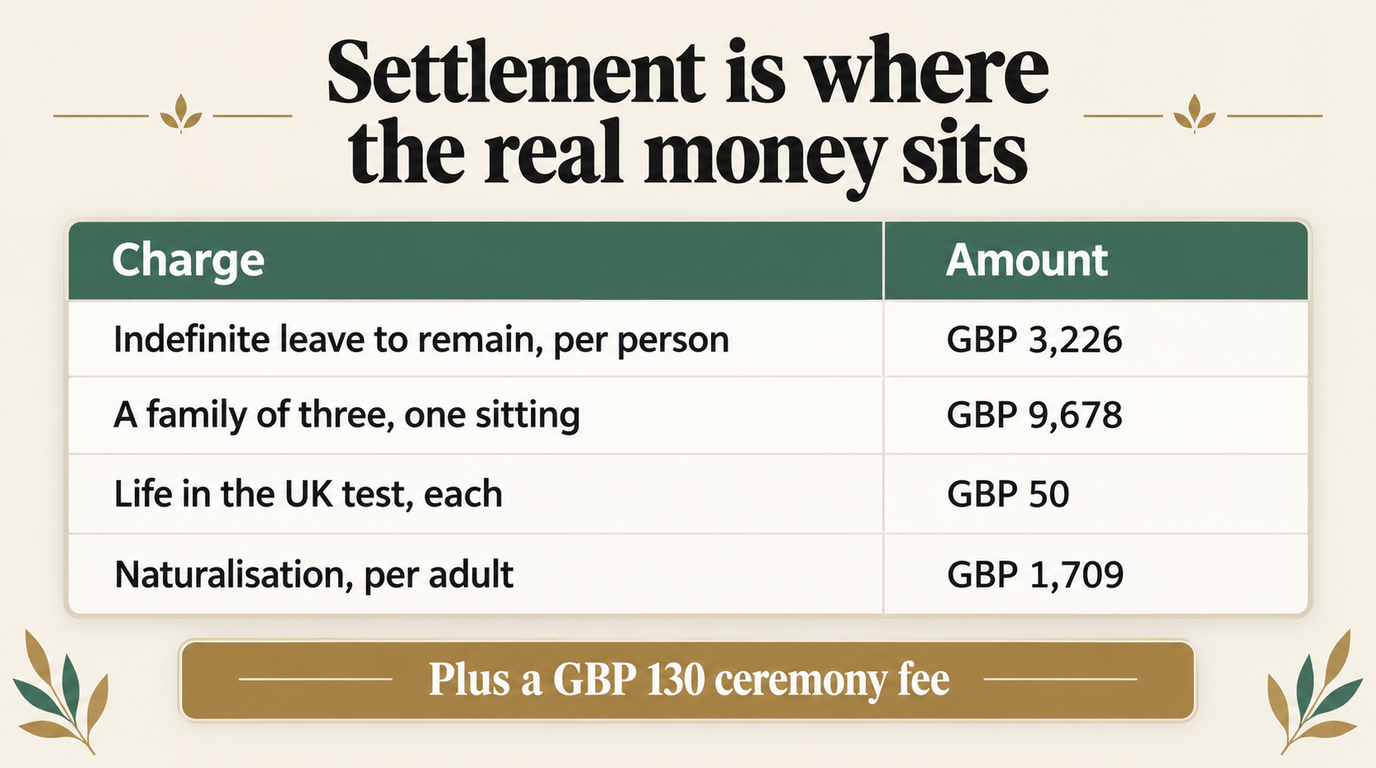
Settlement is where the real money sits. Indefinite leave to remain costs GBP 3,226 per person from 8 April 2026, so a family of three pays GBP 9,678 in one sitting, plus GBP 50 each for the Life in the UK test. Naturalisation afterwards is a separate GBP 1,709 per adult and a GBP 130 ceremony fee.
On this page
This guide starts with why the search term has no price attached to it in 2026, then sets out what the closed route actually cost and the two deadlines that still run inside it, prices the routes a new applicant can file from the Home Office's own fee table, totals three years of the realistic route for a family of three, deals with the GBP 5 million scheme that keeps being reported but does not exist in the Rules, and finishes by comparing Britain with the European programmes you can still buy. This site's renderer does not emit heading anchors, so the list below is a map rather than a set of jump links.
- UK golden visa cost in 2026: there is nothing to buy
- What GBP 2 million bought, and the two dates that still run
- What is open now, priced from the Home Office's own fee table
- Three years on Innovator Founder, costed for a family of three
- Two things that could change this, and neither is in the Rules yet
- Where the UK sits against routes you can actually buy
- Related guides on Domicila
UK golden visa cost in 2026: there is nothing to buy
If you are pricing a UK golden visa cost in 2026, the honest answer is that Britain never had one under that name and no longer has the thing the name pointed at. The search term covered the Tier 1 (Investor) visa, and the Home Office's own caseworker guidance opens with the closure: from 4:00pm on 17 February 2022 the route is closed to all new initial applications for entry clearance or leave to remain, switching into it from another route included. That single fact is worth more than any fee table, and it is the fact most pages ranking for this query bury under a quote form.
The time of day is not a flourish. An application filed at 3pm on 17 February 2022 was inside the window; one filed at 5pm was not, and the guidance instructs caseworkers to record it as void and refund the fee. The version of that guidance published as we write is 20.0, so this is not a stale document that nobody has revisited.
What the closure did not do is create a replacement. Britain has work routes that investors use, but none of them price residence as a product, and the distinction matters enough that we wrote a whole guide on citizenship by investment vs golden visa. The table below is the short version for the UK specifically.
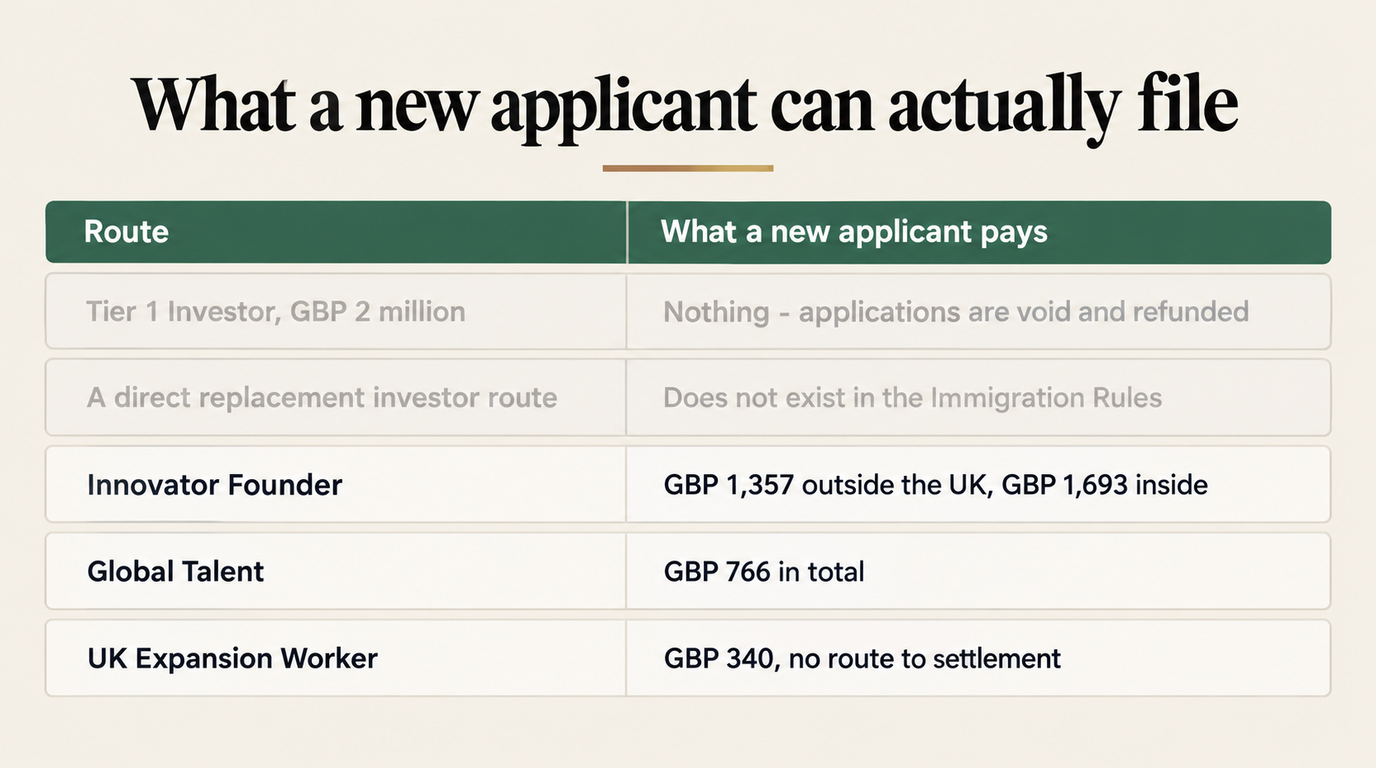
| What "UK golden visa" usually means | Status in September 2026 | What a new applicant pays |
|---|---|---|
| Tier 1 (Investor), GBP 2 million | Closed to new applicants since 4pm, 17 February 2022 | Nothing — applications are void and refunded |
| A direct replacement investor route | Does not exist in the Immigration Rules | Not applicable |
| Innovator Founder (endorsed business) | Open | GBP 1,357 outside the UK, GBP 1,693 in the UK |
| Global Talent (endorsed or prize-based) | Open | GBP 766 in total |
| UK Expansion Worker (overseas business setting up here) | Open, no route to settlement | GBP 340 |
What GBP 2 million bought, and the two dates that still run
Because the GBP 2 million figure is still quoted at you, it is worth setting out accurately once with its status attached. To score the required 75 points an applicant needed money of their own, under their own control, held in a regulated financial institution and disposable in the UK, of not less than GBP 2 million, and a UK regulated bank account opened for the purpose of investing it. The money then had to go into share capital or loan capital in active UK companies, and stay there.
The part that made the route attractive to the very wealthy was the accelerated settlement ladder, which is still the reason people search for it. Investing more bought a shorter qualifying period, and the guidance sets the tiers out explicitly for anyone who entered under the rules in force from 6 November 2014.
| Money under your control in the UK | Continuous residence needed for settlement | Status for a new applicant in 2026 |
|---|---|---|
| GBP 2 million | 5 years | Closed |
| GBP 5 million | 3 years | Closed |
| GBP 10 million | 2 years | Closed |
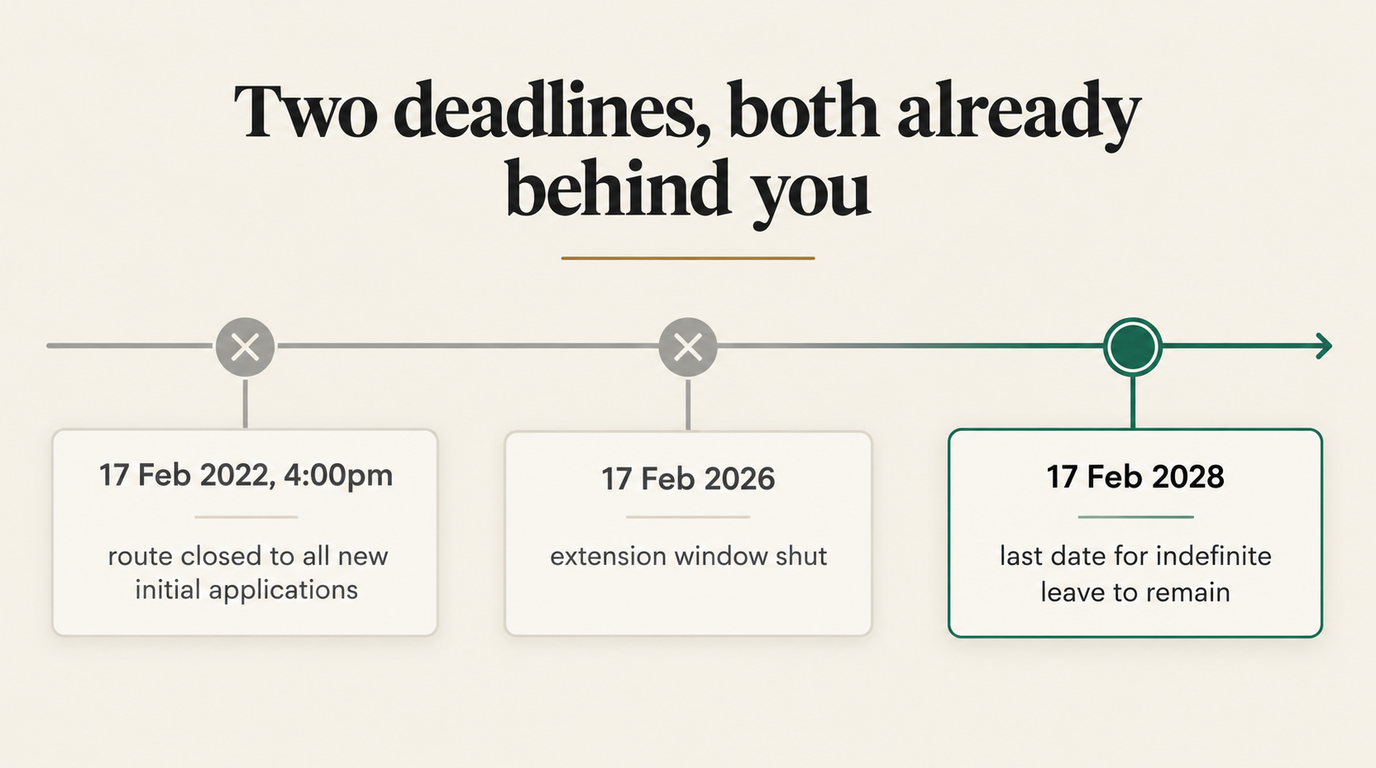
For the people already inside the scheme, two dates govern what is left of it, and this is where almost every competing page is either vague or wrong. One page ranking on page one of this query gives 5 April 2025 as the final settlement deadline in one section and 17 February 2028 in another. The Rules are not ambiguous: paragraph 245EF says the application must be made before 17th February 2028.
| Date | What it did | Still live? |
|---|---|---|
| 17 February 2022, 4:00pm | Route closed to all new initial applications | Yes, permanently |
| 17 February 2026 | Last date to apply to extend a Tier 1 (Investor) visa | No — this deadline has passed |
| 17 February 2028 | Last date to apply for indefinite leave to remain | Yes, roughly 17 months left |
Settlement on the closed route is not automatic either. The applicant must have maintained the investment throughout the qualifying period, have been absent from the UK for no more than 180 days in any 12 calendar months, and meet the knowledge of language and life requirement under Appendix KoLL unless they are under 18 or 65 and over. If you hold one of these visas, the operative fact is that the extension door is shut and only the settlement door is open.
What is open now, priced from the Home Office's own fee table
Here is where this guide differs from the pages competing for the term: every figure below comes from the Home Office fee table in force from 8 April 2026, not from a consultancy's estimate. Two of the three pages we checked on the first page of results for this term carry no Home Office fee at all, and one tells the reader to ring the firm for current figures.
| Route | Application fee | Paid to a third party | Healthcare surcharge | Leads to settlement? |
|---|---|---|---|---|
| Innovator Founder, applying from outside the UK | GBP 1,357 per person | GBP 1,000 endorsement, GBP 500 per contact-point meeting | GBP 1,035 per adult per year | Yes, after 3 years |
| Innovator Founder, extending or switching in the UK | GBP 1,693 per person | Same | Same | Yes |
| Global Talent, endorsement route | GBP 561 endorsement plus GBP 205 visa | None | GBP 1,035 per adult per year | Yes |
| Global Talent, prestigious prize route | GBP 766 | None | Same | Yes |
| UK Expansion Worker | GBP 340 per person | Sponsor licence costs sit with the business | GBP 1,035 per adult per year | No |
| Tier 1 (Investor), settlement only | GBP 3,226 per person | None | Not payable at settlement | Already on it |
The endorsement is the real gate on the Innovator Founder route, not the money. GOV.UK requires the business idea to be new, innovative, viable, scalable and endorsed by an approved body before the Home Office looks at anything, and you meet that body again at 12 months and 24 months at GBP 500 a time. The visa can be cut short if the endorsement is withdrawn.
Note what is missing from that route: a minimum investment. The old Innovator visa asked for GBP 50,000 and the Innovator Founder replacement dropped it, so GOV.UK's own page now says only that you must prove to your endorsing body that you have enough funding and where it came from. Anyone quoting you a fixed UK investment threshold in 2026 is quoting a rule that no longer exists.
The personal-savings test is separate and small: GBP 1,270 held for 28 consecutive days, plus GBP 285 for a partner, GBP 315 for a first child and GBP 200 for each additional child. English is required at B2 on the CEFR scale, which is a level higher than most work routes ask for, and that catches people who assumed a business visa would not be tested at all.
Three years on Innovator Founder, costed for a family of three
Headline fees are not what anyone actually pays, so we ran the numbers for the case most readers are in: a main applicant, a partner and one child under 18, applying from outside the UK for the initial three-year grant. Every line is a published government charge or a published endorsing-body charge, and none of it includes lawyers, accountants or the business itself.
| Line item | Rate | Count | Total |
|---|---|---|---|
| Endorsement by an approved body | GBP 1,000 | 1 | GBP 1,000 |
| Visa application, outside the UK | GBP 1,357 | 3 people | GBP 4,071 |
| Healthcare surcharge, adults | GBP 1,035 per year | 2 adults x 3 years | GBP 6,210 |
| Healthcare surcharge, child under 18 | GBP 776 per year | 1 child x 3 years | GBP 2,328 |
| Contact-point meetings at 12 and 24 months | GBP 500 | 2 meetings | GBP 1,000 |
| Three-year state and endorsement cost | GBP 14,609 | ||
| Indefinite leave to remain at year three | GBP 3,226 | 3 people | GBP 9,678 |
| Life in the UK test | GBP 50 | 2 adults | GBP 100 |
| Running total to settlement | GBP 24,387 |
Two things stand out. The healthcare surcharge is GBP 8,538 of a GBP 14,609 three-year bill, which is more than the application fees and the endorsement combined, and it is the line that comparison pages omit most often because it is charged by year of grant rather than per application. And settlement costs more in one sitting than the entire first three years of visas.
British citizenship, if you want it, is a further step with its own price list: GBP 1,709 for naturalisation per adult and GBP 130 to arrange the ceremony, on top of the GBP 3,226 already paid for settlement. That is roughly GBP 5,065 per adult across the two stages before any advice is bought. The comparison worth making is with the EB-5 route in the United States, where the government filing fees are smaller and the capital requirement is the entire cost.
If your reason for looking at Britain was a business rather than a passport, the cheaper honest comparison is a US route: our E-2 visa business plan guide covers the treaty route that has no minimum investment either, and is judged on substantiality rather than a threshold. Neither country sells residence; both sell a process.
Two things could change this, and neither is in the Rules yet
The first is a reported new investor route. Since 2025 the immigration and private-wealth press has carried repeated accounts of an invitation-only scheme requiring around GBP 5 million into priority sectors such as artificial intelligence, clean energy and life sciences, with property excluded and a shortened path to settlement. We looked for it where it would have to appear, and it is not there: the statement of changes to the Immigration Rules published on 3 September 2026, HC 584, introduces no investor or residence-by-investment route, and does not touch the Innovator Founder or Global Talent rules either.
Treat that as a proposal being briefed, not a product. Nothing in it is buyable, no fee has been set, no endorsing body exists, and an invitation-only scheme by definition cannot be applied for. If a firm offers to prepare your application for it today, they are selling you a place in a queue for something that has no published criteria.
The second is the opposite risk, and it points at the numbers in our table above. The government consulted on an earned settlement model that would raise the default qualifying period for indefinite leave to remain from five years to ten for most migrants. That consultation closed in February 2026. As of the 3 September 2026 statement of changes, no government response has been implemented in the Rules and the existing qualifying periods still apply, including the three-year route to settlement on Innovator Founder.
Our view is that the three-year figure is the least durable number in this guide. A cost projection that assumes settlement at year three is sound today and could be wrong for anyone who applies after the response lands. If you are modelling a decade in Britain, model the surcharge for longer than you expect to pay it — at GBP 1,035 an adult per year, four extra years for two adults is GBP 8,280 that is not in anyone's comparison table.
Where the UK sits against routes you can actually buy
Set against Europe's surviving programmes, Britain is not expensive so much as a different product: low government fees, no capital threshold, and a business you have to genuinely run in front of an endorsing body twice a year. The thresholds below are the published figures from our own country guides; confirm any of them at source before committing, because several changed terms in the last eighteen months.
| Country | Cheapest route open to a new applicant | Entry threshold | What it grants |
|---|---|---|---|
| United Kingdom | Innovator Founder, endorsed business you run | No published minimum, GBP 1,357 in fees | 3 years, extendable |
| Ireland | Start-up Entrepreneur Programme | EUR 50,000 plus EUR 350 | 2 years, renewable for 3 |
| Latvia | Share capital of a small company | EUR 50,000 plus EUR 10,000 | Up to 2 years |
| Greece | Property in the lowest-threshold zones | EUR 250,000 | 5 years |
| Hungary | Investment fund units | EUR 250,000 | 10 years |
| Portugal | Qualifying funds | EUR 500,000 | 2 years, renewable |
| Spain | Closed to new applicants since April 2025 | Not available | Not available |
| United Kingdom under Tier 1 (Investor), until 2022 | Share or loan capital in active UK companies | GBP 2,000,000 | Closed |
Read the threshold column against the last one. Ireland is the closest match in shape, having killed its own investor programme in 2023 and kept an entrepreneur route behind it, and Spain is the closure Britain's most resembles in reasoning. Greece and Portugal still sell residence as a product for a quarter of a million euros and up, which the UK has not done since 2022 and shows no sign of doing again.
Our honest read is that Britain belongs on a shortlist for one profile: a founder with a genuinely innovative, scalable business who wants to build it in the UK and would pass an endorsing body on the merits. For a passive investor the search term is a dead end, and the useful move is to price the programmes that are open rather than to wait for a scheme that exists only in press briefings. Our golden visa cost comparison is where that pricing lives.
Related guides on Domicila
If Britain has ruled itself out, these are the comparisons that do the most work next:
- Golden visa cost comparison — Europe's surviving programmes on published 2026 fee tables
- Golden visa countries — what is still open, and what closed in the last two years
- Cheapest golden visa — why the lowest advertised threshold is rarely the lowest real bar
- Ireland golden visa cost — the other closure that kept an entrepreneur route behind it
- Spain golden visa cost — the closure the UK's most resembles
- Golden visa health insurance requirements — the cover most programmes demand, priced
- Citizenship by investment vs golden visa — residence and a passport are not the same purchase
Common questions
How much does a UK golden visa cost in 2026?
There is no UK golden visa to buy in 2026, so there is no price. The Tier 1 (Investor) visa, which is what the search term referred to, closed to all new initial applications from 4:00pm on 17 February 2022, and the Home Office caseworker guidance instructs staff to record any later initial application as void and refund the fee. The cheapest investment-flavoured route a new applicant can file is the Innovator Founder visa, which costs GBP 1,357 per person from outside the UK on the fee table in force from 8 April 2026, plus GBP 1,000 to an approved endorsing body.
Is the UK Tier 1 Investor visa really closed?
Yes, and the closure is permanent rather than a suspension. Version 20.0 of the Home Office's Tier 1 (Investor) caseworker guidance opens by stating that the route closed to all new initial applications for entry clearance or leave to remain from 4:00pm on 17 February 2022, including switching into it from other routes. The route now exists only as a legacy scheme for people already in it, and the Immigration Rules give them until 17 February 2028 to apply for settlement.
Can an existing Tier 1 Investor visa holder still extend?
No. The caseworker guidance states that an extension application, whether for entry clearance or for leave to remain, had to be made before 17 February 2026. That date has passed. What remains open is settlement: paragraph 245EF of the Immigration Rules says an application for indefinite leave to remain must be made before 17 February 2028. Anyone still holding this visa should be taking advice about the settlement application, not about an extension.
What replaced the UK investor visa?
Nothing replaced it. The Innovator Founder and Global Talent routes existed before the closure and were not created to fill the gap; neither prices residence against a capital sum. We checked the statement of changes to the Immigration Rules published on 3 September 2026, HC 584, and it introduces no investor or residence-by-investment route. Any page describing a live UK investor visa in 2026 is describing something that does not appear in the Rules.
Is the reported GBP 5 million UK investor visa real?
It has been reported repeatedly since 2025, but it is not law and not buyable. The accounts describe an invitation-only route requiring roughly GBP 5 million into priority sectors such as artificial intelligence, clean energy and life sciences, with property excluded and a shortened path to settlement. No such route appears in the published Immigration Rules, no fee has been set, and no endorsing arrangements exist. Treat it as a proposal being briefed to the press rather than a programme you can prepare an application for.
How much is the UK healthcare surcharge for a visa?
GBP 1,035 a year for most applicants and GBP 776 a year for students, their dependants, Youth Mobility Scheme holders and anyone under 18 at the time of application, according to GOV.UK. It is charged for the whole length of the grant and paid up front, so a three-year Innovator Founder visa costs GBP 3,105 in surcharge for each adult before the application fee. It is the single largest government charge on most UK work visas and the line most comparison pages leave out.
How long does the Innovator Founder route take to settlement?
Three years under the rules as they stand. GOV.UK grants an initial three years, requires contact-point meetings with your endorsing body at 12 and 24 months, and says you may be able to apply for settlement once you have been in the UK for three years. That figure carries risk: the government consulted on an earned settlement model that would raise the default qualifying period to ten years for most migrants, the consultation closed in February 2026, and nothing implementing it had reached the Immigration Rules as of the 3 September 2026 statement of changes.
What does UK settlement and citizenship cost after the visa?
Indefinite leave to remain is GBP 3,226 per person on the fee table in force from 8 April 2026, so a family of three pays GBP 9,678 at once, plus GBP 50 each for the Life in the UK test. British citizenship afterwards is a separate application at GBP 1,709 for an adult, with a further GBP 130 to arrange the citizenship ceremony. None of those figures include legal advice, English testing or the cost of the business itself.
Official sources to verify
- Tier 1 (Investor) caseworker guidance, version 20.0 (accessible)Home Office, UK Visas and Immigration
- Home Office immigration and nationality fees, 8 April 2026Home Office
- Immigration Rules Part 6A: the points-based system (paragraph 245EF)Home Office
- Investor visa (Tier 1)GOV.UK
- Innovator Founder visaGOV.UK
- Apply for the Global Talent visaGOV.UK
- Pay for UK healthcare as part of your immigration applicationGOV.UK
- Explanatory memorandum to the statement of changes in Immigration Rules: HC 584, 3 September 2026Home Office
Compare golden visa advisors
Ask for a route-specific quote that separates investment amount, government fees, legal work, fund or property costs, and renewal obligations.
We may earn a referral fee if you choose an advisor through this site. We still aim to show cost ranges, caveats, and official source links plainly.