ireland golden visa cost
Ireland Golden Visa Cost 2026: The IIP Is Closed
The Ireland golden visa cost is still quoted across the web as EUR 1 million into an Irish enterprise, or EUR 500,000 as a philanthropic endowment. Neither is buyable. The Immigrant Investor Programme stopped taking applications at close of business on 15 February 2023, and the only investment-linked residence route still open to a new applicant is the Start-up Entrepreneur Programme, which asks for EUR 50,000 of funding and a EUR 350 application fee. We priced what is left against the Department of Justice's own published fees, and found the Department's own IIP page still inviting applications and quoting its bank details more than three years after the programme closed.

Key takeaways
There is no Irish golden visa to buy in 2026. The Immigrant Investor Programme closed to further applications at close of business on 15 February 2023 and has not been replaced. Every page quoting EUR 1 million into an Irish enterprise, EUR 2 million into a REIT or a EUR 500,000 endowment as a live option is describing a programme that stopped accepting applicants more than three years ago.
What survived costs EUR 50,000 and a EUR 350 application fee. The Start-up Entrepreneur Programme was explicitly kept open in the same announcement that closed the IIP. It asks for EUR 50,000 of funding behind an innovative business proposal, and the application fee is EUR 350, non-refundable, paid by bank transfer before the file is looked at.
The state's own page still invites IIP applications. On 26 September 2026 the Department's investor page was still headed "You may apply to become an investor in the IIP if", still listing the four investment options, and still publishing the EUR 1,500 fee with the department's IBAN. Its last-updated stamp reads 15 October 2025, two and a half years after closure.
Budget the EUR 300 registration fee per person, because nobody else does. The application fee is not the last state charge: registering the permission that follows costs EUR 300 per person for the Irish Residence Permit card. On a STEP file for two adults and a child that is EUR 900 nobody put in the comparison table.
This is residence, not a passport, and the ladder is long. STEP grants two years, renewable for three, then in five-year instalments, with long-term residence available after five years. Naturalisation is separate: five years of reckonable residence in the last nine, a EUR 175 application fee and up to EUR 950 on certification.
On this page
This guide starts with what a new applicant can actually apply for in 2026, then prices the programme that closed, shows what the Department's own pages still say, totals the surviving route line by line, sets out what it will not do for you, walks the permit ladder to citizenship, and compares Ireland with the European programmes still open. The renderer on this site does not emit heading anchors, so the list below is a map rather than a set of jump links.
- Ireland golden visa cost in 2026: there is nothing to buy
- What the Immigrant Investor Programme cost until 15 February 2023
- The Department's own page still invites applications
- The EUR 50,000 STEP route, priced line by line
- What STEP will not do for you
- Two years, then three, then five: the ladder to citizenship
- Ireland against Europe's open routes
- Related guides on Domicila
Ireland golden visa cost in 2026: there is nothing to buy
If you are pricing an Ireland golden visa cost in 2026, the honest answer is that there is no price, because there is no programme. Ireland never used the phrase golden visa officially; the search term covered the Immigrant Investor Programme, and the Minister for Justice obtained government approval to close it to further applications from close of business on 15 February 2023. Nothing has replaced it. That single fact is worth more than any fee table, and it is the fact most pages ranking for this query either bury or get wrong.
The date matters more than it looks. The press release is dated 14 February 2023 and says the programme closes "from close of business tomorrow, 15 February 2023", which is why some guides say the 14th and others the 15th. An application lodged on 15 February 2023 was inside the window; one lodged on the 16th was not. If you are reading a page that cannot get that right, check everything else on it.
One route did survive, and it survived on purpose. The same announcement stated that the government also operates the Start-up Entrepreneur Programme, established in 2012, "and this will continue". That is the whole of what an investment-minded non-EEA national can apply for today, and its entry figure is EUR 50,000 rather than EUR 1 million. If you are still choosing a country rather than a route, our golden visa countries guide covers what is open across Europe.
The scale of what closed explains why the search demand has not gone away. The Department put approved investment under the IIP at almost EUR 1.252 billion since 2012, with roughly 1,500 cases on hand at the moment it shut. Those investors and their agents are still in the system, still renewing permissions, and still generating the search traffic that keeps stale pages alive.
What the Immigrant Investor Programme cost until 15 February 2023
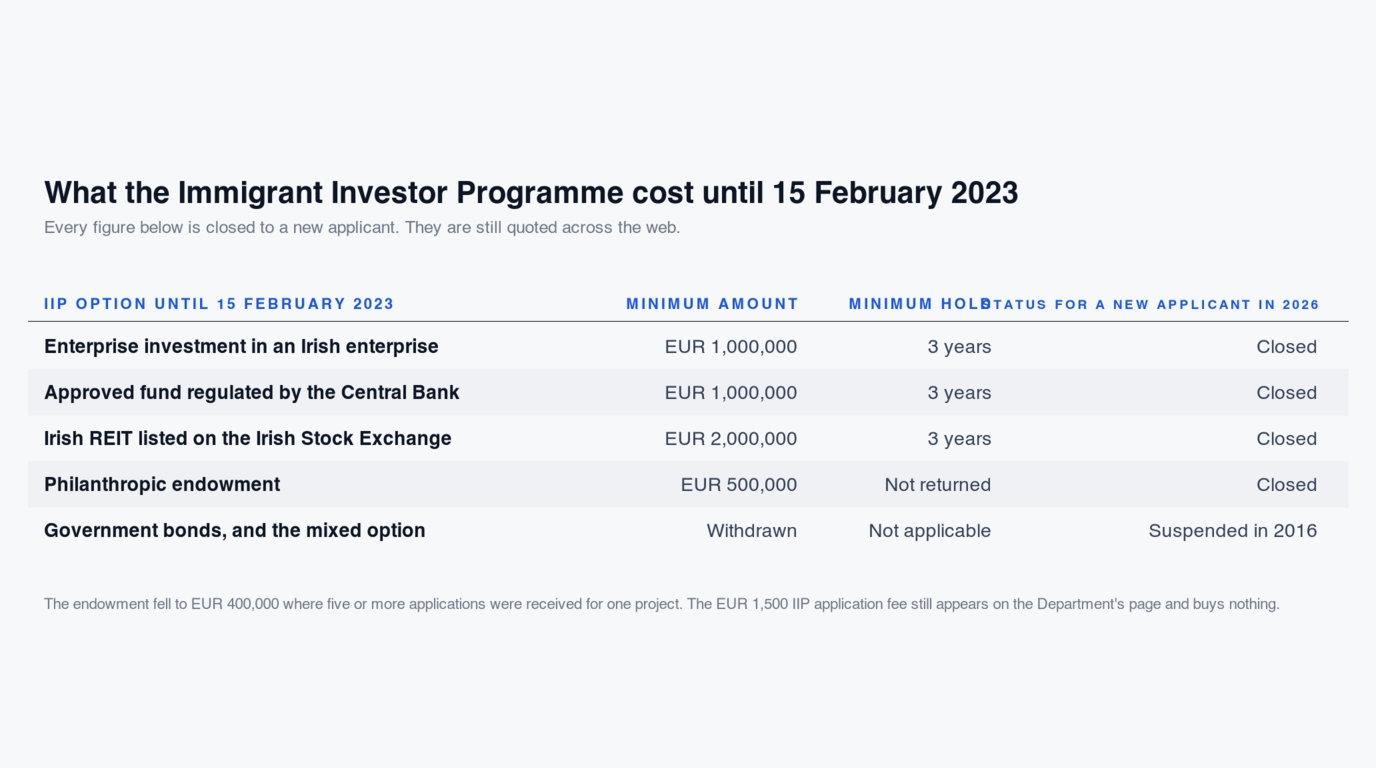
Because the figures are still quoted at you, they are worth setting out accurately once, with their status attached. The IIP required a personal net worth of at least EUR 2 million, funds from the applicant's own resources rather than a loan, and a minimum holding period of three years on every investment option. Two further options, government bonds and a mixed investment, had already been suspended in 2016 and were gone well before the programme itself.
| IIP option until 15 February 2023 | Minimum amount | Minimum hold | Status for a new applicant in 2026 |
|---|---|---|---|
| Enterprise investment in an Irish enterprise | EUR 1,000,000 | 3 years | Closed |
| Approved investment fund regulated by the Central Bank | EUR 1,000,000 | 3 years | Closed |
| Irish REIT listed on the Irish Stock Exchange | EUR 2,000,000 | 3 years | Closed |
| Philanthropic endowment to an arts, sports, health, culture or education project | EUR 500,000, or EUR 400,000 where 5 or more applications are received | Donation, not returned | Closed |
| Government bonds, and the mixed investment option | Withdrawn | Not applicable | Suspended in 2016 |
The endowment is the line that causes the most trouble now, because advisory pages describe donations to pre-approved projects as something still available in 2026. What the Department actually says is narrower: the closure does not affect existing projects, approved projects may continue to source new investors to complete funding already approved, and applications on hand at closure continue to be processed. Whether any of that is reachable by someone starting today is a question for the IIP Unit in writing, not for a comparison page. We would treat the endowment as closed.
The other number in the old fee table is the EUR 1,500 IIP application fee, non-refundable, and it is the one figure on the Department's page that is still perfectly current in form while being unusable in practice. Paying it today buys nothing, because there is no application to attach it to.
The Department's own page still invites applications
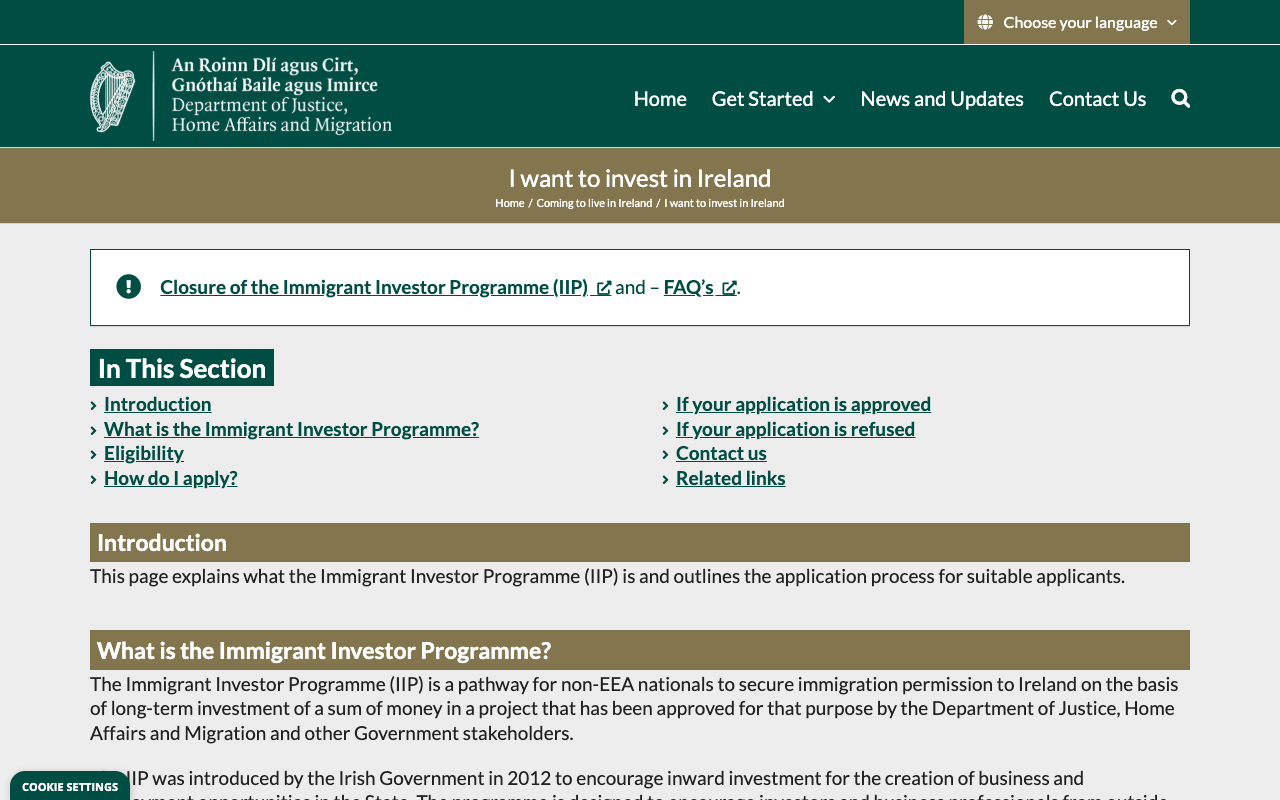
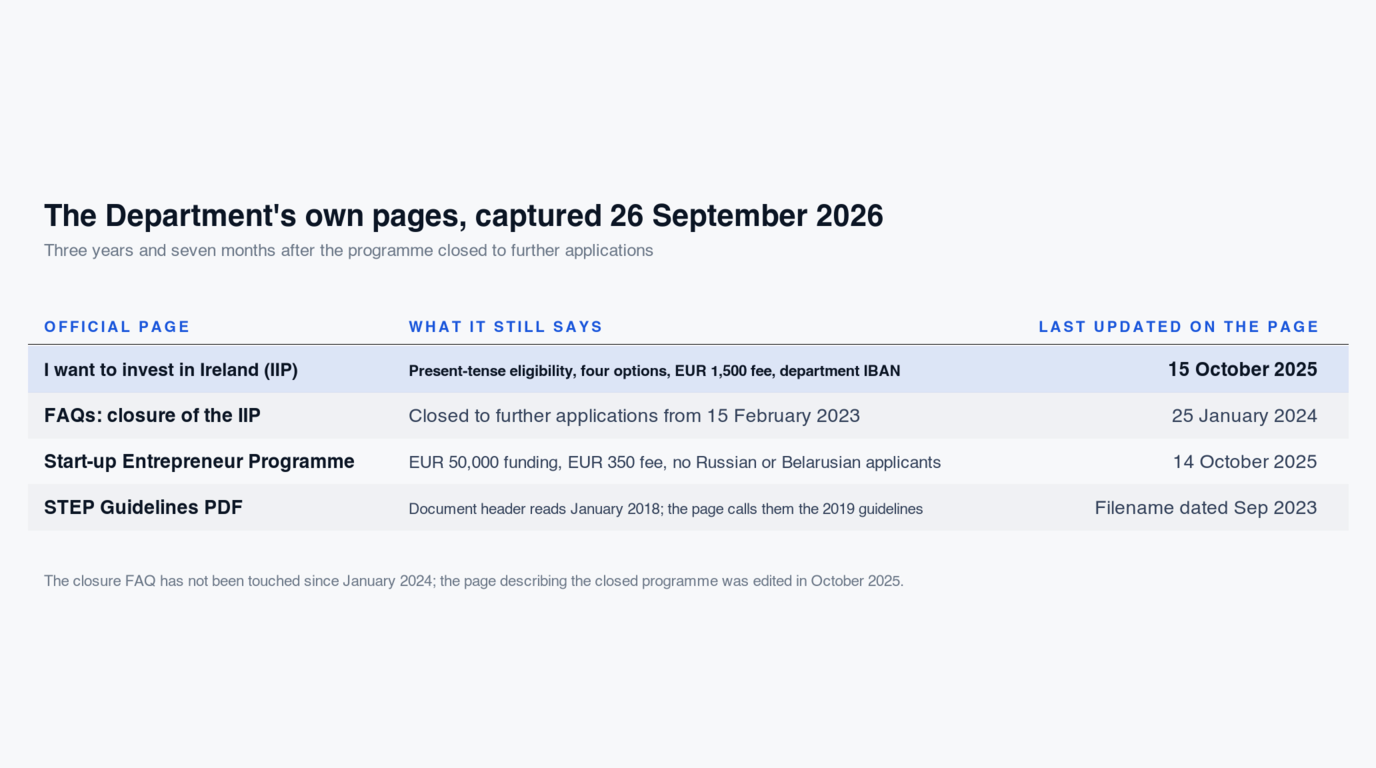
The most expensive thing about this closure is not the money, it is the paperwork trail the state has left standing. We fetched the Department's investor pages on 26 September 2026, three years and seven months after the programme closed, and the main IIP page still reads as a live product: present tense throughout, an eligibility list beginning "You may apply to become an investor in the IIP if", the four investment options laid out, the EUR 1,500 fee, and the department's IBAN and BIC for paying it. The only sign of closure is a link at the very top to the closure FAQ.
| Official page, captured 26 September 2026 | What it still says | Last updated on the page |
|---|---|---|
| I want to invest in Ireland (IIP) | Present-tense eligibility, four investment options, EUR 1,500 fee, department IBAN | 15 October 2025 |
| FAQs: closure of the IIP | Closed to further applications from 15 February 2023 | 25 January 2024 |
| Start-up Entrepreneur Programme (STEP) | EUR 50,000 funding, EUR 350 fee, no applications from Russian or Belarusian citizens | 14 October 2025 |
| STEP Guidelines PDF linked from that page | Document header reads January 2018; the page calls them the 2019 guidelines | Filename dated September 2023 |
Read the second and third rows together and the picture is clear enough: the closure FAQ has not been touched since January 2024, while the page describing the closed programme was edited in October 2025. That is not a website catching up slowly. It is a live page for a dead programme, and it is the single best explanation for why so many commercial guides still present the IIP as buyable. One of the better-trafficked ones we checked while researching this article describes the IIP as active in 2026 and gives you the four options and the EUR 1,500 fee with no closure notice at all.
The working rule is the one we apply to every programme we price: treat the statute or the ministerial decision as current and the topic page as historical. A page last edited in October 2025 cannot tell you whether a programme closed in February 2023 unless it says so, and this one does not. Our golden visa cost comparison dates every figure to the instrument it came from for exactly this reason, and Latvia is the other current example of a migration authority whose own pages outlived the routes they describe.
The EUR 50,000 STEP route, priced line by line
The Start-up Entrepreneur Programme is the only investment-linked route a new applicant can actually file, and it is cheap by the standards of this category. You need EUR 50,000 of funding available for the business proposal, evidence of where that funding came from, evidence of good character, and an innovative business idea. The application fee is EUR 350, non-refundable, paid by electronic transfer with your passport number as the reference, and the file is not processed until the fee clears in full.
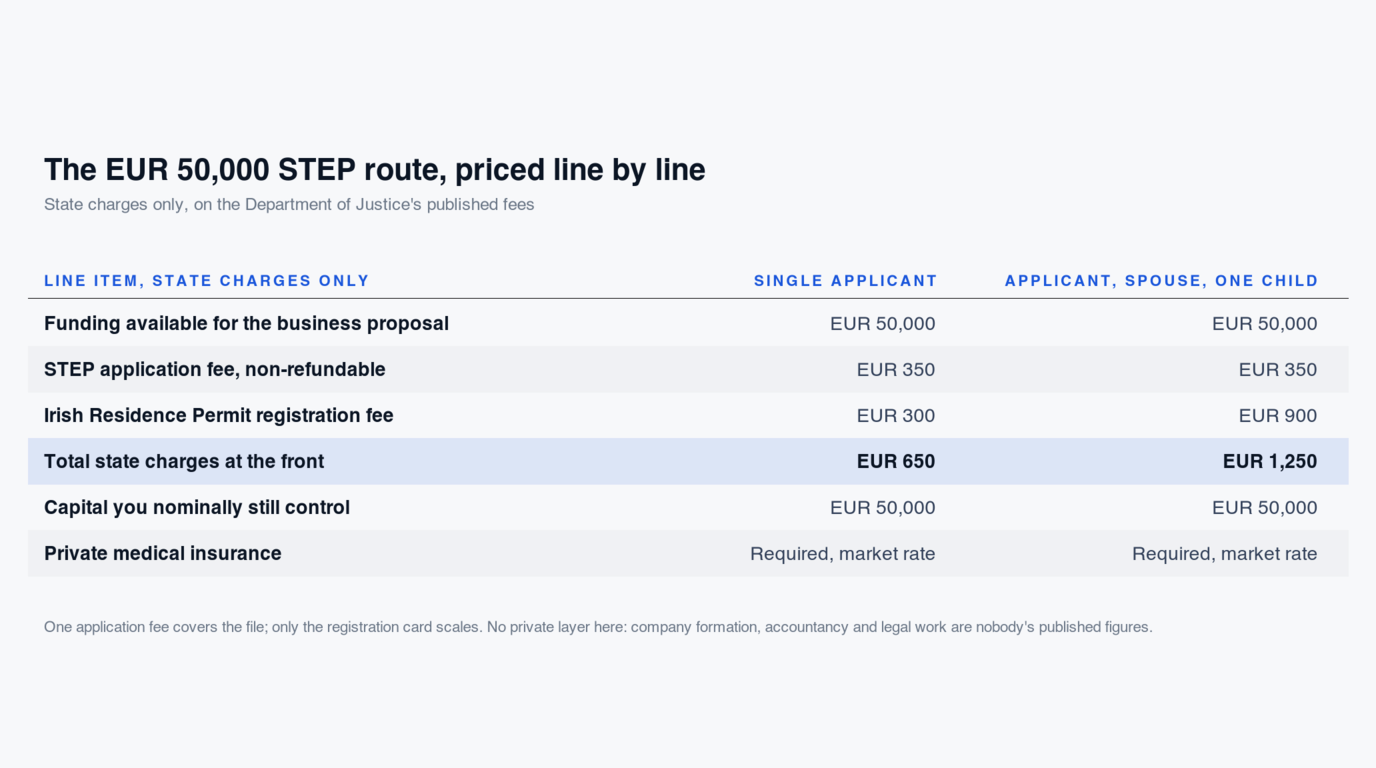
What almost nobody budgets is the layer after approval. Registering the permission that follows means an Irish Residence Permit card, and the registration fee is EUR 300 per person. Here is the whole state bill for a single founder and for a founder bringing a spouse and one child, on the published fees.
| Line item, state charges only | Single applicant | Applicant, spouse, one child |
|---|---|---|
| Funding you must have available for the business | EUR 50,000 | EUR 50,000 |
| STEP application fee, non-refundable | EUR 350 | EUR 350 |
| Registration fee for the Irish Residence Permit card | EUR 300 | EUR 900 |
| Total state charges at the front | EUR 650 | EUR 1,250 |
| Capital you nominally still control | EUR 50,000 | EUR 50,000 |
| Private medical insurance | Required, market rate | Required, market rate |
The middle rows are our arithmetic from the published fee schedule on the assumption that each family member registers and pays the EUR 300 in the normal way; the EUR 50,000 and the EUR 350 are the Department's own figures. Family members do not need their own funding, which is what makes this route unusually cheap for a household: one application fee covers the file, and the only thing that scales is the registration card. Note that EUR 650 of hard state cost against a EUR 50,000 commitment is a different shape of deal from anything else in this category.
What the table deliberately leaves out is the private layer, because no authority publishes it and we are not going to invent it: company formation, an accountant, legal work on the proposal, private medical insurance for everyone on the permission, and whatever an adviser charges to assemble the file. Insurance is a condition of the permission rather than a nice-to-have, so ask for it as a separate quoted line the way our golden visa health insurance requirements guide suggests. One figure we will not repeat is the extra EUR 30,000 per additional founder that several advisory pages state: it does not appear in the guidelines the Department publishes, so confirm it with the unit before you plan around it.
What STEP will not do for you
The EUR 50,000 is the cheapest part of this route and the least of the obstacles, which is the opposite of how a golden visa works and the reason STEP is not a golden visa. The programme is built to support a High Potential Start-Up, and the Department's definition is specific: a venture introducing a new or innovative product or service to international markets, capable of creating ten jobs in Ireland and EUR 1 million in sales within three to four years, led by an experienced management team, headquartered and controlled in Ireland, and less than six years old.
The exclusions are equally specific. The scheme is not intended for retail, personal services, catering or similar businesses, and the guidelines say plainly that domestically oriented business areas such as retail or hospitality are not appropriate. Nor is this a passive holding: the conditions of permission require you to establish the business as described, work on it full time, and not be employed in any other capacity. There is no version of this route where you invest, leave, and collect a residence card.
The process has real gatekeeping in it too. Applications can be filed electronically at any time, but proposals go to an independent evaluation committee of senior public and civil servants that sits quarterly and makes recommendations to the Minister. A refusal is final and carries no review or appeal, and the EUR 350 does not come back. Lobbying or canvassing disqualifies both the applicant and the project. Since 2022 the Minister has instructed that no further applications from Russian or Belarusian citizens be accepted into the programme.
None of this is a reason to dismiss STEP; it is a reason to stop calling it a golden visa. It is an entrepreneur route with a low capital bar and a high evidentiary one, which is close to the inverse of the trade a residence-by-investment buyer is looking for. If what you actually want is optionality bought with capital rather than a business to run, Ireland does not currently sell it and our cheapest golden visa guide is the better starting point. There are also ordinary employment-permit routes into Ireland for people with a job offer, which sit outside this site's remit.
Two years, then three, then five: the ladder to citizenship
A successful STEP applicant and the nominated family members are granted residence for two years, renewable for a further three, and after that in five-year instalments. Renewal is conditional rather than automatic: the start-up must still be in place, the evaluation committee assesses whether the investment is succeeding or viable, good character must hold, and private medical insurance must be maintained with no recourse to publicly funded welfare. After five years of residence, participants become eligible for long-term residence in the State.
| Stage | Duration | Conditions to clear | State cost |
|---|---|---|---|
| First permission after approval | 2 years | Business established, worked full time, no other employment, insurance held | EUR 350 application, EUR 300 per person to register |
| First renewal | 3 further years | Start-up still in place, committee assessment, good character, insurance | Registration fee per person |
| Subsequent renewals | 5-year instalments | Same conditions, assessed again | Registration fee per person |
| Long-term residence | After 5 years of residence | Eligibility, not entitlement | Separate application |
| Naturalisation | 5 years reckonable residence in the last 9 | 1 year continuous immediately before applying, plus 4 in the previous 8 | EUR 175 application, up to EUR 950 on certification |
Citizenship is a separate statute and the guidelines say so explicitly: the programme does not provide for Irish citizenship, and a STEP holder applies under the Irish Nationality and Citizenship Acts on the same terms as anyone else. That means five years of reckonable residence out of the last nine, including one continuous year immediately before the application, a EUR 175 application fee, and a further fee of up to EUR 950 if the application succeeds. Reckonable residence is time actually spent legally resident, so a permission held by someone living elsewhere does not accumulate it.
That distinction between a residence permission and a passport is the one most worth holding on to when you read anything in this category, and it is what our citizenship by investment vs golden visa guide exists to draw. Ireland is now firmly on the residence side of it for anyone starting today, and a two-year first permission conditional on a business you must run full time is a long way from the five-year Stamp 4 the IIP used to hand an investor.
Ireland against Europe's open routes
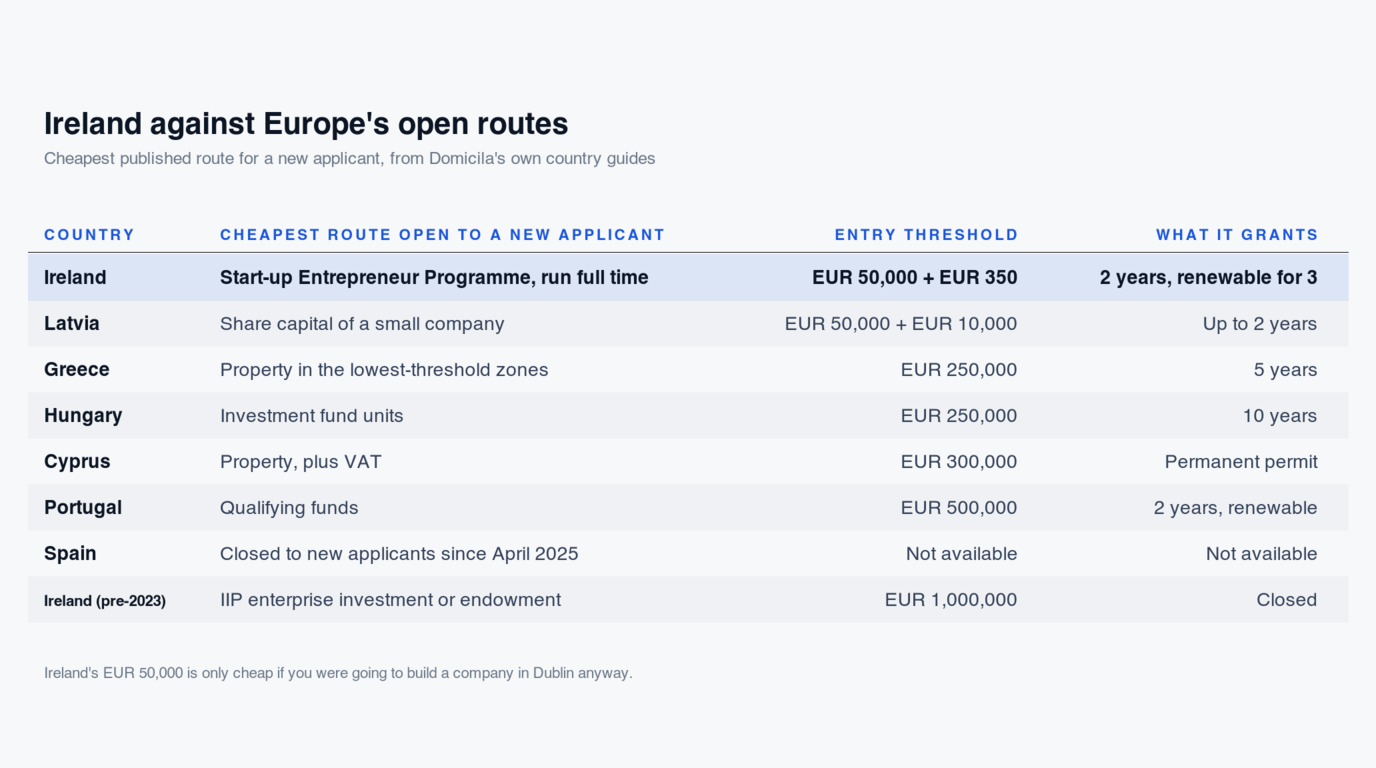
Set against what is still buyable in Europe, Ireland is not a cheap option so much as a different product: the lowest capital figure on the table below, attached to the heaviest set of ongoing conditions. The thresholds are the published figures from our own country guides; confirm any of them at source before committing, because several of these programmes changed terms in the last eighteen months.
| Country | Cheapest published route for a new applicant | Entry threshold | What it grants |
|---|---|---|---|
| Ireland | Start-up Entrepreneur Programme, business you run full time | EUR 50,000 plus EUR 350 | 2 years, renewable for 3 |
| Latvia | Share capital of a small company | EUR 50,000 plus EUR 10,000 | Up to 2 years |
| Greece | Property in the lowest-threshold zones | EUR 250,000 | 5 years |
| Hungary | Investment fund units | EUR 250,000 | 10 years |
| Cyprus | Property, plus VAT | EUR 300,000 | Permanent permit |
| Portugal | Qualifying funds | EUR 500,000 | 2 years, renewable |
| Spain | Closed to new applicants since April 2025 | Not available | Not available |
| Ireland under the IIP, until 15 February 2023 | Enterprise investment or endowment | EUR 1,000,000, or EUR 500,000 endowment | Closed |
Read the entry column against the last one. Latvia asks the same capital as Ireland and does not require you to run the company yourself, though its permit is just as short. Greece and Hungary ask five times as much and hand back five and ten years respectively with no business to operate. Cyprus issues a permanent permit for EUR 300,000 plus VAT. Against those, Ireland's EUR 50,000 is only cheap if you were going to build a company in Dublin anyway.
Our view is that Ireland belongs on a shortlist for one profile and no other: a founder with a genuinely international, innovative business who wants to be headquartered in Ireland and would pass the High Potential Start-Up test on the merits. For everyone else the search term is a dead end, and the useful move is to price the routes that are actually open rather than to wait for an Irish programme that the government has given no indication of reviving.
Related guides on Domicila
If Ireland has ruled itself out, these are the comparisons that do the most work next:
- Golden visa cost comparison — Europe's surviving programmes on published 2026 fee tables
- Golden visa countries — what is still open, and what closed in the last two years
- Cheapest golden visa — why the lowest advertised threshold is rarely the lowest real bar
- Latvia golden visa cost — the other EUR 50,000 route, without the full-time work condition
- Greece golden visa cost — the threshold zones, and what they did to the entry price
- Spain golden visa cost — the closure Ireland's most resembles, three years later
- Citizenship by investment vs golden visa — residence and a passport are not the same purchase
Common questions
How much does the Ireland golden visa cost in 2026?
There is no Irish golden visa to buy in 2026, so there is no price. The Immigrant Investor Programme, which was what the search term referred to, closed to further applications at close of business on 15 February 2023 and has not been replaced. The only investment-linked residence route a new applicant can file is the Start-up Entrepreneur Programme, which requires EUR 50,000 of funding available for an innovative business proposal and a non-refundable application fee of EUR 350. Registering the permission that follows costs a further EUR 300 per person for the Irish Residence Permit card.
Is the Irish Immigrant Investor Programme really closed?
Yes. The Minister for Justice obtained government approval on 14 February 2023 to close the programme to further applications from close of business the following day, 15 February 2023, and the Department's closure FAQ confirms it. The confusion comes from the Department's own investor page, which was still written in the present tense, still listed the four investment options and still published the EUR 1,500 application fee with the department's bank details when we checked it on 26 September 2026, under a last-updated stamp of 15 October 2025.
Can I still make a EUR 500,000 endowment to get Irish residency?
We would treat that as closed and confirm it in writing before acting on anything else. The endowment was one of the four IIP options, at EUR 500,000, or EUR 400,000 where five or more applications were received for the same project. What the Department says now is that the closure does not affect existing projects, that already-approved projects may continue to source investors to complete funding previously approved, and that applications on hand at closure continue to be processed. Whether a person starting today can reach any of that is a question for the IIP Unit, not for a comparison page.
What replaced the Immigrant Investor Programme in Ireland?
Nothing replaced it. The Start-up Entrepreneur Programme was already running when the IIP closed, having been established in the same year, 2012, and the closure announcement said it would continue. It is not a substitute for a residence-by-investment route: it requires an innovative business aimed at international markets, full-time work on that business, no other employment, and assessment by an independent evaluation committee that sits quarterly. The government has given no indication of a new investor programme.
How much funding does the Start-up Entrepreneur Programme require?
EUR 50,000 must be available for the business proposal, and you must evidence both the funding and where it came from. Several advisory pages add a further EUR 30,000 of funding for each additional founder, such as a second director or chief technology officer, but that figure does not appear in the guidelines the Department publishes, so confirm it with the unit rather than budgeting on it. The application fee itself is EUR 350 and is not refunded if the application is unsuccessful.
How long does a STEP residence permission last?
Two years initially, for the applicant and the nominated family members, renewable for a further three years, and thereafter in five-year instalments. Renewal is conditional on the start-up remaining in place, an evaluation committee assessment of the success or viability of the investment, continued good character, and maintained private medical insurance with no recourse to publicly funded welfare. After five years of residence, participants become eligible to apply for long-term residence in the State.
Does the Irish start-up route lead to citizenship?
Not by itself. The guidelines state that the programme does not provide for Irish citizenship, and a holder applies for naturalisation under the Irish Nationality and Citizenship Acts on the same terms as any other resident. That normally means five years of reckonable residence within the previous nine years, including one continuous year immediately before the application, a EUR 175 application fee, and a further fee of up to EUR 950 if the application is granted. Reckonable residence counts time actually lived in Ireland under a qualifying permission.
Which family members can come on an Irish STEP permission?
A successful applicant's spouse, civil partner or partner and dependent children under 18 can be granted residence alongside them, and the guidelines note that where family members are granted residency their status follows the main applicant's for as long as the criteria are met. Children between 18 and 24 will be considered in certain cases. The family members do not need funding of their own, but each person registering pays the EUR 300 Irish Residence Permit fee, and private medical insurance is required for everyone on the permission.
Official sources to verify
- Minister Harris announces closure of the Immigrant Investor Programme, 14 February 2023Department of Justice, Home Affairs and Migration, Ireland
- I want to invest in Ireland: Immigrant Investor Programme (page last updated 15 October 2025)Immigration Service Delivery, Department of Justice, Home Affairs and Migration, Ireland
- FAQs: Closure of the Immigrant Investor Programme (IIP)Immigration Service Delivery, Department of Justice, Home Affairs and Migration, Ireland
- Start-up Entrepreneur Programme (STEP) (page last updated 14 October 2025)Immigration Service Delivery, Department of Justice, Home Affairs and Migration, Ireland
- Start-up Entrepreneur Programme Guidelines (document dated January 2018)Irish Naturalisation and Immigration Service, Ireland
- Registering your immigration permission for the first time: required documents and registration feesImmigration Service Delivery, Department of Justice, Home Affairs and Migration, Ireland
- Becoming an Irish citizen through naturalisation: application and certification feesCitizens Information Board, Ireland
- Coming to set up a business or invest in IrelandCitizens Information Board, Ireland
Compare golden visa advisors
Ask for a route-specific quote that separates investment amount, government fees, legal work, fund or property costs, and renewal obligations.
We may earn a referral fee if you choose an advisor through this site. We still aim to show cost ranges, caveats, and official source links plainly.