hong kong investment visa cost
Hong Kong Investment Visa Cost 2026: Every Fee
The Hong Kong investment visa cost is quoted everywhere as HK$30 million, and that number is right about the threshold and wrong about the money. HK$30 million is what you must hold in qualifying assets, not what you spend: the government's own fees come to HK$1,900 per person per grant, while the expenses that feel like the cost of the visa — stamp duty, commissions, accountants' reports — are expressly excluded from the HK$30 million count, so they are cash on top. The route most comparison pages recommend, buying a flat, is the one that costs most: a HK$30 million residential purchase counts for only HK$10 million against the threshold and attracts HK$1,275,000 of ad valorem duty, so satisfying a HK$30 million requirement that way means deploying about HK$50 million. We priced every line from the Rules for the New Capital Investment Entrant Scheme, the scheme's own FAQs, the Immigration Department's specified-scheme fee structure and the Inland Revenue Department's ad valorem rate table, all read on 5 November 2026.

Key takeaways
The HK$30 million is a holding requirement, not a payment. Paragraph 3.1 of the Scheme Rules requires a minimum investment of HK$30 million Net in permissible assets, of which HK$27 million sits in financial assets or real estate and HK$3 million goes into the CIES Investment Portfolio run by the Hong Kong Investment Corporation. At the HK$7.75 to HK$7.85 band the Monetary Authority maintains, that is about US$3.8 million.
The government's immigration fees are trivial: HK$1,900 per person per grant. Since 11am on 26 February 2025 the New CIES has been a "specified scheme", so each applicant and each dependant pays a non-refundable HK$600 application fee plus a HK$1,300 visa issuance fee on any permission longer than 180 days. Three paid rounds carry a single applicant through the first eight years for HK$5,700.
Buying a flat is the expensive way in, by a wide margin. Residential real estate counts toward the threshold only up to HK$10 million, and the minimum qualifying purchase is a single property at HK$30 million or more. Buy that flat and you still need HK$17 million of financial assets plus the HK$3 million portfolio placement — about HK$50 million deployed to satisfy a HK$30 million test.
Stamp duty is real money and it counts for nothing. Ad valorem duty on a HK$30 million residential purchase is HK$1,275,000 at the 4.25% band in force from 26 February 2026, and the scheme's own FAQ states that stamp duties, fees, commissions and taxes "shall not be counted as committed investment". The one piece of good news is that Buyer's Stamp Duty and the 7.5% Scale 1 rate were removed for instruments executed on or after 28 February 2024, so a non-resident buyer now pays the same duty as anyone else.
Family size changes the fees and not the threshold. A spouse and two children add HK$5,700 per paid round and nothing at all to the HK$30 million, which is the opposite of how Caribbean citizenship pricing works. Across the first eight years a family of four pays about HK$22,800 in immigration fees.
On this page
Every figure below is tied to the instrument that states it, because the problem with this subject is not that the rules are hidden — InvestHK publishes a 44-page rulebook and a long FAQ — but that the pages ranking for it stop at the HK$30 million headline. The Scheme Rules are the source for every threshold, cap and maintenance obligation; the scheme's FAQs for what does and does not count as committed investment; the Immigration Department's specified-scheme page for every fee you actually pay the government; and the Inland Revenue Department's rate table for the duty. This site's renderer does not emit heading anchors, so the list below is a map rather than jump links.
- What the Hong Kong investment visa costs in 2026
- The immigration fees are small, and they repeat
- Why the property route costs the most
- Stamp duty, and the rule that it counts for nothing
- What a family pays, and what it does not
- Where the money has actually gone
- The 1 November 2026 rule that can disqualify assets you already hold
- What is recoverable, what is locked and what is gone
- What to confirm before you commit
What the Hong Kong investment visa costs in 2026
Start by separating two numbers that every page on this subject runs together. The threshold is what you must put into qualifying assets and keep there. The cost is what leaves your account and does not come back. Hong Kong's threshold is high and its cost is unusually low, and that combination is the whole story of the programme.
The scheme is the New Capital Investment Entrant Scheme, launched on 1 March 2024 and administered jointly by the New CIES Office under Invest Hong Kong, which assesses the money, and the Immigration Department, which assesses the person. It is open to foreign nationals, Macao residents, Chinese residents of Taiwan, and Chinese nationals who hold permanent residence in a foreign country. Nationals of Afghanistan, Cuba and North Korea are excluded.
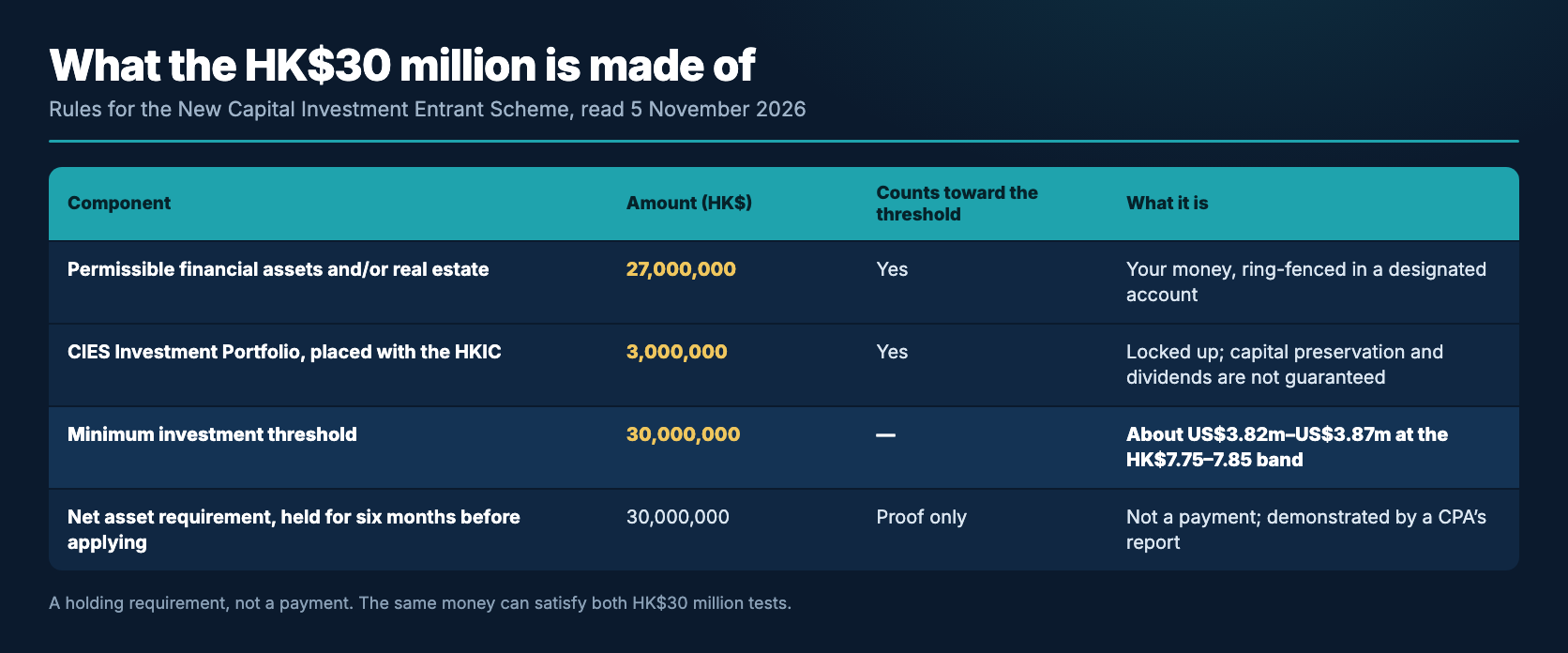
Here is what the HK$30 million is made of, and what each component is:
| Component | Amount (HK$) | Counts toward the threshold | What it is |
|---|---|---|---|
| Permissible financial assets and/or real estate | 27,000,000 | Yes | Your money, ring-fenced in a designated account |
| CIES Investment Portfolio, placed with the HKIC | 3,000,000 | Yes | Locked up; capital preservation and dividends are not guaranteed |
| Minimum investment threshold | 30,000,000 | — | About US$3.82m-US$3.87m at the HK$7.75-7.85 band |
| Net asset requirement, held for six months before applying | 30,000,000 | Proof only | Not a payment; demonstrated by a CPA's report |
The net asset requirement trips people up because it looks like a second HK$30 million. It is not: paragraph 1.17 asks you to demonstrate net assets of at least HK$30 million throughout the six months preceding the issue of your accountant's fulfillment document. The same money can satisfy both tests. What it does mean is that you cannot borrow your way to the threshold — "Net" is defined in paragraph 1.11 as the figure after deducting every charge, lien or encumbrance secured on the asset.
Timing is structured rather than fast. You engage a practising CPA at your own cost, apply for Net Asset Assessment, then lodge your entry application within 14 days of the fulfillment document being issued. Approval-in-principle admits you on visitor status for up to 180 days to make the investment; once InvestHK verifies it, formal approval brings up to 24 months, then extensions of up to three years each. Our golden visa cost comparison sets every programme's figures beside the date each was read.
The immigration fees are small, and they repeat
This is the part no comparison page prices, and it is the easiest to get exactly right because the Immigration Department publishes it as a table. From 11am on 26 February 2025, the New CIES is one of ten "specified schemes" under Schedule 2 of the Immigration Regulations, which means a two-tiered fee replaced the old flat charge:
| Item | Fee (HK$) | Who pays it |
|---|---|---|
| Application fee, non-refundable whatever the outcome | 600 | Principal applicant and each dependant, per application |
| Visa issuance fee, permission longer than 180 days | 1,300 | Each approved applicant |
| Visa issuance fee, permission of 180 days or less | 600 | Each approved applicant |
| One grant of more than 180 days, all in | 1,900 | Per person |
Two details matter more than the amounts. The application fee is charged on every application and is not refunded if you are refused, and an extension of stay is a fresh application — so the HK$1,900 is not a one-off. The initial 24-month permission and each three-year extension all sit in the longer-than-180-days tier, which gives a predictable ladder:
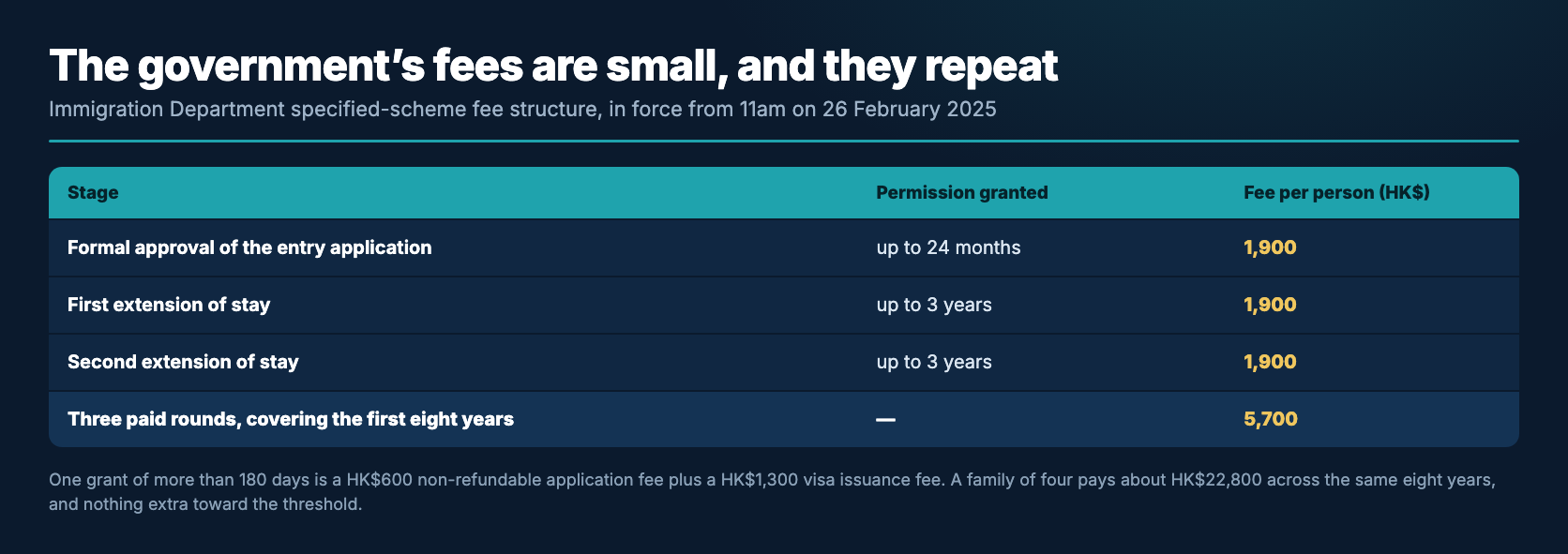
| Stage | Permission granted | Fee per person (HK$) |
|---|---|---|
| Formal approval of the entry application | up to 24 months | 1,900 |
| First extension of stay | up to 3 years | 1,900 |
| Second extension of stay | up to 3 years | 1,900 |
| Three paid rounds, covering the first eight years | — | 5,700 |
Three rounds take you past the seven-year mark that matters, because seven years of continuous ordinary residence is what opens an application to become a Hong Kong permanent resident. If you cannot meet the residence test but have complied with the portfolio rules for seven years, paragraph 4.11 lets you apply instead for unconditional stay. Note that the specified-scheme fee structure expressly excludes applications for unconditional stay, so that step is charged under the department's general fee tables rather than the HK$600-plus-HK$1,300 structure above.
Set against a HK$30 million threshold, HK$5,700 is a rounding error, and that is the point. The government is not making money from the fees; it is making the investment the price of entry, which moves the real question to what happens to your capital.
Why the property route costs the most
Hong Kong re-admitted real estate as a qualifying asset in the 2024 Policy Address, and the 2025 Policy Address loosened it again: from 17 September 2025 the minimum transaction price for a qualifying residential property fell from HK$50 million to HK$30 million, and the aggregate cap on real estate counting toward the threshold rose from HK$10 million to HK$15 million. Almost every page covering those announcements read them as a discount. Run the arithmetic and they are not.
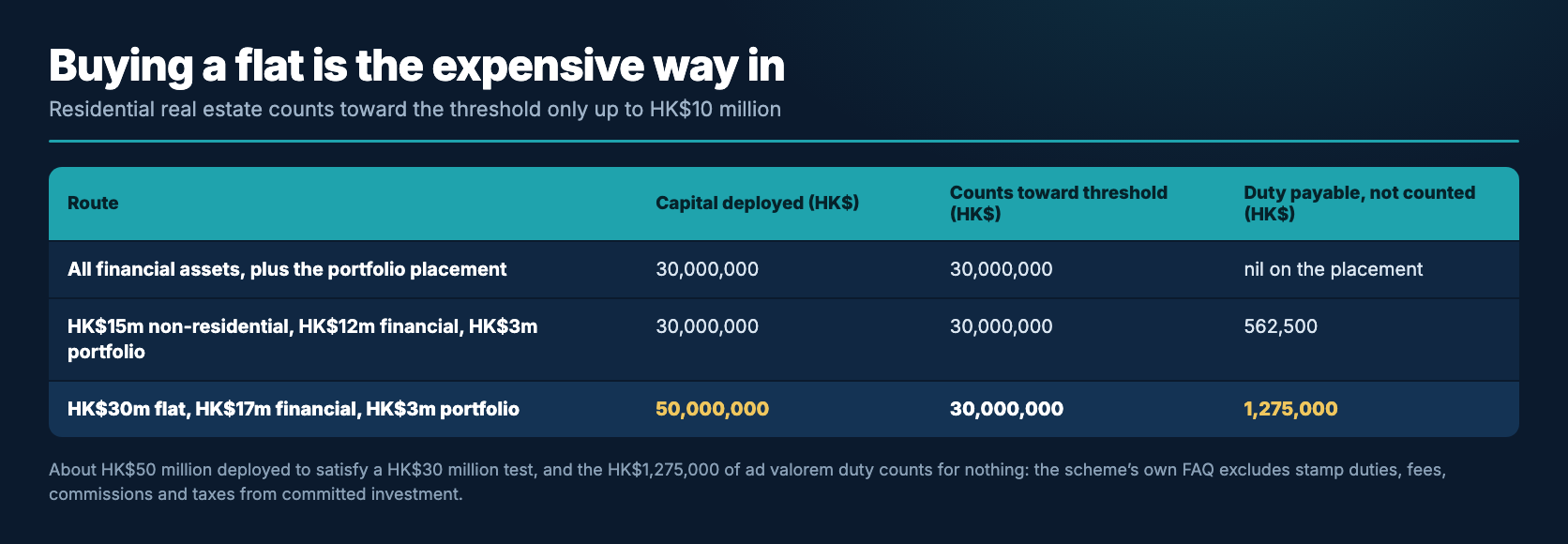
The cap is the thing. Paragraph 5.2 counts real estate toward the threshold up to an aggregate of HK$15 million, of which residential property is capped at HK$10 million — while requiring that any residential investment be a single property priced at HK$30 million or more. So the cheapest flat that qualifies at all contributes a third of its price to the test you are trying to satisfy:
| Route | Capital deployed (HK$) | Counts toward threshold (HK$) | Duty payable, not counted (HK$) |
|---|---|---|---|
| All financial assets, plus the portfolio placement | 30,000,000 | 30,000,000 | nil on the placement |
| HK$15m non-residential, HK$12m financial, HK$3m portfolio | 30,000,000 | 30,000,000 | 562,500 |
| HK$30m flat, HK$17m financial, HK$3m portfolio | 50,000,000 | 30,000,000 | 1,275,000 |
The third row is the one to sit with. Buying the minimum qualifying flat leaves you HK$20 million further from the threshold than you started, because HK$20 million of the purchase price counts for nothing, and the HK$1,275,000 of duty you pay to complete it counts for nothing either. Mixing in commercial property to reach the HK$15 million aggregate does not rescue it: you would be deploying HK$50 million for the same HK$30 million of credit.
Two further catches apply to both property routes. A mortgage reduces what counts, because "Net" means net of every charge secured on the asset, and the rules prohibit leveraging against the qualifying portfolio. Real estate also carries its own reporting: the Director-General may require a valuation, at your cost, from a valuer registered with the Hong Kong Institute of Surveyors.
Non-residential property is the better-behaved option of the two. It has no minimum price per property, no restriction on how many you buy, and it can carry the full HK$15 million aggregate on its own. If the plan is to hold Hong Kong property anyway, buy commercial; if the plan is a home, buy it with money that is not doing double duty as your qualifying investment. For a nearby programme that priced its property route the other way round, see our guide to the Singapore golden visa.
Stamp duty, and the rule that it counts for nothing
Two separate rules collide here, and together they are the largest avoidable cost in the programme. The first is in the scheme's own FAQ, under Investment Requirements, and it is unambiguous: "All fees, charges, commissions, stamp duties, taxes, levies and all other expenses incurred during the process of acquiring, disposing or realising the Permissible investment assets shall not be counted as committed investment." The second is the Inland Revenue Department's rate table.
Ad valorem duty rates changed on 26 February 2026. These are the bands that matter at the prices this scheme pushes you toward:
| Consideration or value (whichever is higher) | Residential rate | Non-residential rate |
|---|---|---|
| HK$10,080,001 to HK$20,000,000 | 3.75% | 3.75% |
| HK$20,000,001 to HK$21,739,120 | HK$750,000 + 10% of the excess over HK$20,000,000 | same |
| HK$21,739,121 to HK$100,000,000 | 4.25% | 4.25% (HK$21,739,121 and above) |
| HK$100,000,001 to HK$109,574,470 | HK$4,250,000 + 30% of the excess over HK$100,000,000 | — |
| HK$109,574,471 and above | 6.5% | — |
Applied to the two property routes, that gives HK$1,275,000 on a HK$30 million flat and HK$562,500 on HK$15 million of commercial space. Neither figure moves you a dollar closer to the threshold, and neither is refundable in any circumstance.
The genuinely good news is what is no longer charged. For instruments executed on or after 28 February 2024, residential transactions are no longer subject to Special Stamp Duty or Buyer's Stamp Duty, and the 7.5% rate under Part 1 of Scale 1 was amended down to the Scale 2 equivalent; the Stamp Duty (Amendment) Ordinance 2024 was gazetted on 19 April 2024 to give effect to it. Before that, a foreign buyer of a HK$30 million flat faced Buyer's Stamp Duty at 15% on top of the ad valorem charge. Any page quoting that combination is more than two years out of date.
One change does not reach this scheme at all: the rate on residential consideration above HK$100 million rose to 6.5% from 26 February 2026. At HK$30 million you are nowhere near it.
What a family pays, and what it does not
Dependants are where most investment-migration programmes extract their real margin, and Hong Kong is the exception worth naming. The HK$30 million threshold does not increase with family size. A single applicant and a family of four face the same investment requirement, which is the reverse of how Caribbean pricing works, where each extra person has a published price attached.
What dependants do cost is immigration fees, because each of them is a separate applicant paying the same HK$600 plus HK$1,300:
| Household | Fee per paid round (HK$) | Three rounds, first eight years (HK$) |
|---|---|---|
| Single applicant | 1,900 | 5,700 |
| Applicant and spouse | 3,800 | 11,400 |
| Applicant, spouse and one child | 5,700 | 17,100 |
| Applicant, spouse and two children | 7,600 | 22,800 |
Eligible dependants are a spouse — or the other party to a civil partnership, civil union or same-sex marriage recognised in the place of celebration — and unmarried dependent children under 18. A de facto partner, fiancé or cohabiting partner does not qualify, and the Scheme Rules say so explicitly. Entry also remains subject to the general dependant policy: genuine relationship, no adverse record, and the means to support them.
That last clause is easy to skim and does real work. Paragraph 2.1(f) requires you to show you can support yourself and your dependants without relying on any return from the permissible assets, on employment, or on public assistance. The programme is designed around someone with income from outside the ring-fenced portfolio, not someone planning to live off it. For how differently the same household is priced elsewhere in this market, compare our breakdown of citizenship by investment family cost.
Where the money has actually gone
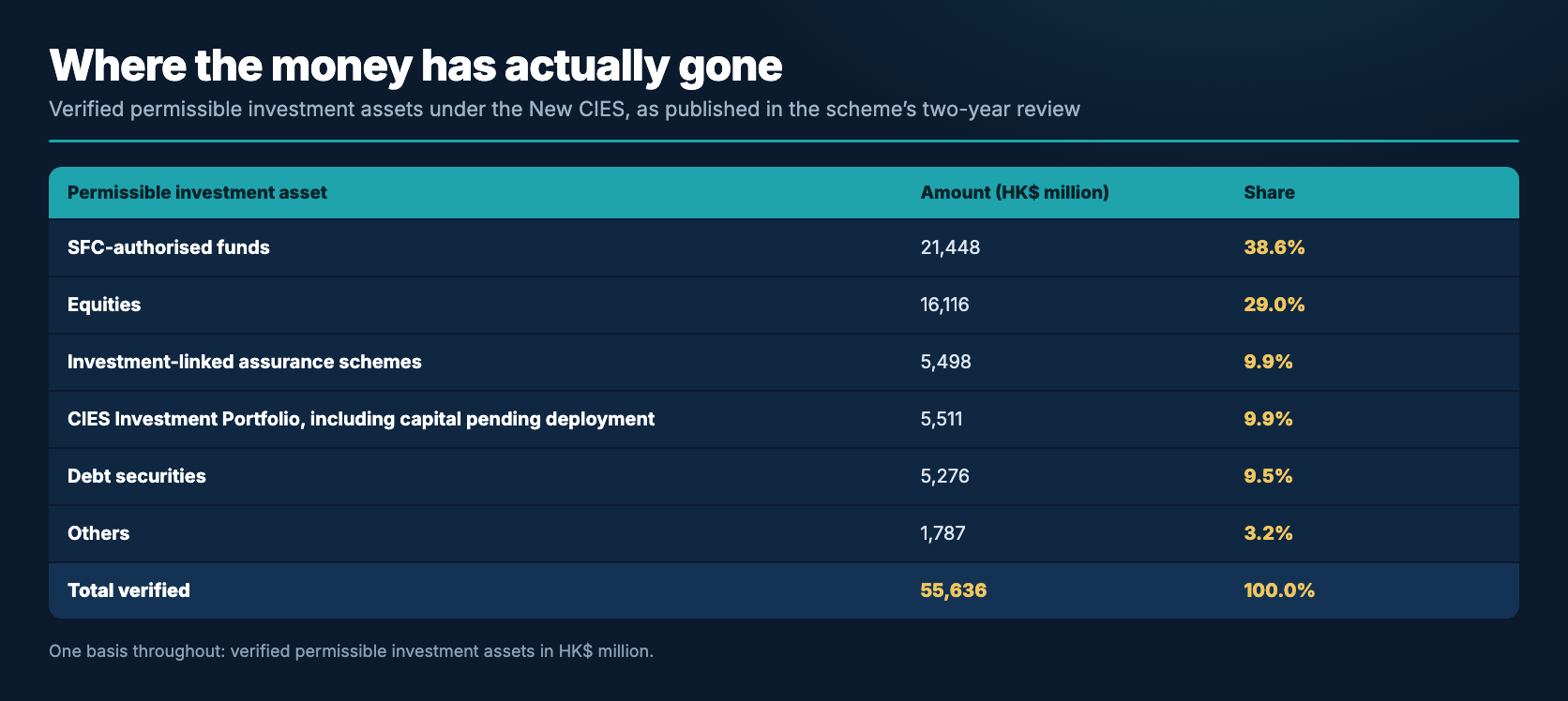
InvestHK publishes the composition of the capital it has verified, which is the only hard evidence available about how applicants are actually choosing to meet the threshold. As at 28 February 2026, two years after launch, it had received 3,166 applications, of which 1,762 had completed their investment and received formal approval, representing an anticipated HK$95 billion for the city. Second-year applications rose 145% to 2,248.
Of the HK$55.6 billion verified as meeting the investment requirements by that date, this is how it was allocated:
| Permissible investment asset | Amount (HK$ million) | Share |
|---|---|---|
| SFC-authorised funds | 21,448 | 38.6% |
| Equities | 16,116 | 29.0% |
| Investment-linked assurance schemes | 5,498 | 9.9% |
| CIES Investment Portfolio, including capital pending deployment | 5,511 | 9.9% |
| Debt securities | 5,276 | 9.5% |
| Others | 1,787 | 3.2% |
| Total verified | 55,636 | 100.0% |
Read that table against the previous two sections and it confirms the arithmetic from the other side. Real estate does not appear as a category of its own, and the only line it can be sitting inside is "Others", at 3.2% of all verified capital. Two property liberalisations in two years have not moved applicants into property, which is what you would expect of a concession capped at a third of the threshold and taxed at 4.25% on the way in.
The HK$5,511 million against the CIES Investment Portfolio is close to the HK$3 million per approved applicant you would predict from 1,762 formal approvals, and it is the one line every entrant has in common. What applicants are overwhelmingly doing otherwise is the first row of our route table: authorised funds and listed equities in a designated account. That is the cheapest way through in cash terms, and the market has worked it out even where the published guides have not.
The 1 November 2026 rule that can disqualify assets you already hold
This is the newest change and we have not found it covered anywhere outside the government's own pages. It is a four-day-old rule as this guide is published, and it can invalidate a plan that was sound in October.
The portfolio maintenance rules have always required qualifying financial assets to be held in a designated account opened with an eligible financial intermediary — an authorised institution under the Banking Ordinance, a corporation licensed for Type 1 or Type 9 regulated activity, or an insurer authorised for Class C business. Until now, assets bought elsewhere could be moved into that designated account and counted. InvestHK noticed applicants doing exactly that and closed it:
"For all applications for Net Asset Assessment submitted on or after 1 November 2026, financial assets acquired through the non-designated accounts will not be considered as meeting the Investment Requirements... transfer of financial assets from non-designated account(s) to designated account(s) will no longer be accepted. The financial assets which can be counted towards the Applicant's committed investment must be transacted through the designated account(s)."
The practical consequence is a sequencing rule: appoint your intermediary and open the designated account before you buy anything you intend to count. An existing portfolio at an overseas private bank, or even at another Hong Kong broker, is now net assets for the purposes of the net asset test and nothing more. You can hold at most three intermediaries, one from each of the three permitted categories, and the account must be in your own name or that of a qualifying holding company — of which you may have no more than three.
Three other dates are worth checking your plan against, because each one changed what counts and each applies from a different point. From 1 March 2025, investments made through an eligible wholly-owned private company began to count, and the net asset assessment was eased. From 17 September 2025, the residential threshold and the real-estate caps moved, and the rules are explicit that the new caps apply only where completion of the purchase falls on or after that date. From 1 March 2026, the conditions a holding company must satisfy were updated again. Assets acquired before the scheme's 1 March 2024 launch date never count, whatever account they sit in.
What is recoverable, what is locked and what is gone
The question worth answering before any of the fee tables is which of this money you ever see again. The Scheme Rules answer it cleanly, and the answer is better than most programmes in this market and worse than the marketing suggests.
| Money | Amount | Status |
|---|---|---|
| Immigration fees, three paid rounds, single applicant | HK$5,700 | Gone. Application fees are non-refundable whatever the outcome |
| Ad valorem duty, if you buy the HK$30m flat | HK$1,275,000 | Gone, and never counted toward the threshold |
| CPA reports: net assets, investment requirements, each anniversary | not published | Gone, and recurring annually |
| Permissible financial assets and real estate | HK$27,000,000 | Yours, ring-fenced. Market risk is yours |
| CIES Investment Portfolio placement | HK$3,000,000 | Locked for the applicable period; no capital guarantee |
| Dividends, interest and rent from the assets | — | Yours to keep, and need not be ring-fenced |
| Capital appreciation above HK$30 million | — | Cannot be withdrawn; must be reinvested under the scheme |
Two provisions in paragraph 7 define the shape of the deal. You are not required to top up if the market value of your portfolio falls below HK$30 million, "even in the event of a total loss" — an unusually generous rule, and the reason the scheme is a genuine investment rather than a disguised donation. In exchange, you may not withdraw appreciation: gains are ring-fenced and must be reinvested, with narrow exceptions for income, rent, surplus equity on real estate and the amount needed to redeem a mortgage.
The HK$3 million portfolio placement is the one line where the risk is not ordinary market risk. Paragraph 5.3.1 states that capital preservation and dividends are not guaranteed and that distributions are discretionary, and the rules note that the timing of any withdrawal after the lock-up may depend on market liquidity and on the fund managers' realisation strategy. Treat it as HK$3 million at risk with an uncertain exit date rather than as a deposit.
The ring-fence lifts in only two ways. Become a Hong Kong permanent resident after seven years of continuous ordinary residence, or be approved for unconditional stay after seven years of continuous compliance — either one leaves you free to dispose of the assets, subject to the terms of the underlying investments. Until then the portfolio stays inside the scheme. Against programmes whose whole cost is a non-refundable contribution, that makes this an expensive entry with a cheap bill; our ranking of the cheapest golden visa routes sorts this market on money you never get back rather than on the sum you have to show.
What to confirm before you commit
Five checks, in the order the money moves. First, the account. Appoint your financial intermediary and open the designated account before buying a single qualifying asset, because after 1 November 2026 nothing bought elsewhere can be transferred in and counted. Confirm in writing which of the three intermediary categories your bank falls into.
Second, the route. Price the all-financial route against the property routes before assuming the flat is the efficient option. On the published caps it is not close: the same HK$30 million of credit costs about HK$50 million of deployed capital plus HK$1,275,000 of duty on the residential route.
Third, the duty. Get the applicable rate confirmed against the instrument rather than a rate card, remembering that duty is charged on consideration or market value, whichever is higher, and that nothing you pay in duty, commission or professional fees counts toward the threshold.
Fourth, the accountant. A practising CPA's report is mandatory at net asset assessment, at investment verification, and at every anniversary of formal approval. No government document publishes what that costs, so get a quote for the whole seven-year sequence rather than for the first report, and ask whether a valuation for any unlisted asset or real estate is included.
Fifth, the residence. The scheme carries no minimum day count, but permanent residence does: seven years of continuous ordinary residence. If you do not intend to live in Hong Kong, the realistic end point is unconditional stay rather than a passport, and the two are not the same thing. On that distinction generally, see citizenship by investment vs golden visa.
Every figure here is the published number, read on 5 November 2026 from the instruments linked below; the arithmetic is ours. This scheme has been amended in some material way in each of the last three years, and the most recent change took effect four days before this guide was written, so verify each line against its source and treat the totals as planning arithmetic rather than a quote. None of this is legal, immigration or tax advice, and the New CIES is not a citizenship programme: it grants permission to stay, with permanent residence available only through the Immigration Ordinance after seven years.
Related guides on Domicila
- Golden visa cost comparison — every threshold in the currency it is actually set in, with the date each was read.
- Cheapest golden visa — this market's low end, ranked on money you never get back rather than the sum you have to show.
- Singapore golden visa — the other Asian financial centre's investment route, and how differently it prices property.
- Thailand Elite visa cost — the regional alternative that charges a fee instead of requiring an investment.
- Malaysia golden visa cost — the nearest programme built around a fixed deposit rather than a managed portfolio.
- Citizenship by investment vs golden visa — why a residence permit and a passport are priced so differently.
Common questions
How much does a Hong Kong investment visa cost in 2026?
The threshold is HK$30 million held in permissible investment assets, of which HK$3 million must be placed into the CIES Investment Portfolio. The amounts actually paid out are much smaller: HK$600 as a non-refundable application fee plus HK$1,300 as a visa issuance fee for any permission longer than 180 days, so HK$1,900 per person per grant. A single applicant pays about HK$5,700 in immigration fees across the first eight years, plus accountants' fees that no government document publishes.
Is the HK$30 million a fee or an investment?
An investment. Paragraph 3.1 of the Scheme Rules requires a minimum investment of HK$30 million Net in permissible assets, and paragraph 7.1 states you are not required to top it up if its market value falls, even in the event of a total loss. The money remains yours but is ring-fenced: you cannot withdraw appreciation above the threshold, and the ring-fence lifts only on becoming a permanent resident or being approved for unconditional stay after seven years.
Can I buy property to qualify for the Hong Kong investment visa?
Partly. Real estate counts toward the threshold up to an aggregate of HK$15 million, of which residential property is capped at HK$10 million, and any residential investment must be a single property with a transaction price of HK$30 million or more. The new caps apply only where completion of the purchase falls on or after 17 September 2025. Because of the caps, buying the minimum qualifying flat means deploying about HK$50 million of capital to satisfy a HK$30 million requirement.
How much stamp duty would I pay on a qualifying Hong Kong property?
Ad valorem duty at the rates effective from 26 February 2026 is 4.25% on consideration between HK$21,739,121 and HK$100,000,000, so HK$1,275,000 on a HK$30 million residential purchase. Non-residential property at HK$15 million falls in the 3.75% band, giving HK$562,500. The scheme's FAQ states that stamp duties, fees, commissions and other transaction expenses are not counted as committed investment, so that duty is cash on top of the HK$30 million.
Do foreigners still pay Buyer's Stamp Duty in Hong Kong?
No. For instruments executed on or after 28 February 2024, residential property transactions are no longer subject to Special Stamp Duty or Buyer's Stamp Duty, and the 7.5% rate under Part 1 of Scale 1 was amended to match Scale 2. The Stamp Duty (Amendment) Ordinance 2024 was gazetted on 19 April 2024 to give that effect. A non-permanent-resident buyer now faces the same ad valorem rate as anyone else, which in the relevant band is 4.25%.
What changed on 1 November 2026?
For all applications for Net Asset Assessment submitted on or after 1 November 2026, financial assets acquired through non-designated accounts no longer count toward the investment requirements, and transfers from a non-designated account into a designated one are no longer accepted. Anything you intend to count must be transacted through a designated account opened with an eligible financial intermediary, so the account has to exist before the purchase. Assets held elsewhere still count toward the separate net asset requirement.
How much does the Hong Kong investment visa cost for a family?
The HK$30 million threshold does not increase with family size, which is unusual in this market. Each dependant pays their own immigration fees, so a spouse and two children add HK$5,700 per paid round, bringing a family of four to HK$7,600 per round and about HK$22,800 across the first eight years. Eligible dependants are a spouse or recognised civil partner and unmarried dependent children under 18; de facto partners and fiancés do not qualify.
Does the Hong Kong investment visa lead to permanent residence?
It can, but not automatically. After seven years of continuous ordinary residence an entrant and their dependants may apply to become Hong Kong permanent residents under the Immigration Ordinance. If the residence test cannot be met while the portfolio rules have been satisfied for seven years, paragraph 4.11 allows an application for unconditional stay instead, which permits entry and stay without conditions or a limit of stay. Nothing in the Scheme Rules promises either outcome.
Official sources to verify
- Rules for the New Capital Investment Entrant SchemeInvest Hong Kong and Immigration Department
- New Capital Investment Entrant Scheme: frequently asked questionsNew CIES Office, Invest Hong Kong
- New Capital Investment Entrant Scheme: eligibility criteriaNew CIES Office, Invest Hong Kong
- Guidebook for the New Capital Investment Entrant Scheme (full version)New CIES Office, Invest Hong Kong
- Two-year milestone: nearly 3,200 applications and about HK$95 billion of expected investmentInvest Hong Kong and Immigration Department
- New fee structure for visa applications under specified schemes, from 26 February 2025Immigration Department, Hong Kong SAR
- Ad valorem stamp duty rates effective from 26 February 2026Inland Revenue Department, Hong Kong SAR
- Demand-side management measures for residential properties (SSD, BSD and NRSD)Inland Revenue Department, Hong Kong SAR
- Linked Exchange Rate System (HK$7.75-7.85 to US$1)Hong Kong Monetary Authority
Compare golden visa advisors
Ask for a route-specific quote that separates investment amount, government fees, legal work, fund or property costs, and renewal obligations.
We may earn a referral fee if you choose an advisor through this site. We still aim to show cost ranges, caveats, and official source links plainly.