malaysia golden visa cost
Malaysia Golden Visa Cost 2026: MM2H and PVIP
Nobody in the Malaysian government uses the phrase golden visa, which is why the Malaysia golden visa cost you find online is usually two numbers from two different programmes, added together by somebody who never opened either fee table. There are in fact two: Malaysia My Second Home, run by the Ministry of Tourism, Arts and Culture in four categories from a USD 32,000 fixed deposit up to USD 1 million, and the Premium Visa Programme, run by the Immigration Department, where the participation fee alone is RM 200,000. We priced both from the government's own pages and PDFs, converted every ringgit figure at Bank Negara Malaysia's published middle rate for 9 October 2026 rather than at a rate nobody names, added the two charges every competing guide leaves out, and then checked the fee schedule against the revenue the minister reported to Parliament. The arithmetic reconciles to within RM 3,000.

Key takeaways
There are two programmes, and the cheap one does not let you work. MM2H runs four categories under the Ministry of Tourism, Arts and Culture; business and employment are permissible on Platinum only. The Premium Visa Programme (PVIP), run by the Immigration Department, permits work, study and business and is the closer fit for what the market means by a golden visa.
The lowest entry price is a USD 32,000 deposit, not USD 150,000. The SEZ/SFZ category at age 50 and over asks USD 32,000 — about RM 130,800 at Bank Negara's middle rate of RM 4.0885 to the dollar on 9 October 2026 — for a 10-year renewable pass. The catch is the house: Forest City, Johor only, bought before your pass is endorsed.
Every category pays a RM 5,000 processing fee, plus RM 2,500 per dependent. It sits on MOTAC's own category matrix and on the ministry's downloadable one-page summary, and it appears on none of the cost guides we read for this piece.
Platinum's participation fee is RM 200,000 — two hundred times Silver's RM 1,000. Of the RM 5.2 million in participation fees the minister reported to Parliament for the first nine months of the current rules, roughly RM 3.8 million came from just 19 Platinum endorsements.
The compulsory house now carries 8% stamp duty for a non-citizen. Budget 2026 doubled the fixed rate from 4%, for transfer instruments executed from 1 January 2026: RM 48,000 on Silver's RM 600,000 floor, RM 160,000 on Platinum's RM 2 million. No MM2H cost table we found includes it.
On this page
This guide prices both programmes from the government's own pages, the ministry's PDFs and the Immigration Department's published FAQ, converts each ringgit figure at a dated central-bank rate, and sets the fee schedule against the uptake figures tabled in Parliament. This site's renderer does not emit heading anchors, so the list below is a map rather than a set of jump links.
- Malaysia golden visa cost in 2026: the two programmes behind the phrase
- MM2H cost by category: the official matrix
- What the government charges you, line by line
- The compulsory house is the biggest number on the page
- PVIP: the route that behaves like a golden visa
- Who is actually buying it, by category
- What none of these tables include
- Related guides on Domicila
Malaysia golden visa cost in 2026: the two programmes behind the phrase
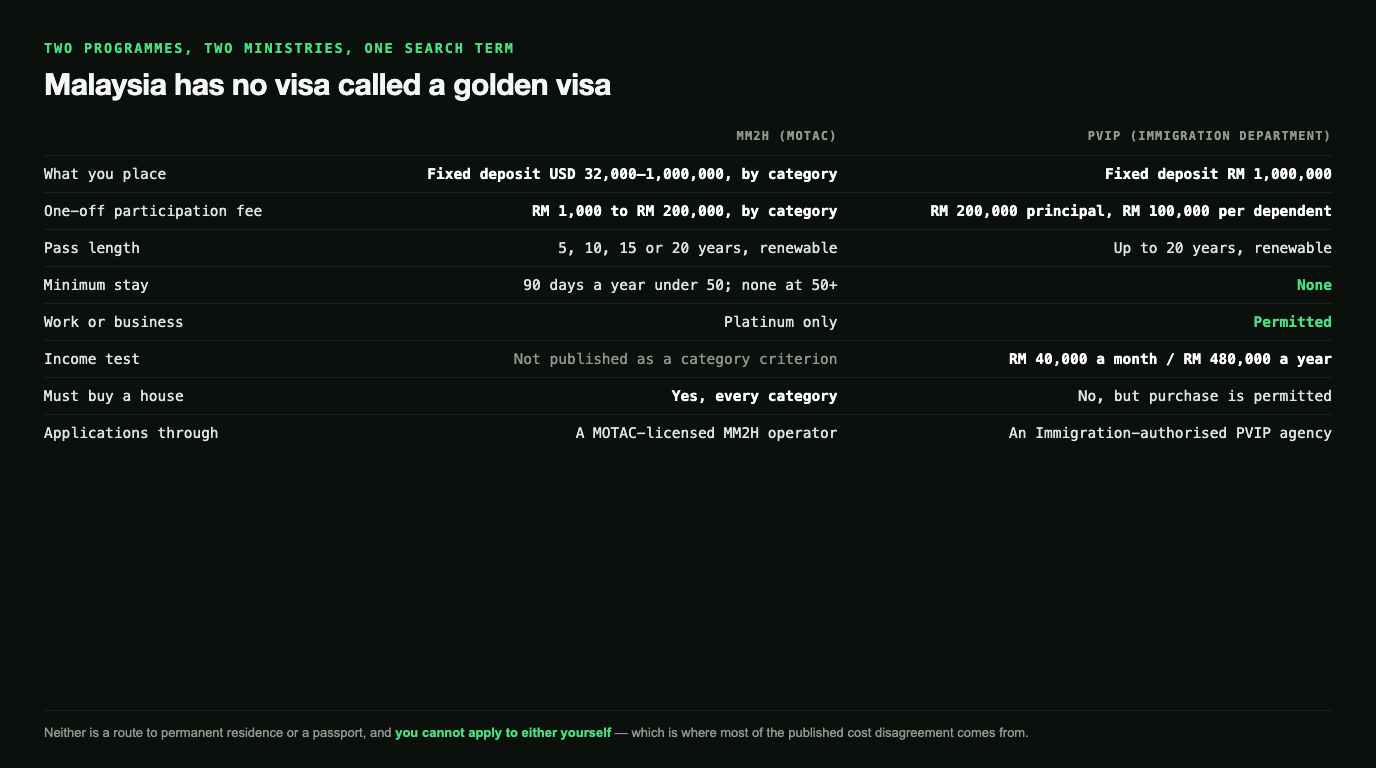
Malaysia has no visa called a golden visa. Search the term and you land on pages describing one of two separate programmes, run by two different ministries, with different fees, different rights and different application channels. Confusing them is why published figures for the Malaysia golden visa cost range from RM 1,000 to RM 200,000 without either number being wrong.
MM2H — Malaysia My Second Home — is a renewable social visit pass with a multiple-entry visa, administered by the Ministry of Tourism, Arts and Culture (MOTAC) through the One Stop Centre MM2H. It has run since 2002 and was restructured into four categories: Platinum, Gold, Silver and a Special Economic Zone / Special Financial Zone tier. PVIP — the Malaysia Premium Visa Programme — is an Immigration Department product offering up to 20 years, with no minimum stay and no age limit, and it is the one that grants the right to work.
| MM2H (MOTAC) | PVIP (Immigration Department) | |
|---|---|---|
| What you place | Fixed deposit of USD 32,000 to USD 1,000,000, by category | Fixed deposit of RM 1,000,000 |
| One-off participation fee | RM 1,000 to RM 200,000, by category | RM 200,000 principal, RM 100,000 per dependent |
| Pass length | 5, 10, 15 or 20 years, renewable | Up to 20 years, renewable |
| Minimum stay | 90 days a year under age 50; none at 50 and over | None |
| Work or business | Platinum only | Permitted |
| Income test | Not published as a category criterion | RM 40,000 a month or RM 480,000 a year |
| Must buy a house | Yes, every category | No, but purchase is permitted |
| Applications through | A MOTAC-licensed MM2H operator | An Immigration-authorised PVIP agency |
Two structural points fall out of that table before any money changes hands. Neither programme is a route to permanent residence or a passport, and MM2H's own guidelines put final immigration approval with the Ministry of Home Affairs rather than with the tourism ministry that sets the price. If a second nationality is the actual objective, our guide to citizenship by investment versus a golden visa explains why a residence pass is the wrong instrument for it.
The second point is that you cannot apply to either programme yourself. MM2H applications must be submitted through a tour operating business licensed by MOTAC under the Tourism Industry Act 1992, and PVIP applications must go through an agency appointed by the Immigration Department. Neither government publishes what those intermediaries charge, which is where most of the cost disagreement online comes from.
MM2H cost by category: the official matrix
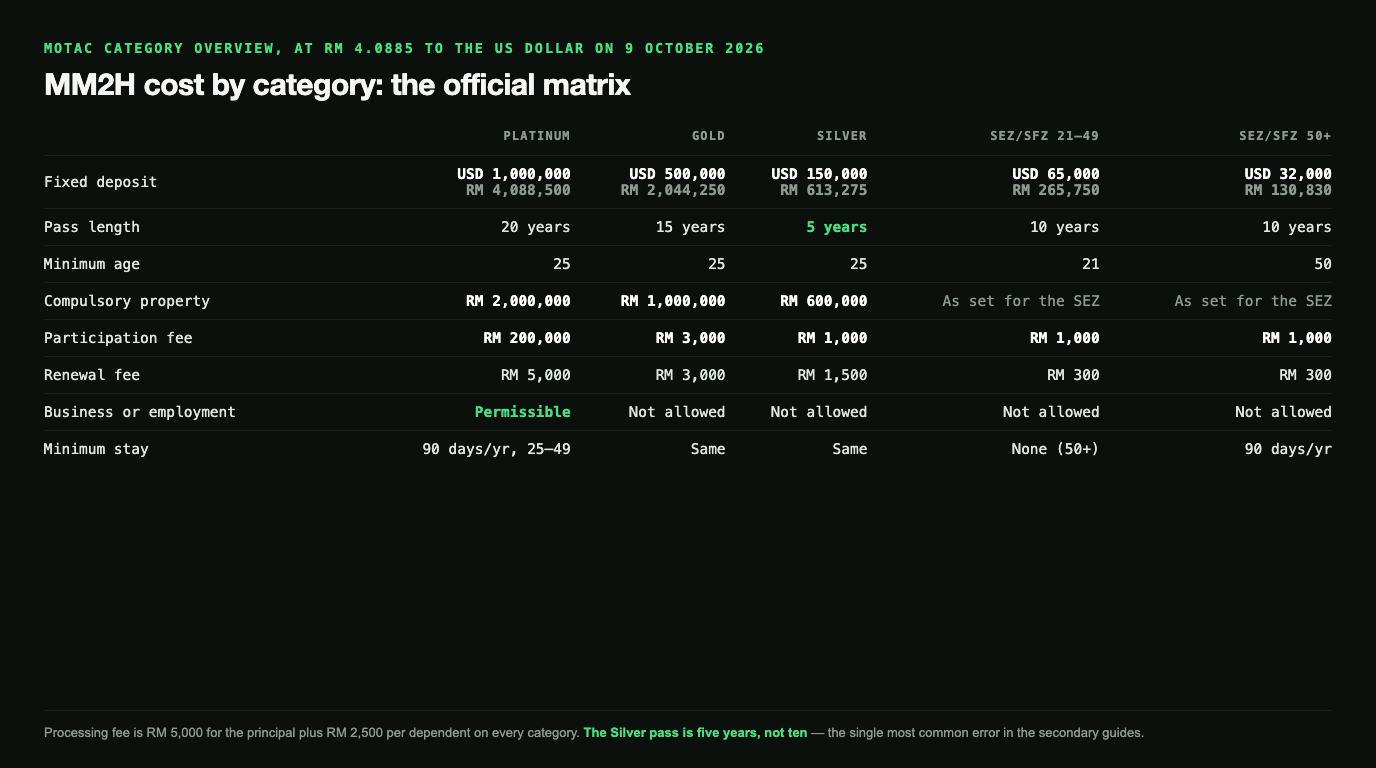
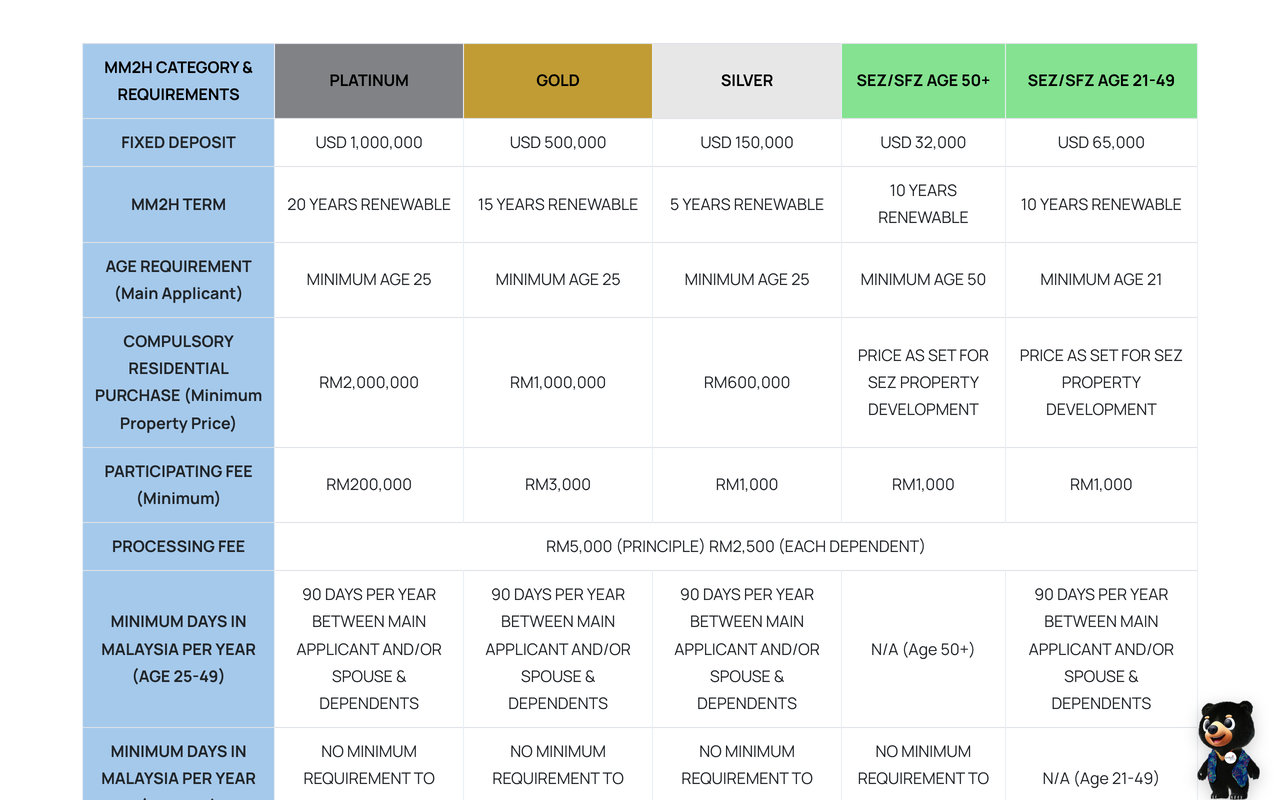
MOTAC publishes the whole category structure as a single comparison on its category overview page, and the same matrix is downloadable as a one-page PDF called Insights on The Categories. Everything below is read off those two documents, with dollar and ringgit equivalents added at the Bank Negara Malaysia middle rate of RM 4.0885 to the US dollar on 9 October 2026.
| Platinum | Gold | Silver | SEZ/SFZ age 21-49 | SEZ/SFZ age 50+ | |
|---|---|---|---|---|---|
| Fixed deposit | USD 1,000,000 (RM 4,088,500) | USD 500,000 (RM 2,044,250) | USD 150,000 (RM 613,275) | USD 65,000 (RM 265,750) | USD 32,000 (RM 130,830) |
| Pass length | 20 years renewable | 15 years renewable | 5 years renewable | 10 years renewable | 10 years renewable |
| Minimum age, main applicant | 25 | 25 | 25 | 21 | 50 |
| Compulsory property purchase | RM 2,000,000 | RM 1,000,000 | RM 600,000 | Price as set for the SEZ development | Price as set for the SEZ development |
| Participation fee, one-off | RM 200,000 (USD 48,920) | RM 3,000 (USD 730) | RM 1,000 (USD 245) | RM 1,000 | RM 1,000 |
| Processing fee | RM 5,000 principal + RM 2,500 per dependent | Same | Same | Same | Same |
| Renewal fee | RM 5,000 | RM 3,000 | RM 1,500 | RM 300 | RM 300 |
| Business or employment | Permissible | Not allowed | Not allowed | Not allowed | Not allowed |
| Minimum stay | 90 days a year, ages 25-49 | Same | Same | None (age 50+) | 90 days a year |
The Silver pass is five years, not ten. This is the single most common error in the secondary guides, and it matters: a five-year pass on a deposit of USD 150,000 and a compulsory RM 600,000 house, with a RM 1,500 fee every renewal cycle, is a materially different proposition from the ten years those guides promise. MOTAC's category page states five years renewable, and the ministry's PDF says the same.
The fixed deposit is not a cost, and it is not fully liquid either. A maximum of 50% of the principal may be withdrawn after approval, and only for buying a residence, education, medical treatment or tourism within Malaysia. The ministry's own summary sheet adds a timing qualifier the web pages omit — withdrawal allowed after one year — so treat the first twelve months as fully locked and ask the One Stop Centre to confirm your category in writing.
There is also a currency instruction most guides miss. MOTAC's May 2025 notice encourages the deposit to be placed in ringgit at a value equivalent to the US dollar figure for your category. That makes the ringgit amount you must deposit a function of the rate on the day it is placed, and it puts the currency risk on you for as long as the pass runs. Our golden visa cost comparison separates recoverable capital of this kind from fees you never see again, across every programme that publishes both.
One more eligibility note, because it changes who can bring whom: dependants may include a spouse, children under 21, children aged 21 to 34 who are unemployed and single, medically certified disabled children with no age limit, and parents or parents-in-law. A foreign domestic helper is Platinum only. The ministry's PDF gives the child ceiling as 35 while its category pages say 34, so confirm an adult child's eligibility before you file rather than after.
What the government charges you, line by line
Strip out the deposit and the house and what remains is the money that actually leaves your account for good. It is a short list, and the reason no competing guide prints it is that it is spread across three government documents rather than one.
| Charge | Amount | When |
|---|---|---|
| Participation fee, Platinum | RM 200,000 (USD 48,920) | One-off, per principal application |
| Participation fee, Gold | RM 3,000 (USD 730) | One-off, per principal application |
| Participation fee, Silver and SEZ/SFZ | RM 1,000 (USD 245) | One-off, per principal application |
| Processing fee | RM 5,000 principal, RM 2,500 each dependent | On application |
| Fixed pass fee | RM 500 per year | On each in-programme renewal |
| Visa fee | RM 0 to RM 50, by nationality | On each in-programme renewal |
| Renewal fee after the programme term ends | RM 5,000 / 3,000 / 1,500 / 300 by category | Every 5 years |
| Medical check-up at a MOTAC panel clinic | Not published | After approval, principal and dependants |
| Health insurance | Not published | Required at renewal |
No participation fee is charged for dependants on any MM2H category — a genuinely unusual piece of generosity in this sector, where a family of four normally multiplies every line. The processing fee does scale with family size, at RM 2,500 a head, so a couple with two children pays RM 5,000 plus RM 7,500, or RM 12,500 in total.
Notice the renewal arithmetic, because it is the one recurring charge and it is easy to read as trivial. A RM 500 fixed pass fee per year plus a visa fee of up to RM 50 applies while you are still inside your programme term, and the per-category renewal fee applies once that term expires. On Silver's five-year pass that is RM 2,500 in pass fees before you reach the RM 1,500 renewal; on Platinum's twenty years it is RM 10,000 before the RM 5,000.
Insurance is a requirement rather than a figure: MOTAC publishes a list of approved insurance companies and asks for health insurance at renewal, without naming a premium or a minimum cover level. That is standard across this sector, and our guide to golden visa health insurance requirements sets out what the comparable European programmes demand and what cover actually satisfies them.
The compulsory house is the biggest number on the page
Every MM2H category requires you to buy and own a residence. This is not an investment option you may take instead of something else — it is a condition of holding the pass, and MOTAC states plainly that failure to comply results in the pass being revoked. You may not sell the property for 10 years, with one exception: you may upgrade to a more expensive one.
Then there is the charge that turns a property condition into a cost. Malaysia's Budget 2026 proposed raising the fixed stamp duty rate on instruments of transfer of residential homes executed by non-citizen individuals and foreign companies from 4% to 8%, for instruments executed from 1 January 2026 (Appendix 14 of the Ministry of Finance's tax measures). MM2H participants are not citizens and not permanent residents, so this is the rate that applies to the compulsory purchase.
| Category | Minimum property price | Stamp duty at 8% | Participation + processing fee | Non-recoverable total |
|---|---|---|---|---|
| Platinum | RM 2,000,000 | RM 160,000 | RM 205,000 | RM 365,000 (USD 89,250) |
| Gold | RM 1,000,000 | RM 80,000 | RM 8,000 | RM 88,000 (USD 21,520) |
| Silver | RM 600,000 | RM 48,000 | RM 6,000 | RM 54,000 (USD 13,210) |
| SEZ/SFZ | Set by the SEZ development | 8% of the price paid | RM 6,000 | RM 6,000 plus 8% of the price |
Read that last column as the floor of what the programme costs a single applicant, not the price. It excludes the deposit, which you keep; the house, which you own; the agent, whose fee nobody publishes; and the legal and valuation work on the purchase itself. On Silver, the stamp duty alone is eight times the government's own participation and processing fees combined — which is why a cost page that itemises the RM 1,000 and skips the RM 48,000 is worse than useless.
The timing rules are category-specific and they are published in a Malay-language notice that the English guides do not appear to have read. For Platinum, Gold and Silver, participants have one year from the endorsement of the MM2H pass to complete the purchase. For SEZ/SFZ, the order reverses: you must already own or buy the property before the pass is endorsed, the purchase must be from a Forest City developer rather than from a third party, and your MM2H operator must report the transaction to the Invest Malaysia Facilitation Centre Johor.
The same notice sets the conditions for using the deposit on the house. A 50% withdrawal for a property purchase requires, on Platinum, Gold and Silver, that the purchase was made within two years before the endorsement date, and on SEZ/SFZ within six months of it — and the property's current value must still meet the category minimum. MOTAC publishes no floor price for the SEZ/SFZ category, deferring to Johor state property acquisition policy; the RM 500,000 figure circulating in agency guides appears on no government page we could open, so treat it as unconfirmed and get it in writing from the developer and the state land office.
PVIP: the route that behaves like a golden visa
If what you want is the thing the phrase describes — long residence, no stay requirement, the right to work and run a business — then PVIP, not MM2H, is the Malaysian programme to price. The Immigration Department's published FAQ sets it out: up to 20 years with a multiple-entry visa, no age limit, exemption from any minimum stay, permission to work, study, buy real estate for residential, commercial or industrial use, and to bring a spouse, children, parents and domestic helpers.
The financial test is higher and much more specific than MM2H's. You need three months of bank statements showing onshore and offshore income of RM 40,000 a month or RM 480,000 a year — or, as an alternative to proving cash flow, a total net worth of at least RM 1 billion. On top of that sits a RM 1,000,000 fixed deposit with a licensed Malaysian bank, with no withdrawal permitted against the principal until six months after your first endorsement, and then only 50%, only for real estate, medical or education, and only with a recommendation letter from Immigration.
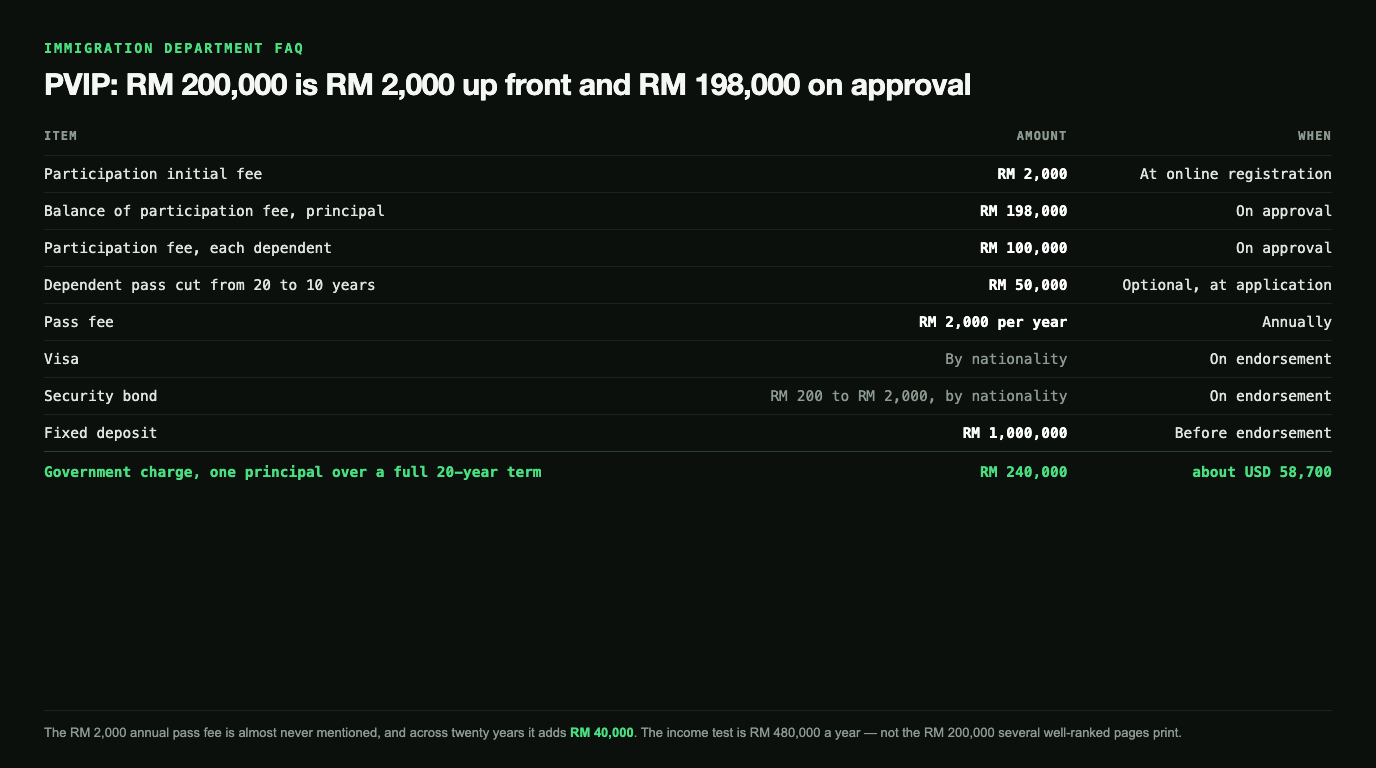
| Item | Amount | When |
|---|---|---|
| Participation initial fee | RM 2,000 | At online registration |
| Balance of participation fee, principal | RM 198,000 | On approval |
| Participation fee, each dependent | RM 100,000 | On approval |
| Dependent pass reduced from 20 to 10 years | RM 50,000 instead of RM 100,000 | Optional, at application |
| Pass fee | RM 2,000 per year | Annually |
| Visa | By nationality | On endorsement |
| Security bond | By nationality, RM 200 to RM 2,000 | On endorsement |
| Fixed deposit | RM 1,000,000 | Before endorsement |
That table is the cost most pages get wrong, in both directions. The headline RM 200,000 is real but it is RM 2,000 up front and RM 198,000 on approval, which changes what you risk if the application fails. And the RM 2,000 annual pass fee is almost never mentioned: across a full 20-year pass it adds RM 40,000, so the government's own charge for a single principal running the term is RM 240,000, or about USD 58,700 — before the visa fee and the security bond, both of which are set by nationality.
The income figure is worth checking against whatever you read elsewhere. Several well-ranked pages state PVIP requires offshore income of RM 200,000 a year. The Immigration Department's FAQ says RM 480,000 a year, and a page that is wrong by a factor of 2.4 on the central eligibility test is not a page to budget from. A family also multiplies here in a way MM2H does not: dependants pay RM 100,000 each, or RM 50,000 for a halved 10-year pass, so a couple with two children is looking at RM 500,000 in participation fees rather than RM 200,000.
For how this sits beside the region's other long-stay products, our guides to the Thailand Elite visa cost and the Indonesia golden visa cost price the nearest alternatives route by route, and Singapore's golden visa covers the Global Investor Programme at the top of the market.
Who is actually buying it, by category
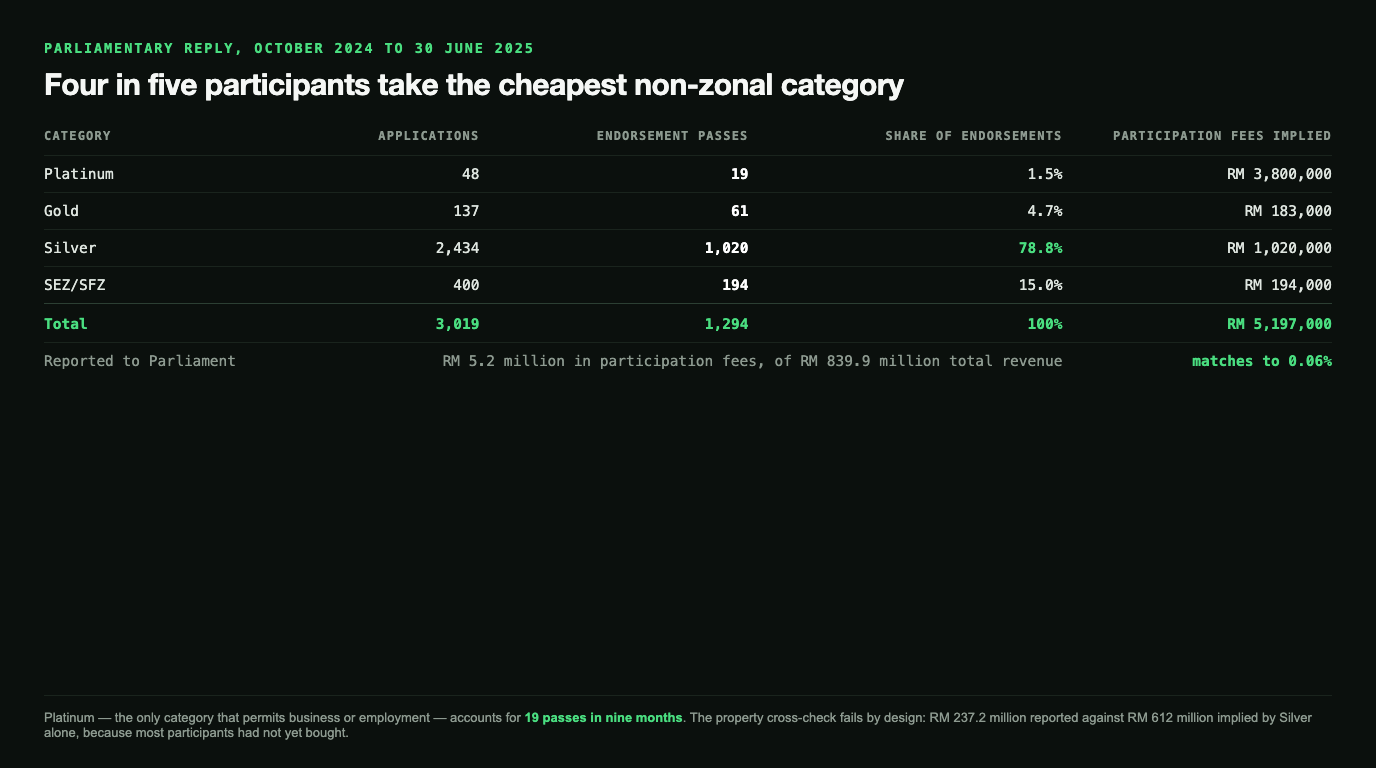
The uptake figures are public, and they say something the marketing does not. In a written parliamentary reply reported on 31 July 2025, the Tourism, Arts and Culture Minister gave the application and endorsement split for the period from October 2024, when the current categories took effect, to 30 June 2025.
| Category | Applications | Endorsement passes | Share of endorsements |
|---|---|---|---|
| Platinum | 48 | 19 | 1.5% |
| Gold | 137 | 61 | 4.7% |
| Silver | 2,434 | 1,020 | 78.8% |
| SEZ/SFZ | 400 | 194 | 15.0% |
| Total | 3,019 | 1,294 | 100% |
Four in five participants take the cheapest non-zonal category. Platinum, the only category that permits business or employment, accounts for 19 passes in nine months. Whatever the brochures imply about Malaysia competing for internationally mobile executives, the programme in practice is a USD 150,000 deposit and a RM 600,000 apartment.
The same reply put total revenue at RM 839.9 million: RM 597.5 million in fixed deposits, RM 237.2 million in property, and RM 5.2 million in participation fees. That last figure is worth doing the arithmetic on, because it is the only independent check available on the fee schedule above. Nineteen Platinum endorsements at RM 200,000 is RM 3,800,000; 61 Gold at RM 3,000 is RM 183,000; 1,020 Silver at RM 1,000 is RM 1,020,000; 194 SEZ/SFZ at RM 1,000 is RM 194,000. The total is RM 5,197,000 against RM 5.2 million reported — a match to within 0.06%, and confirmation that the published fees are the fees actually charged.
Run the same check on property and it fails, which is just as informative. The compulsory minimums imply at least RM 612 million from Silver endorsements alone, against RM 237.2 million reported for all four categories. The gap is the one-year purchase window: most of those 1,294 participants had not yet bought. The property requirement is a liability you take on at endorsement, not a payment you have already made — and it arrives with the 8% stamp duty attached.
One procedural change belongs here too. Since the ministry's notice of 28 May 2025, the Royal Malaysia Police conduct random interviews of prospective participants in addition to the existing security vetting, and the One Stop Centre has added a housing-information confirmation form. Neither carries a fee. Both lengthen the timeline, and our guide to citizenship by investment processing time explains why published timelines in this sector so rarely survive contact with a vetting queue.
What none of these tables include
Four costs are real, unavoidable and unpublished. Any total you see online that does not say which of these it excludes is an estimate dressed as a quote.
| Cost | Who sets it | Published? |
|---|---|---|
| MM2H operator or PVIP agency fee | The licensed intermediary | No — and you cannot apply without one |
| Medical check-up | MOTAC panel clinics and hospitals | No; the panel list is published, the prices are not |
| Health insurance premium | Approved insurers | No; the approved list is published, the premiums are not |
| Legal, valuation and transfer costs on the house | Market and the state land office | No; consent requirements vary by state |
The intermediary fee is the big one, and the reason it cannot be pinned down is that it is unregulated: MOTAC licenses the operators, not their pricing. Published agency quotes for the professional handling of an MM2H file run into the tens of thousands of ringgit, and they bundle different things — some include the medical, the first year of insurance, translations and the security bond, others do not. Ask for the line items, not the package price, and check which government charges from the tables above are inside it.
Two things the fee tables cannot tell you either. MOTAC states that participants receive tax exemption on foreign funds or income, including profit on the Malaysian fixed deposit — but a pass is not a tax residence position, and the country you are leaving applies its own tests regardless of what Malaysia exempts. And neither programme leads to permanent residence: MM2H is a social visit pass, PVIP is a residence pass, and both are renewable rather than permanent.
If the entry price is what is driving the decision, our cheapest golden visa guide ranks the programmes where the real floor is lowest once the sunk fees are counted, and golden visa countries tracks which programmes are open, closed, or mid-rewrite this year.
Related guides on Domicila
If Malaysia is on your shortlist, these are the comparisons that do the most work next:
- Golden visa cost comparison — every open programme priced on its current official fee table
- Cheapest golden visa — where the entry price is genuinely lowest, and what you give up for it
- Thailand Elite visa cost — the nearest regional alternative, priced per tier
- Indonesia golden visa cost — twelve badged routes, from a US$25,000 deposit upward
- Singapore golden visa — what the Global Investor Programme really asks for
- UAE golden visa cost — the ten-year permit this one is most often compared to
- Citizenship by investment vs golden visa — a passport now, or a residence pass first
Common questions
How much does the Malaysia golden visa cost in 2026?
It depends which programme you mean, because Malaysia runs two. Under MM2H the fixed deposit is USD 1,000,000 for Platinum, USD 500,000 for Gold, USD 150,000 for Silver and USD 65,000 or USD 32,000 for the SEZ/SFZ category by age, plus a one-off participation fee of RM 200,000, RM 3,000 or RM 1,000 by category, a RM 5,000 processing fee with RM 2,500 for each dependant, and a compulsory property purchase from RM 600,000 to RM 2,000,000. Under the Premium Visa Programme the government charge is RM 200,000 for the principal and RM 100,000 per dependant, plus RM 2,000 a year in pass fees, on top of a RM 1,000,000 fixed deposit. Neither total includes the licensed intermediary you are required to apply through.
What is the cheapest way to get Malaysian residency by investment?
On the published figures it is the MM2H SEZ/SFZ category at age 50 and over: a USD 32,000 fixed deposit, about RM 130,800 at Bank Negara's middle rate on 9 October 2026, a RM 1,000 participation fee and a RM 5,000 processing fee, for a 10-year renewable pass. Applicants aged 21 to 49 pay USD 65,000 on the same category. The restriction that makes it cheap is geographic: the compulsory property purchase must be in Forest City, Johor, bought from a Forest City developer rather than a third party, and completed before the pass is endorsed.
Is MM2H the same as the Malaysia golden visa?
No, although most pages use the terms interchangeably. MM2H is a renewable social visit pass administered by the Ministry of Tourism, Arts and Culture, and on three of its four categories you may not work or run a business. The Premium Visa Programme, run by the Immigration Department, is the product that behaves like a golden visa: up to 20 years, no minimum stay, no age limit, and permission to work, study, run a business and buy property. The Malaysian government does not use the phrase golden visa for either one.
Do you have to buy property to qualify for MM2H?
Yes. Purchasing and owning a residence is compulsory on every MM2H category after approval, at a minimum price of RM 2,000,000 for Platinum, RM 1,000,000 for Gold, RM 600,000 for Silver, and a price set for the SEZ development on the SEZ/SFZ category. You may not sell for 10 years, though you may upgrade to a more expensive property. Platinum, Gold and Silver participants have one year from pass endorsement to complete the purchase; SEZ/SFZ participants must already own or buy the property before endorsement.
What stamp duty does an MM2H buyer pay on the compulsory house?
A non-citizen who is not a Malaysian permanent resident pays a fixed rate of stamp duty on the instrument of transfer, and Budget 2026 doubled that rate from 4% to 8% for residential transfer instruments executed from 1 January 2026. On the category minimums that is RM 48,000 on Silver's RM 600,000, RM 80,000 on Gold's RM 1,000,000 and RM 160,000 on Platinum's RM 2,000,000. No MM2H cost table we reviewed includes it. Confirm the rate assessed on your own transaction with the Inland Revenue Board or your solicitor before you commit, because the duty is charged on the instrument rather than on the booking.
Can you work in Malaysia on an MM2H or PVIP pass?
On MM2H, only on the Platinum category: MOTAC lists business, investment activities and career opportunities as permissible on Platinum and not allowed on Gold, Silver and SEZ/SFZ. PVIP participants are permitted to work and to carry out legal business activities under Malaysian law, which is one of the main reasons to pay its higher participation fee. Dependants' rights differ again, and children on either programme may study up to tertiary level at government-recognised institutions.
Can you get the MM2H fixed deposit back?
The deposit is yours throughout — it is placed in your own account at a licensed Malaysian financial institution rather than paid to anybody — but access to it is restricted while you hold the pass. A maximum of 50% of the principal may be withdrawn after approval, and only for purchasing a residence, education, medical treatment or tourism activities in Malaysia. The ministry's own category summary adds that the withdrawal is allowed after one year. MOTAC also encourages the deposit to be placed in ringgit at a value equivalent to the US dollar figure for your category, which leaves the currency risk with you.
Does MM2H or PVIP lead to permanent residence or citizenship?
Neither does. MM2H is a social visit pass with a multiple-entry visa, renewable every five years after the category term ends, and PVIP is a residence pass of up to 20 years, also renewable. Both are held rather than owned, and both depend on continuing compliance: MM2H participants must keep the deposit in place, keep the property for 10 years and, under age 50, spend 90 cumulative days a year in Malaysia. If a passport is the objective, a residence programme of this kind is the wrong instrument and the comparison to run is against citizenship by investment, not against other visas.
Official sources to verify
- MM2H Category and RequirementsMinistry of Tourism, Arts and Culture, Malaysia
- MM2H Requirements and RegulationsMinistry of Tourism, Arts and Culture, Malaysia
- MM2H Platinum CategoryMinistry of Tourism, Arts and Culture, Malaysia
- MM2H Gold CategoryMinistry of Tourism, Arts and Culture, Malaysia
- MM2H Silver CategoryMinistry of Tourism, Arts and Culture, Malaysia
- MM2H Special Economic Zone and Special Financial Zone CategoryMinistry of Tourism, Arts and Culture, Malaysia
- Insights on The Categories (MM2H category and fee matrix)One Stop Centre MM2H, Ministry of Tourism, Arts and Culture
- Pengumuman Terkini Program MM2H (28 May 2025)One Stop Centre MM2H, Ministry of Tourism, Arts and Culture
- Frequently Asked Questions: Malaysia Premium Visa Programme (PVIP)Immigration Department of Malaysia
- Budget 2026 tax measures, Appendix 14: stamp duty on property ownership by non-citizensMinistry of Finance, Malaysia
- Exchange rates (USD/MYR middle rate)Bank Negara Malaysia
Compare golden visa advisors
Ask for a route-specific quote that separates investment amount, government fees, legal work, fund or property costs, and renewal obligations.
We may earn a referral fee if you choose an advisor through this site. We still aim to show cost ranges, caveats, and official source links plainly.