indonesia golden visa cost
Indonesia Golden Visa Cost 2026: All 12 Routes
Search the Indonesia golden visa cost and you will be told it is US$350,000, or US$2.5 million if you want to run a company. Both figures are real, and both come from the same two paragraphs of a 2023 press release that every guide has been copying since. The Directorate General of Immigration's own visa list tells a different story: twelve separate visa indices carry the Golden Visa badge, the cheapest of them asks US$25,000, and one of them asks for no investment at all beyond a deposit you keep in your own bank account. We went through all twelve official index pages one at a time, pulled the itemised government fee from each, converted it at Bank Indonesia's published rate for 8 October 2026 rather than at whatever the rupiah was worth when the last guide was written, and then checked the ministry's own issuance data to see which of these routes anybody is actually using.

Key takeaways
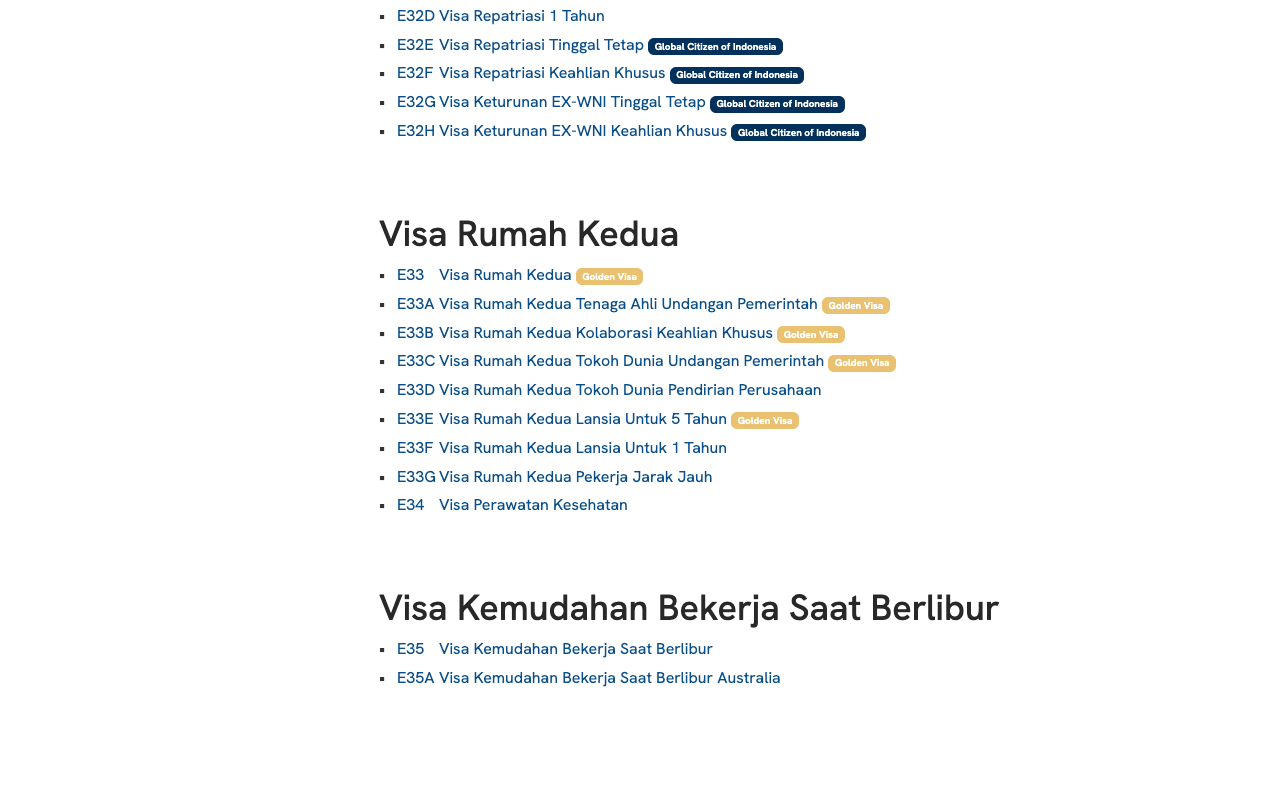
Twelve visa indices carry the Golden Visa badge, not two. Immigration's own Indonesian Visa List marks E28B, E28C, E28D, E28F, E28G, E32A, E32B, E33, E33A, E33B, E33C and E33E as Golden Visa. Most competing pages cover the five E28 investor indices and stop.
The cheapest Indonesia golden visa cost is US$25,000, not US$350,000. That is the E32A repatriation route for former Indonesian citizens. The E32B descendant route asks US$30,000 for five years or US$60,000 for ten, and both are badged Golden Visa on the official list.
Government fees are fixed in rupiah, so they have fallen in dollars. IDR 13,000,000 for a five-year permit and IDR 19,500,000 for ten years work out at US$727 and US$1,090 at Bank Indonesia's JISDOR rate of Rp17,890 on 8 October 2026. The US$798 and US$1,197 figures still circulating imply a rate near Rp16,290.
The US$350,000 route is a rounding error in the programme. Of the Rp 52.1 trillion the ministry reports to 18 May 2026, the individual capital-market category (E28C) accounts for Rp 179.4 billion — 0.34%. Corporate investors under E28D supplied 97.7%.
The retiree route needs no investment, only a deposit you still own. E33E asks for age 55 or over, a US$50,000 deposit in your own account at a state-owned bank, and evidence of US$3,000 a month in income. Nothing is donated and nothing is spent.
On this page
This guide prices every route from the Directorate General of Immigration's own index pages rather than from adviser summaries, converts each government fee at a dated central-bank rate, and sets the published thresholds against the ministry's own issuance figures. This site's renderer does not emit heading anchors, so the list below is a map rather than a set of jump links.
- Indonesia golden visa cost in 2026: every route priced
- The government fees nobody converts
- Indonesia golden visa cost for a retiree, former citizen or descendant
- What the US$350,000 route actually buys, and who uses it
- Nusantara: the threshold that was cut by 80%
- What you must keep doing, and what the visa does not give you
- Related guides on Domicila
Indonesia golden visa cost in 2026: every route priced
The legal basis is Regulation of the Minister of Law and Human Rights No. 22 of 2023 together with Regulation of the Minister of Finance No. 82 of 2023, both promulgated on 30 August 2023. The programme itself launched on 25 July 2024. Immigration does not run it as one visa with tiers; it runs it as a set of separately numbered indices, each with its own eligibility test, its own threshold and its own fee.
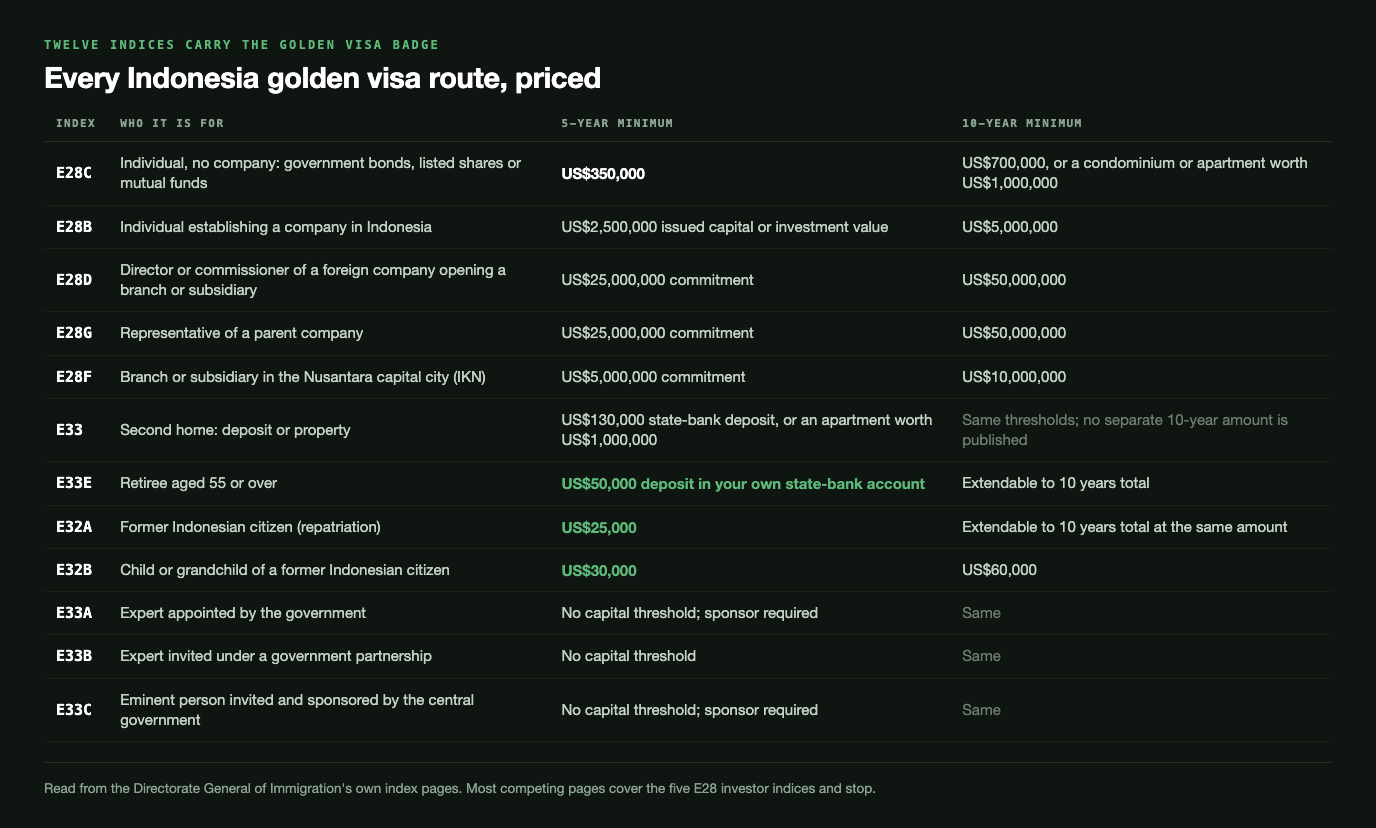
Here is the full badged set, taken index by index from the official pages. Every figure below is the minimum the relevant index page states.
| Index | Who it is for | 5-year minimum | 10-year minimum |
|---|---|---|---|
| E28C | Individual, no company: government bonds, listed shares or mutual funds | US$350,000 | US$700,000, or a condominium or apartment worth US$1,000,000 |
| E28B | Individual establishing a company in Indonesia | US$2,500,000 issued capital or investment value | US$5,000,000 |
| E28D | Director or commissioner of a foreign company opening a branch or subsidiary | US$25,000,000 commitment | US$50,000,000 |
| E28G | Representative of a parent company | US$25,000,000 commitment | US$50,000,000 |
| E28F | Branch or subsidiary in the Nusantara capital city (IKN) | US$5,000,000 commitment | US$10,000,000 |
| E33 | Second home: deposit or property | US$130,000 state-bank deposit, or an apartment worth US$1,000,000 | Same thresholds; no separate 10-year amount is published |
| E33E | Retiree aged 55 or over | US$50,000 deposit in your own state-bank account | Extendable to 10 years total |
| E32A | Former Indonesian citizen (repatriation) | US$25,000 | Extendable to 10 years total at the same amount |
| E32B | Child or grandchild of a former Indonesian citizen | US$30,000 | US$60,000 |
| E33A | Expert appointed by the government | No capital threshold; sponsor required | Same |
| E33B | Expert invited under a government partnership | No capital threshold | Same |
| E33C | Eminent person invited and sponsored by the central government | No capital threshold; sponsor required | Same |
Two things in that table are worth sitting with. The first is the spread: the same badge covers a US$25,000 bond purchase and a US$50,000,000 corporate commitment, a factor of two thousand. The second is that four of the twelve indices have no capital threshold at all — they are invitation routes, and no amount of money opens them.
The money also has to arrive on a clock. On the E28B company route the company must be established and the capital in place within 90 days, and the same 90-day deadline applies to the commitment statements on the other investor indices, counted from entry. A commitment statement is not a formality: it is the document the permit is granted against, and the index pages say the value must be maintained for as long as the stay permit is valid. If the shape of your file depends on someone else funding the placement, read our guide to source of funds in investment migration before you choose a route.
Note also what is not badged. E28A, the ordinary investor visa, is not a Golden Visa. Neither is E28E for special economic zones, E33D for distinguished entrepreneurs, E33F for one-year retirees or E33G for remote workers. The four Global Citizen of Indonesia indices (E32E to E32H) are a separate programme with its own badge on the same list, which is a distinction several guides collapse.
The government fees nobody converts
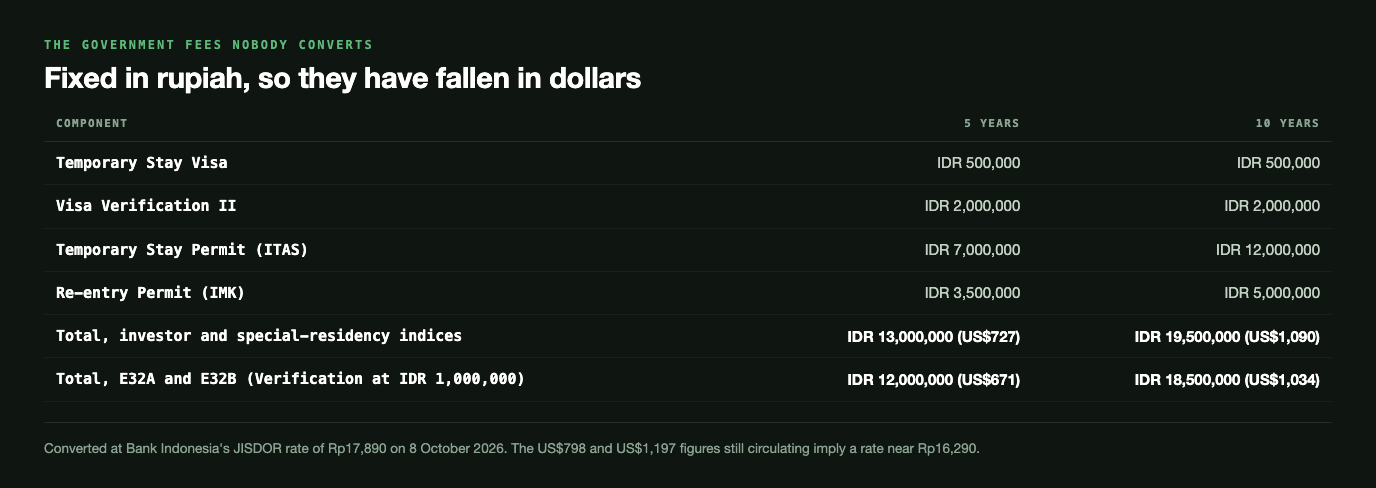
Each index page publishes its fee as a PNBP total with the components itemised underneath, and the itemisation is where the useful detail lives. The total is not uniform across the badge: the repatriation and descendant indices pay Visa Verification at IDR 1,000,000 while the investor and special-residency indices pay Verification II at IDR 2,000,000, so the five-year bill is IDR 12,000,000 on one and IDR 13,000,000 on the other.
We converted each at the Bank Indonesia JISDOR reference rate of Rp17,890 per US dollar for 8 October 2026. Quote a rupiah fee in dollars without saying which rate and which day you used and the number is already drifting.
| Component | 5 years | 10 years |
|---|---|---|
| Temporary Stay Visa | IDR 500,000 | IDR 500,000 |
| Visa Verification II | IDR 2,000,000 | IDR 2,000,000 |
| Temporary Stay Permit (ITAS) | IDR 7,000,000 | IDR 12,000,000 |
| Re-entry Permit (IMK) | IDR 3,500,000 | IDR 5,000,000 |
| Total, investor and special-residency indices | IDR 13,000,000 (US$727) | IDR 19,500,000 (US$1,090) |
| Total, E32A and E32B (Verification at IDR 1,000,000) | IDR 12,000,000 (US$671) | IDR 18,500,000 (US$1,034) |
Set against the investment, these are trivial — a four-figure cost on a six- or seven-figure placement. Set against the published guides, they are interesting for a different reason. The US$798 and US$1,197 figures that circulate for the five- and ten-year permits imply a rate of about Rp16,290 to the dollar. The rupiah has weakened since, and because the fee is denominated in rupiah, the dollar cost of an Indonesian golden visa has gone down while every published guide has left it unchanged. It is the rare case in this sector where the real number moved in the applicant's favour.
Three caveats before you budget from that table. The fees are non-refundable if the application is rejected, which the index pages state plainly. They are paid through a billing code the system issues after submission, at designated banks, so there is no card payment at the end of a form. And they cover the government's charge only — not the legal work, not the notary and company-establishment costs on the E28B route, not the audit documentation the corporate indices require, and not the cost of the investment itself. Our golden visa cost comparison separates recoverable investment from sunk fees across the programmes that publish both.
Indonesia golden visa cost for a retiree, former citizen or descendant
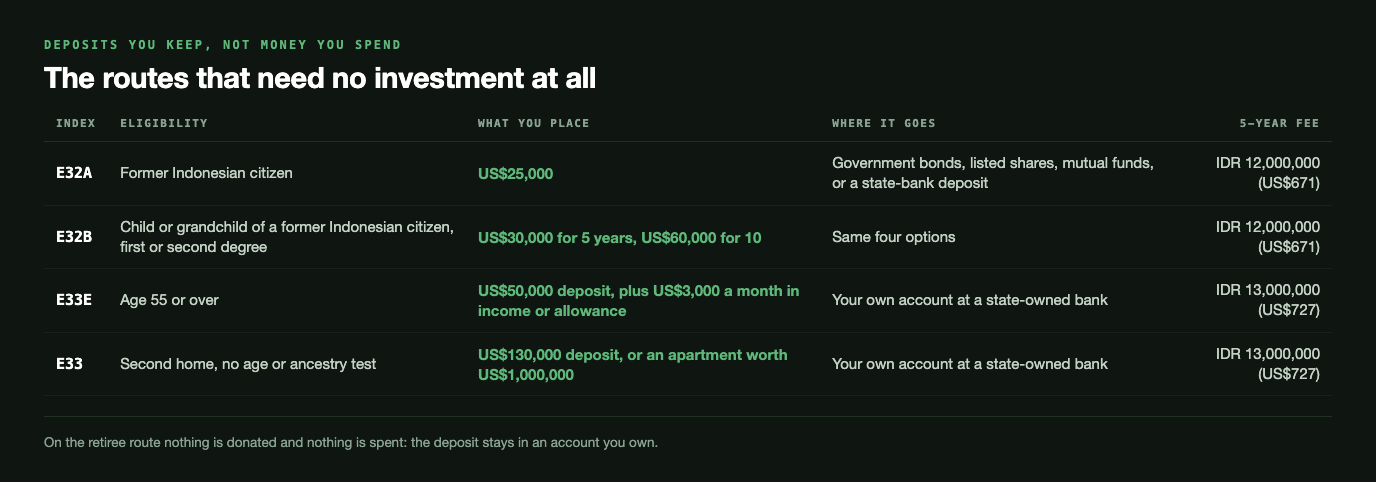
This is the half of the programme the market has not written up, and it is the half with the low numbers. Three of the badged indices are aimed at people rather than at capital, and the ministry's own category list names them in its press material: silver hair, repatriasi eks WNI and keturunan eks WNI — the retiree, former-citizen and descendant routes.
| Index | Eligibility | What you place | Where it goes | 5-year fee |
|---|---|---|---|---|
| E32A | Former Indonesian citizen | US$25,000 | Government bonds, listed shares, mutual funds, or a state-bank deposit | IDR 12,000,000 (US$671) |
| E32B | Child or grandchild of a former Indonesian citizen, first or second degree | US$30,000 for 5 years, US$60,000 for 10 | Same four options | IDR 12,000,000 (US$671) |
| E33E | Age 55 or over | US$50,000 deposit, plus US$3,000 a month in income or allowance | Your own account at a state-owned bank | IDR 13,000,000 (US$727) |
| E33 | Second home, no age or ancestry test | US$130,000 deposit, or an apartment worth US$1,000,000 | Your own account at a state-owned bank | IDR 13,000,000 (US$727) |
The E33E retiree route deserves a second look, because on the official page it is not an investment at all. The requirement is an Immigration Guarantee, satisfied by a statement of commitment to hold at least US$50,000 in the applicant's own account at a state-owned bank, reported to the issuing immigration office within 90 days of entry and maintained while the permit is valid. You have not bought anything and you have not given anything away. You have moved US$50,000 into an Indonesian bank and kept it there, and the real cost is the difference between what that money earns in Jakarta and what it would have earned at home.
The supporting documents are correspondingly light: a passport with six months' validity, evidence of the Immigration Guarantee, a three-month personal bank statement showing a balance of at least US$2,000, a recent photograph, a CV, a travel history and itinerary. No sponsor is required on E33E, E33, E32A or E32B — which is the quiet benefit of the whole badge, since an ordinary Indonesian stay permit normally needs a company or an individual to guarantee you.
One correction worth making, because it is repeated on at least one well-ranked page: the former-citizen figure is US$25,000 and the descendant figure is US$30,000, not the other way round, and the descendant route is the one that goes to US$60,000 for a ten-year permit. The two index pages state each amount four times over, once in the commitment list and once in the proof-of-ownership list for each duration. If you are weighing this against a cheaper programme elsewhere, our cheapest golden visa guide ranks the entry prices that are genuinely comparable.
What the US$350,000 route actually buys, and who uses it
E28C is the index behind every headline. You buy Indonesian government bonds, shares in publicly listed companies or mutual funds to a value of US$350,000 for five years or US$700,000 for ten, and from the ten-year tier there is an alternative: a condominium or apartment in Indonesia worth at least US$1,000,000. Note the shape of that property option — a strata-titled unit, at a million dollars, only on the ten-year tier. It is not a route into a villa, and standalone landed property is not what the index page describes.
What it buys is genuinely good: five or ten years of stay with no sponsor, family included, multiple entry and exit while the re-entry permit is valid, and — the detail returning applicants care about — no trip to an immigration office to convert the visa into a stay permit, because the ITAS and the re-entry permit are issued automatically at the border on arrival.
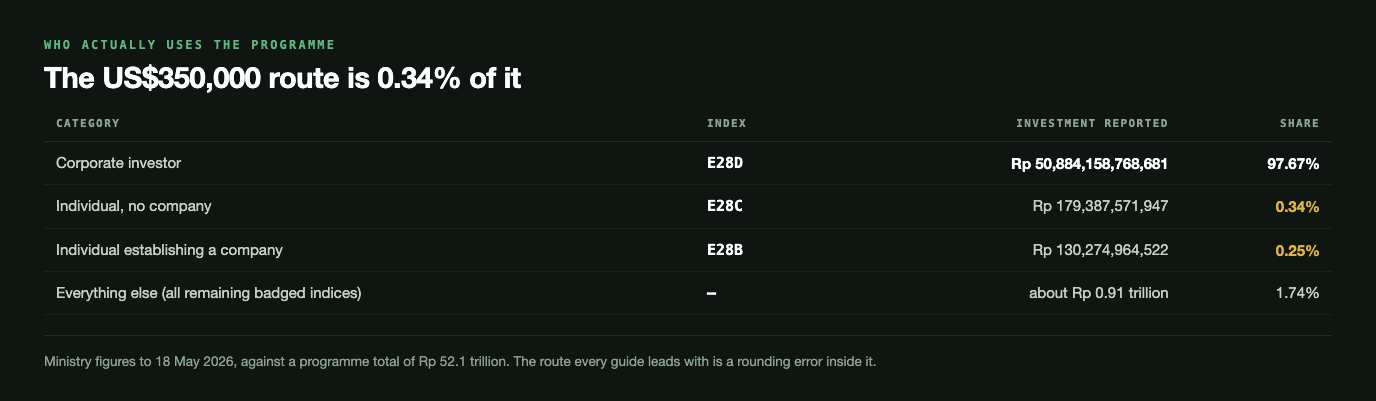
Then there is the question nobody asks. The Directorate General of Immigration published its own numbers on 21 May 2026: Rp 52.1 trillion of investment as at 18 May 2026, from 1,274 Golden Visas issued since launch. It broke the total down by index.
| Category | Index | Investment reported | Share |
|---|---|---|---|
| Corporate investor | E28D | Rp 50,884,158,768,681 | 97.67% |
| Individual, no company | E28C | Rp 179,387,571,947 | 0.34% |
| Individual establishing a company | E28B | Rp 130,274,964,522 | 0.25% |
| Everything else (all remaining badged indices) | — | about Rp 0.91 trillion | 1.74% |
Rp 179.4 billion is about US$10.0 million at the 8 October 2026 rate. At the US$350,000 minimum that is on the order of thirty people across nearly two years — and the rupiah figures were booked at the rate of the day rather than today's, so read it as an order of magnitude rather than a headcount. The entire retail market that this keyword serves, and that every page competing for it is written for, is a few dozen applicants. The programme's Rp 52.1 trillion is a corporate story: 1,274 permits over 662 days, roughly 59 a month, with 97.7% of the capital arriving through E28D.
That is not an argument against the route. It is an argument for reading the uptake figures before you believe a page telling you Indonesia is competing for your US$350,000. The three largest holder nationalities the ministry names are the United States with 160, China with 147 and Taiwan with 110. For how this sits against programmes that genuinely court individual capital, see our guides to golden visa countries and the Thailand Elite visa cost, the nearest regional alternative on price.
Nusantara: the threshold that was cut by 80%
E28F is the index for a branch or subsidiary established in Nusantara, the new capital city in East Kalimantan. It was created at the same US$25,000,000 and US$50,000,000 levels as the ordinary corporate indices. The official index page now states US$5,000,000 for five years and US$10,000,000 for ten — a reduction of 80%, reported as taking effect in January 2026.
This matters mainly as a warning about sources. A page that quotes US$25,000,000 for the Nusantara route is not describing a different interpretation; it is five times out of date, and you can settle it in one fetch of the E28F index page. We found secondary guides still carrying the old figure while linking to the page that contradicts them.
Two things to hold in mind before treating it as the cheap corporate door. The cut applies to a commitment to invest in a specific place, and reporting on it indicates eligibility is narrower than the number suggests, with the route aimed at investors affiliated with a defined list of international professional-services firms. We could not confirm that restriction from the index page itself, which states the threshold and the documentary requirements but not an affiliation test — so treat the eligibility narrowing as reported rather than as established, and ask immigration or counsel directly before committing to the route.
The government fee on E28F is the same as on every other investor index: IDR 13,000,000 for five years, IDR 19,500,000 for ten. The threshold moved by US$20,000,000 and the paperwork cost did not move at all, which is a fair summary of where the real money is in this programme.
What you must keep doing, and what the visa does not give you
A golden visa here is a stay permit, not a status you own outright. The obligations are light but they are continuing, and the first of them catches people.
| Obligation | What it means |
|---|---|
| Hold the placement | The qualifying amount must be maintained at no less than the committed value for as long as the stay permit is valid |
| Meet the 90-day deadline | Commitments must be fulfilled and reported to the issuing immigration office within 90 days of entry |
| Use the visa in time | The visa is valid for 90 days from issuance; unused, you must apply again to enter |
| Report activity changes | Work, study or other activities must be reported to the immigration office that issued the permit |
| Watch the 10-year ceiling | On the extendable indices, total stay may not exceed 10 years before conversion to another permit type |
Now the three things it does not do, because two of them change decisions.
It is not a passport, and Indonesia does not let you keep your old one. Naturalisation under Law No. 12 of 2006 requires five consecutive years of residence or ten years intermittently, and Article 9 requires an applicant to relinquish their existing nationality on acquiring Indonesian citizenship. Indonesia does not recognise dual citizenship for naturalised adults. So the end of this road is not a second passport in the sense this market usually means: it is a replacement passport, and approvals are discretionary and reportedly rare. If a second nationality is the actual objective, our citizenship by investment vs golden visa guide explains why a residence programme is the wrong instrument.
It is not a tax result. Holding the permit says nothing about where you are tax resident. Indonesia applies its own residence tests, and the country you are leaving applies its own; a permit in a drawer moves neither. Nothing in the index pages addresses tax at all, and any adviser who prices this route as a tax outcome is selling you something the regulation does not contain.
It is not an exemption from reporting. The permitted-activities lists are specific, and the prohibitions are too: no staying beyond the authorised period, no work outside what the permit allows, and on the special-residency indices no selling goods or services unless that is part of authorised employment. For the sequence an Indonesian application actually runs through, our citizenship by investment processing time guide sets published timelines against real ones across this sector.
Related guides on Domicila
If Indonesia is on your shortlist, these are the comparisons that do the most work next:
- Golden visa cost comparison — every open programme priced on its current official fee table
- Cheapest golden visa — where the entry price is genuinely lowest, and what you give up for it
- Golden visa countries — which programmes are open, closed or mid-rewrite
- Thailand Elite visa cost — the nearest regional alternative, priced per tier
- Singapore golden visa — what the Global Investor Programme really asks for
- UAE golden visa cost — the ten-year permit this one is most often compared to
- Citizenship by investment vs golden visa — passport now, or residence first
Common questions
How much does the Indonesia golden visa cost in 2026?
It depends entirely on which of the twelve badged indices you qualify for. The individual capital-market route (E28C) asks US$350,000 for five years or US$700,000 for ten, with a US$1,000,000 apartment as an alternative on the ten-year tier. Establishing a company (E28B) asks US$2,500,000 or US$5,000,000. The corporate routes (E28D and E28G) ask US$25,000,000 or US$50,000,000, and the Nusantara route (E28F) now asks US$5,000,000 or US$10,000,000. The lower end is cheaper than most pages suggest: US$130,000 on the second-home index, US$50,000 for a retiree aged 55 or over, US$30,000 for a descendant of a former Indonesian citizen and US$25,000 for a former citizen. Government fees are IDR 13,000,000 for five years and IDR 19,500,000 for ten on most indices, about US$727 and US$1,090 at the 8 October 2026 Bank Indonesia rate.
What is the cheapest Indonesian golden visa?
On the Directorate General of Immigration's own visa list, the cheapest index carrying the Golden Visa badge is E32A, the five-year repatriation visa for former Indonesian citizens, at US$25,000 placed in government bonds, listed shares, mutual funds or a state-owned bank deposit. Next is E32B for children and grandchildren of former Indonesian citizens at US$30,000 for five years. If you have no Indonesian ancestry, the cheapest routes open to you are E33E at US$50,000 if you are 55 or over, and E33 at US$130,000 with no age or ancestry test. None of these amounts is a donation — each is a placement you continue to own.
Do you need to invest to get an Indonesian golden visa?
Not on every index. Four of the twelve badged indices have no capital threshold at all: E33A and E33B for experts appointed by or partnered with the government, and E33C for an eminent person invited and sponsored by the central government. Those are invitation routes, so no amount of money opens them. On the retiree index (E33E) the US$50,000 is an Immigration Guarantee held in your own account at a state-owned bank rather than an investment in anything, alongside evidence of at least US$3,000 a month in income or allowance.
What are the Indonesian golden visa government fees?
The published PNBP total is IDR 13,000,000 for a stay permit of up to five years on the investor and special-residency indices, made up of IDR 500,000 for the Temporary Stay Visa, IDR 2,000,000 for Visa Verification II, IDR 7,000,000 for the five-year ITAS and IDR 3,500,000 for the five-year re-entry permit. Ten years costs IDR 19,500,000, with the ITAS at IDR 12,000,000 and the re-entry permit at IDR 5,000,000. The repatriation and descendant indices pay IDR 1,000,000 for verification instead of IDR 2,000,000, so their totals are IDR 12,000,000 and IDR 18,500,000. Fees are non-refundable if the application is rejected and are paid at designated banks against a billing code the system issues after submission.
Can you buy property in Indonesia to get a golden visa?
Only in a narrow form and only on one tier. The E28C index page allows a condominium or apartment in Indonesia valued at a minimum of US$1,000,000 as an alternative to US$700,000 in securities, and only for the ten-year permit. The E33 second-home index allows an apartment or condominium unit at the same US$1,000,000 value as an alternative to a US$130,000 state-bank deposit. In both cases the asset described is a strata-titled unit at a million dollars, which is a different proposition from the villa purchases often marketed alongside this visa. There is no property option at all on the five-year E28C tier.
How long does an Indonesian golden visa last and can it be extended?
The badged indices grant a stay of five or ten years depending on the tier you qualify for, counted from the date of the entry stamp at the border. The permits are extendable and may be converted to another type of temporary stay permit, but on several indices the total period of stay in Indonesia may not exceed ten years before a conversion is needed. The visa itself is valid for 90 days from issuance, which is a separate clock from the period of stay: if you do not enter within those 90 days you have to apply again.
Does the Indonesia golden visa lead to citizenship?
Not in the way this market usually means. Naturalisation under Law No. 12 of 2006 requires five consecutive years of residence or ten years intermittently, along with language ability, a clean record and a steady income, and it is a discretionary application rather than an entitlement. More importantly, Article 9 requires an applicant to relinquish their existing citizenship, and Indonesia does not recognise dual citizenship for naturalised adults. So the realistic end point of this route is long-term residence, not an additional passport held alongside your current one.
Do you need a sponsor for an Indonesian golden visa?
Not on most of them, and that is one of the programme's real advantages. The index pages state that no sponsor is required for E28B, E28C, E28D, E28F, E28G, E32A, E32B, E33 or E33E. A sponsor is required on E33A and E33C, which are government-invitation routes. An ordinary Indonesian stay permit normally needs a company or individual guarantor, so removing that requirement is a substantive change rather than a convenience, and it is why the ministry describes the programme as offering long-term stay without an Indonesian guarantor.
Official sources to verify
- Indonesian Visa ListDirectorate General of Immigration, Republic of Indonesia
- E28B Company Establishment Investor VisaDirectorate General of Immigration, Republic of Indonesia
- E28C Capital Market Investor VisaDirectorate General of Immigration, Republic of Indonesia
- E28F Nusantara Capital City Branch or Subsidiary Establishment Investor VisaDirectorate General of Immigration, Republic of Indonesia
- E32A 5-Year Repatriation VisaDirectorate General of Immigration, Republic of Indonesia
- E32B 5 or 10-Year Descendant VisaDirectorate General of Immigration, Republic of Indonesia
- E33 Special Residency VisaDirectorate General of Immigration, Republic of Indonesia
- E33E 5-Year Retiree Special Residency VisaDirectorate General of Immigration, Republic of Indonesia
- Nilai Investasi dari Golden Visa Indonesia Tembus Rp 52,1 Triliun (21 May 2026)Directorate General of Immigration, Republic of Indonesia
- Regulation on Golden Visa Launched, Attract Foreign Investors to IndonesiaDirectorate General of Immigration, Republic of Indonesia
- JISDOR USD/IDR reference rateBank Indonesia
Compare golden visa advisors
Ask for a route-specific quote that separates investment amount, government fees, legal work, fund or property costs, and renewal obligations.
We may earn a referral fee if you choose an advisor through this site. We still aim to show cost ranges, caveats, and official source links plainly.