italy golden visa cost
Italy Golden Visa Cost 2026: The EUR 1M Catch
The Italy golden visa cost is quoted at EUR 250,000 almost everywhere, and that number is real. It is not, however, the qualifying bar: Article 26-bis of the Immigration Code asks the same EUR 250,000 startup applicant to prove they are the beneficial owner of EUR 1,000,000, available and transferable to Italy, before the committee will issue a nulla osta at all. That is a gap of three quarters of a million euro between the advertised price and the entry test, and almost none of the pages selling this route mention it. We read the statute as it stands in 2026, priced the visa, the permit and the card from the government's own fee decrees, and checked what the 2026 Budget Law did to the flat tax that most of these pages still quote at EUR 100,000.

Key takeaways
The headline is EUR 250,000 and the entry test is EUR 1,000,000. Article 26-bis, comma 1, number 1 of Legislative Decree 286/1998 requires an applicant on the company or donation routes to show they are the holder and beneficial owner of at least EUR 1,000,000, and EUR 2,000,000 on the government bond route, with that sum available and transferable to Italy. The startup investor commits EUR 250,000 and still has to evidence the million.
The state fees are trivially small next to the investment. A national long-stay visa is EUR 116 at Italian consulates. The two-year residence permit costs EUR 50 in contributo, EUR 30.46 for the electronic card, a EUR 16 revenue stamp and EUR 30 at the post office: about EUR 242 per adult, all in, on a file that starts at a quarter of a million euro.
You invest after approval, not before. The money moves within three months of your arrival in Italy, once the nulla osta and the visa are already in hand. That sequencing is Italy's single biggest structural advantage over Greece and Portugal, where you buy or subscribe first and apply afterwards.
The flat tax number on most pages is out of date by a factor of three. Article 1, commi 25 and 26 of Law 199/2025 raised the substitute tax under Article 24-bis TUIR from EUR 200,000 to EUR 300,000 a year, and from EUR 25,000 to EUR 50,000 per included family member, for anyone moving their tax residence to Italy after 1 January 2026. The original 2017 figure was EUR 100,000.
The permit is revocable, and the clock is specific. Comma 5 lets the questura revoke it before expiry if the investment is not made within three months of entry or is divested inside the two-year holding period. Renewal under comma 6 runs three years at a time and requires proof the money is still invested.
On this page
This guide runs from the four statutory routes to the amount you must prove you hold, then through the published fee lines, the 2026 tax position and the obligations that survive approval. The renderer on this site does not emit heading anchors, so the list below is a map rather than a set of jump links.
- Italy golden visa cost in 2026: four routes, one article of law
- The EUR 1,000,000 nobody advertises
- Government fees: the visa, the permit and the card
- The EUR 300,000 flat tax, and why older pages have the wrong number
- What it costs to keep: three months, two years, five years
- Family, work, and the five-year presence exemption
- Italy against the golden visas still open
- What to get in writing before you file
- Related guides on Domicila
Italy golden visa cost in 2026: four routes, one article of law
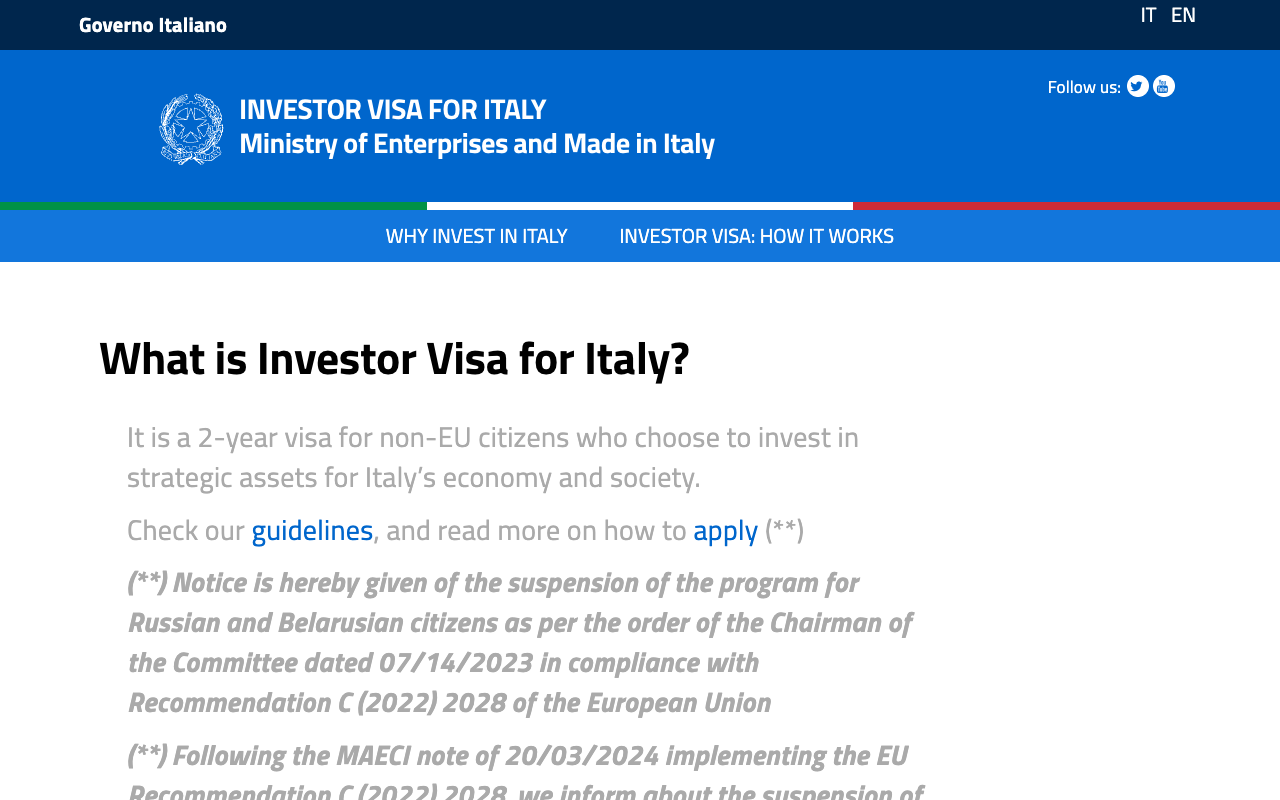
There is no Italian statute that uses the phrase golden visa. What exists is Article 26-bis of the Consolidated Immigration Act, Legislative Decree 286/1998, headed entrance and stay for investors, introduced by the 2017 Budget Law and implemented by an interministerial decree of 21 July 2017. It sets four qualifying routes, and the Ministry of Enterprises and Made in Italy publishes the same four on its Investor Visa for Italy portal.
| Route | Minimum | What it buys | Holding period |
|---|---|---|---|
| Government securities | EUR 2,000,000 | Bonds issued by the Italian government | At least two years |
| Company or venture capital fund | EUR 500,000 | Capital instruments of a company or VC fund established and operating in Italy | At least two years |
| Innovative startup | EUR 250,000 | Capital in a company registered in the special section of the business register | At least two years |
| Philanthropic donation | EUR 1,000,000 | A public-interest project in culture, education, immigration management, scientific research, or the recovery of cultural and landscape assets | Not applicable, the money is given |
The EUR 250,000 figure is a conditional discount on the EUR 500,000 company route rather than a route of its own. The statute grants it only where the target company is an innovative startup registered in the special section of the business register under Article 25, comma 8 of Decree-Law 179/2012, converted by Law 221/2012. That registration is not a label a founder can claim: the company must be under five years old, based in Italy or in the EU with production in Italy, focused on high-technology products or services, not the product of a merger or demerger, and it must satisfy at least one of three innovation tests, the commonest being research and development spending of at least 15 per cent of the greater of turnover and production cost.
Those amounts have moved once. Article 38, comma 10 of Decree-Law 34/2020 halved the company and startup thresholds from EUR 1,000,000 and EUR 500,000 to their current levels, and Article 35, comma 1 of Law 193/2024 widened the company route to include venture capital funds. The bond and donation figures have not changed since 2017. Nothing announced for 2026 changes any of the four.
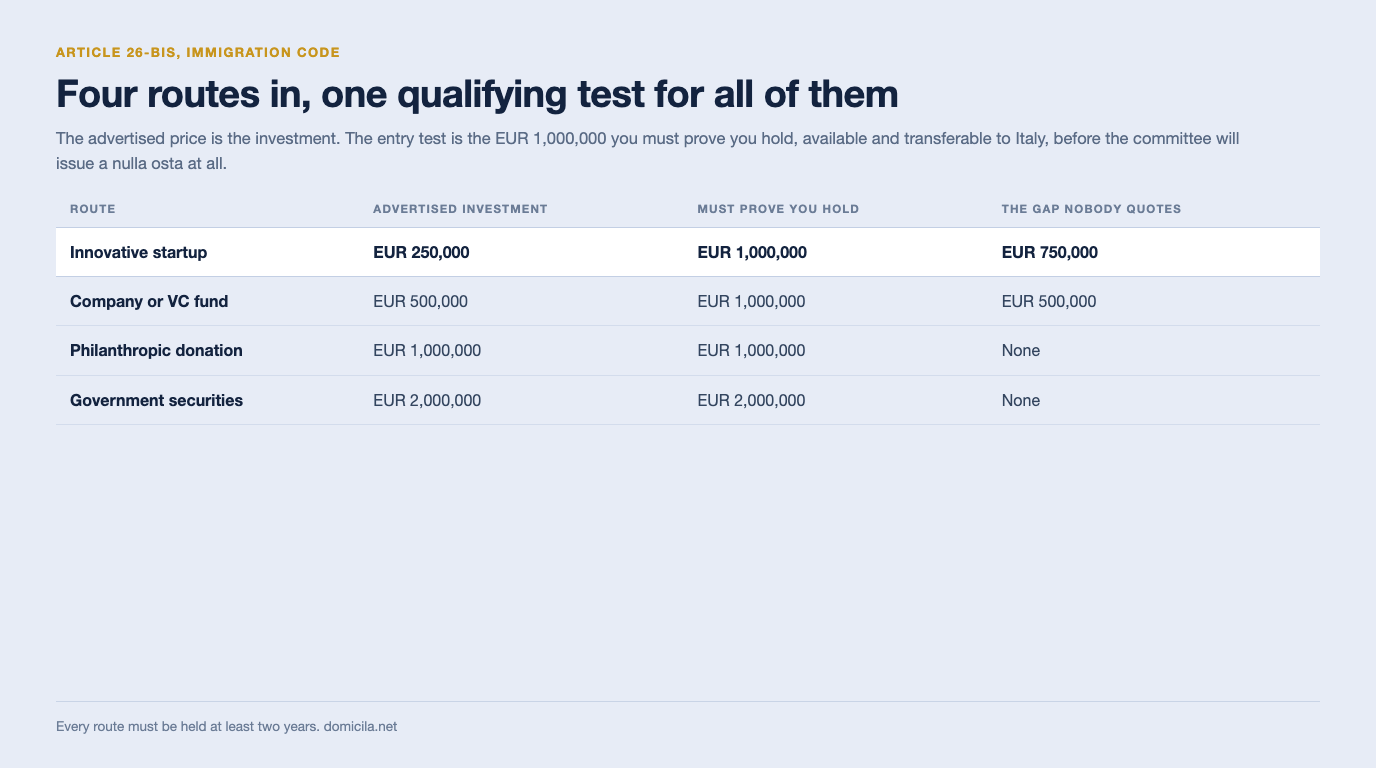
The EUR 1,000,000 nobody advertises
This is the part of the Italy golden visa cost that decides whether you qualify, and it is missing from almost every comparison page we read while researching this one. Article 26-bis, comma 1 does not stop at the investment. It attaches three further conditions to it, numbered 1 to 3, and the first is a proof-of-funds test set independently of the amount you intend to invest.
The statute requires the applicant to demonstrate that they are the holder and beneficial owner of a sum of at least EUR 2,000,000 in the case of letter a), or EUR 1,000,000 in the cases of letters b) and c), and that the sum is in each case available and transferable to Italy. Letter b) is the company and startup route. So the EUR 250,000 startup applicant and the EUR 500,000 company applicant face the same EUR 1,000,000 evidential bar.
| Route | You commit | You must prove you hold | Gap |
|---|---|---|---|
| Government securities | EUR 2,000,000 | EUR 2,000,000 | None |
| Company or VC fund | EUR 500,000 | EUR 1,000,000 | EUR 500,000 |
| Innovative startup | EUR 250,000 | EUR 1,000,000 | EUR 750,000 |
| Philanthropic donation | EUR 1,000,000 | EUR 1,000,000 | None |
Read the third row again, because it reframes the whole programme. The route marketed as one of the lowest entry points in the European Union is open on its face to anyone with EUR 250,000, and open in law only to someone who can document a liquid million. That does not make Italy expensive by European standards, but it does mean the honest comparison is against Portugal's EUR 500,000 fund route and Greece's EUR 400,000 and EUR 800,000 property zones rather than against Hungary's EUR 250,000 fund subscription. Our cheapest golden visa guide explains why the lowest advertised threshold is so rarely the lowest real bar.
A third condition sits underneath both. Number 3 of the same comma requires resources for your own maintenance during the stay, in addition to the investment funds and at a level above the statutory minimum for exemption from healthcare cost-sharing. Italy's income-based exemption codes put that minimum at EUR 8,263.31 of household income, rising to EUR 11,362.05 where there is a spouse and by EUR 516.46 for each dependent child. Consulates read the reference differently and some apply the much higher over-65 threshold, so ask yours which figure it uses rather than budgeting from this page.
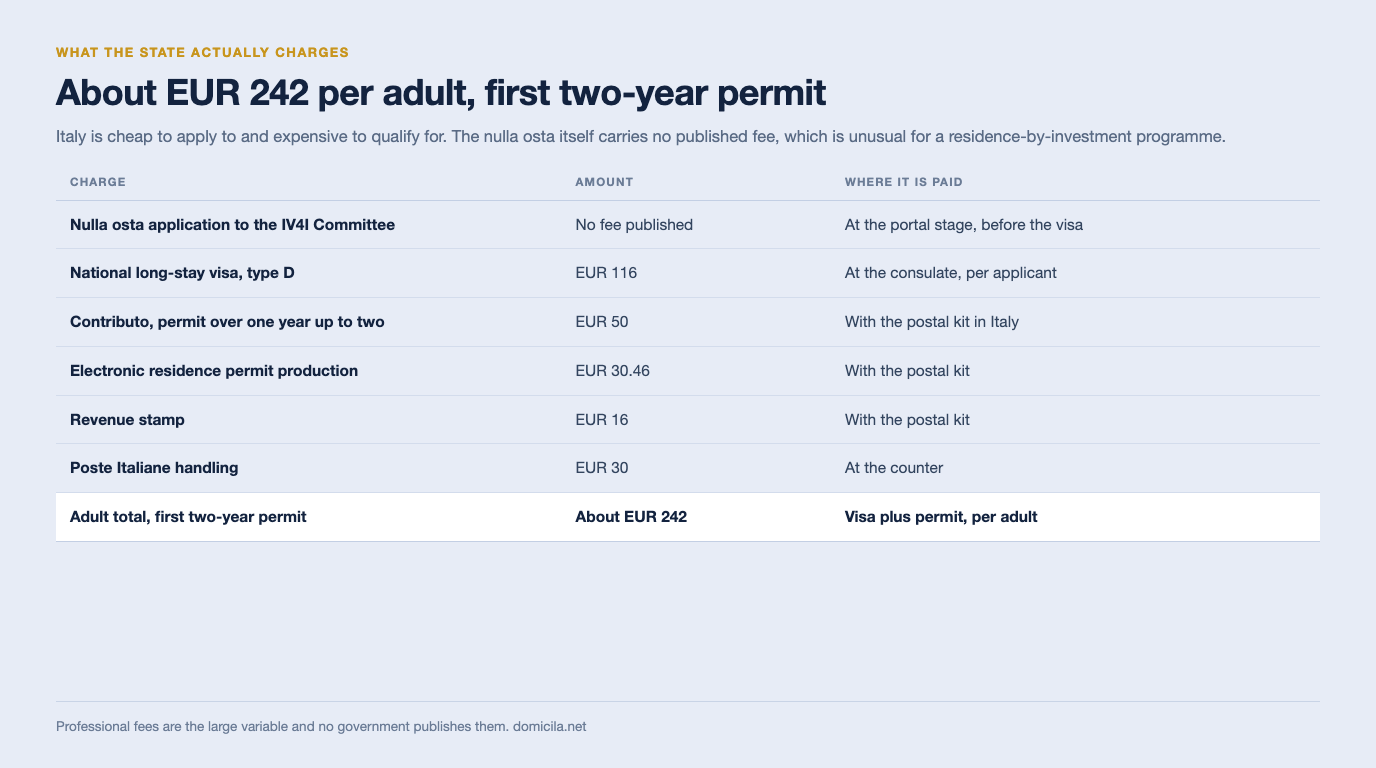
Government fees: the visa, the permit and the card
Against the investment, the Italian state charges very little, and every line is published. Nothing here is an estimate: the visa fee comes from the consular tariff, and the permit lines come from the ministerial decree of 5 May 2017, published in Gazzetta Ufficiale n. 131 and in force from 9 June 2017.
| Charge | Amount | When it is paid |
|---|---|---|
| Nulla osta application to the IV4I Committee | No fee published | At the portal stage, before the visa |
| National long-stay visa, type D | EUR 116 | At the consulate, per applicant |
| Contributo, permit over one year and up to two | EUR 50 | With the postal kit in Italy |
| Electronic residence permit production | EUR 30.46 | With the postal kit |
| Revenue stamp | EUR 16 | With the postal kit |
| Poste Italiane handling | EUR 30 | At the counter |
| Adult total, first two-year permit | About EUR 242 | Visa plus permit, per adult |
Two things in that table are worth pausing on. The first is that the nulla osta itself carries no published fee, which is unusual for a residence-by-investment programme and is one reason Italy is cheap to apply to and expensive to qualify for. The second is that the contributo band stops where the investor permit's renewal begins. The 2017 decree sets three amounts only: EUR 40 for permits over three months and up to a year, EUR 50 for permits over one year and up to two, and EUR 100 for EU long-term permits and for executives and specialised workers. The investor renewal under comma 6 runs three years, which is above the top ordinary band, so confirm the amount with the questura rather than assuming it is EUR 50 again.
Consulate fees are charged in local currency at a rate adjusted quarterly, so the euro figure is the one to plan from. The Italian consulate in Los Angeles, for example, was charging USD 135.20 for the same type D visa in the third quarter of 2026. Professional fees are the genuinely large variable and no government publishes them: immigration counsel, the corporate and anti-money-laundering work on the target company, and the certification of lawful origin of funds required by comma 2, letter c) are all priced by the market. Advisory firms quote roughly EUR 5,000 to EUR 15,000 for the file, and some package their own subscription fees well above that, so ask for the breakdown rather than the total.
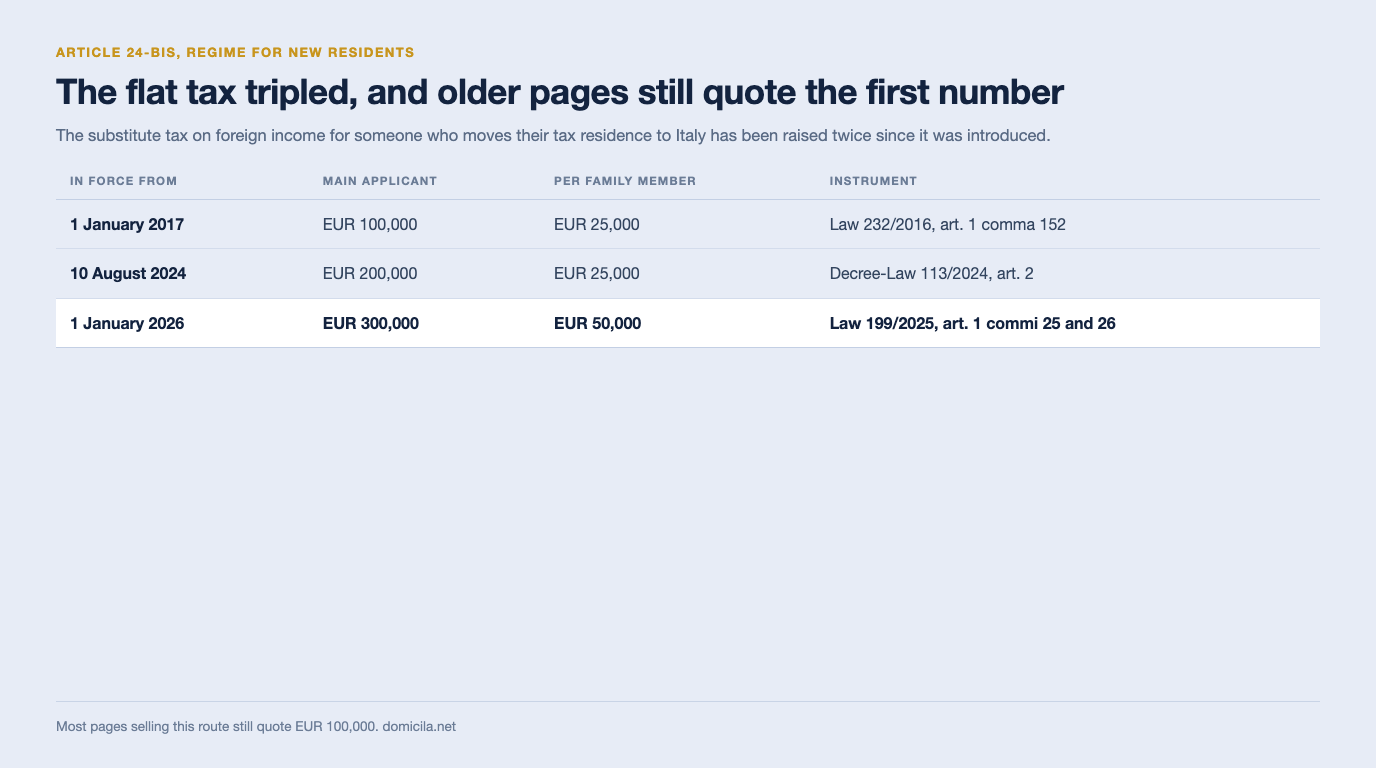
The EUR 300,000 flat tax, and why older pages have the wrong number
The investor visa is frequently sold alongside Italy's regime for new residents, and this is where published guidance has gone stale fastest. Article 24-bis of the income tax code lets someone who moves their tax residence to Italy substitute a flat annual amount for ordinary income tax on all foreign-source income, for up to fifteen years, provided they were not resident in Italy for at least nine of the ten preceding tax periods.
The flat amount has now been raised twice, and the current figure is triple the original.
| In force from | Principal | Per family member | Set by |
|---|---|---|---|
| 1 January 2017 | EUR 100,000 | EUR 25,000 | Law 232/2016, art. 1 comma 152 |
| 10 August 2024 | EUR 200,000 | EUR 25,000 | Decree-Law 113/2024, art. 2 |
| 1 January 2026 | EUR 300,000 | EUR 50,000 | Law 199/2025, art. 1 commi 25 and 26 |
The trigger is the date you move your tax residence to Italy, not the date you apply for the visa or the date the money lands. Anyone transferring residence after 1 January 2026 pays EUR 300,000, and each family member they elect to include pays EUR 50,000 rather than the EUR 25,000 that applied through 2025. The Revenue Agency's own tax bulletin describes the change in exactly those terms.
Whether that is a good deal is pure arithmetic, and it is worth doing before the visa rather than after. EUR 300,000 flat is a saving only if ordinary Italian tax on your foreign income would exceed it, which broadly means foreign income well into seven figures; below that, the regime costs you money. It also does nothing for Italian-source income, which is taxed normally. The regime and the investor visa are separate products that happen to suit the same person, and neither requires the other.
What it costs to keep: three months, two years, five years
Approval is not the end of the obligations, and Article 26-bis is unusually explicit about what ends the permit. Three deadlines govern the first five years, and missing any of them is a revocation risk rather than a paperwork problem.
| Obligation | Deadline | Source | Consequence of missing it |
|---|---|---|---|
| Apply for the visa after the nulla osta | 6 months | Portal guidance | The nulla osta lapses |
| Enter Italy after the visa is issued | 2 years | Portal guidance | The visa lapses |
| Apply for the permit at the questura | On arrival, with the postal kit | Phase 2 guidance | No permit, no lawful stay |
| Make the investment or donation | 3 months from entry | Art. 26-bis comma 5 | Permit revocable before expiry |
| Keep the investment in place | 2 years | Art. 26-bis comma 5 | Permit revocable before expiry |
| Prove it is still invested | At each renewal | Art. 26-bis comma 6 | Renewal refused |
The three-month rule is the one that catches people, because it starts at the date of entry into Italy rather than at the date of approval, and the evidence has to be uploaded to the same portal that issued the nulla osta. Comma 5 gives the administrative authority a direct line to the questura: if it reports that the investment was not made in time, or that it was divested before the two-year term expired, the permit is revocable before its own expiry date.
Renewal is a three-year cycle under comma 6, and it is not automatic. The authority has to be satisfied, on documentation, both that the sum was fully deployed within three months of entry and that it is still invested in the instruments the statute describes. Comma 7 then routes the renewal nulla osta to the questura of the province where the applicant actually lives, which is the first point in the process where a real Italian address matters.
One more provision deserves more attention than it gets. Comma 9 makes exhibiting or transmitting false documents, in whole or in part, or supplying untrue information anywhere in this procedure, punishable by eighteen months to six years in prison, with the money-laundering offences in the penal code expressly preserved. That is a criminal sanction attached to an immigration file, and it is the reason the source-of-funds certification is worth doing properly. Our guide to citizenship by investment source of funds covers what that evidence usually has to show.
Family, work, and the five-year presence exemption
Two of Italy's better features are buried in commi 5-bis and 8, both inserted or relied on after the original 2017 text, and both change the cost picture.
Comma 8 lets family members who would qualify for reunification under Article 29 enter alongside the investor rather than after them, receiving a family visa under Article 30. In practice that means a spouse, minor children, dependent adult children and dependent parents travel on the same timetable as the principal, each paying their own EUR 116 visa and their own permit fees, without the separate income and housing assessment that an ordinary reunification application triggers later.
| Who travels | Basis | What they pay | What they get |
|---|---|---|---|
| The investor | Art. 26-bis comma 3 | EUR 116 visa plus about EUR 126 in permit charges | Two-year permit marked for investors, renewable for three years at a time |
| Spouse | Art. 26-bis comma 8, via art. 29 | Same visa and permit charges | Family visa under art. 30, permit for family reasons |
| Minor children | Art. 26-bis comma 8, via art. 29 | Visa fee applies, contributo waived for minors | Family visa under art. 30 |
| Dependent adult children | Art. 26-bis comma 8, via art. 29 | Same visa and permit charges | Family visa under art. 30, dependency must be evidenced |
| Dependent parents, and parents over 65 | Art. 26-bis comma 8, via art. 29 | Same visa and permit charges | Family visa under art. 30, conditions in art. 29 apply |
Comma 5-bis is the provision behind every no minimum stay claim you will read about Italy, and it is narrower than those claims suggest. It gives the investor permit holder the same rights as a self-employment permit under Article 26, exempts them from the reciprocity check, and, for a total of five years from first issue, exempts them from the integration agreement and from the continuity-of-stay obligations in the implementing regulation. Read the time limit: the exemption is five years, not indefinite, and it is an exemption from continuity rules rather than a statement that presence never matters.
That distinction decides what the permit is actually for. If the goal is optionality and Schengen access, five years of exemption is generous and the permit renews on the investment alone. If the goal is an Italian passport, presence becomes the binding constraint rather than the money: naturalisation under Article 9 of Law 91/1992 requires ten years of legal residence for a non-EU national, with registration in a comune throughout and a B1 Italian certificate, and the EU long-term residence permit at five years requires genuine residence too. No investment shortens either clock. If a passport rather than a permit is the point, citizenship by investment vs golden visa sets out what each route actually delivers.
Healthcare sits on the same fault line. Comma 5-bis gives the investor the rights attaching to a self-employment permit, which is the branch of national health service enrolment that is compulsory rather than voluntary, but enrolment in practice follows registered residence in a comune rather than the label on the permit. An investor who never registers falls back on the voluntary route, where the 2024 Budget Law replaced the old flat charge with a percentage of income subject to a floor of EUR 2,000 a year. Ask the local health authority which side of that line your file falls on before you buy private cover, and see golden visa health insurance requirements for how the other programmes handle the same question.
Italy against the golden visas still open
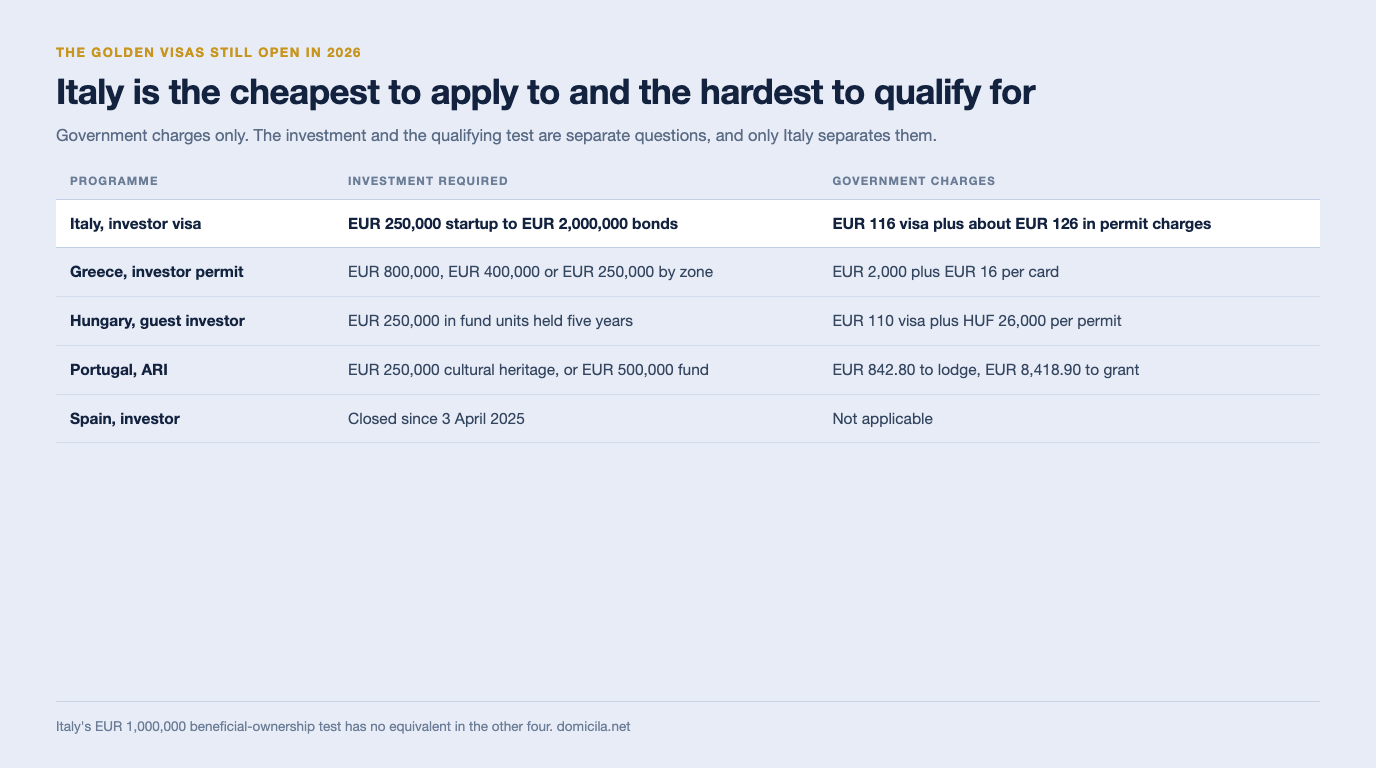
Italy's pitch is a low cash outlay, no purchase of anything you do not want to own, and money that moves only after the state has already said yes. The comparison that matters is against the European programmes still accepting applications, on each authority's own published figures.
| Programme | Entry price | State fees | Minimum stay | Invest before or after approval |
|---|---|---|---|---|
| Italy, investor visa | EUR 250,000 startup, EUR 500,000 company, EUR 2,000,000 bonds, EUR 1,000,000 donation | EUR 116 visa plus about EUR 126 in permit charges | None for five years under comma 5-bis | After |
| Greece, investor permit | EUR 800,000, EUR 400,000 or EUR 250,000 by zone and route | EUR 2,000 plus EUR 16 per card | None | Before |
| Hungary, guest investor | EUR 250,000 in fund units held five years | EUR 110 visa plus HUF 26,000 per permit | None | Before |
| Portugal, ARI | EUR 250,000 cultural heritage, or EUR 500,000 fund, company or research routes | EUR 842.80 to lodge and EUR 8,418.90 to grant, each per person | 7 days in year one, 14 days in each later period | Before |
| Spain, investor | Closed since 3 April 2025 | Not applicable | Not applicable | Not applicable |
On state fees Italy is the cheapest open programme in Europe by an order of magnitude: about EUR 242 against Portugal's EUR 9,261.70 per person to lodge and grant. On the entry test it is mid-table once the EUR 1,000,000 proof-of-funds rule is applied. On sequencing it is alone, and that is the argument worth taking seriously, because a refused application in Greece or Portugal leaves you holding an asset you bought for a permit you did not get.
The routes also differ in what you end up owning. Italy's cheapest route buys equity in an early-stage private company, which is the highest-risk asset class in this table and can go to zero while the permit obligation to keep it invested continues. Hungary's guest investor route buys regulated fund units, Greece buys property you choose, and Spain's programme closed by statute in 2025. For the field as a whole, golden visa countries lists what is still open and golden visa cost comparison sets the published fee tables side by side.
What to get in writing before you file
Four documents turn a pitch into a file you can defend, and all four should exist before any money leaves your account. The Italian process is unusually forgiving about sequencing and unusually strict about evidence, which is the opposite of the trade-off most applicants prepare for.
First, a written confirmation from your adviser of which proof-of-funds figure applies to your route, and a statement of how you will evidence it. The million is the application, not the investment, and a file that documents EUR 250,000 beautifully and the EUR 1,000,000 vaguely is the commonest way this goes wrong.
Second, on the startup route, the target company's registration in the special section of the business register, with the date and the innovation criterion it satisfies, on paper. That registration can lapse, and a company that was an innovative startup when the pitch deck was written may not be one on the day the committee looks.
Third, the source-of-funds certification required by comma 2, letter c), prepared by someone who has read comma 9. Fourth, a schedule of your own deadlines as dates rather than durations: six months to request the visa, two years to enter, three months from entry to invest, two years holding, three years to renewal. Our guide to citizenship by investment processing time explains why statutory and real timelines diverge so widely in this sector, and why the committee's thirty-day assessment window is the shortest part of any of this.
Related guides on Domicila
- Golden visa cost comparison — Portugal, Greece and the UAE with the full published fee tables
- Golden visa countries — which residency-by-investment programmes are still open in 2026
- Cheapest golden visa — why the lowest advertised threshold is rarely the lowest real bar
- Greece golden visa cost — the zoned EUR 800,000, EUR 400,000 and EUR 250,000 thresholds
- Hungary golden visa cost — the EUR 250,000 fund route with no proof-of-funds multiplier
- Spain golden visa cost — the European investor route closed by statute in 2025
- Citizenship by investment vs golden visa — passport now, or residence first
Common questions
How much does the Italy golden visa cost in 2026?
The qualifying investment is EUR 250,000 in an innovative startup, EUR 500,000 in an Italian company or venture capital fund, EUR 2,000,000 in Italian government securities, or a EUR 1,000,000 philanthropic donation. State fees are small: a national long-stay visa is EUR 116, and the two-year residence permit costs EUR 50 in contributo plus EUR 30.46 for the electronic card, a EUR 16 revenue stamp and EUR 30 at the post office, so roughly EUR 242 per adult. Professional fees are quoted in the EUR 5,000 to EUR 15,000 range and no government publishes them.
Do you really only need EUR 250,000 for the Italian investor visa?
To invest, yes. To qualify, no. Article 26-bis, comma 1, number 1 requires an applicant on the company or startup route to demonstrate they are the holder and beneficial owner of at least EUR 1,000,000, available and transferable to Italy, and EUR 2,000,000 on the government bond route. So the EUR 250,000 startup investor still has to evidence a liquid million before the committee will issue a nulla osta. A further condition requires maintenance resources in addition to those funds.
Do you have to invest before applying for the Italian investor visa?
No, and this is Italy's main structural advantage over Greece, Portugal and Hungary. You apply for the nulla osta first, receive the visa, enter Italy, and then have three months from the date of entry to make the investment or donation and upload the evidence. If the money is not deployed in that window, Article 26-bis comma 5 makes the permit revocable before its expiry, so the sequencing removes the risk of buying an asset for a permit you do not get, not the obligation itself.
Is there a minimum stay on the Italian investor visa?
Comma 5-bis exempts the holder from the continuity-of-stay obligations in the implementing regulation for a total of five years from first issue, which is where the no minimum stay claim comes from. Read the limit: it is five years, not indefinite. It is also a rule about the permit and nothing else. The EU long-term residence permit at five years and naturalisation under Article 9 of Law 91/1992 at ten years both require genuine residence, registration in a comune and, for citizenship, a B1 Italian certificate.
How long does the Italian investor visa take?
The Investor Visa for Italy Committee communicates its assessment within 30 days of a complete application, and it can stop the clock once to request further information. After a positive decision you have six months to request the visa at the Italian mission where you live, and two years from the release of the visa to enter Italy. The residence permit is then applied for at the local questura on arrival. The 30-day committee window is the shortest and most predictable part of the process.
What is the Italian flat tax for new residents in 2026?
Article 1, commi 25 and 26 of Law 199/2025 raised the substitute tax under Article 24-bis of the income tax code from EUR 200,000 to EUR 300,000 a year on all foreign-source income, and from EUR 25,000 to EUR 50,000 for each family member included, for anyone transferring tax residence to Italy after 1 January 2026. It runs for up to fifteen years and requires that you were not resident in Italy for at least nine of the ten preceding tax periods. The regime is separate from the investor visa and neither requires the other.
Can family members join an Italian investor visa holder?
Yes. Comma 8 of Article 26-bis lets family members who would qualify for reunification under Article 29 travel alongside the investor rather than applying separately afterwards, receiving a family visa under Article 30. That covers a spouse, minor children, dependent adult children and dependent parents. Each pays their own EUR 116 visa fee and their own permit charges, and the ordinary income and housing assessment that a later reunification application triggers does not apply at this stage.
Who cannot apply for the Italian investor visa?
The programme has been suspended for Russian and Belarusian citizens since a suspension order dated 14 July 2023, and the Foreign Ministry extended that in a note of 20 March 2024 to non-EU citizens holding dual nationality where one of the two passports is Russian or Belarusian. Separately, where the application is made by the legal representative of a foreign legal person, commi 3-bis and 3-ter require a prior check that the condition of reciprocity under Article 16 of the preliminary provisions to the Civil Code is satisfied.
Official sources to verify
- Investor Visa for Italy — why invest in ItalyMinistero delle Imprese e del Made in Italy
- Investor Visa: how it worksMinistero delle Imprese e del Made in Italy
- Investor Visa for Italy: un visto per attrarre investimenti strategici dall'esteroMinistero delle Imprese e del Made in Italy
- Decreto interministeriale sul visto per investitori (art. 26-bis d.lgs. 286/1998)Ministero dell'Interno, Repubblica Italiana
- Permesso di soggiorno: i costi per il rilascio e il rinnovo (DM 5 maggio 2017)Polizia di Stato, Repubblica Italiana
- Cost for a visa and how to pay — national visa (type D) EUR 116Consolato Generale d'Italia, Ministero degli Affari Esteri
- Opzione per i neo residenti — normativa e prassi (art. 24-bis TUIR)Agenzia delle Entrate, Repubblica Italiana
- Regime agevolato dei neo residenti, maggiorati gli importi forfettariFiscoOggi, Agenzia delle Entrate
Compare golden visa advisors
Ask for a route-specific quote that separates investment amount, government fees, legal work, fund or property costs, and renewal obligations.
We may earn a referral fee if you choose an advisor through this site. We still aim to show cost ranges, caveats, and official source links plainly.