latvia golden visa cost
Latvia Golden Visa Cost 2026: Property Route Closed
The Latvia golden visa cost is quoted almost everywhere as EUR 250,000 of property plus a 5 per cent payment to the state, or EUR 280,000 parked with a Latvian bank. Both routes stopped taking new applicants on 15 September 2026, when a new Immigration Law came into force. What is left is a EUR 50,000 share-capital route with a EUR 10,000 payment on top, and a EUR 150,000 route into a state-established investment fund that the migration authority says has not been set up yet. We priced both survivors against the published state duties, and found the official pages still describing the closed ones.

Key takeaways
Two investment routes survive, and the cheaper one starts at EUR 60,000. A new applicant can put EUR 50,000 into the share capital of a small Latvian company and pay EUR 10,000 into the state budget, or commit EUR 150,000 to a state-established investment fund and pay the same EUR 10,000. Everything else marketed as the Latvia golden visa is shut to new applications.
The EUR 250,000 property route is gone, and so are the deposit and the bonds. Real estate, a EUR 280,000 subordinated liability with a Latvian bank and EUR 250,000 of interest-free government securities do not appear among the new law's grounds at all, although comparison pages published this month still offer the bonds at EUR 250,000 plus EUR 38,000.
The fund that the EUR 150,000 route depends on does not exist yet. The Office of Citizenship and Migration Affairs describes the new option as an investment in the manager of a fund established by the state, and says in the same announcement that the fund has not been created. Until it is, the route is a law without a counterparty.
The permit got shorter and the road behind it got longer. A share-capital permit is now issued for up to two years rather than five, and permanent residence is no longer granted on a first application: EU long-term resident status requires at least five years of prior residence on a temporary permit.
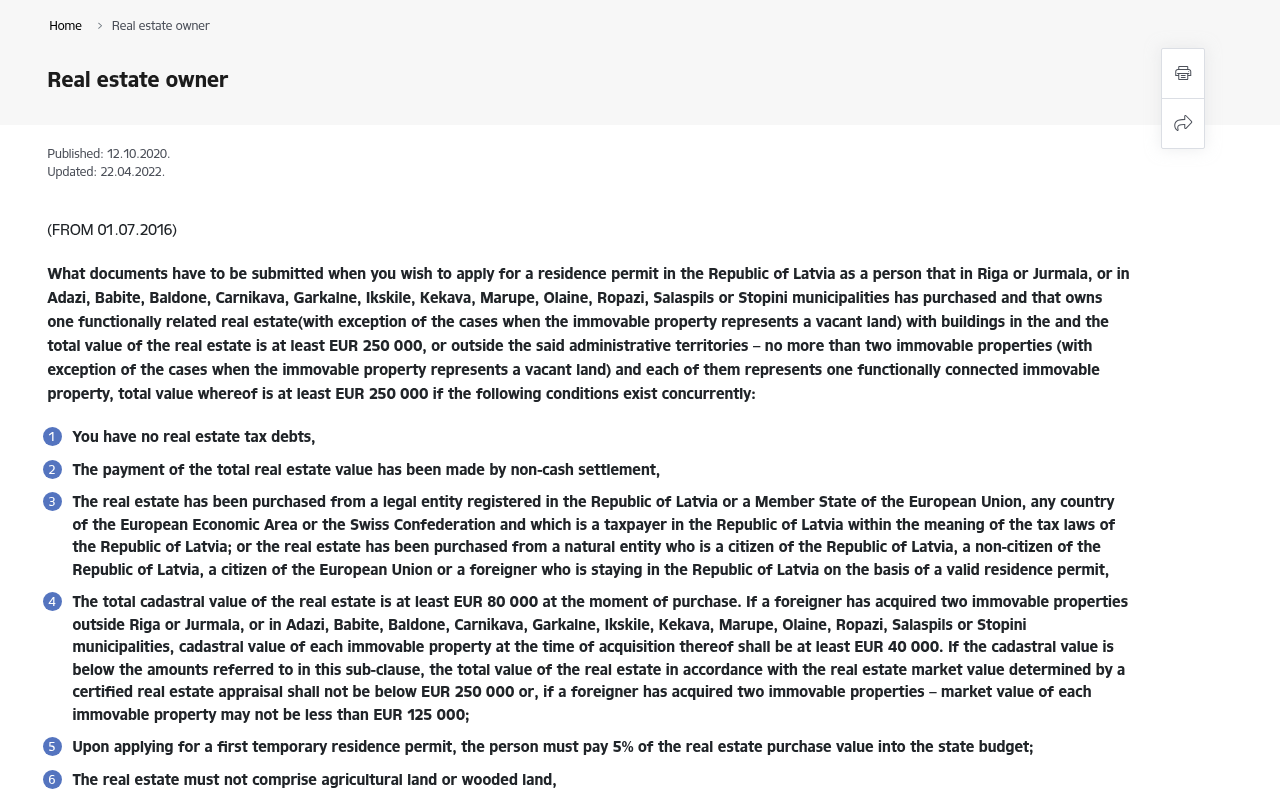
The official pages still describe the closed routes. On 24 September 2026, nine days after the law took effect, the authority's own real-estate-owner page still set out the EUR 250,000 purchase, the EUR 80,000 cadastral floor and the 5 per cent payment with no closure notice, under a last-updated date of 22 April 2022.
On this page
This guide starts with what a new applicant can actually buy in 2026, then covers the routes that closed on 15 September, why the official pages have not caught up, a line-by-line price for each survivor, what a two-year permit is worth, and how Latvia compares with Europe's other open programmes. The renderer on this site does not emit heading anchors, so the list below is a map rather than a set of jump links.
- Latvia golden visa cost in 2026: what is actually on sale
- The routes that closed on 15 September 2026
- Why the official pages still describe the closed routes
- The EUR 60,000 company route, priced line by line
- The EUR 150,000 fund route, and the fund that does not exist yet
- Two years instead of five, and what happens to permits already issued
- Latvia against Europe's other open routes
- Related guides on Domicila
Latvia golden visa cost in 2026: what is actually on sale
Latvia has never issued anything called a golden visa. The search term covers a set of grounds in the Immigration Law on which a foreign national can be issued a temporary residence permit for making an investment, and on 15 September 2026 that set was replaced wholesale: the old law was repealed and a new one took its place. The question is not what changed within a familiar programme but which grounds survived into a new statute.
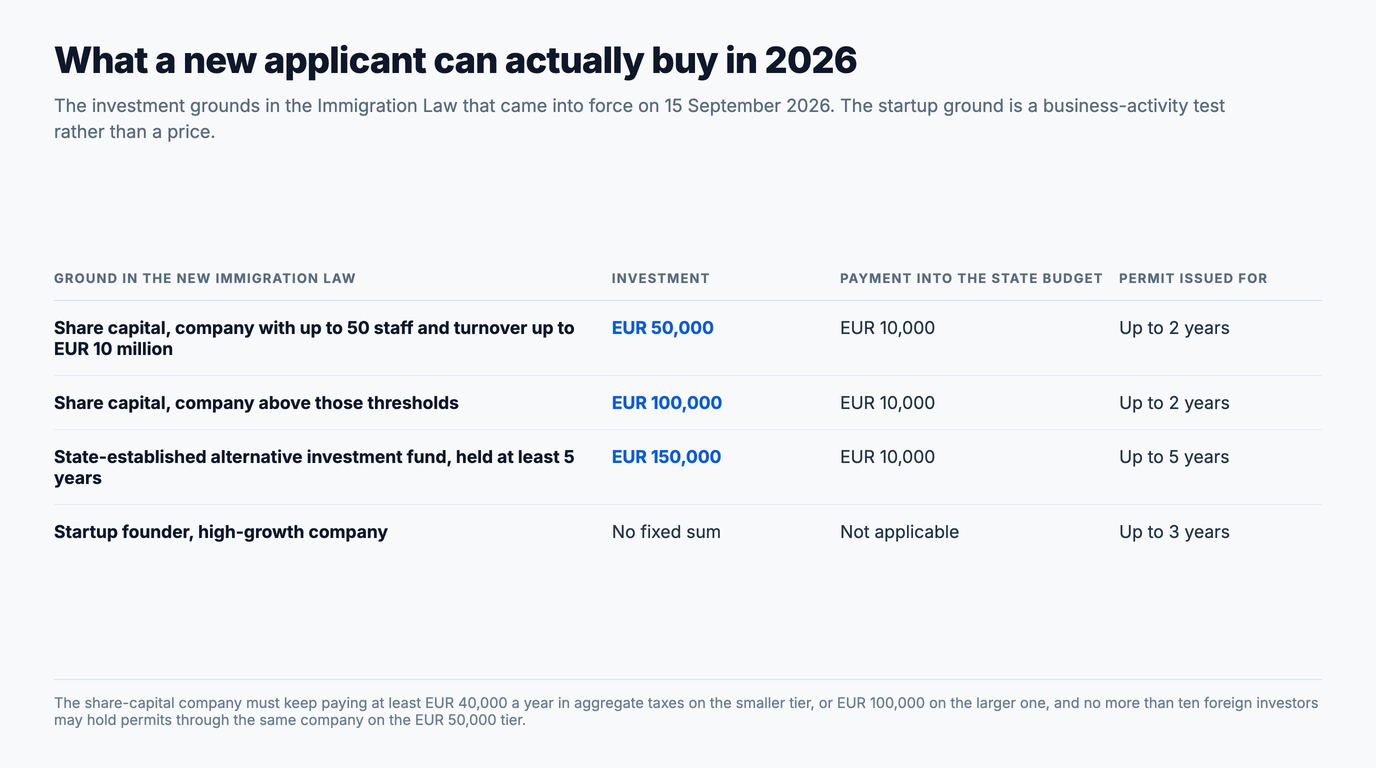
Three did. The share-capital ground issues a permit for up to two years to someone who has invested in a Latvian company. A startup ground issues one for up to three years to a founder building a high-growth company, and it is a business-activity test rather than a price, so we have left it out of the cost tables below. The third is new: up to five years for an investment of at least EUR 150,000, held for at least five years, in a state-established alternative investment fund.
| Ground in the new Immigration Law | Investment | Payment into the state budget | Permit issued for |
|---|---|---|---|
| Share capital, company with up to 50 staff and turnover up to EUR 10 million | EUR 50,000 | EUR 10,000 | Up to 2 years |
| Share capital, company above those thresholds | EUR 100,000 | EUR 10,000 | Up to 2 years |
| State-established alternative investment fund, held at least 5 years | EUR 150,000 | EUR 10,000 | Up to 5 years |
| Startup founder, high-growth company | No fixed sum | Not applicable | Up to 3 years |
The share-capital route carries a condition that is easy to miss and does most of the work of filtering applicants. The company you invest in has to keep paying tax: at least EUR 40,000 a year in aggregate taxes for the smaller tier, or EUR 100,000 for the larger one. No more than ten foreign investors can hold permits through the same company on the EUR 50,000 tier. This is not a route you satisfy by incorporating a shell and wiring yourself EUR 50,000; it needs a real business with real payroll, and if that business stops paying tax your permit is what breaks. If you are still choosing a country rather than a route, our golden visa countries guide covers what is open in Europe.
The routes that closed on 15 September 2026
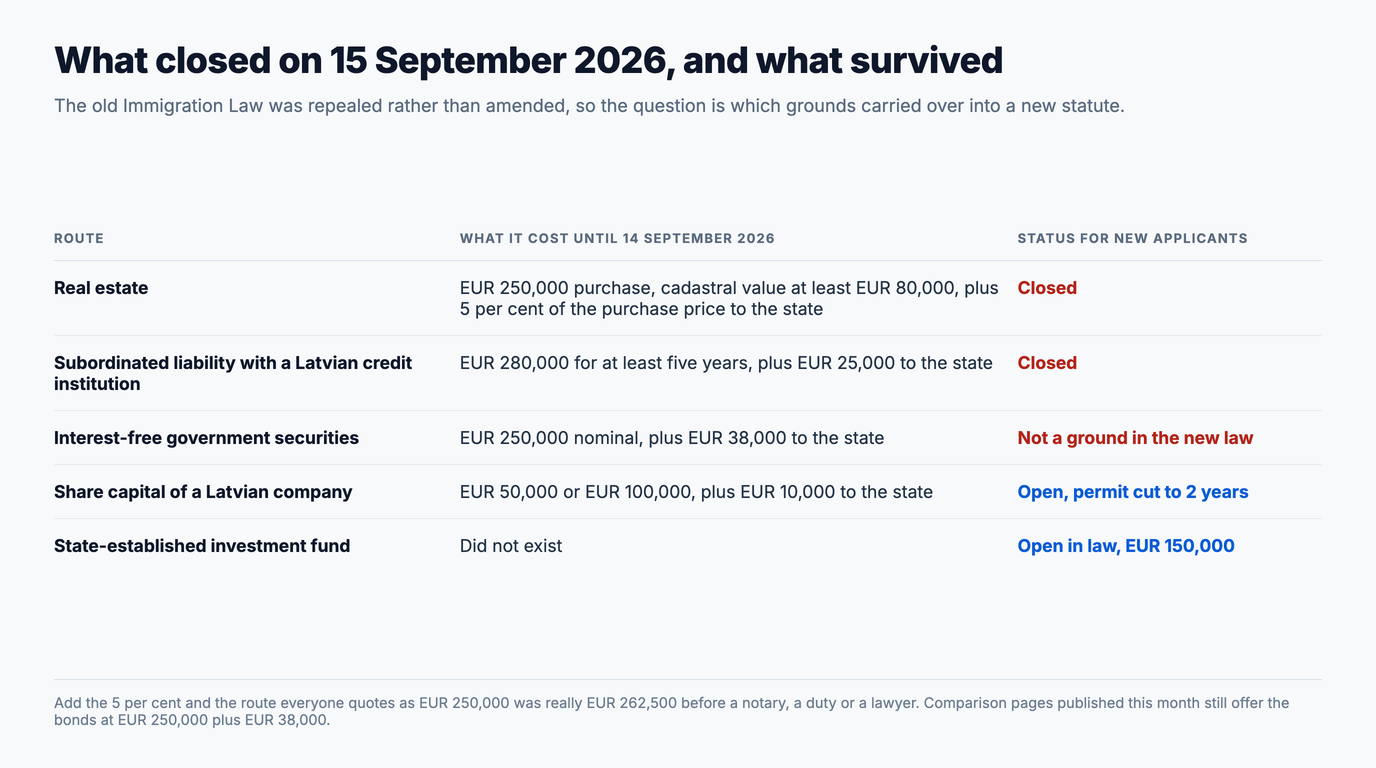
Three grounds that carried nearly all of Latvia's investor demand did not survive. The migration authority's own announcement is blunt about two: the law no longer provides for granting temporary residence permits to real estate purchasers or to investors in subordinated liabilities of credit institutions. The third, interest-free government securities, is not mentioned in that announcement at all, and we could not find it among the new law's grounds either.
| Route | What it cost until 14 September 2026 | Status for new applicants |
|---|---|---|
| Real estate | EUR 250,000 purchase, cadastral value at least EUR 80,000, plus 5 per cent of the purchase price to the state | Closed |
| Subordinated liability with a Latvian credit institution | EUR 280,000 for at least five years, plus EUR 25,000 to the state | Closed |
| Interest-free government securities | EUR 250,000 nominal, plus EUR 38,000 to the state | Not a ground in the new law |
| Share capital of a Latvian company | EUR 50,000 or EUR 100,000, plus EUR 10,000 to the state | Open, permit cut to 2 years |
| State-established investment fund | Did not exist | Open in law, EUR 150,000 |
Add the 5 per cent to the property figure and the route everyone quotes as EUR 250,000 was really EUR 262,500 before a notary, a duty or a lawyer. It also demanded the highest subsistence showing of any Latvian route, EUR 1,500 a month against the EUR 500 that applies elsewhere, and it excluded agricultural land, forest and bare plots. It was never the cheap option it was sold as, and it is now not an option at all.
The bonds are the one thing we cannot state flatly, and we would rather say so than round it off. Comparison pages published this month still list EUR 250,000 of government securities plus EUR 38,000 as open after 15 September. Searching the new law's grounds for securities, bonds and interest-free turns up nothing, and the official page describing that route has not been touched since 2022. If the bonds matter to your plan, get it in writing from the migration authority before you move money.
Why the official pages still describe the closed routes
The gap between the statute and the website is the most expensive thing about this change, because the website is what an applicant reads first. We fetched the migration authority's investor pages on 24 September 2026, nine days after the law took effect, and the closed routes were still laid out as live products with their old figures and no notice of any kind.
| Official page, captured 24 September 2026 | What it still says | Last updated on the page |
|---|---|---|
| Real estate owner | EUR 250,000 purchase, EUR 80,000 cadastral value, 5 per cent to the state | 22 April 2022 |
| Person investing in bonds | EUR 250,000 nominal, EUR 38,000 to the state | 22 April 2022 |
| Investments, credit institution route | EUR 280,000 for five years, EUR 25,000 to the state | Not dated on the page |
| State fee for issuing the residence permit | EUR 160 / EUR 280 / EUR 560 by speed | 18 March 2026 |
That last row is the one to trust, and it is the one nobody quotes. Examining the documents for a temporary residence permit costs EUR 160 on the standard thirty-day track, EUR 280 for ten working days and EUR 560 for five. The card itself is EUR 45 if you can wait ten working days and EUR 80 in two. These are per person, they are not refundable if you are refused, and they are missing from every all-in figure we have seen published for this programme.
The rule while the site catches up is to treat the topic pages as historical and the law as current. A page not edited since April 2022 cannot tell you about a statute in force since September 2026, whatever it says at the top. That discipline is worth applying to every programme you price, which is why our golden visa cost comparison dates each figure to the instrument it came from.
The EUR 60,000 company route, priced line by line
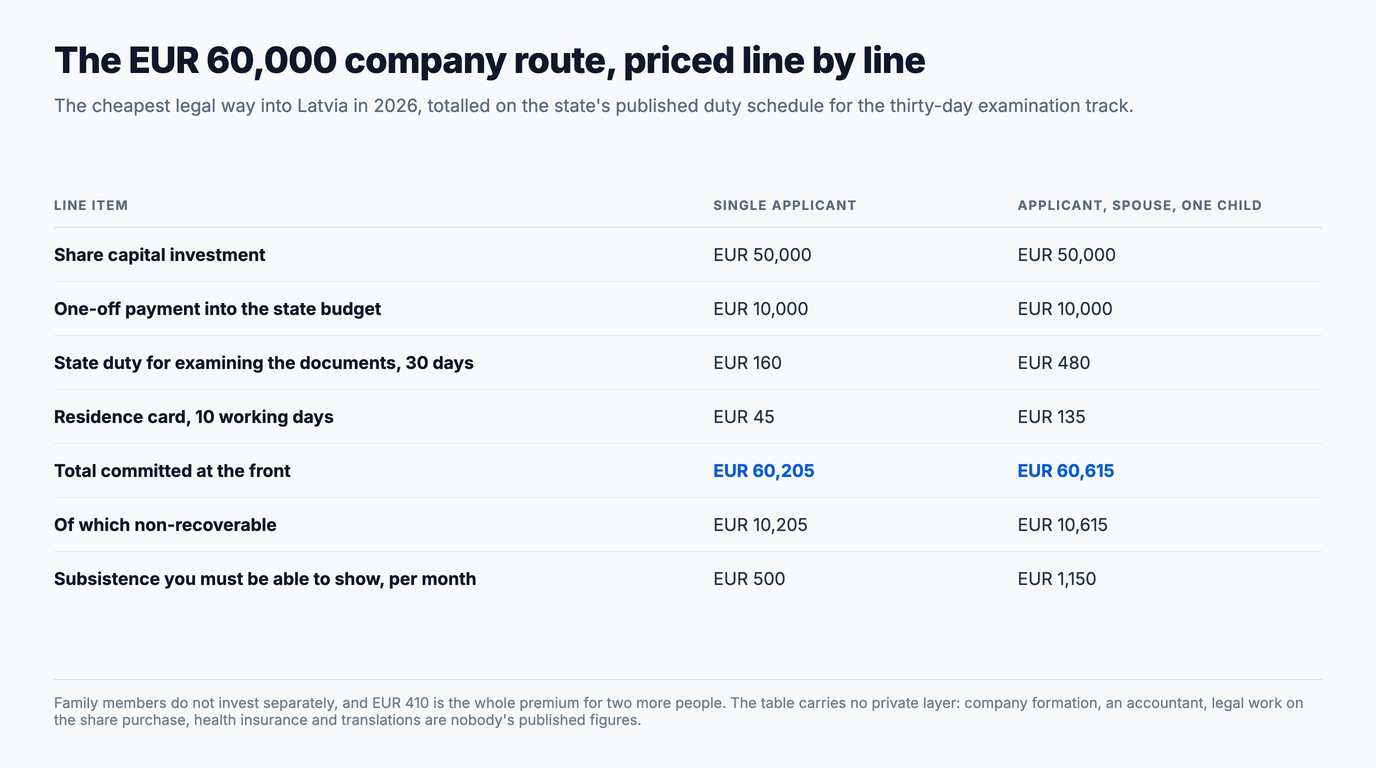
Strip out the marketing and the cheapest legal way into Latvia in 2026 is EUR 60,000 plus change: EUR 50,000 of share capital in a qualifying small company and EUR 10,000 handed to the state. Only the first number is an asset you nominally still hold. Here is the same route totalled for a single applicant and for a family of three, using the state's published duties on the thirty-day track.
| Line item | Single applicant | Applicant, spouse, one child |
|---|---|---|
| Share capital investment | EUR 50,000 | EUR 50,000 |
| One-off payment into the state budget | EUR 10,000 | EUR 10,000 |
| State duty for examining the documents, 30 days | EUR 160 | EUR 480 |
| Residence card, 10 working days | EUR 45 | EUR 135 |
| Total committed at the front | EUR 60,205 | EUR 60,615 |
| Of which non-recoverable | EUR 10,205 | EUR 10,615 |
| Subsistence you must be able to show, per month | EUR 500 | EUR 1,150 |
The arithmetic in the middle rows is ours, built from the published duty schedule on the assumption that each family member is examined on the same track; the investment and the EUR 10,000 payment are the law's own figures. What the table deliberately does not carry is the private layer, because nobody publishes it: company formation, an accountant who can keep the tax threshold evidenced year after year, legal work on the share purchase, health insurance and translations. Ask for that as a separate line on any quote, the way our golden visa health insurance requirements guide suggests you ask about cover.
Family members do not invest separately, which is what makes this route cheap for a household relative to almost anything else in Europe. They do have to be maintained: the subsistence showing is EUR 500 a month for the applicant, EUR 500 for each accompanying adult and EUR 150 for each minor. The gap between EUR 60,205 and EUR 60,615 for two extra people is the smallest family premium we have priced on any European programme, and it is a genuine argument for Latvia that has nothing to do with property.
The EUR 150,000 fund route, and the fund that does not exist yet
The new law's headline addition is a permit for up to five years in exchange for at least EUR 150,000 placed, for at least five years, with the manager of an alternative investment fund established by the state, plus the same EUR 10,000 into the budget. On paper it is the better of the two live routes: five years instead of two, one renewal cycle instead of three, and no dependence on a third-party company's tax behaviour.
On the ground it is not yet a product. The migration authority's own announcement of the new law says the state-established fund has not been created. No fund means no manager, no subscription agreement and no way to make the transfer the permit is conditional on, so an application on this ground cannot currently be completed however willing the applicant is.
The law also hands the government a switch that nobody quoting the EUR 150,000 figure seems to mention. The Cabinet can suspend the issuing of permits on this ground for a period of up to five years on security or economic grounds, taking into account how many foreign nationals have used it and how concentrated they are by region. That is not a hypothetical drafting flourish in a statute whose whole purpose was tightening migration control; it is a route that can be closed administratively without another trip through parliament.
Our reading is that the EUR 150,000 route is worth watching and not worth planning around until the fund is named, its manager licensed and its terms published. Anyone selling it today is selling a section of a statute. The EUR 50,000 share-capital route, whatever its conditions, has a counterparty you can actually pay.
Two years instead of five, and what happens to permits already issued
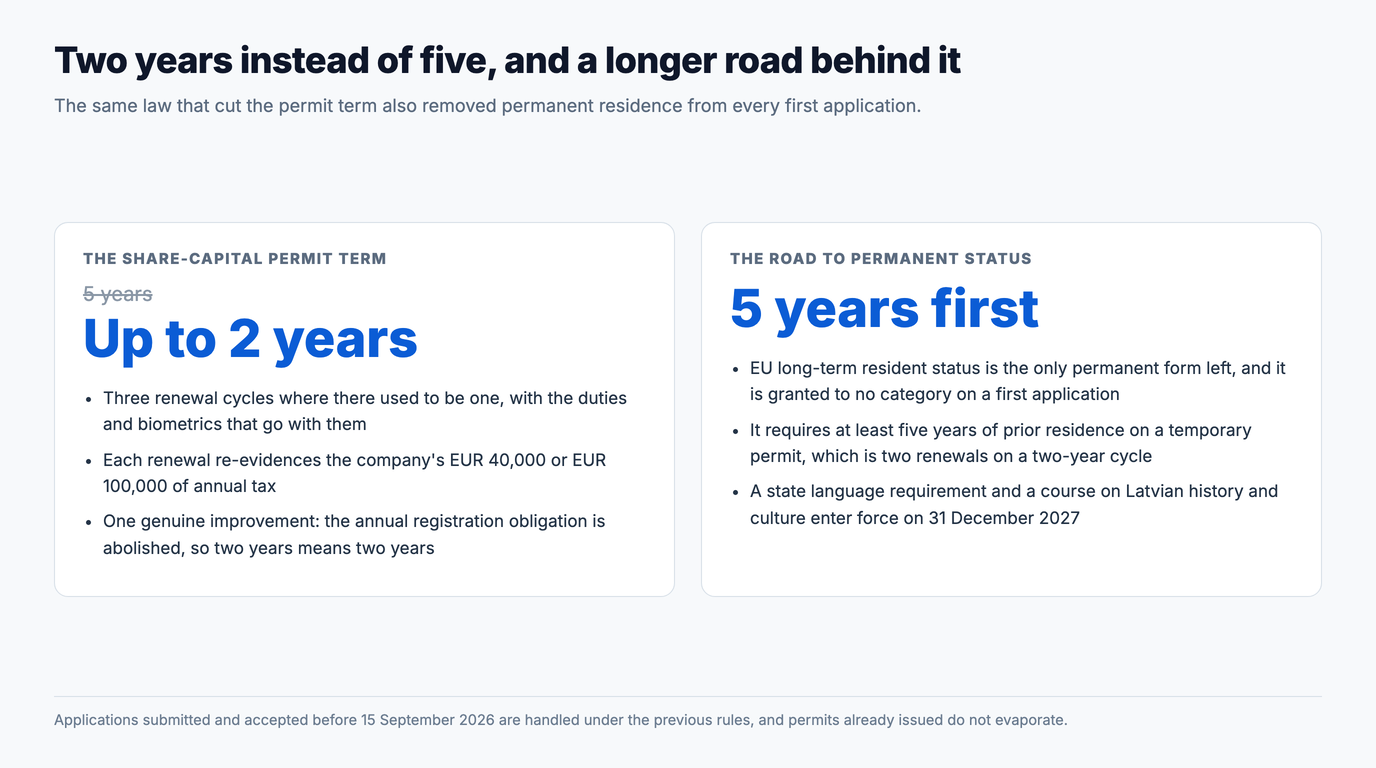
The share-capital permit used to run for five years. It now runs for up to two, which triples the number of renewals across the same stretch of time and, with them, the duties, the biometrics appointments and the evidence that the company is still paying its EUR 40,000 or EUR 100,000 in annual tax. One genuine improvement came with the same law: the obligation to register the permit annually has been abolished, so a two-year permit is two years rather than two years of yearly check-ins.
The route to anything permanent got materially longer, and that is the change with the longest shadow. Only one form of permanent status remains, EU long-term resident status, and it is no longer granted to any category of applicant on a first application. The criterion is at least five years of residence on a temporary permit, which on a two-year cycle means two renewals before the clock even finishes. A separate obligation to learn the state language and complete a course on Latvian history and culture enters force on 31 December 2027, so anyone starting now should assume it applies to them.
Applications submitted and accepted before 15 September 2026 are handled under the previous rules, and existing permits do not evaporate: sector guidance is that holders of permits granted for property or a deposit keep them until their identity cards expire, and should apply to the migration authority during that window to continue on the same basis. That is law firm summary rather than the authority's own published statement, which does not address it, so anyone in that position should get their file confirmed in writing rather than act on a comparison page, ours included.
One thing none of this buys is a passport. This is residence, not citizenship, and the distinction is the one our citizenship by investment vs golden visa guide exists to draw. Latvian naturalisation runs on its own requirements, measured in years of actual residence and a language test, which a permit holder who visits occasionally does not accumulate.
Latvia against Europe's other open routes
Set beside what is left in Europe, Latvia now has the cheapest entry price on the continent and one of the weakest permits. The figures below are the published thresholds from our own country guides; confirm any of them at source before you commit, because three of these programmes changed terms in the last eighteen months.
| Country | Cheapest published route | Entry threshold | Permit issued for |
|---|---|---|---|
| Latvia | Share capital of a small company | EUR 50,000 plus EUR 10,000 | Up to 2 years |
| Greece | Property, lowest-threshold zones | EUR 250,000 | 5 years |
| Hungary | Investment fund units | EUR 250,000 | 10 years |
| Cyprus | Property, plus VAT | EUR 300,000 | Permanent permit |
| Malta | Lease route, plus EUR 99,000 non-refundable | EUR 14,000 a year | Indefinite certificate |
| Portugal | Qualifying funds | EUR 500,000 | 2 years, renewable |
| Spain | Closed to new applicants since April 2025 | Not available | Not available |
Read the last column with the third one. Latvia asks a tenth of what Portugal asks and gives a permit that expires in two years and depends on a company you do not control staying solvent and tax-compliant. Greece asks five times as much for five years at a stretch, Cyprus issues a permanent permit for EUR 300,000 and VAT, and Malta asks the least capital of anyone on its lease route while taking EUR 99,000 you never see again.
Latvia is a real answer for one profile: someone who wants a legitimate European base, has a genuine reason to be involved with a Latvian company, and cares more about the entry price than about how long the permit runs. It is a poor answer for someone buying optionality with no intention of being there, because the conditions are continuous rather than one-off. Our cheapest golden visa guide makes the general version of the argument: the lowest advertised threshold is almost never the lowest real bar.
Related guides on Domicila
If you are pricing Latvia against the alternatives, these are the comparisons that do the most work:
- Golden visa cost comparison — Europe's surviving programmes on published 2026 fee tables
- Cheapest golden visa — why the lowest advertised threshold is rarely the lowest real bar
- Golden visa countries — what is still open, and what closed in the last two years
- Greece golden visa cost — the threshold zones, and what they did to the entry price
- Hungary golden visa cost — the other EU fund route, at five times Latvia's price
- Spain golden visa cost — the programme Latvia's closure most resembles
Common questions
How much does the Latvia golden visa cost in 2026?
The cheapest route open to a new applicant is EUR 50,000 invested in the share capital of a Latvian company with up to 50 employees and turnover up to EUR 10 million, plus a one-off EUR 10,000 payment into the state budget. The state then charges EUR 160 per person to examine the documents on the thirty-day track and EUR 45 for the residence card, so a single applicant commits about EUR 60,205 before private costs such as company formation, legal work and insurance, which no authority publishes. The other open route is EUR 150,000 into a state-established investment fund plus the same EUR 10,000.
Can you still get Latvian residency by buying property?
No. The Immigration Law that came into force on 15 September 2026 does not provide for a temporary residence permit on the basis of a real estate purchase, and the Office of Citizenship and Migration Affairs confirmed that in its own announcement of the new law. The EUR 250,000 purchase with a 5 per cent payment to the state is closed to new applicants, even though the authority's page describing it was still live, and last updated in April 2022, when we checked on 24 September 2026.
What happened to the EUR 280,000 bank deposit route?
It closed on the same day. The new law no longer grants permits to investors in subordinated liabilities of credit institutions, which is the formal description of the route marketed as a EUR 280,000 five-year bank deposit with a EUR 25,000 payment to the state. Like the property route, it is still described on official pages that have not been revised, so a page offering it is quoting the previous statute.
Is the EUR 250,000 government bond route still open in Latvia?
We could not confirm that it is, and we would treat it as closed until the authority says otherwise. The new Immigration Law's grounds for a temporary residence permit make no mention of government securities, interest-free bonds or a EUR 38,000 payment, and the official page describing that route has not been updated since 2022. Some comparison sites published in September 2026 still list it at EUR 250,000 plus EUR 38,000. Ask the Office of Citizenship and Migration Affairs in writing before acting on either version.
How long is a Latvian investor residence permit valid now?
A share-capital investor permit is issued for up to two years, down from five under the previous law, and the startup founder ground runs for up to three. The new alternative investment fund ground carries up to five years, but the fund it depends on has not been created yet. The requirement to register the permit every year has been abolished, so the shorter term is at least not compounded by annual check-ins.
Does the Latvia golden visa lead to permanent residence or citizenship?
Not quickly, and not on a first application. The new law leaves EU long-term resident status as the only permanent status and requires at least five years of prior residence on a temporary permit before it can be granted, which on a two-year cycle means several renewals first. An obligation to learn the state language and complete a course on Latvian history and culture enters force on 31 December 2027. Citizenship is separate, under naturalisation rules measured in years of actual residence rather than in payments.
What happens to people who already hold a Latvian investor permit?
Applications submitted and accepted for examination before 15 September 2026 continue to be assessed under the previous rules. For permits already issued on the basis of property or a deposit, sector guidance is that they stay valid until the holder's identity card expires, and that the holder should apply to the Office of Citizenship and Migration Affairs during that window to continue on the same basis. The authority's own announcement does not address the point, so confirm your file with it in writing rather than relying on a summary.
Why did Latvia close its golden visa property route?
The change came through a complete replacement of the Immigration Law rather than an amendment. The Saeima adopted the new law on 11 June 2026, President Edgars Rinkevics returned it for a second review on 19 June, citing national security concerns including verification of the origin of investment funds, and parliament adopted it again on 20 August without restoring the property route. It was proclaimed on 1 September and came into force on 15 September 2026, with the stated purpose of strengthening state security and making migration control more effective.
Official sources to verify
- Imigracijas likums (Immigration Law), in force from 15 September 2026Republic of Latvia, published on Likumi.lv by Latvijas Vestnesis
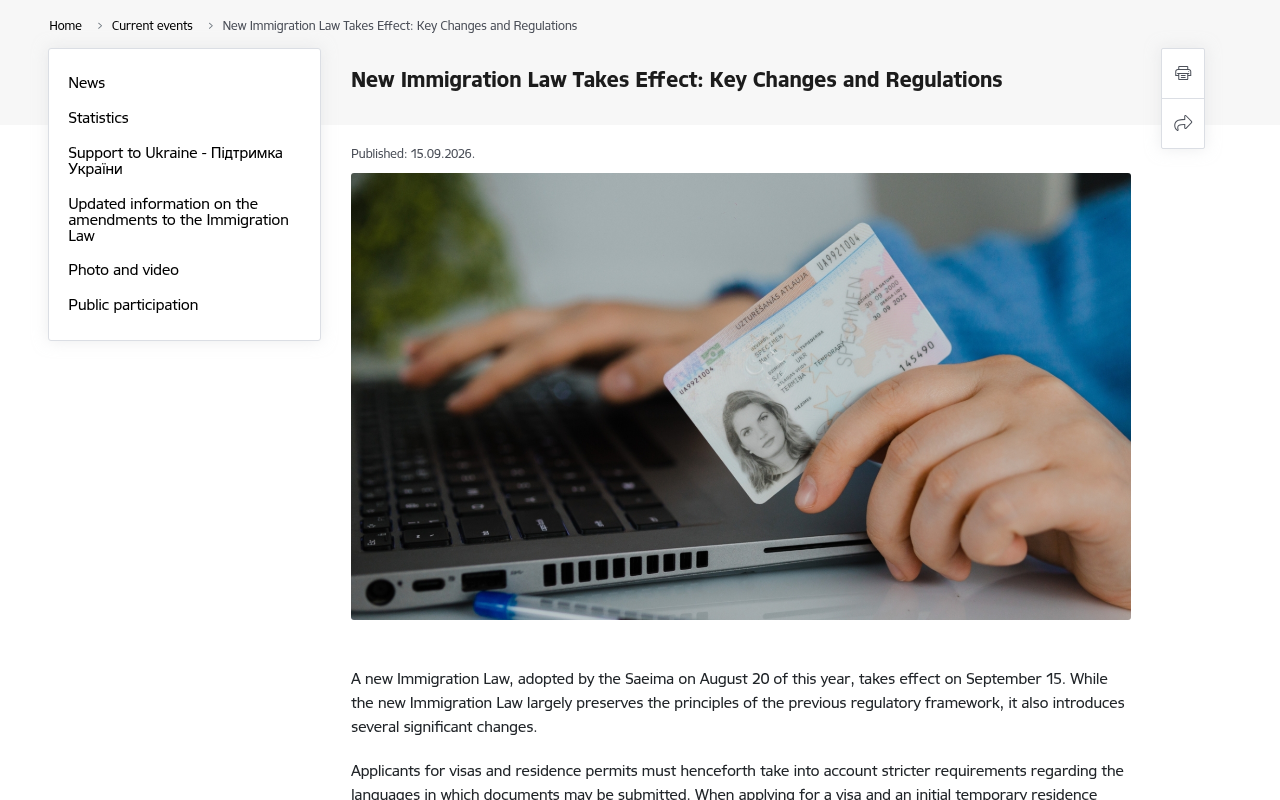
- New Immigration Law Takes Effect: Key Changes and RegulationsOffice of Citizenship and Migration Affairs (PMLP), Republic of Latvia
- Share capital investor: temporary residence permit requirementsOffice of Citizenship and Migration Affairs (PMLP), Republic of Latvia
- Real estate owner: temporary residence permit requirements (page last updated 22 April 2022)Office of Citizenship and Migration Affairs (PMLP), Republic of Latvia
- State fee for issuing the residence permitOffice of Citizenship and Migration Affairs (PMLP), Republic of Latvia
- President of Latvia submits the Immigration Law to the Saeima for a second reviewChancery of the President of Latvia
Compare golden visa advisors
Ask for a route-specific quote that separates investment amount, government fees, legal work, fund or property costs, and renewal obligations.
We may earn a referral fee if you choose an advisor through this site. We still aim to show cost ranges, caveats, and official source links plainly.