mexico golden visa cost
Mexico golden visa cost 2026: the real price
Mexico does not have a golden visa. No Mexican statute sells residence or citizenship, and the nearest thing to it is a documentary route to the ordinary temporary-residence visa, priced in multiples of an inflation index that moves every February. We read the visa rules as published in the Diario Oficial on 25 July 2025, priced every government charge against the Federal Fees Law as it stands today, found the increase that doubled residence-card fees on 1 January 2026 and the second one that lands on 1 January 2027, and checked our own arithmetic against the dollar figures two Mexican consulates publish.

Key takeaways
- There is no Mexican golden visa, and that is the honest answer to the search. No statute grants residence or citizenship in exchange for an investment. The nearest route is a way of qualifying for the ordinary temporary-residence visa: capital in a Mexican company above 45,850 UMA days, which is MXN 5,378,663.50 at the 2026 index, roughly USD 273,000.
- The thresholds are set in UMA days, so they move every February. INEGI fixed the 2026 UMA at 117.31 pesos a day with effect from 1 February 2026. The savings test for temporary residence is 11,460 days (MXN 1,344,372.60) and the income test 680 days a month (MXN 79,770.80) — about a quarter of the investor figure, for the same card.
- Mexico doubled its residence-permit fees on 1 January 2026, to the peso. A one-year temporary resident card went from MXN 5,570.37 to 11,140.74, the four-year card from 12,528.91 to 25,057.82 and permanent residence from 6,789.48 to 13,578.96. Every one of those is exactly twice the 2025 amount.
- A 50 per cent discount exists and an investor cannot claim it. The paragraph added to article 8 on 7 November 2025 halves those fees only for family unity, a job offer from a registered employer, or an invitation to unpaid work. Investment, savings and pension applicants pay the doubled rate.
- A second increase lands on 1 January 2027. A decree published on 13 November 2026 takes the consular visa fee from MXN 990.79 to 1,639.80, the trust permit for coastal or border property from 21,648.83 to 27,000.00, and one restricted-zone property notice from 1,473.64 to 13,000.00.
On this page
This guide follows the money in the order you would spend it: what Mexico offers instead of a golden visa, the investor test and the property test, the fees that doubled this year, the ones that rise in January, the cheaper route most applicants actually qualify for, and where the path to a passport runs. This site's renderer does not emit heading anchors, so the list below is a map rather than a set of jump links.
- What Mexico has instead of a golden visa
- The investor route, and the sentence that decides who qualifies
- The property route costs twice as much, and the trust fee is extra
- The fees Mexico doubled on 1 January 2026
- What changes again on 1 January 2027
- Why most applicants should price the solvency route instead
- Four years to permanent residence, five to a passport
- The costs we will not estimate, and how to check ours at source
- Related guides on Domicila
What Mexico has instead of a golden visa
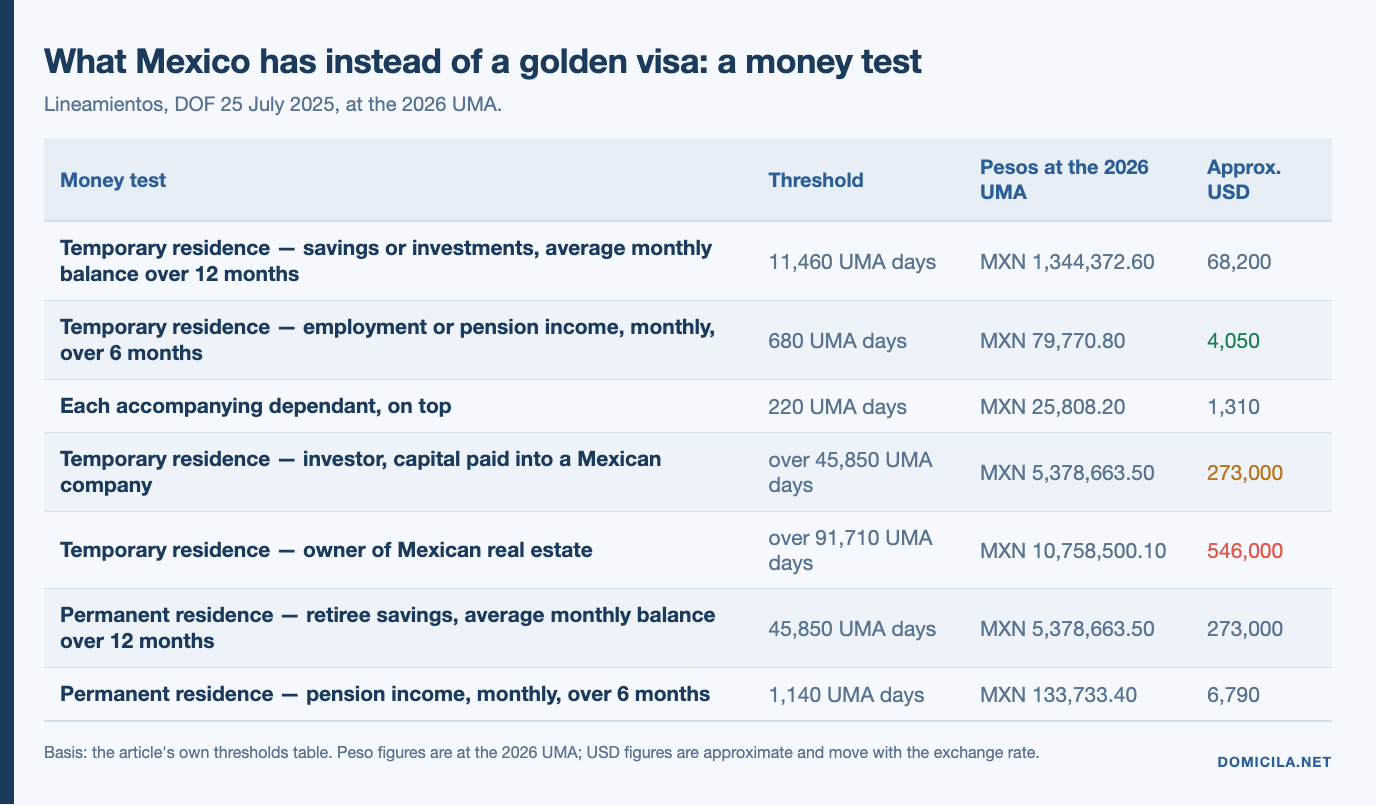
Ask the internet what the Mexico golden visa cost is and you will be quoted somewhere between USD 218,000 and USD 600,000, with no fee schedule, no exchange rate and no date attached. Those numbers are not prices. They are stale conversions of a threshold Mexico writes as a multiple of an inflation index, and they leave out every government charge — including the one that doubled eleven months ago. We read the rules in the Diario Oficial, priced each charge against the Federal Fees Law as it reads today, and then tested our arithmetic against what two Mexican consulates publish in dollars.
Start with what does not exist. Article 52 of the Ley de Migración recognises three conditions of stay — visitor, temporary resident and permanent resident — and none of them is an investor category. The investment test is not a programme at all: it is one of several ways to document a temporary-residence visa application, listed in the Lineamientos Generales para la expedición de visas, an administrative instrument signed by the interior and foreign secretaries. The current version was published on 25 July 2025 and took effect fifteen days later, abrogating the version that had stood since October 2014.
That matters before any figure does. Two cabinet secretaries can rewrite these thresholds without Congress, and in July 2025 they did: every money test's day count went up by a factor of roughly 2.2 to 2.3 while the unit being counted changed from the minimum wage to the UMA. A European golden visa lives in a statute and dies in parliament. This lives in a signature.
| Money test (Lineamientos, DOF 25 July 2025) | Threshold | Pesos at the 2026 UMA | Approx. USD |
|---|---|---|---|
| Temporary residence — savings or investments, average monthly balance over 12 months | 11,460 UMA days | MXN 1,344,372.60 | 68,200 |
| Temporary residence — employment or pension income, monthly, over 6 months | 680 UMA days | MXN 79,770.80 | 4,050 |
| Each accompanying dependant, on top | 220 UMA days | MXN 25,808.20 | 1,310 |
| Temporary residence — investor, capital paid into a Mexican company | over 45,850 UMA days | MXN 5,378,663.50 | 273,000 |
| Temporary residence — owner of Mexican real estate | over 91,710 UMA days | MXN 10,758,500.10 | 546,000 |
| Permanent residence — retiree savings, average monthly balance over 12 months | 45,850 UMA days | MXN 5,378,663.50 | 273,000 |
| Permanent residence — pension income, monthly, over 6 months | 1,140 UMA days | MXN 133,733.40 | 6,790 |
Peso figures are the UMA day count multiplied by the 2026 daily UMA of 117.31 pesos. Dollar figures use the Banco de México FIX of 25 November 2026, 19.7040 pesos to the dollar, and move with it.
The investor route, and the sentence that decides who qualifies
The investor test sits in requirement III(g) of Trámite 5, and it is worth reading in full rather than in summary, because the summaries drop the second half. The first limb asks for a notarial instrument of the Mexican company showing that the applicant holds part of its capital and that the amount actually paid out for that participation exceeds 45,850 UMA days — the law's word is erogado, paid out, provable by a share purchase contract or a document from the company recording the contribution.
Then the text continues: and title to movable property or fixed assets of a foreign company used for business purposes above the same figure, or documentation that economic or business activities are being carried out in Mexico. That third limb is the interesting one, because it is qualitative rather than monetary: contracts, service orders, invoices, receipts, business plans, licences or permits, or a certificate from the Instituto Mexicano del Seguro Social showing the foreign company employs at least three workers.
So the route is narrower than a cheque and broader than a threshold. A shareholder who paid in the money can show the deed and the trading evidence; a foreign company operating in Mexico with three insured employees has a documentary case that no amount of passive capital provides. Note also what the visa is not: a temporary resident may only work for a Mexican employer with a separate permit tied to a job offer, under article 52 fracción VII, so this is residence, not a work permit.
One more line from the same trámite deserves a reader's attention. Under the criteria for issuance, the visa is subject to the result of the consular interview — the money test is a floor, not a decision. If you are weighing this against a programme where a qualifying investment produces a defined outcome, our citizenship by investment versus golden visa comparison sets out what each type of permission actually buys.
Every figure on this page is denominated in pesos, including the capital you would pay into a Mexican company and each government fee. A multi-currency business account at least shows you the rate you are converting at.
The property route costs twice as much, and the trust fee is extra
Requirement III(f) of the same trámite takes a different kind of applicant: an owner of Mexican real estate, proved by a public deed before a notary, with a value exceeding 91,710 UMA days — MXN 10,758,500.10 at this year's index, about USD 546,000. That is exactly twice the investor threshold for the same card, which is the first thing most comparison pages get wrong when they quote property as the cheaper door.
The second thing they omit is that owning the property may cost a permit. Under article 2 of the Ley de Inversión Extranjera the restricted zone is the strip 100 kilometres along the land borders and 50 kilometres along the coasts, mirroring article 27 of the constitution. A foreign buyer cannot hold residential property there directly: a Mexican bank holds it in trust, which needs a permit from the foreign ministry under article 11, for a term of up to fifty years, extendable on request. Outside the zone, article 10-A requires the buyer to file the constitutional agreement and obtain a permit before acquiring.
Those permits have published prices, and they are among the charges the 2027 decree moves most.
| Foreign ministry charge (Ley Federal de Derechos, art. 25) | 2026 | From 1 Jan 2027 | Change |
|---|---|---|---|
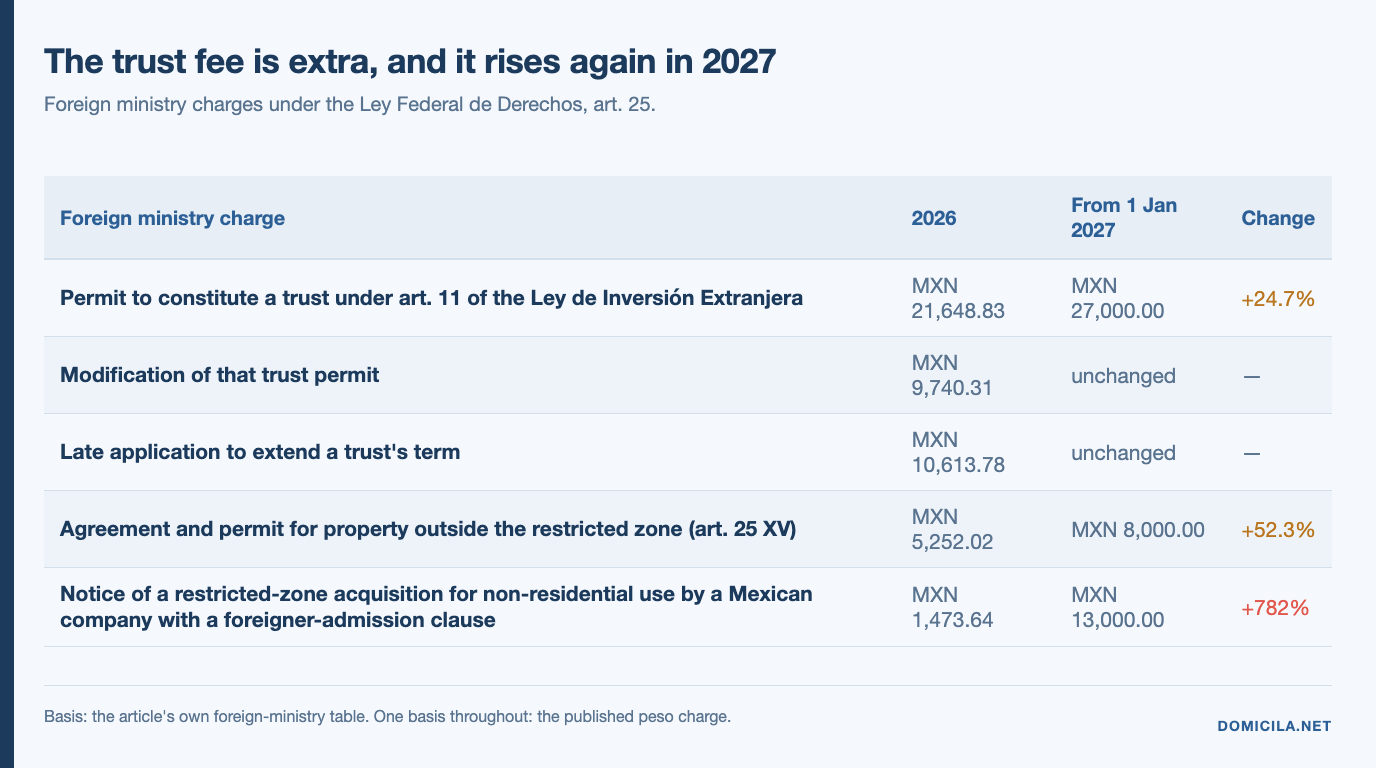
| Permit to constitute a trust under art. 11 of the Ley de Inversión Extranjera | MXN 21,648.83 | MXN 27,000.00 | +24.7% |
| Modification of that trust permit | MXN 9,740.31 | unchanged | — |
| Late application to extend a trust's term | MXN 10,613.78 | unchanged | — |
| Agreement and permit for property outside the restricted zone (art. 25 XV) | MXN 5,252.02 | MXN 8,000.00 | +52.3% |
| Notice of a restricted-zone acquisition for non-residential use by a Mexican company with a foreigner-admission clause | MXN 1,473.64 | MXN 13,000.00 | +782% |
That last row is the sharpest rise among the property charges, and it falls on the structure most often used to put a commercial property into a company's name.
What we are not pricing here is the trust itself. A bank charges a set-up fee and an annual fee for acting as trustee, and those are commercial terms, not published rates — ask two banks before you assume a number.
The fees Mexico doubled on 1 January 2026
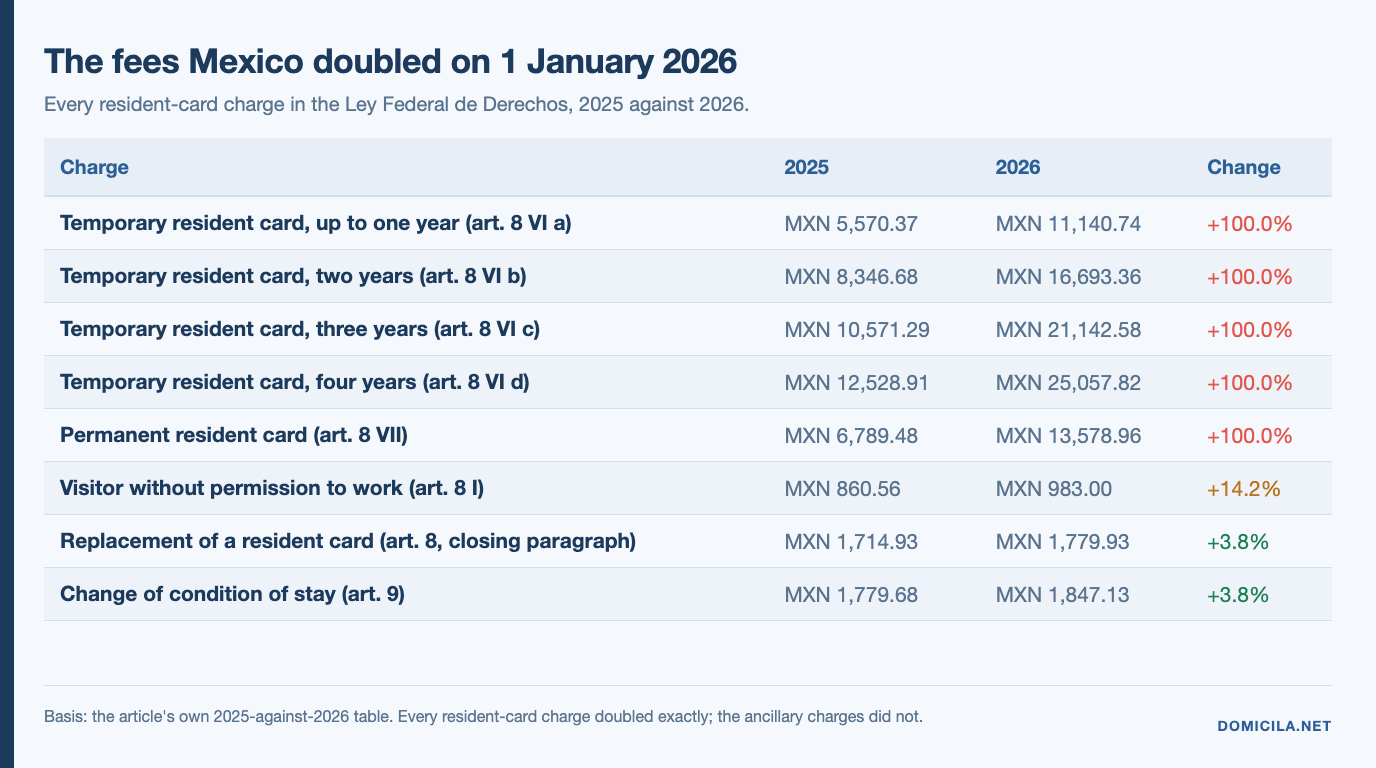
Here is the part no page selling Mexican residency mentions. A decree published on 7 November 2025 rewrote article 8 of the Ley Federal de Derechos, the schedule that prices the document proving your condition of stay, and the new amounts took effect on 1 January 2026. We checked them against the 2025 figures in Anexo 19 of that year's Resolución Miscelánea Fiscal, and the multiplier is not approximate: every residence fee is exactly two times what it was.
| Charge (Ley Federal de Derechos) | 2025 | 2026 | Change |
|---|---|---|---|
| Temporary resident card, up to one year (art. 8 VI a) | MXN 5,570.37 | MXN 11,140.74 | +100.0% |
| Temporary resident card, two years (art. 8 VI b) | MXN 8,346.68 | MXN 16,693.36 | +100.0% |
| Temporary resident card, three years (art. 8 VI c) | MXN 10,571.29 | MXN 21,142.58 | +100.0% |
| Temporary resident card, four years (art. 8 VI d) | MXN 12,528.91 | MXN 25,057.82 | +100.0% |
| Permanent resident card (art. 8 VII) | MXN 6,789.48 | MXN 13,578.96 | +100.0% |
| Visitor without permission to work (art. 8 I) | MXN 860.56 | MXN 983.00 | +14.2% |
| Replacement of a resident card (art. 8, closing paragraph) | MXN 1,714.93 | MXN 1,779.93 | +3.8% |
| Change of condition of stay (art. 9) | MXN 1,779.68 | MXN 1,847.13 | +3.8% |
Renewal is charged at the same rate as the original grant, so a renewed card is a second full fee, not a discount.
The same decree added a paragraph that halves the resident fees — and it is drafted around people who are not investors. The 50 per cent rate applies where the holder proves to the migration institute that their stay is for the preservation of family unity, a job offer from an employer with a valid employer registration, or an invitation from a public or private institution to take part in unpaid activities. An investor, a retiree and a remote worker on the savings route all pay full price.
Run the arithmetic on that and the reform looks less like an inflation adjustment and more like a redistribution: a one-year card at the halved rate costs MXN 5,570.37, which is the 2025 price to the centavo. Families and sponsored employees were held flat. Everyone else's fee went up 100 per cent.
One planning note that follows from the table rather than from any rule: a four-year card at MXN 25,057.82 is MXN 7,225.50 cheaper than a one-year card followed by a three-year renewal. Which duration you are granted is the institute's decision inside the four-year ceiling in article 52 fracción VII, so treat it as a question to ask rather than a saving to assume.
What changes again on 1 January 2027
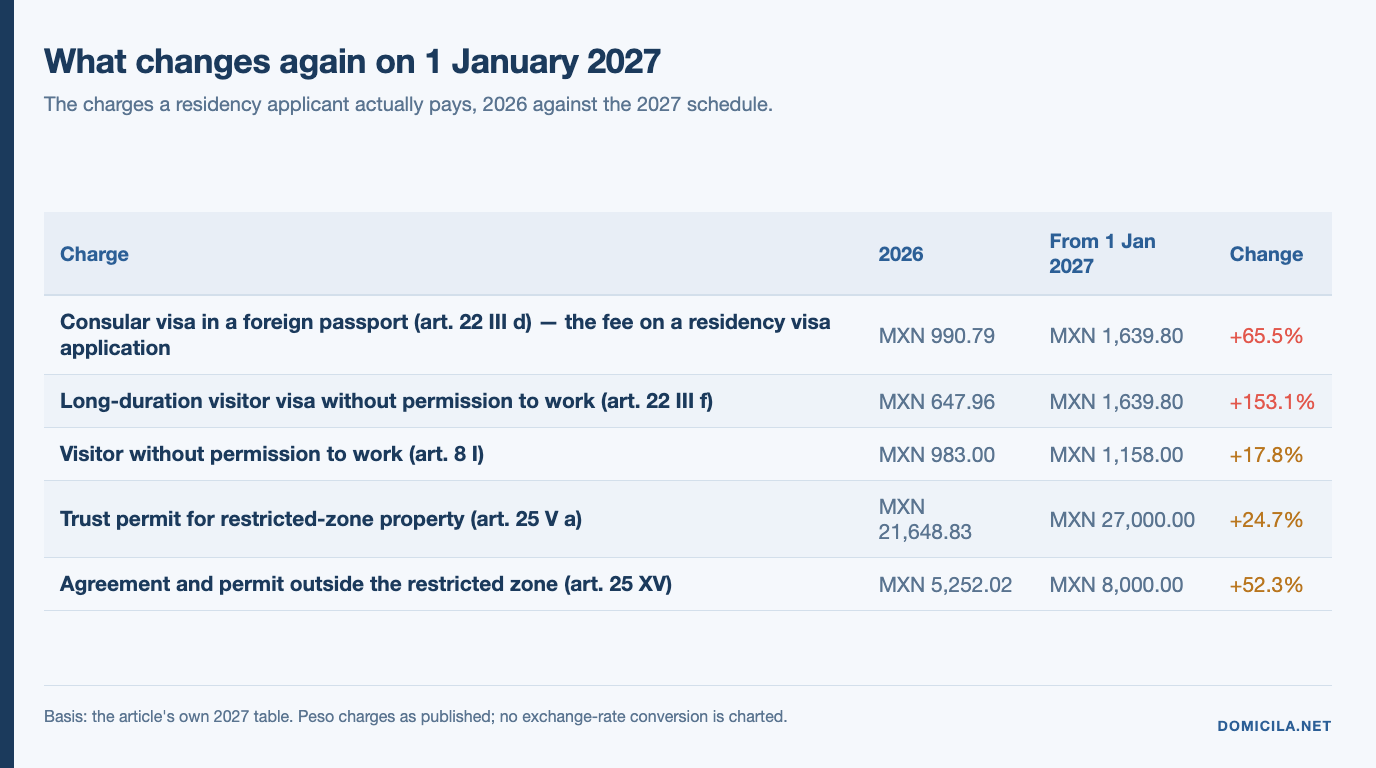
A second decree, published on 13 November 2026 and signed three days earlier, reforms the Federal Fees Law again. Its first transitory article sets commencement at 1 January 2027, so these are next year's numbers, and the residence-card fees in article 8 fracciones VI and VII are untouched this time — they were doubled a year ago.
| Charge | 2026 | From 1 Jan 2027 | Change |
|---|---|---|---|
| Consular visa in a foreign passport (art. 22 III d) — the fee on a residency visa application | MXN 990.79 | MXN 1,639.80 | +65.5% |
| Long-duration visitor visa without permission to work (art. 22 III f) | MXN 647.96 | MXN 1,639.80 | +153.1% |
| Visitor without permission to work (art. 8 I) | MXN 983.00 | MXN 1,158.00 | +17.8% |
| Trust permit for restricted-zone property (art. 25 V a) | MXN 21,648.83 | MXN 27,000.00 | +24.7% |
| Agreement and permit outside the restricted zone (art. 25 XV) | MXN 5,252.02 | MXN 8,000.00 | +52.3% |
These are the amounts as enacted. Article 1 of the Ley Federal de Derechos updates its own figures for inflation, so expect them to be restated in the 2027 Resolución Miscelánea before anybody pays them.
The consular fee is the one that touches every applicant on this page, because it is charged on the visa application itself, before the card. In 2026 the statutory amount is MXN 990.79 and the consulate converts it: San Diego lists USD 56, cash only, non-refundable. A 65.5 per cent increase on a fifty-dollar fee is not what decides a six-figure move, but it tells you the direction of travel for Mexico's immigration charges — up twice in fourteen months.
Why most applicants should price the solvency route instead
If you came here pricing an investment, the most useful thing on this page may be that you probably do not need one. The savings test for the same temporary-residence visa is 11,460 UMA days of average monthly balance across twelve months — MXN 1,344,372.60, about USD 68,200 — or monthly income free of encumbrances above 680 UMA days, MXN 79,770.80. That is a quarter of the investor threshold and roughly an eighth of the property one, for an identical card.
Dependants are priced separately and cheaply: 220 UMA days each, MXN 25,808.20, proved either as a twelve-month balance or as six months of income. A couple with two children adds MXN 77,424.60 to the principal applicant's requirement, which is the kind of figure that decides whether a family route is viable.
Two consulates publish the same statutory test in dollars and do not agree, which is worth understanding before you panic about a shortfall. San Diego's 2026 sheet asks for USD 68,241 in savings or USD 4,049 a month; Houston's quotes approximately USD 73,188.95 and USD 4,342.08, plus USD 1,405.02 per dependant. Neither is wrong — they converted the same UMA figure on different days. Our own arithmetic at the FIX for 25 November 2026 gives USD 68,228 and USD 4,048 — thirteen dollars and one dollar away from San Diego's figures, which is the check that tells you the method is right. Ask your own consulate for its current number and use that one.
Two practical notes the fee tables do not carry. The Lineamientos impose no health-insurance requirement on these routes, which is a sharper contrast than most applicants expect if you have dealt with the Schengen visa insurance requirement. And once the visa is used, article 59 of the Reglamento de la Ley de Migración gives you thirty natural days from entry to attend the migration institute and exchange the entry document for the card you have just paid for.
Four years to permanent residence, five to a passport
The reason to price this route carefully is that it leads somewhere, slowly. Article 54 of the Ley de Migración grants permanent residence on several grounds, and fracción V is the one most applicants use: four years have elapsed since the foreigner held a temporary residence permit. Fracción III covers retirees with a foreign pension sufficient to live on, which is the route the visa version prices at 45,850 UMA days of savings or 1,140 UMA days of monthly pension, MXN 133,733.40. Fracción IV leaves a points system to the institute's discretion under article 57.
Citizenship is a separate law and a longer clock. Article 20 of the Ley de Nacionalidad requires five years of residence in Mexico immediately before the application, cut to two years for nationals of a Latin American country or the Iberian Peninsula, parents of a Mexican child, direct descendants of a Mexican by birth, and spouses who have lived in the conjugal home in Mexico. The naturalisation letter itself costs MXN 9,502.01 under article 26 of the Federal Fees Law; a certificate of Mexican nationality is MXN 2,472.65.
No amount of money shortens either period. That is the structural difference between this and a Caribbean passport programme, and it is why Mexico belongs in a different part of your shortlist: our cheapest golden visa page covers the residence end of the market, and golden visa countries covers which programmes are still open at all. Mexico is not on either list, and the queries that bring people here are the reason this page exists.
The costs we will not estimate, and how to check ours at source
Everything above is a published figure with a citation. These are the costs that are real and that we will not put a number on, because no authority publishes one: notary fees and state acquisition tax on a Mexican property purchase, a trustee bank's set-up and annual charges, immigration lawyers and relocation agents, apostilles and certified translations of foreign documents, private health cover nobody requires but most movers buy, and the spread your bank takes converting into pesos.
We also will not predict the duration the migration institute grants you, or the outcome of the consular interview that decides the visa. Both are discretionary, and a page that pretends otherwise is selling something.
To verify the figures yourself, in the order we did: the Lineamientos at the official DOF repository under document 5763837, where Trámite 5 carries the temporary-residence tests and Trámite 7 the permanent ones; the consolidated Ley Federal de Derechos at the Chamber of Deputies, where the header line tells you the last reform it includes — the 13 November 2026 decree is not consolidated into it yet, so read that decree separately; INEGI's January press release for the year's UMA; the Banco de México FIX for the conversion; and your own consulate's requirements sheet for the dollar figure it will actually apply. Every source is listed with its URL at the foot of this page, and we read all of them on 25 November 2026.
Related guides on Domicila
If you are pricing Mexico against the alternatives, these are the comparisons that do the most work:
- Golden visa cost comparison — the open programmes side by side with their full fee tables
- Golden visa countries — which residency-by-investment programmes still exist in 2026
- Cheapest golden visa — why the lowest advertised threshold is rarely the lowest real cost
- Panama golden visa cost — the Latin American route that does have a statutory investor programme
- Colombia golden visa cost — the other regional option priced in a local index rather than dollars
- Citizenship by investment versus golden visa — what a passport buys that a residence permit does not
Common questions
How much does the Mexico golden visa cost in 2026?
Mexico has no golden visa, so there is no programme price. The closest equivalent is the investor route to a temporary-residence visa, which requires capital actually paid into a Mexican company above 45,850 UMA days, or 5,378,663.50 pesos at the 2026 daily UMA of 117.31. Government charges are separate and small by comparison: 990.79 pesos for the consular visa in 2026, rising to 1,639.80 pesos on 1 January 2027, and 11,140.74 pesos for a one-year resident card or 25,057.82 pesos for a four-year one.
Does Mexico have a residency by investment programme?
Not as a programme. Article 52 of the Ley de Migración creates no investor condition of stay, and the investment test exists only as one way of documenting an ordinary temporary-residence visa application under the Lineamientos Generales para la expedición de visas, published in the Diario Oficial on 25 July 2025. That instrument is signed by the interior and foreign secretaries rather than enacted by Congress, so the thresholds can be changed administratively, as they were in July 2025.
How much money do I need in the bank for Mexican temporary residency in 2026?
The test is an average monthly balance equivalent to 11,460 UMA days over the last twelve months, which is 1,344,372.60 pesos at the 2026 UMA, or monthly income free of encumbrances above 680 UMA days, which is 79,770.80 pesos. Each accompanying dependant adds 220 UMA days, or 25,808.20 pesos. Consulates publish their own dollar equivalents and they differ: San Diego lists 68,241 dollars in savings or 4,049 dollars a month, while Houston's sheet quotes about 73,188.95 dollars and 4,342.08 dollars.
How much is the Mexican residence card fee in 2026?
Under article 8 of the Ley Federal de Derechos it is 11,140.74 pesos for up to one year, 16,693.36 for two years, 21,142.58 for three years and 25,057.82 for four years, with permanent residence at 13,578.96 pesos. Each of those is exactly double the 2025 amount, following the decree published on 7 November 2025 that took effect on 1 January 2026. Renewal is charged at the same rate as the original grant, and replacing a lost card costs 1,779.93 pesos.
Can I get Mexican residency by buying property?
Yes, if the property is expensive enough. Requirement III(f) of the temporary-residence trámite accepts a public deed showing ownership of Mexican real estate worth more than 91,710 UMA days, which is 10,758,500.10 pesos at the 2026 UMA — twice the investor threshold for the same permit. If the property is residential and inside the restricted zone, which runs 100 kilometres from the land borders and 50 kilometres from the coasts, it has to be held through a bank trust with a foreign ministry permit costing 21,648.83 pesos in 2026 and 27,000 pesos from January 2027.
Who qualifies for the 50 per cent discount on Mexican residence fees?
The paragraph added to article 8 on 7 November 2025 halves the temporary and permanent resident fees where the applicant proves to the migration institute that their stay is for the preservation of family unity, a job offer from an employer holding a valid employer registration, or an invitation from a public or private organisation to carry out unpaid activities. Investors, retirees and applicants using the savings or income tests are not covered and pay the full doubled rate.
What currency are the fees paid in?
The statutory amounts are all in Mexican pesos. For the visa application the Lineamientos state that consular offices charge the fee in the currency of the country authorised by the finance ministry, which is why the San Diego consulate publishes a 56 dollar, cash-only processing fee against a statutory 990.79 pesos. Dollar figures anywhere on this page are conversions at the Banco de México FIX of 25 November 2026, 19.7040 pesos per dollar, and will move with the rate.
How long before I could apply for a Mexican passport?
Permanent residence comes first: article 54 fracción V of the Ley de Migración grants it once four years have passed holding temporary residence. Naturalisation is governed by article 20 of the Ley de Nacionalidad, which requires five years of residence in Mexico immediately before the application, reduced to two years for nationals of Latin American countries or the Iberian Peninsula, parents of Mexican children, direct descendants of a Mexican by birth, and spouses living in the conjugal home in Mexico. The naturalisation letter costs 9,502.01 pesos and no investment shortens the waiting period.
Official sources to verify
- Lineamientos Generales para la expedición de visas que emiten las secretarías de Gobernación y de Relaciones Exteriores — Trámite 5 (residencia temporal), requisitos III(a), (f) y (g); Trámite 7 (residencia permanente), requisito III(a). Published DOF 25 July 2025, in force 9 August 2025, abrogating the Lineamientos of 10 October 2014. Read 25 November 2026Secretaría de Gobernación / Secretaría de Relaciones Exteriores (SIDOF)
- Ley Federal de Derechos, texto vigente — art. 8o. (migration documents), art. 9o. (change of condition of stay), art. 22 fracción III (consular visas), art. 25 (article 27 constitutional permits), art. 26 (nationality and naturalisation). Última reforma DOF 7 November 2025; amounts for 2026 updated by Resolución Miscelánea Fiscal DOF 28 December 2025. Read 25 November 2026Cámara de Diputados del H. Congreso de la Unión
- Decreto por el que se reforman, adicionan y derogan diversas disposiciones de la Ley Federal de Derechos, DOF 13 November 2026 — art. 8o. fracción I, art. 22 fracción III incisos d) y f), art. 25 fracciones V(a), X, XI and XV; in force 1 January 2027 per transitorio Primero. Read 25 November 2026Diario Oficial de la Federación (via Cámara de Diputados)
- Anexo 19 de la Resolución Miscelánea Fiscal para 2025 — cantidades actualizadas establecidas en la Ley Federal de Derechos para 2025, art. 8 fracciones I a VII, art. 9, art. 22 fracción III. DOF 30 December 2024. Read 25 November 2026Servicio de Administración Tributaria (via Cámara de Diputados)
- Comunicado de prensa 1/26, Unidad de Medida y Actualización (UMA), 8 January 2026 — UMA values in force from 1 February 2026: 117.31 pesos daily, 3,566.22 monthly, 42,794.64 annual, a 3.69 per cent increaseInstituto Nacional de Estadística y Geografía (INEGI)
- Ley de Migración — art. 52 fracción VII (residente temporal, four-year ceiling) and art. 54 (grounds for permanent residence, including fracción V, four years of temporary residence). Última reforma DOF 15 January 2026. Read 25 November 2026Cámara de Diputados del H. Congreso de la Unión
- Reglamento de la Ley de Migración — art. 59, second paragraph: thirty natural days from entry to attend the Instituto Nacional de Migración and exchange the entry document for the residence card. Read 25 November 2026Cámara de Diputados del H. Congreso de la Unión
- Ley de Nacionalidad — art. 20: five years of residence before a naturalisation application, reduced to two years for nationals of a Latin American country or the Iberian Peninsula, parents of Mexican children, direct descendants of a Mexican by birth, and spouses living in the conjugal home in Mexico. Read 25 November 2026Cámara de Diputados del H. Congreso de la Unión
- Ley de Inversión Extranjera — art. 2 fracción VI (restricted zone: 100 km along the borders, 50 km along the coasts), art. 10-A (permit and article 27 agreement outside the restricted zone), art. 11 (trust permit for residential property inside it) and art. 13 (fifty-year trust term, extendable). Última reforma DOF 19 November 2026. Read 25 November 2026Cámara de Diputados del H. Congreso de la Unión
- Visa de residente temporal — solvencia económica, 2026 requirements sheet: average monthly balance of USD 68,241 over twelve months or monthly income of USD 4,049 over six months, and a non-refundable USD 56 processing fee. Read 25 November 2026Consulado General de México en San Diego
- Visa residente temporal por solvencia económica, requirements sheet: the same statutory test quoted as approximately USD 73,188.95 in savings, USD 4,342.08 in monthly income and USD 1,405.02 per dependant. Read 25 November 2026Consulado de México en Houston
- Tipo de cambio para solventar obligaciones denominadas en dólares de los EE.UU.A. — FIX of 25 November 2026: 19.7040 pesos per dollarBanco de México
Compare golden visa advisors
Ask for a route-specific quote that separates investment amount, government fees, legal work, fund or property costs, and renewal obligations.
We may earn a referral fee if you choose an advisor through this site. We still aim to show cost ranges, caveats, and official source links plainly.