qatar golden visa cost
Qatar Golden Visa Cost 2026: Not USD 200,000
Every page on the Qatar golden visa cost quotes two prices, USD 200,000 and USD 1 million, and both of them are too small to qualify. Qatar writes its thresholds in riyals — more than QAR 730,000 for a real estate residency, more than QAR 3,650,000 for one carrying the privileges of a permanent residency card — and the riyal is pegged at 3.64 to the dollar, not the 3.65 those round figures were divided by. We read the Council of Ministers' own instruction manual for Decision No. 28 of 2020, Invest Qatar's pages, the State Department's 2025 investment statement and the text of the permanent residency law, then did the arithmetic: at the real peg USD 200,000 buys QAR 728,000 and clears nothing.
Key takeaways
The thresholds are riyal figures, and the dollar figures everyone repeats fall short of them. The Council of Ministers' instruction manual for Decision No. 28 of 2020 requires a property worth more than QAR 730,000 for a real estate residency and more than QAR 3,650,000 for one carrying permanent residency privileges. At the official peg of 3.64 riyals to the dollar those are USD 200,550 and USD 1,002,748 — so the advertised USD 200,000 buys QAR 728,000 and qualifies for nothing.
The round numbers come from dividing by 3.65, which is not the exchange rate. QAR 730,000 and QAR 3,650,000 divide exactly by 3.65. The peg, set in June 1980 and reaffirmed by Amiri Decree 34/2001, is 3.64. Qatar's own investment promotion agency publishes the USD 200,000 and USD 1 million versions.
The upper tier is not Qatar's permanent residency. The manual grants "the advantages prescribed for permanent residency card holders" under Article 7, paragraph 2 — health care, education, investment in some activities. The card itself comes from Law No. 10 of 2018, which asks for twenty years of residence, Arabic, and is capped at one hundred permits a year.
Several properties can be added together. The manual's own FAQ says one property worth QAR 3,650,000 or several reaching that total both qualify for the Article 7(2) benefits. No competing page we read mentions it.
The published transfer fee is 0.25% of the property value, not the 0.01% the advisory pages quote. On a property just over the lower threshold that is about QAR 1,825; just over the upper one, about QAR 9,125.
On this page
Every figure below is attached to the document that states it, because on this programme the gap between the official riyal threshold and the dollar figure the market quotes is the whole story. The Council of Ministers' instruction manual for Decision No. 28 of 2020 is the source for the thresholds, the conditions and the fees; Invest Qatar for the programme's own dollar framing and for the routes that ask for no investment at all; the US State Department's 2025 Investment Climate Statement for the peg and the stay requirement; the published abstract of Law No. 10 of 2018 for what the permanent residency card actually requires. This site's renderer does not emit heading anchors, so the list below is a map rather than jump links.
- What the Qatar golden visa cost actually is in 2026
- The dollar figures everyone quotes are divided by the wrong rate
- "Privileges of permanent residency" is not permanent residency
- Where a non-Qatari is allowed to buy
- The fees Qatar publishes, and the ones it does not
- Qatar's other residency routes ask for no investment at all
- How the Qatar golden visa cost compares across the Gulf
- What to check before you wire anything
What the Qatar golden visa cost actually is in 2026
Two thresholds, both written in riyals, both using the words "more than" rather than "at least". They come from the instruction manual the Council of Ministers published for its Decision No. (28) of 2020, the executive decision under Law No. 16 of 2018 on the regulation of non-Qatari ownership and use of real estate.
The manual's wording is worth having in front of you, because the conditions clause is four sentences long and does almost all the work:
| Condition in the manual | Threshold | What it grants |
|---|---|---|
| Value of the real estate | More than QAR 730,000 | "Real estate residency" |
| Value of the real estate | More than QAR 3,650,000 | Real estate residency with the privileges of permanent residency: health, education, investment in some economic activities |
| Value below QAR 730,000 | Under QAR 730,000 | Purchase permitted, no residency |
That third row matters more than it looks. Buying below the threshold is allowed — you simply get no permit with it, and nothing in the manual suggests a smaller purchase can be topped up later by a second one for the lower tier. Only the upper tier is explicitly aggregable, and we come to that below.
Now the arithmetic the market skips. The riyal is pegged to the dollar, so converting the thresholds is not an estimate; it is a division. The State Department's 2025 Investment Climate Statement records the rate: "The official peg is $1 per 3.64 Qatari riyals, as set by the government in June 1980 and reaffirmed by Amiri decree 34/2001."
| Threshold | In riyals | At the peg of 3.64 | Commonly quoted as |
|---|---|---|---|
| Real estate residency | More than QAR 730,000 | More than USD 200,550 | USD 200,000 |
| With permanent residency privileges | More than QAR 3,650,000 | More than USD 1,002,748 | USD 1,000,000 |
So the real entry price is about USD 550 above the figure in general circulation, and the upper one about USD 2,750 above it. Small sums against the purchase — and exactly the sums that decide whether a wire clears a statutory threshold or lands under it.

The dollar figures everyone quotes are divided by the wrong rate
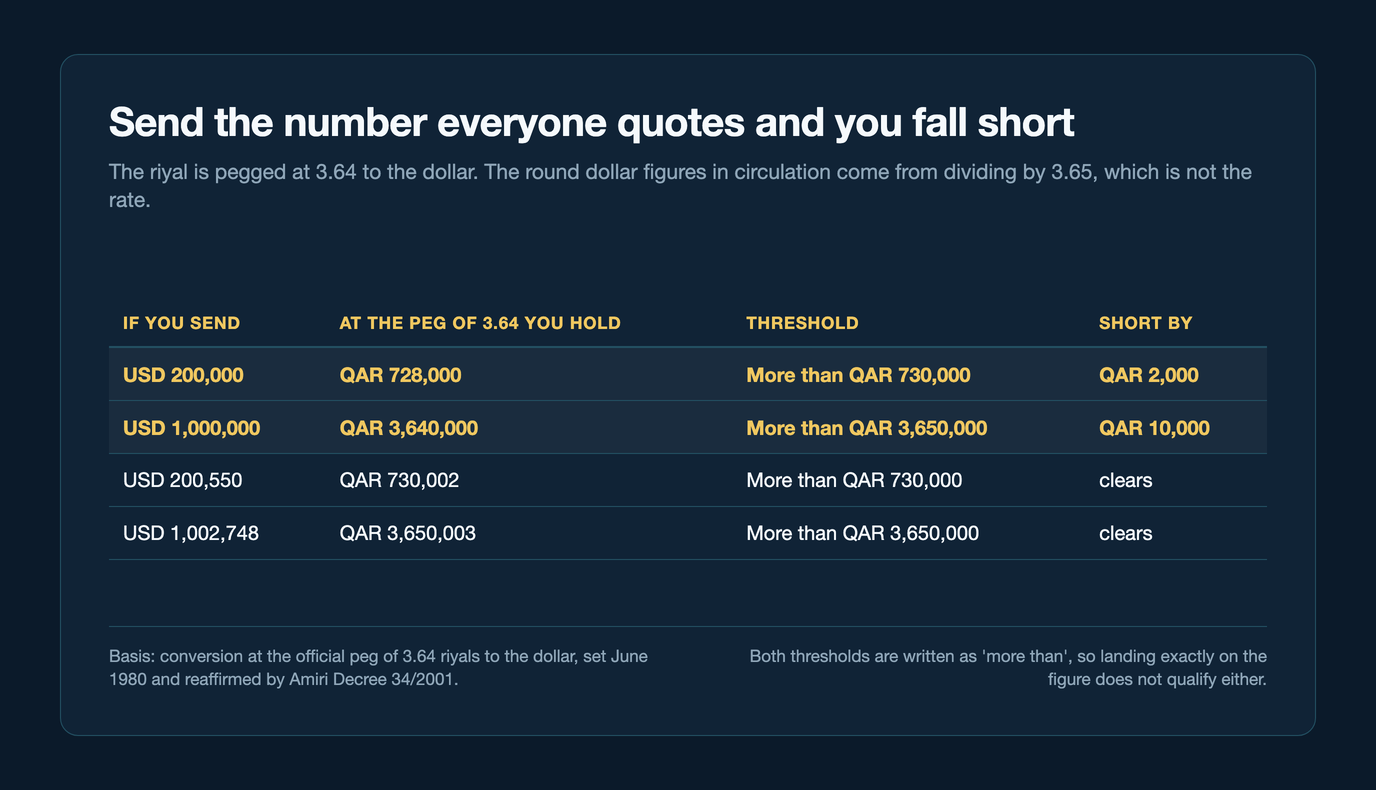
Divide QAR 730,000 by 3.65 and you get USD 200,000 exactly. Divide QAR 3,650,000 by 3.65 and you get USD 1,000,000 exactly. That is where the round numbers come from: someone converted at 3.65, the figure appeared clean, and it has been copied ever since.
The peg is 3.64. Run it the other way and the shortfall is arithmetic, not opinion:
| If you send | At the peg of 3.64 you hold | Threshold | Short by |
|---|---|---|---|
| USD 200,000 | QAR 728,000 | More than QAR 730,000 | QAR 2,000 |
| USD 1,000,000 | QAR 3,640,000 | More than QAR 3,650,000 | QAR 10,000 |
| USD 200,550 | QAR 730,002 | More than QAR 730,000 | clears |
| USD 1,002,748 | QAR 3,650,003 | More than QAR 3,650,000 | clears |
This is not a trap laid by the Qatari government. Invest Qatar, the state's own investment promotion agency, publishes the dollar version itself: its real estate sector page says "Residents investing a minimum of $1million in real estate are granted permanent residency" and "Residents investing a minimum of $200,000 are granted a 5-year renewable residency permit." Both sentences are on an official website, and both understate the legal threshold the Council of Ministers wrote.
In practice a buyer does not usually wire dollars at the mid rate and hope. Property is priced and registered in riyals, banks and exchange houses apply a margin either side of the peg, and the number that counts is the value on the title deed, not what left your account. The useful conclusion is narrower and more actionable than "the sites are wrong": budget against the riyal figure and treat any dollar number as a conversion someone else performed. A property listed at QAR 730,000 on the nose does not satisfy a condition that says more than QAR 730,000 either.
Our golden visa cost comparison makes the same point across programmes — almost every threshold in this market is set in a local currency and quoted to you in dollars, and the rounding is rarely in the applicant's favour.
"Privileges of permanent residency" is not permanent residency
The manual is careful here and the market is not. At the upper threshold the owner "obtains real estate residency with the advantages of permanent residency, most notably health, education and investment in some fields and economic activities". Its FAQ ties those to Article 7, paragraph 2 of Decision No. 28 of 2020 and calls them "the advantages prescribed for permanent residency card holders".
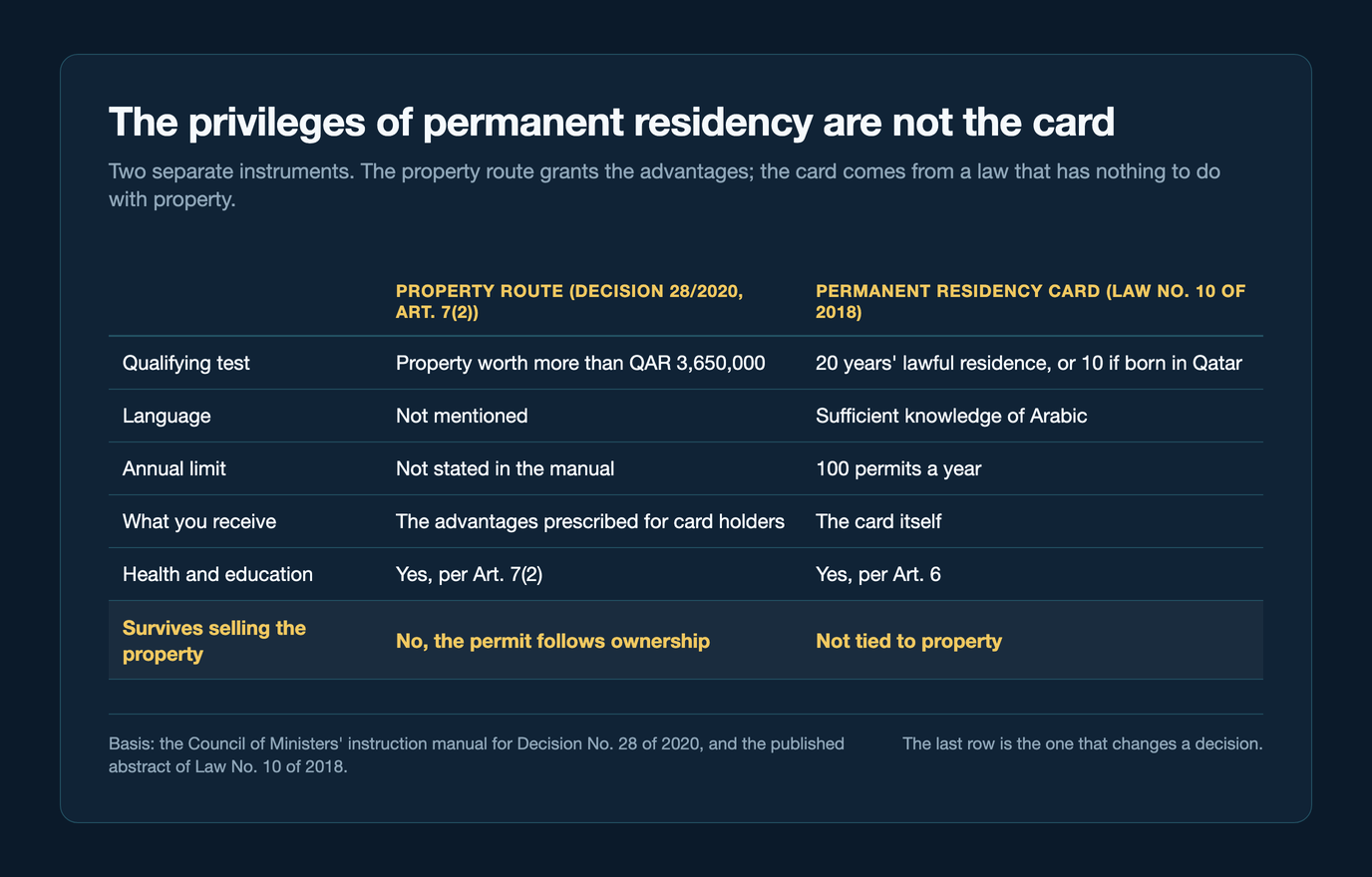
Advantages prescribed for card holders are not the card. Qatar's permanent residency card is created by a separate instrument, Law No. 10 of 2018, and its conditions have nothing to do with property:
| Property route (Decision 28/2020, Art. 7(2)) | Permanent residency card (Law No. 10 of 2018) | |
|---|---|---|
| Qualifying test | Property worth more than QAR 3,650,000 | 20 years' lawful residence, or 10 if born in Qatar |
| Language | Not mentioned | Sufficient knowledge of Arabic |
| Annual limit | Not stated in the manual | 100 permits a year |
| What you receive | The advantages prescribed for card holders | The card itself |
| Health and education | Yes, per Art. 7(2) | Yes, per Art. 6 |
| Survives selling the property | No — the permit follows ownership | Not tied to property |
The last row is the one that changes a decision. The State Department's statement puts it plainly: foreign owners "are eligible for residency in Qatar for as long as they own their property". A card under Law No. 10 of 2018 does not evaporate when an asset is sold; a real estate residency does. Anyone describing the QAR 3,650,000 tier as buying permanent residency is describing a permit with an exit condition attached to it.
There is a second, quieter difference. The hundred-permit annual cap in Law No. 10 of 2018 is a cap on the card. The manual does not say the property route is subject to it, and it would be odd if it were, since the property route does not issue the card — but we found no official text addressing the question either way, so treat any page that confidently applies or dismisses the cap as going beyond its sources. Ours stops here.
Where a non-Qatari is allowed to buy
A threshold is only useful inside a permitted area, and Qatar's list is specific. Decision No. 28 of 2020 opens 9 areas to freehold ownership and 16 to usufruct of up to 99 years, renewable by agreement and inheritable. The manual totals this as "(25) real estate ownership and usufruct areas" in one paragraph and refers to "the twenty-six areas mentioned in the decision" in another; the two tables it prints add to 25.
The nine freehold areas, with the zone numbers the manual gives, are where the headline projects sit:
| Freehold area | Zone |
|---|---|
| The Pearl | 66 |
| Legtaifiya (West Bay Lagoon) | 66 |
| Lusail | 69 |
| Al Kharaej | 69 |
| Jabel Thuaileb (Fox Hills) | 69 |
| Al Dafna (administrative area) | 60 |
| Al Dafna (administrative area) | 61 |
| Onaiza (administrative area) | 63 |
| Al Khor Resort | 74 |
The sixteen usufruct areas are inner-Doha districts — Mushaireb, Freej Abdul Aziz, Al Doha Al Jadeeda, Old Al Ghanim, Al Rufaa and Old Al Hitmi, Al Salata, two Freej Bin Mahmoud zones, Rawdat Al Khail, Al Mansoura and Freej Bin Durham, Najma, Umm Ghuwailina, Al Khulaifat, Al Sadd, Al Mirqab Al Jadeed and Freej Al Nasr, and the Doha International Airport area. A usufruct holder may use, lease and dispose of the property for the term, but the bare ownership stays with the titleholder.
Two carve-outs sit outside both lists. A non-Qatari may buy detached units — offices and shops — in commercial complexes anywhere in the country, with no limit on number; and one residential unit in one residential complex in any area, provided the unit is detached. The manual states that the owner of such a unit "has the right to purchase and request residency accordingly", so the residency route is not confined to the 25 named areas.
Inheritance has its own rule: a property devolving by inheritance or will can be retained outside the designated areas if it is residential, no larger than 3,000 square metres, and the heir's residence in the country is continuous.
The fees Qatar publishes, and the ones it does not
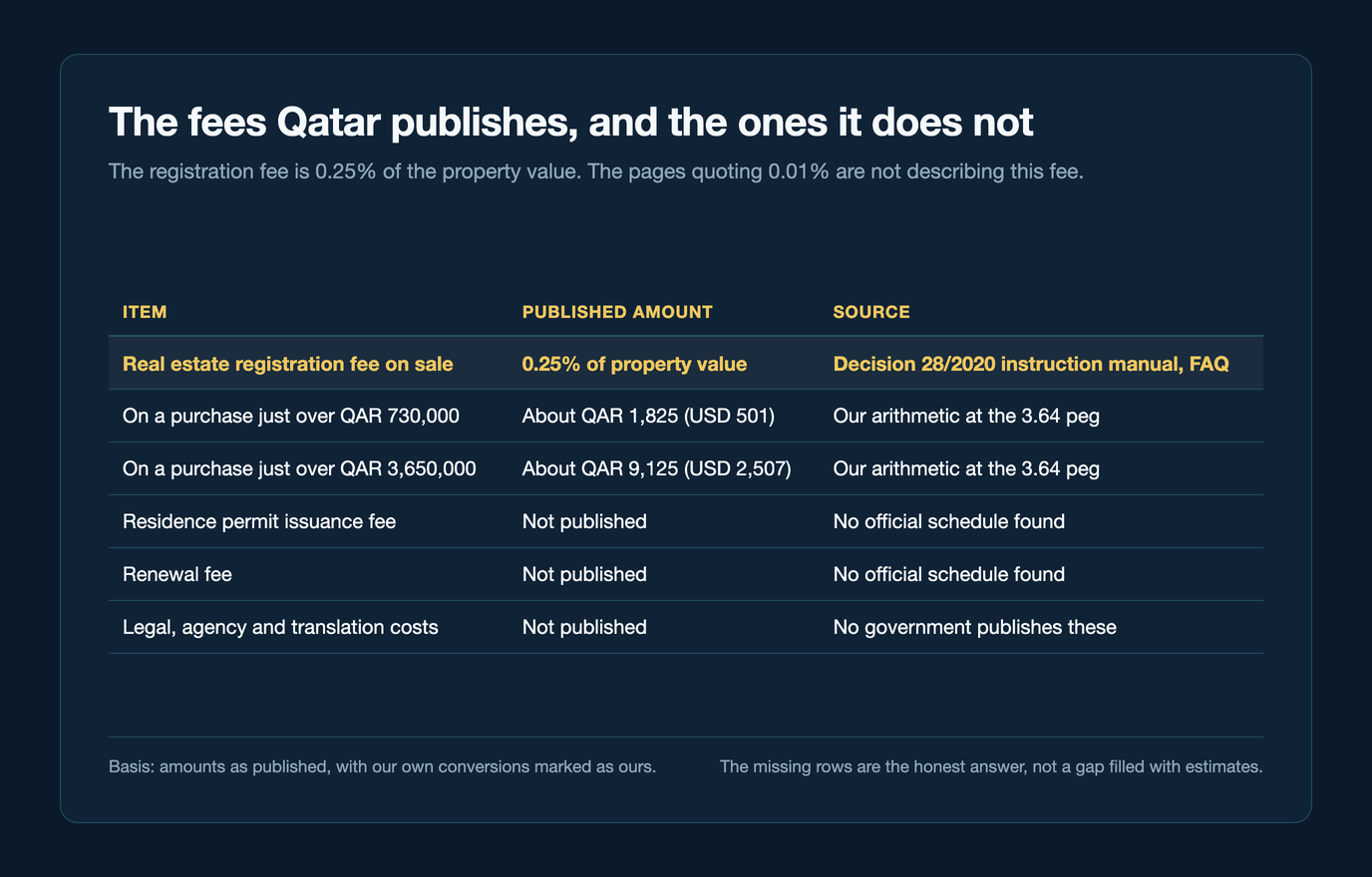
Qatar publishes less of its fee stack than Bahrain does and more than Oman. What exists is in the manual's FAQ, and one line of it contradicts most of the advisory market: "The real estate registration fee in case of sale is (0.25%) of the property value." The pages that quote 0.01% are not describing this fee.
| Item | Published amount | Source |
|---|---|---|
| Real estate registration fee on sale | 0.25% of property value | Decision 28/2020 instruction manual, FAQ |
| — on a purchase just over QAR 730,000 | About QAR 1,825 (USD 501) | Our arithmetic at the 3.64 peg |
| — on a purchase just over QAR 3,650,000 | About QAR 9,125 (USD 2,507) | Our arithmetic at the 3.64 peg |
| Residence permit issuance fee | Not published | No official schedule found |
| Renewal fee | Not published | No official schedule found |
| Legal, agency and translation costs | Not published | No government publishes these |
The missing rows are the honest answer rather than a gap we filled with estimates. We could not reach the Ministry of Justice's own non-Qatari ownership page from our research environment, and no document we could fetch sets a permit fee for this route. Advisory pages circulate a QAR 3,000 figure; it appears in material about the Law No. 10 of 2018 application, not about real estate residency, so we are not repeating it as a cost of this programme.
Two obligations do carry a real price if you ignore them. Vacant land must be built on within four years of registration in the owner's name, and the manual repeats this as a limit on disposal: vacant land may not be disposed of except by building inside that window. And the permit is conditioned on presence — the State Department's statement records a minimum of 90 days a year in Qatar for owners relying on property for residency, a condition the instruction manual itself does not mention anywhere.
Applications go through the Ministry of Justice website's electronic services as a purchase request for a foreign investor. The mandatory attachments are the title deed, a copy of the passport or ID, and — for applicants not resident in Qatar — a certificate of good conduct. The two offices for non-Qatari ownership are in the Al Mahara building in the Pearl District and in Lusail, and the manual publishes their contact details, including the address NQO@moj.gov.qa.
Qatar's other residency routes ask for no investment at all
This is the comparison the market has no incentive to draw. Alongside the property route, Invest Qatar runs a self-sponsored Residency Program through the Jusour platform, in two streams, and neither sets an investment threshold. The qualifying tests are a bank balance or a salary.
| Entrepreneur stream | Executive stream | |
|---|---|---|
| Who it is for | Founders endorsed by a recognised Qatari incubator | Senior executives already holding a QID, nominated by their employer |
| Financial test | QAR 36,500 minimum balance over three months if resident; USD 10,000 if applying from overseas | Monthly salary of QAR 50,000 for CEO, COO, CTO, CFO or Chairman roles; QAR 80,000 for other Executive Director titles |
| Other requirements | Incubator endorsement certificate, police clearance, passport valid six months, age 18+ | Five years' senior executive experience, direct local contract with a qualifying employer |
| Residency granted | Long-term, renewable | Long-term, renewable |
| Property purchase required | None | None |
Set that beside QAR 730,001 of real estate and the difference is two orders of magnitude. The streams are narrow — an incubator has to endorse you, or an employer nominate you, and Invest Qatar states that acceptance is at Jusour's discretion and approval is not guaranteed — but a founder who can clear a QAR 36,500 balance is being asked for roughly 5% of the lower property threshold, and nothing that has to be sold to get out.
The practical reading: the property route is for people who want the asset anyway. If the residency is the point and the property is the means, Qatar has cheaper means, and so do its neighbours — our guide to the cheapest golden visa ranks them on what you cannot get back.
Invest Qatar publishes contact details for the programme rather than an online threshold calculator, which is itself a signal about how discretionary it is.
How the Qatar golden visa cost compares across the Gulf
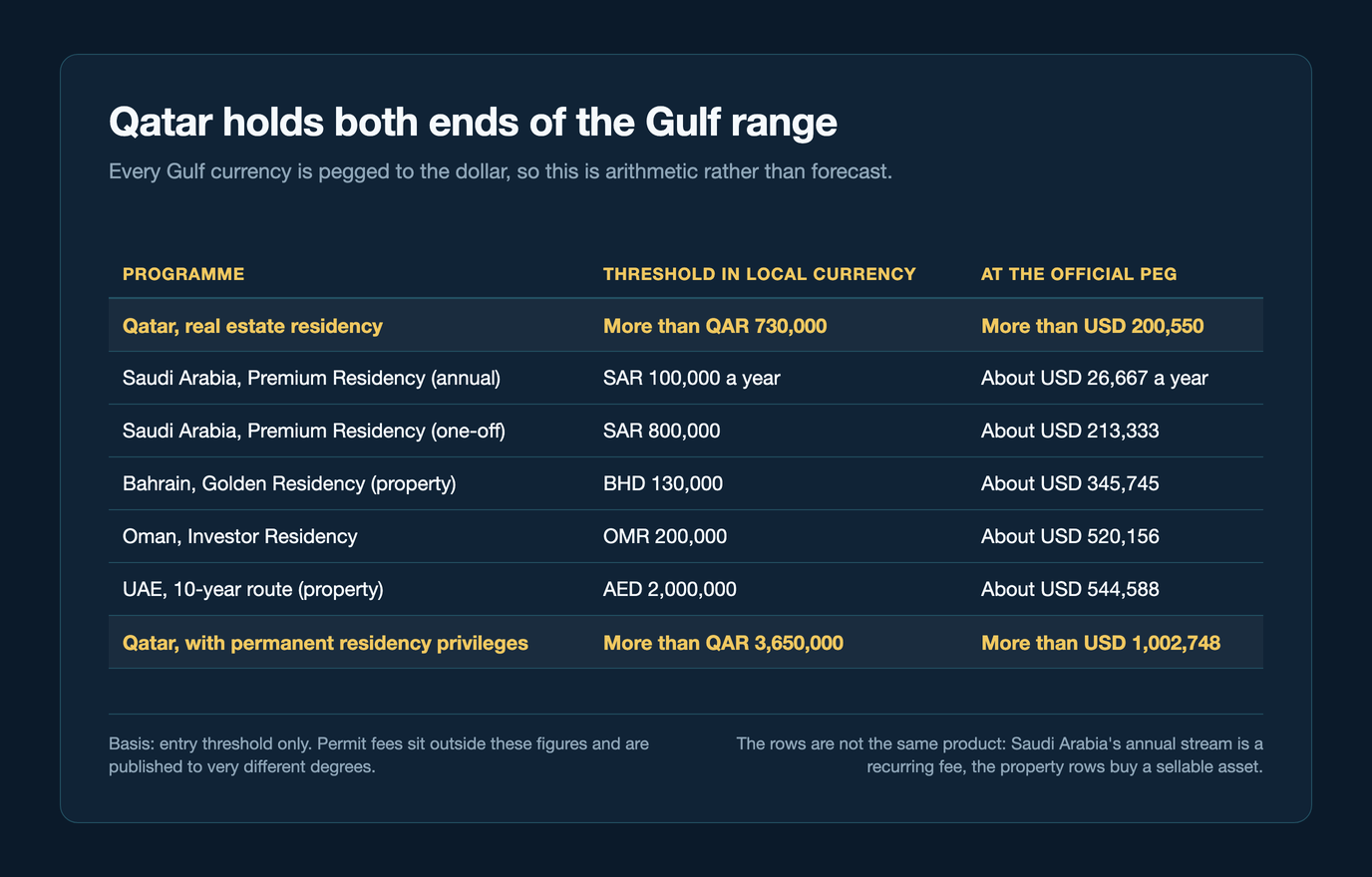
Every Gulf currency is pegged to the dollar, so the comparison below is arithmetic rather than forecast. It is also where Qatar's two tiers land in a useful place: the lower one is the cheapest property threshold in the GCC, and the upper one is the most expensive.
| Programme | Threshold in local currency | At the official peg |
|---|---|---|
| Qatar, real estate residency | More than QAR 730,000 | More than USD 200,550 |
| Saudi Arabia, Premium Residency (annual) | SAR 100,000 a year | About USD 26,667 a year |
| Saudi Arabia, Premium Residency (one-off) | SAR 800,000 | About USD 213,333 |
| Bahrain, Golden Residency (property) | BHD 130,000 | About USD 345,745 |
| UAE, 10-year route (property) | AED 2,000,000 | About USD 544,588 |
| Oman, Investor Residency | OMR 200,000 | About USD 520,156 |
| Qatar, with permanent residency privileges | More than QAR 3,650,000 | More than USD 1,002,748 |
Three cautions about reading that table as a ranking. First, the rows are not the same product: Saudi Arabia's annual Premium Residency is a recurring fee rather than an asset, so it is cheap to enter and never finished, while the property rows buy something you can sell. Our Saudi Arabia golden visa cost guide works out the year at which paying once beats paying annually.
Second, the permit fees sit outside the thresholds and vary wildly in transparency. Bahrain publishes BHD 305 for the permit itself — see our Bahrain golden visa cost guide — Qatar publishes nothing for this route, and Oman publishes no permit fee either while running a queue tens of thousands deep. A threshold you can read and a fee you cannot is a recurring shape in this market.
Third, what each permit does differs more than its price. The UAE golden visa cost buys a ten-year renewable residence with no minimum stay of this kind; Qatar's lower tier carries a 90-day annual presence condition and lasts while you own. Price per year of residence is the wrong metric when one permit has a stay requirement and the other does not.
What to check before you wire anything
Five questions, in this order, and the first one has already caught most of the pages you will have read.
What is the value in riyals on the title deed? Not the dollar price, not the listing — the registered value, and whether it is more than the threshold rather than equal to it. Which tier is the adviser actually selling? The QAR 3,650,000 tier grants the advantages prescribed for permanent residency card holders under Article 7(2), not the Law No. 10 of 2018 card, and the difference shows up the day you sell. Is the area on the list? Nine freehold zones, sixteen usufruct zones, plus detached commercial units anywhere and one detached residential-complex unit; anything else does not carry the route. What is the permit fee and who sets it? Qatar publishes no schedule for this route, so get it in writing from the Ministry of Justice office rather than from a brochure. How will the 90 days be evidenced at renewal? The condition is in the State Department's account of the programme and absent from the Council of Ministers' manual, which is precisely the kind of gap that becomes a problem at renewal rather than at purchase.
Our guide to golden visa health insurance requirements covers the cover question that follows a Gulf permit, and citizenship by investment processing time explains why published decision windows describe a government's part of the clock and not an applicant's.
Nothing here is a quote or advice to buy. Qatar has published a clear pair of thresholds in its own currency and a procedure to apply under them; the dollar figures attached to those thresholds in public circulation are smaller than the thresholds themselves. Budget in riyals and the problem disappears.
Related guides on Domicila
- UAE golden visa cost — the Gulf's best-known route, and the fee stack behind the headline threshold.
- Bahrain golden visa cost — BHD 305 for the permit, and a property threshold that fell 35% in November 2025.
- Oman golden visa cost — two official thresholds that disagree, and a queue nobody has been pulled out of.
- Saudi Arabia golden visa cost — seven versions of Premium Residency, including two you can simply buy.
- Golden visa cost comparison — every threshold in this market, in the currency it is actually set in.
- Cheapest golden visa — the low end, ranked on money you never get back.
Common questions
How much does the Qatar golden visa cost in 2026?
Qatar sets two thresholds in riyals: a property worth more than QAR 730,000 for a real estate residency, and more than QAR 3,650,000 for one carrying the privileges of a permanent residency card. At the official peg of 3.64 riyals to the dollar those are more than USD 200,550 and more than USD 1,002,748. The widely quoted USD 200,000 and USD 1 million are conversions at 3.65 and both fall short of the riyal thresholds. On top of the purchase, the published real estate registration fee on a sale is 0.25% of the property value; no permit fee for this route is published.
Does Qatar actually have a golden visa?
Not under that name. The Council of Ministers' instruction manual for Decision No. 28 of 2020 calls it "real estate residency", and Invest Qatar describes a renewable residency permit and permanent residency privileges. The phrase golden visa is a market label applied to Qatar's property-linked residency under Law No. 16 of 2018, not an official programme name.
Why is USD 200,000 not enough for Qatar residency by investment?
Because the threshold is a riyal figure and the dollar figure was converted at the wrong rate. QAR 730,000 divides exactly by 3.65 to give USD 200,000, but the riyal is pegged at 3.64 to the dollar, as set in June 1980 and reaffirmed by Amiri Decree 34/2001. At 3.64, USD 200,000 is QAR 728,000 — two thousand riyals under a threshold the manual states as more than QAR 730,000. Clearing it takes about USD 200,550.
Does QAR 3,650,000 of Qatari property buy permanent residency?
It buys the advantages prescribed for permanent residency card holders under Article 7, paragraph 2 of Decision No. 28 of 2020 — health care, education and investment in some economic activities — not the card. Qatar's permanent residency card comes from Law No. 10 of 2018, which requires twenty years of lawful residence, or ten if you were born in Qatar, plus sufficient Arabic, and is capped at one hundred permits a year. A real estate residency follows the property: the State Department records that foreign owners are eligible for residency for as long as they own it.
Can several properties be added together to reach the threshold?
For the upper tier, yes. The instruction manual's FAQ asks exactly this and answers that a person holding one property worth QAR 3,650,000 or several properties reaching that total value qualifies in both cases for the benefits in Article 7, paragraph 2 of the decision. The manual does not make the same statement about the QAR 730,000 tier, so do not assume aggregation works there without confirming it with the Ministry of Justice office.
Where in Qatar can a foreigner buy property?
Decision No. 28 of 2020 opens nine areas to freehold ownership — among them The Pearl, Lusail, Legtaifiya, Fox Hills, Al Kharaej, Al Dafna, Onaiza and Al Khor Resort — and sixteen inner-Doha areas to usufruct of up to 99 years. Separately, a non-Qatari may buy detached offices and shops in commercial complexes anywhere in the country with no limit on number, and one detached residential unit in one residential complex in any area, which the manual says also carries the right to request residency.
How many days a year must you spend in Qatar to keep the residency?
The US State Department's 2025 Investment Climate Statement records that foreign real estate owners are eligible for residency for as long as they own the property, provided they reside in Qatar for a minimum of 90 days a year. That condition does not appear in the Council of Ministers' instruction manual, so confirm how it is counted and evidenced with the Ministry of Justice office for non-Qatari ownership before relying on a particular reading of it.
Is there a cheaper way to get Qatari residency than buying property?
Invest Qatar runs a self-sponsored Residency Program through the Jusour platform with an entrepreneur stream and an executive stream, and neither asks for an investment. The entrepreneur stream tests a minimum balance of QAR 36,500 over three months for applicants already in Qatar, or USD 10,000 for applicants overseas, on top of an endorsement from a recognised Qatari incubator. The executive stream tests a monthly salary of QAR 50,000 for chief executive, operating, technology or financial officer and chairman roles, or QAR 80,000 for other executive director titles. Invest Qatar states that acceptance is discretionary and approval is not guaranteed.
Official sources to verify
- Instruction Manual — Council of Ministers' Decision No. 28 of 2020 on non-Qatari ownership and use of real estateGovernment of Qatar (published via Qatar Tourism)
- Investment Opportunities in Qatar's Real Estate SectorInvest Qatar (Investment Promotion Agency Qatar)
- Residency Program — Entrepreneur and Executive streamsInvest Qatar (Investment Promotion Agency Qatar)
- 2025 Investment Climate Statement: QatarUS Department of State
- Qatar: Law No. 10 of 2018 Regarding Permanent ResidenceGulf Labour Markets, Migration and Population Programme (GLMM)
Compare golden visa advisors
Ask for a route-specific quote that separates investment amount, government fees, legal work, fund or property costs, and renewal obligations.
We may earn a referral fee if you choose an advisor through this site. We still aim to show cost ranges, caveats, and official source links plainly.