mauritius golden visa cost
Mauritius Golden Visa Cost 2026: USD 1m, No Fee
Mauritius has launched a visa it actually calls the Golden Visa, and the first thing almost every page about it gets wrong is the arithmetic. The Mauritius golden visa cost is reported everywhere as USD 1 million, which is the investment you give a written undertaking to make within twelve months — not a fee, not a payment to anybody, and not due on the day you apply. The government charges nothing at all for this one: the Economic Development Board's own guidelines say "No processing fee applicable", while the cheaper permits this visa sits above each carry a USD 1,000 statutory fee and, since 1 December 2025, a USD 50 non-refundable application fee that no comparison table we found shows. We priced all seven routes from the EDB's August 2026 guidelines and the government residency portal, read the Finance Act 2026 to see what Parliament actually enacted, and converted every rupee figure at the Bank of Mauritius middle rate for 12 October 2026.

Key takeaways
The USD 1 million is an undertaking, not a fee. The Golden Visa Scheme guidelines published by the Economic Development Board in August 2026 require a written undertaking at the time of application to invest at least USD 1 million in Mauritius within twelve months of the visa being issued. You bring a bank statement showing the balance; you do not transfer it to the government, and nothing is payable on approval.
The Golden Visa itself is free. The permits beneath it are not. The guidelines list "No processing fee applicable" among the visa's key features. Every Occupation Permit and retired Residence Permit, by contrast, costs USD 1,000 on approval under the fee schedule in force since 11 July 2022, plus a USD 50 non-refundable application fee that the residency portal says took effect on 1 December 2025.
It buys two years, not residence. The visa is valid for up to two years, multi-entry, renewable on reapplication. A Permanent Residence Permit only becomes available once the million has actually been invested in a qualifying business activity inside that twelve-month window — and Mauritius runs no citizenship-by-investment programme at all, which is the distinction our citizenship by investment vs golden visa guide exists to draw.
The property route is still USD 375,000, and the duty on it changed in August 2026. Guides written in mid-2026 price a non-citizen's purchase under an EDB scheme at 10% registration duty plus 10% land transfer tax. The Finance Act 2026 repealed the provision that would have done that. What survives is a 10% additional duty confined to residential property on State land or Pas Géométriques, and the Act says the transferor pays it.
Cheaper routes have existed for years and most comparisons misname them. USD 100,000 buys a ten-year investor Occupation Permit, USD 50,000 a self-employed one, and USD 24,000 a year a ten-year retirement permit. None of those is the Golden Visa, and the USD 375,000 property threshold grants a residence permit rather than the permanent residence it is routinely described as.
On this page
This guide prices every Mauritian route from the EDB's own guidelines PDF, the government residency portal and the text of the Finance Acts 2025 and 2026 as published by the Mauritius Revenue Authority, and converts each rupee figure at a dated central-bank rate. This site's renderer does not emit heading anchors, so the list below is a map rather than a set of jump links.
- Mauritius golden visa cost in 2026: a USD 1m undertaking, not a fee
- What the government actually charges, route by route
- What "USD 1 million invested" commits you to
- The seven routes, priced side by side
- The property route, and the duty every comparison still prices wrong
- Tax: the remittance rule the Finance Act 2026 extended to you
- From golden visa to permanent residence: the turnover gates
- What none of these numbers include
- Related guides on Domicila
Mauritius golden visa cost in 2026: a USD 1m undertaking, not a fee
The Mauritius golden visa cost question has a strange answer, and the shape of it matters before any numbers: the headline figure is capital you commit to deploy, and the government's own charge for the visa is zero. Most write-ups quietly convert the million into a price, which is how you end up reading that Mauritius is "80% cheaper" than something while nobody states a single fee.
The scheme is real and the paperwork exists: a ten-page EDB guidelines document dated August 2026, with an application form on the National Electronic Licensing System, a checklist, a model undertaking and an annex on domestic workers' permits. Parliament gave it a statutory footing in the same window. The Finance Act 2026, Act No. 14 of 2026, passed on 31 July 2026 and assented on 12 August 2026, inserts into the Income Tax Act a definition reading "'golden visa' means a visa issued by the passport officer under the Passports Act to a non-citizen on the recommendation of the Economic Development Board".
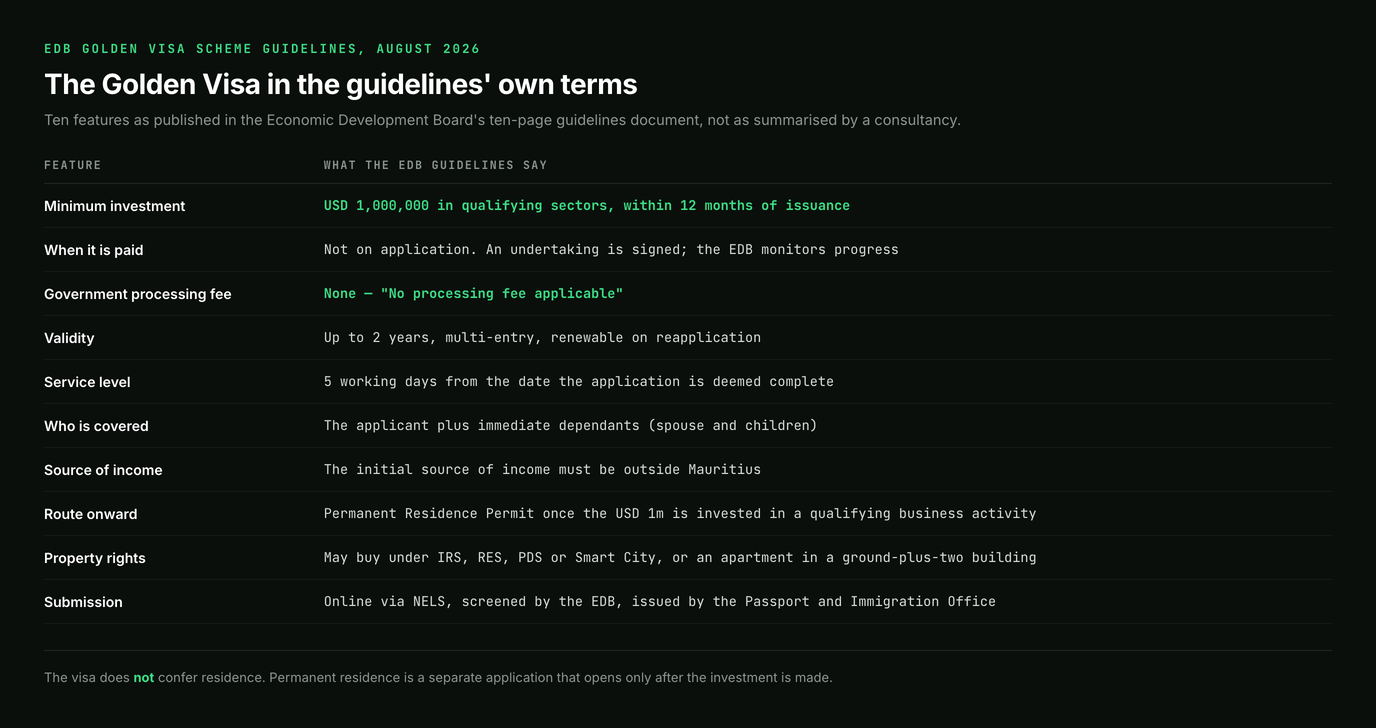
Here is what the guidelines say the visa is, in the guidelines' own terms rather than a consultancy's summary of them.
| Feature | What the EDB guidelines say |
|---|---|
| Minimum investment | USD 1,000,000 in qualifying sectors, within 12 months of issuance |
| When it is paid | Not on application. An undertaking is signed; the EDB monitors progress |
| Government processing fee | None — "No processing fee applicable" |
| Validity | Up to 2 years, multi-entry, renewable on reapplication |
| Service level | 5 working days from the date the application is deemed complete |
| Who is covered | The applicant plus immediate dependants (spouse and children) |
| Source of income | The initial source of income must be outside Mauritius |
| Route onward | Permanent Residence Permit once the USD 1m is invested in a qualifying business activity |
| Property rights | May buy under IRS, RES, PDS or Smart City, or an apartment in a ground-plus-two building |
| Submission | Online via NELS, screened by the EDB, issued by the Passport and Immigration Office |
Two of those lines deserve flagging because they are reported wrongly almost everywhere. The visa does not confer residence, permanent or otherwise — permanent residence is a separate application that opens only after the investment is made. And the widely quoted cap of roughly 100 recipients a year appears nowhere in the guidelines; it comes from ministerial briefing, so treat it as policy intent rather than a published rule.
What the government actually charges, route by route
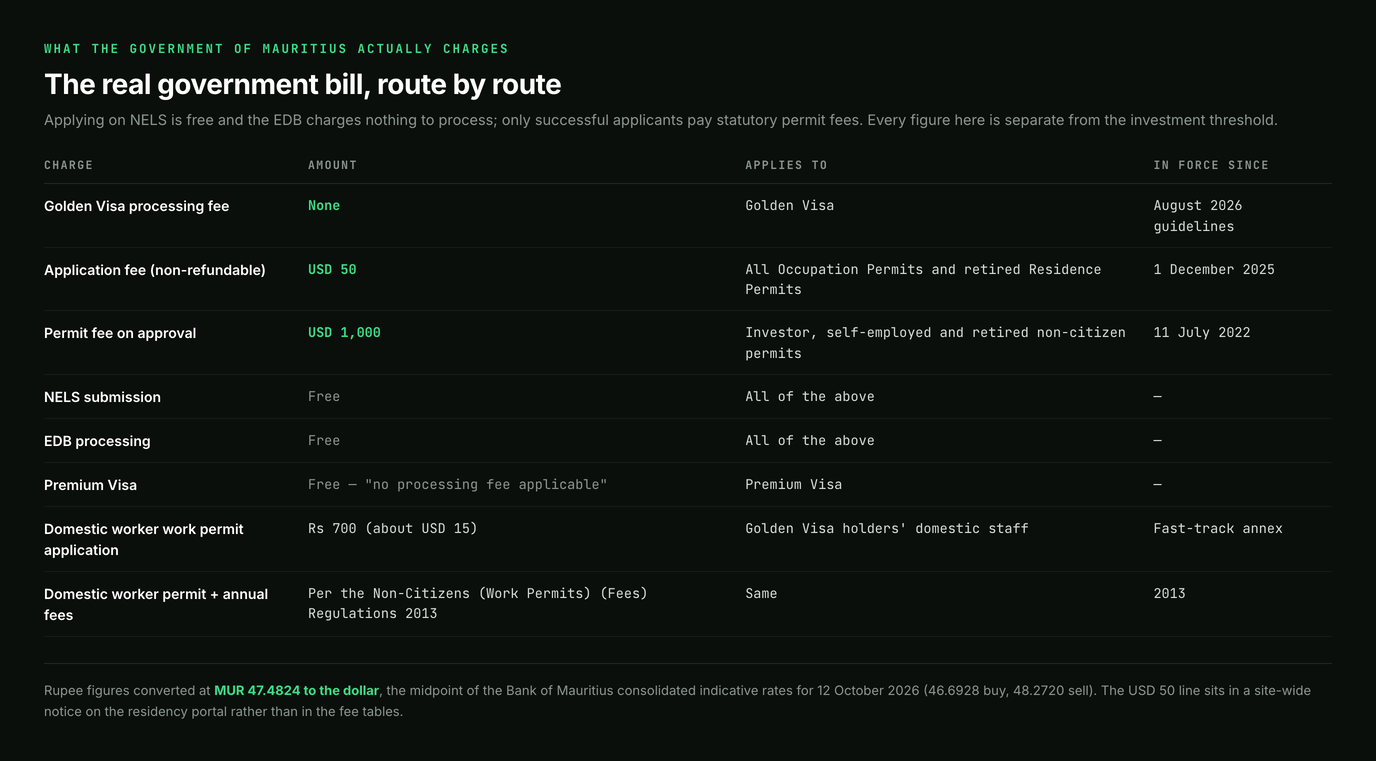
This is the table no competing page carries, and it is the one a reader budgeting for Mauritius actually needs. Applying on NELS is free, and the EDB states plainly that it charges nothing for processing these applications — only successful applicants pay the statutory permit fees to the Government of Mauritius. So the real government bill for any Mauritian route is small, specific, and completely separate from the investment threshold.
| Charge | Amount | Applies to | In force since |
|---|---|---|---|
| Golden Visa processing fee | None | Golden Visa | August 2026 guidelines |
| Application fee (non-refundable) | USD 50 | All Occupation Permits and retired Residence Permits | 1 December 2025 |
| Permit fee on approval | USD 1,000 | Investor, self-employed and retired non-citizen permits | 11 July 2022 |
| NELS submission | Free | All of the above | — |
| EDB processing | Free | All of the above | — |
| Premium Visa | Free — "no processing fee applicable" | Premium Visa | — |
| Domestic worker work permit application | Rs 700 (about USD 15) | Golden Visa holders' domestic staff | Fast-track annex |
| Domestic worker permit + annual fees | Per the Non-Citizens (Work Permits) (Fees) Regulations 2013 | Same | 2013 |
Rupee figures throughout this guide are converted at MUR 47.4824 to the dollar, the midpoint of the Bank of Mauritius consolidated indicative rates for 12 October 2026 (46.6928 buy, 48.2720 sell). We name the rate and the date because the rupee moved from 47.54 to 48.36 and back inside September 2026, and a comparison table that converts at an unnamed rate is a table you cannot check.
The USD 50 line is the one worth noting if you are reading an older guide. The residency portal carries it as a site-wide notice rather than in the fee tables, so it is easy to miss and it is absent from every third-party comparison we read. On a family application it is charged per applicant, which is still trivial against a USD 1,000 permit fee — the point is that the published cost of a Mauritian permit is now two numbers, not one.
What this adds up to is a jurisdiction whose government fees are almost a rounding error, with the entire cost of entry sitting in the investment or the property. That is the opposite of, say, the Caribbean programmes in our golden visa cost comparison, where the government contribution is the price.
What "USD 1 million invested" commits you to
The undertaking at Annex of the guidelines is a single page and it is worth reading before anything else, because it is the document that defines your exposure. You declare that you intend to transfer and invest at least USD 1,000,000 into a bank account in your own name, or in the name of an entity of which you are the beneficial owner, at a licensed banking institution in Mauritius, within twelve months of the visa being issued.
You further undertake that the funds will be invested in qualifying high-value sectors under Mauritian law, that you will produce whatever evidence the authorities ask for, and — the clause that matters — that you understand failure to meet the commitment in time may result in the cancellation, revocation or non-renewal of the Golden Visa and any related permits or approvals. The EDB says it will monitor the investment's progress throughout.
Which sectors qualify is where the guidelines contradict themselves, and we have not seen this noted anywhere. The overview in §1 describes the scheme as aimed at individuals "specialised in high value sectors such as FinTech, global treasury, artificial intelligence, biotechnology, and renewable energy" — the five sectors named in the Budget. But §4, headed "Qualifying sectors", lists eleven: financial services, fintech, ICT, tourism and hospitality, manufacturing, healthcare and wellness, education, renewable energy, blue economy, innovative or knowledge-based, and creative industries. Global treasury, artificial intelligence and biotechnology are in the first list and absent from the second.
On its face §4 is the operative list, and it is far wider than the Budget's framing — good news for a business in tourism or manufacturing. But a sector list that differs by six entries inside one ten-page PDF is not a thing to build a USD 1 million commitment on. Confirm your own activity with the EDB before you sign, and get the answer in writing.
The rest of the checklist is conventional for the price point: a passport valid at least six months, a detailed business plan, travel and health insurance, a letter of accommodation, and a certified bank statement showing a balance of at least USD 1 million. Our guide to golden visa health insurance requirements covers what that insurance line asks for across programmes.

The seven routes, priced side by side
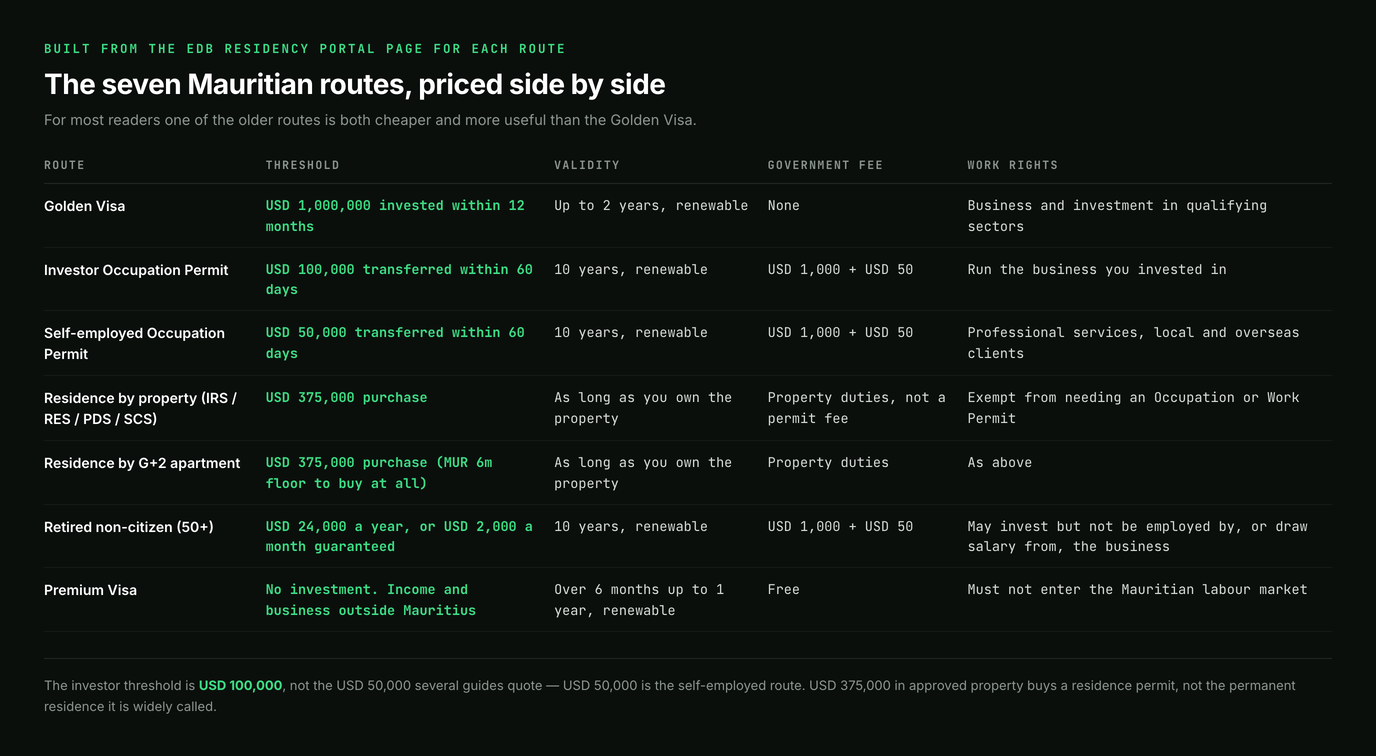
Mauritius was open to foreign capital long before it used the phrase golden visa, and for most readers one of the older routes will be both cheaper and more useful. The table below is built from the EDB residency portal page for each route, not from a secondary summary — which matters, because the two figures competitors most often garble are both in it.
| Route | Threshold | Validity | Government fee | Work rights |
|---|---|---|---|---|
| Golden Visa | USD 1,000,000 invested within 12 months | Up to 2 years, renewable | None | Business and investment in qualifying sectors |
| Investor Occupation Permit | USD 100,000 transferred within 60 days | 10 years, renewable | USD 1,000 + USD 50 | Run the business you invested in |
| Self-employed Occupation Permit | USD 50,000 transferred within 60 days | 10 years, renewable | USD 1,000 + USD 50 | Professional services, local and overseas clients |
| Residence by property (IRS / RES / PDS / SCS) | USD 375,000 purchase | As long as you own the property | Property duties, not a permit fee | Exempt from needing an Occupation or Work Permit |
| Residence by G+2 apartment | USD 375,000 purchase (MUR 6m floor to buy at all) | As long as you own the property | Property duties | As above |
| Retired non-citizen (50+) | USD 24,000 a year, or USD 2,000 a month guaranteed | 10 years, renewable | USD 1,000 + USD 50 | May invest but not be employed by, or draw salary from, the business |
| Premium Visa | No investment. Income and business outside Mauritius | Over 6 months up to 1 year, renewable | Free | Must not enter the Mauritian labour market |
Two corrections. The investor Occupation Permit threshold is USD 100,000, not the USD 50,000 several guides quote — USD 50,000 is the self-employed route, a factor of two on the number most readers shop on. And USD 375,000 in approved property buys a residence permit lasting as long as you own the property, not the Permanent Residence Permit it is widely called; the PDS page adds that a spouse and children under 24 are covered alongside the buyer.
The renewal gates are where the cheap routes get expensive. An investor permit renews on a minimum annual turnover of MUR 8 million (about USD 168,500) from year five, with the same page naming MUR 5 million from year three — two figures worth confirming with the EDB. Self-employed renewal asks MUR 3 million (about USD 63,200) from year five, plus three letters of intent at application stage.
The Premium Visa is the genuinely free option, and unglamorous in a useful way: no investment, no permit fee, over six months up to a year, renewable, open to nationals of a long published list and to anyone already in Mauritius on a tourist visa. It is required for any stay over 180 days in a calendar year. If you want twelve months of remote work rather than relocation, that is the route — and our cheapest golden visa guide shows how rare a zero-cost residence option is.
The property route, and the duty every comparison still prices wrong
Buy into an EDB-approved scheme at USD 375,000 or above and you get a residence permit for as long as you hold the property, plus exemption from needing an Occupation or Work Permit to invest and work in Mauritius. That is a strong offer, and the transaction taxes on it are where published guides have gone off the rails in 2026.
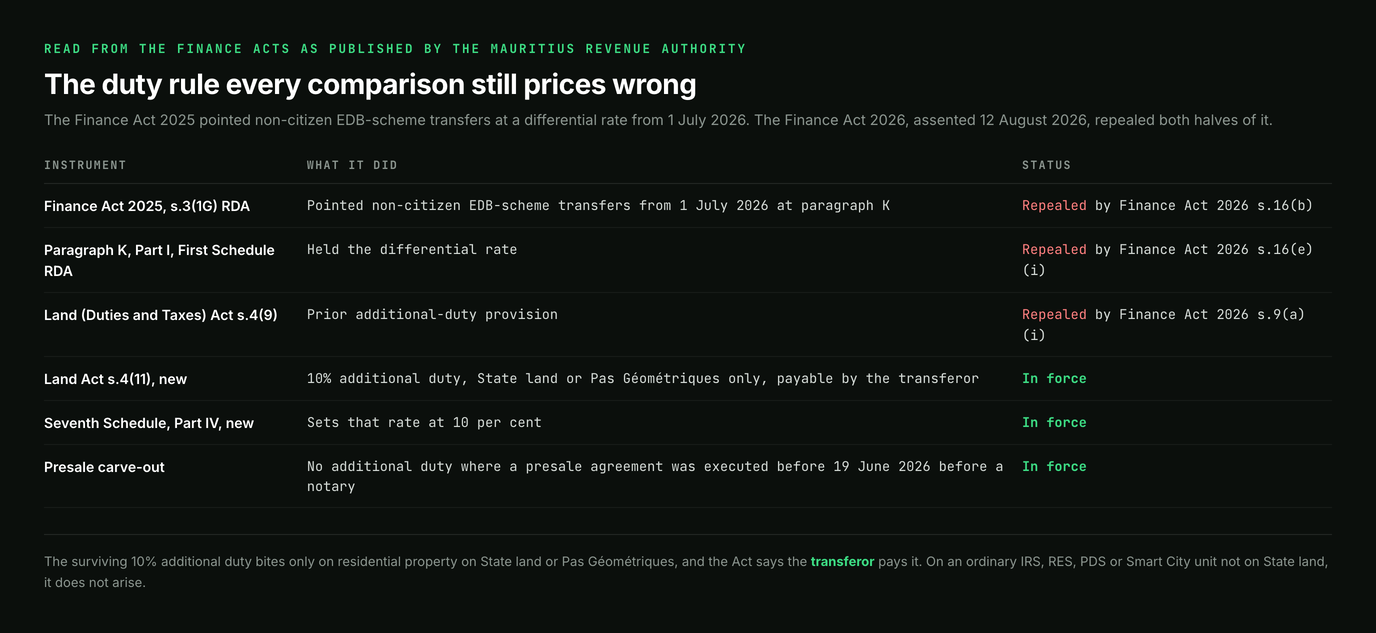
Here is what happened, from the Acts themselves rather than from commentary. The Finance Act 2025 inserted a new subsection 3(1G) into the Registration Duty Act, providing that duty on the registration of a deed transferring residential property under an EDB Property Scheme to a non-citizen, on or after 1 July 2026, would be charged in accordance with paragraph K of Part I of the First Schedule rather than at the ordinary rate. The Finance Act 2026 then repealed both halves of that: section 16(b) repeals subsection 3(1G), and section 16(e)(i) repeals paragraph K itself.
| Instrument | What it did | Status |
|---|---|---|
| Finance Act 2025, s.3(1G) RDA | Pointed non-citizen EDB-scheme transfers from 1 July 2026 at paragraph K | Repealed by Finance Act 2026 s.16(b) |
| Paragraph K, Part I, First Schedule RDA | Held the differential rate | Repealed by Finance Act 2026 s.16(e)(i) |
| Land (Duties and Taxes) Act s.4(9) | Prior additional-duty provision | Repealed by Finance Act 2026 s.9(a)(i) |
| Land Act s.4(11), new | 10% additional duty, State land or Pas Géométriques only, payable by the transferor | In force |
| Seventh Schedule, Part IV, new | Sets that rate at 10 per cent | In force |
| Presale carve-out | No additional duty where a presale agreement was executed before 19 June 2026 before a notary | In force |
So the "10% registration duty plus 10% land transfer tax on foreign buyers" that leading guides still publish — one with a worked example of roughly USD 37,500 of duty on a USD 375,000 purchase, citing the Finance Act 2025 — describes a regime Parliament unwound. The surviving 10% additional duty is narrow in two ways that change who pays and whether it touches you: it bites only on residential property on State land or Pas Géométriques transferred to a non-citizen, and the Act says it shall be paid by the transferor. On an ordinary IRS, RES, PDS or Smart City unit not on State land, it does not arise.
One wrinkle to take to a notary rather than to a blog. The 2025 provision commenced on 1 July 2026 by its own terms, and the Finance Act 2026 was assented on 12 August 2026, so there is a six-week window in which deeds were registered under a regime that has since been repealed. The Finance Act 2026 as published contains no express refund provision for that window. If you registered a deed between those dates, that is a question for the Registrar-General and your notary, and anyone who tells you confidently how it resolves is guessing.
What we deliberately do not quote is the ordinary rate. Paragraph K's figure lived in the Registration Duty Act's First Schedule and the paragraph no longer exists; the general rates are the Registrar-General's to state, not ours to infer from a repealed cross-reference. Get the duty quoted in writing by the notary handling the deed — the same discipline our Panama golden visa cost guide applies to that country's bank-letter rules.
Tax: the remittance rule the Finance Act 2026 extended to you
The EDB guidelines summarise the tax position in three lines: income earned and taxed outside Mauritius is not subject to tax locally, funds remitted to Mauritius may be taxable unless proof of prior taxation is provided, and expenditure in Mauritius via foreign cards is not subject to tax. That summary is accurate, but it is a summary of a statutory provision, and the provision is more precise than the summary.
Section 73B of the Income Tax Act was written for the Premium Visa. The Finance Act 2026 renamed its heading to "Premium visa or golden visa" and inserted "or golden visa" into each of its three subsections, so what follows now governs Golden Visa holders too. In the Act's words: income derived for work performed remotely from Mauritius is deemed derived in Mauritius when it is remitted in Mauritius; money spent in Mauritius through a foreign credit or debit card is deemed not to have been remitted; and where a holder deposits money in a Mauritian bank account, they are liable to income tax on those deposits unless a declaration is made that the required tax has been paid on that income in their country of origin or residence.
Read those three together and the shape is clear. The relief is not an exemption, it is a remittance basis with a documentation condition attached, and the condition is the part people skip. The declaration about foreign tax paid is what stands between a deposit and a Mauritian tax charge, so the paperwork trail from your home jurisdiction is not optional housekeeping — it is the mechanism.
Separately, residence for tax purposes is a day-count and nothing to do with which visa you hold: the residency portal puts it at a stay of 183 days or more in an income year, or an aggregate of 270 days or more across the income year and the two preceding ones. A two-year Golden Visa makes it perfectly possible to spend enough time in Mauritius to become tax resident without ever having thought about it, and the undertaking's requirement that your initial source of income be outside Mauritius does not change that arithmetic.
From golden visa to permanent residence: the turnover gates
The Golden Visa's headline benefit is the onward route: a holder who has invested at least USD 1 million in a qualifying business activity within the twelve months becomes eligible to apply for a Permanent Residence Permit. That is a shortcut worth having, because the ordinary paths to the same twenty-year permit take five years and clear some demanding financial gates.
| Prior permit | Minimum years held | Financial test for the 20-year PRP |
|---|---|---|
| Golden Visa | None stated | USD 1,000,000 invested in a qualifying business activity within 12 months |
| Occupation Permit, investor | 5 | MUR 15m annual turnover for 5 years (about USD 315,900), or MUR 75m aggregate over 5 consecutive years |
| Occupation Permit, professional | 5 | Basic monthly salary of at least MUR 400,000 (about USD 8,400) for 5 consecutive years |
| Occupation Permit, self-employed | 5 | MUR 3m annual business income for 5 years, or MUR 15m aggregate over 5 consecutive years |
| Residence Permit, retired non-citizen | 5 | Aggregate transfers of at least USD 200,000 over the 5 consecutive preceding years |
| Any PRP holder switching category | — | Disposable annual income of USD 40,000 to move onto the retired non-citizen PRP |
Two procedural details that are easy to lose. The professional and self-employed applications must be made no later than six months after you satisfy the criteria, so the window closes rather than staying open indefinitely. And the PRP runs twenty years and is renewable for another twenty provided the residency requirements have been fulfilled — it is a long permit, not a status you hold outright.
Dependants are generously defined by the standards of this market. For Occupation Permit and retired non-citizen holders they include a spouse — an opposite-sex common law partner counts — parents, and unmarried children not in gainful activity, each eligible for a residence permit of the same duration. The Passport and Immigration Office determines those, not the EDB.
What none of this reaches is a passport. Mauritius runs no citizenship-by-investment programme, and nothing in the Golden Visa guidelines, the Finance Act 2026 or the PRP criteria creates one; naturalisation is a separate statutory process with its own residence requirement. If a passport rather than a base is the objective, the programmes in our golden visa countries overview that do lead to citizenship are a different shortlist entirely.
What none of these numbers include
Every figure above is a government charge or a published threshold. The gap between that and your bank statement is filled by costs no Mauritian ministry publishes, and we would rather name them than pretend the table is a budget.
Professional fees come first and are the largest unpublished line. Nobody applies for a Golden Visa without a business plan covering shareholder background, implementation schedule and project financing, and that plan is drafted by somebody. Company incorporation through the Corporate and Business Registration Department, licence or clearance work where your activity is regulated, notarial fees on a property deed, and tax advice spanning your home jurisdiction and Mauritius are all real and all quoted per engagement.
Then the conditional costs. Travel and health insurance for the intended period of stay is a checklist item on both the first application and the renewal, bought on the open market. Accommodation has to be evidenced before you arrive — a hotel booking or a rental agreement — so the first months are priced at tourist rates unless you are buying. Medical clearance for a domestic worker involves a specified panel of blood tests and a chest x-ray, before arrival and again within a week after, paid to private labs.
And the currency risk is yours. The bank statement, the thresholds and the permit fees are denominated in dollars while the duties, the work permit fees and the MUR 6 million apartment floor are in rupees, and the two move against each other. The rupee traded between 47.52 and 48.59 to the dollar across September 2026 on the Bank of Mauritius series; on a USD 375,000 purchase, a one-rupee move is about MUR 375,000 of difference in what the rupee-denominated costs come to.
The honest summary of the Mauritius golden visa cost, then, is this: the government's fee is nothing, the capital requirement is USD 1 million of your own money deployed into a business you have to actually run, and the costs that will surprise you are professional and conditional rather than statutory. That is a much better deal than most programmes at the price point, and a worse one than "no processing fee" sounds.
Related guides on Domicila
If Mauritius is on your shortlist, these are the comparisons that do the most work next:
- Golden visa cost comparison — every open programme priced on its current official fee table
- Cheapest golden visa — where the entry price is genuinely lowest, and what you give up for it
- Golden visa countries — which programmes lead to citizenship and which stop at residence
- Malaysia golden visa cost — two programmes behind one phrase, priced from the ministry's tables
- Indonesia golden visa cost — twelve badged routes, from a US$25,000 deposit upward
- UAE golden visa cost — the ten-year permit this one is most often compared to
- Golden visa health insurance requirements — what the insurance line on every checklist actually asks for
- Citizenship by investment vs golden visa — a passport now, or a residence permit first
Common questions
How much does the Mauritius golden visa cost in 2026?
The Economic Development Board charges no processing fee for the Golden Visa at all — "No processing fee applicable" is listed among the scheme's key features in the August 2026 guidelines. The USD 1,000,000 figure reported everywhere is not a fee: it is the minimum investment you give a written undertaking to make in qualifying sectors within twelve months of the visa being issued, held in a bank account in your own name or in an entity you beneficially own. At application you provide a certified bank statement showing a balance of at least USD 1 million, not a payment. The costs you will actually incur are professional ones: the business plan, incorporation, licences where your activity is regulated, insurance and tax advice.
Does the Mauritius Golden Visa give you residence or citizenship?
Neither, by itself. The Golden Visa is a multi-entry visa valid for up to two years with an option to renew, and it allows the holder and immediate dependants to stay in Mauritius for that period. Permanent residence is a separate application that becomes available once at least USD 1 million has been invested in a qualifying business activity inside the twelve-month window. Mauritius operates no citizenship-by-investment programme, and nothing in the Golden Visa guidelines or the Finance Act 2026 creates a route to a passport; naturalisation is a separate statutory process with its own residence requirement.
What is the cheapest way to get Mauritian residency in 2026?
The Premium Visa, which is free. It carries no investment requirement and no processing fee, runs from over six months up to one year and is renewable, and is open to nationals of a long published list of countries as well as to anyone already in Mauritius on a tourist visa. The conditions are that you must not enter the Mauritian labour market and that your main place of business and source of income must be outside Mauritius. It is required for any stay exceeding 180 days in a calendar year. If you need to work locally, the cheapest permit is the self-employed Occupation Permit at USD 50,000 transferred within 60 days, plus a USD 1,000 permit fee and a USD 50 application fee.
Is the Mauritius investor permit USD 50,000 or USD 100,000?
USD 100,000, and the confusion is worth clearing up because several comparison guides have it wrong. The investor Occupation Permit requires a written undertaking to transfer USD 100,000 from abroad into your Mauritian bank account within 60 days of the permit being issued, and runs ten years renewable. USD 50,000 is the separate self-employed Occupation Permit, which also runs ten years and additionally asks for three letters of intent including two from potential local clients. Both carry the same USD 1,000 permit fee on approval and the same USD 50 non-refundable application fee introduced on 1 December 2025.
What property duty does a foreign buyer pay in Mauritius now?
Less than most 2026 guides say, and the published worked examples are out of date. The Finance Act 2025 inserted a provision pointing non-citizen purchases of EDB-scheme residential property, from 1 July 2026, at a higher duty rate in paragraph K of the Registration Duty Act's First Schedule. The Finance Act 2026, assented on 12 August 2026, repealed both that provision and paragraph K itself. What remains is a 10% additional duty under a new section 4(11) of the Land (Duties and Taxes) Act, confined to residential property located on State land or on Pas Géométriques, and the Act states it is paid by the transferor rather than the buyer. Have the duty quoted in writing by the notary handling your deed, because deeds registered between 1 July and 12 August 2026 sit in a window the repealing Act does not expressly address.
How much property do you need to buy for Mauritian residency?
USD 375,000, under the Integrated Resort Scheme, Real Estate Scheme, Property Development Scheme or Smart City Scheme, or in an apartment in a building of at least two floors above ground. That grants a residence permit for as long as you own the property — not the Permanent Residence Permit it is often called — and the Property Development Scheme page adds that a spouse and children below the age of 24 are covered too. Holders are exempted from needing an Occupation or Work Permit to invest and work in Mauritius. Note that the ground-plus-two route carries two thresholds that do different jobs: MUR 6 million, about USD 126,400 at the Bank of Mauritius middle rate for 12 October 2026, is the minimum price at which a non-citizen may buy such an apartment at all, while USD 375,000 is the level at which the purchase carries a residence permit.
Which sectors qualify for the Mauritius Golden Visa?
The guidelines give two different answers and you should confirm yours with the EDB before signing anything. The overview in section 1 names FinTech, global treasury, artificial intelligence, biotechnology and renewable energy, matching the Budget's framing. The section actually headed "Qualifying sectors" lists eleven: financial services, fintech, ICT, tourism and hospitality, manufacturing, healthcare and wellness, education, renewable energy, blue economy, innovative or knowledge-based activities, and creative industries. Global treasury, artificial intelligence and biotechnology appear in the first list and not the second. The second list is the operative one on its face and is considerably wider, but a six-entry discrepancy inside one ten-page document is not a basis for a USD 1 million commitment.
How is a Mauritius Golden Visa holder taxed?
On a remittance basis with a documentation condition. The Finance Act 2026 extended section 73B of the Income Tax Act, written for the Premium Visa, to golden visa holders. Income derived for work performed remotely from Mauritius is deemed derived in Mauritius when it is remitted there; money spent in Mauritius through a foreign credit or debit card is deemed not to have been remitted; and money deposited into a Mauritian bank account is liable to income tax unless a declaration is made that the required tax has already been paid on that income in your country of origin or residence. That declaration is the whole mechanism, so the evidence trail from your home jurisdiction matters. Tax residence itself is a day count, not a visa question: 183 days or more in an income year, or 270 days aggregate across that year and the two preceding ones.
Official sources to verify
- Golden Visa Scheme Mauritius — Guidelines, August 2026Economic Development Board, Mauritius
- Work & Live in MauritiusEconomic Development Board, Mauritius
- Residency by Investment of USD 100,000 (Investor Occupation Permit)Economic Development Board, Mauritius
- Self-Employed Entrepreneurs Occupation PermitEconomic Development Board, Mauritius
- Retired Non-Citizen +50 years Residence PermitEconomic Development Board, Mauritius
- Permanent Residence Permit (PRP)Economic Development Board, Mauritius
- Mauritius Premium VisaEconomic Development Board, Mauritius
- Property Development Scheme (PDS)Economic Development Board, Mauritius
- Integrated Resort Scheme (IRS)Economic Development Board, Mauritius
- Real Estate Scheme (RES)Economic Development Board, Mauritius
- Smart City Scheme (SCS)Economic Development Board, Mauritius
- Ground + 2 ApartmentsEconomic Development Board, Mauritius
- The Finance Act 2026 (Act No. 14 of 2026)Mauritius Revenue Authority
- The Finance Act 2025Mauritius Revenue Authority
- The Income Tax Act 1995 (consolidated)Mauritius Revenue Authority
- Rupee Exchange Rates — Consolidated Indicative RatesBank of Mauritius
Compare golden visa advisors
Ask for a route-specific quote that separates investment amount, government fees, legal work, fund or property costs, and renewal obligations.
We may earn a referral fee if you choose an advisor through this site. We still aim to show cost ranges, caveats, and official source links plainly.