new zealand golden visa cost
New Zealand Golden Visa Cost 2026: NZ$5m and 21 Days
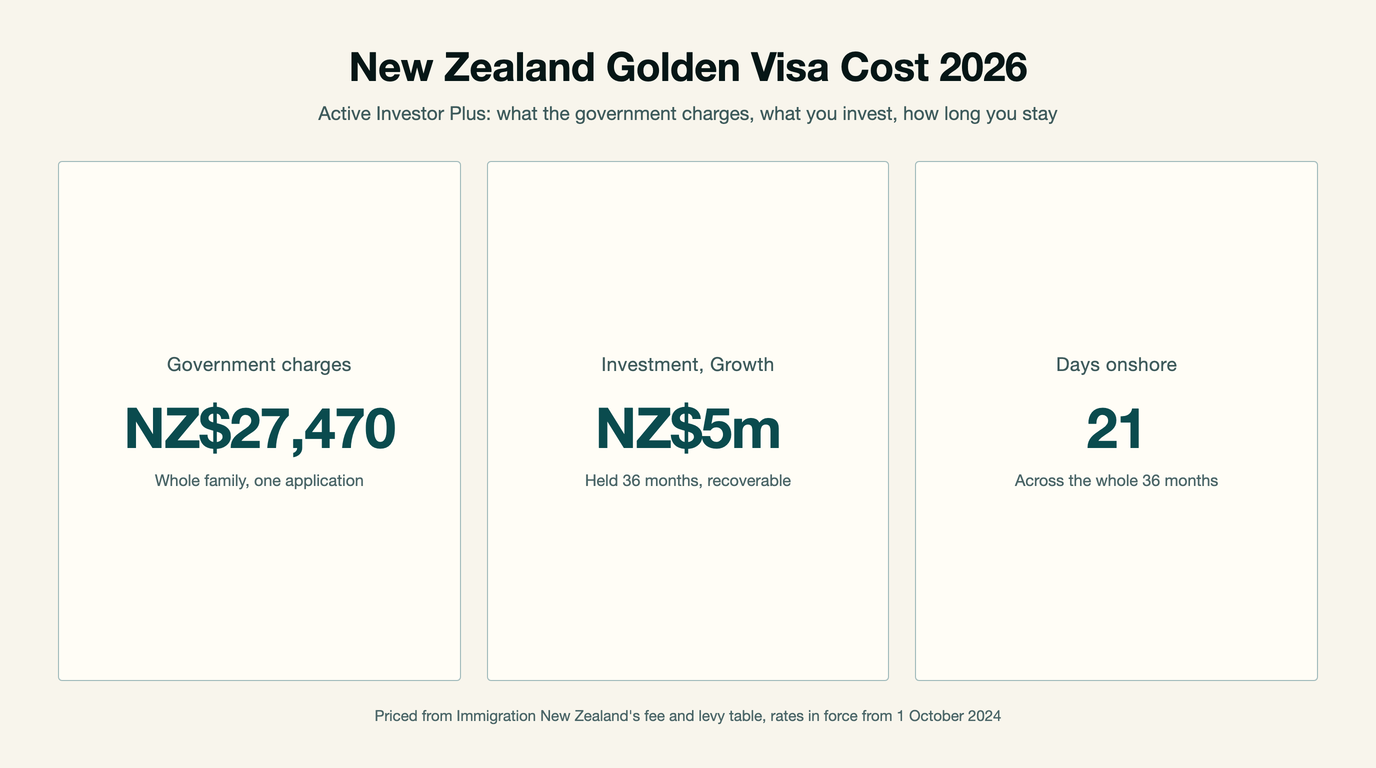
The New Zealand golden visa cost splits into two numbers that most pages merge into one. Government charges are NZ$27,470 for the whole family, and the investment is NZ$5 million held for three years on the Growth category or NZ$10 million held for five on Balanced. What makes it unusual is the third number: 21 days. That is the total time a Growth investor must spend in New Zealand across the entire three-year investment period, which is the lightest presence requirement of any major investor visa. We priced every line from Immigration New Zealand's own fee and levy table, the operational instructions, the Land Information New Zealand consent guidance published in March 2026, and the Ministry of Business, Innovation and Employment quarterly report released in September 2026.
Key takeaways
The New Zealand golden visa cost in government charges is NZ$27,470, and that figure covers the whole family. Immigration New Zealand's fee table splits it into a NZ$12,070 application fee and a NZ$15,400 immigration levy. Several competing cost pages quote roughly NZ$6,000 in government fees, which is less than a quarter of the real charge.
The investment is NZ$5 million for 36 months on the Growth category, or NZ$10 million for 60 months on Balanced. The old scheme asked NZ$15 million under a weighted model. That version drew 116 applications in two and a half years; the rebuilt one took 801 in fifteen months.
Growth investors must spend only 21 days in New Zealand across the whole 36-month period. Balanced asks 105 days over 60 months, reducible by 14 days for every extra NZ$1 million placed in Growth-category assets, to a floor of 63. There is no English-language test.
Only four of 801 applications were declined between April 2025 and June 2026, and approval in principle averaged 27 working days. The money is the barrier here, not the adjudication.
Since March 2026 a holder can buy one New Zealand home worth more than NZ$5 million, which the foreign-buyer ban otherwise blocks. Consent costs NZ$2,040 or NZ$3,500 and takes about five working days — but that house does not count toward the NZ$5 million investment.
On this page
This guide prices the visa from the government's own tables rather than from adviser marketing. It separates the application fee from the levy, sets the two categories against each other, explains which investments actually qualify after two rule changes, totals the cost for a household, works through the NZ$5 million house carve-out and the consent fee nobody quotes, reads the official approval and processing data, and ends on the four-year tax exemption that changes the real cost of moving. This site's renderer does not emit heading anchors, so the list below is a map rather than a set of jump links.
- New Zealand golden visa cost in 2026: the NZ$27,470 line
- Growth or Balanced: two prices, two timetables
- What actually counts as an acceptable investment
- New Zealand golden visa cost for a family of four
- The NZ$5 million house: the 2026 carve-out and what consent costs
- What the official data says about approval odds and processing
- The four-year tax exemption most cost pages leave out
- Related guides on Domicila
New Zealand golden visa cost in 2026: the NZ$27,470 line
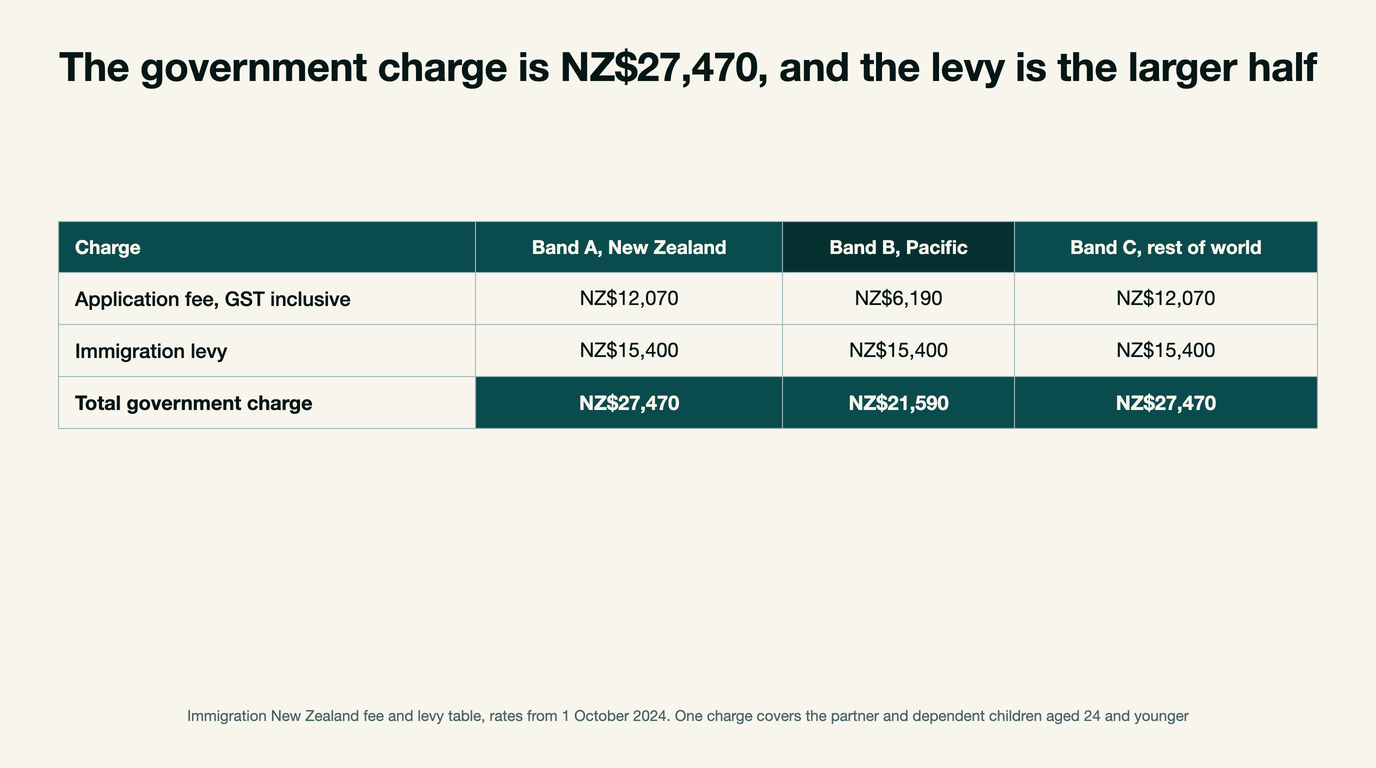
The programme's real name is the Active Investor Plus visa, and its own page on the Immigration New Zealand site prices it from NZD $27,470. That number is not one fee. It is an application fee plus a separate immigration levy, and the split matters because the levy is the larger half and is the part competing pages drop.
The fee and levy table sets the current rates, in force from 1 October 2024. It also shows something almost nobody reports: the application fee is banded by where you apply from, and Pacific applicants pay roughly half.
| Charge | Band A, New Zealand | Band B, Pacific | Band C, rest of world |
|---|---|---|---|
| Application fee, GST inclusive | NZ$12,070 | NZ$6,190 | NZ$12,070 |
| Immigration levy | NZ$15,400 | NZ$15,400 | NZ$15,400 |
| Total government charge | NZ$27,470 | NZ$21,590 | NZ$27,470 |
Set that against the figure in circulation. Several pages ranking for this term put government fees at around NZ$6,000 for the lead applicant, which appears to be the pre-2024 charge of roughly NZ$7,900 misremembered downward. The levy alone is NZ$15,400. If you are budgeting from one of those pages you are short by more than NZ$20,000 before anyone opens your file.
The rest of the budget is not set by government at all, and that is the honest way to present it. There is no published schedule for licensed advisers, lawyers, source-of-funds work or fund due diligence, and quotes vary with family size and how complicated your money is.
| Line | Amount | Basis |
|---|---|---|
| Application fee and immigration levy | NZ$27,470 | Official, INZ fee and levy table |
| Investment, Growth category | NZ$5,000,000 | Official, held 36 months, recoverable |
| Overseas Investment Office consent, only if buying a home | NZ$2,040 or NZ$3,500 | Official, LINZ guidance |
| Licensed adviser or immigration lawyer | No government schedule | Estimate — published adviser figures run into the tens of thousands of NZ dollars |
| Fund, custodian and annual compliance costs | No government schedule | Estimate — depends on the fund, not the visa |
The two estimate rows are estimates, and we have labelled them rather than dressing them as prices. Ask any adviser to itemise those lines against the official ones above, because the official lines are the only part of this that is fixed. Our golden visa cost comparison does the same exercise across the European programmes.
Growth or Balanced: two prices, two timetables
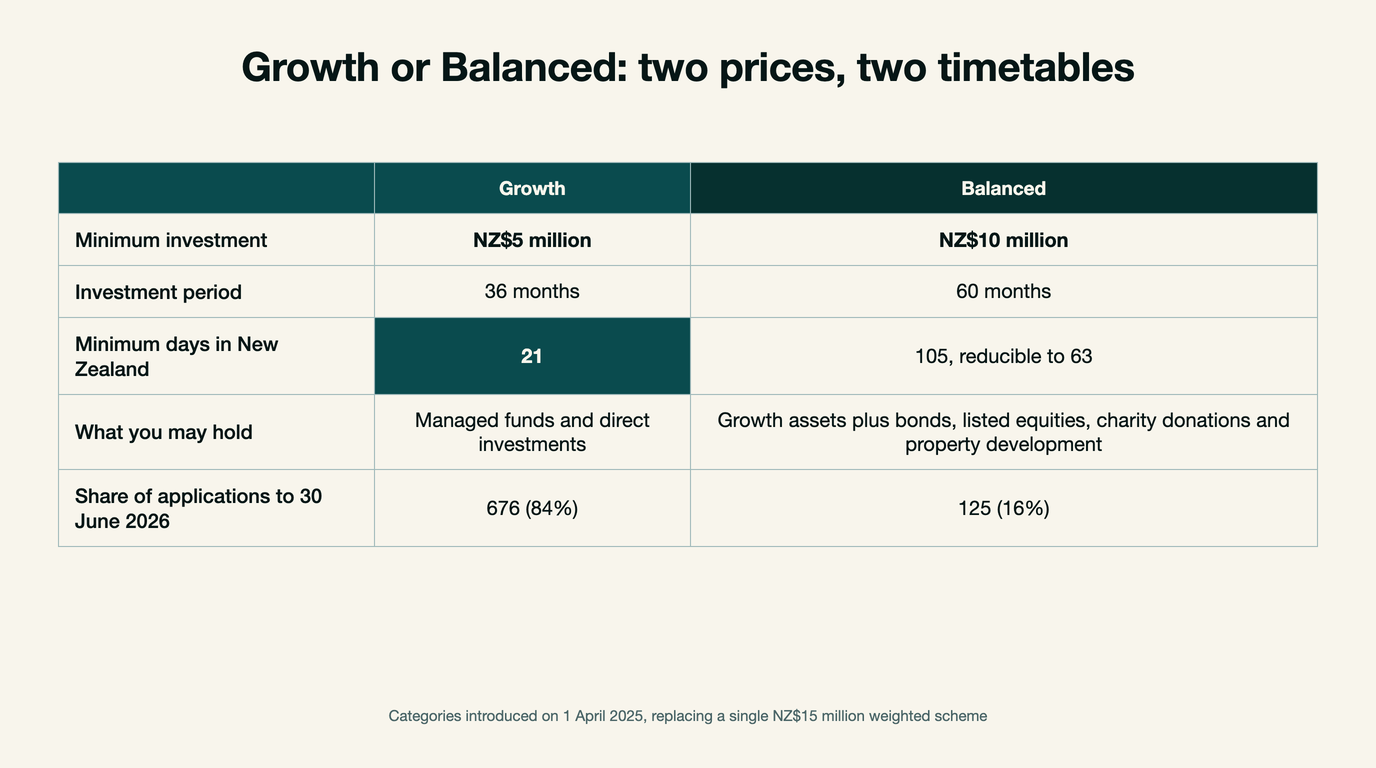
On 1 April 2025 the government replaced a single NZ$15 million weighted scheme with two categories, and the change is the reason this visa is worth a look at all. The archived instructions for the old version asked for NZ$7.5 million inside 18 months, NZ$15 million inside 36, and 117 days in the country across a 48-month investment period. The replacement asks a third of the money and a sixth of the time.
| Growth | Balanced | |
|---|---|---|
| Minimum investment | NZ$5 million | NZ$10 million |
| Investment period | 36 months | 60 months |
| Minimum days in New Zealand | 21 | 105, reducible to 63 |
| What you may hold | Managed funds and direct investments | Growth assets plus bonds, listed equities, charity donations and property development |
| Risk profile | Higher, active | Lower, passive options allowed |
| Share of applications, to 30 June 2026 | 676 (84%) | 125 (16%) |
Growth is not the cheap option so much as the concentrated one: half the money, but it has to go into New Zealand businesses or funds that back them. Balanced doubles the cheque and lets you sit in government bonds, which is why it attracts a sixth of the volume and almost all of the risk-averse money.
The presence requirement is where this visa separates itself from everything else in the market. Twenty-one days across three years is roughly a single holiday. Balanced starts at 105 days across five years, and buys that down at a published rate.
| Extra Growth-category investment above the NZ$10m minimum | Day reduction | Minimum days |
|---|---|---|
| None | 0 | 105 |
| NZ$1 million | 14 | 91 |
| NZ$2 million | 28 | 77 |
| NZ$3 million or more | 42 (capped) | 63 |
The reduction is 14 days per additional NZ$1 million placed in Growth-category investments, and it stops at 42 days. So the floor on Balanced is 63 days however much you add, and a Balanced investor who wants the lightest possible presence is paying NZ$13 million to get to 63 days when NZ$5 million on Growth gets to 21. Compare that with Portugal, where the days are light but the naturalisation clock is long, or Thailand's elite visa, which asks nothing of your capital and gives nothing back in residence rights.
Both categories give a resident visa that lets you live, work and study in New Zealand indefinitely, with permanent residence available later once the investment and presence conditions are met. There is no English-language requirement and no upper age limit, though you must pass health checks, which include a medical examination and chest X-ray, and character checks requiring police certificates less than six months old for everyone aged 17 and over.
What actually counts as an acceptable investment
This is where applications stall, and where two 2026 rule changes have already made older guides wrong. The acceptable investments list is maintained by Invest New Zealand, and a managed fund only qualifies for Growth if it is on that published list. Buying into a reasonable-looking New Zealand fund that is not on the list does not count.
| Investment type | Growth | Balanced | Note |
|---|---|---|---|
| Managed funds on the Invest NZ list | Yes | Yes | 80% of all Growth capital committed |
| Direct equity in New Zealand businesses | Yes | Yes | Only 2% of Growth capital |
| Build to rent | Yes, via managed funds only | Yes | Added December 2024 |
| Philanthropy | Yes, capped at 20% of the total | Yes | Cap effective 1 June 2026 |
| New Zealand bonds | No | Yes | 83% of all Balanced capital |
| Listed equities | No | Yes | 13% of Balanced capital |
| Property development | No | Yes | 4% of Balanced capital |
| A home for your own use | No | No | Never an acceptable investment |
| Discretionary investment management services | Removed | Removed | Withdrawn December 2025 |
Two rows there deserve emphasis. Discretionary investment management services were removed as an acceptable investment in December 2025, which the official quarterly report records in a footnote. They still account for NZ$271.5 million of committed Growth capital from before the change, so you will find guides describing them as a live option. They are not one.
Philanthropy is capped at 20% of the total investment from 1 June 2026. A donation to a New Zealand charity is genuinely acceptable up to that ceiling, which on a Growth file means up to NZ$1 million of the NZ$5 million can be money you never get back. That is a deliberate design choice by the government and a significant one for anyone comparing this against a Caribbean contribution, where the whole payment is non-returnable.
The last row is the one that catches people who have read about the 2026 property change. A house you live in is not an investment for visa purposes, no matter what it cost. The Land Information New Zealand guidance says so directly: consent can be obtained to buy a home, but this "will not be considered an acceptable investment for the purposes of an investor visa application."
If the investment menu is what is pushing you away, our golden visa countries guide covers the programmes that still accept straightforward property purchases.
New Zealand golden visa cost for a family of four
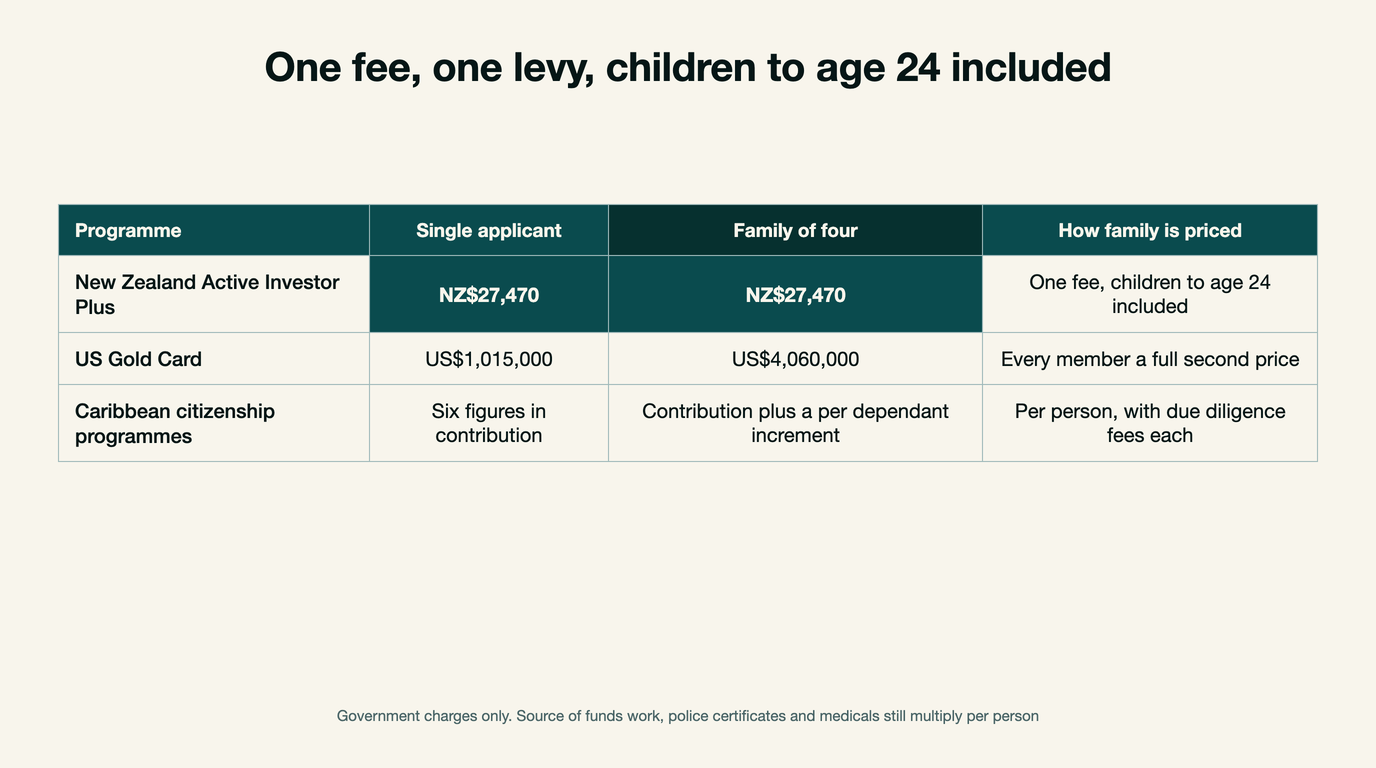
Here the arithmetic breaks in your favour, and it is the single most underreported fact about this visa. The official page states that you can include your partner and your dependent children aged 24 and younger in the application. One application, one fee, one levy.
So a family of four pays NZ$27,470 in government charges. Not NZ$27,470 each. The investment does not scale with family size either: NZ$5 million is NZ$5 million whether you arrive alone or with three dependants. Set that against how the rest of this market prices families.
| Programme | Government cost, single applicant | Government cost, family of four | How family is priced |
|---|---|---|---|
| New Zealand Active Investor Plus | NZ$27,470 | NZ$27,470 | One fee, children to age 24 included |
| US Gold Card | US$1,015,000 | US$4,060,000 | Every member a full second price |
| Caribbean citizenship programmes | Six figures in contribution | Contribution plus a per-dependant increment | Per person, with due-diligence fees each |
The age-24 ceiling is unusually generous. Most programmes cut dependent children off at 18 or, with conditions, 21 — the US Gold Card uses unmarried children under 21. A New Zealand applicant with a 23-year-old at university abroad can include them at no extra government charge, which for some families is the deciding feature rather than a footnote.
The caveat is that the professional bill does scale. Source-of-funds work, police certificates and medicals multiply per person even when the government fee does not, so a large family still costs more to prepare — it just does not cost more to file. Our citizenship by investment family cost guide sets out how the per-dependant model works where it does apply.
The NZ$5 million house: the 2026 carve-out and what consent costs
New Zealand has banned most foreign buyers from residential property since 2018. In March 2026 a narrow door opened: holders of an Active Investor Plus, Investor 1 or Investor 2 visa may buy or build one home worth more than NZ$5 million. Land Information New Zealand published detailed guidance in March 2026, and it is the most useful document in this whole file because it is the one the competing pages have not read.
Consent under the Overseas Investment Act is required before you buy, not after. You either hold consent before signing, bidding or tendering, or you make the agreement conditional on it — LINZ suggests allowing about 20 working days. You cannot bid at auction at all unless the vendor has agreed in advance that your bid is conditional on consent.
| Situation | Consent fee | Decision time |
|---|---|---|
| Land with an existing house, purchase price above NZ$5 million | NZ$2,040 | Generally 5 working days |
| Everything else, including buying land to build on | NZ$3,500 | Generally 5 working days |
The NZ$5 million threshold is measured more strictly than you would expect. It covers the agreed price of land and fixtures only, including GST, and excludes chattels — furniture, curtains, freestanding appliances, rugs, garden equipment. Vendor and purchaser have to agree how the price splits between the two, and a vendor cannot pad the figure with artwork, a vehicle or a cash-back arrangement to lift it over NZ$5 million. Renovation spending does not count either: if the purchase price is NZ$5 million or less, a new house has to be built.
Several categories of land are shut out even for eligible visa holders, and this is where a deal can die late.
| Land type | Available under these rules |
|---|---|
| Residential or lifestyle land on the district valuation roll | Yes |
| Land including the seabed or foreshore | No |
| Land adjoining the seabed or foreshore and larger than 0.2 hectares | No |
| Non-urban rural land larger than 5 hectares | No |
| Land on certain islands, including Waiheke and Great Barrier | Special rules apply |
Three further conditions are worth budgeting for. You may own only one property bought under these rules, and must sell it before buying another. If you buy bare land, a dwelling must be completed within three years of consent, extendable only if LINZ is satisfied you are making good progress. And the house can be lived in, used as a holiday home or run as a business — the Act places no limit on use, though local planning rules may.
Buying through a company or trust is allowed with ownership limits: the visa holder, or the holder with their spouse or partner jointly, needs more than a 25% ownership or control interest, and other overseas persons must not cumulatively hold more than 25%. Take legal advice before signing anything; LINZ says so three times in its own guidance.
What the official data says about approval odds and processing
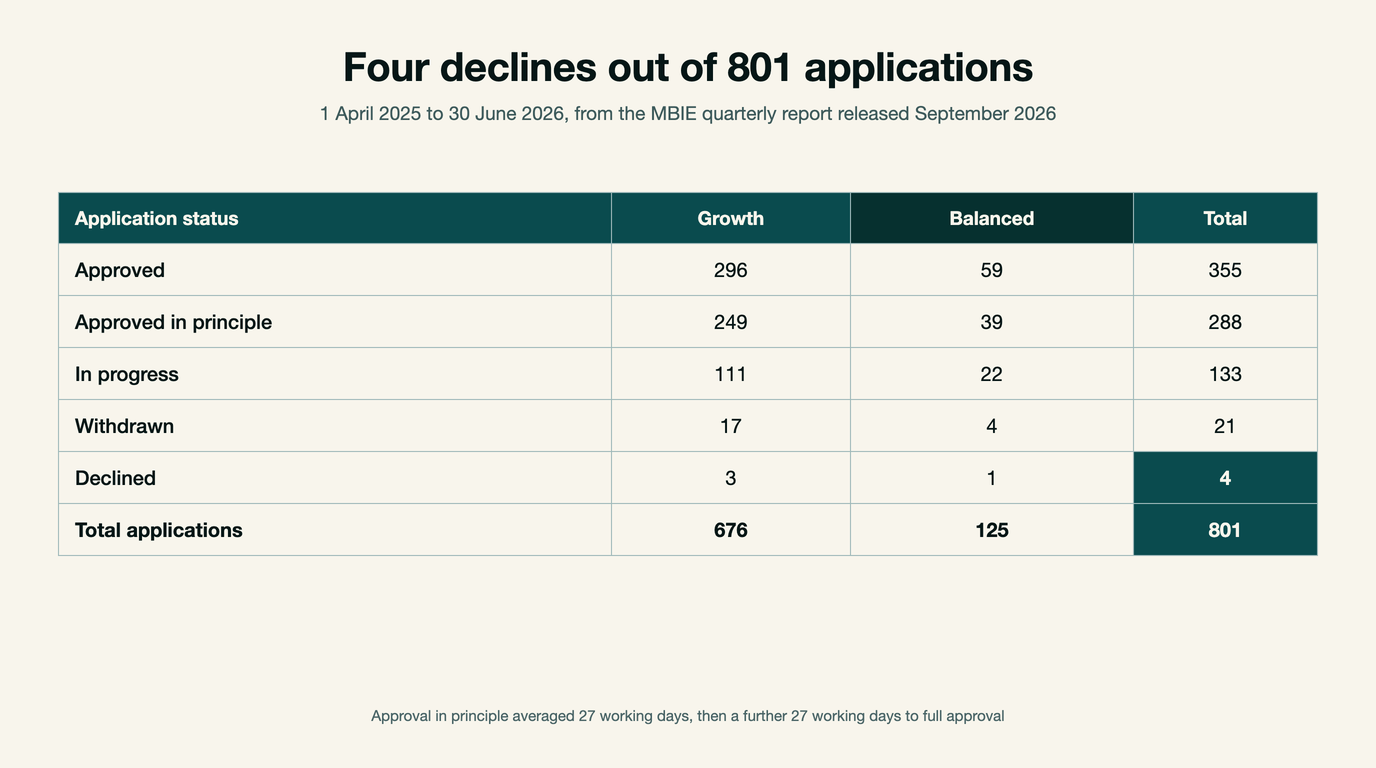
In September 2026 the Ministry of Business, Innovation and Employment proactively released its quarterly report on the visa covering the period to 30 June 2026. It is the best evidence available on this programme and it is not quoted anywhere else in the search results for this term.
| Application status, 1 April 2025 to 30 June 2026 | Growth | Balanced | Total |
|---|---|---|---|
| Approved | 296 | 59 | 355 |
| Approved in principle | 249 | 39 | 288 |
| In progress | 111 | 22 | 133 |
| Withdrawn | 17 | 4 | 21 |
| Declined | 3 | 1 | 4 |
| Total applications | 676 | 125 | 801 |
Four declines out of 801 applications. Five times as many people withdrew as were refused. That is not a programme that screens hard on merit; it screens on whether you have the money and whether your money is clean, and if both are true the adjudication is close to a formality. Treat any adviser who prices their fee against approval risk with that table in hand.
Processing is quick by the standards of this market. The report records approval in principle in an average of 27 working days, and then a further 27 working days to full approval once evidence of the transferred and invested funds is provided. The visa's own page commits to approving 80% of applications in principle within four months. Between those two stages you have six months to move the money and invest it.
Where the money actually goes is the other thing the report settles. Of NZ$2.12 billion committed, NZ$1.49 billion came through Growth and NZ$627.3 million through Balanced.
| Where committed capital went | Amount | Share of its category |
|---|---|---|
| Growth: managed funds | NZ$1.2 billion | 80% |
| Growth: of which private credit | NZ$842.1 million | 70.1% of managed funds |
| Growth: venture capital | NZ$135.3 million | 11.2% of managed funds |
| Growth: direct investment in businesses | NZ$27 million | 2% |
| Balanced: bonds | NZ$523.6 million | 83% |
| Balanced: listed equities | NZ$80.4 million | 13% |
| Balanced: property development | NZ$22 million | 4% |
Private credit taking 70% of all Growth managed-fund money is worth pausing on. The category was sold as capital for New Zealand's productive economy, and direct investment into businesses came to NZ$27 million — about 2% of Growth capital, spread across nine companies in the most recent quarter. Most Growth investors are lending, not building.
Demand is still climbing. The June quarter brought 171 applications against 123 in the previous one, a 39% rise, with May 2026 the highest month since the relaunch. Americans lead by a wide margin at 242 applications covering 730 people, then China at 142, Hong Kong at 100, Germany at 54 and Taiwan at 43. For how this compares with the queues elsewhere, see our citizenship by investment processing time guide.
The four-year tax exemption most cost pages leave out
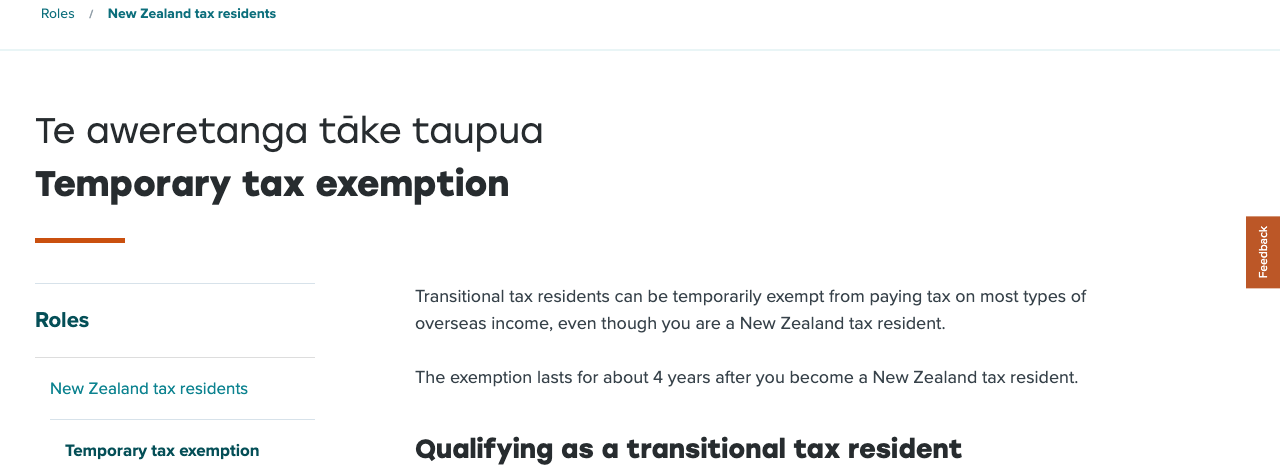
A cost page that stops at fees has skipped the largest number in the calculation. New Zealand gives most new migrants a temporary tax exemption on foreign income for about four years after they become tax resident, and for someone with NZ$5 million invested offshore that is worth more than every fee on this page combined.
You qualify if you became a New Zealand tax resident on or after 1 April 2006 and were not tax resident at any point in the preceding ten years. There is nothing to apply for — it applies automatically — and you can only have it once in your life.
| Income while a transitional resident | Exempt? |
|---|---|
| Overseas interest and dividends | Yes |
| Foreign investment fund income | Yes |
| Overseas rental income | Yes |
| Lump-sum withdrawals from a foreign superannuation fund | Yes |
| Income from employment performed overseas | No |
| Income from supplying personal services | No |
| New Zealand-sourced income of any kind | No |
The exclusions are the trap. Foreign employment income and income from personal services are not exempt, so a consultant who keeps billing overseas clients from an Auckland desk is taxable on that from day one, while their dividend and rental income is not. Double tax agreements may soften the overlap, but the exemption itself does not cover earned income.
Four things end it early, and two are easy to do by accident: claiming Working for Families tax credits, including Best Start, by you or a transitional-resident partner; putting exempt income into an IR3 return; telling a foreign tax authority you will pay New Zealand tax on your overseas income for the period; or notifying Inland Revenue that you no longer want transitional-resident status. Any one of those ends the exemption for good.
Note also what this exemption is not. It is a four-year grace period, not a tax regime. New Zealand has no lump-sum deal of the Swiss kind and no non-dom carve-out; once the four years run out you are taxed on worldwide income like any other resident. If the tax position is the point of the move rather than a side effect, that is the question to answer before the NZ$27,470 leaves your account.
Related guides on Domicila
If New Zealand's NZ$5 million is beyond the budget, or the 21 days is the feature you are shopping for, these are the comparisons that do the most work next:
- Golden visa cost comparison — every open programme priced on its current official fee table
- Cheapest golden visa — where the entry price is lowest, and what you give up for it
- Golden visa countries — which programmes are open, closed or in the middle of a rewrite
- Australia citizenship by investment cost — the nearest neighbour, and why its investor streams closed
- Singapore golden visa — the other high-threshold Asia-Pacific route, and what it really asks
- US Gold Card cost — the per-person alternative at US$1,015,000 a head
- Citizenship by investment vs golden visa — passport now, or residence first
Common questions
How much does the New Zealand golden visa cost in 2026?
Government charges are NZ$27,470: a NZ$12,070 application fee plus a NZ$15,400 immigration levy, at the rates in force since 1 October 2024. That single charge covers the principal applicant, their partner and dependent children aged 24 and younger. On top of it sits the investment itself, which is NZ$5 million held for 36 months on the Growth category or NZ$10 million held for 60 months on Balanced. Applicants from Pacific countries pay a reduced Band B application fee of NZ$6,190, bringing their total to NZ$21,590.
Does New Zealand actually have a golden visa?
Yes, though it is not called one. The Active Investor Plus visa is a residence-by-investment programme: you invest, you receive a resident visa, and you may later qualify for permanent residence. It is not citizenship by investment, and there is no route that sells a New Zealand passport. The term golden visa is how people search for it rather than the government's own language, which is why official pages use the programme name instead.
How many days do you have to spend in New Zealand?
On the Growth category, 21 days in total across the 36-month investment period. On Balanced, 105 days across 60 months, reduced by 14 days for every additional NZ$1 million placed in Growth-category investments up to a maximum reduction of 42 days, so the lowest Balanced figure is 63 days. These are among the lightest presence requirements of any investor visa, and they were cut as part of the 1 April 2025 changes.
What is the difference between the Growth and Balanced categories?
Growth requires NZ$5 million for 36 months and restricts you to managed funds on Invest New Zealand's approved list and direct investments in New Zealand businesses. Balanced requires NZ$10 million for 60 months but opens up lower-risk options: New Zealand government, local government and corporate bonds, listed equities, donations to a New Zealand charity, and property development. Growth is half the money with more risk and fewer days onshore; Balanced is double the money with passive options allowed. To 30 June 2026, 84% of applications were Growth.
Can an Active Investor Plus visa holder buy a house in New Zealand?
Since March 2026, yes — one home worth more than NZ$5 million, which is an exception to the general ban on foreign residential buyers. Consent under the Overseas Investment Act must be granted before you buy, costs NZ$2,040 where the land already has a house and the price exceeds NZ$5 million or NZ$3,500 otherwise, and is generally decided in five working days. The NZ$5 million is measured on land and fixtures only, excluding chattels. Importantly, a home for your own use does not count toward the visa's investment requirement.
How long does the Active Investor Plus visa take to process?
Official figures for the quarter to 30 June 2026 show approval in principle in an average of 27 working days, then a further 27 working days to full approval once you have provided evidence that the funds were transferred and invested. Immigration New Zealand's published service commitment is to approve 80% of applications in principle within four months. Between the two stages you have six months to move and invest the money.
How often are applications declined?
Rarely. Of 801 applications received between 1 April 2025 and 30 June 2026, four were declined and 21 were withdrawn, according to the Ministry of Business, Innovation and Employment quarterly report released in September 2026. More applicants withdrew than were refused. The practical barriers are the investment threshold and satisfying source-of-funds, health and character requirements rather than a competitive assessment, since there is no cap on numbers and no English-language test.
Is foreign income taxed once you move to New Zealand?
Not for the first four years, in most cases. Inland Revenue grants new migrants a temporary tax exemption on most foreign-sourced income for about four years after they become a New Zealand tax resident, provided they were not tax resident at any time in the previous ten years. Overseas interest, dividends, foreign investment fund income and rent are covered automatically. Income from overseas employment or supplying personal services is not covered. The exemption is available once only, and claiming Working for Families tax credits ends it early.
Official sources to verify
- Active Investor Plus VisaImmigration New Zealand
- Active Investor Plus Visa overview and 1 April 2025 changesImmigration New Zealand
- Immigration fee and levy table, rates from 1 October 2024Immigration New Zealand
- Quarterly report on the Active Investor Plus visa, Q4 FY25/26Ministry of Business, Innovation and Employment
- Detailed information for investor visa holders buying a house in New Zealand (March 2026)Land Information New Zealand
- Acceptable investments for the Active Investor Plus visaInvest New Zealand
- Temporary tax exemption on foreign income for new migrantsInland Revenue Department
Compare golden visa advisors
Ask for a route-specific quote that separates investment amount, government fees, legal work, fund or property costs, and renewal obligations.
We may earn a referral fee if you choose an advisor through this site. We still aim to show cost ranges, caveats, and official source links plainly.