japan golden visa cost
Japan Golden Visa Cost 2026: ¥30M and Rising
Search the Japan golden visa cost and the page ranking best for it will quote you 5 million yen, or two employees instead. Both numbers were superseded on 16 October 2025, when the Ministry of Justice raised the capital floor for the Business Manager status six-fold to 30 million yen — about 188,000 US dollars — and turned the employee, the language, the experience and an outside expert's sign-off from nothing into four simultaneous requirements. Then on 1 October 2026 the fee to renew a permit went from a flat 6,000 yen to as much as 75,000, and permanent residence went from 10,000 yen to 200,000. We read the Immigration Services Agency's own before-and-after table, its fee schedule and its Q&A, the National Tax Agency's registration tax rates and the notaries' fee order, all on 13 November 2026. Japan has no golden visa and no residency by investment of any kind. What it has is a route that requires a real business, and it costs considerably more than it did a year ago.

Key takeaways
- Japan has no golden visa, so there is no golden visa cost. No property route, no government bond, no donation, no deposit. The investor route is the Business Manager status, and it requires a business that actually trades.
- The capital floor is 30 million yen, not 5 million. The amended landing criteria took effect on 16 October 2025 and raised it six-fold — about 188,000 US dollars at 159.80 yen to the dollar on 13 November 2026. The pages still quoting 5 million yen are a full ordinance cycle out of date.
- The "or two employees" alternative is gone. It used to be capital or two full-time staff. It is now 30 million yen and at least one full-time employee, who must be Japanese, a special permanent resident, or hold one of the Table 2 statuses — not a colleague on a work visa.
- Three further conditions appeared from nothing, and almost no page on this keyword mentions them: three years of management experience or a master's-level degree in the field; CEFR B2 Japanese from the applicant or an employee; and verification of the business plan by an outside SME consultant, accountant or tax accountant.
- Then the fees moved. From 1 October 2026 a renewal costs 10,000 to 75,000 yen depending on the period you are granted, against a flat 6,000 before, and permanent residence went from 10,000 yen to 200,000. Existing holders have until 16 October 2028 before the new criteria bite.
On this page
Every figure below is tied to the instrument that states it, and where the ranking pages disagree with the Immigration Services Agency we say so rather than average them. Japan does not hide these rules: the Agency publishes a before-and-after table of the 2025 amendment, a fee schedule with every tier, and a Q&A answering the obvious objections. The keyword is simply served by pages written before October 2025 and never revisited. This site's renderer does not emit heading anchors, so the list below is a map rather than jump links.
- Why there is no Japan golden visa to price
- What changed on 16 October 2025
- The 30 million yen, precisely: what counts and what does not
- What the government charges from 1 October 2026
- The formation costs the capital floor drags up with it
- The grace period, and why permanent residence has none
- What to confirm before you commit
Why there is no Japan golden visa to price
Japan has never operated a residency-by-investment programme. There is no threshold you can transfer and no asset you can buy that produces a residence permit, which is why the honest answer to this search is that the question has no object. What Japan offers instead are routes that turn on what you do, not what you pay: the Business Manager status for people running a company here, the points-based Highly Skilled Professional system, and the J-Skip and J-Find designations for high earners and graduates of leading universities. None is for sale.
The Business Manager status is the one these searches are really reaching for. The Immigration Services Agency defines its activity as running a trade or other business in Japan, or engaging in the management of one, and excludes work that legally requires a lawyer's or accountant's qualification. It is granted for 5 years, 3 years, 1 year, 6 months, 4 months or 3 months — a list that matters more than it looks, because since October 2026 the renewal fee is set by which of those periods you are given.
This is a structurally different product from the routes that genuinely price residence. Thailand's elite visa is a membership fee with a published tariff, and Hong Kong's investment route prices access by capital. Japan asks for an operating company with staff, premises and filings. If what you want is a passport rather than a place to work, the distinction in citizenship by investment versus golden visa is where to start, because Japan sits a long way down the residence side of it.
What changed on 16 October 2025
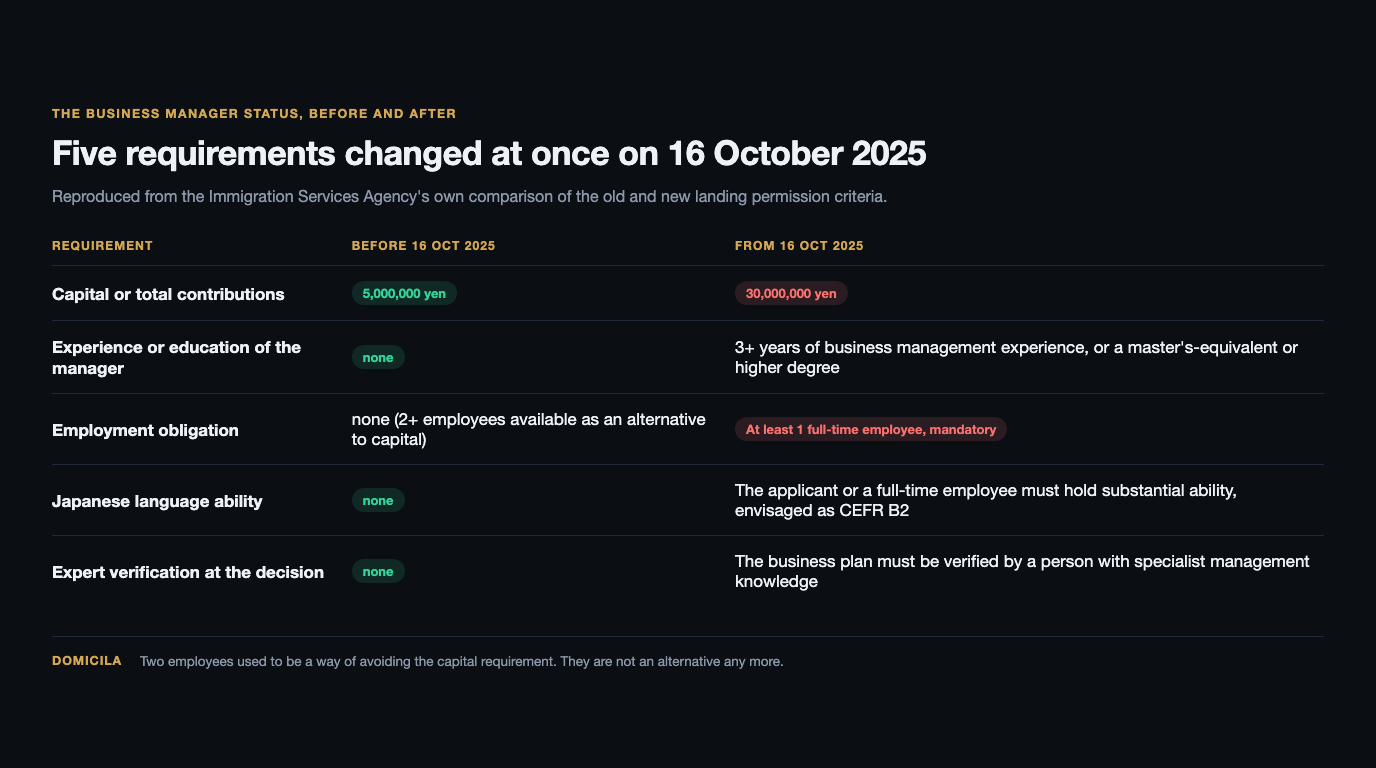
The Ministry of Justice amended the landing permission criteria for the Business Manager status with effect from 16 October 2025, and the Agency published its own one-page comparison of the old and new requirements. Reproduced below, because it settles every disagreement among the pages ranking for this keyword:
| # | Requirement | Before 16 Oct 2025 | From 16 Oct 2025 |
|---|---|---|---|
| 1 | Capital or total contributions | 5,000,000 yen | 30,000,000 yen |
| 2 | Experience or education of the manager | none | 3+ years of business management experience, or a master's-equivalent or higher degree in management or the business's field |
| 3 | Employment obligation | none (2+ employees available as an alternative to capital) | at least 1 full-time employee, mandatory |
| 4 | Japanese language ability | none | the applicant or a full-time employee must hold substantial ability, envisaged as CEFR B2 |
| 5 | Expert verification at the time of the decision | none | the new business plan must be verified by a person with specialist management knowledge (listed-company-scale businesses excepted) |
Read row 3 carefully, because it is the one most often reported backwards. Two employees used to be a way of avoiding the capital requirement. They are not an alternative any more: you need the capital and the staff. The Agency also narrows who counts — a full-time employee for this purpose excludes anyone residing under an Appended Table 1 status, which is to say the ordinary work visas. The person must be a Japanese national, a special permanent resident, or hold a Table 2 status: Permanent Resident, Spouse or Child of a Japanese National, Spouse or Child of a Permanent Resident, or Long-Term Resident.
Row 4 contains a distinction worth the price of admission. The employment obligation in row 3 cannot be met by a foreign national on a work visa, but the Agency's note on the language requirement says the opposite for row 4: the "full-time employee" whose Japanese may be counted there does include foreigners residing under Table 1 statuses. The same words carry two scopes in adjacent rows, so a plan satisfying one may not satisfy the other. For the language itself, JLPT N2 or above is the usual evidence, with the BJT business Japanese test at 400 points, twenty years as a mid-to-long-term resident, graduation from a Japanese higher education institution, or Japanese compulsory education plus high school as alternatives.
The 30 million yen, precisely: what counts and what does not
The figure is not a fee and not a deposit. It is capital put into a business you own, and the Agency defines it two different ways depending on what you are.
For a company, it is the paid-in capital of a kabushiki kaisha, or the total contributions of a gomei, goshi or godo kaisha. That is all it is: the Agency's Q&A is explicit that a company cannot reach the threshold by adding up salaries and office costs. For a sole proprietor the test is broader and arguably easier — the total invested as necessary to run the business, expressly including securing premises, one year of employee salaries, and equipment.
Three points the comparison pages leave out. If you are involved in more than one company, at least one of them must meet the threshold on its own; you cannot aggregate across a group. Using your home as the business premises is, as a rule, not accepted. And the Agency scrutinises where the money came from — Japanese practitioners discuss this as misekane, capital parked to clear a threshold and withdrawn afterwards — so source-of-funds evidence and remittance records matter as much as the balance on the day.
At 159.80 yen to the US dollar on 13 November 2026 the threshold is about 188,000 dollars, against roughly 31,000 under the old rule. Because it is fixed in yen, the dollar cost moves with the exchange rate, and a strengthening yen raises your bill without a word of law changing. The discipline we apply in our golden visa cost comparison applies here: separate the money you still own from the money you never see again. Almost all of the 30 million yen is the former, which is why calling it a cost misleads.
What the government charges from 1 October 2026
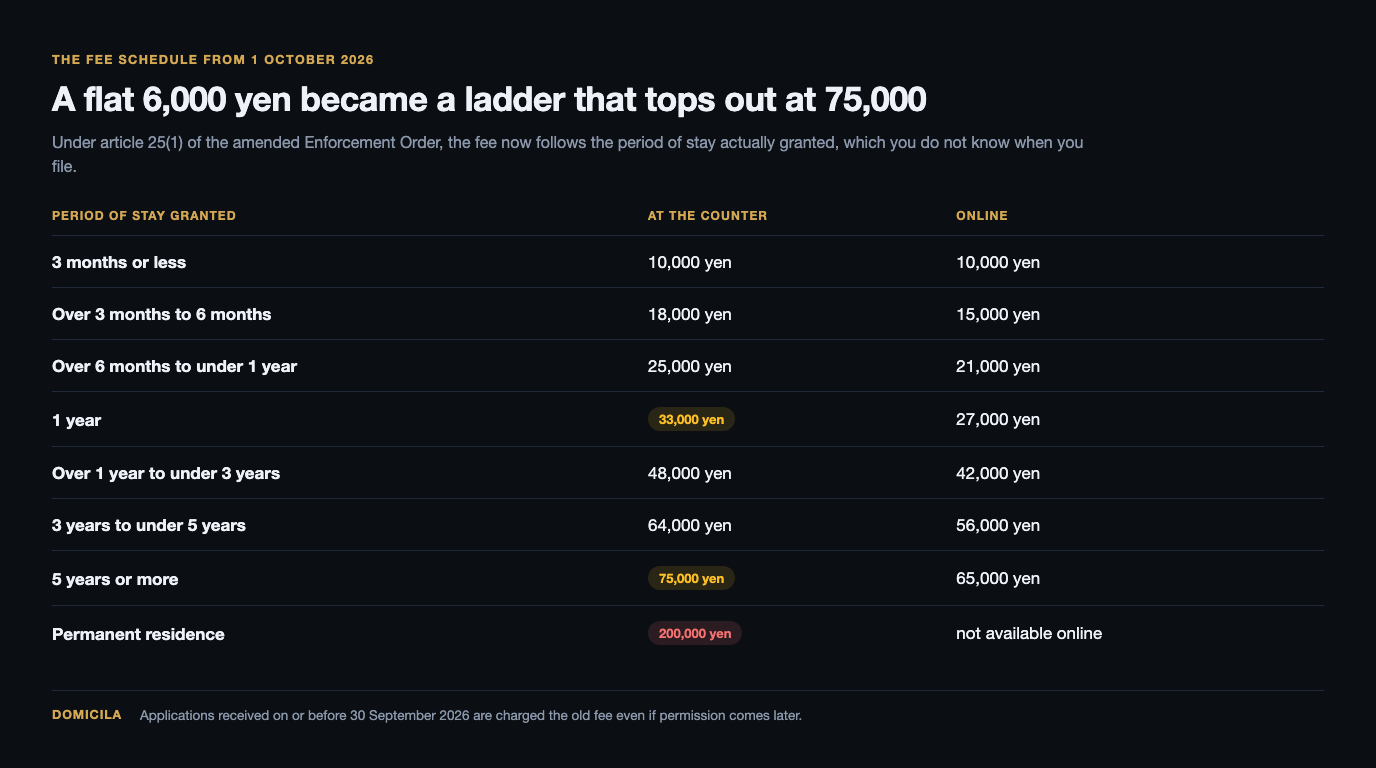
Until 30 September 2026 a change of status or an extension cost a flat 6,000 yen at the counter and 5,500 online, and permanent residence cost 10,000. On 1 October 2026 that schedule was replaced under article 25(1) of the amended Enforcement Order, and the fee now depends on the length of the period you are granted — not the period you asked for:
| Period of stay granted | At the counter | Online |
|---|---|---|
| 3 months or less | 10,000 yen | 10,000 yen |
| Over 3 months to 6 months | 18,000 yen | 15,000 yen |
| Over 6 months to under 1 year | 25,000 yen | 21,000 yen |
| 1 year | 33,000 yen | 27,000 yen |
| Over 1 year to under 3 years | 48,000 yen | 42,000 yen |
| 3 years to under 5 years | 64,000 yen | 56,000 yen |
| 5 years or more | 75,000 yen | 65,000 yen |
| Permanent residence | 200,000 yen | not available online |
Map that onto the Business Manager periods and the effect is concrete. A first grant of 1 year now costs 33,000 yen to renew instead of 6,000, a 4-month grant costs 18,000, and the 5-year card at the top of the ladder costs 75,000. A holder cycling through one-year renewals for five years pays about 165,000 yen in fees where the old schedule charged 30,000. Online filing saves up to 10,000 yen per application, but must be paid by convenience store or bank settlement rather than revenue stamps, with a separate processing charge on top.
Two timing points worth having. Applications received on or before 30 September 2026 are charged the old fee even if permission is granted later, so anything already in the queue is unaffected. And because the amount follows the period actually granted, you do not know your fee when you file — a request for five years that comes back as one year is priced at 33,000 yen, not 75,000. Reductions exist but are narrow: they are for applicants in poverty comparable to public assistance recipients who also need humanitarian consideration, and cannot be claimed online.
The formation costs the capital floor drags up with it
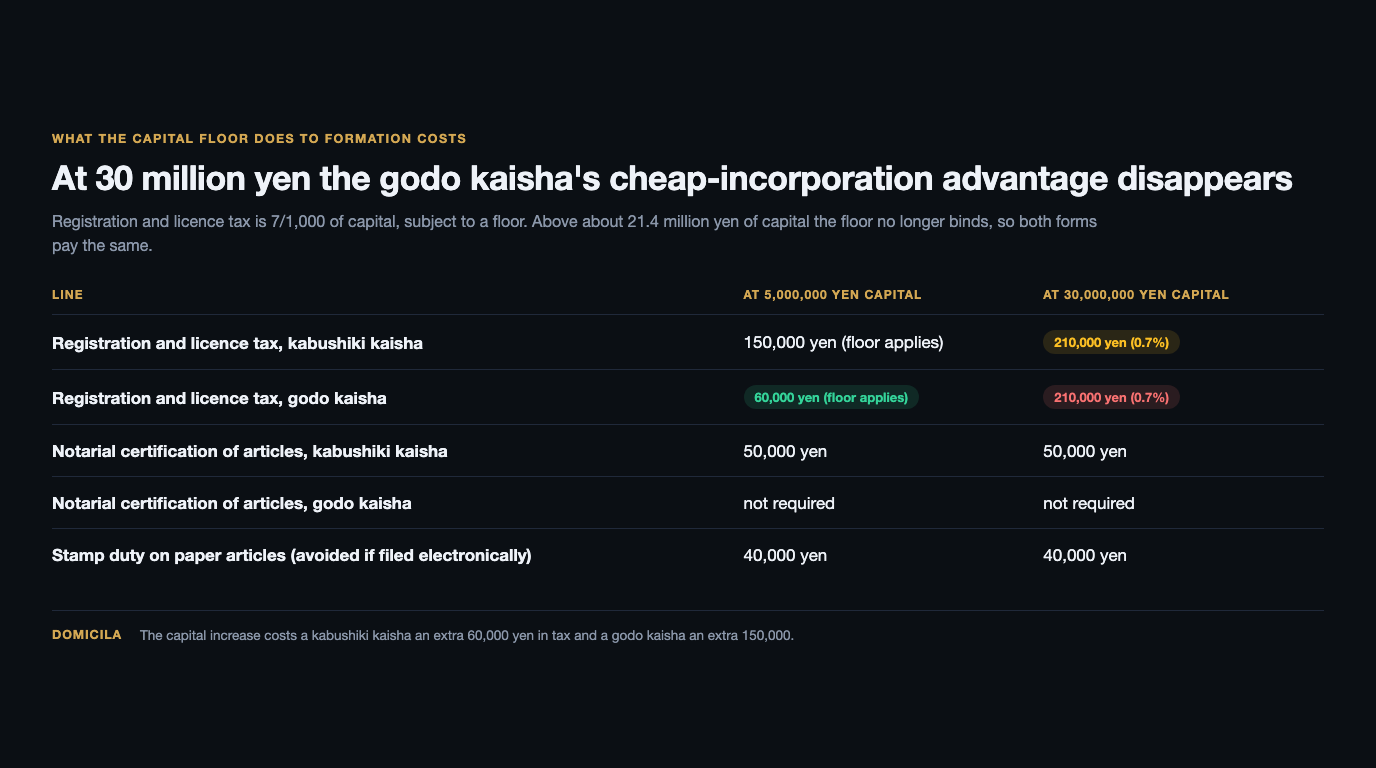
Here is a consequence of the 2025 amendment we have not seen stated anywhere, and it falls straight out of published tax rates. Japan's registration and licence tax on incorporation is 7/1,000 of capital, subject to a floor of 150,000 yen for a kabushiki kaisha and 60,000 for a godo kaisha. At the old 5 million yen minimum, 0.7% came to 35,000 yen, so every applicant paid the floor. At 30 million yen, 0.7% is 210,000 yen — above both floors, so the tax is now computed rather than fixed, and it rises with the capital.
| Line | At 5,000,000 yen capital | At 30,000,000 yen capital |
|---|---|---|
| Registration and licence tax, kabushiki kaisha | 150,000 yen (floor applies) | 210,000 yen (0.7%) |
| Registration and licence tax, godo kaisha | 60,000 yen (floor applies) | 210,000 yen (0.7%) |
| Notarial certification of articles, kabushiki kaisha | 50,000 yen | 50,000 yen |
| Notarial certification of articles, godo kaisha | not required | not required |
| Stamp duty on paper articles (avoided if filed electronically) | 40,000 yen | 40,000 yen |
So the capital increase costs a kabushiki kaisha an extra 60,000 yen in tax and a godo kaisha an extra 150,000 — the godo kaisha's cheap-incorporation advantage disappears entirely at this threshold, because the floor it used to enjoy no longer binds. Notarial certification of the articles, which only a kabushiki kaisha needs, is set by article 35 of the Notaries' Fees Order at 50,000 yen for any capital of 3 million yen or more, so it does not move.
What is deliberately not in that table: the scrivener or lawyer who prepares your application, the consultant or accountant who must verify your business plan, your office lease, recruitment, and the salary of the employee you must hire. No government publishes those, and we would rather omit the rows than invent a range. The salary bites hardest because it is not a one-off — requirement 3 is a permanent staffing obligation, not a setup cost.
The grace period, and why permanent residence has none
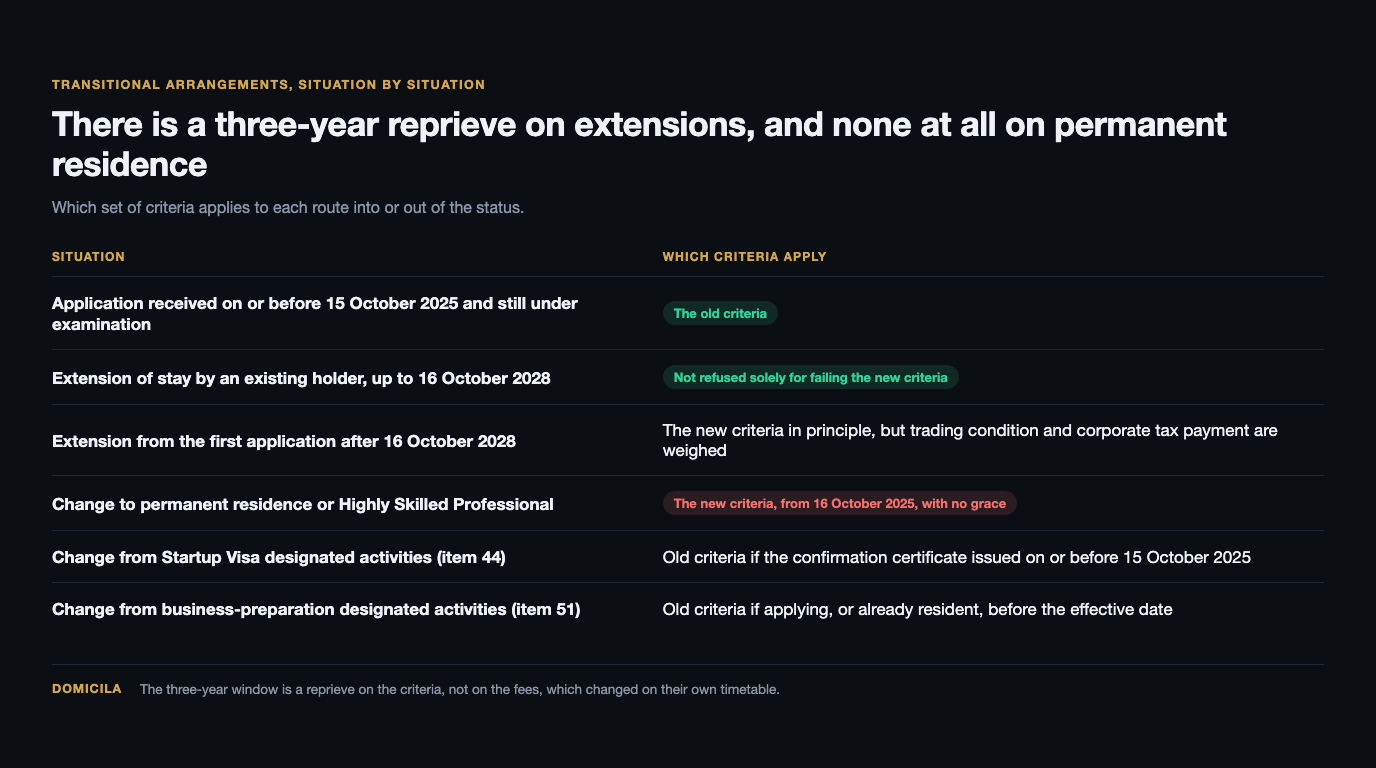
The amendment did not strand everyone already holding the status. The transitional arrangements are specific, and widely misreported:
| Situation | Which criteria apply |
|---|---|
| Application received on or before 15 October 2025 and still under examination | the old criteria |
| Extension of stay by an existing holder, up to 16 October 2028 | not refused solely for failing the new criteria |
| Extension from the first application after 16 October 2028 | the new criteria in principle, but trading condition and corporate tax payment are weighed |
| Change to permanent residence or Highly Skilled Professional | the new criteria, from 16 October 2025, with no grace |
| Change from Startup Visa designated activities (item 44) | old criteria if the confirmation certificate issued on or before 15 October 2025 |
| Change from business-preparation designated activities (item 51) | old criteria if applying, or already resident, before the effective date |
Two things follow. The three-year window is a reprieve on the criteria, not on the fees, which changed on their own timetable and apply to everyone from 1 October 2026. And even after October 2028 the Agency says it will not refuse an extension uniformly just because capital is under 30 million yen: it weighs how the business is actually trading and whether corporate tax has been paid. Its Q&A goes further and flatly denies the claim circulating among existing holders that anyone unable to raise 30 million yen within three years must leave the country — the Agency's word is that this is not true.
The exception is the one most likely to catch a long-term resident out. If you hold this status and intend to apply for permanent residence, or to switch to Highly Skilled Professional, there is no grace at all: those applications are judged against the new criteria from the effective date onward. A holder sitting comfortably on 5 million yen of capital and planning a permanent residence application has been outside the transitional protection since October 2025.
Permanent residence is also where the largest genuine fee on this page sits. It went from 10,000 yen to 200,000 on 1 October 2026, a twenty-fold rise, payable at the counter only. The reduced 20,000 yen rate reaches only applicants in genuine hardship who are also the spouse or child of a Japanese national, permanent resident or special permanent resident. It buys consideration, not a result — permanent residence here remains discretionary. Nor is any of this a citizenship route: none of these instruments promises a Japanese passport. The honest framing is the one we use for Singapore: a demanding, non-purchasable route into a country that wants operators rather than investors.
What to confirm before you commit
Five questions, in this order, and all of them before a company is registered or money crosses a border.
- Which entity am I forming, and what does the capital cost in tax? At 30 million yen the registration and licence tax is 210,000 yen whichever form you choose, so the godo kaisha's traditional saving is gone. Price it as 0.7%, not as the floor.
- Who is my full-time employee going to be? This is the requirement that fails plans. The person must be Japanese, a special permanent resident, or hold a Table 2 status, and the obligation continues for as long as you hold the status.
- Who signs off my business plan? Verification by an SME consultant, certified public accountant or tax accountant is mandatory at the decision stage. An officer or employee of your own company cannot do it; an external adviser can.
- Where does the language requirement land? Either you or a full-time employee needs CEFR B2 Japanese, and the employee satisfying this may be a foreign national on a work visa even though the employee in question 2 may not. Confirm both separately.
- What does leaving my current country cost? Exit taxes, deemed disposals and 183-day rules at the other end routinely exceed every figure on this page, and none of it appears in a Japanese fee schedule.
Everything here describes published law and official guidance as at 13 November 2026, converted at 159.80 yen to the dollar on that date. It is not legal, tax or immigration advice, and nothing here promises any application will be granted — Japanese immigration decisions are discretionary. Take Japanese professional advice before you act, and ask any provider offering a "Japan golden visa" which instrument they are filing under.
Related guides on Domicila
If Japan is on your list, these are the comparisons that answer the question it raises next:
- Hong Kong investment visa cost — the nearest Asian hub that genuinely prices residence by capital.
- Singapore golden visa — the other route asking for an operating business rather than a transfer.
- Thailand elite visa cost — the regional alternative that is a published, purchasable membership.
- Malaysia golden visa cost — MM2H, the deposit-based route Japan's is most often confused with.
- Vietnam golden visa cost — another country whose golden visa exists only in the search results.
- Golden visa cost comparison — every major route priced side by side, so 30 million yen has something to sit against.
Common questions
Does Japan have a golden visa in 2026?
No. Japan has never operated a residency-by-investment programme, and there is no property, bond, donation or deposit route to a Japanese residence permit. The closest equivalent is the Business Manager status, which requires an operating business with capital, premises and at least one qualifying full-time employee.
What is the Japan golden visa cost?
There is no such visa, so there is no price for one. If you are pricing long-term residence as an investor, the relevant figure is the Business Manager capital threshold, which has been 30 million yen since 16 October 2025. That is roughly 188,000 US dollars at 159.80 yen to the dollar on 13 November 2026, and it is capital contributed to a business you own, not a fee.
How much capital does the Japan Business Manager visa need in 2026?
Thirty million yen. For a company this is the paid-in capital of a kabushiki kaisha or the total contributions of a gomei, goshi or godo kaisha; salaries and office costs cannot be added to reach it. For a sole proprietor it is the total invested in the business, which does include premises, one year of staff salaries and equipment.
Is the 5 million yen Business Manager requirement still valid?
No, and this is the most common error on pages covering this topic. Five million yen was the old threshold, and the alternative of hiring two full-time employees instead of meeting it was abolished at the same time. Since 16 October 2025 the requirement is 30 million yen of capital and at least one full-time employee together.
Do I need to speak Japanese for the Business Manager visa?
Either you or one of your full-time employees does. The amended criteria require substantial Japanese ability, which the Immigration Services Agency frames as CEFR B2 equivalent, usually evidenced by JLPT N2 or above or 400 points on the BJT business Japanese test. The employee relied on for this may hold an ordinary work visa, unlike the employee who satisfies the hiring requirement.
How much does it cost to renew a Japanese residence permit in 2026?
From 1 October 2026 the fee depends on the period granted: 10,000 yen for three months or less, 18,000 for three to six months, 25,000 for six months to under a year, 33,000 for one year, 48,000 for one to under three years, 64,000 for three to under five years, and 75,000 for five years or more. The previous fee was a flat 6,000 yen.
How much is permanent residence in Japan now?
Two hundred thousand yen, up from 10,000, for applications from 1 October 2026 onward, payable at the counter only. A reduced fee of 20,000 yen is available to applicants in hardship comparable to public assistance recipients who are also the spouse or child of a Japanese national, permanent resident or special permanent resident.
What happens to existing Business Manager holders with only 5 million yen?
They have until 16 October 2028, and until then an extension will not be refused solely because the new criteria are unmet. After that the new criteria apply in principle, but the Agency says it will weigh how the business is trading and whether corporate tax has been paid. There is no grace period for a change to permanent residence or Highly Skilled Professional.
Official sources to verify
- Review of the "Business Manager" permission criteria, in force 16 October 2025 — the official before-and-after table, read 13 November 2026Immigration Services Agency of Japan
- Amendment of the landing permission criteria for the "Business Manager" status, with the official Q&A, read 13 November 2026Immigration Services Agency of Japan
- Guidelines on the amended "Business Manager" criteria: capital, employee, Japanese ability, experience, expert verification, read 13 November 2026Immigration Services Agency of Japan
- Residence status "Business Manager" — activities, periods of stay and required documents, read 13 November 2026Immigration Services Agency of Japan
- Fees for residence procedures revised from 1 October 2026 — full table by period granted, counter and online, read 13 November 2026Immigration Services Agency of Japan
- Q&A on the revision of residence permission fees from 1 October 2026, read 13 November 2026Immigration Services Agency of Japan
- Reduction and exemption of residence permission fees on and after 1 October 2026, read 13 November 2026Immigration Services Agency of Japan
- Registration and licence tax rate table — incorporation at 7/1,000 of capital, with the 150,000 and 60,000 yen minimums, read 13 November 2026National Tax Agency of Japan
- Notarial fees for certifying articles of incorporation under article 35 of the Notaries' Fees Order, read 13 November 2026Japan National Notaries Association
- JLPT level summary, including what N2 certifies, read 13 November 2026Japan Foundation and JEES
Compare golden visa advisors
Ask for a route-specific quote that separates investment amount, government fees, legal work, fund or property costs, and renewal obligations.
We may earn a referral fee if you choose an advisor through this site. We still aim to show cost ranges, caveats, and official source links plainly.