vietnam golden visa cost
Vietnam Golden Visa Cost 2026: It Does Not Exist
Searching the Vietnam golden visa cost in 2026 returns a one-time payment of 300,000 US dollars, a resolution number that passed in March, and an application window that opened on 1 July. None of it holds up. We looked for the National Assembly resolution the ranking pages cite and it is not in the Vietnamese legal databases under that number; the most recent visa legislation actually before the National Assembly, presented on 7 November 2026, contains no golden visa and no investor category at all. What Vietnam does have is the DT investor visa ladder, written into Law 47/2014 as amended by Law 51/2019 and priced in dong, and the ten-year card everybody advertises sits at the top of it at **VND 100 billion** of contributed capital — about **3.9 million US dollars**, roughly thirty-three times the figure the comparison pages quote. We priced every line against the amending law itself, the Ministry of Finance fee circular in force since 1 April 2026, and the official English text of Resolution 222/2025/QH15, all read on 11 November 2026, and we say plainly which figures the Government has not published.

Key takeaways
- There is no Vietnam golden visa, and there is therefore no cost. No decree, no application channel, no published threshold. The scheme has been a Tourism Advisory Board proposal to the Prime Minister since 2025 and remains one.
- The resolution the ranking pages cite does not exist under that number. At least one page ranking for this keyword reports "Resolution 41/2026/QH15" as passed on 20 March 2026 with a pilot from 1 July 2026. A search of the Vietnamese legal databases returns no National Assembly resolution with that number. What exists with "41/2026" is Resolution 41/NQ-CP of 11 March 2026, the Government's action programme for the 14th Party Congress, which is not about visas.
- The ten-year card costs VND 100 billion, not 300,000 dollars. A DT1 visa and its ten-year temporary residence card require contributed capital of VND 100 billion or more — about 3.9 million US dollars at 25,600 dong to the dollar on 11 November 2026. The 100,000 to 300,000 dollars quoted everywhere buys DT3: a three-year visa and a three-year card.
- Government fees are trivial and nobody quotes the current ones. Circular 28/2026/TT-BTC has set them since 1 April 2026: USD 165 for a residence card of five to ten years, USD 10 to extend a stay. Pages still citing USD 100 are reading a superseded schedule.
- The one real ten-year route is not for sale. Resolution 222/2025/QH15, in force since 1 September 2025, grants ten-year visas and cards (codes UD1 and UD2) to key investors, experts and managers at organisations in the Ho Chi Minh City and Da Nang financial hubs. It attaches no investment threshold, and not one page ranking for this query mentions it.
On this page
Every figure below is tied to the instrument that states it, and where sources disagree we say so rather than take the more quotable number. The problem with this subject is not that Vietnam hides the rules — the National Assembly publishes the amending law, the Ministry of Finance publishes the fee schedule, and the Da Nang financial hub publishes Resolution 222 in English. The problem is that a tourism board's proposal was reported in 2025 as though it had been enacted, and the pages that rank now price a product no Vietnamese authority has created. This site's renderer does not emit heading anchors, so the list below is a map rather than a set of jump links.
- Why there is no Vietnam golden visa to buy
- What Vietnamese law actually offers instead
- What the Vietnam golden visa cost actually buys
- What the government charges, and what it does not
- The one ten-year route that does exist
- Why "permanent residency after five years" is wrong
- What to confirm before you commit
Why there is no Vietnam golden visa to buy
The proposal is real. In 2025 Vietnam's Tourism Advisory Board put a package to the Prime Minister containing three tracks: a five-to-ten-year golden visa, a ten-year investor visa with permanent residence contemplated after five years, and a five-year talent visa, with pilots mooted for Ho Chi Minh City, Hanoi and Da Nang. Forbes covered it in May 2025, and that is where most of today's circulating figures come from.
What has not happened is enactment: no decree number, no circular, no form, no office taking applications. The threshold most often repeated — between 100,000 and 400,000 US dollars — appears in no Vietnamese legal instrument, and the pages quoting it cite none.
One claim deserves naming, because it makes this search actively misleading rather than merely vague. At least one page ranking for this keyword reports that the golden visa became law by Resolution 41/2026/QH15 on 20 March 2026, with a pilot from 1 July 2026 — while admitting in its own key takeaways that it could not find the resolution on any government source, then calling it confirmed law further down. We searched the Vietnamese-language legal databases: there is no National Assembly resolution with that number. The document that does carry "41/2026" is Resolution 41/NQ-CP of 11 March 2026, the Government's action programme for the 14th Party Congress.
The strongest evidence is the most recent. On 7 November 2026 the Minister of Culture, Sports and Tourism, Lam Thi Phuong Thanh, presented a draft National Assembly resolution on special tourism mechanisms on the Prime Minister's behalf. It is the live visa legislation in Vietnam right now, and it proposes:
- expanded bilateral visa exemptions for priority tourism markets;
- visa policies tailored to high-spending visitors, long-stay tourists and conference delegates;
- controlled pilot arrangements for foreign nationals working remotely from Vietnam;
- pilot visa and residence arrangements for medical tourists and accompanying family;
- simplified permits and residence for foreign experts and artists.
There is no golden visa in that list, and no investor category. It is also still a draft: the Committee for Culture and Social Affairs asked for the scope of the proposed "special visa policy" to be clarified. So the honest answer to what a Vietnam golden visa costs is that the question has no object; the useful question is what existing law charges.
What Vietnamese law actually offers instead
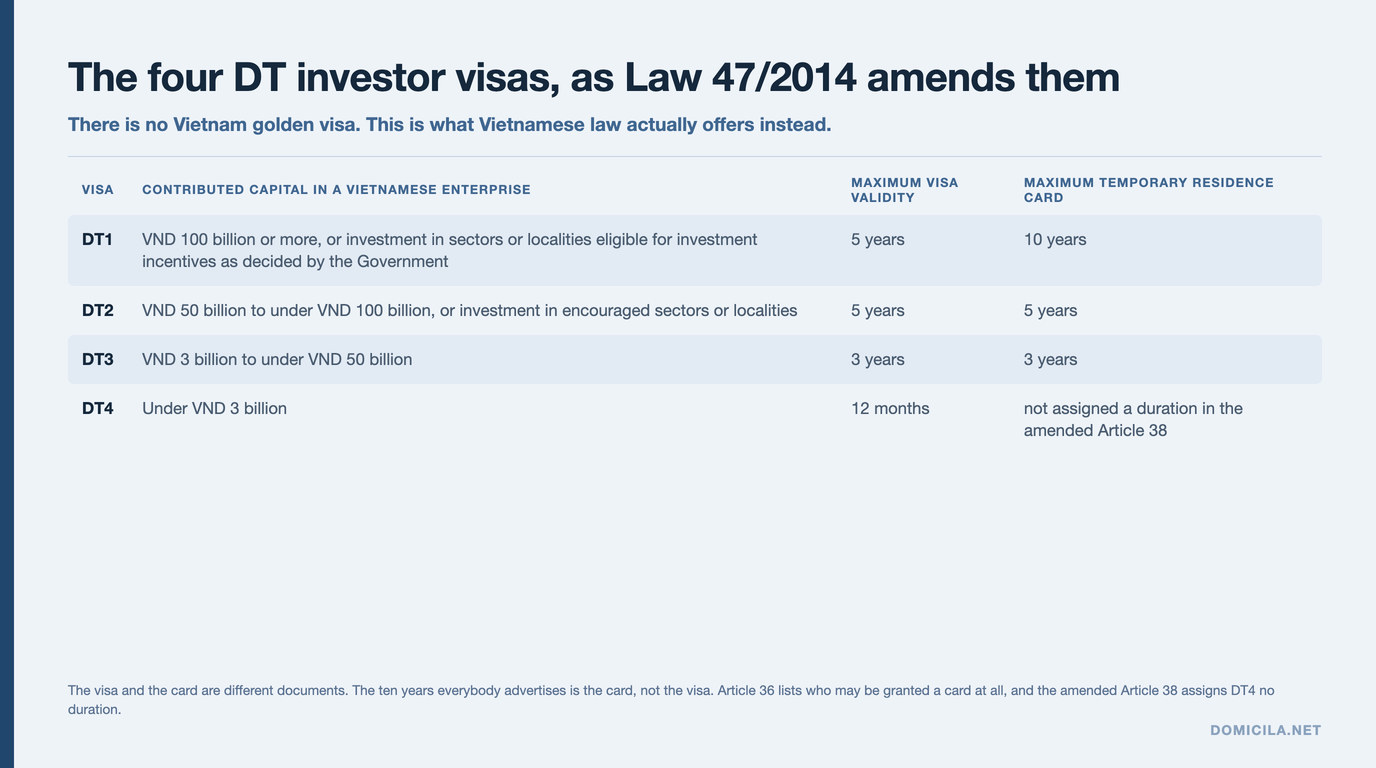
The investor route is the DT ladder, and it is statutory rather than promotional. Law 51/2019/QH14 of 25 November 2019 amended the Law on Foreigners' Entry into, Exit from, Transit through and Residence in Vietnam (Law 47/2014/QH13), taking effect on 1 July 2020. Article 1(3)(c) inserted clauses 7a to 7d into Article 8, splitting what had been a single DT symbol into four tiers by contributed capital. Article 1(4) set the visa validity for each, and Article 1(16), amending Article 38, set how long the temporary residence card can run.
| Visa | Contributed capital in a Vietnamese enterprise | Maximum visa validity | Maximum temporary residence card |
|---|---|---|---|
| DT1 | VND 100 billion or more, or investment in sectors or localities eligible for investment incentives as decided by the Government | 5 years | 10 years |
| DT2 | VND 50 billion to under VND 100 billion, or investment in encouraged sectors or localities | 5 years | 5 years |
| DT3 | VND 3 billion to under VND 50 billion | 3 years | 3 years |
| DT4 | Under VND 3 billion | 12 months | not assigned a duration in the amended Article 38 |
Two details in that table are routinely got wrong. The first is that the visa and the card are different documents. A DT1 visa is valid for at most five years; the ten years everybody advertises is the temporary residence card, which Article 38 as amended caps at ten years for DT1, five for DT2 and three for DT3. Article 36 lists the visa holders who may be granted a card at all, and the amended Article 38 assigns no duration to DT4 — so the cheapest tier does not obviously carry a card, and we would not assume it does without asking the Immigration Department.
The second is what "contributed capital" means. This is capital actually contributed to a Vietnamese enterprise, which implies an investment registration certificate and a company that exists and files. It is not a bank deposit you can place and watch, and it is not property. That makes the DT ladder structurally unlike the deposit-based routes in the region — compare Thailand's elite visa, which is a membership fee, or Malaysia's MM2H, which turns on a fixed deposit. In Vietnam the money has to go into a business and stay there.
What the Vietnam golden visa cost actually buys
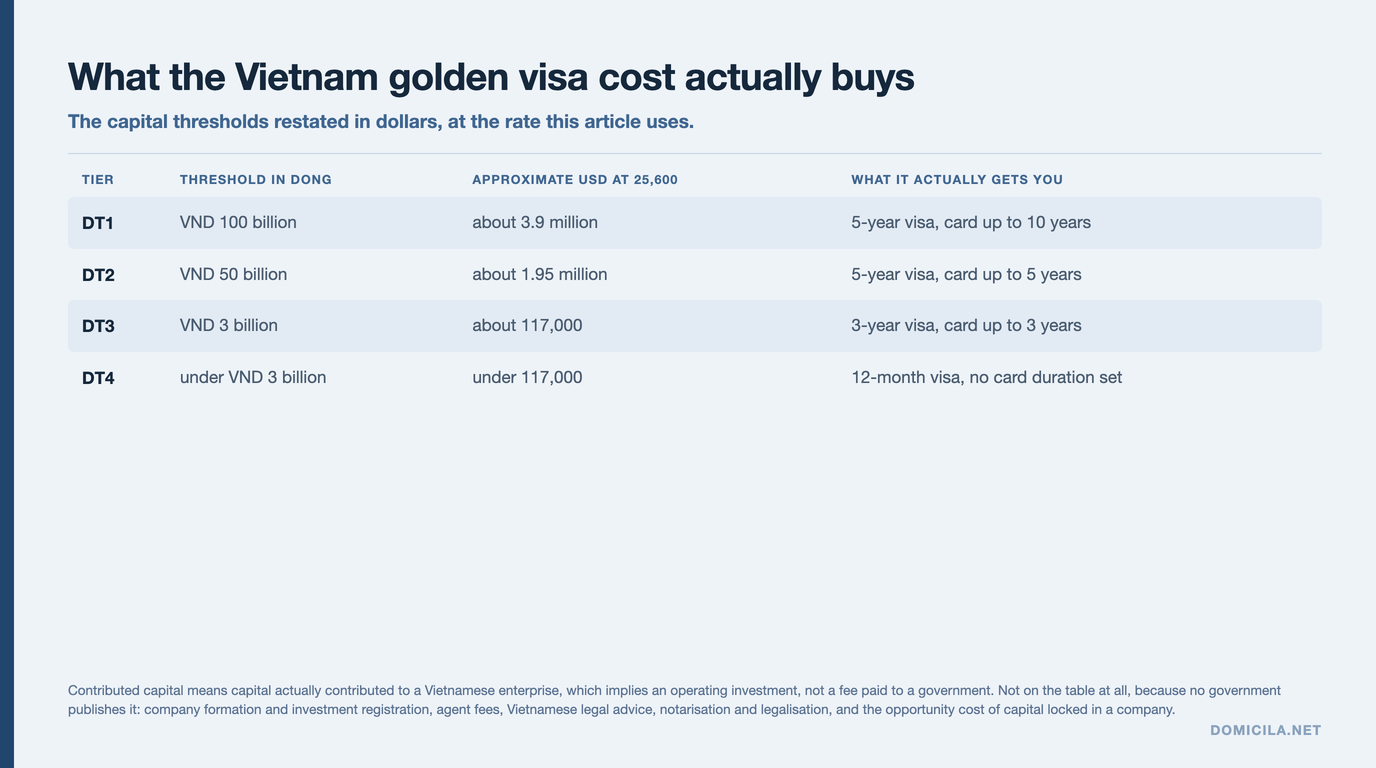
Because the thresholds are fixed in dong, the dollar figure moves with the exchange rate — which is exactly how the comparison pages end up an order of magnitude out. On 11 November 2026 the dong traded at roughly 25,500 to 25,660 to the US dollar across the rate sources we checked; the conversions below use 25,600 and are rounded, and they will drift.
| Tier | Threshold in dong | Approximate USD at 25,600 | What it actually gets you |
|---|---|---|---|
| DT1 | VND 100 billion | about 3.9 million | 5-year visa, card up to 10 years |
| DT2 | VND 50 billion | about 1.95 million | 5-year visa, card up to 5 years |
| DT3 | VND 3 billion | about 117,000 | 3-year visa, card up to 3 years |
| DT4 | under VND 3 billion | under 117,000 | 12-month visa, no card duration set |
Now put that against what the search results say. The figure most often attached to the "Vietnam golden visa" is 300,000 US dollars, with a range of 250,000 to 400,000; one widely cited guide gives 100,000 to 200,000 for the investor visa. Every one of those numbers lands in DT3 — the three-year tier. The ten-year card they are describing requires VND 100 billion, about 3.9 million dollars, which is roughly thirty-three times the 117,000 dollars that clears the DT3 floor.
That gap is the whole story of this keyword. A reader who budgets 300,000 dollars expecting a decade of residence has mispriced the thing by a factor of thirteen, and will discover it after forming a company. It is the same failure mode as Spain's withdrawn golden visa and the reason Norway's non-existent programme is worth reading as a corrective: the brochure and the statute are different documents, and only one of them is enforceable.
One honest caveat on the top tier. DT1 and DT2 both have an alternative limb that is not a number at all — investment in sectors or localities eligible for investment incentives as decided by the Government. An investor below VND 100 billion in a sufficiently favoured sector may qualify for DT1 on that basis. The law does not quantify it, so neither will we; it is a question for the Immigration Department and Vietnamese counsel, not for a comparison table.
What the government charges, and what it does not
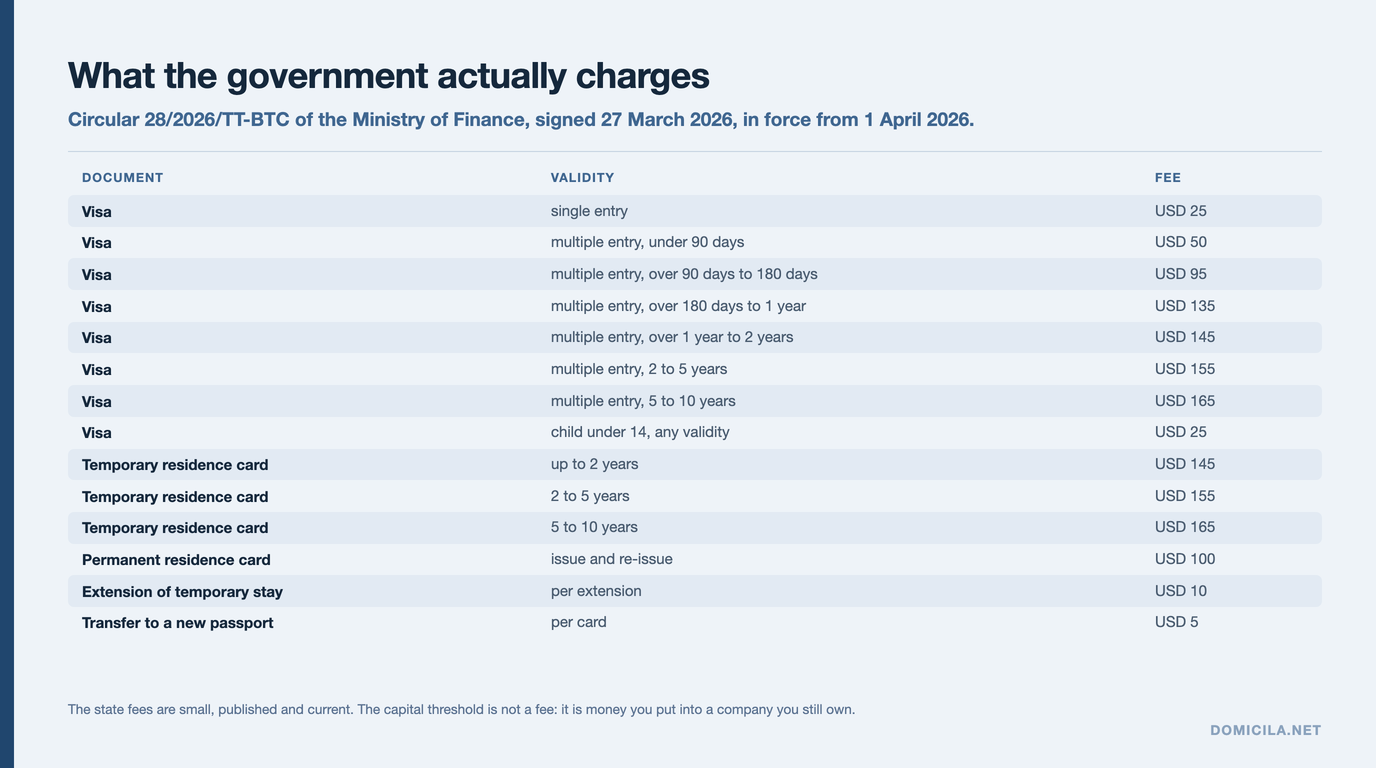
The state fees are small, published, and current. They are set by Circular 28/2026/TT-BTC of the Ministry of Finance, signed on 27 March 2026 and in force from 1 April 2026. The Government portal published the schedule in full:
| Document | Validity | Fee |
|---|---|---|
| Visa | single entry | USD 25 |
| Visa | multiple entry, under 90 days | USD 50 |
| Visa | multiple entry, over 90 days to 180 days | USD 95 |
| Visa | multiple entry, over 180 days to 1 year | USD 135 |
| Visa | multiple entry, over 1 year to 2 years | USD 145 |
| Visa | multiple entry, 2 to 5 years | USD 155 |
| Visa | multiple entry, 5 to 10 years | USD 165 |
| Visa | child under 14, any validity | USD 25 |
| Temporary residence card | up to 2 years | USD 145 |
| Temporary residence card | 2 to 5 years | USD 155 |
| Temporary residence card | 5 to 10 years | USD 165 |
| Permanent residence card | issue and re-issue | USD 100 |
| Extension of temporary stay | per extension | USD 10 |
| Transfer to a new passport | per card | USD 5 |
Note what this does to the arithmetic. The government's charge for the ten-year card at the centre of every "Vietnam golden visa" page is USD 165. The cost of the route is not the fee; it is the VND 100 billion. Any page presenting a fee schedule as the cost of the programme has answered a different question.
Note also what it does to the pages quoting older figures. Several guides still give USD 100 for a new temporary residence card, which is the rate from the superseded Circular 25/2021/TT-BTC; others attribute the 145/155/165 bands to that 2021 circular, which did not contain them. Secondary sources report that Circular 28/2026 replaced both Circular 25/2021 and Circular 62/2023 — the Government portal we read states the rates and the 1 April 2026 effective date but not the repeals, so treat the replacement as reported rather than confirmed, and check the circular text before relying on it for a filing.
And note what is not on the table at all, because no government publishes it: company formation and investment registration costs, the fees of the agent who files for you, Vietnamese legal advice, notarisation and legalisation of your documents, and the opportunity cost of capital locked in an operating company. We have left all of it out rather than invent a range. Our golden visa cost comparison sets the same discipline against the European programmes.
The one ten-year route that does exist
Here is the part none of the pages ranking for this query mention, and it is the closest thing in Vietnamese law to the product they are describing.
Resolution 222/2025/QH15 on International Financial Hubs in Vietnam was ratified by the National Assembly on 27 June 2025 and came into force on 1 September 2025. It establishes financial hubs in Ho Chi Minh City and Da Nang, and its Article 20 deals with entry, exit, residence and employment. Article 20(1)(a) provides that visas and temporary residence cards "with a validity of up to 10 years shall be issued to foreign key investors, experts, managers, or highly qualified employees recruited by agencies or organizations that set up offices in the International financial hub", under visa and card code UD1, with UD2 for accompanying family members.
Two further provisions matter. Article 20(1)(b) says key investors, experts, scientists, individuals with exceptional talents and senior managers working long-term at hub organisations may be granted temporary residence cards at the request of the Executive Body, and are entitled to more favourable treatment on permanent residence procedures than the general rules allow. Article 20(3) removes the work permit requirement for foreigners working in the hubs who meet the professional standards the Government or the Executive Body prescribes.
What this route does not have is a price. Article 20(1)(c) leaves the criteria for eligibility, and the appraisal authority, to the Government — so there is no published threshold, and anyone quoting one is guessing. Eligibility turns on your role at an organisation established in the hub, not on a sum transferred. That is the significant difference from a golden visa: it cannot be bought, and it is the only ten-year investor-adjacent card Vietnam has actually legislated. The resolution runs for five years before a Government review, with a dedicated Law on International Financial Hubs to be proposed to the National Assembly by 30 March 2034.
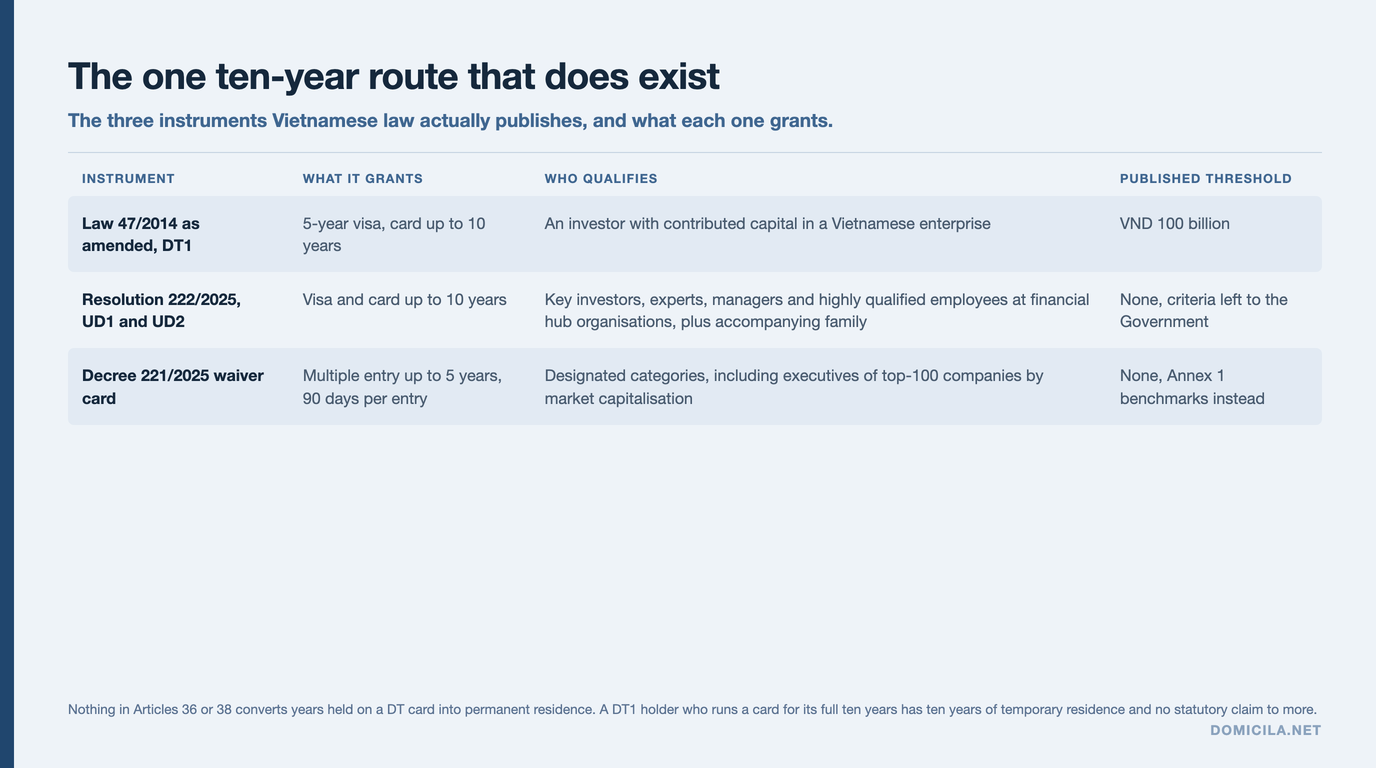
| Instrument | What it grants | Who qualifies | Published threshold |
|---|---|---|---|
| Law 47/2014 as amended, DT1 | 5-year visa, card up to 10 years | An investor with contributed capital in a Vietnamese enterprise | VND 100 billion |
| Resolution 222/2025, UD1 and UD2 | Visa and card up to 10 years | Key investors, experts, managers and highly qualified employees at financial hub organisations, plus accompanying family | None — criteria left to the Government |
| Decree 221/2025 waiver card | Multiple entry up to 5 years, 90 days per entry | Designated categories, including executives of top-100 companies by market capitalisation | None — Annex 1 benchmarks instead |
A second enacted instrument gets miscast as a golden visa and is worth separating. Decree 221/2025/ND-CP, issued on 8 August 2025, creates a limited-term visa waiver for designated categories — scholars, experts, scientists, professors, chief engineers, high-quality digital technology personnel, investors and executives of the world's largest corporations, and others. Holders receive a special visa waiver card valid for multiple entries over up to five years, but each entry permits a stay of only 90 days. It is an exemption from needing a visa, not a residence permit, and its Annex 1 benchmarks are demanding: corporate leaders are expected to represent top-100 companies by market capitalisation, scientists to hold prestigious international awards. It is not purchasable either.
Why "permanent residency after five years" is wrong
This claim is on the page currently ranking best for the keyword: a DT1 holder who maintains the investment and stays continuously for five years can apply for permanent residency, described as the nearest thing Vietnam offers to a settlement track. It is stated without a legal citation, and the law says otherwise.
Article 39 of Law 47/2014/QH13 lists the people who may be considered for permanent residence, and there are four categories: foreigners who gave meritorious service to Vietnam's national construction and defence and hold state medals or honorary titles; scientists and experts temporarily residing in Vietnam; foreigners guaranteed by a parent, spouse or child who is a Vietnamese citizen permanently residing in Vietnam; and stateless persons temporarily resident in Vietnam since 2000 or earlier.
Investor is not among them. Article 40 then adds conditions — a lawful place of habitation and stable income for all categories, a ministerial request for the scientists and experts, and at least three consecutive years of temporary residence for the family-guaranteed route. Nothing in either article converts years held on a DT card into a permanent residence entitlement. A DT1 holder who runs a card for its full ten years has ten years of temporary residence and no statutory claim to more.
The one qualified exception is the financial hub provision above, and read it precisely: Article 20(1)(b) of Resolution 222/2025 says such people may be granted cards at the request of the Executive Body and get more favourable permanent residence procedures. That is discretion exercised on a proposal, conditioned on your role, not a right that accrues with time. Nor does any of this reach nationality: these instruments concern entry and residence, and none of them promises a Vietnamese passport. If a citizenship horizon is what you are buying, the distinction set out in citizenship by investment versus golden visa is the one to start from, because Vietnam sits firmly on the residence side of it.
What to confirm before you commit
Five questions, in this order, and all of them before a company is formed or money moves.
- Which tier does my capital actually reach, in dong? Convert at the rate on the day and leave headroom: the thresholds are fixed in dong, so a weakening dollar quietly raises your bill. VND 100 billion is the only number that reaches a ten-year card.
- Does my sector or province qualify for the incentive limb? DT1 and DT2 both have an alternative route through sectors or localities eligible for investment incentives as decided by the Government. Ask the Immigration Department how it is assessed before assuming you are below the cash threshold.
- Is a temporary residence card available on my tier at all? Article 36 governs eligibility and the amended Article 38 assigns no card duration to DT4. Get the answer in writing rather than inferring it.
- Am I actually a candidate for UD1 at a financial hub? If your plan involves an organisation establishing in Ho Chi Minh City or Da Nang, Resolution 222/2025 is a materially better route than DT3 — and the Government has yet to publish its criteria, so ask.
- What does leaving my current country cost? Exit taxes, deemed disposals and 183-day rules at the other end routinely exceed everything on this page, and none of it appears in a visa fee schedule.
One process note: do not treat a draft as a timetable. The tourism resolution presented on 7 November 2026 may be adopted, amended or dropped, and a pilot for remote workers is not an investor route however it is reported. If a provider offers to file a golden visa application for you today, ask which instrument they are filing under and what the form is called.
Everything here describes published law and reported amendments as at 11 November 2026. It is not legal or immigration advice, and nothing on this page promises that any application will be accepted — Vietnamese immigration decisions are discretionary. Take Vietnamese legal advice before you act.
Related guides on Domicila
If Vietnam is on your list, these are the comparisons that answer the question it raises next:
- Thailand elite visa cost — the regional alternative that is genuinely a published, purchasable membership.
- Malaysia golden visa cost — MM2H, the deposit-based route Vietnam's ladder is most often confused with.
- Indonesia golden visa cost — the closest working comparison in South-East Asia, with real thresholds.
- Philippines SRRV cost — the cheapest regional residence route, and what the low price omits.
- Hong Kong investment visa cost — the other Asian hub that prices access by capital.
- Golden visa cost comparison — every major route priced side by side, so VND 100 billion has something to sit against.
- Norway citizenship by investment cost — a programme that does not exist, and how to tell before you pay someone.
Common questions
Does Vietnam have a golden visa in 2026?
No. As at 11 November 2026 there is no enacted golden visa, no decree number, no published investment threshold and no office accepting applications. A five-to-ten-year golden visa was proposed to the Prime Minister by the Tourism Advisory Board in 2025 and remains a proposal. The draft tourism resolution presented to the National Assembly on 7 November 2026 proposes pilot arrangements for remote workers and medical tourists, and contains no golden visa and no investor category.
What is the Vietnam golden visa cost?
There is no cost, because there is no such visa. The figures circulating of 300,000 US dollars, or a range of 100,000 to 400,000, do not appear in any Vietnamese legal instrument. If you want to price long-term residence as an investor, the real instrument is the DT visa ladder in Law 47/2014 as amended by Law 51/2019, where the thresholds are set in dong and the top tier requires contributed capital of VND 100 billion or more.
Was the Vietnam golden visa passed by Resolution 41/2026/QH15?
We could not verify that. At least one page ranking for this keyword reports such a resolution passing on 20 March 2026 with a pilot from 1 July 2026, while also stating that it could not find the resolution on any Vietnamese government source. A search of the Vietnamese legal databases returns no National Assembly resolution under that number. Resolution 41/NQ-CP of 11 March 2026 does exist, but it is the Government's action programme for the 14th Party Congress and does not concern visas.
How much investment does a ten-year residence card in Vietnam need?
Contributed capital of VND 100 billion or more, which qualifies for a DT1 visa. At about 25,600 dong to the US dollar on 11 November 2026 that is roughly 3.9 million US dollars. The DT1 visa itself is valid for at most five years; the ten years is the temporary residence card, capped at ten years for DT1 by Article 38 of Law 47/2014 as amended. Because the threshold is fixed in dong, the dollar equivalent changes with the exchange rate.
What are the official Vietnamese visa and residence card fees?
Circular 28/2026/TT-BTC of the Ministry of Finance has set them since 1 April 2026. A temporary residence card costs USD 145 for up to two years, USD 155 for two to five years and USD 165 for five to ten years. A permanent residence card is USD 100, extending a temporary stay is USD 10 per extension, and transferring a card to a new passport is USD 5. Multiple-entry visas run from USD 50 to USD 165 depending on validity. These are state fees only and exclude company formation, agent and legal costs.
Can I get permanent residence in Vietnam after five years as an investor?
Not under the general law. Article 39 of Law 47/2014 lists four categories eligible for consideration: those with meritorious service recognised by state medals or honorary titles, scientists and experts temporarily residing in Vietnam, people guaranteed by a Vietnamese-citizen parent, spouse or child, and stateless persons resident since 2000 or earlier. Investors are not a category, and Article 40's conditions do not convert time held on a DT card into an entitlement. The exception is the financial hub route, where permanent residence is discretionary and granted on the Executive Body's proposal.
What is the UD1 visa, and is it the Vietnamese golden visa?
UD1 is the visa and temporary residence card code created by Article 20 of Resolution 222/2025/QH15, in force since 1 September 2025, for key investors, experts, managers and highly qualified employees at organisations that set up offices in the Ho Chi Minh City and Da Nang international financial hubs, with UD2 for accompanying family. It carries a validity of up to ten years, which makes it the only ten-year investor-adjacent card in Vietnamese law. It is not a golden visa: it attaches no investment threshold, eligibility criteria are still to be set by the Government, and it turns on your role rather than on a payment.
Official sources to verify
- Law No. 51/2019/QH14 amending the Law on Foreigners' Entry, Exit, Transit and Residence (Art. 1(3)(c) DT1-DT4 thresholds; Art. 1(4) visa validity; Art. 1(16) card validity), read 11 November 2026National Assembly of Vietnam
- Law No. 47/2014/QH13 on Entry, Exit, Transit and Residence of Foreigners in Vietnam (Art. 36 card eligibility; Arts. 39-40 permanent residence), read 11 November 2026National Assembly of Vietnam
- Renewed fees on entry, exit, transit and residence in Viet Nam — full Circular 28/2026/TT-BTC schedule, in force 1 April 2026, read 11 November 2026Viet Nam Government Portal
- Resolution No. 222/2025/QH15 on International Financial Hubs in Vietnam, official English text (Art. 20 UD1/UD2 visas and cards; Art. 35 entry into force), read 11 November 2026Viet Nam International Financial Centre, Da Nang
- Vietnam grants visa-free entry to high-profile foreigners — Decree 221/2025/ND-CP, special visa waiver card, 90-day stay per entry, read 11 November 2026Vietnam Law and Legal Forum, Ministry of Justice
- Vietnam proposes special visas to attract high-spending and medical tourists — draft tourism resolution presented to the National Assembly 7 November 2026, read 11 November 2026VietNamNet
- Immigration Department — the authority that issues Vietnamese visas and temporary residence cards, read 11 November 2026Ministry of Public Security, Vietnam
Compare golden visa advisors
Ask for a route-specific quote that separates investment amount, government fees, legal work, fund or property costs, and renewal obligations.
We may earn a referral fee if you choose an advisor through this site. We still aim to show cost ranges, caveats, and official source links plainly.